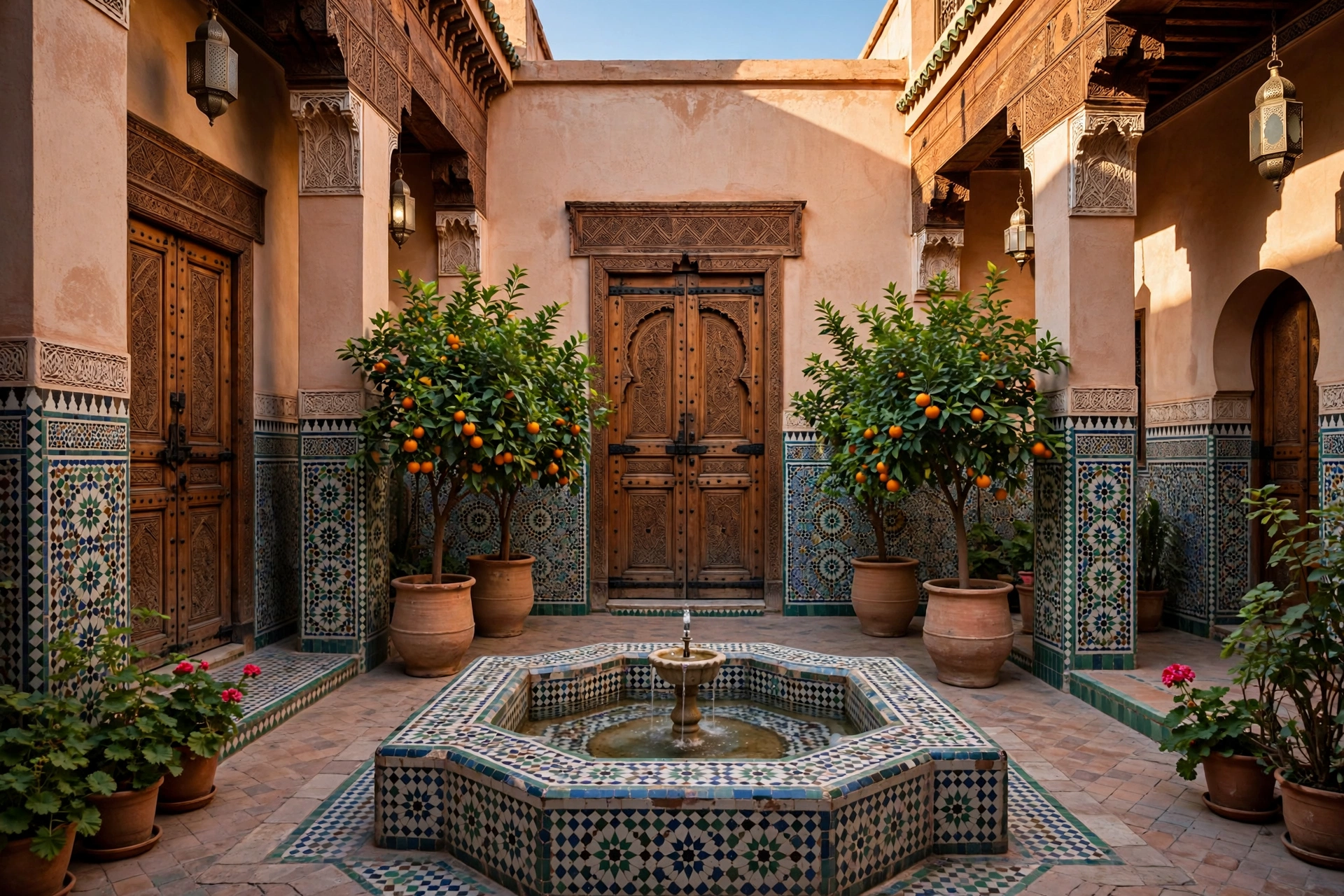
If you have spent a few weeks in Morocco, you have probably had the thought: what if I just bought a place here? Buying property in Morocco is genuinely possible for foreigners, and thousands of Europeans, Americans, and Gulf buyers have done it. But it is not the same as buying a flat in London. The rules are different, the paperwork is different, and the mistakes are more expensive.
I am Moroccan, and I have watched friends from abroad buy beautiful homes here — and a few lose money on deals that looked too good to be true. This is the honest version: the law, the title, the notaire, the costs, and the traps. Prices below are indicative ranges checked in November 2026, in Moroccan dirhams (MAD) with US dollar equivalents.
[rank_math_toc]
Can Foreigners Buy Property in Morocco?
Yes. Foreigners can buy most property in Morocco — apartments, houses, villas, riads, and commercial premises — on broadly the same terms as Moroccan citizens. There is no special foreign-buyer permit for a normal residential purchase, and you do not need to be a resident to buy. You will need a passport, a Moroccan bank account, and a notaire to handle the sale.
Now the one fact that changes everything, which you should know before you look at a single listing.
The One Rule That Changes Everything: Agricultural Land
Here is the single most important legal fact about buying property in Morocco: foreigners cannot buy agricultural land. Under Moroccan law, agricultural land is reserved for Moroccan nationals. This is not a grey area. It is a hard restriction, enforced at the land registry.
This matters because much of the land around Moroccan cities and villages is classified as agricultural, even when it looks like an empty plot with a view. A "bargain" plot on the edge of town may be agricultural land you legally cannot own. Before you pay anything toward buying property in Morocco, your notaire must confirm the land’s classification. If a seller or agent tells you the restriction does not apply to you, walk away. That is how people lose deposits.
The same applies to large rural plots and land sold as "perfect for building": a house on non-agricultural land is fine; a field you hope to build on may not be. When in doubt, ask the notaire, not the agent.
Buying Property in Morocco: Titre Foncier vs Moulk
The second thing to understand is the title. Morocco’s land and property system mixes French-inspired registered title with older traditional forms — read the background on Morocco’s land and property system if you like; here is what matters in practice.
A titre foncier is a registered title at the land registry (the Conservation Foncière, run by the ANCFCC, Morocco’s land registry). It is one official document proving ownership, describing the boundaries, and listing any mortgages, liens, or debts on the property. With a clean titre foncier, the notaire checks the title, transfers it into your name, and the registry records the change.
Moulk (also spelled melk) is a traditional, unregistered title. Ownership is proven by old deeds, often written by an adoul (a traditional notary) and passed down through families. Many beautiful old medina houses are moulk. Moulk is not automatically a scam — it is real and common — but it is harder to verify. Boundaries may be vague, heirs may appear years later claiming a share, and debts may not be recorded anywhere official.
Then there is land with no clear title at all: plots sold with a handshake or a promise that "the papers are being sorted". Never buy this — a property without a clear, verifiable title is a dispute waiting to happen.
My rule is simple: when buying property in Morocco, insist on a clean titre foncier. If the property is moulk, proceed only with a licensed notaire and an independent lawyer who can verify the chain of ownership — and accept that it will take longer and cost more.
Where Foreigners Actually Buy — and What It Costs
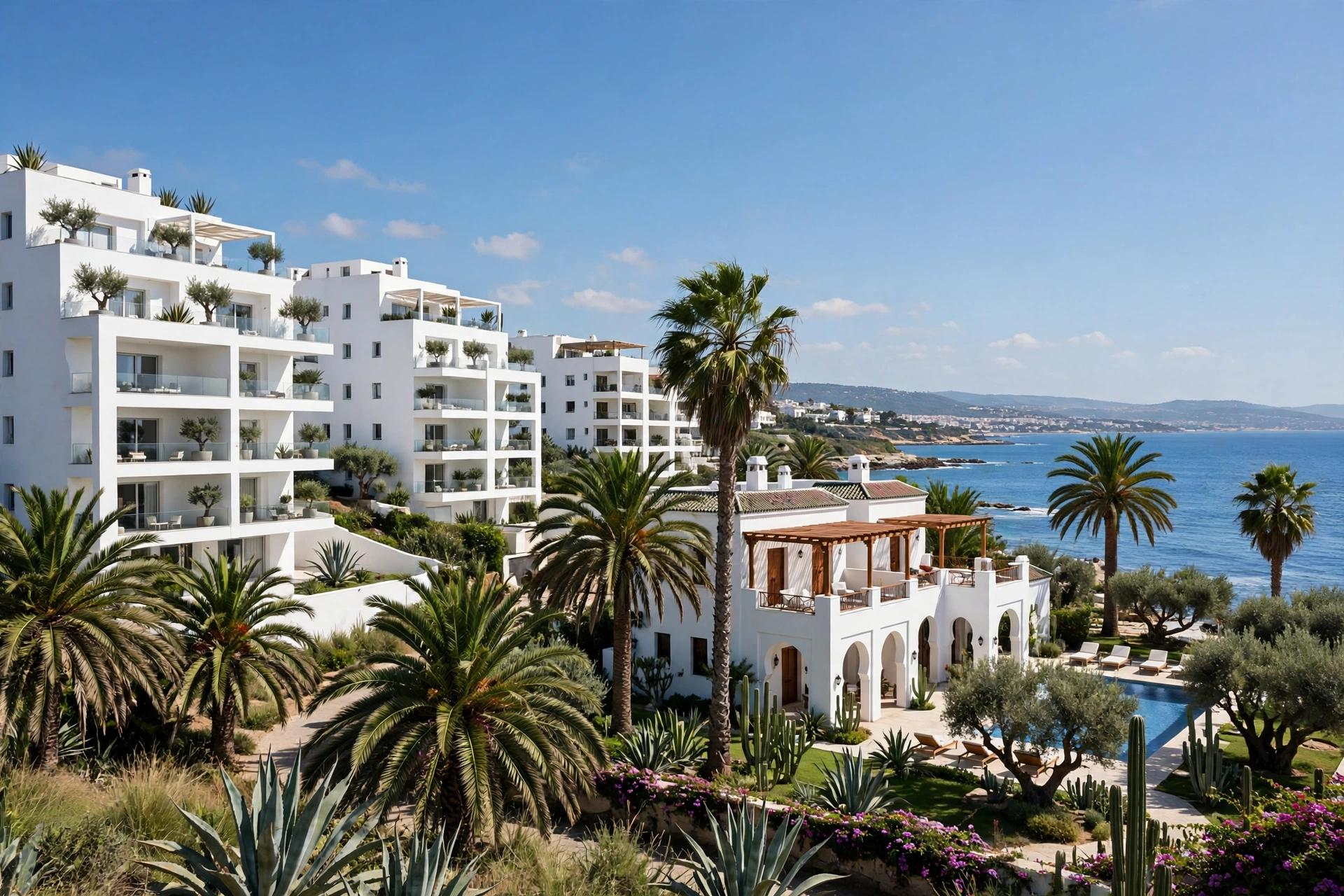
If you are buying property in Morocco, most foreigners cluster in a handful of cities, each with its own market. Marrakech is the classic choice: riads in the medina, villas in the Palmeraie, apartments in Guéliz. Tangier is booming, Fes offers more space for your money, and Casablanca is the business city, with the highest apartment prices in the country.
The table below gives indicative price ranges, checked in November 2026. Treat them as starting points, not quotes. A renovated riad in the Marrakech medina and a shell needing full renovation can differ by a factor of three.
| Property type | City / area | Indicative price range |
|---|---|---|
| Riad in the medina (renovated) | Marrakech | 2,500,000–6,000,000 MAD ($250,000–$600,000) |
| Riad in the medina (to renovate) | Marrakech | 1,200,000–3,000,000 MAD ($120,000–$300,000) |
| Modern apartment (2-bed) | Marrakech, Guéliz | 900,000–1,800,000 MAD ($90,000–$180,000) |
| Apartment (2-bed, city centre) | Casablanca | 1,500,000–3,500,000 MAD ($150,000–$350,000) |
| Apartment (2-bed) | Rabat, Agdal | 1,200,000–2,500,000 MAD ($120,000–$250,000) |
| Villa with garden | Essaouira | 2,000,000–5,000,000 MAD ($200,000–$500,000) |
| Modern apartment (2-bed) | Tangier | 800,000–1,600,000 MAD ($80,000–$160,000) |
| Apartment (2-bed) | Agadir | 700,000–1,500,000 MAD ($70,000–$150,000) |
| Traditional house / riad | Fes medina | 800,000–2,500,000 MAD ($80,000–$250,000) |
| Apartment (2-bed) | Fes, new town | 600,000–1,200,000 MAD ($60,000–$120,000) |
The dirham trades at roughly 10 MAD to the US dollar, and I have used that round rate above. Check the rate on the day you transfer funds. If you are still choosing where to settle, our guide to the best places to live in Morocco compares these cities in detail.
The Notaire Process, Step by Step
The notaire is the central figure when buying property in Morocco: a licensed public official, not just a lawyer, and the sale is not legally complete until the notaire has done their part. Here is how a normal purchase works.
Step 1: The offer and the compromis de vente. Once you agree on a price, you sign a preliminary agreement called a compromis de vente. It sets out the price, the deposit (usually 10%), and the deadline for completion. It is binding, so have your notaire review it before you sign.
Step 2: Title and due diligence. The notaire requests an up-to-date certificate from the land registry confirming the titre foncier, the seller’s identity, and any mortgages, liens, or unpaid charges. This is the step that protects you when buying property in Morocco. If there is a debt on the property, it shows up here.
Step 3: The acte de vente. On completion day, buyer and seller sign the final deed of sale (acte de vente) before the notaire. You pay the balance, usually by bank transfer or certified cheque, and the notaire holds the funds in escrow until registration is complete.
Step 4: Registration and taxes. The notaire pays the registration tax and registers the transfer at the Conservation Foncière. The title is then issued in your name. This can take several weeks, sometimes a few months. You are the owner once the deed is signed, but the registered title in your name is the final proof.
After completion, transfer the utilities into your name and register with the syndic (building management) if there are shared areas.
A good notaire explains each step, answers your questions, and flags problems before you are committed. If yours rushes you or discourages an independent lawyer, find another one.
The Adoul, the Lawyer, and Why You Need Both
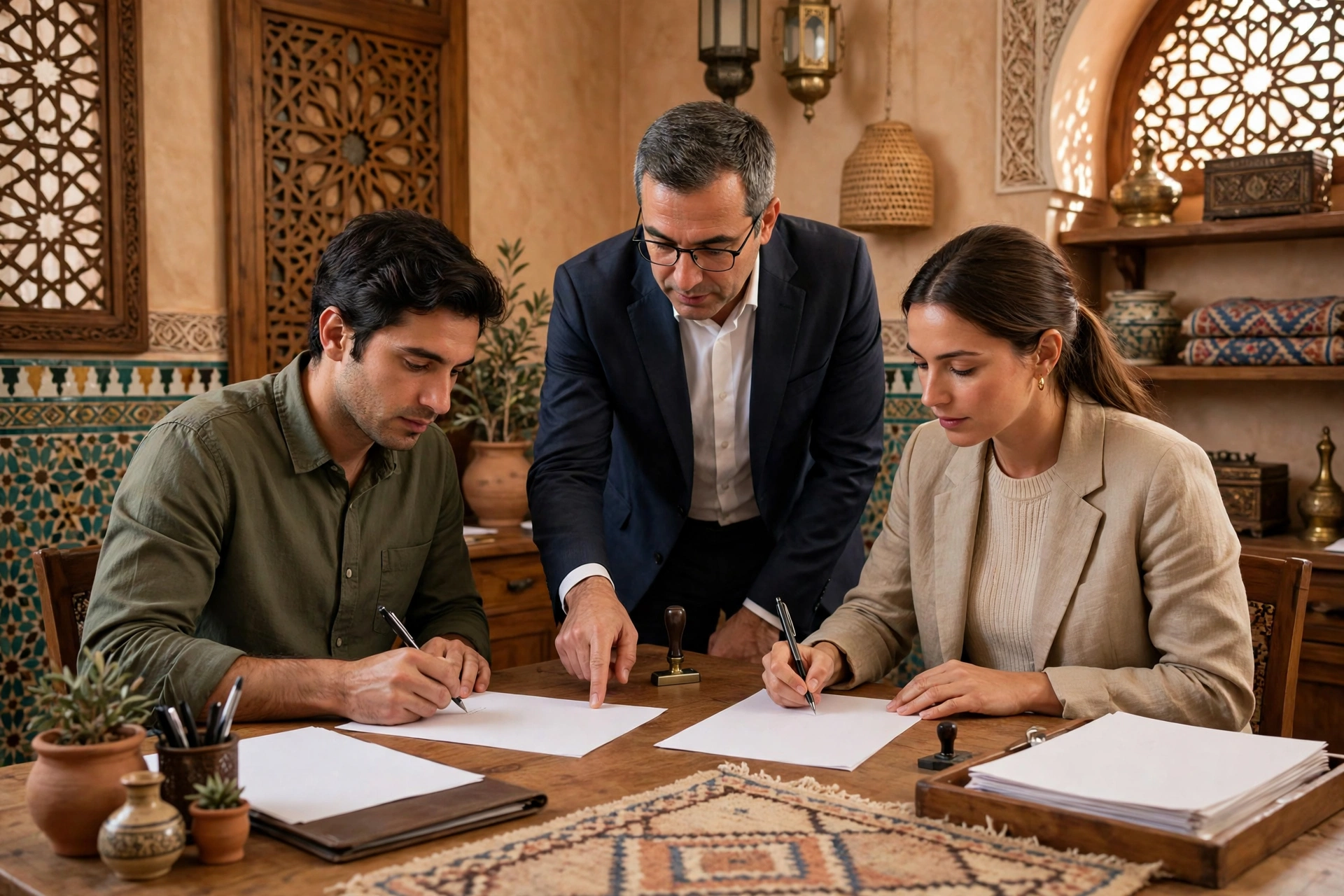
You will hear the word adoul when you look at older properties. An adoul is a traditional notary who draws up deeds under Moroccan family and property law, particularly for moulk property and inheritance. Adouls are respected professionals, but an adoul is not a substitute for a licensed notaire, and an adoul’s deed does not carry the same registry-backed guarantees as a titre foncier.
For a foreign buyer, the safest combination when buying property in Morocco is a licensed notaire plus an independent lawyer who works for you alone. The notaire is a neutral public official; the lawyer is your advocate, checking the title history, the seller’s right to sell, and hidden heirs or disputes before you sign. A lawyer’s fee is a small fraction of the price — the cheapest insurance you will ever buy. This matters most for moulk and inheritance sales, where several family members may own shares.
What Buying Property in Morocco Really Costs
The purchase price is not the total cost. The figures below are typical ranges, checked in November 2026 — your notaire will give you an exact breakdown before you sign.
Registration tax. The biggest single cost. For a first home, the rate is around 4% of the property value; for other purchases it is generally 6%.
Notaire fees. Expect roughly 1% to 2.5% of the purchase price, depending on the value and complexity of the transaction. Fees are regulated, but ask for a written estimate upfront so there are no surprises.
Land registry fees. The Conservation Foncière charges fees for registering the transfer and issuing the new titre foncier — usually around 1% of the property value, plus small fixed charges.
Agency commission. Typically 2.5% to 5%, usually paid by the seller but sometimes split. Agree on this in writing before you start viewing properties.
All told, total transaction costs for buying property in Morocco usually come to roughly 6% to 8% of the purchase price. On a 2,000,000 MAD home, that is 120,000 to 160,000 MAD ($12,000–$16,000) on top of the price — so budget for the top of the range when buying property in Morocco.
Off-Plan, Medinas and Riads: The Traps to Avoid
Most of these risks are avoidable if you know where to look.
Off-plan (VEFA) risks. Buying off-plan — VEFA (vente en l’état futur d’achèvement) — means buying a property that is not built yet. The price is attractive, but the risks are real: delays of a year or more, developers who go bankrupt, and finished flats that do not match the brochure. Only buy off-plan from a developer with a verifiable track record, pay through the notaire in staged payments tied to construction progress, and never pay the full price upfront.
Buying in a medina. A riad in the Marrakech or Fes medina is the dream for many buyers, but go in with your eyes open. Renovation costs are routinely double the first estimate: old walls hide damp, plumbing, and structural problems, and heritage rules can restrict what you change. Many medina houses have no vehicle access, so every bag of cement arrives by donkey or handcart. Get a structural survey and three renovation quotes, and budget a generous contingency.
Scams and "too cheap" deals. If a deal looks far too cheap while you are buying property in Morocco, there is a reason. Common scams include sellers who do not own the property, properties with hidden debts, and agents who take a deposit for a property that is not for sale. Never pay a deposit in cash to an individual. Pay through the notaire, only after the title has been checked.
Debts and liens. A property can carry unpaid taxes, unpaid syndic charges, or a mortgage the seller "forgot" to mention. The notaire’s check should reveal registered debts — but ask specifically about syndic arrears and tax bills, and get written confirmation they are settled first.
Money, Bank Accounts and the Office des Changes
When buying property in Morocco, you will need a Moroccan bank account. Most foreign buyers open a convertible dirham account, which lets you transfer money in from abroad — and out again if you later sell. Keep every transfer receipt — you will need them when you sell.
Morocco has exchange controls administered by the Office des Changes. In plain terms, the rules about money moving in and out differ for residents and non-residents. For a non-resident buyer, the usual path is to transfer funds from abroad into your Moroccan account and pay through the notaire, keeping a paper trail of every step.
Requirements depend on your residency status, nationality, and the amount involved, and the rules change — check with your bank and your notaire rather than trusting any single article, including this one. If anyone offers a shortcut involving cash, informal transfers, or skipping the bank, refuse. A clean paper trail protects your money twice when buying property in Morocco: once when you buy, and again when you sell.
Should You Buy? Rent First, Buy Second
Here is my honest advice, as a Moroccan who wants you to love living here rather than regret a rushed decision: rent first. Spend six months to a year renting an apartment in Morocco first, in the city and neighbourhood you think you want. You will learn which areas are noisy at night, which buildings have water pressure problems, and whether you like the place in February as much as you did in May.
Renting first also gives you time to understand the market before buying property in Morocco and spot the difference between a fair price and a foreigner price. Many buyers who rent first end up buying in a different neighbourhood — or a different city — than the one they first fell in love with. That is the system working.
It makes most sense once you have lived here a while and know the city — when you are buying a home, not a holiday fantasy. If you are retiring in Morocco, that patience matters even more. For the wider picture of settling in — visas, residency and the carte de séjour, healthcare, and daily life — start with our guide to living in Morocco as an expat.
Frequently Asked Questions About Buying Property in Morocco
Can a foreigner buy property in Morocco?
Yes. Buying property in Morocco is open to foreigners for apartments, houses, villas, and riads. The main exception is agricultural land, reserved for Moroccan nationals. No residency is needed, but you do need a Moroccan bank account and a notaire.
What is a titre foncier, and why does it matter?
A titre foncier is a registered title proving ownership and listing any debts or liens. It is the safest title for a foreign buyer. Moulk is a traditional unregistered title, harder to verify and riskier.
How much are the extra costs when buying property in Morocco?
Budget roughly 6% to 8% on top of the price: registration tax (around 4% for a first home, generally 6% otherwise), notaire fees of about 1% to 2.5%, and land registry fees. Figures checked November 2026.
Can foreigners buy agricultural land in Morocco?
No. Agricultural land is restricted to Moroccan nationals, enforced at the land registry. Always confirm the land classification with your notaire before paying anything.
Is it safe to buy a riad in the Marrakech medina?
It can be — with a clean titre foncier, a structural survey, and a realistic renovation budget. Medina houses often hide damp and structural problems, and renovation costs frequently run double the first estimate.
Should I rent before buying in Morocco?
Yes — renting first for six to twelve months lets you test the city, the neighbourhood, and the seasons before committing a large sum to buying property in Morocco.
Buying property in Morocco can be one of the best decisions you make — a beautiful home at prices still reasonable by European or American standards. But it rewards patience and punishes haste. The buyers who do well check the title, hire a good notaire and an independent lawyer, budget the full 6% to 8%, and rent first. The buyers who lose money fall in love with a view, skip the checks, and pay cash to a stranger.
Take your time — when buying property in Morocco, the right house will still be there after you have done your homework. If you do it properly, buying property in Morocco is not a gamble; it is the start of a life here.