
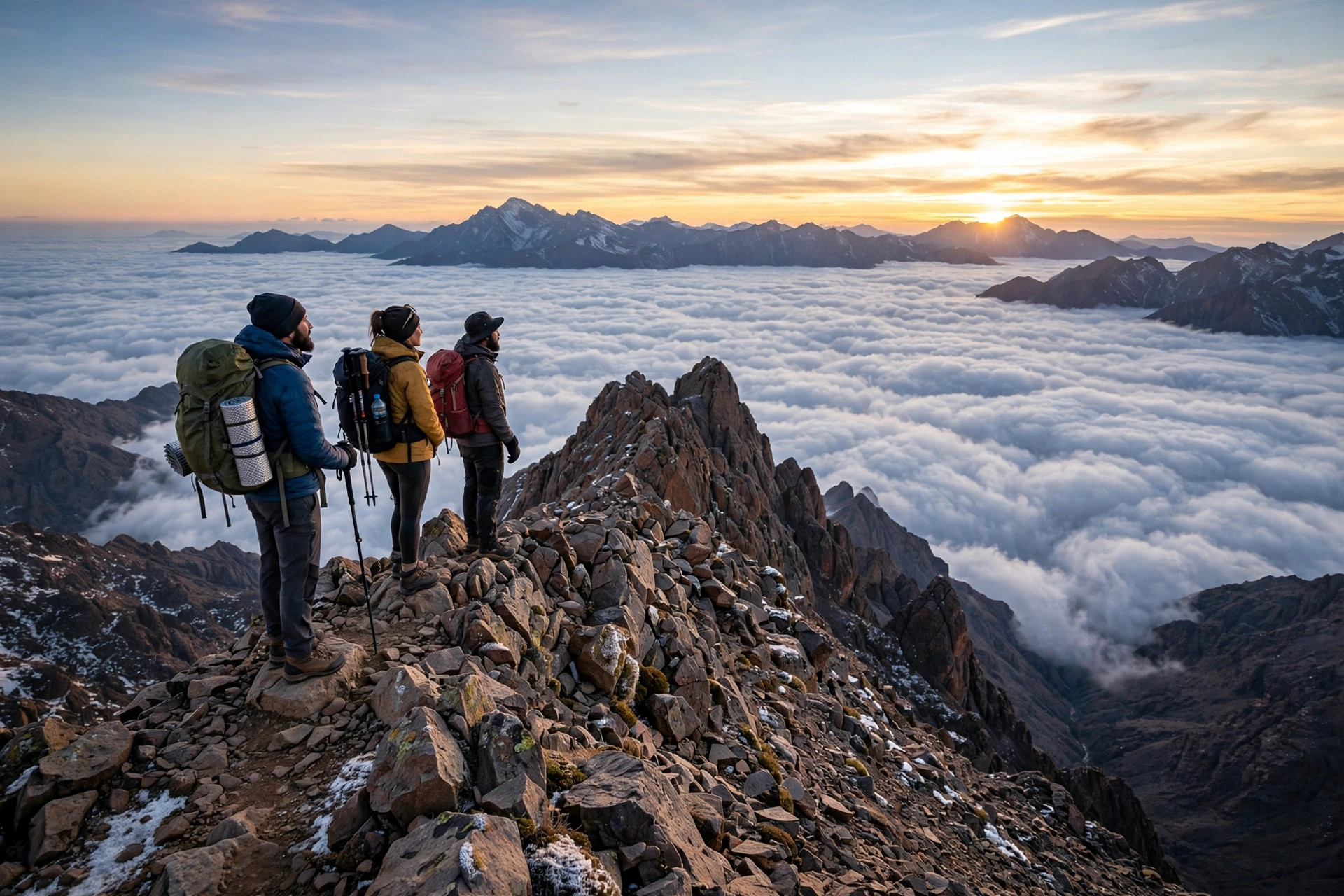
The cost of climbing Toubkal is the first question every walker asks about North Africa's highest peak — and the answer is pleasantly low by world mountain standards. Mount Toubkal stands 4,167 metres above the High Atlas, a two-day walk from the village of Imlil, and a self-arranged climb for two people typically runs 2,200–3,500 MAD ($220–$350) all in, once the guide, the refuge night, meals and the transfer from Marrakech are added up. A packaged trek costs more, roughly €120–€280 ($130–$300) per person.
Every price below, in our Costs & Practical Life section, is in Moroccan dirhams (MAD), checked in November 2026, at roughly 10 MAD to $1 — planning ranges, not quotes: confirm them in Imlil before you walk.
In this guide
- Toubkal at a Glance
- The Short Answer: What Climbing Toubkal Costs
- The Licensed Guide: The Cost You Cannot Skip
- Mules and Porters: What They Cost and When You Need One
- The Refuges at 3,207 Metres: Beds, Meals and Booking
- Getting to Imlil: Transport Costs from Marrakech
- Food, Water and Gear on the Mountain
- Winter Costs: Crampons, Ice Axe and Extra Days
- Two Days or Three: Which Trek Costs Less Per Person
- Package or Do It Yourself: What the Agencies Charge
- Money-Saving Tips for Climbing Toubkal
- Safety and Altitude: Costs Worth Paying
- Frequently Asked Questions
- Conclusion
Toubkal at a Glance
| Fact | Detail |
|---|---|
| Summit | 4,167 m — highest in Morocco and North Africa |
| Trailhead | Imlil village, ~1,740 m, 64 km south of Marrakech |
| Standard trek | 2 days, 1 night at the refuge (3,207 m) |
| Day 1 | Imlil to refuge, ~11 km, 5–6 hours, +1,467 m |
| Day 2 | Summit push 3–4 hours up, 5–7 hours back to Imlil |
| Guide | Licensed mountain guide required in practice since 2019 |
| Best season | June to September for snow-free walking |
| Winter season | November to March, crampons and ice axe needed |
Toubkal is a walk, not a climb: in summer there is no technical rock and no rope work, only a long, steep path and some easy scrambling on the final summit cone. That is why the cost of climbing Toubkal stays low: a guide, a bed and a mule, not ropes or permits. Read more on Wikipedia.
The Short Answer: What Climbing Toubkal Costs
For two people arranging everything themselves in Imlil, the cost of climbing Toubkal over the standard two days looks like this. The guide fee is the biggest line, and it is split across the group — which is why climbing with friends is the single best way to cut the price per person.
| Cost item | Typical price (2026) | Notes |
|---|---|---|
| Licensed guide, 2 days | 1,000–1,600 MAD ($100–$160) | 500–800 MAD per day, split across the group |
| Refuge night, half board | 280–350 MAD ($28–$35) | Per person, dinner and breakfast included |
| Mule and muleteer, 2 days | 300–600 MAD ($30–$60) | Optional; 150–300 MAD per day, split across the group |
| Transfer Marrakech–Imlil return | 700–1,500 MAD ($70–$150) | Private vehicle; shared taxi far cheaper per seat |
| Food and water on the trail | 150–300 MAD ($15–$30) | Per person: lunches, snacks, bottled water |
| Park fee | A few dozen MAD | Small fixed fee at the Imlil checkpoint |
| Tips for guide and muleteer | 300–500 MAD ($30–$50) | From the whole group, not per person |
| Total for two, self-arranged | 2,200–3,500 MAD ($220–$350) | For the pair, not per person |
A solo walker pays the most, because the guide and the transfer do not shrink: expect roughly 1,800–2,800 MAD ($180–$280) alone. A group of four to six splits the guide and the vehicle, so the cost of climbing Toubkal can fall below 1,200 MAD ($120) each — see our cost of a week in Morocco guide.
The Licensed Guide: The Cost You Cannot Skip
A licensed mountain guide costs 500–800 MAD ($50–$80) per day when hired directly in Imlil, so the standard two-day climb means 1,000–1,600 MAD for the guide alone. The Bureau des Guides posts an official day rate of about 500–550 MAD. The fee is per group, not per person, so a group of six pays under 150 MAD each per day.
Since 2019, after the December 2018 tragedy near Imlil, trekkers in Toubkal National Park are required in practice to walk with a licensed guide, and checkpoints on the route do ask. Sources disagree on the rule's exact legal form, but the effect is the same: almost nobody climbs without a guide. That is why the guide is the first line in any honest cost of climbing Toubkal budget.
Hire at the Bureau des Guides in Imlil, or through your guesthouse the evening before, rather than through a middleman in Marrakech — the same guide costs noticeably more once an agency takes its cut. A good guide sets the pace for altitude, reads the weather and knows when to turn a group around. Ask for the licence card, agree the full price in dirhams in advance, and confirm whether the guide's own bed and meals are included.
Mules and Porters: What They Cost and When You Need One
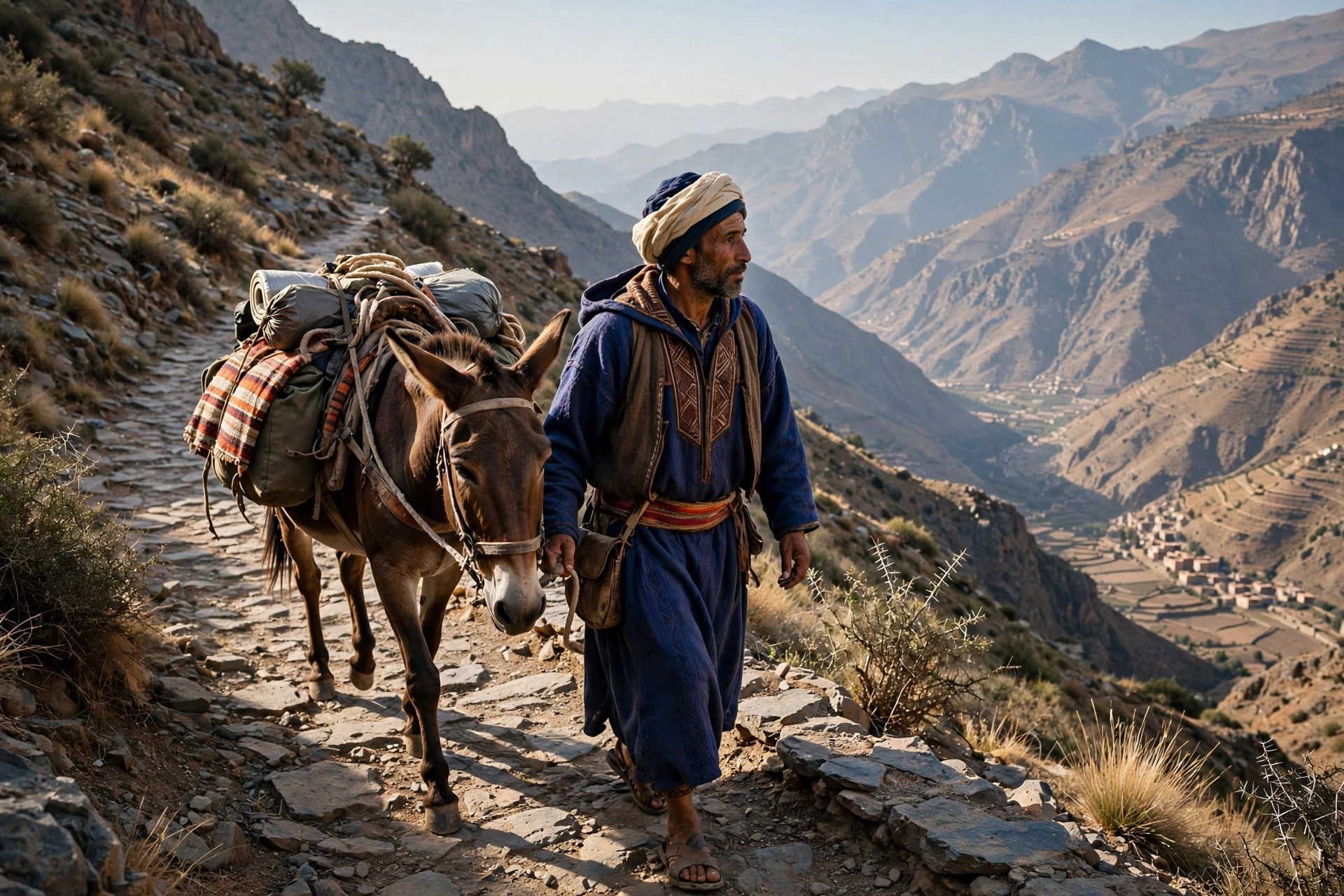
A mule with its muleteer costs 150–300 MAD ($15–$30) per day and carries the heavy bags of the whole group up to the refuge. For the standard two days that is 300–600 MAD, split between everyone — a small price for walking the steepest 1,467 metres of ascent with a light day pack.
You do not strictly need a mule. Fit walkers carrying their own packs save the money, and the load is the only real burden on a well-marked trail. But most groups hire one: the climb to the refuge is long and hot, a light pack makes the altitude easier, and the muleteer's wage goes directly to a family in the valley.
Tipping is a small, customary part of the cost of climbing Toubkal — never compulsory. The useful figures are per day and per role: 150–200 MAD a day for the guide and 70–100 MAD a day for the muleteer, paid by the whole group, not by each walker — roughly 300–500 MAD in tips on a two-day trek. See our tipping in Morocco guide for the wider customs.
The Refuges at 3,207 Metres: Beds, Meals and Booking
The overnight stop is the refuge complex at 3,207 metres — two adjacent stone huts, the older Refuge du Toubkal (Neltner, run by the Club Alpin Français) and the newer, larger Les Mouflons, run by a Moroccan team. A bed with half board — dinner and breakfast in a shared bunkroom — runs 280–350 MAD ($28–$35) per person per night: dinner soup and tagine, breakfast before dawn. That refuge bed is a fixed line in the cost of climbing Toubkal: there is no cheaper way to sleep on the mountain.
The two refuges suit different walkers. The CAF refuge is smaller and better heated, with a fireplace in the common room — the deciding point in cold weather. Les Mouflons is bigger and airier, with a panoramic terrace, but it heats less in deep cold. Both fill up from April to October, so book ahead through your guide or guesthouse.
Bring a sleeping bag liner — bunks come with blankets, but a liner is warmer and cleaner — and a sleeping bag of your own in winter; bag rental runs around 50–100 MAD. Expect basic shared bathrooms, no showers worth the name, and little or no phone charging. Cash is king at 3,207 metres: no card machines, so carry dirhams for drinks, snacks and the bag rental.
Getting to Imlil: Transport Costs from Marrakech
Imlil is about 64 km south of Marrakech, a 1.5 to 2-hour drive. The cheapest way there is the shared grand taxi, roughly 40–60 MAD ($4–$6) per seat when the car is full — but taxis leave when full, not on a timetable. A private return transfer, booked through your guesthouse or an agency, runs 700–1,500 MAD ($70–$150) per vehicle, not per person — good value for a group. Transport is the most flexible line in the cost of climbing Toubkal.
Most walkers stay a night in Imlil first — 150–400 MAD ($15–$40) per person with breakfast in a simple gîte — to meet the guide and hire missing gear. Our train ticket prices guide covers the rail leg into Marrakech.
Food, Water and Gear on the Mountain
Food on the mountain is simple and cheap, and it barely moves the cost of climbing Toubkal. Lunches on the trail — bread, cheese, tinned sardines, fruit and nuts bought in Imlil or Marrakech — run 50–100 MAD ($5–$10) per person per day. Dinner and breakfast are included in half board; the refuge sells water and snacks at mountain prices, around 10–20 MAD a bottle. Carry at least two litres per person for the climb to the refuge, and refill only where the guide says the water is safe.
Gear is the hidden cost for first-timers: with good boots, layers and a day pack, the mountain asks for nothing extra in summer. Without them, Imlil's shops rent poles, a day pack, a warm layer and a sleeping bag for a few dozen dirhams a day each. Buy sunscreen and blister plasters in Marrakech, where they cost half the Imlil price. A headlamp is essential for the pre-dawn summit push — the trail leaves around 4 or 5 in the morning, in the dark.
Winter Costs: Crampons, Ice Axe and Extra Days
From November to March, Toubkal is a different mountain and the cost of climbing Toubkal rises with it. Snow covers the upper trail, and the kit adds crampons and an ice axe, rented in Imlil for 100–150 MAD ($10–$15) per day for the pair. Winter guides charge at the top of the range — 700–800 MAD a day — and many groups add a third day for acclimatisation, which adds another guide day, refuge night and day of food.
Budget roughly 3,500–5,500 MAD ($350–$550) for two people on a three-day winter climb, self-arranged, and more for a winter package with a higher level of support. The reward is a snow-covered summit with a fraction of the crowds — but never climb in winter without a guide who knows the snow conditions. See our Morocco ski trip costs guide for nearby Oukaïmeden.
Two Days or Three: Which Trek Costs Less Per Person
The two-day climb is the cheapest cost of climbing Toubkal: one refuge night, two guide days, one mule day. The three-day version adds a night — in Imlil before the climb, or at the refuge for a slower ascent — and costs more in total but raises your chances of summiting. The cost of climbing Toubkal is driven by the same lines.
| Option | Days | Guide + refuge cost for two | Summit chances | Best for |
|---|---|---|---|---|
| 2-day standard | 2 | 1,600–2,300 MAD ($160–$230) | Good if fit and acclimatised | Fit walkers short on time |
| 3-day with Imlil night | 3 | 2,400–3,400 MAD ($240–$340) | Better, with a rest day | First-timers, slower walkers |
| 3-day with extra refuge night | 3 | 2,800–4,000 MAD ($280–$400) | Best, with acclimatisation | Altitude-sensitive walkers |
Altitude is the real variable: the two-day schedule gains nearly 2,400 metres in about 36 hours, so headaches and nausea are common on summit morning. A third day is not wasted money if it means standing on the summit instead of turning around at 3,800 metres.
Package or Do It Yourself: What the Agencies Charge
A fully packaged two-day trek from Marrakech — transfers, guide, refuge half board, mule and all meals — typically costs €120–€280 ($130–$300) per person, depending on group size and service level. Solo travellers pay the top of the range, around €300 or more; groups of five to eight pay the bottom. Three-day packages run roughly €210–€420 per person. In July and August, refuge beds sell out — book early, or the only option left is a package at a premium. Prices are quoted in dirhams and paid in cash in the valley, so carry enough from Marrakech: Imlil has no ATM and the refuge has none either.
Doing it yourself in Imlil is almost always cheaper: the same two days run about 1,100–1,750 MAD ($110–$175) per person for a pair, against €120–€280 packaged. What the package buys is convenience — no haggling, no booking, a guaranteed bed in peak season, a transfer that waits for you — at roughly double the price and on a fixed schedule. The middle path suits many walkers: book the transfer and the refuge bed through an Imlil guesthouse, hire the guide at the Bureau des Guides, and keep the savings. See our tour guide prices guide for rates across Morocco.
Money-Saving Tips for Climbing Toubkal
The cheapest way to cut the cost of climbing Toubkal is to share it. A group of four to six splits the guide, the mule and the transfer so far that the per-person price falls by a third or more against a pair. Joining a group departure from Marrakech is the solo walker's version of the same trick — ask guesthouses who is walking in the next few days.
Travel light and the mule becomes optional: a 30-litre pack with layers, water and lunch is enough for two days, and carrying it yourself saves 300–600 MAD. Bring trail food from Marrakech, where a supermarket shop costs a third less than the refuge kiosk, and skip the private transfer if your schedule is flexible — the shared taxi costs a tenth of the price. None of these savings is large alone; together they can take 500–800 MAD off a two-person climb.
Safety and Altitude: Costs Worth Paying
Some lines in the cost of climbing Toubkal are not worth cutting. Travel insurance covering trekking to 4,200 metres costs a few hundred dirhams for a week — check the altitude limit, because many standard policies stop at 3,000 metres. See our travel insurance costs guide for what to look for.
A guide who turns you around is doing their job: altitude sickness, storms and snow can end a summit attempt at any height, and the descent is where most injuries happen. Carry a basic first-aid kit, sun protection and twice the water you think you need. Spend on the guide, the insurance and the extra acclimatisation day — the lines in the cost of climbing Toubkal that keep you safe; save on the transfer and the trail snacks.
Frequently Asked Questions
How much does it cost to climb Toubkal in 2026?
For two people arranging it themselves, the cost of climbing Toubkal is roughly 2,200–3,500 MAD ($220–$350) for the pair over two days, including guide, refuge, mule, food and transfer. Solo walkers pay about 1,800–2,800 MAD, and packaged treks run €120–€280 per person.
Do I need a guide to climb Toubkal?
In practice, yes: since 2019, trekkers in Toubkal National Park are expected to walk with a licensed guide, and checkpoints do ask. Sources differ on the rule's exact legal form, but almost nobody climbs without one — budget 500–800 MAD per day for the guide.
How much is the Toubkal refuge per night?
A bed with half board at the Refuge du Toubkal or Les Mouflons costs about 280–350 MAD ($28–$35) per person per night, with dinner and breakfast included in a shared bunkroom — a fixed line in the cost of climbing Toubkal. Book ahead from April to October, when both refuges fill up.
How much does a mule cost on Toubkal?
A mule with its muleteer costs 150–300 MAD ($15–$30) per day, or 300–600 MAD for the standard two-day trek, split across the group — a small share of the cost of climbing Toubkal. Mules are optional if you carry your own pack.
Can I climb Toubkal in one day?
It is possible for very fit walkers — about 10–12 hours from Imlil to the summit and back — but not recommended, and guides will usually refuse: gaining 2,427 metres in a single day is a real sickness risk. Two days is the standard.
What is the best month to climb Toubkal, and does it change the cost of climbing Toubkal?
June to September offers snow-free trails and the warmest refuge nights, with July and August the busiest. April, May and October are quieter and cooler, with possible snow on the summit cone. November to March is winter climbing, needing crampons, an ice axe and a guide experienced in snow.
Conclusion
The cost of climbing Toubkal is refreshingly honest: a few thousand dirhams, paid mostly to the guide, the muleteer and the refuge keeper who make the mountain possible, with no permit maze and no expedition price tag. For two people, the cost of climbing Toubkal is 2,200–3,500 MAD for the standard two days; for a group, less each; for a solo walker, joining a group is the smartest saving. Book the guide at the Bureau des Guides, reserve the refuge bed early, carry cash from Marrakech, and give the mountain the extra day if your legs or lungs ask for it. The summit — 4,167 metres, the roof of North Africa — costs far less than the memory of standing on it is worth. LahbabiGuide is written from inside Morocco — see our About page.