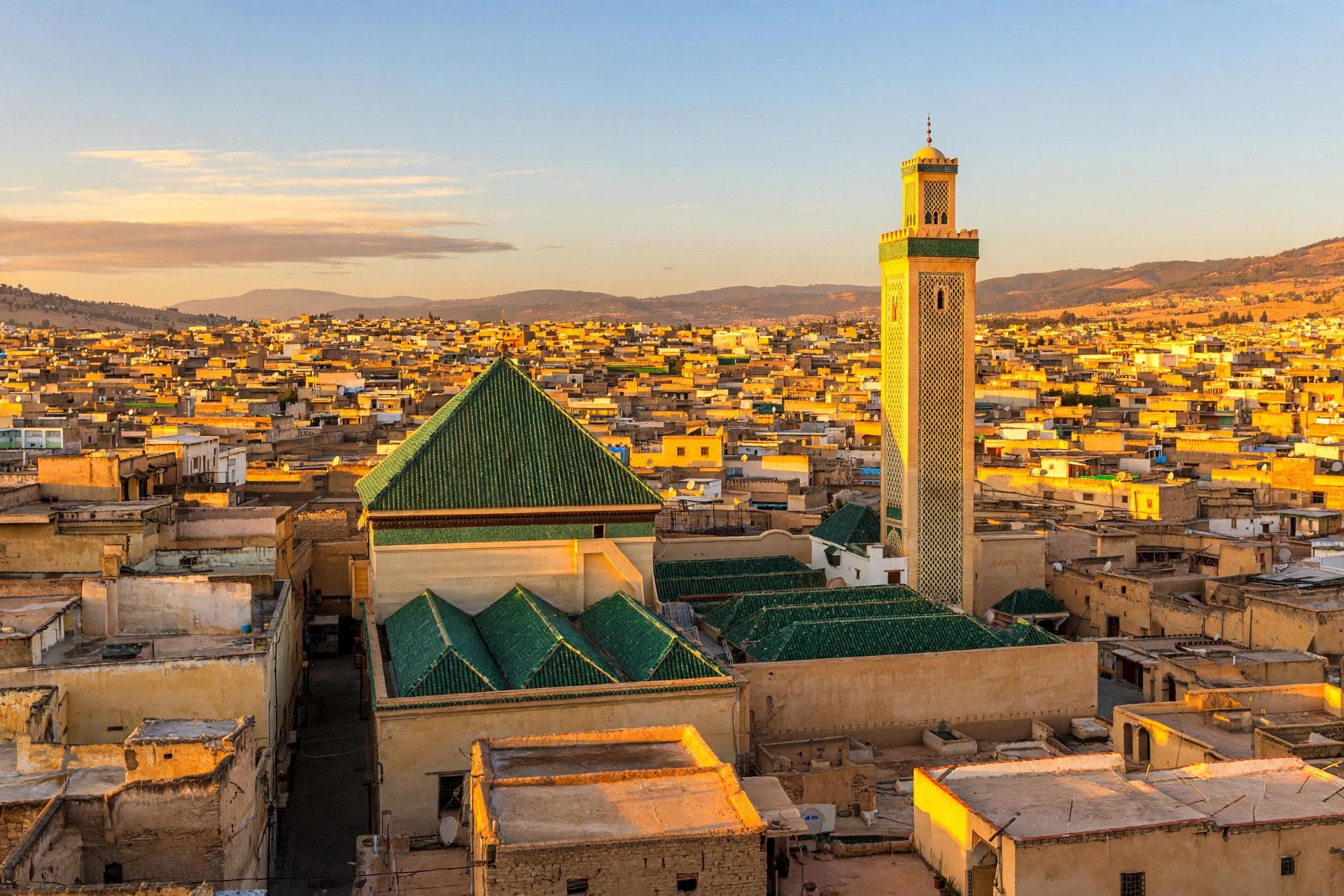
Imperial cities Morocco history: Every Morocco itinerary mentions the “imperial cities” — Fes, Marrakech, Meknes and Rabat — as if they were four equal stops on one neat tour. They are not. They are four completely different cities, built by four completely different dynasties, for four completely different reasons, and the fastest way to understand any of them is to learn which dynasty built it and why.
That is the key to this article. Fes is a city of learning, founded by a dynasty that needed legitimacy and got it from scholars. Marrakech is a city of spectacle, built by desert warriors who wanted the world to see their power. Meknes is a city of one man’s ego — Sultan Moulay Ismail’s attempt to build a Moroccan Versailles, with stone carted in from a Roman ruin. And Rabat is the capital that was never finished, an Almohad dream abandoned when its caliph died and never quite resumed. Learn the dynasty first, and the city explains itself.
Imperial Cities Morocco history: What “Imperial City” Means
Here is the first correction, and it matters more than it sounds: the “imperial cities” label is a modern tourist grouping, not a medieval one. No Moroccan sultan ever used the phrase. The four cities were capitals at different times, under different dynasties, and often in rivalry with each other. Grouping them together is a twentieth-century travel-industry convenience — a useful one, but a convenience all the same.
What they do share is this: each one was the capital of the dynasty that defined an era of Moroccan history, and each one still carries that dynasty’s personality in its stones. If you want the full story in one thread, start with the history of Morocco — this article is the close-up of its four great cities.
Fes: The City of Learning
Fes is the oldest of the four, and the one whose founding is the most honestly uncertain. The standard story says Idris I founded the city in 789, on the banks of the Oued Fes, and his son Idris II expanded it a generation later. That date is the one you will see on plaques and in guidebooks, but historians argue over the details — whether the two settlements on either bank were founded decades apart, and exactly when the city became a single urban centre. The honest version is that Fes was founded in the late eighth and early ninth centuries by the Idrisid dynasty, and the precise year is not settled.
What is not in doubt is what Fes became. In 859, Fatima al-Fihri founded the University of al-Qarawiyyin, recognised as the oldest continuously operating university in the world. That single fact explains the whole city. Fes was never primarily a military capital or a trading port. It was the city Moroccans sent their sons to study in — the city of theologians, jurists and physicians — and the dynasty that ruled it understood that scholarship was legitimacy. The Idrisids were a new dynasty in a new land, descended from the Prophet’s family, and a great mosque-university was worth more than a fortress.
The Marinids, who made Fes their capital in the thirteenth century, understood this too. They built Fes el-Jdid — “New Fes” — beside the old medina, and filled the city with madrasas whose carved cedar and zellige tilework remain the finest in Morocco: the Bou Inania, the Attarine, the Seffarine. Walk into the Bou Inania today and you are looking at the Marinid idea of power — not a palace, but a school.
Spend two full days here. One day is enough to see the famous sights; two days is what it takes to start navigating by the two main arteries, Talaa Kebira and Talaa Seghira, instead of by panic. The Bou Inania madrasa costs around 20–30 MAD (roughly $2–3) for foreign visitors; the great mosques, including al-Qarawiyyin itself, are closed to non-Muslims. The Chouara tannery viewpoint is free from the surrounding leather shops, though the shopkeepers will expect you to look at their goods — that is the deal, and it is an honest one. Prices checked November 2026. Entry fees for major monuments across Morocco generally run 60–100 MAD (roughly $6–10) for foreign adults, with lower rates for children and Moroccan residents.
Marrakech: The City of Spectacle
If Fes is the city of the mind, Marrakech is the city of the eye. It was founded around 1070 — the usual date given is 1070, though, like Fes, the exact year is debated — by Abu Bakr ibn Umar, a leader of the Almoravids, the desert Sanhaja Berbers who had united the Sahara and the Moroccan south under a strict reformist movement. The movement’s spiritual founder, Abdallah ibn Yasin, died in battle against the Barghawata; historians place his death in 1058 or 1059, and the date is genuinely not settled, so any guide that states one year as fact is guessing. What matters is what his successors built after him: a capital in the Haouz plain, at the foot of the Atlas, designed to be seen.
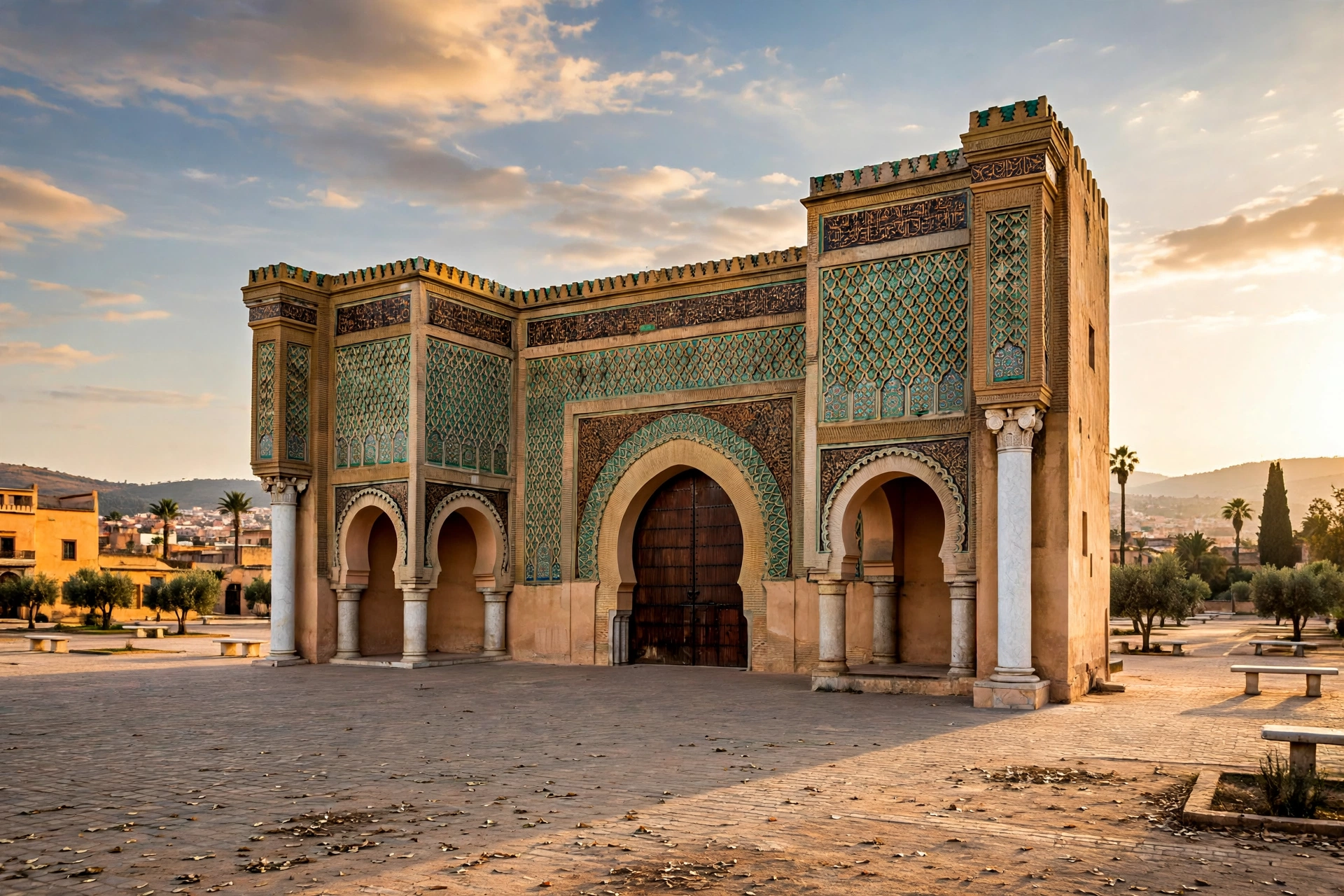
The Almoravids built Marrakech as a statement. The Koutoubia minaret — the tower that still defines the city’s skyline, completed under the Almohads who followed them — is visible from almost anywhere in the city, and that was the point. The great square, Jemaa el-Fna, was the city’s beating heart: storytellers, snake charmers and orange-juice sellers by day, and at dusk one of the largest open-air food markets in the world. Marrakech was built to impress visitors, subjects and rivals alike, and it still does exactly that job.
The Saadians, who ruled from Marrakech in the sixteenth century, doubled down on spectacle. Sultan Ahmad al-Mansur built the El Badi Palace with gold from the Sudan — so lavishly that his successors stripped it for building material, leaving the roofless ruin you see today.
Honest advice from a local: Marrakech is the loudest, pushiest and most tiring of the four cities, and also the most fun. The hassle in Jemaa el-Fna at noon is real, and the square is at its best after sunset, when the food stalls light up and the crowds become a celebration rather than a gauntlet. The Bahia Palace, El Badi Palace and Saadian Tombs each charge in the region of 70–100 MAD (roughly $7–10) for foreign adults — prices checked November 2026 — and the three sit within a short walk of each other, making one efficient morning rather than three separate excursions.
Meknes: One Sultan’s Versailles
Meknes is the strangest of the four imperial cities, and the most misunderstood. Visitors arrive expecting another Fes or another Marrakech and find something else entirely: a small, quiet city wrapped around monuments built for an empire that never quite arrived.
The city itself is old, but the Meknes you see today is the creation of one man: Sultan Moulay Ismail, who ruled from 1672 to 1727 and made Meknes his capital. Ismail was the most powerful Alaouite sultan, a builder on a scale Morocco had never seen, and he wanted a capital to match his ambition. His model was Versailles. He conscripted tens of thousands of workers and built on a scale that still staggers — the Heri es-Souani granaries, vast enough to store grain for a siege of years; the royal stables, said to have housed twelve thousand horses; and city walls running for kilometres around the imperial city.
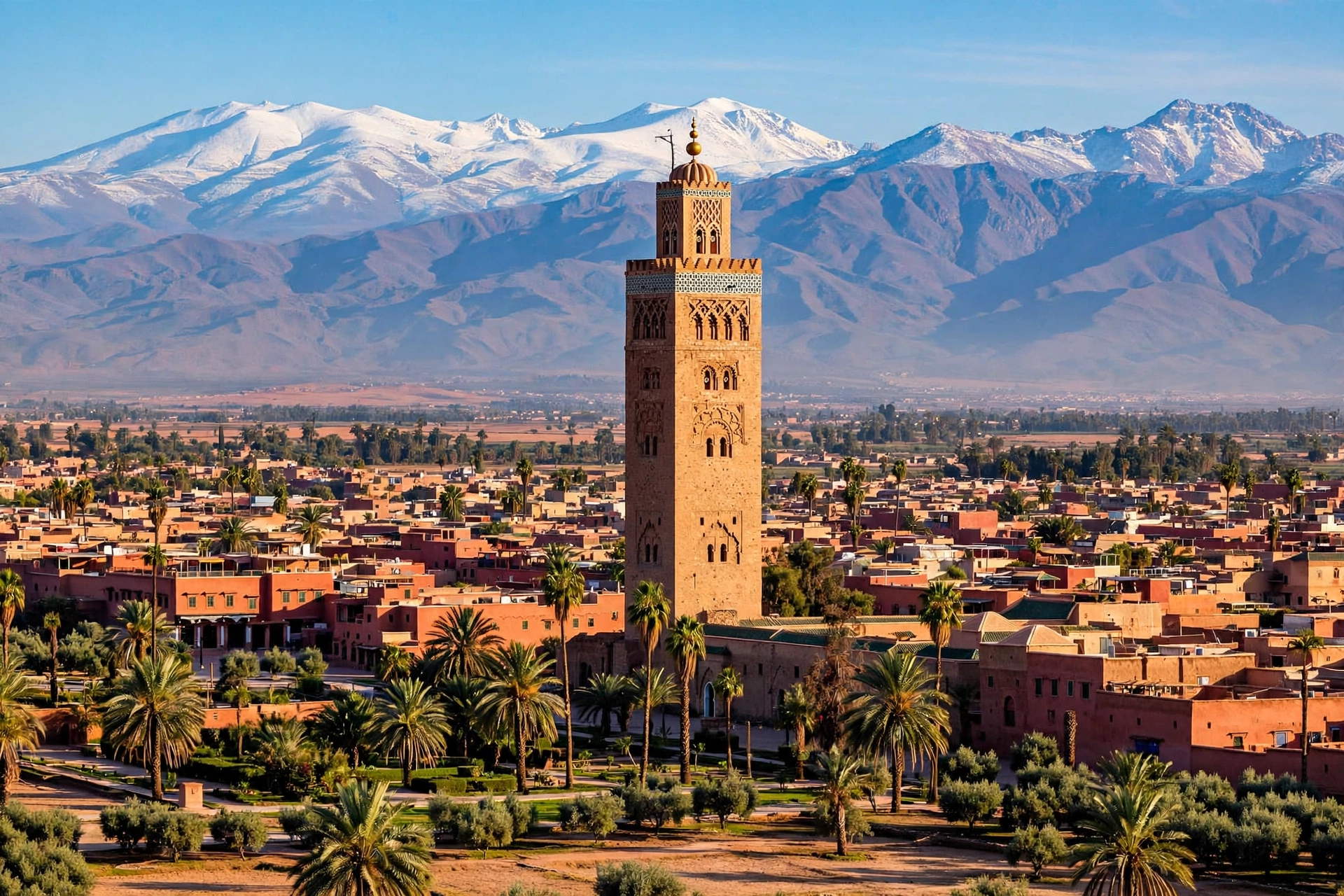
Its great gate, Bab Mansour el-Aleuj — completed in 1732, five years after Ismail’s death — is the most photographed gate in Morocco, and a monument to a project that outlived its builder.
Here is the insider detail most guides skip: much of Meknes was built with stone and marble taken from the Roman ruins of Volubilis, about 30 kilometres away. Ismail’s builders dismantled columns and marble blocks from the ancient city and hauled them to Meknes. That is why Volubilis is a ruin of foundations and mosaics today — and why Meknes has Roman marble in its walls. If you visit Volubilis — entry generally 70–100 MAD (roughly $7–10) for foreign adults, prices checked November 2026 — go to Meknes the same day and you will see where its stones went. The story of Jebel Irhoud and Morocco’s deep past is a reminder that this land’s history runs far deeper than any one dynasty.
Meknes needs one full day, and rewards it: the imperial city in the morning, the medina in the afternoon, and dinner in the quiet main square, Place el-Hedim, which locals compare — favourably, and with a small smile — to a calmer Jemaa el-Fna.
Rabat: The Capital That Was Never Finished
Rabat is the correction most visitors need most. It is the current capital of Morocco, and the calmest, greenest, most liveable city in the country — but it is not the oldest capital, and it is not, in any simple sense, an “imperial” city at all.
The city’s great moment came under the Almohads, the dynasty that followed the Almoravids and ruled a vast empire from Morocco to Andalusia. The Almohad caliph Yaqub al-Mansur made Rabat his capital in the late twelfth century and began building on an imperial scale: a vast mosque, the largest in the Muslim west, with a minaret that would have risen some 86 metres. Then al-Mansur died in 1199, the empire began its slow decline, and the mosque was never finished. Its minaret — the Hassan Tower — stands today at about 44 metres, half its intended height, surrounded by the stumps of columns that were meant to hold a roof that was never built. It is the most eloquent ruin in Morocco: a dynasty’s ambition, interrupted mid-sentence.
Visit Rabat for the Hassan Tower and the Mausoleum of Mohammed V beside it — free to enter, and one of the most beautiful modern buildings in Morocco — and for the Kasbah of the Udayas, a blue-and-white fortress town on a cliff above the Atlantic. The Chellah, the ruined Marinid necropolis outside the city walls, charges in the region of 60–70 MAD (roughly $6–7) for foreign adults, prices checked November 2026. One full day is enough for Rabat’s highlights; two days let you slow down and enjoy the city the way Moroccans who live there do — unhurriedly.
The Four Cities at a Glance
| City | Founded / made capital by | Defining dynasty | Key monuments | How long to spend |
|---|---|---|---|---|
| Fes | Idrisids, late 8th–early 9th century (exact year not settled) | Idrisid, Marinid | al-Qarawiyyin, Bou Inania Madrasa, Chouara Tannery | 2 days |
| Marrakech | Almoravids, c. 1070 (exact year debated) | Almoravid, Saadian | Koutoubia, Jemaa el-Fna, Bahia Palace, Saadian Tombs | 2–3 days |
| Meknes | Made capital by Moulay Ismail, 1672 | Alaouite | Bab Mansour, Heri es-Souani, royal stables | 1 day |
| Rabat | Made capital by the Almohads, late 12th century | Almohad | Hassan Tower, Mausoleum of Mohammed V, Kasbah of the Udayas | 1–2 days |
How to Visit the Imperial Cities in One Trip
The practical question is how to string the four cities together, and the honest answer is that you should not try to do all four in one short trip. Pair them instead: Fes and Meknes together, since they are barely an hour apart by train, and Marrakech on its own, since it deserves the time. Rabat sits on the train line between Casablanca and Tangier, so it pairs naturally with a northbound leg.
A realistic imperial-cities trip is seven days: two in Fes with a Meknes–Volubilis day trip, one travelling south, and three in Marrakech, with Rabat added at either end if you fly through Casablanca.
Frequently Asked Questions
Which imperial city should I visit if I only have time for one?
Fes, if you want history you can walk through, and Marrakech, if you want energy and spectacle. Fes el-Bali is the most complete medieval city in the Arab world; Marrakech is the most fun. If you have two days, Fes rewards them more deeply.
Is Rabat really an imperial city?
Only in the modern tourist sense. Rabat was an Almohad capital for a short period in the late twelfth century, and its great mosque was never finished, but it spent most of its history as a modest town. It became important again as the administrative capital under the French protectorate in 1912 and has been the capital of independent Morocco since 1956. Calling it “imperial” is a convenience, not a medieval fact.
Why is Fes considered the cultural capital of Morocco?
Because of al-Qarawiyyin, founded in 859 and the oldest continuously operating university in the world, and because Fes was the seat of the Marinid dynasty, which filled it with madrasas, mosques and libraries.
Can I visit all four imperial cities by train?
Yes. All four are on the ONCF rail network. Fes–Meknes is under an hour; Rabat–Fes is roughly two and a half to three hours; Rabat–Marrakech is around four hours. Book first class for a small supplement if you want a guaranteed seat. There is no direct Marrakech–Fes train; the route runs via Casablanca.
What is the best order to visit the imperial cities?
Chronologically, if you want the history to build: Fes first (the oldest, the Idrisids and Marinids), then Marrakech (the Almoravids and Saadians), then Meknes (Moulay Ismail), then Rabat (the unfinished Almohad dream and the modern capital).
The Dynasty Is the Map
The four imperial cities are not four versions of the same place. They are four answers to the same question — what should a capital be? — given by four different dynasties. Fes answered with a university. Marrakech answered with a square and a minaret. Meknes answered with granaries and stables on a scale no one needed. Rabat answered with a tower that was never finished.
Imperial cities Morocco history: Learn the dynasty first, and the city explains itself. For the practical side of your trip, see About LahbabiGuide.