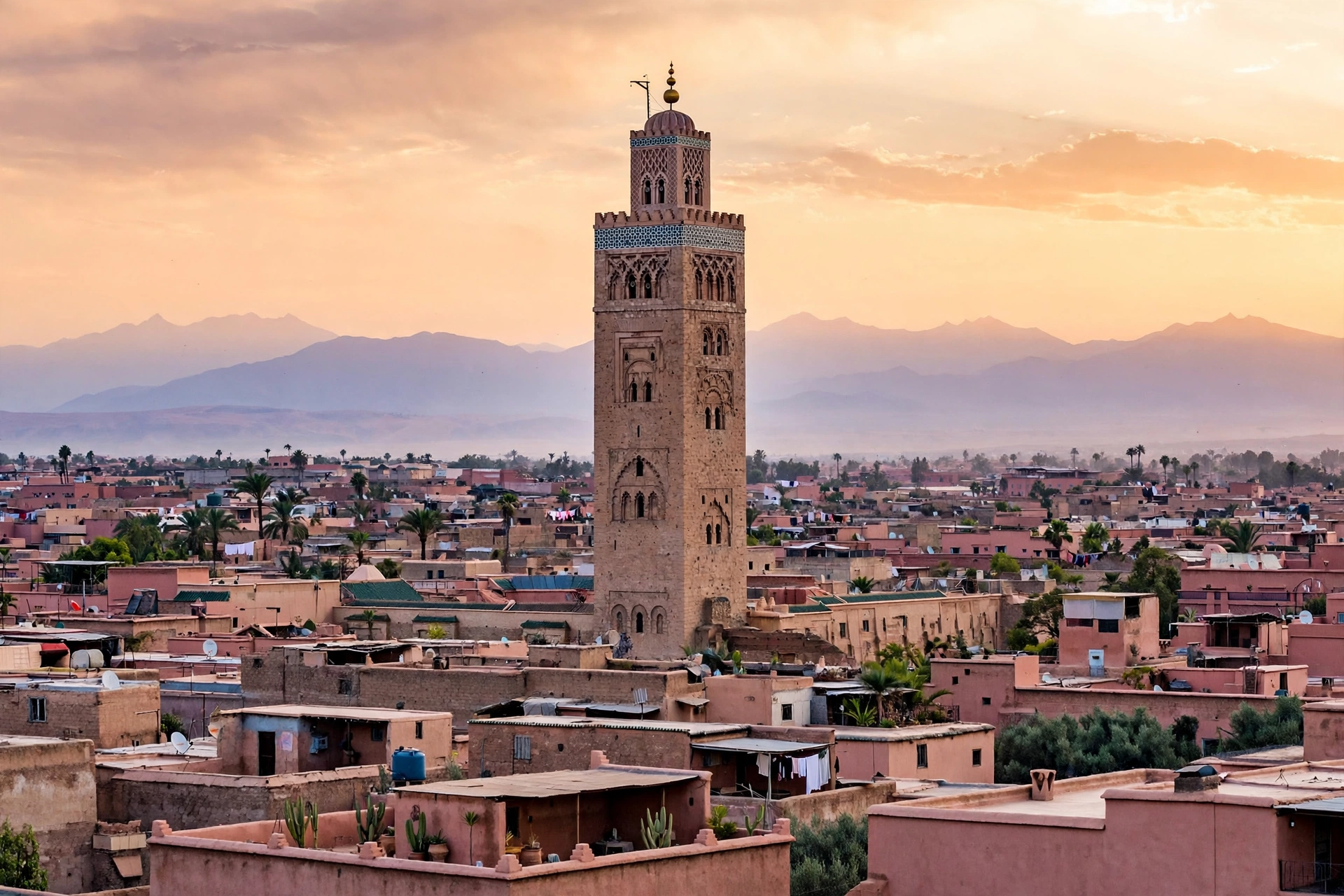
Marrakech is the city most visitors picture when they picture Morocco: a pink-walled medina, a square that turns into an open-air restaurant every evening, a minaret that has watched over it all for nearly nine centuries. It is also the city most visitors misunderstand. They arrive expecting a desert oasis frozen in time and find a busy, modern, sometimes pushy city of more than a million people.
I am Moroccan, and Marrakech is the city I keep coming back to. This guide is the honest version I give friends: what is genuinely worth your time, where to sleep so you actually rest, what to skip without regret, and what things really cost in dirhams. If this is your first trip to the country, start with our Morocco travel guide for first-time visitors for the visa, money and safety basics.
Marrakech in One Paragraph: What It Is (and Isn’t)
Marrakech was founded around 1070 by the Almoravids, and it has been a trading city ever since — not a museum, not a resort, not a film set. The medina is a working neighbourhood where families live, artisans hammer copper, and donkeys carry goods down alleys too narrow for cars. Around it sits the ville nouvelle, with wide avenues, cafés and most of the big hotels, and the Atlas Mountains rise to the south, snow-capped in winter.
Here is the correction most guides get wrong: Marrakech is not the Sahara, and a “desert trip” sold from Marrakech in a single day is not the Sahara either. The real dunes at Merzouga are roughly 550 kilometres away; day trips reach only the Agafay stone desert — beautiful at sunset, but with no sand dunes. Give the Sahara two or three days, or skip it and enjoy Marrakech properly. Our 7-day Morocco itinerary shows how the desert fits into a week without backtracking.
When to Go
March to May and September to November are the sweet spot: daytime highs around 25–30°C, cool evenings, and gardens at their best. December to February brings crisp, sunny days around 18–22°C and cold nights — pack a jacket, because riads are built around open courtyards and get chilly after dark. June to August is brutal, with July highs regularly above 40°C; sightseeing between noon and 5 p.m. becomes an endurance test.
For the month-by-month breakdown, see our guide to the best time to visit Morocco. The short version is regional: a month that is unbearable in Marrakech can be perfect on the coast.
Where to Stay: Riad or Hotel, Medina or Guéliz
Where you sleep decides how much you enjoy Marrakech.
Stay in a medina riad if you want atmosphere
A riad is a traditional house built around a courtyard, usually with a handful of rooms, a rooftop terrace and, in the better ones, a small plunge pool. Staying in one puts you steps from Jemaa el-Fna and the souks, and waking up to birdsong in a tiled courtyard is the closest thing Marrakech has to magic. The trade-offs: dark alleys at night, no car to your door, and the call to prayer before dawn. Budget riads start around 300–600 MAD ($30–60) a night; a comfortable mid-range riad runs 700–1,500 MAD ($70–150); a luxury riad can pass 3,000 MAD ($300). Book one with recent reviews that mention hot water and quiet rooms.
Stay in Guéliz or Hivernage if you want comfort
Guéliz is the modern district: wide streets, chain hotels, restaurants with wine lists, pharmacies, and taxis that actually use the meter. Hivernage, just south of it, holds most of the big five-star hotels and is a 10-minute walk from Jemaa el-Fna. If you are travelling with children, have mobility issues, or simply want a proper bed and a taxi at the door, this is the sensible choice. Decent hotels start around 500 MAD ($50); good four-star hotels run 1,000–2,000 MAD ($100–200).
Where not to stay
Avoid the cheapest rooms right on Jemaa el-Fna itself unless you have read very recent reviews: the noise runs until 1 a.m. And check the map pin on any listing that calls itself a “riad” — some are apartment blocks outside the medina walls.
What to See: The One-Morning Trio
The key point: the Bahia Palace, El Badi Palace and the Saadian Tombs are one morning’s walk, not three separate excursions. They sit within ten minutes of each other in the southern medina, and each charges around 100 MAD (about $10). Walk them yourself, in this order, from 9 a.m.
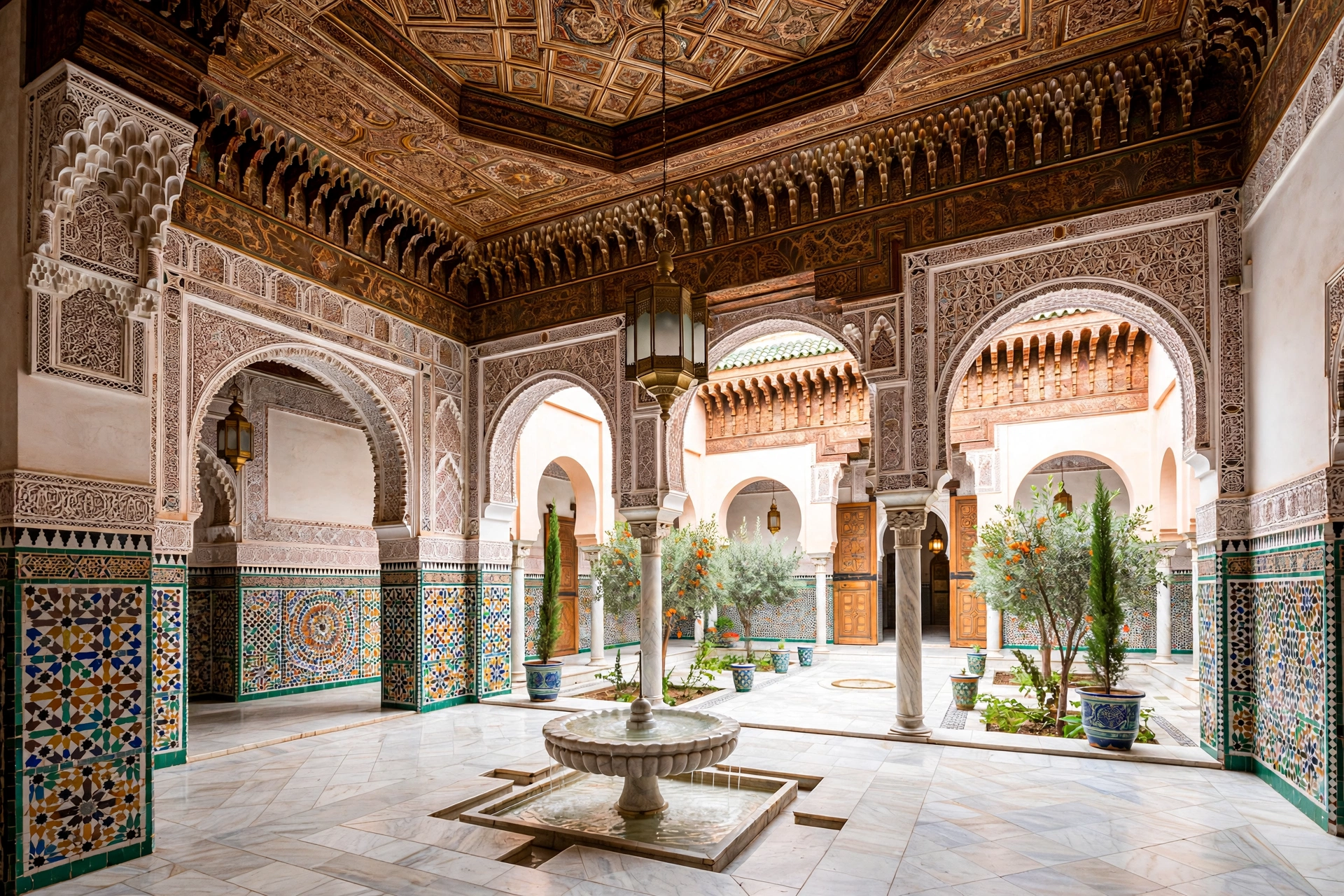
Bahia Palace is the essential one. Built in the late 19th century for a grand vizier, it is a maze of painted cedar ceilings, carved plaster, zellige tilework and quiet courtyards — the best surviving example of Moroccan palace craft you can walk through. Allow an hour.
El Badi Palace is the opposite: a vast, roofless ruin. The Saadian sultan Ahmed al-Mansour built it in the 16th century with gold, onyx and Italian marble, and a later sultan stripped it bare. What remains is a sunken courtyard with pools and orange trees. Thirty minutes is enough; the terrace view over the rooftops is the payoff.
The Saadian Tombs are small and often crowded, which is why you go third — by late morning the tour groups have moved on. Rediscovered in 1917 after being walled up for two centuries, they hold Saadian sultans in two mausoleums, the finest a chamber of carved cedar and Italian marble.
Entry Fees and Practical Prices
| Place | Entry (approx.) | Notes |
|---|---|---|
| Bahia Palace | ~100 MAD (~$10) | Open ~9 a.m.–5 p.m.; go first |
| El Badi Palace | ~100 MAD (~$10) | Ruin; 30–40 min is enough |
| Saadian Tombs | ~100 MAD (~$10) | Small; expect a short queue |
| Koutoubia Mosque | Free (exterior) | Non-Muslims cannot enter; the garden and minaret are the visit |
| Jardin Majorelle | ~170 MAD (~$17) garden only | Book online; mornings are quietest |
| Ben Youssef Madrasa | ~60–80 MAD (~$6–8) | Beautiful carved courtyard; 45 min |
| Petit taxi (medina–Guéliz) | ~10–20 MAD (~$1–2) | Insist on the meter, or agree the price first |
Prices checked 18 November 2026. Fees are approximate and can change; the exchange rate used is roughly 10 MAD to $1. For full trip budgeting, see how much a trip to Morocco costs.
Jemaa el-Fna: Go at Dusk, Not Noon
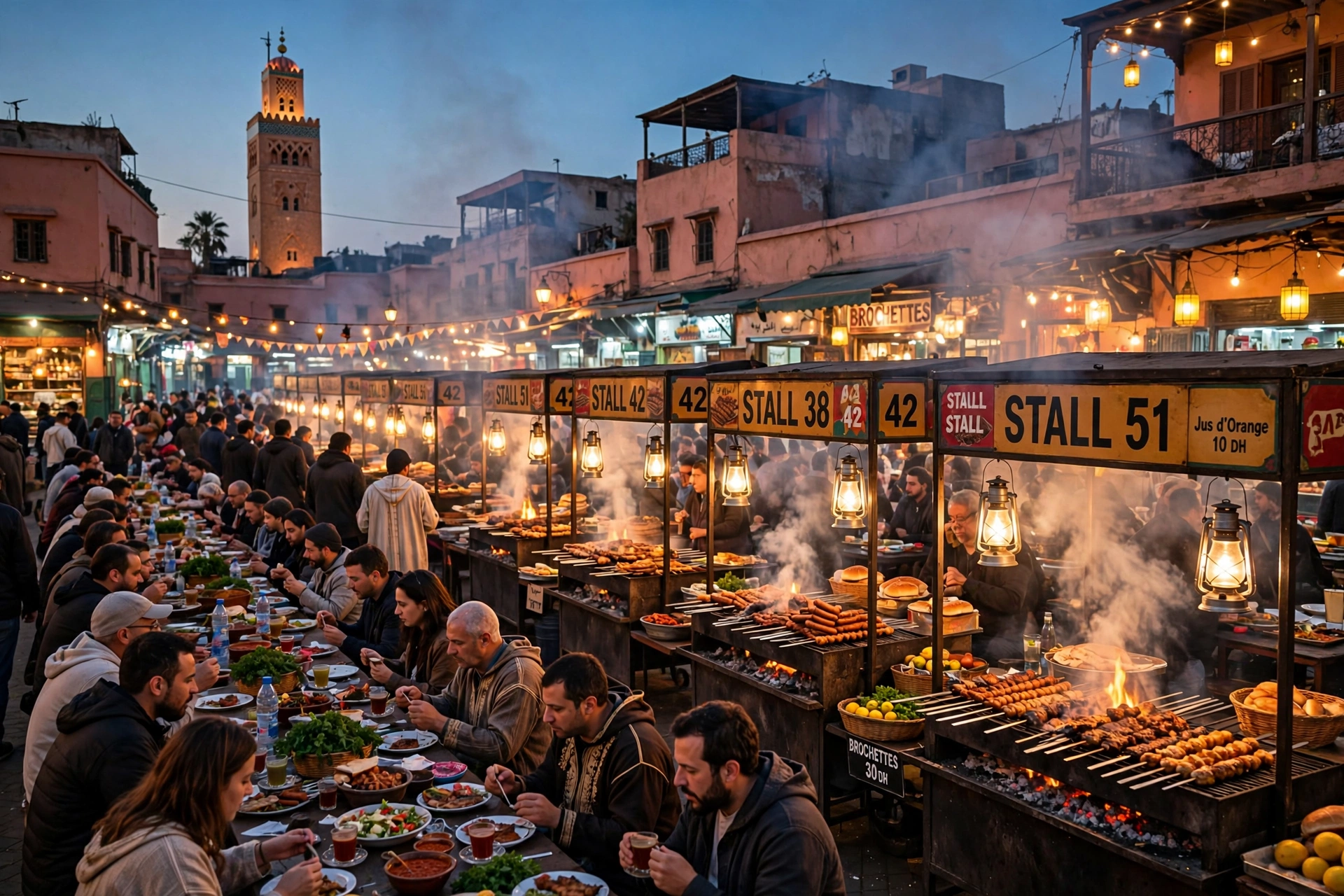
Jemaa el-Fna is the beating heart of Marrakech and a UNESCO-listed cultural space — and it is two different places depending on the hour. At noon it is a big, dusty, mostly empty square with snake charmers and men with monkeys charging for photos. That is the version most day-trippers see, and they leave unimpressed.
Locals visit at dusk, for the food stalls, not at noon for the photo. From about 6 p.m. the square transforms: more than a hundred grill stalls roll out, smoke rises, lanterns come on, and the whole city seems to be there eating. Sit at a stall and eat what Marrakech eats — grilled meats, harira soup, snails, fresh orange juice for a few dirhams. Dinner costs roughly 60–100 MAD ($6–10) per person. Pick the stalls with the longest queues of Moroccans, not the ones whose touts grabbed your arm.
The snake charmers charge for every photo, including ones you did not ask for — a polite “no, thank you” and walking on works better than arguing. For the famous view, go to a rooftop café at sunset, order a mint tea, and watch the square fill up below you.
The Souks Without Getting Fleeced
The souks north of Jemaa el-Fna are a maze of covered lanes selling spices, slippers, lanterns and more. They are wonderful and a trap in equal measure — wonderful because the craft is real, a trap because the first price you hear is a starting point, not a price.
Haggle on unpriced goods like carpets, leather bags, lamps and jewellery, but never on food, spices sold by weight, or anything with a fixed price tag. A fair landing point is usually around half to two-thirds of the first asking price, reached with a smile and a willingness to walk away. Never let a “helpful stranger” walk you to a shop — the commission is added to your bill. Tea in a shop is the start of a negotiation, not a gift — polite to accept, and equally polite to leave without buying.
Buy one thing well rather than five things cheaply.
Beyond the Medina: Worth It, and Worth Skipping
Koutoubia Mosque is the city’s landmark; its 77-metre minaret has defined the skyline since the 12th century. Non-Muslims cannot enter, and that is fine — the visit is the garden around it, the minaret at sunset, and the storks. It is free, five minutes from the square.
Jardin Majorelle is the famous cobalt-blue garden created by the painter Jacques Majorelle and later restored by Yves Saint Laurent. It is genuinely beautiful and genuinely crowded, with timed entry and a ticket of around 170 MAD ($17) for the garden alone. Book online and go at opening time.
Ben Youssef Madrasa, a 16th-century Quranic school near the souks, has one of the most photographed courtyards in Morocco — carved cedar, marble and zellige in every direction. Entry is around 60–80 MAD ($6–8).
Downgrade the Menara Gardens and the Palmeraie. The Menara is a pleasant olive grove, underwhelming as a “must-see”; the Palmeraie is mostly hotels and quad bikes now. Skip both without guilt if time is short.
What to Skip (Without Regret)
The camel ride “in the desert” ten minutes outside the city is a photo stop on a dusty track, not a desert experience. The “traditional” hammam sold by your hotel for 400+ MAD ($40+) is often a rushed tourist version; a real local hammam costs 30–50 MAD ($3–5) plus a scrub, but it is a public, no-frills, gender-separated bathhouse.
And the single biggest skip: any “free guided tour” offered on the street. Nothing in Marrakech is free; the price is extracted later at a carpet shop or a “closed” street that needs a paid detour. A licensed guide booked through your riad costs around 300–500 MAD ($30–50) for a half day and is worth every dirham; a stranger at the gate is not.
Eating in Marrakech: Where Locals Actually Eat
Marrakech eats well and cheaply if you follow the locals: eat where the menu is handwritten, the room is full of Moroccans, and no one outside is begging you to come in. In the medina, that means the food stalls at night, the tiny grill restaurants in the souks, and the sandwich shops near Bab Doukkala. A proper lunch — tagine, bread, salad, mint tea — runs 50–80 MAD ($5–8).
Seek out tangia, the Marrakech speciality of beef slow-cooked in a clay urn in hammam ashes — order a day ahead, because it takes hours — and pastilla, the sweet-savoury pie dusted with cinnamon. Couscous is a Friday lunch in Moroccan homes, not an everyday restaurant dish. For breakfast, do what we do: mint tea, msemen and honey at a neighbourhood café for 15–25 MAD ($1.50–2.50).
Getting Around
Inside the medina, walk — cars cannot reach most of it, and the best of it is found by getting happily lost for an hour. For longer hops, use the petit taxis: insist on the meter (“le compteur”) before you get in. A ride inside the city should be 10–20 MAD ($1–2), and 30 MAD ($3) at night is fair. Agree a price first for the airport (around 70–100 MAD / $7–10).
Renting a car is unnecessary in the city; rent one only if you are leaving for the Atlas or the coast, and pick it up in Guéliz. Learn more about the site and its writers on our About page.
A Sensible Two-Day Plan
Day one — the medina core. Start at 9 a.m. with the Bahia–Badi–Saadian Tombs trio, wander the souks, and take a long lunch in the medina. Late afternoon, see the Koutoubia gardens, then a rooftop mint tea at sunset and dinner at the Jemaa el-Fna stalls. Day two — the wider city. Morning at Jardin Majorelle and the Ben Youssef Madrasa, lunch in Guéliz, an afternoon at a hammam or a cooking class, and a final evening in the square.
Frequently Asked Questions
- How many days do you need in Marrakech? Two or three full days is right: one for the medina’s palaces, tombs and souks, one for the gardens and the wider city, and a third for a side trip or a slow day. One day is possible but rushed.
- Is Marrakech safe for tourists? Yes, for the overwhelming majority of visitors. Violent crime against tourists is rare; the real annoyance is small scams — unmetered taxis, “helpful” strangers steering you to shops, and photo charges in the square. Stay aware in crowds, agree taxi prices in advance, and say a firm, friendly no.
- Can non-Muslims enter the Koutoubia Mosque? No — like most mosques in Morocco, the Koutoubia is closed to non-Muslim visitors, except for the Hassan II Mosque in Casablanca, which runs guided tours. Enjoy the Koutoubia from its gardens, and visit the Ben Youssef Madrasa for sacred architecture from the inside.
- What is the best area to stay in Marrakech? For atmosphere, a riad in the medina near Jemaa el-Fna. For comfort, quiet and easy taxis, Guéliz or Hivernage. Families, light sleepers and travellers with mobility issues are usually happier in Guéliz; first-timers who want the full medina experience are happier in a riad.
- How much money do I need per day in Marrakech? A comfortable mid-range day runs roughly 600–1,200 MAD ($60–120) per person including a riad or hotel, meals, taxis and one or two paid entries; a budget traveller can manage on 300–500 MAD ($30–50). See our breakdown in how much a trip to Morocco costs.
Marrakech rewards the visitor who slows down. It is a rooftop at dusk, getting lost in the souks, dinner at a stall beside a family who has eaten there for twenty years. Do the trio in one morning, eat in the square at night, stay where you will actually sleep, and skip the rest without a second thought.
Prices checked 18 November 2026. Entry fees are approximate and may change; the exchange rate used is roughly 10 MAD to $1.