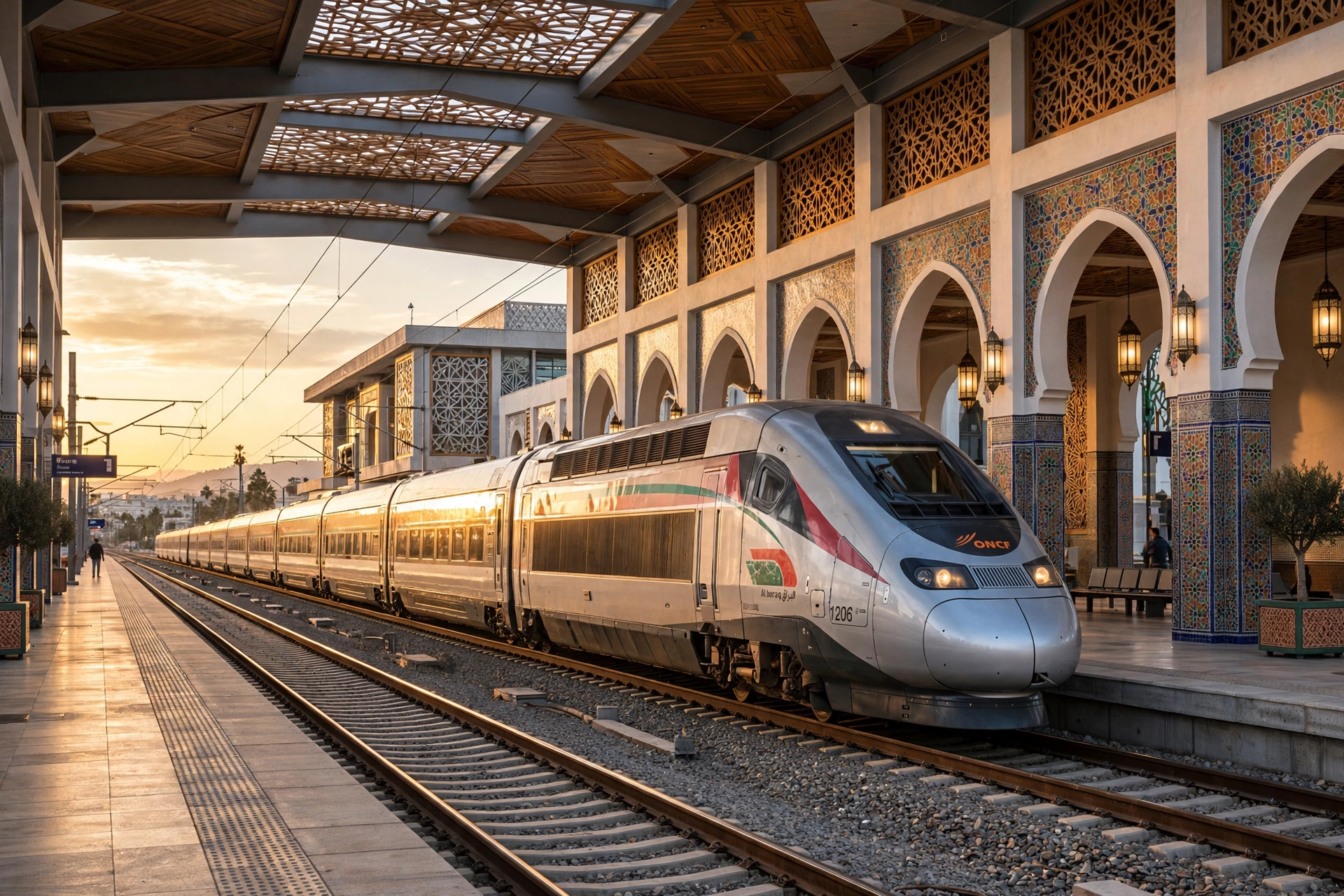
Morocco is one of the easiest countries in North Africa to cross without a car — and one of the most confusing if you try to plan it the way you would plan a trip in Europe. The trains are good but they only cover the north and west. The buses go almost everywhere but they are slow. The taxis are cheap until they are not. And the famous Al Boraq high-speed train serves exactly one line: Tangier to Casablanca, via Rabat and Kenitra.
This guide covers getting around Morocco: the trains run by ONCF, the CTM and Supratours buses, grand and petit taxis, when a rental car actually makes sense, and the practical mistakes I see tourists make again and again.
The ONCF Train Network: What It Covers — and What It Doesn’t
Morocco’s rail network is shaped like a spine running down the Atlantic coast, with branches inland to Fes and Marrakech. The main lines are:
- Tangier – Rabat – Casablanca: the flagship corridor, including the Al Boraq high-speed service.
- Casablanca – Marrakech: the busiest tourist line, about three hours.
- Casablanca – Fes: via Rabat and Meknes, roughly four hours.
- Fes – Oujda: the eastern line, less used by visitors.
- Casablanca – El Jadida and Casablanca – Settat: short regional runs.
What the train does not do matters just as much. There is no train to the desert: Merzouga and the Erg Chebbi dunes have no railway — the road is the way, by bus, shared taxi, or a tour from Marrakech or Fes. There is no train to Chefchaouen (nearest station Tangier, about two hours by bus or grand taxi), no train to Essaouira (nearest station Marrakech), and no train to Agadir. If your itinerary is Marrakech → desert → Fes, the train can only carry you on the Marrakech–Casablanca–Fes leg — and even that has a catch, explained below.
Trains in Morocco are comfortable, air-conditioned, punctual more often than not, and genuinely cheap by European standards. Stations in the big cities — Tangier Ville, Rabat Agdal, Casablanca Voyageurs, Marrakech — are modern and easy to navigate, with ticket machines and staffed counters.
Al Boraq: The High-Speed Train Worth Taking
Al Boraq is Morocco’s — and Africa’s — first high-speed train, launched in November 2018. It runs on a dedicated high-speed line between Tangier and Kenitra, then continues on conventional track to Rabat and Casablanca. The full Tangier–Casablanca journey takes about 2 hours 10 minutes, against roughly 5 hours by car or conventional train.
Routes and journey times
| Route | Service | Journey time | 2nd class (approx.) | 1st class (approx.) |
|---|---|---|---|---|
| Tangier – Casablanca | Al Boraq | ~2h 10m | 150–250 MAD (~$15–25) | 250–350 MAD (~$25–35) |
| Tangier – Rabat | Al Boraq | ~1h 20m | 110–190 MAD (~$11–19) | 190–290 MAD (~$19–29) |
| Casablanca – Marrakech | Al Atlas | ~3h | 90–140 MAD (~$9–14) | 150–220 MAD (~$15–22) |
| Casablanca – Fes | Al Atlas | ~4h | 130–200 MAD (~$13–20) | 200–300 MAD (~$20–30) |
| Rabat – Fes | Al Atlas | ~2h 45m | 100–160 MAD (~$10–16) | 160–240 MAD (~$16–24) |
| Marrakech – Casablanca Airport (Mohammed V) | Al Atlas / shuttle | ~3h 15m | 100–150 MAD (~$10–15) | 160–230 MAD (~$16–23) |
Fares vary with the time of day and how early you book: Al Boraq uses dynamic pricing, so the cheapest seats sell first. Book a few days ahead, and expect to pay more for Friday afternoon and Sunday evening departures. The ranges above are realistic planning figures for 2026, not a fare guarantee — ONCF adjusts prices seasonally.
Prices checked: 18 November 2026. Fares are in Moroccan dirhams (MAD); USD equivalents use roughly 10 MAD = $1.
First class vs second class: the insider correction
Here is the thing most visitors get wrong. On Moroccan trains, first class typically costs only about 50–90 MAD more than second class (roughly $5–9). For that you get a guaranteed seat in a quieter, roomier carriage, wider seats, and — crucially on Al Boraq — a reserved seat. Second class on Al Atlas trains is unreserved: you buy a ticket and take whatever seat is free. On busy routes and holiday weekends, second-class passengers stand in the aisles.
Yet I watch visitors queue for second class every day, saving the price of a coffee to stand for three hours. My honest advice: take first class on any journey over two hours, and on every Al Boraq trip.
How to buy ONCF tickets
- Online: oncf-voyages.ma or the ONCF Voyages app. Book Al Boraq seats and show the e-ticket on your phone. The site is in French and Arabic, with some English — use your browser’s translate function if needed.
- At the station: ticket counters and machines at every major station. Machines accept cards; counters accept cash and cards. Buy at least 30 minutes before departure at busy stations.
- On the train: you can buy from the conductor, but you will pay a surcharge, and on Al Boraq you may be refused if the train is full. Don’t rely on it.
Seat reservations are included with Al Boraq tickets. On Al Atlas trains, first class is reservable and second class is not. Keep your ticket until you leave the station — inspectors check, and some stations have exit gates.
A useful trick: the Marrakech–Fes detour
If you are travelling Marrakech to Fes by train, know that the line detours west through Casablanca — the journey takes about seven hours with a change. The road via the Middle Atlas and the desert edge (Marrakech → Merzouga → Fes) is the scenic shortcut, and it is why most travellers do the desert in the middle. If you are short on time and skipping the desert, fly instead, or accept the long train day — the stretch between Casablanca and Fes is genuinely pretty.
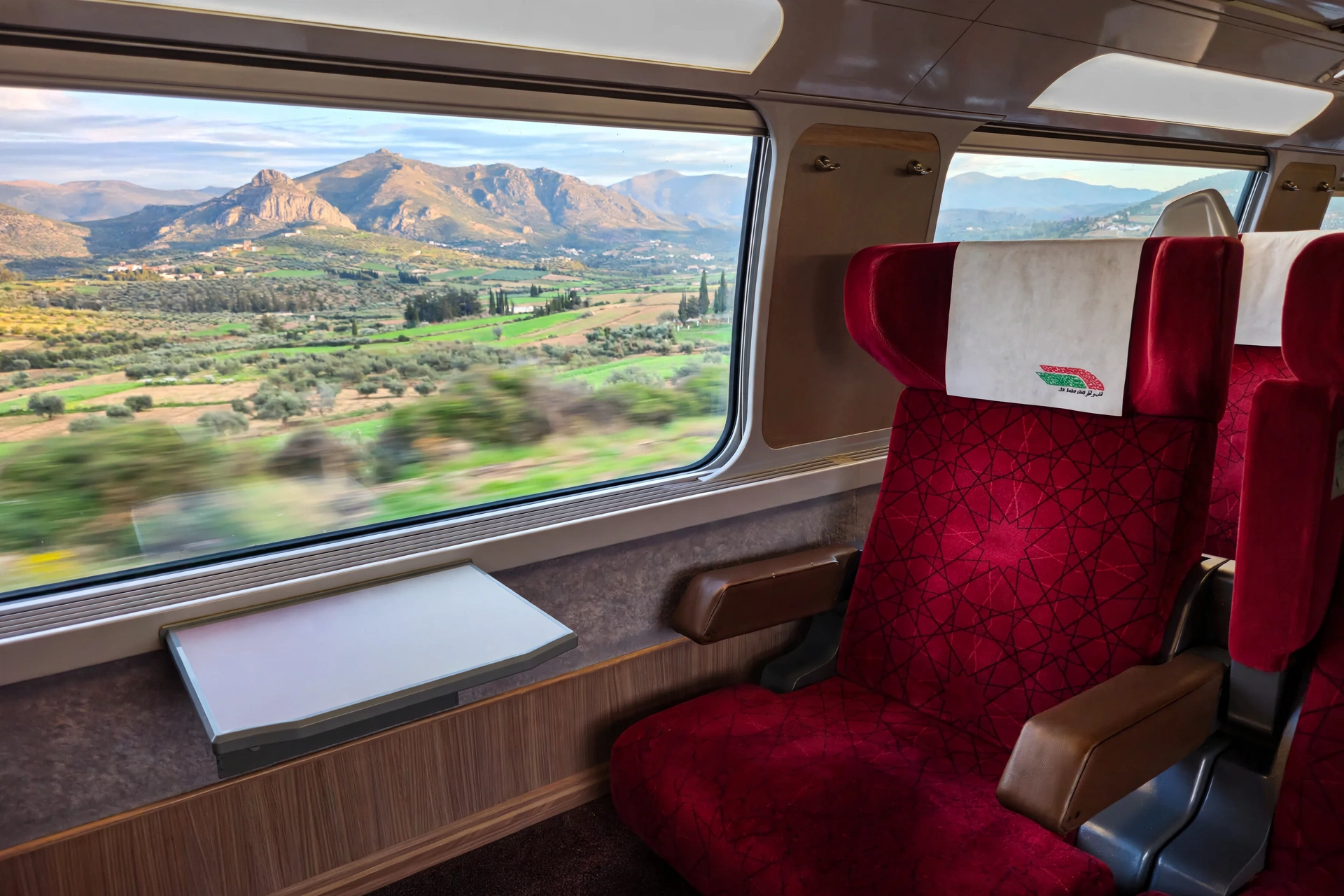
CTM and Supratours: The Buses That Go Everywhere the Train Doesn’t
Where the railway stops, the bus takes over. Two companies dominate long-distance travel:
CTM is Morocco’s premium bus company — modern coaches, air conditioning, assigned seats, luggage stored underneath, and a network covering almost every town worth visiting, including Chefchaouen, Essaouira, Agadir, and Merzouga. Book online at ctm.ma or at CTM stations. Typical fares: Marrakech–Essaouira around 80–110 MAD (~$8–11), Marrakech–Agadir around 120–160 MAD (~$12–16), Fes–Chefchaouen around 70–100 MAD (~$7–10).
Supratours is ONCF’s own bus arm, designed to connect with the trains. Its buses run from Marrakech station to Essaouira, from Fes to the desert towns, and on other routes the railway doesn’t reach. Tickets can be bought combined with a train ticket.
Both are reliable and safe. The drawbacks are the ones you’d expect: journeys are slow on winding mountain roads, departure times slip, and the air conditioning is sometimes enthusiastic to the point of freezing. Bring a layer, bring water, and don’t plan a tight connection after a bus arrival.
Grand Taxis and Petit Taxis: Cheap, Essential — and Where the Scams Live
Taxis are the connective tissue of Moroccan transport: the last mile from the station, the hop between towns with no bus, the ride to the airport at midnight.
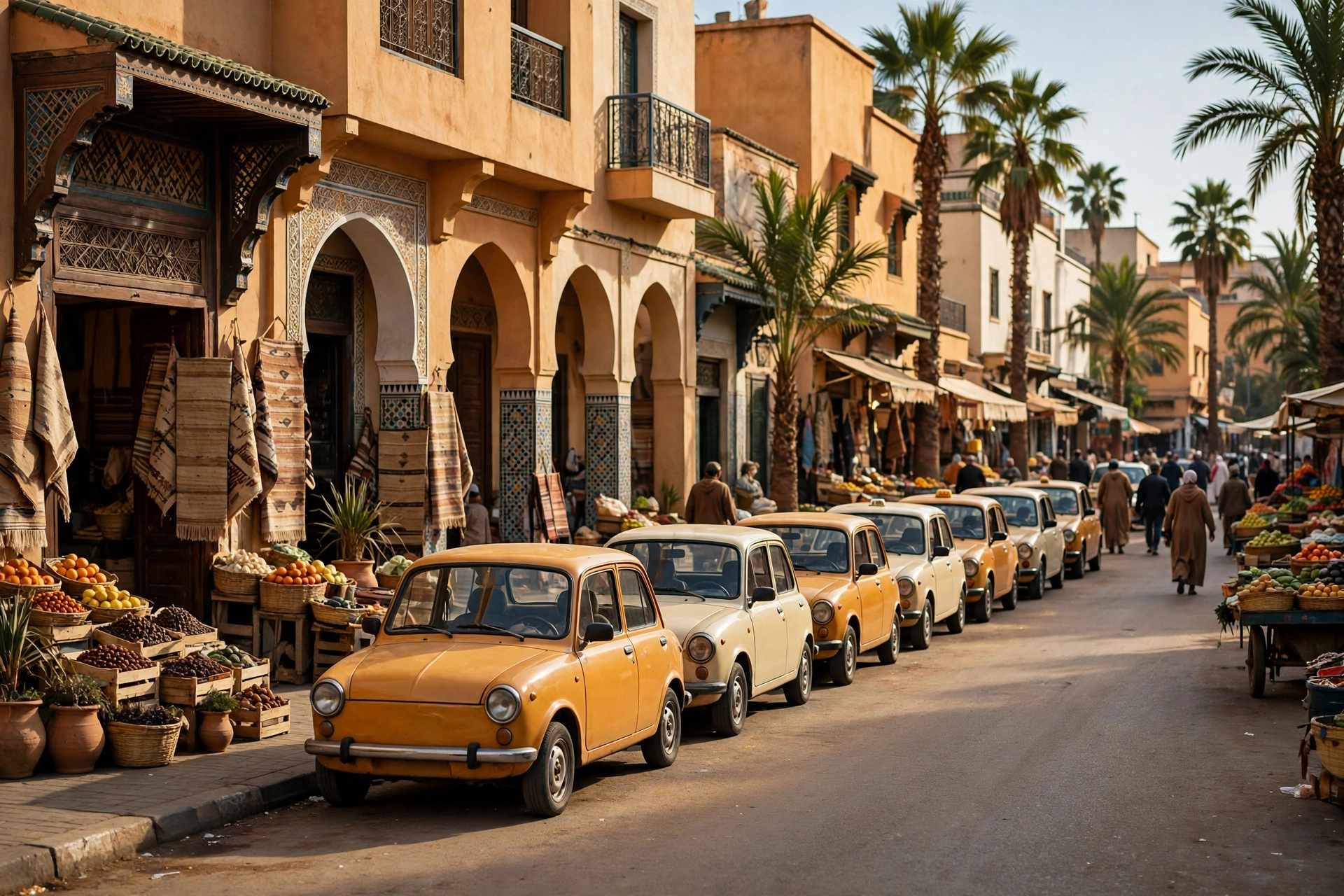
Petit taxis: inside the city
Petit taxis are small city cars (usually a Dacia Logan or similar) that operate within one city only. They are colour-coded by city — red in Casablanca, blue in Rabat, ochre in Marrakech, light blue in Fes — which is a handy way to know you are in the right place.
The rules are simple and widely ignored in tourist areas:
- The meter must run. By law, petit taxis use a meter. In practice, drivers in Marrakech’s medina, around Casablanca’s stations, and at airports will quote a flat price — often two or three times the metered fare.
- Typical metered fares: a short ride across a city centre runs about 7–15 MAD (~$0.70–1.50) by day; a longer cross-town ride 20–35 MAD (~$2–3.50). At night a supplement applies and the meter rate roughly doubles — that is legal, not a scam.
- How to avoid overcharging: walk 50 metres away from the station exit, the airport arrivals door, or the main square, and flag a moving taxi. Insist on the meter — “le compteur, s’il vous plaît” — and if the driver refuses, close the door and take the next one. In Marrakech, the meter is so routinely refused in the medina that many visitors simply agree a price in advance; if you do, agree it before you get in, and expect around 20–30 MAD for a medina-to-Gueliz hop, not 100.
Grand taxis: between towns
Grand taxis are old Mercedes (increasingly newer cars) that run fixed intercity routes from dedicated ranks, usually near the bus station. They leave when full — six passengers, four in the back and two in the front — and they are the fastest way to cover short hops the train doesn’t serve: Tangier to Chefchaouen, Fes to Meknes, Marrakech to Essaouira if you miss the bus.
You pay per seat, and you can buy the whole car if you want to leave immediately. Typical per-seat fares run 30–80 MAD (~$3–8) for a one-to-two-hour hop. Agree the price before you sit down, confirm whether it is per person or for the car, and expect to pay for two seats if you have large luggage — that is normal practice, not a trick.
Ride-hailing and airport transfers
International ride-hailing apps do not operate officially in Morocco. Your hotel or riad can arrange a transfer — usually 150–300 MAD (~$15–30) from the airport depending on the city — worth it on a first night arrival. Agree the price in writing before you land.
Car Rental: When It Makes Sense (and When It Doesn’t)
Renting a car gives you the Morocco the trains and buses can’t: the Atlas valleys, the Atlantic coast road, the desert approach at your own pace. International chains operate at the airports and in the big cities; local agencies are cheaper, but check the car and the insurance carefully.
It makes sense when: you are doing a loop (Marrakech → Atlas → Essaouira → Agadir), you are travelling with family or a group, or you want to stop in villages along the way.
It does not make sense when: your trip is city to city on the train corridor, you are staying in a medina (cars cannot enter, and parking outside is a daily negotiation), or you are heading to the desert — the road to Merzouga is long and remote, and a driver who knows the route is worth more than the rental saving. For the desert, take a tour or a grand taxi and bus combination instead.
If you do rent, budget roughly 300–500 MAD (~$30–50) per day for a small car with basic insurance, plus fuel at around 14–16 MAD per litre. Driving is on the right. Never drive at night on rural roads — unlit carts, animals, and unmarked speed bumps are a real hazard.
Domestic Flights: The Shortcut Nobody Talks About
Royal Air Maroc runs domestic flights that can turn a seven-hour train day into a one-hour hop: Casablanca–Agadir, Casablanca–Marrakech, Casablanca–Fes, Tangier–Casablanca. Fares are often 400–900 MAD (~$40–90) if booked a few weeks ahead.
Use them for Marrakech to Fes (skipping the desert), or reaching Agadir from the north without a nine-hour bus. Don’t use them for Tangier to Casablanca, where the Al Boraq is faster door to door once you count airport time.
Getting Around Morocco: Practical Tips for First-Timers
Plan around the train corridor, not against it. Build your route on the rail spine — Tangier, Rabat, Casablanca, Marrakech, Fes — and use buses and grand taxis for the spokes (Chefchaouen, Essaouira, the desert). This is how Moroccans travel.
Book Al Boraq early. The cheapest fares go first, and Friday afternoon trains sell out.
Carry small cash. Taxis, bus stations, and small-town ticket counters run on cash and small notes. Keep 10, 20 and 50 dirham notes handy; a 200 note at a taxi rank will earn you a sigh.
Keep your ticket. Inspectors check on trains, and some stations check at the exit. A lost ticket can mean a fine.
Friday afternoons and Sunday evenings are the rush. Students and workers travel home; trains and buses fill up. Travel mid-morning on weekdays for the quietest ride.
Mind the luggage. Trains have overhead racks and space at the carriage ends; CTM buses store bags underneath with a numbered tag — keep the tag.
For the full trip budget, see our cost of living guide, the real prices for a trip to Morocco, and the first-time visitor guide. You can also read about LahbabiGuide.
FAQ
Is the Al Boraq worth it compared to a normal train?
Yes, on the Tangier–Casablanca corridor. It cuts the journey from about five hours to just over two, and first-class fares are often only 50–90 MAD more than second.
Can I buy ONCF train tickets online as a foreigner?
Yes. The official site oncf-voyages.ma and the ONCF Voyages app accept foreign cards. Book Al Boraq a few days ahead for the best fares; you can show the e-ticket on your phone. If the site struggles with your card, buy at the station — counters and machines accept cards.
How do I avoid being overcharged by a taxi in Morocco?
Use the meter in petit taxis, and walk away from the station or airport exit to flag a moving cab. Agree the price before getting into a grand taxi, and confirm whether it is per person or for the whole car. Typical city rides are 7–35 MAD on the meter; if someone quotes 100 MAD for a short hop, that is a tourist price.
Is there a train to Merzouga or the Sahara desert?
No. There is no train to Merzouga or anywhere near the Erg Chebbi dunes. The usual route is a bus or tour from Marrakech (about 9–10 hours via the Atlas) or from Fes (about 7–8 hours). The desert trip is a road journey — plan it as one, with an overnight stop in the Atlas or the Draa Valley if you can.
Should I rent a car or take the train in Morocco?
Take the train between the big cities on the rail corridor — it is cheap, comfortable, and you avoid medina parking entirely. Rent a car only for loops through the Atlas, the coast, or the countryside, where the train doesn’t go. For the desert, take a tour or a bus and grand taxi combination.
The Bottom Line
Getting around Morocco rewards travellers who mix transport modes instead of committing to one. Take the Al Boraq where it runs, the Al Atlas trains between the imperial cities, CTM or Supratours buses where the rails end, grand taxis for short hops, and petit taxis — on the meter — inside the cities. Book the fast train early, take first class when the journey is long, carry small cash, and accept that the desert is a road trip.