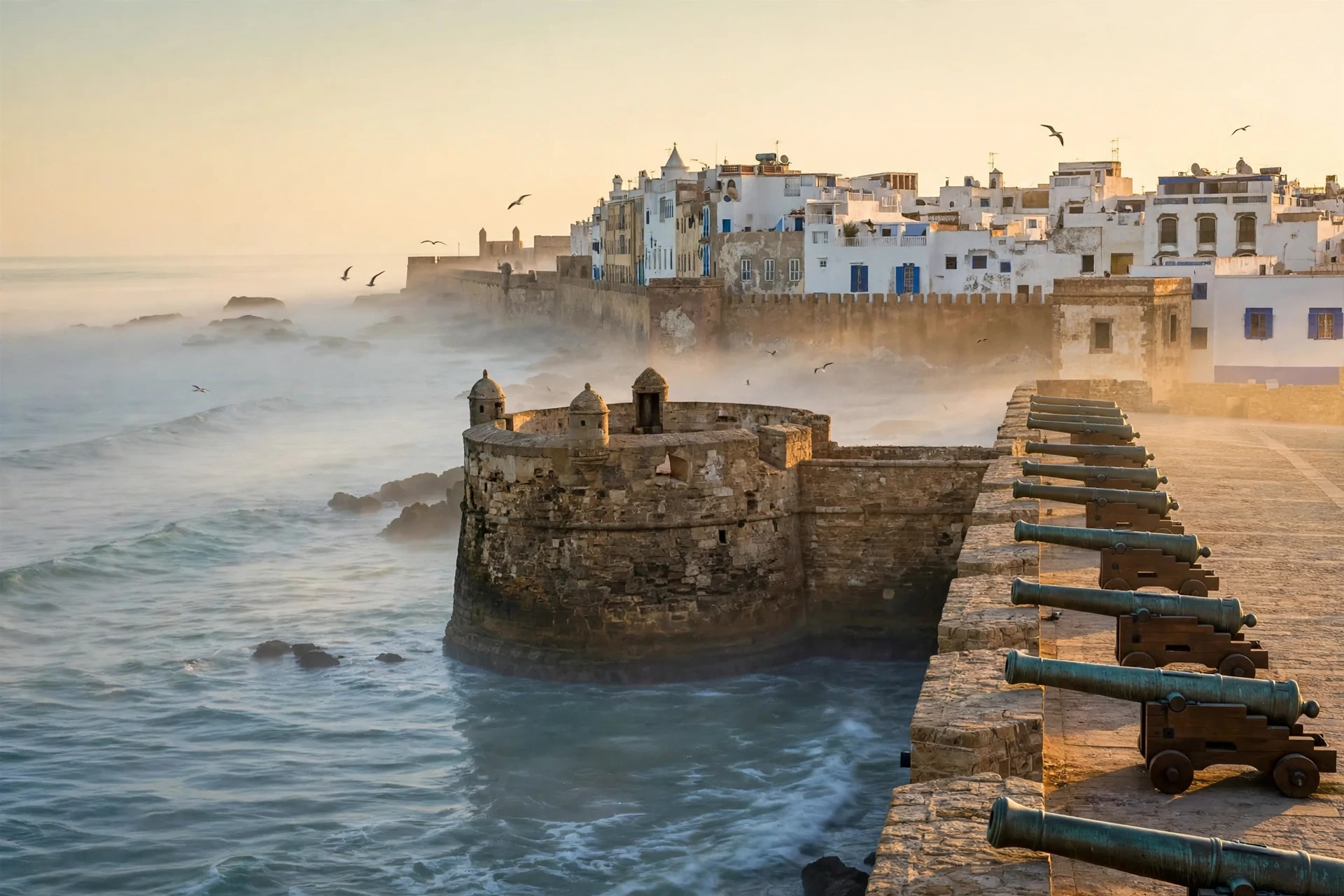
This essaouira travel guide starts with an honest confession: Essaouira is the town I send friends to when they are tired. Tired of being followed through the souks and haggling over every price. Here the air moves, the medina is small enough to learn in a day, and nobody chases you down the street. It is the one medina in Morocco where you can simply walk, look around, and be left alone.
Essaouira is not the most spectacular town in the country, and no essaouira travel guide should pretend otherwise. It has no giant mosque or famous tannery. What it has is rarer: a slow rhythm, a working fishing port, a beach built for wind sports, and a July that stays cool while Marrakech cooks at 45 degrees. Prices below were checked in November 2026, in dirhams (MAD) with dollar equivalents at about 10 MAD to the dollar.
- Why This Essaouira Travel Guide Says: Stay the Night
- The Wind and the Best Time to Visit
- The Medina: A Planned Port City, Not a Painted Village
- The Fishing Port and Grilled Fish
- The Beach, Surfing and Kitesurfing
- Getting to Essaouira
- Where to Stay
- Where to Eat in Essaouira
- What Essaouira Costs
- Honest Drawbacks and What to Skip
- Essaouira FAQ
- Conclusion
Why This Essaouira Travel Guide Says: Stay the Night
The first rule of this essaouira travel guide is simple: sleep here. Most visitors arrive on a day trip from Marrakech, spend three hours in the medina, eat a rushed lunch, and leave before sunset — then tell people Essaouira was “nice but small”. The town they missed appears after five in the evening, when the buses leave and the medina goes back to its residents.
Stay the night and the next morning is yours. Between seven and nine, before the day-trip buses arrive, the medina is quiet enough to hear gulls and the Atlantic beyond the ramparts. The fishermen are at work and the light on the whitewashed walls is soft and golden. New to Morocco? Start with our Morocco travel guide for first-time visitors.
The Wind and the Best Time to Visit
Essaouira is known as the Windy City, and the wind is not a detail — it is the town’s character. The alizé, the north-east trade wind, blows most afternoons, strongest from April to September. In July, when Marrakech sits above 40 degrees, Essaouira is usually around 24 to 27 degrees. If you are escaping a Moroccan summer, this is the escape hatch — and any essaouira travel guide that skips the weather is doing you a disservice.
The same wind is the town’s main drawback, and this essaouira travel guide has to say so plainly. On a strong afternoon the sand stings your legs on the beach and café terraces fill with blowing napkins. The trick is timing: mornings are usually calm, the wind builds after midday, and evenings on the ramparts are dramatic rather than comfortable. Bring a windbreaker even in summer, and plan the beach and the Skala walk for the morning.
The best months are March to June and September to November. Spring and autumn bring mild days, warm seas and thin crowds. The Gnaoua World Music Festival usually takes place in June and fills the town for four days of music; dates vary from year to year, so check them before booking, because prices double and rooms sell out.
The Medina: A Planned Port City, Not a Painted Village
Essaouira’s medina looks nothing like the medieval maze of Fes or the red chaos of Marrakech, and there is a reason: it was designed. In the 1760s, Sultan Sidi Mohammed ben Abdallah rebuilt this small Atlantic town as a royal port, with straight streets inside Vauban-style fortifications laid out by French architect Théodore Cornut. The medina was inscribed on UNESCO’s World Heritage List in 2001 — see the official UNESCO page on the Medina of Essaouira.
Here is the insider correction most visitors get wrong: the blue-and-white look is not a Chefchaouen-style tradition. Essaouira was never painted blue for religious or symbolic reasons; the white walls and blue shutters are the town’s 18th-century planned port-city design, kept up by residents ever since. The famous blue boats are painted that way for the fishing fleet, not for photographs. For the other kind of blue, the one that really is a tradition, read our Chefchaouen blue city guide — this essaouira travel guide is happy to share the credit.
The medina is small and walkable, and that is its charm. Start at the Skala de la Ville, the sea bastion where old brass cannons point over the Atlantic. Entry is about 60 MAD (about $6), checked November 2026, and the walk along the top is the best viewpoint in town — go early, before the wind picks up. The Skala du Port, free to enter, gives the classic view back across the boats. Between the two, wander the spice lanes near the Mellah and the workshops where thuya wood is carved. Shopkeepers here mostly let you browse in peace — the town’s relaxed manner is real.
The Fishing Port and Grilled Fish
The fishing port is the beating heart of Essaouira. Every day, blue wooden boats unload sardines, sea bream and sole onto the quay, where fishmongers clean the catch in front of you and gulls circle overhead.
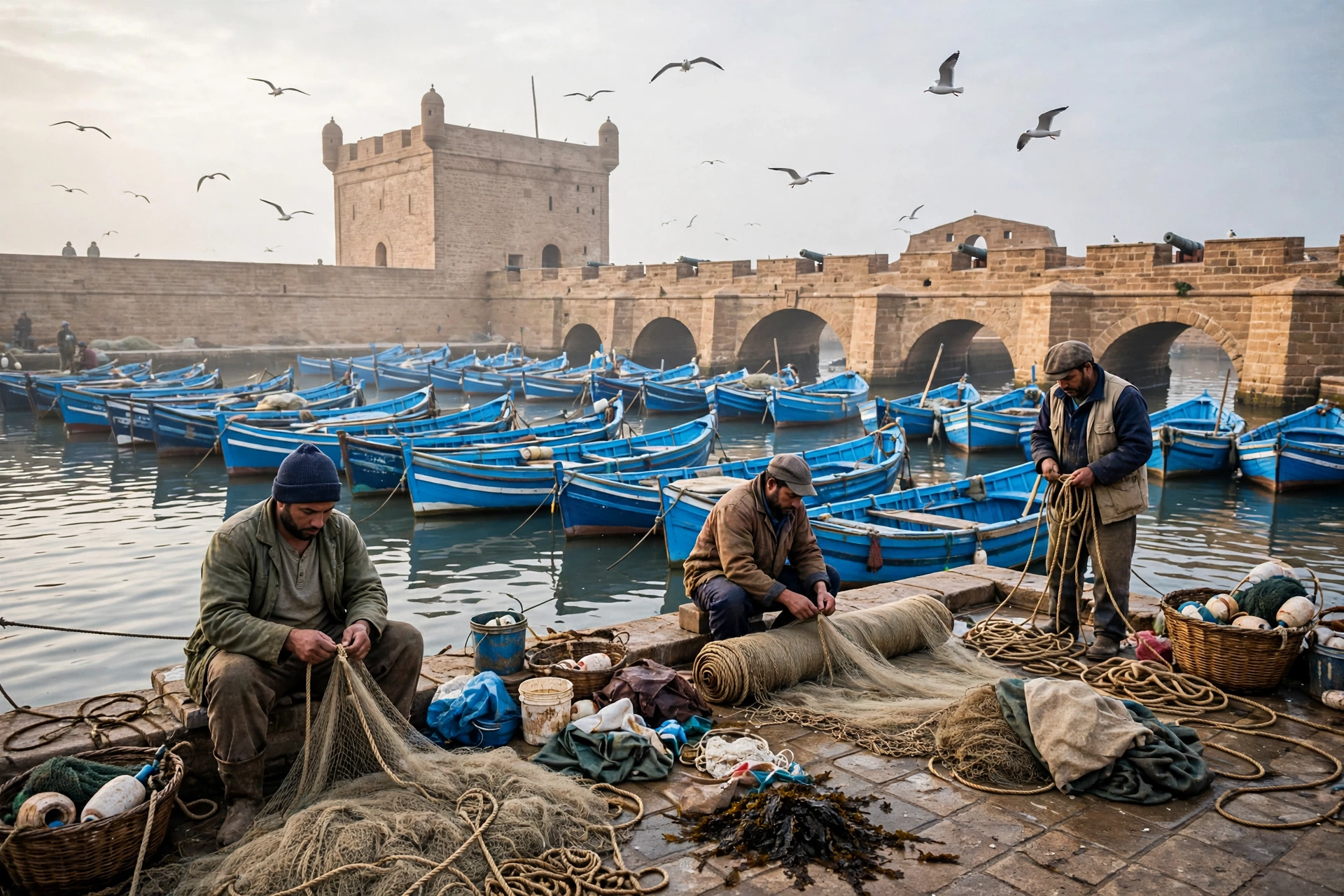
The best meal in Essaouira is also the simplest. At the harbour, small grill stalls cook the morning’s catch over charcoal: grilled sardines cost around 20 to 30 MAD (about $2–$3), and a mixed grilled fish plate runs about 60 to 100 MAD (about $6–$10), with bread and salad included. Pick your fish, point at the grill, and eat at a plastic table with the port in front of you. Port restaurants serve the same fish for 120 to 200 MAD (about $12–$20) a plate, but the harbour stalls are the real experience, and this essaouira travel guide sends you to the stalls first.
The Beach, Surfing and Kitesurfing
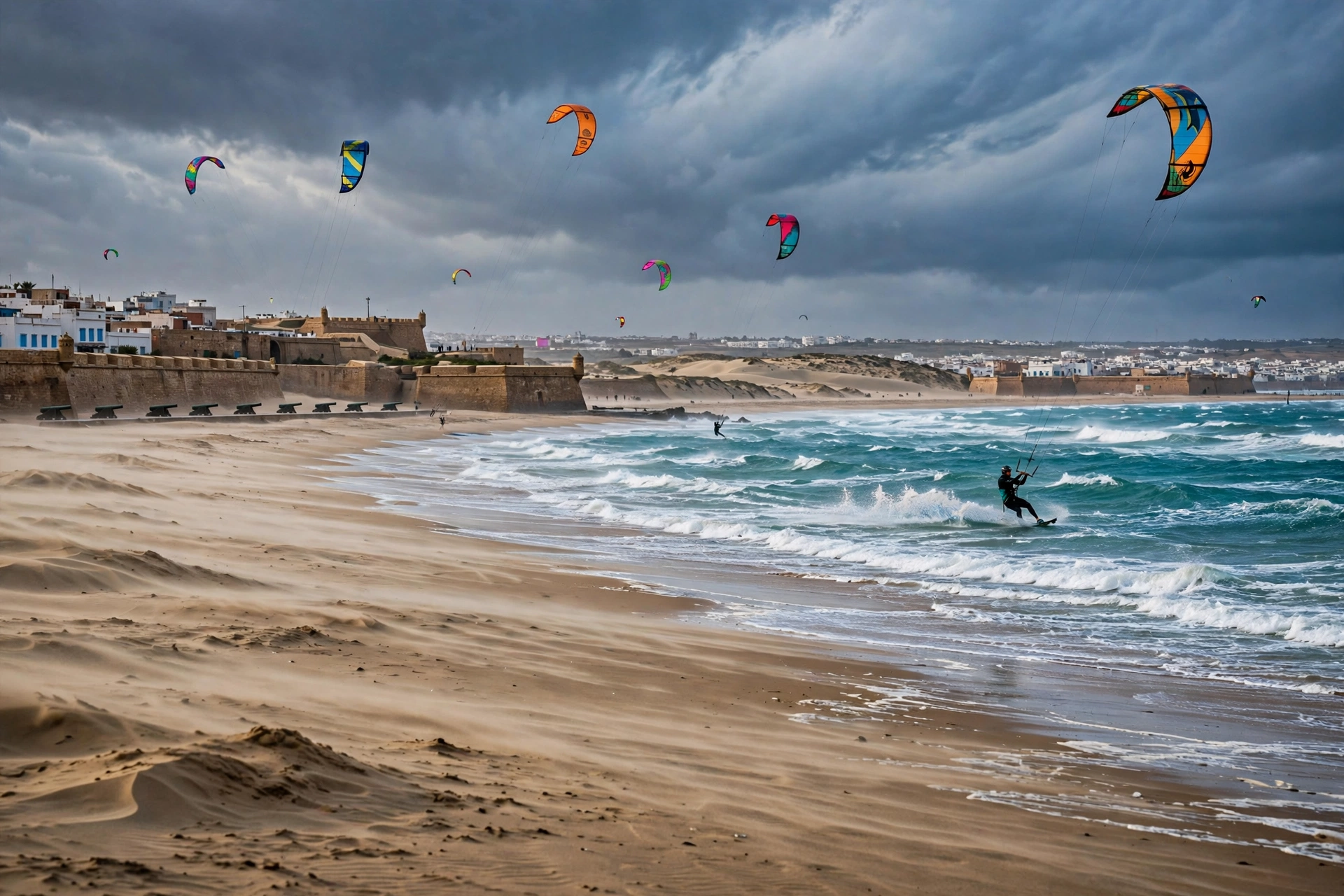
Essaouira’s beach is a long, wide curve of sand running south from the medina, built for wind sports rather than sunbathing. The same alizé that cools the town makes this one of the best windsurfing and kitesurfing spots in Morocco: steady wind, long shallow water, and schools along the beachfront that teach beginners all year. That is why this essaouira travel guide puts the beach second only to the medina.
A group surf lesson costs roughly 300 to 400 MAD (about $30–$40) for two hours including board and wetsuit, and a surfboard rental runs about 150 to 200 MAD (about $15–$20) a day. Kitesurfing costs more: an introductory course of about three days runs roughly 2,500 to 3,500 MAD (about $250–$350) including gear. Book the lesson for the morning if you are a beginner — the wind is gentler and the beach is emptier. Prices rise a little in July and August, so confirm before you book.
Now the honest part, because an essaouira travel guide that tells you to go swimming here is not doing its job. Swimming is often impractical: the Atlantic is cold even in summer, usually 18 to 21 degrees, the wind chops the surface, and the currents along this open beach are strong. Treat the beach as a place to walk, ride horses, watch the kites, and learn to surf — not as a swimming beach.
A horse ride costs around 100 to 150 MAD (about $10–$15) an hour, and a camel ride about the same; agree the price before you mount. The walk south to the dunes at Cap Sim takes about an hour each way and is one of the town’s best free experiences.
Getting to Essaouira
There is no train to Essaouira, and anyone selling you one is selling a bus. The town has no railway station, so every arrival is by road: bus, grand taxi, or private car. The standard route is from Marrakech, about 175 kilometres and roughly three hours by bus. Supratours runs several buses a day from beside the Marrakech train station, at around 100 to 125 MAD (about $10–$12.50), while CTM runs a morning departure at roughly 105 MAD (about $10.50). Check live times on the ONCF website before you travel.
A shared grand taxi from Marrakech costs about 100 to 150 MAD (about $10–$15) per seat and is faster, around two and a half hours, but it only leaves when all six seats are full. From Agadir, buses run north along the coast in about three hours for roughly 90 to 120 MAD (about $9–$12). Drivers should note cars cannot enter the old town; your riad will direct you to the nearest car park.
The day-trip warning matters here more than anywhere else, and this essaouira travel guide repeats it deliberately. A day trip from Marrakech gives you the crowded middle of the day and a tired three-hour ride back; it is the worst way to see the town. Stay a night — the bus fare is the same either way, and the morning you gain is the whole point of coming. Our Marrakech travel guide covers the city you will probably arrive from.
Where to Stay
Stay inside the medina if you can. A riad room inside the old town typically costs 400 to 900 MAD (about $40–$90) a night, often including breakfast on a rooftop terrace, and it puts you in the middle of the quiet morning the town is famous for. The trade-off: stairs, narrow lanes, and luggage carried on foot from the nearest gate, because cars cannot enter.
Hotels in the new town, along Avenue Mohammed V and towards the beach, run about 250 to 600 MAD (about $25–$60) a night for a simple, clean room, often bigger than a riad room and with easier parking. For a longer stay on a tight budget, the new town is perfectly good; for one or two nights, the medina is worth the premium. Hostel dorm beds run from about 100 to 150 MAD (about $10–$15) a night. Book ahead in June, during the Gnaoua festival, and in July and August — as this essaouira travel guide has learned, summer Fridays in the medina sell out.
Where to Eat in Essaouira
Beyond the harbour grills, Essaouira eats well and cheaply. A chicken or vegetable tagine in a medina restaurant costs roughly 60 to 90 MAD (about $6–$9); a bowl of harira with bread is 15 to 25 MAD (about $1.50–$2.50); mint tea is 10 to 15 MAD (about $1–$1.50). Rooftop terraces with sea views serve a three-course dinner for 150 to 250 MAD (about $15–$25) per person.
One honest note about argan oil, because every essaouira travel guide mentions it and few are straight about it. The road from Marrakech is lined with argan oil cooperatives, and many of them are tourist shops in cooperative clothing: the oil is real, but the prices are inflated and the “women’s cooperative” story is often a sales pitch. The town’s real specialities are the fish, the thuya wood carvings and the woven blankets in the souk lanes.
What Essaouira Costs
Essaouira is one of the cheaper coastal towns in Morocco: cheaper than Marrakech for food and rooms, and the main sights are free or nearly so. The table below uses prices checked in November 2026, at about 10 MAD to the dollar, and this essaouira travel guide stands behind every figure in it. See also our cost of living in Morocco guide.
| Item | Price in MAD | Approx. USD |
|---|---|---|
| Supratours bus, Marrakech–Essaouira | 100–125 | $10–$12.50 |
| CTM bus, Marrakech–Essaouira | 105 | $10.50 |
| Grand taxi seat, Marrakech–Essaouira | 100–150 | $10–$15 |
| Riad room in the medina (1 night) | 400–900 | $40–$90 |
| Hotel in the new town (1 night) | 250–600 | $25–$60 |
| Skala de la Ville entry | 60 | $6 |
| Grilled sardines at the harbour | 20–30 | $2–$3 |
| Mixed grilled fish plate | 60–100 | $6–$10 |
| Group surf lesson (2 hours) | 300–400 | $30–$40 |
| Kitesurfing intro course (3 days) | 2,500–3,500 | $250–$350 |
| Tagine in a medina restaurant | 60–90 | $6–$9 |
| Mint tea | 10–15 | $1–$1.50 |
Excluding transport to town, a comfortable daily budget is about 500 to 800 MAD (about $50–$80) per person for a medina riad, meals, tea and a surf lesson or the Skala. A careful traveller staying in the new town and eating at the harbour grills can manage on 300 to 450 MAD (about $30–$45) a day. Those are the numbers this essaouira travel guide stands behind.
Honest Drawbacks and What to Skip
An honest essaouira travel guide has to name the drawbacks, because the town is not for everyone. The wind is the first: on a strong afternoon it is genuinely tiring, sand gets into everything, and the beach is no place for a relaxed sunbathe. If you hate wind, come in October or November, when it eases, and sightsee in the mornings. The second drawback is the sea temperature — the Atlantic here is cold all year, and anyone expecting warm-water swimming will be disappointed.
What to skip: the overpriced “Berber pharmacy” shops selling miracle argan and saffron at tourist prices; the midday camel rides on the crowded part of the beach; any tour promising a Game of Thrones pilgrimage as its main event — the Skala is worth seeing for itself, not for a television show; and the day trip from Marrakech, which we have already warned you about twice. Skip trying to see Essaouira in an afternoon. The town rewards slowness and punishes rushing.
Essaouira FAQ
When is the best time to visit Essaouira?
The best months are March to June and September to November, when the days are mild, the wind is manageable, and the town is relaxed. Winter is quiet and cool, good for walking and bad for the beach. As this essaouira travel guide notes above, check the Gnaoua festival dates before booking in June, because rooms sell out and prices rise sharply.
Can you swim in the sea at Essaouira?
Usually not comfortably. The Atlantic here is cold, around 18 to 21 degrees even in summer, and the wind and currents make swimming impractical on most days. The beach is best for walking, surfing, kitesurfing, horse riding and watching the kites.
How many days do you need in Essaouira?
Two nights is the sweet spot: one full day for the medina, the port and the ramparts, and a second day for the beach, a surf lesson, or a slow morning that starts at seven in the empty streets. A day trip from Marrakech shows you the crowded middle of the day only, and this essaouira travel guide does not recommend it.
How do I get from Marrakech to Essaouira?
Take the Supratours or CTM bus, about three hours for 100 to 125 MAD (about $10–$12.50), or a shared grand taxi for 100 to 150 MAD (about $10–$15) per seat. There is no train to Essaouira.
Is Essaouira safe for tourists?
Essaouira is one of the safest and most relaxed towns in Morocco for visitors. The medina is small, well lit, and famously free of the hassle and aggressive touting found in bigger cities — it is the one medina where nobody chases you.
Is Essaouira good for families with children?
Yes, with the right expectations. Children love the port, the boats, the camels on the beach and the ramparts, and the medina’s calm streets are far easier with a pushchair than Fes or Marrakech. The beach is better for playing in the sand and watching kites than for swimming.
Conclusion: Slow Down in Essaouira
Essaouira does not shout. It does not have the drama of the desert or the grandeur of the imperial cities, and it does not need them. What it offers is rarer in Morocco: a town that lets you breathe. The wind, the quiet medina, the fishermen unloading the morning’s catch, the kites over a long empty beach — small pleasures that add up to the most restful two days you will spend in the country. So take this essaouira travel guide’s advice and stay the night, get up early, eat the grilled sardines at the harbour, and let the town set the pace. It will simply, quietly, make you want to come back.