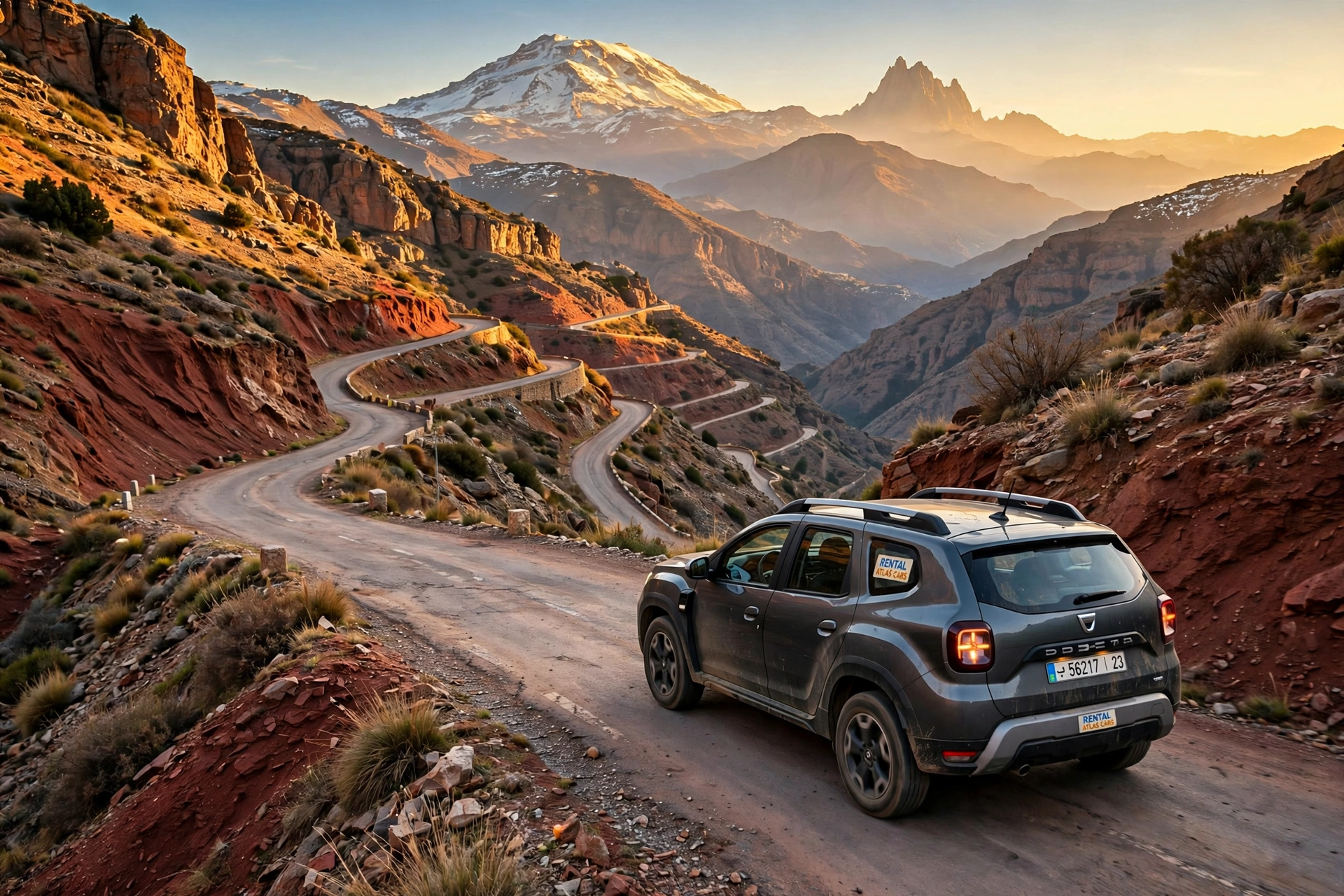
Morocco rewards drivers. Trains are good between the big cities, but the country you actually came to see — the Atlas passes, the Atlantic coast road, the desert gateways — only opens up behind a steering wheel. This driving in morocco rental car guide covers licences, real rental prices, insurance small print, toll motorways, speed limits and fines, and the routes worth the effort. Prices are in dirhams (MAD) with dollar equivalents, checked November 2026.
Driving here is not difficult, but it is different. City traffic is assertive, rural roads can be narrow and unlit, and mountain passes demand patience. With a decent car and the rules in this driving in morocco rental car guide, self-driving is one of the best ways to see the country.
- Driving in Morocco Rental Car Guide: Is It Worth Renting a Car?
- Licence, IDP and Age Rules for Renting a Car in Morocco
- How to Rent a Car in Morocco: Airports, Agencies and Booking Tips
- Rental Costs in Morocco: What You Will Actually Pay
- Insurance, Deposits and the Credit-Card Hold
- Fuel, Toll Motorways and Paying on the Road
- Driving in Morocco Rental Car Guide: Road Rules, Speed Limits and Fines
- Police Checkpoints, Mountain Passes and Night Driving
- Desert Driving: Merzouga, Zagora and the Road to the Dunes
- Three Scenic Routes Worth the Wheel
- Frequently Asked Questions
Driving in Morocco Rental Car Guide: Is It Worth Renting a Car?
It depends on your itinerary: three days in Marrakech with one day in Essaouira needs no car. Trains and buses cover the Marrakech–Casablanca–Rabat–Fes corridor, and medinas are no-car zones — see our getting around Morocco guide. But the moment your plan includes the Atlas Mountains, the gorges, the desert, or the coast south of Agadir, a car changes everything.
A car buys you the stops no bus makes: argan cooperatives near Essaouira, the viewpoint above Ait Ben Haddou, mint-tea stalls on the Tizi n’Tichka pass. A private transfer from Marrakech to Merzouga costs roughly 1,200–1,800 MAD ($120–$180) one way; a rental car for the same loop often costs less.
The trade-off is responsibility: improvised-feeling roundabouts, narrow mountain roads, parking near crowded medinas. This driving in morocco rental car guide assumes you are driving yourself.
Licence, IDP and Age Rules for Renting a Car in Morocco
Most visitors can drive on their home licence. Morocco recognises foreign licences for tourists for up to one year, provided the licence is valid and written in Latin script. If yours uses another alphabet — Arabic script included, unless it also carries a Latin transliteration — you need an International Driving Permit (IDP).
Even when an IDP is not required, carry one anyway. It costs little, removes all doubt at checkpoints, and some rental desks ask for it regardless of nationality. Bring your passport too: agencies photograph it, and police may ask to see it with your licence.
Age rules are stricter than in many countries. Most agencies require drivers to be at least 21; many set the minimum at 23 or 25 for larger cars. Drivers under 25 usually pay a young-driver surcharge of 50–100 MAD ($5–$10) a day, and you need at least one year of experience. Book in the name of the oldest, most experienced driver.
How to Rent a Car in Morocco: Airports, Agencies and Booking Tips
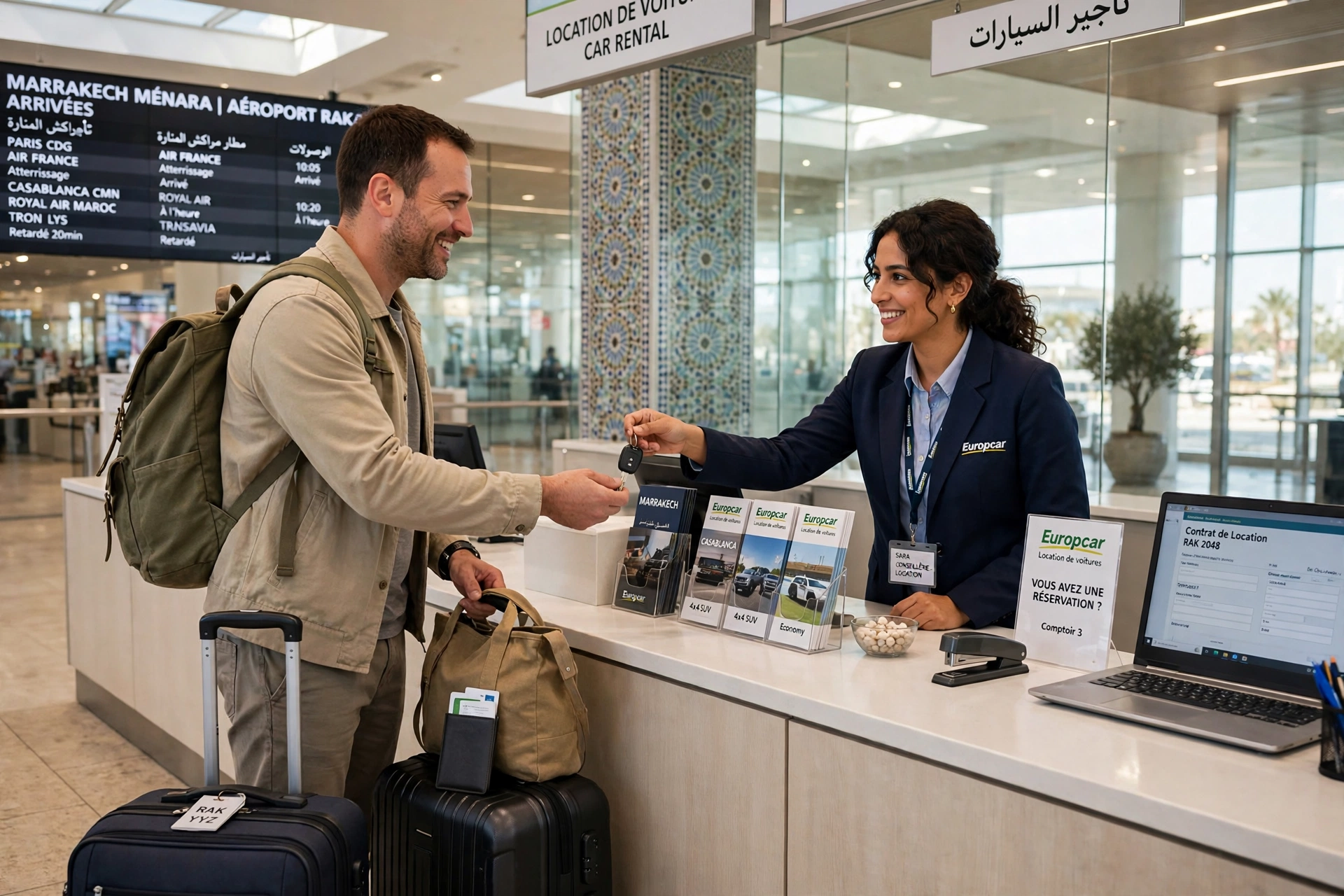
The easiest pickup points in this driving in morocco rental car guide are the airports: Marrakech Menara, Casablanca Mohammed V, Fes-Saiss, Agadir Al Massira and Tangier Ibn Battouta all have desks in arrivals. Airport pickup adds a 50–150 MAD ($5–$15) surcharge. A one-way rental, say Marrakech to Fes, usually adds 300–600 MAD ($30–$60).
International brands (Hertz, Avis, Europcar, Sixt) operate alongside strong local agencies, often 20–30% cheaper for the same class of car. Book online before you travel: walk-up prices are higher, and automatics and SUVs sell out in spring and autumn. Automatics are rare and cost 30–50% more than manuals.
At pickup, inspect the car slowly and photograph everything: every scratch and dent, the windscreen, the tyres, the fuel gauge and the mileage. Make sure the agent notes damage on the agreement before you sign. Check the spare tyre, jack and warning triangle are present — they are legally required. This five-minute inspection is the best money-saving habit in this driving in morocco rental car guide: undocumented damage is the most common source of deposit disputes.
Rental Costs in Morocco: What You Will Actually Pay
Prices are reasonable by European standards but swing with the season. An economy car costing 250 MAD ($25) a day in January can cost 450 MAD ($45) in April or October. Weekly rentals usually cut the daily rate by 15–25%. The table below shows typical ranges for a multi-day rental booked in advance, checked November 2026, including basic insurance but before extras — the baseline this driving in morocco rental car guide uses for budgeting.
| Car class | Example models | Low season (per day) | High season (per day) | Best for |
|---|---|---|---|---|
| Economy | Dacia Logan, Fiat Panda | 200–300 MAD ($20–$30) | 350–500 MAD ($35–$50) | City pairs, coastal roads |
| Compact | Renault Clio, Peugeot 208 | 280–400 MAD ($28–$40) | 450–650 MAD ($45–$65) | First-time Morocco drivers |
| Family sedan | Dacia Duster, Toyota Corolla | 400–550 MAD ($40–$55) | 600–850 MAD ($60–$85) | Atlas passes, long distances |
| SUV / 4×4 | Toyota Land Cruiser, Nissan Patrol | 700–1,000 MAD ($70–$100) | 1,100–1,600 MAD ($110–$160) | Desert tracks, rough roads |
| Minivan (7 seats) | Mercedes Vito, Renault Trafic | 800–1,100 MAD ($80–$110) | 1,200–1,700 MAD ($120–$170) | Families and groups |
Watch the extras, the quiet budget-killer in this driving in morocco rental car guide. GPS costs 40–70 MAD ($4–$7) a day, but your phone with offline maps does the same job free — download Morocco in Google Maps or Maps.me on airport Wi-Fi. Some budget deals cap mileage at 200–250 km a day, charging 1–2 MAD ($0.10–$0.20) per extra kilometre — ruinous on a Marrakech–Merzouga loop, so confirm mileage terms in writing.
Fuel is the other big running cost. Petrol runs about 14–15 MAD ($1.40–$1.50) per litre and diesel about 13–14 MAD ($1.30–$1.40) as of November 2026. A diesel Dacia Duster on the roughly 1,000 km Marrakech–Merzouga round trip uses about 60 litres, so budget around 800 MAD ($80) for fuel.
Insurance, Deposits and the Credit-Card Hold
Every Moroccan rental includes basic third-party liability insurance. What varies is the collision damage waiver (CDW) and the excess — what you pay if the car is damaged. Standard CDW leaves an excess of 5,000–10,000 MAD ($500–$1,000). Full cover, or “super CDW”, cuts that excess to zero or near zero for roughly 100–200 MAD ($10–$20) a day. If there is one upgrade this driving in morocco rental car guide recommends without hesitation, it is full cover for mountain and desert legs.
Read the exclusions before you pay. Most policies exclude damage to tyres, windscreens, the underbody and the roof — the parts most at risk on rough roads. Some exclude unpaved roads entirely, which matters for desert camps. If your route includes pistes, say so at the desk and get coverage confirmed in writing.
Then there is the deposit. Agencies block a hold of 3,000–10,000 MAD ($300–$1,000) on your credit card for the rental period. It is a hold, not a charge, but it reduces your available credit — do not arrive with a nearly maxed-out card. Debit cards are often refused for the deposit. Use a credit card in the main driver’s name, keep headroom for the hold plus trip spending, and check after return that the hold is released — it can take 5–15 working days. Holds surprise first-time renters, so this driving in morocco rental car guide flags the deposit before you travel, not after.
Fuel, Toll Motorways and Paying on the Road
Morocco’s toll motorways, the autoroutes, are excellent: smooth, well-signed, mostly empty outside holiday weekends, and the fastest way between the big cities. The network links Tangier, Rabat, Casablanca, Marrakech, Fes and Agadir. Take a ticket at entry and pay at the exit, in cash or by card.
Tolls, checked November 2026: Casablanca to Marrakech about 100–120 MAD ($10–$12), Rabat to Fes about 90–110 MAD ($9–$11), and Casablanca to Tangier about 130–160 MAD ($13–$16). The free national roads parallel most motorways and are slower but far more scenic — for a holiday, often the better choice, and the one this driving in morocco rental car guide leans toward whenever time allows.
Fuel stations are frequent on main roads and motorways, with attendants who fill the tank — tipping 5–10 MAD ($0.50–$1) is customary. On motorways, stations appear every 40–60 km. On desert and mountain roads, fill up whenever you see a station and your tank drops below half: the stretch from Tinghir to Merzouga has long gaps between pumps.
Driving in Morocco Rental Car Guide: Road Rules, Speed Limits and Fines
If you have driven in Europe, the rules feel familiar: drive on the right, overtake on the left, give way to traffic already on a roundabout, seatbelts front and rear. Expect scooters filtering past on both sides, taxis stopping without warning, and pedestrians crossing in rural areas. Defensive driving is the whole method here, and the thread running through this driving in morocco rental car guide: assume the car ahead will brake suddenly, and leave twice the gap you normally would.
Speed limits are 60 km/h in built-up areas, 100 km/h on national roads, and 120 km/h on motorways, dropping to 40 km/h near schools. Fixed speed cameras are common on motorways and city approaches, and mobile radar traps are frequent on national roads. Speeding fines typically cost 300–700 MAD ($30–$70); serious offences can reach 1,000 MAD ($100) or more.
Two rules catch visitors out. First, the drink-driving limit is effectively zero, so do not drink at all before driving. Second, using a mobile phone while driving carries a fine of around 300 MAD ($30). If you are in an accident, do not move the vehicles, call the police on 19 and your rental agency immediately. Your insurance depends on the official police report, the constat — never settle a bump privately at the roadside. That is the firmest rule in this driving in morocco rental car guide.
Police Checkpoints, Mountain Passes and Night Driving
Police and gendarmerie checkpoints are routine, and this is where first-time drivers get nervous for no reason. Slow down well before the checkpoint, stop fully at the line, and hand over your licence and passport when asked. Keep documents in the door pocket, not in a bag in the boot. Never argue about a fine at the roadside — pay it, take the receipt, and move on.
The mountain passes are the other defining experience of a Moroccan road trip. The Tizi n’Tichka pass between Marrakech and Ouarzazate climbs to 2,260 metres on endless switchbacks: take it slowly, use engine braking, and pull over for faster local traffic. The unwritten rule is that the bigger vehicle owns the pass — a truck or bus coming uphill has right of way in practice. Give way early and generously — the mountain rule this driving in morocco rental car guide repeats for a reason.
Night driving is the one thing this driving in morocco rental car guide actively discourages outside cities and motorways. Rural roads are often unlit, shared with unlit carts, wandering livestock, pedestrians in dark clothing, and the occasional unmarked speed bump. Plan your driving day to end by sunset — leave by 8 a.m. for any leg over three hours — and book accommodation you can reach in daylight.
Desert Driving: Merzouga, Zagora and the Road to the Dunes
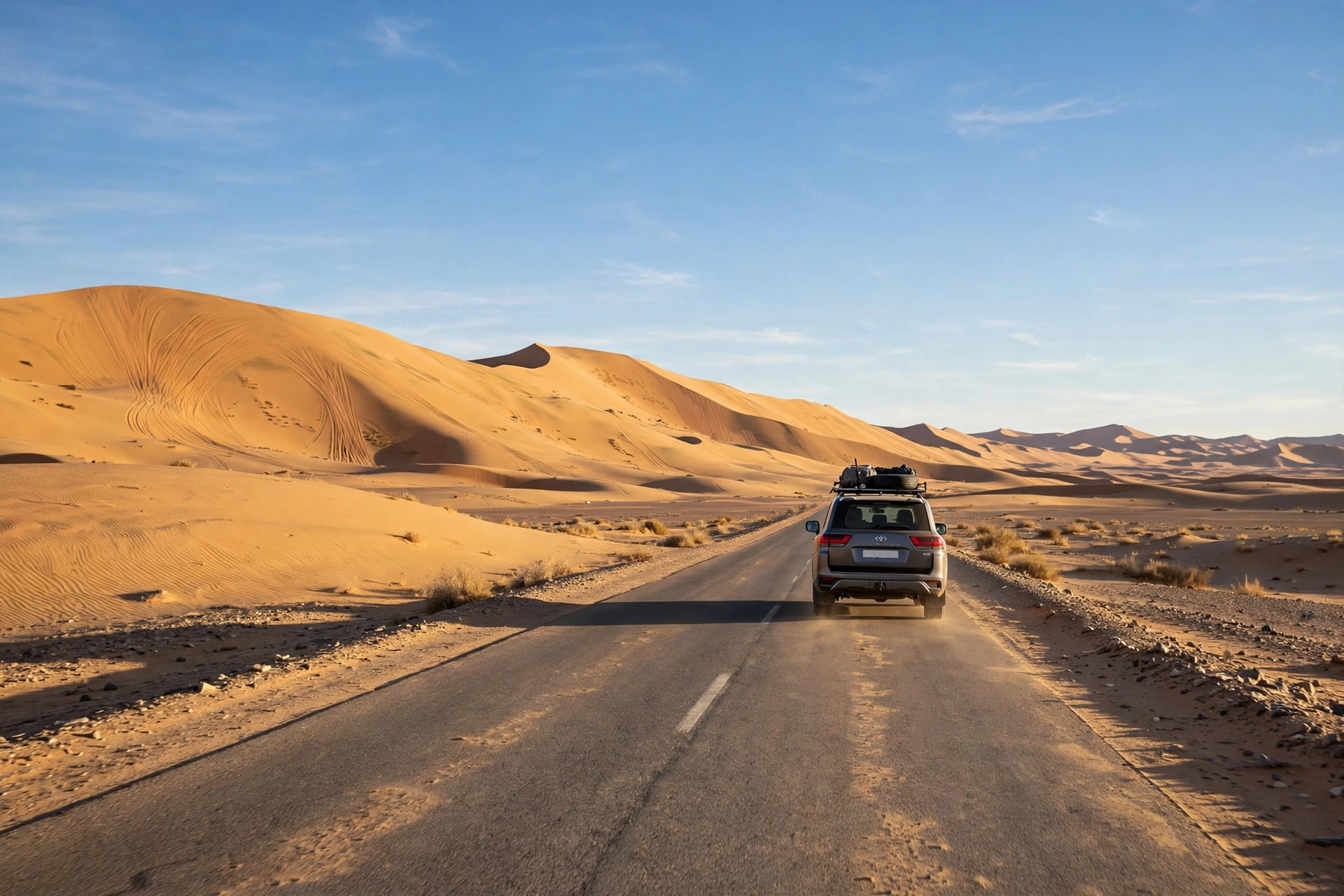
The road to Merzouga is one of the great drives in North Africa, and it is entirely doable in an ordinary car. From Marrakech the route runs over the Tizi n’Tichka to Ouarzazate, then through the Dades Valley and Tinghir to the dunes of Erg Chebbi — about 560 km, nine to ten hours with stops. Our full comparison of the two desert gateways is in our guide to the Sahara desert in Morocco, Merzouga versus Zagora.
The paved road reaches Merzouga village, where hotels and camps have parking. The dunes are another matter: driving onto sand is for 4x4s with deflated tyres and a driver who knows the terrain. Your rental agreement almost certainly forbids it, and a stuck car can cost thousands of dirhams to recover. Park in the village and let your camp arrange the transfer.
Desert practicalities matter more than desert romance. Carry two litres of water per person, keep your phone charged, and download offline maps — signal fades between towns. Fill the tank in Tinghir or Erfoud before the last leg. Continuing to Zagora and the Draa Valley? The road south from Ouarzazate is quiet, beautiful and long, with fuel stops that close early; drive it in daylight with a full tank. For the wider itinerary, see our Morocco travel guide.
Three Scenic Routes Worth the Wheel
1. Marrakech to Fes over the Middle Atlas (about 500 km, two days). Take the road through Beni Mellal, the Cascades d’Ouzoud and Ifrane — Morocco’s “Little Switzerland” — not the motorway. Stay a night in Ifrane, then drop into Fes, where our Fes travel guide picks up the story.
2. The Atlantic coast road, Tangier to Essaouira (about 600 km, three days). The relaxed drive: Larache, Rabat, Casablanca, El Jadida and Oualidia, with the ocean on your right. Stop for grilled sardines in El Jadida, sleep in Oualidia’s lagoon, and finish in Essaouira. Flat, well-signed and forgiving — the gentlest route in this driving in morocco rental car guide.
3. The southern loop: Marrakech – Ait Ben Haddou – Dades – Todra – Merzouga (about 900 km, four to five days). The big one, and the reason most people rent a car: the ksar of Ait Ben Haddou, the hairpins of the Dades Gorge, the cliffs of Todra and the dunes of Erg Chebbi in a single loop. Build in rest days and drive the mountain sections in morning light. For the blue-city detour north, our Chefchaouen blue city guide explains how to fit it in, and our Marrakech travel guide is the natural starting point for the loop this driving in morocco rental car guide calls the country’s best drive.
Frequently Asked Questions
Do I need an International Driving Permit to drive in Morocco?
Not always. Morocco accepts foreign licences in Latin script for tourists for up to one year, so most European and North American visitors can drive on their home licence alone. But an IDP is cheap and removes all doubt at checkpoints.
Is it safe to drive in Morocco as a tourist?
Yes, with the right habits. Motorways are excellent and national roads are in good condition. The risks are behavioural: assertive city traffic, unlit rural roads at night, livestock on mountain roads. Drive defensively, avoid night driving outside cities — the core advice in this driving in morocco rental car guide.
How old do you have to be to rent a car in Morocco?
Most agencies require drivers to be at least 21, many set the minimum at 23 or 25 for larger cars. Drivers under 25 usually pay a young-driver surcharge of 50–100 MAD ($5–$10) a day.
How much does it cost to rent a car in Morocco?
Expect 200–300 MAD ($20–$30) a day for an economy car in low season, rising to 350–500 MAD ($35–$50) in high season. A family SUV runs 700–1,000 MAD ($70–$100) a day. Add fuel at roughly 13–15 MAD ($1.30–$1.50) per litre, tolls of about 100–160 MAD ($10–$16) per long leg, and full insurance at 100–200 MAD ($10–$20) a day.
Can I drive a rental car to the Sahara desert?
Yes — the paved road reaches Merzouga village, and an ordinary car handles it comfortably. What you cannot do is drive onto the dunes: rental agreements forbid off-road driving, and sand driving needs a 4×4. Park in the village and let your camp arrange the transfer.
What should I do if I am stopped at a police checkpoint?
Slow down, stop fully, and hand over your licence and passport. Checkpoints are routine and usually over in under a minute. Keep documents within easy reach, never argue about a fine at the roadside, and always ask for an official receipt — the same advice this driving in morocco rental car guide gives for any fine.
Conclusion
Morocco is a country that opens up at 80 kilometres an hour, beyond the reach of trains. Rent the right car for your route, get the insurance in writing, respect the checkpoints and passes, and never drive rural roads after dark. Do that, and this driving in morocco rental car guide will have done its job: you will remember the drives — the Tizi n’Tichka at sunrise, the coast road at golden hour, the Erg Chebbi dunes — as the best part of the trip. For the wider picture, start with our Morocco travel guide, and see the Visit Morocco portal and Transport in Morocco on Wikipedia.