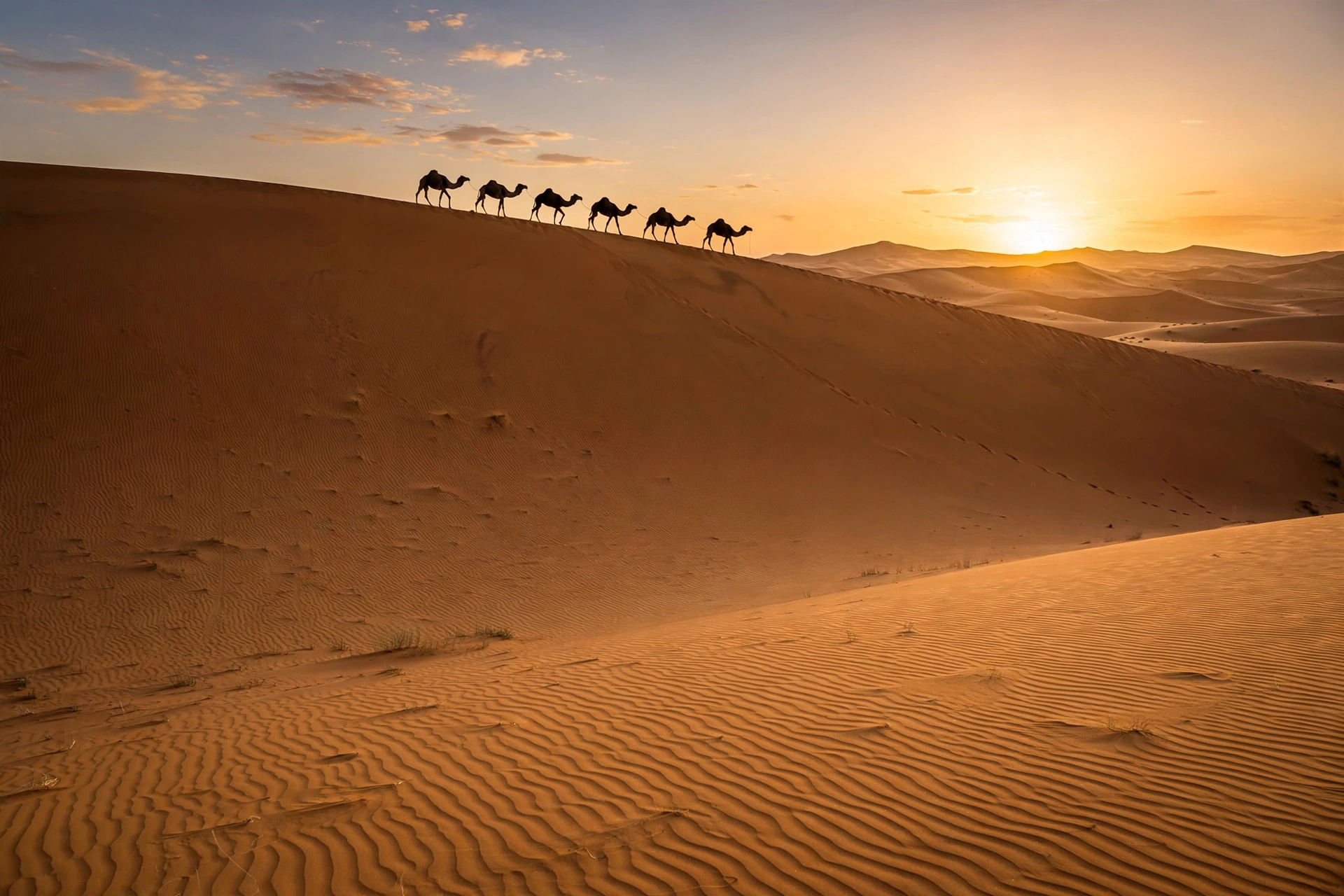
A morocco sahara desert tour is the most photographed experience in the country — and the most misunderstood. The image in your head is real: orange dunes taller than a ten-storey building, a camel line walking into the sunset, dinner under a sky full of stars. That place exists: Erg Chebbi, near Merzouga in the far south-east. But getting there takes a full day of driving from Marrakech, and not every trip sold under the word "Sahara" goes there at all.
I am Moroccan, and I have watched too many visitors come home disappointed because nobody told them the honest version before they paid. This guide is that version: the three places sold as "the Sahara", what the camps are really like, real prices in dirhams, and the drawbacks nobody puts in the brochure. If you read one page before booking a morocco sahara desert tour, make it this one.
New to the country? Start with our Morocco travel guide for first-time visitors for visas, money and safety basics. Fitting the desert into a wider trip? Our 7-day Morocco itinerary shows the Merzouga route without backtracking.
The Three "Saharas": Merzouga vs Zagora vs Agafay
Here is the insider correction that matters most: Morocco has two real sand seas — ergs — plus one rocky desert near Marrakech that sellers routinely call "the Sahara." They are not interchangeable.
Erg Chebbi, by Merzouga, is the postcard. Its dunes rise to about 150 metres, the sand is fine and orange-gold, and the dunes sit close enough to the village that you ride a camel in at sunset and sleep among them. Erg Chigaga, reached from Zagora or M’hamid, is wilder and far bigger — a sea of dunes some 40 kilometres long — but reaching it takes a 4×4 and a full day of rough track, and there is no village at its edge. Agafay, about 40 minutes from Marrakech, is a stone desert: pale, rocky and beautiful at sunset, but with no sand dunes at all.
A morocco sahara desert tour can mean any of the three, and the price tells you which one you are buying. If a "two-day Sahara tour" from Marrakech costs less than a nice dinner, you are going to Agafay, not to the dunes. Before you pay for any morocco sahara desert tour, check the destination name on the booking page — Merzouga, Zagora or Agafay — and if the listing will not say, do not book it.
| Merzouga (Erg Chebbi) | Zagora (Erg Chigaga) | Agafay (near Marrakech) | |
|---|---|---|---|
| Drive from Marrakech | 9–10 hours (560 km) | 7 hours to Zagora; +2–3 hrs off-road to Chigaga | 40 minutes |
| Drive from Fes | 7–8 hours (470 km) | 10+ hours | Not practical |
| Dune height | Up to ~150 m | Up to ~60 m, but vast | No sand dunes (rocky plateau) |
| Camp price (per person/night) | 300–700 MAD standard; 1,500–4,000 MAD luxury | 400–800 MAD standard; 1,800–4,500 MAD luxury | 600–2,500 MAD (day trip 400–900 MAD) |
| Typical tour length | 3 days / 2 nights from Marrakech | 2–3 days from Marrakech | Half day or 1 night |
| Best for | First-timers who want the classic dunes | Travellers who want remoteness | Short on time; sunset dinner only |
Merzouga and Erg Chebbi: The Tall Dunes
Merzouga is a small village on the edge of Erg Chebbi, and the erg itself is what every desert photograph you have ever seen of Morocco actually shows. The dunes run about 22 kilometres long, and the tallest crest rises roughly 150 metres above the plain around it. At sunset the sand turns from gold to deep orange to red. The Morocco National Tourist Office lists the region among the country’s flagship experiences — see visitmorocco.com — and you can read the background on Erg Chebbi on Wikipedia before you go.
A standard morocco sahara desert tour to Merzouga runs three days and two nights from Marrakech: day one driving over the High Atlas through Ouarzazate and the Draa Valley, day two at the dunes with a sunset camel ride and a night in camp, day three driving back. A morocco sahara desert tour starting in Fes is shorter — about seven to eight hours — and many travellers build the desert into a one-way Marrakech–Fes route.
In Merzouga, the dunes start at the last houses. You leave your bags at a guesthouse, ride a camel for about an hour into the erg as the sun drops, eat a tagine on carpets, listen to drums around a fire, and sleep in a tent with the sand still warm under the floor. In the morning you climb a dune before dawn — the sunrise is quieter and emptier than the sunset — and ride back for breakfast.
The honest drawback is the driving: nine to ten hours each way from Marrakech in a minibus with strangers. If you get carsick, take tablets and sit near the front. If you only have two days total, Merzouga is not the right choice — anyone selling it as a two-day morocco sahara desert tour is selling you a drive, not a desert.
Zagora and Erg Chigaga: The Wild Sahara
Zagora is the other gateway, and it suits a different kind of traveller. The town sits in the Draa Valley, about seven hours south of Marrakech, and the dunes most Zagora tours visit are Erg Chigaga — the largest sand sea in Morocco. The dunes here are lower than Erg Chebbi, topping out around 60 metres, but the scale is bigger and the emptiness is the point. There is no village, no guesthouse strip and no other camp on the horizon.
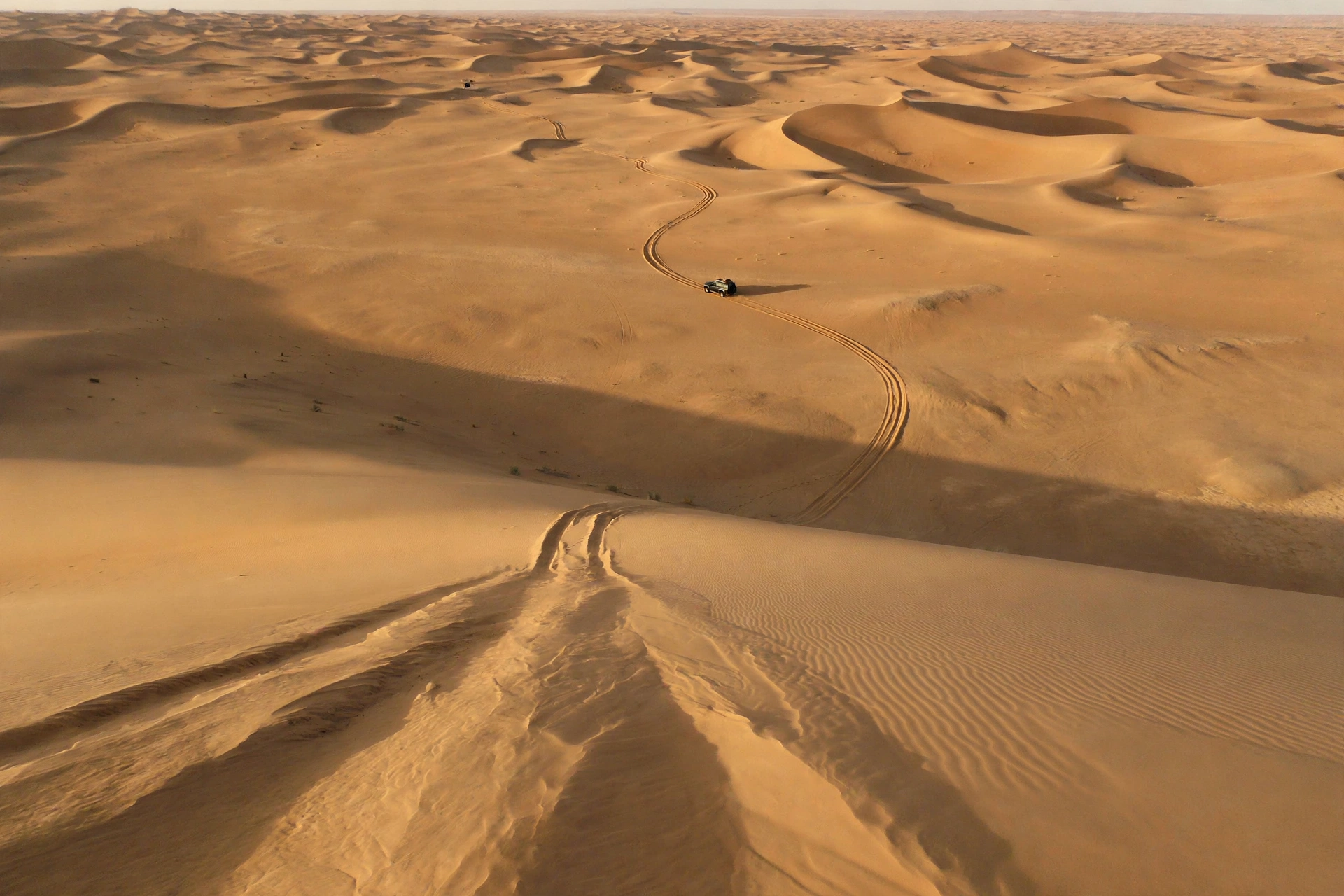
Getting there is the adventure and the price. From Zagora you drive two to three hours off-road — real off-road, over stone plains and sand tracks — in a 4×4, usually via M’hamid, the last village before the desert proper. That is why a morocco sahara desert tour to Erg Chigaga costs more and runs longer than the Merzouga equivalent: the transport alone is a full expedition. Most Chigaga trips run three days from Marrakech, with the middle day entirely in the dunes.
Choose Zagora and Chigaga if you have already seen a desert or if crowds would ruin it for you. In high season the popular Merzouga camps can hold dozens of guests and the sunset dune feels like a queue; Chigaga never does. Do not choose it for a first morocco sahara desert tour on a tight schedule — the extra hours and cost buy wilderness, not taller dunes, and first-timers usually want the tall dunes. Zagora town itself is a staging post, not a destination: sleep there only the night before or after the dunes.
Agafay: The One-Day "Sahara" That Isn’t
This is the section locals wish every seller would read. Agafay is a beautiful rocky desert about 40 minutes from Marrakech — pale stone, low hills, and a superb Atlas sunset. What it is not, is the Sahara. There are no sand dunes in Agafay. There never were. A camel ride there is a short loop on flat ground, and the "desert camp" is a tented lodge with a swimming pool and a restaurant.
That does not make Agafay a scam — only a different product, and the problem is the labelling. As a sunset dinner with live music, a short camel ride and a night in a comfortable tent, it is a genuinely good evening, and the only desert experience that fits a traveller with one free afternoon. The trouble starts when sellers call it a morocco sahara desert tour and charge Sahara prices for it, and visitors arrive expecting Erg Chebbi and find gravel. If you book Agafay, book it knowingly and pay Agafay prices — a half-day trip runs about 400–900 MAD ($40–90) per person — and enjoy it for what it is.
My rule is simple: if a morocco sahara desert tour from Marrakech promises the Sahara in one day, it is Agafay. Real sand dunes cannot be reached and returned from in a day. The sellers know this; now you do too.
What a Morocco Sahara Desert Tour Actually Includes
Most options for a morocco sahara desert tour follow the same skeleton: transport from Marrakech or Fes, a driver-guide, one night in a desert camp with dinner and breakfast, a sunset camel ride and a sunrise dune walk. What changes with price is comfort, group size and how much of the driving is shared. Read the inclusions line by line, because the cheapest listings leave out the parts that cost you later.
Standard camps are the classic experience and honestly good value. You sleep in a Berber-style tent with a real mattress, blankets and a shared bathroom block a short walk away. Dinner is a tagine or couscous, breakfast is bread, eggs and mint tea. Expect 300–700 MAD ($30–70) per person per night when booked as part of a tour.
Luxury camps are a different product. Private tents with proper beds, en-suite bathrooms, solar power and sometimes a pool. Prices run 1,500–4,000 MAD ($150–400) per person per night, and the top end buys real comfort in the middle of nowhere. But be honest with yourself about the word "luxury" here: you are still sleeping in a tent in the desert, the shower water is limited, the Wi-Fi is weak or absent, and a sandstorm does not care what you paid.
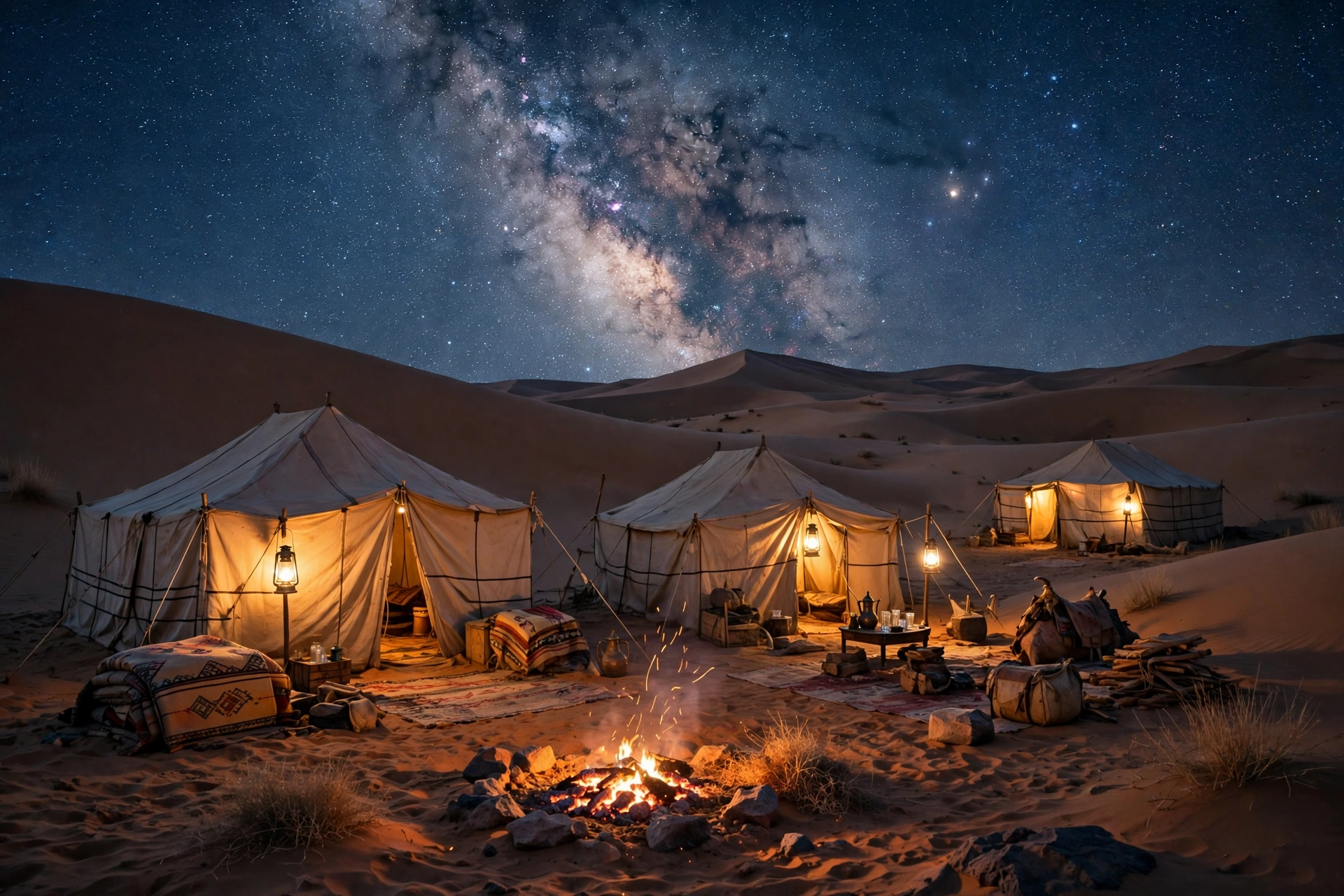
Whatever the camp, confirm four things before paying for your morocco sahara desert tour: whether the camel ride is included or an extra (150–300 MAD, $15–30, if charged separately); whether dinner and breakfast are included; whether the camp has a private or shared bathroom; and what happens in bad weather — a good operator moves you to a solid room in the village. Also confirm the group size: a "small group" tour with 17 people in a minibus is not small.
What It Costs: Real Prices, Checked November 2026
Prices below are ranges from tour listings and camp rates, checked November 2026, in dirhams with approximate dollar equivalents at about 10 MAD to $1. Treat them as budgets for your morocco sahara desert tour, not quotes — the exact price depends on season, group size and how far ahead you book.
| Item | Price range (MAD) | Approx. USD |
|---|---|---|
| 3-day group tour, Marrakech–Merzouga, standard camp | 900–1,800 | $90–180 |
| 3-day group tour, Marrakech–Merzouga, luxury camp | 2,500–4,500 | $250–450 |
| 3-day private tour for 2, Marrakech–Merzouga | 6,000–12,000 total | $600–1,200 |
| 2-day group tour, Marrakech–Zagora, standard camp | 700–1,500 | $70–150 |
| 3-day tour to Erg Chigaga (4×4), per person | 2,000–4,000 | $200–400 |
| Agafay half-day trip with dinner, per person | 400–900 | $40–90 |
| Camel ride alone (if not included) | 150–300 | $15–30 |
| Luxury camp night, per person | 1,500–4,000 | $150–400 |
| Tip for driver-guide (3 days, per person) | 100–200 | $10–20 |
Two costs catch people out on a morocco sahara desert tour. The first is lunch: most tours include dinner and breakfast only, so budget 60–120 MAD ($6–12) per lunch at roadside restaurants. The second is the "optional" stops — a carpet cooperative here, a fossil shop there — where the pressure to buy is real. You are never obliged to buy anything. For the wider trip budget, see our 7-day Morocco itinerary and getting around Morocco.
Which One Should You Choose?
The right choice depends on your time, not your budget, when picking a morocco sahara desert tour. With three days or more, go to Merzouga and Erg Chebbi — the classic, and what a first desert should look like. With four days and a taste for empty places, go to Erg Chigaga from Zagora and accept the longer, rougher road as part of the trip. With one afternoon only, go to Agafay, call it a desert sunset dinner, and save the real dunes for a return trip.
A morocco sahara desert tour also works best as part of a route, not as a return journey. The classic shape is Marrakech over the Atlas to Merzouga, then on to Fes through the Ziz Valley — or the reverse. That is exactly how our 7-day Morocco itinerary runs it, saving a full day of backtracking.
Families should note the driving honestly: children under five will struggle with the long days, and the camel ride is not suitable for very small children — ask for a 4×4 transfer into camp instead.
Honest Warnings Before You Book
The nights are cold. The desert drops fast after sunset, and in December and January it can fall to near freezing at night. Bring a warm layer even if Marrakech was 28°C at lunch.
The drive is long and the road is real. The Marrakech–Merzouga road crosses the Tizi n’Tichka pass at 2,260 metres, then runs through long empty stretches. If a seller promises a morocco sahara desert tour to Merzouga "in six hours," they are lying about the road or planning to drive dangerously fast.
Not every "luxury camp" is one. Some listings show photographs of camps that are not theirs. Check recent traveller photos, not the operator’s gallery, and read the last ten reviews rather than the average score. If a price looks too good for what is promised — a "luxury" three-day tour for 800 MAD — it is.
Scams are small, not dramatic. The common ones are a "closed road" detour into a shop and a camel handler asking for a tip before you have even mounted.
Sand gets everywhere, and that is fine. It will be in your shoes, your bag and your hair for days. Bring a scarf or shemagh — sold in every souk for 30–60 MAD ($3–6) — to cover your face on the camel and on windy ridges. Remember that any morocco sahara desert tour is still a desert trip: heat, cold, dust and long roads are the price of the stars.
When to Go: The Best Months for the Desert
The best months for a morocco sahara desert tour are October–November and February–April. The days are warm, the nights are cool but bearable, and the light is at its best. December and January bring the coldest nights and clearest skies — excellent if you pack warmly, though camps fill up, so book ahead. March and April can bring wind and the occasional sandstorm.
May and September are cheaper shoulder months for a morocco sahara desert tour; June to August brings heat over 45°C, so do everything at dawn and dusk and rest through the middle of the day.
What to Pack for the Desert
Pack light for your morocco sahara desert tour: you carry your own overnight bag to the camp, and the big suitcase stays in the vehicle. Essentials are a warm layer, a scarf for sand and sun, sunscreen, a water bottle, a headlamp for the walk to the bathroom, and a power bank, since camp electricity is limited.
Leave behind anything you would mind getting sandy. Cash matters on a morocco sahara desert tour: camps and villages rarely take cards, so bring enough dirhams for tips, lunches and extras — an ATM in Marrakech, Ouarzazate or Erfoud before you leave is the last reliable one. Download offline maps before departure, because signal fades well before the dunes begin. If you are continuing to Fes afterwards, our guide to getting around Morocco covers the trains and buses from the desert road back to the cities.
Sahara Desert Morocco FAQ
Is a morocco sahara desert tour worth it?
Yes — if you go to real dunes and give it three days. The Merzouga sunset and the night sky are the two experiences visitors mention most when they come home. It is not worth it as a rushed one-day trip, because the driving eats the experience.
Merzouga or Zagora — which is better?
Merzouga (Erg Chebbi) has the taller dunes, about 150 metres, and is easier to reach, so it suits first-timers. Zagora (Erg Chigaga) is wilder, emptier and farther, and suits travellers who value remoteness over dune height. Neither is wrong; they are different trips.
How many days do I need for the Sahara from Marrakech?
Three days and two nights is the minimum for Merzouga, and the honest minimum. Two days means roughly 20 hours of driving for one night in the dunes. For Erg Chigaga, plan three to four days.
Is the Agafay desert the real Sahara?
No. Agafay is a beautiful rocky desert near Marrakech with no sand dunes. It is a good sunset dinner trip, but it is not the Sahara, and sellers who call it one are misleading you.
How cold does the desert get at night?
In winter (December–February) nights can drop to around 0–5°C, and in summer they stay warm, around 20–25°C. Spring and autumn nights are usually 10–15°C. Bring a warm layer in every season.
Can I visit the Sahara independently without a tour?
Yes. Take a bus or grand taxi to Merzouga, stay in a village guesthouse, and book the camel ride and camp night locally — often cheaper and more flexible than a Marrakech package. You need a 4×4 and a guide for Erg Chigaga, which is not a DIY trip.
Conclusion
The Sahara in Morocco rewards the traveller who chooses honestly: tall dunes at Merzouga, wild emptiness at Erg Chigaga, or a sunset evening at Agafay. Pick the place that matches your days, pay the price that matches the place, and pack for cold nights and long roads. Booked that way, a morocco sahara desert tour is not just the photograph you came for. It is the quiet hour after dinner, the fire going low, the dunes dark around you and the sky doing something no city sky ever does — and that is the part you will still be talking about years later.