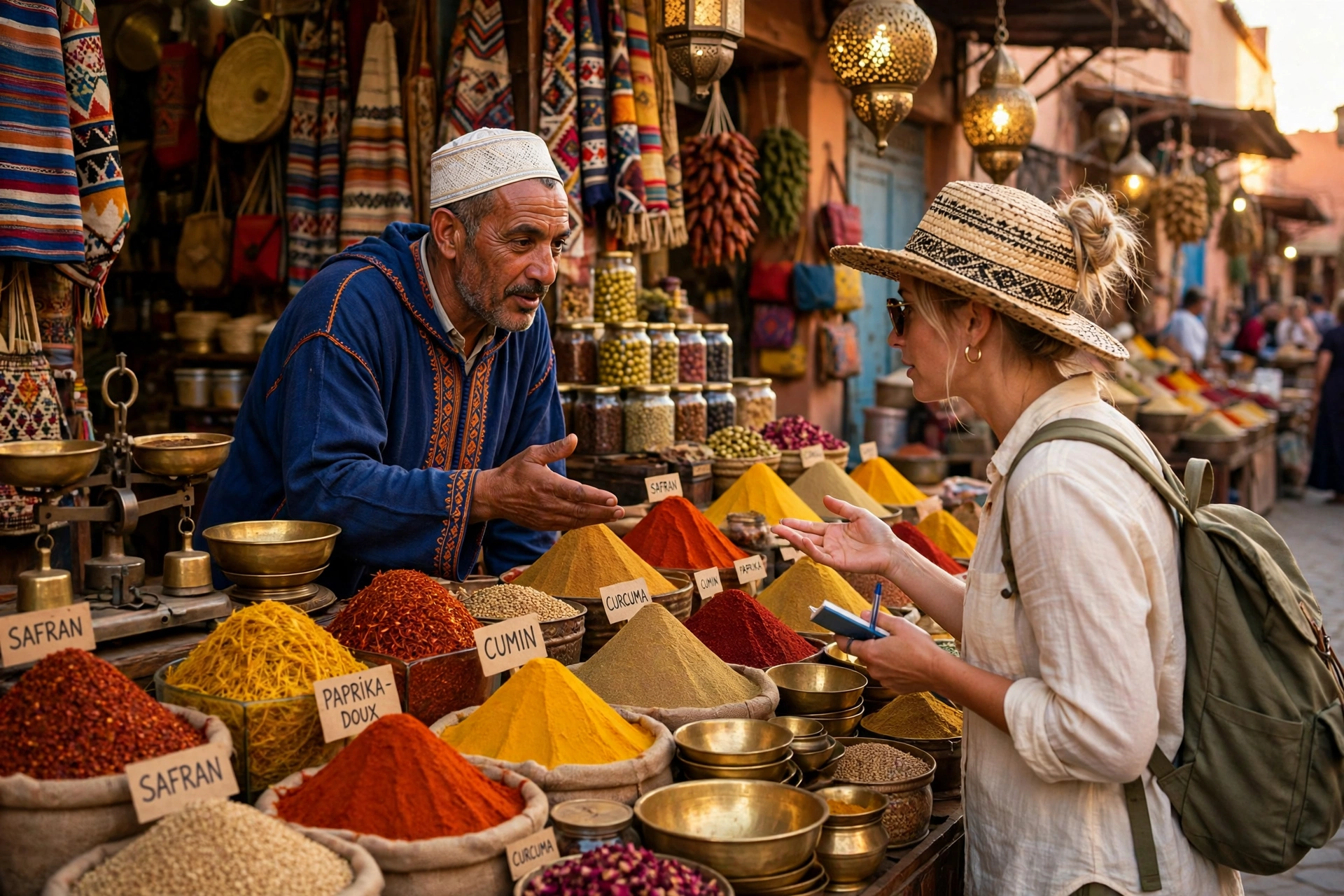
Haggling in Morocco is the first real conversation most visitors have with the country — and it is also the one most visitors get wrong. Walk into a Marrakech souk and a shopkeeper will quote you a price for a leather bag that sounds absurd, and your instinct will be either to pay it and feel cheated later, or to fight it down to a tenth and feel clever. Both instincts miss the point. It is a social ritual with rules, a rhythm, and a fair landing zone. Learn the rules and you will enjoy haggling in Morocco — and pay fair prices.
I grew up watching this dance from the other side of the counter — my uncle sold ceramics in Fes — and I learned early that a good negotiation leaves both people smiling. This guide covers fair prices, the exact words to use, what never to bargain over, and how the rules change by city. All prices are in dirhams (MAD), with dollar equivalents at roughly 10 MAD to $1, checked November 2026.
What Haggling in Morocco Really Is
Haggling in Morocco is a conversation, not a confrontation. On unpriced goods in the souks — leather, rugs, lanterns, ceramics, jewellery — the first price a shopkeeper quotes is an opening, not a verdict. He expects you to answer with a lower figure, and he expects to meet you somewhere in the middle.
And here is the number most guides get vague about: for ordinary souk goods, a fair final price usually lands near 50 to 70 percent of the first ask. If a bag is first offered at 600 MAD ($60), a fair deal is somewhere around 300 to 420 MAD ($30–$42). That is the range where the shopkeeper still makes his margin and you have not overpaid. Morocco’s official tourism portal, Visit Morocco, lists the souks among the country’s essential experiences — the negotiation is part of that experience, not an obstacle to it. Bargaining is one of the oldest forms of trade; the background on bargaining shows how it predates fixed pricing worldwide.
The insider correction most visitors get wrong
Here is the correction I wish every visitor knew before their first souk visit: haggling in Morocco is not universal, and treating it as universal is the fastest way to look foolish. Food is not haggled. Nobody bargains over a kilo of tomatoes, a loaf of bread, or a mint tea. Pharmacies are not haggled. Fixed-price cooperatives — the women’s argan cooperatives along the road to Essaouira, for example — are not haggled either, and trying to bargain there is insulting, because those prices are set to pay the producers fairly. The souk stall with no price tags is a negotiation; the shop with printed price tags is not. Learn the difference before you open your mouth.
There is a second correction worth making. The first price is not a lie and it is not a trap. A shopkeeper who quotes 800 MAD for a rug is not trying to rob you; he is opening high because he knows you will come down, and because some buyers in a hurry will simply pay it. The price is the start of the dance, not the end of it. Treat it as a personal insult and the dance is over — and so is your discount.
Why the ritual matters
Time is part of the price when haggling in Morocco. A shopkeeper who invites you in for tea is not wasting your time; he is doing business the Moroccan way. Sit down. Drink the tea. Ask where the piece comes from and how it was made. Ten minutes of talk will almost always beat thirty seconds of pointing and asking “how much?”. The relationship is the discount. For the wider picture of what life here costs, our guide to the cost of living in Morocco puts souk prices in the context of rents, food, and transport.
Fair Prices: What Souk Goods Should Actually Cost
Use this table as your anchor before haggling in Morocco. These are fair prices for good-quality, handmade items in the main souks, checked November 2026.
| Item | First ask (typical) | Fair price | In USD |
|---|---|---|---|
| Leather bag (medium, handmade) | 500–700 MAD | 250–400 MAD | $25–$40 |
| Brass lantern (medium, pierced) | 300–500 MAD | 150–300 MAD | $15–$30 |
| Berber rug (small, 1 x 1.5 m) | 1,500–3,000 MAD | 800–1,800 MAD | $80–$180 |
| Ceramic plate or bowl (hand-painted) | 80–150 MAD | 40–80 MAD | $4–$8 |
| Spices (saffron, per gram) | 30–60 MAD | 15–30 MAD | $1.50–$3 |
| Spices (cumin, paprika, per 100 g) | 20–40 MAD | 10–20 MAD | $1–$2 |
| Djellaba (wool, good quality) | 400–700 MAD | 200–400 MAD | $20–$40 |
| Babouches / leather slippers | 150–300 MAD | 80–150 MAD | $8–$15 |
| Argan oil (100 ml, cosmetic, cooperative) | 100–180 MAD | 90–150 MAD | $9–$15 |
A note on argan oil: buy it from a cooperative or a reputable shop, not from a stranger in an alley. Real argan oil is expensive to produce, and a bottle offered at 30 MAD is not a bargain — it is almost certainly diluted. Cooperatives charge fixed prices for a reason: the women who make it. For a sense of what good Moroccan food and ingredients cost, see our Moroccan food guide.
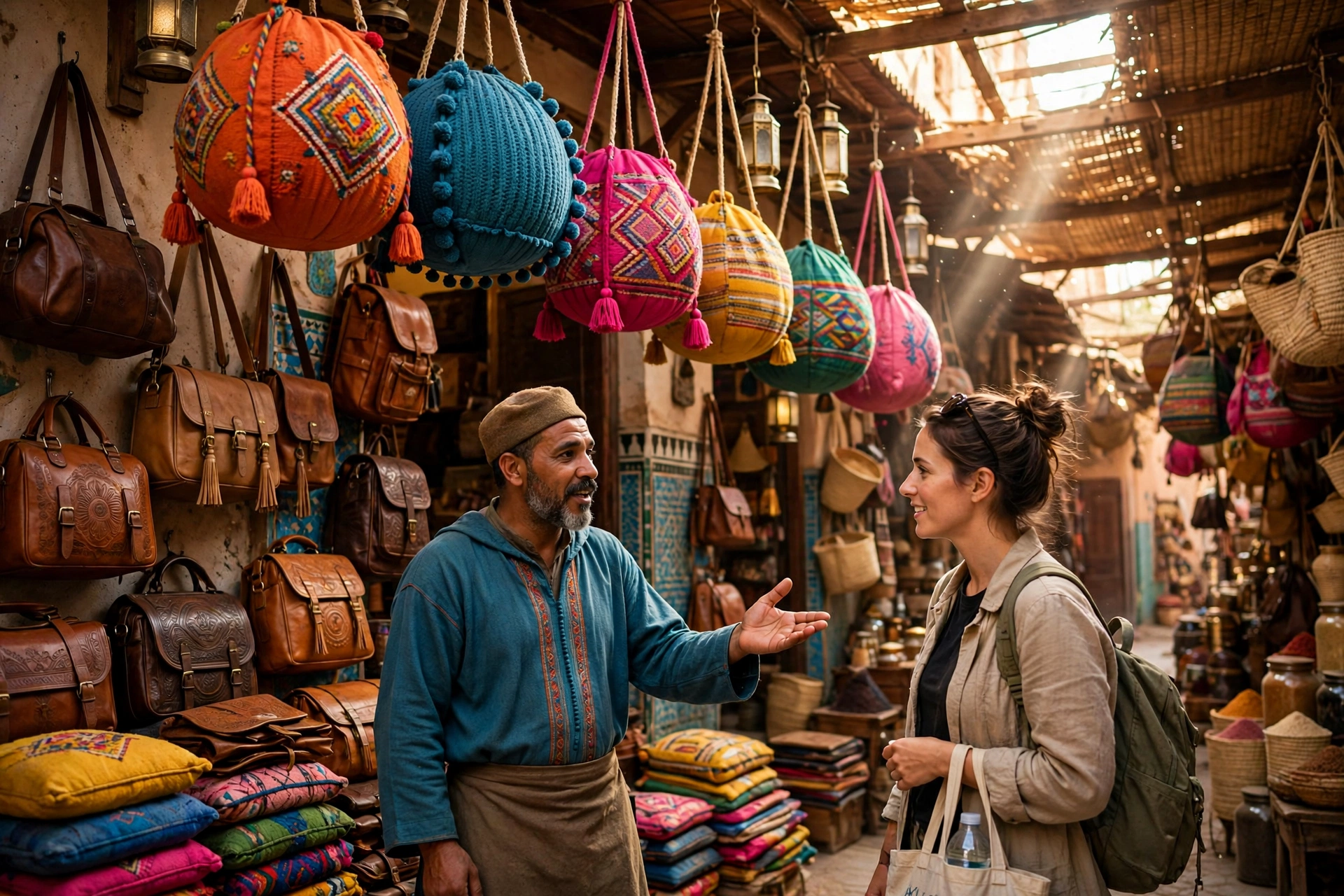
The Step-by-Step Haggling Script
You do not need fluent Arabic or French. A smile, a few words, and patience will carry you through almost any round of haggling in Morocco. Here is the script that works.
Step 1: Look first, ask second. Browse before you touch anything. When something catches your eye, admire it, and ask where it was made and what it is made of. Interest is flattering; grabbing an item and asking “how much?” in the same breath marks you as an easy sale.
Step 2: Ask the price, and do not react. Whatever number comes back, keep your face neutral. Do not gasp, do not laugh, do not say “that’s crazy.” A calm “hmm” is worth more than any argument.
Step 3: Offer about half. Your first counter-offer should be around 50 percent of the ask — sometimes a little less for high-ticket items like rugs. Say it with a smile: “I can do 250.” Nobody is offended by a low first offer, as long as it is not absurd. Offering 50 MAD for a 600 MAD bag is absurd; offering 300 is a conversation.
Step 4: Let him come down in steps. He will counter, perhaps at 500. You go to 300. He goes to 450. You go to 350. The steps get smaller as you approach the middle, and that is how you know you are close. That shrinking rhythm is the shape of haggling in Morocco.
Step 5: Use the walk-away — gently. If you are stuck, thank him, say you will think about it, and start to leave slowly. If your price was fair, he will often call you back with a better number. If he does not, your price was too low, or he genuinely cannot go lower. Either way, you have lost nothing.
Step 6: Close with grace. When you agree, pay happily and thank him. Do not keep negotiating after the deal is struck or reopen the price once money has changed hands. Ask him to wrap the piece properly for travel — most shopkeepers will do this gladly.
A useful phrase to carry with you: “C’est mon dernier prix” — “this is my last price” — works in French, and in Arabic, “akhir taman” means the same. Use it once, and only once. Use it twice and it means nothing.
Cash helps. Small notes in dirhams give you flexibility the card machine does not, and many smaller stalls are cash-only. Our Morocco money and dirham guide explains denominations, ATMs, and where to change money.
What Never to Haggle Over
This is the part of haggling in Morocco that visitors most often get wrong.
Food and drink. Market produce, bread, pastries, restaurant meals, and mint tea all have set prices. Bargaining over a 10 MAD tea is not saving money.
Pharmacies and medicine. Prices are regulated and fixed. Do not try.
Fixed-price shops and cooperatives. If there is a price tag, the price is the price. The argan cooperatives between Marrakech and Essaouira exist so the women who crack the nuts and press the oil are paid properly. Haggling there takes money from them directly.
Taxis with meters — and taxis without them. This is a nuance, not a contradiction. In cities, insist on the meter in a petit taxi rather than negotiating a fare; the meter is the fair price. For a grand taxi between towns or a long trip with no meter, agreeing the fare before you get in is normal and expected — you are setting a price where none exists, not haggling over a fixed one. Our guide to getting around Morocco by train, bus, taxi and Al Boraq explains which fares are metered, which are fixed, and which to agree in advance.
City Differences: Marrakech vs Fes vs Essaouira vs Small Towns
Haggling in Morocco is not the same everywhere. The city changes the game.
Marrakech is the most intense. The souks around Jemaa el-Fnaa see the most tourists in the country, so first asks are the highest and the performance is the most theatrical. Expect opening prices two to three times fair value, and constant approaches. Walk one alley deeper, away from the main drag, and prices drop noticeably.
Fes is quieter and, in my experience, fairer. The medina of Fes el Bali is older, denser, and more working than Marrakech’s — many stalls serve locals as well as tourists, which keeps first asks lower. The leather and ceramics here are often made in workshops you can visit, and a maker selling his own piece is often prouder and more flexible. The best deals in Fes come to the buyer who lingers.
Essaouira is the most relaxed. The pace is slower, the sellers are less pushy, and first asks tend to be closer to fair prices — often only 30 to 50 percent above them. You may save less than in Marrakech, but you will enjoy the process more. Argan oil is the big purchase here, and the cooperatives are fixed-price.
Small towns and villages are a different world again. In a town like Chefchaouen or a village in the Atlas, there may be only one shop selling what you want, and the seller may not be used to negotiating at all. First asks are often close to fair already. Haggle gently, if at all — pushing hard over 20 MAD in a place where that money matters is not a victory, it is bad manners. In small towns, the person selling you the rug may be the person who wove it.
Mistakes That Mark You Out Instantly
A few habits identify a first-time visitor before a single price is mentioned. Avoid them when haggling in Morocco.
Announcing your budget. “I only have 200 MAD” tells the seller exactly where the negotiation ends. Keep your limit in your head, not in the conversation.
Bargaining over food. As above: it is the single clearest signal that you have misunderstood the rules, and every seller in the souk will notice.
Treating the first price as an insult. Theatrical offence — gasping, laughing, walking out in a huff — ends negotiations rather than starting them. The first price is an invitation, not an attack.
Buying the first thing you see. The same bag is sold in twenty stalls. Walk, compare, and come back — the stall you return to will know you are serious, and the price will often be better.
Paying in euros or dollars. Some sellers accept foreign currency, but the exchange rate they apply is never in your favour. Pay in dirhams.
Frequently Asked Questions
Is haggling in Morocco expected, or is it rude?
On unpriced souk goods it is expected — a shopkeeper may be mildly surprised if you pay the first ask without a word. But it is only expected where prices are not fixed. In restaurants, food markets, pharmacies, and fixed-price cooperatives, haggling in Morocco is rude. The rule is simple: no price tag, negotiate; price tag, pay it.
How much should I offer first?
Around half of the first ask is a good opening, and haggling in Morocco follows that rhythm almost everywhere. For rugs, start slightly lower, around 40 percent. Never open at a tenth of the ask — that is not negotiating, it is dismissing the seller’s work.
What is a fair final price for a souk souvenir?
As a rule of thumb, 50 to 70 percent of the first ask for ordinary goods. Our table above gives concrete numbers for the most common items, checked November 2026. If you land in that range for a handmade item, your haggling in Morocco has done well.
Do I need to speak Arabic or French to haggle?
No. Numbers, gestures, a calculator, and a smile go a long way. A few words help enormously when haggling in Morocco, though: “shhal?” (how much?), “ghali bzzaf” (too expensive), and “akhir taman” (last price) will earn you goodwill in any souk.
Is it okay to walk away after agreeing a price?
No — once you have agreed a price and shaken on it, the deal is done. Walking away before agreeing is completely fine, and one of your best tools when haggling in Morocco. Walking away after agreeing is not.
Can I haggle in the malls and modern shops?
No. Modern shops, malls, supermarkets, and chain stores have fixed prices, just as they do anywhere else. Haggling in Morocco belongs to the souks, the medina stalls, and the artisan workshops.
Final Thoughts
Haggling in Morocco rewards the visitor who treats it as what it is: a conversation between two people, one of whom made or sourced something with skill, and the other who wants to take a piece of that skill home. Learn the fair prices, open at half, move in small steps, and know where the ritual stops — at the food stall, the pharmacy, and the cooperative door. Do that, and you will leave the souk with a bag you love at a price you can defend, and with a story about the man who sold it to you. That story is worth more than the last 20 dirhams you might have saved. Prices in this guide were checked November 2026; they will drift with the seasons and the exchange rate, but the rules of haggling in Morocco will not.