This fes travel guide starts with a warning and a promise. The warning: Fes el-Bali has roughly 9,400 alleys, no cars, and no useful street signs. You will get lost. The promise: getting lost is the point, and it is survivable — two main streets, five neighbourhoods, and downhill gravity always bring you back somewhere familiar.
I am Moroccan, and Fes is the city I send friends to when they want the Morocco that still works the way it did centuries ago — tanners dyeing leather in stone pits, students at a university founded in 859. This fes travel guide is the honest version: navigation, the sights worth your time, the tanneries’ real cost, where to sleep, and what to skip.
First trip to the country? Read our Morocco travel guide for first-time visitors for visas, money and safety basics. Stitching Fes into a wider trip? Our 7-day Morocco itinerary shows how the city fits between the Sahara and Marrakech.
Fes in One Paragraph: What It Is (and Isn’t)
Founded in 789 by Idris I, Fes el-Bali has been continuously inhabited ever since. UNESCO listed it as a World Heritage site in 1981, calling it one of the best-preserved medieval cities in the world — accurate about the street plan and crafts, misleading because “medieval city” suggests a museum. It is a working neighbourhood of roughly 150,000 residents living in the lanes you will photograph.
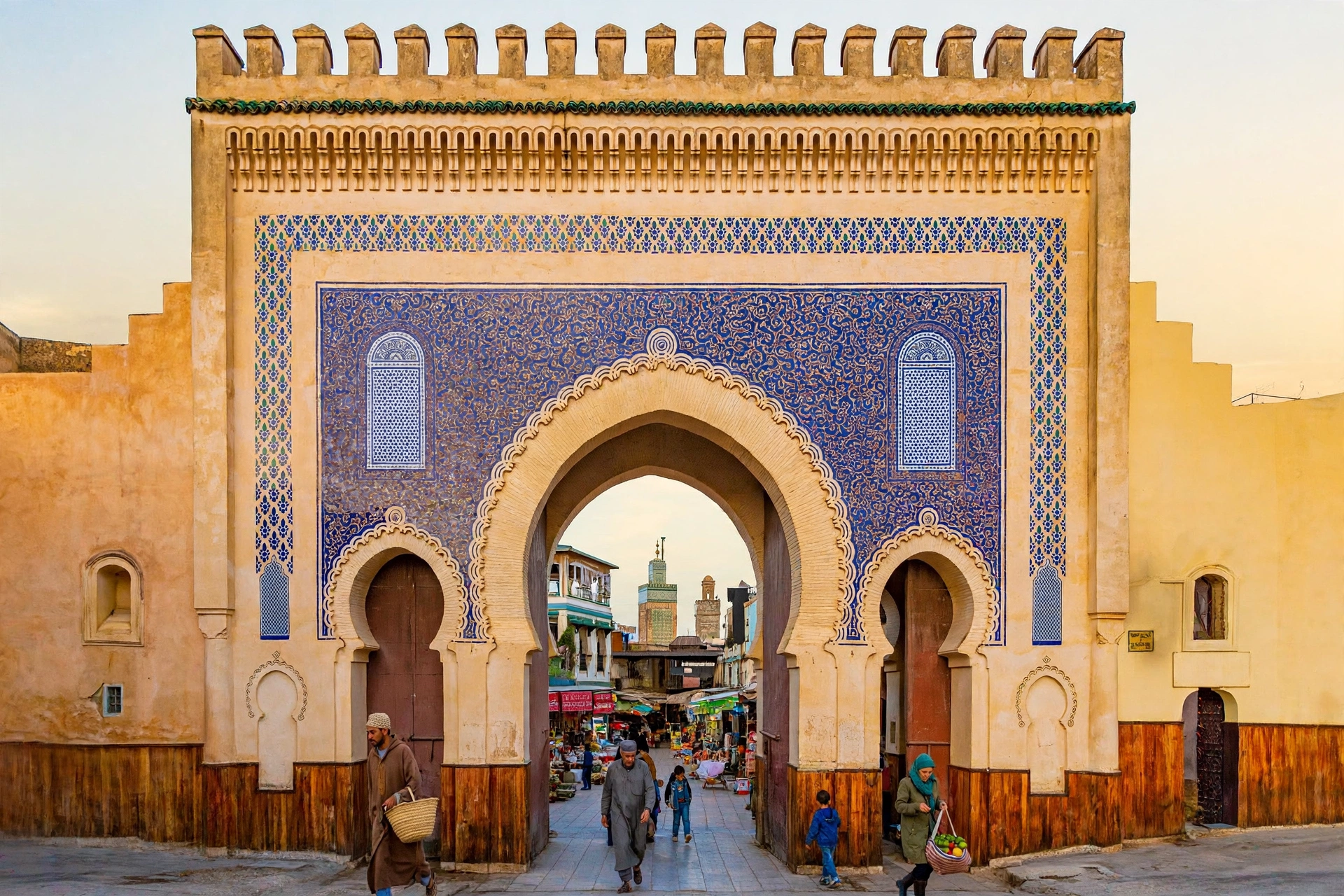
Here is the insider correction most guides get wrong: the famous blue gate is not medieval at all. Bab Bou Jeloud, the blue-tiled gate every visitor photographs, was built in 1913 under the French protectorate, in a deliberately Moorish style. It is beautiful, and the right front door to the medina — but a century old, not twelve. The truly old things are quieter: the 14th-century madrasas and the 9th-century university-mosque. Fes is also not Marrakech: quieter, colder in winter, more conservative, less polished. Come for craft and history, not nightlife.
Fes Travel Guide: How to Navigate 9,400 Alleys
The number everyone quotes — about 9,400 alleys — is real enough, and it terrifies first-timers. Here is how locals navigate, and how this fes travel guide suggests you do the same.
Think in five neighbourhoods, not in street names
Fes el-Bali has five quarters — the entrance around Bab Bou Jeloud, the scholarly Qarawiyyin quarter, the Andalusian quarter across the river, the tanneries and coppersmiths’ square, and the residential lanes to the north. Just know which one you are in and where you are heading.
The two arteries do all the work
Two main streets run through the medina, and almost everything you want is on or just off one of them: Talaa Kebira (the “big slope”) runs downhill from Bab Bou Jeloud toward the Qarawiyyin mosque, and Talaa Seghira (the “small slope”) runs roughly parallel. Learn these two names and which way is downhill, and you have the spine this fes travel guide navigates by. When in doubt, walk downhill: it leads to the river, the main squares, and eventually a gate you recognise.
Download offline maps before you enter
Signal inside the medina is patchy — thick old walls eat it — so download the Fes map offline in Google Maps or Maps.me before you enter. GPS still works without signal; save your riad and Bab Bou Jeloud as starred pins, the two lifelines this fes travel guide insists on.
The fake guides at the gates
This is the single most important practical point in this fes travel guide, so read it twice. Men wait near Bab Bou Jeloud and the other gates offering to show you the medina. Some are licensed guides, worth every dirham. But many are not guides at all: “helpers” who walk you to the tanneries, then to a leather shop, then to a carpet shop, collecting a commission at each stop. The script is always the same — “this street is closed” — and the price is never agreed in advance.
The fes travel guide counter-move is simple: if you want a guide, book through your riad or a reputable agency, agree price and duration in advance (a half-day licensed guide typically costs 200–400 MAD, about $20–40), and check the official badge. If not, say “la, shukran”, keep walking downhill, and follow no one. If properly lost, ask a shopkeeper — not a man who approaches you — and offer 10 MAD for directions.
What to See in Fes el-Bali
Fes rewards slow looking: give it two unhurried days and see the big sights properly rather than racing through a checklist — the ones this fes travel guide covers.
Bou Inania Madrasa — the one building to pay for
Built between 1350 and 1355 by the Marinid sultan Abu Inan Faris, the Bou Inania is the finest madrasa in Morocco that non-Muslims can enter, and the only one in Fes open to visitors. Its courtyard is a masterclass in Moroccan craft: zellige tilework, carved cedar, stucco like lace. Entry is roughly 20–40 MAD (about $2–4), and thirty to forty-five minutes is enough. Come before the tour groups arrive around 10 a.m. and you may have it to yourself: if this fes travel guide had to pick one paid interior in Fes, it would be this one.
Al-Qarawiyyin — the oldest university, seen from the door
The University of al-Qarawiyyin was founded in 859 by Fatima al-Fihri, who used her inheritance to build a mosque that became a centre of learning — often called the oldest continuously operating university in the world, broadly fair, though historians argue over definitions. What matters for your visit: non-Muslims cannot enter. Admire the carved doors and green-tiled minaret from the lanes, and peek through an open door if one is ajar. Every fes travel guide should say this plainly: nobody can get you inside, so never pay anyone who offers to try.
The tanneries — the smell, the fee, and the truth
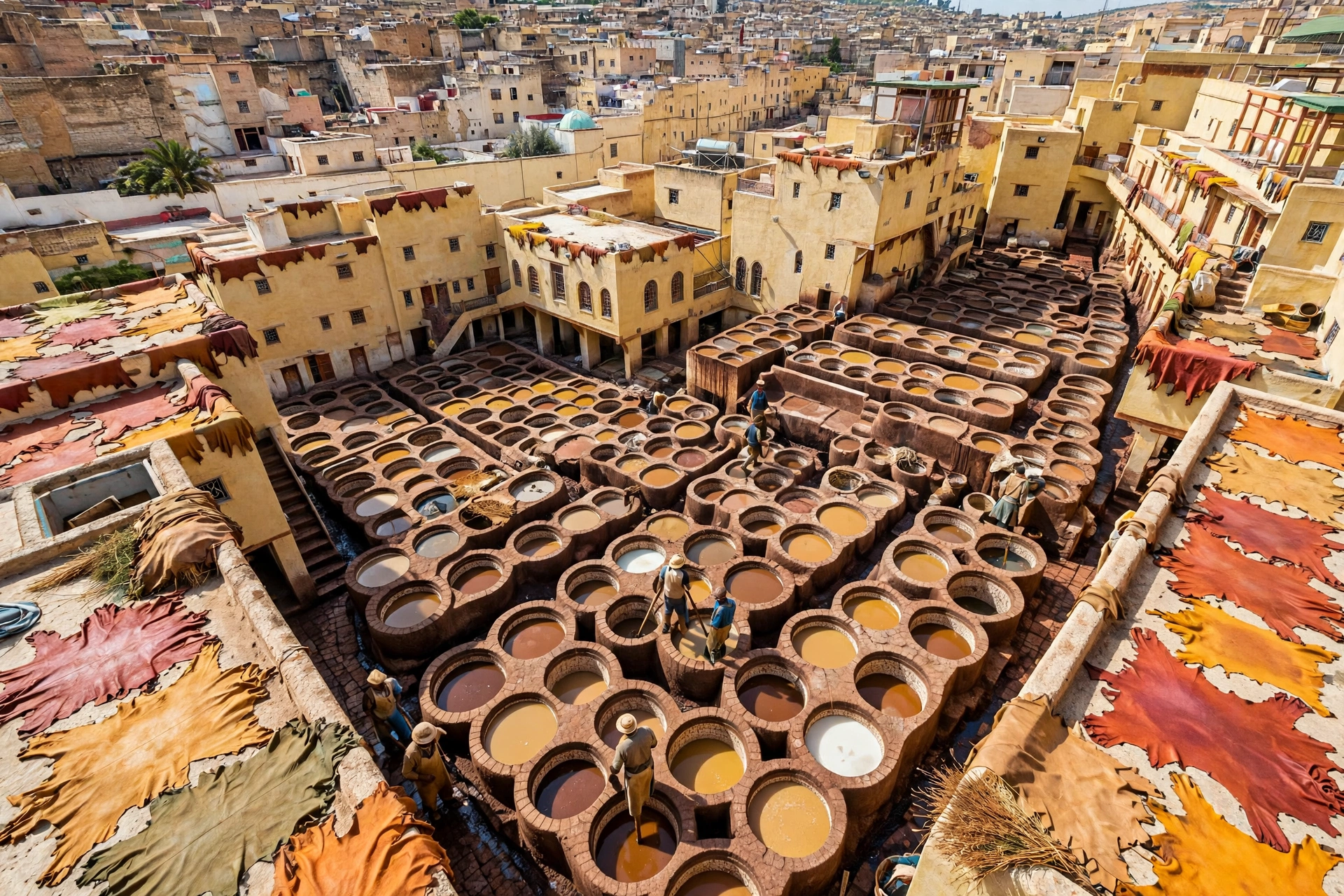
The Chouara tannery is the image of Fes: hundreds of round stone pits filled with coloured dye, workers standing waist-deep in them, hides drying on the rooftops. The smell is real — pigeon droppings and natural dyes are part of the process, and on a hot day it hits you from a street away. The shops hand out mint sprigs, which help a little. Go in the morning, when light is best and the smell is mildest.
Now the money, because this is where visitors get confused. Viewing the tannery from a leather shop’s terrace is free — no official entry fee. A shop invites you onto its terrace, shows you the view, then expects you to look at leather goods on the way out. You are not obliged to buy, and there is no forced fee — but walking out after mint, a view and ten minutes of explanation without glancing at the goods is poor form. The fes travel guide rule: the view is free, the purchase is your choice.
For a clean transaction, buy something small if you like it, haggle firmly (start at roughly half the first price), and walk away politely if you do not. A leather bag starting at 800 MAD should settle around 300–500 MAD (about $30–50) if the quality is decent. Never pay a “viewing fee” on the street.
Bab Bou Jeloud and the lanes around it
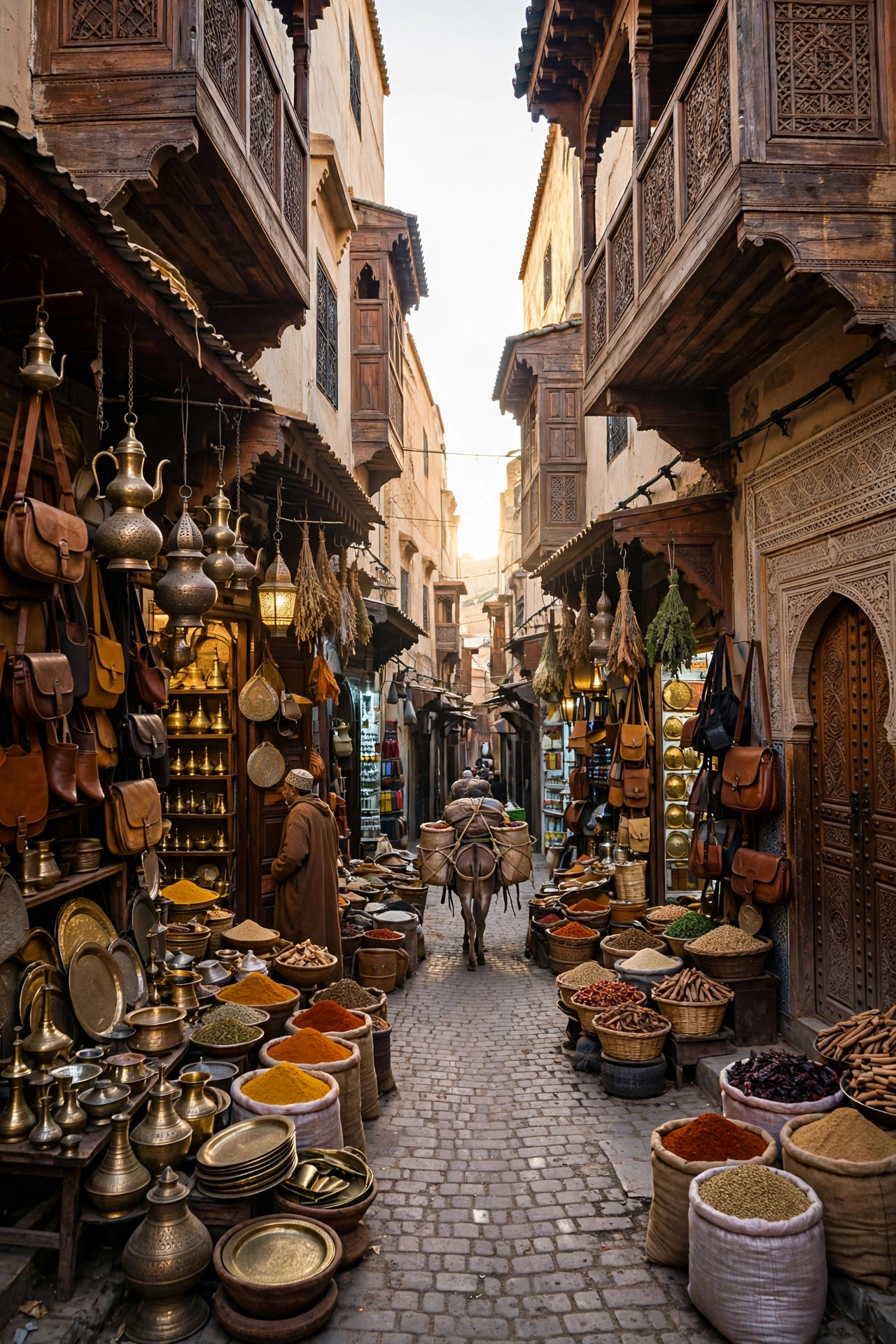
Start at the blue gate, walk down Talaa Kebira, and let the street guide you — past the Madrasa al-Attarine (a small 14th-century college near the Qarawiyyin, also around 20 MAD), the Nejjarine fountain and its woodwork museum, and Place Seffarine, where coppersmiths hammer brass in the open air. Pause at the fountain and listen: these men are not performers, they are at work, and a smile and a “salam” go further than a camera shoved in their faces. That is the walk this fes travel guide would do first on any morning in Fes.
The Merenid Tombs at sunset
For the best view in Fes, climb to the ruined Merenid tombs on the hill north of the medina at sunset — twenty minutes uphill from Bab Guissa, and free. The honey-coloured city spreads out below as the call to prayer rolls across the rooftops. Go with a companion after dark, and bring a jacket: Fes cools fast once the sun drops — the sunset this fes travel guide recommends above every rooftop café.
Where to Stay: Medina Riad or Ville Nouvelle
Where you sleep decides how much you enjoy Fes, and the choice is starker here than in Marrakech: the medina is steeper, darker at night, further from cars. This fes travel guide comes down firmly for the riad.
Stay in a medina riad if you want the real Fes
A riad inside Fes el-Bali puts you steps from the lanes, the call to prayer, and fresh bread from the communal ovens. The best have rooftop terraces and staff who walk you to the gate at night. Budget riads start around 300–600 MAD ($30–60) a night; comfortable mid-range riads run 700–1,500 MAD ($70–150); grand restored palaces pass 2,500 MAD ($250). Two warnings: riads are built around open courtyards, so winter nights are genuinely cold — ask about heating before booking between December and February — and no car can reach your door, so you will carry your bag (or pay a porter 20–30 MAD, about $2–3) from the nearest gate.
Stay in the ville nouvelle if you want comfort
The ville nouvelle, the modern district around Avenue Hassan II, has wide streets, chain hotels, restaurants with wine lists, and taxis at the door — 10–15 minutes by petit taxi (10–20 MAD, about $1–2) from Bab Bou Jeloud. Decent hotels start around 400 MAD ($40); good four-star hotels run 800–1,500 MAD ($80–150). Choose it with small children or mobility issues, or if you want a proper bed, heating, and a taxi at the door. That is the fes travel guide trade-off: you lose the atmosphere; you gain sleep.
What to Skip in Fes
Not everything in Fes deserves your time, and an honest fes travel guide says so. Skip the carpet “demonstrations” that begin with mint tea and end with a hard sell — unless you genuinely want a carpet, go to a fixed-price cooperative, not a shop a tout led you to. Never pay for a “tannery ticket” on the street; the view from the terraces is free. And skip seeing Fes in a single rushed afternoon from Casablanca — the train alone eats most of the day.
How Long to Spend in Fes
Two full days is the sweet spot: one for the medina’s core sights, one for the slower pleasures — the craft quarters, a cooking class, and a half-day trip to Volubilis and Moulay Idriss. One full day works if you follow the plan below. Less than a full day is a mistake — Fes does not reveal itself at a run, as this fes travel guide warns.
| Plan | Morning | Afternoon | Evening |
|---|---|---|---|
| 1 day in Fes | Bab Bou Jeloud → Talaa Kebira → Bou Inania Madrasa → Al-Qarawiyyin quarter | Chouara tannery terraces → Place Seffarine → Nejjarine fountain → Madrasa al-Attarine | Merenid Tombs at sunset, dinner in the medina |
| 2 days in Fes | Day 1 as above, at a slower pace | Day 2: Jnan Sbil gardens → Dar Batha museum → the Mellah and the Jewish cemetery → a craft workshop or cooking class | Rooftop dinner in a medina riad, early night |
Getting to Fes
Fes is one of the easiest Moroccan cities to reach, because it sits on the main rail line. The national rail operator is ONCF, and its trains are the comfortable way to arrive — cheaper and calmer than any bus, and this fes travel guide’s first choice.
By train. Direct trains run from Casablanca (about 4 hours, second class roughly 110–150 MAD, about $11–15; first class roughly 180–220 MAD), from Rabat (about 3 hours, roughly 90–130 MAD), and from Tangier (about 4–5 hours, roughly 140–190 MAD). Book at the station or on the ONCF site; first class costs only a little more and guarantees a seat, which matters at weekends. Fes station is in the ville nouvelle, 10–15 minutes by petit taxi from Bab Bou Jeloud — agree 15–20 MAD first, or insist on the meter.
By air. Fès–Saïs Airport (FEZ) sits about 15 km south of the city, with direct flights from several European cities. A grand taxi to the medina costs roughly 120–150 MAD (about $12–15); agree the price before loading your bags. No reliable airport bus exists.
By grand taxi and bus. From Meknes, the shared grand taxi takes under an hour, roughly 30–40 MAD (about $3–4) per seat. From Chefchaouen, CTM and private buses take about 4 hours, roughly 80–120 MAD. From the Sahara, the road from Merzouga takes 7–8 hours — break it at Midelt, as our 7-day Morocco itinerary explains.
For safety basics across the country, including taxi rules, see our guide to is Morocco safe.
What Fes Costs: Real Prices
Fes is noticeably cheaper than Marrakech, widest on food and rooms. All prices in this fes travel guide were checked in November 2026; treat them as ranges, not promises. The fes travel guide bottom line: Fes is the cheapest of Morocco’s imperial cities for a visitor.
| Item | Price in MAD | Approx. USD |
|---|---|---|
| Bou Inania Madrasa entry | 20–40 MAD | $2–4 |
| Madrasa al-Attarine entry | 20 MAD | $2 |
| Dar Batha museum entry | 20–30 MAD | $2–3 |
| Chouara tannery viewpoint (terrace) | Free (shops hope for a purchase) | Free |
| Merenid Tombs viewpoint | Free | Free |
| Petit taxi in town | 10–20 MAD | $1–2 |
| Grand taxi, airport to medina | 120–150 MAD | $12–15 |
| Train Casablanca–Fes, 2nd class | 110–150 MAD | $11–15 |
| Street food (harira, sandwich, kefta) | 20–40 MAD | $2–4 |
| Restaurant lunch | 60–120 MAD | $6–12 |
| Nice riad dinner | 150–250 MAD | $15–25 |
| Mint tea in a café | 10–15 MAD | $1–1.50 |
| Budget riad room (per night) | 300–600 MAD | $30–60 |
| Mid-range riad room (per night) | 700–1,500 MAD | $70–150 |
| Licensed half-day guide | 200–400 MAD | $20–40 |
A comfortable daily budget for one person in Fes, excluding the room, is roughly 250–450 MAD (about $25–45) for food, entries, taxis, tea.
Fes Travel Guide FAQ
Is Fes safe for tourists?
Yes — the fes travel guide answer is straightforward: violent crime against visitors is rare, and the real risks are small scams and hassle. The medina is safe to walk in the daytime and in the busy evening lanes; stick to lit, populated streets after dark, keep valuables out of sight, and say a firm “la, shukran” to unsolicited helpers. Our is Morocco safe guide has the details.
Can non-Muslims enter the mosques in Fes?
No — with one exception: the Bou Inania Madrasa is open to non-Muslim visitors. The Al-Qarawiyyin mosque-university, the Andalusian mosque and neighbourhood mosques are closed to non-Muslims — admire them from outside, and never pay anyone who claims otherwise.
How bad is the smell at the tanneries, really?
Real but manageable. On a cool morning it is a faint chemical tang; on a hot afternoon it is strong enough to make you wrinkle your nose. The mint sprigs help, and most visitors spend ten minutes at the viewpoint and move on happily. Very sensitive? Visit at opening time.
Do I need a guide in Fes?
No — and this fes travel guide is written so you can navigate without one, using the two main streets and offline maps. A good licensed guide adds real value on a first visit, but only if booked through your riad or an agency with an agreed price. Never hire one who approaches you at a gate.
Is Fes better than Marrakech?
They are different cities. Fes is older, quieter, more traditional, more about craft and scholarship; Marrakech is livelier, warmer, more polished for tourists, better for nightlife and restaurants. History lovers usually prefer Fes; travellers who want energy and variety prefer Marrakech. See both if you can — our Marrakech travel guide covers the other side.
When is the best time to visit Fes?
March to May and September to November, the fes travel guide pick, when daytime temperatures sit around 22–30°C and the lanes are pleasant to walk. December to February is crisp and sunny by day but cold at night — pack layers and ask about heating, since unheated riads can feel freezing. June to August is hot and dry, often above 35°C, and the tannery smell is strongest. For the country-wide picture, see our best time to visit Morocco guide.
Final Word
Fes does not perform for visitors, and that is exactly why it is worth the trip. The medina is not a show; it is a city that has been working, praying, tanning leather and teaching students for more than twelve centuries, and it lets you walk through it if you respect its rules — walk downhill when lost, refuse the helpers at the gates, pay the small honest prices, and look up often enough to notice the carved door above the shop you are passing. Come with two days, an offline map, and a willingness to get lost: this fes travel guide promises you the Morocco most visitors never meet — not a postcard, but a living medieval city, still at work.
Prices checked November 2026. Fes el-Bali is a UNESCO World Heritage site; entry fees and fares are ranges — confirm at the gate or station if a price matters to your budget.