Written by a Moroccan, for people coming to see his country properly.
Morocco is closer than you think — 35 minutes by ferry from Spain, three hours by plane from most of Europe — and yet it operates on rules that no other country on your itinerary shares. The currency cannot be bought before you arrive. The most famous “Sahara tour” sold in Marrakech does not reach the Sahara. The train between the two most visited cities does not take the route you would draw on a map. And the medina that looks like a tourist attraction is, in fact, a working city of several hundred thousand people who are simply going about their day.
This Morocco travel guide is for first-time visitors. I am Moroccan, and this is the guide I give friends before they visit: the honest version, with real prices, real distances, and the specific mistakes I watch first-time visitors make — so you do not have to make them.
Morocco Travel Guide at a Glance
- Capital: Rabat (the political capital — most visitors land in Casablanca or Marrakech instead)
- Currency: Moroccan dirham (MAD, written “dh”). Rough planning rate: $1 ≈ 10 MAD, €1 ≈ 11 MAD — check the Bank Al-Maghrib reference rate before you travel.
- Languages: Arabic (Darija dialect) and Tamazight are official; French is widely used in business, signs and menus; English is growing fast in tourist areas. A few words of French still open doors that English does not.
- Visa: Citizens of around 70 countries — including the US, UK, EU, Canada, Australia and Japan — enter visa-free for up to 90 days. No form, no fee, no e-visa to arrange in advance.
- Best months for a first trip: March–May and October–November.
- Time zone: GMT year-round in practice (Morocco suspends its usual GMT+1 during Ramadan).
- Religion/culture: A Muslim-majority kingdom; dress and behaviour expectations are relaxed in tourist areas but modesty is appreciated, especially in medinas and rural areas.
Before You Go: Visa, Passport and Arrival
For most readers of this guide, entry is refreshingly simple: if you hold a US, UK, EU, Canadian, Australian or Japanese passport (among roughly 70 exempt nationalities), you show up, receive an entry stamp, and may stay up to 90 days. There is no landing card to fill in — it was abolished in 2019 — though the officer may ask where you are staying, so have your first hotel’s name and address on your phone.
Three details that matter more than the visa itself:
- Check your entry stamp before you walk away from the desk. A missing or unclear stamp causes genuine problems on departure. This is the single most common bureaucratic headache visitors face, and it is avoidable in ten seconds.
- Passport validity: Moroccan rules are commonly stated as validity for the duration of stay (often quoted as 90 days minimum), but airlines routinely enforce six months. Travel with at least six months remaining and the question disappears.
- The 90 days is a visitor’s permission, not residency. If you fall in love with the country — many do — staying longer means a residence permit (carte de séjour) applied for at the local police Préfecture, a process we cover in our Living in Morocco guides.
If your nationality is not on the exempt list, Morocco runs an official e-Visa through the Accès Maroc portal (acces-maroc.ma) for eligible travellers; confirm your exact case with a Moroccan consulate before booking, because the exempt list changes.
Insider tip — the arrival airport trick: Every Moroccan airport has exchange desks and SIM kiosks in arrivals, and every one of them is the most expensive place in the country to do either transaction. Change only enough for your first taxi (a few hundred dirhams), buy your SIM at an official operator shop in town, and use ATMs attached to banks once you reach the city.
When to Visit: Morocco Has Four Climates, Not One
The most misleading sentence in travel writing is “the best time to visit Morocco is spring.” Morocco contains an Atlantic coast, a Mediterranean north, high mountains with ski resorts, and the Sahara. In July, Marrakech averages a daytime high of about 38°C (100°F) while Essaouira, three hours away, sits near 23–26°C (73–79°F). Choose the region and the month together.
Month-by-month: average daytime highs (°C)
| Month | Marrakech | Fes | Essaouira (coast) | Desert (Merzouga) | Verdict |
|---|---|---|---|---|---|
| January | 19–20 | 16–17 | 19 | 18 | Cities and desert; cold nights, possible Atlas snow |
| February | 21 | 17 | 19 | 20–21 | Quiet, almond blossom in the south |
| March | 23–24 | 20 | 20 | 24 | Spring begins — excellent almost everywhere |
| April | 26 | 20–21 | 20 | 26–28 | Peak season: warm, green, busy at Easter |
| May | 29–30 | 26–29 | 21–23 | 30–33 | Excellent early month; desert heats up late month |
| June | 34 | 31–32 | 21–24 | 38 | Coast and mountains; inland getting hot |
| July | 38 | 35–38 | 23–26 | 40–42 | Coast only for most people; avoid the desert |
| August | 37–38 | 35–37 | 23–26 | 40 | Coast peak season; inland cities very hot |
| September | 33 | 30 | 23 | 33–35 | Heat breaks late month; harvest season |
| October | 28–29 | 26–28 | 24 | 27–29 | The single best month for a full round trip |
| November | 23 | 21–22 | 22 | 21–23 | Cities and desert; rain returns to the north |
| December | 20 | 17 | 19 | 18 | Mild days, cold desert nights, festive cities |
Long-term climate averages (1991–2020 station normals and 2015–2024 reanalysis ranges); individual days vary. Desert nights run 15–25°C colder than desert days — in mid-winter they approach freezing.
For a first trip that combines cities, mountains and desert, October is the connoisseur’s month: summer heat has left, nights are still mild, and the crowds of April have not formed. March–May is the greener, busier alternative. If your only free month is July or August, do not cancel — rebuild the trip around the Atlantic (Essaouira, Agadir, Tangier) and the Atlas, and give the desert a miss.
Ramadan note: During Ramadan, daily life shifts — many cafés and restaurants close by day, everything reopens and comes alive after the sunset ftour, and opening hours at sites and banks change. Ramadan 2027 is expected to begin around 8 February 2027 (Morocco confirms the start by official moon sighting, announced the evening before — allow ±1 day). Travelling during Ramadan is entirely possible and, in the evenings, magical — but plan your days around it.
How Much Does Morocco Cost? Real Prices
Morocco is not “cheap” in the way brochures promise, nor expensive by European or North American standards. It is a country where the same day can cost $40 or $400 depending on three decisions: where you sleep, whether your taxi meter is running, and whether you eat where Moroccans eat. Planning rate: $1 ≈ 10 MAD.
Daily budgets per person (excluding international flights)
| Style | Per day | What it buys |
|---|---|---|
| Budget | $35–60 (350–600 MAD) | Hostel dorm or simple guesthouse, street food and local cafés, trains and CTM buses, a group desert tour |
| Mid-range | $90–160 (900–1,600 MAD) | A charming riad with breakfast, sit-down restaurants, first-class trains, petit taxis, a guided day every few days |
| Luxury | $250+ (2,500+ MAD) | Boutique riads, private driver, fine dining, luxury desert camp |
Prices you will actually pay (checked November 2026)
| Item | Typical price |
|---|---|
| Bowl of harira or bissara soup at a local stall | 5–20 MAD |
| Sandwich / street-food meal | 15–35 MAD |
| Tagine or couscous in a local restaurant | 40–90 MAD |
| Mint tea in a café | 10–20 MAD |
| Petit taxi ride inside a city (meter on) | 10–40 MAD |
| Hostel dorm bed | 80–150 MAD |
| Simple riad/hotel double, breakfast included | 300–600 MAD |
| Boutique riad in Marrakech or Fes | 900–2,500 MAD |
| Train Casablanca → Marrakech, 2nd class (~2h40–3h) | ~90–140 MAD |
| Train Tangier → Casablanca (Al Boraq high-speed, ~2h10) | ~149–224 MAD |
| Shared 3-day desert tour, Marrakech → Merzouga → Fes | ~900–1,800 MAD |
| Bahia Palace / Saadian Tombs / El Badi Palace entry (foreign adult) | 100 MAD each |
| Jardin Majorelle entry | 170 MAD (garden only; online-only timed tickets at tickets.jardinmajorelle.com; garden + Berber Museum 230 MAD; all three sites incl. YSL Museum 330 MAD; under-10s free) |
| Hassan II Mosque guided tour, Casablanca | ~130–140 MAD |
| Volubilis Roman site entry | 100 MAD (foreign adult; 50 MAD foreign children 7–13; 30 MAD Moroccan/resident adult) |
Two money rules that will save you more than any discount site:
- The dirham is a closed currency. You cannot buy it before you arrive, and you should not try to take significant amounts out when you leave. Arrive with euros, dollars or pounds and exchange or withdraw in Morocco.
- Cash is still king outside the big cities. Cards work in hotels, supermarkets and larger restaurants; the medina, the mountains and the desert run on cash. Withdraw from ATMs attached to banks (better rates, fewer skimming risks) and keep small notes — a 200 MAD note is surprisingly hard to break in a village.
Insider tip — the tourist tax surprise: Moroccan accommodation adds a municipal tourist tax (taxe de séjour), typically 15–50 MAD per person per night depending on category and city, and many riads collect it in cash at checkout even when you prepaid online. It is legitimate, not a scam — but budget for it so it does not sour your last morning.
Getting Around: Trains Are Excellent — Except to the Desert
Morocco’s railway, ONCF, is one of Africa’s best, and its flagship is Al Boraq, the continent’s first high-speed train, running Tangier–Kenitra–Rabat–Casablanca in about 2 hours 10 minutes at up to 320 km/h. Conventional Al Atlas trains link Casablanca with Marrakech (~2h40–3h) and Fes (~4h from Casablanca). Trains are air-conditioned, seats are reservable, and fares bought a few days ahead on oncf-voyages.ma can be 20–30% cheaper than same-day prices.
Now the part the brochures skip:
- There is no train to the desert, and no direct Marrakech–Fes railway line. The train from Marrakech to Fes detours through Casablanca and takes 6½–7½ hours. The road route via the Sahara — Marrakech → Atlas → Merzouga → Fes — is not a detour; it is the classic journey, done by rental car, private driver or shared tour.
- First class is the locals’ upgrade. On Al Atlas trains it typically costs only 50–90 MAD more than second class, guarantees your seat, and buys a quieter carriage. On any ride over an hour, Moroccans who can, do.
- CTM and Supratours buses reach the places trains do not — Chefchaouen, Essaouira, the south — and are comfortable and punctual by regional standards. Book a day ahead in high season.
- Taxis come in two species. Petit taxis (small, metered, city-only): always insist on the meter — “compteur” is the magic word. Grand taxis (shared intercity cars) leave when full and are the backbone of rural Morocco. Ride-hailing apps operate in the big cities and remove the fare negotiation entirely.
Key distances and travel times
| Route | Distance | Realistic time | Best mode |
|---|---|---|---|
| Casablanca → Marrakech | ~240 km | 2h40–3h | Train |
| Tangier → Casablanca | ~340 km | ~2h10 | Al Boraq train |
| Marrakech → Ait Benhaddou/Dades | ~320 km | 5.5–6.5h with stops | Driver / tour / rental |
| Dades → Merzouga (Erg Chebbi) | ~220–250 km | 4–5h | Driver / tour |
| Merzouga → Fes | ~460 km | 6.5–8h | Driver / tour |
| Fes → Chefchaouen | ~165–200 km | 2.5–4h | Bus / grand taxi / driver |
| Marrakech → Essaouira | ~190 km | ~3h | Bus / driver |
The 7-Day Route That Actually Works
If you have one week, resist the urge to see everything. This one-way route is the one Moroccans recommend, because every travel day moves you somewhere new and you never backtrack:
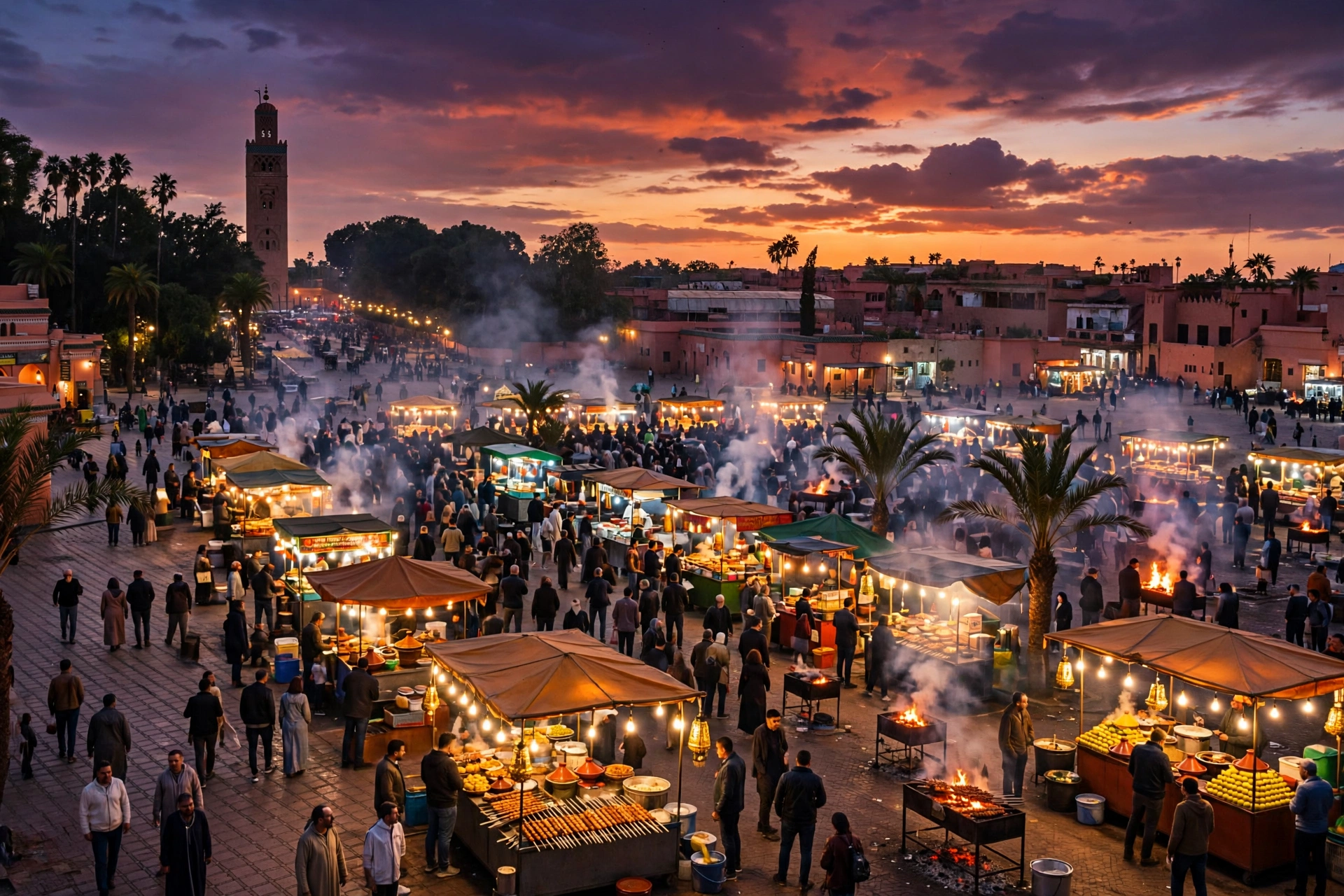
- Days 1–2 — Marrakech. Arrive, sleep in a medina riad, do the Bahia–Badi–Saadian morning (three 100 MAD monuments within a ten-minute walk of each other), get lost in the souks on purpose, and be in Jemaa el-Fna at dusk when the food stalls fire up.
- Day 3 — Over the High Atlas. Cross the Tizi n’Tichka pass (2,260 m), stop at the ksar of Ait Benhaddou, sleep in the Dades Valley. This is a 5½–6½ hour day with stops — anyone who tells you less is selling something.
- Day 4 — Gorges to the dunes. Walk the Todra Gorge in the morning, reach Merzouga by late afternoon, ride into Erg Chebbi at sunset, sleep in a desert camp.
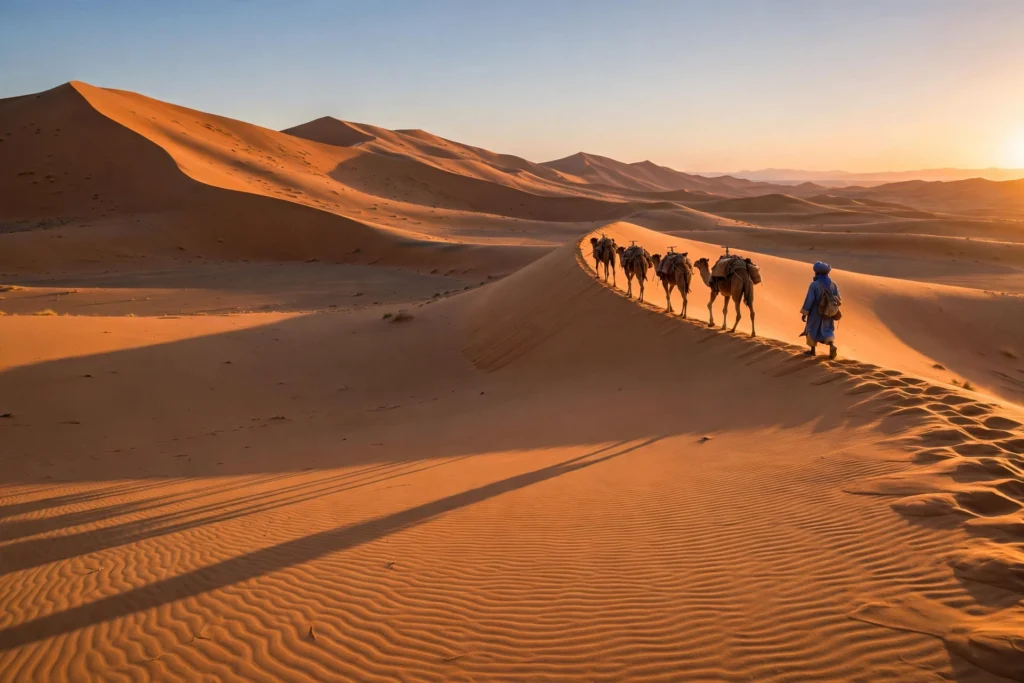
- Day 5 — Merzouga to Fes. Sunrise on the dunes, then the long, beautiful drive north through the Ziz Valley and the Middle Atlas cedar forests (watch for Barbary macaques near Azrou). 6½–8 hours — break it in Midelt if you prefer a gentler pace and arrive in Fes on day 6 instead.
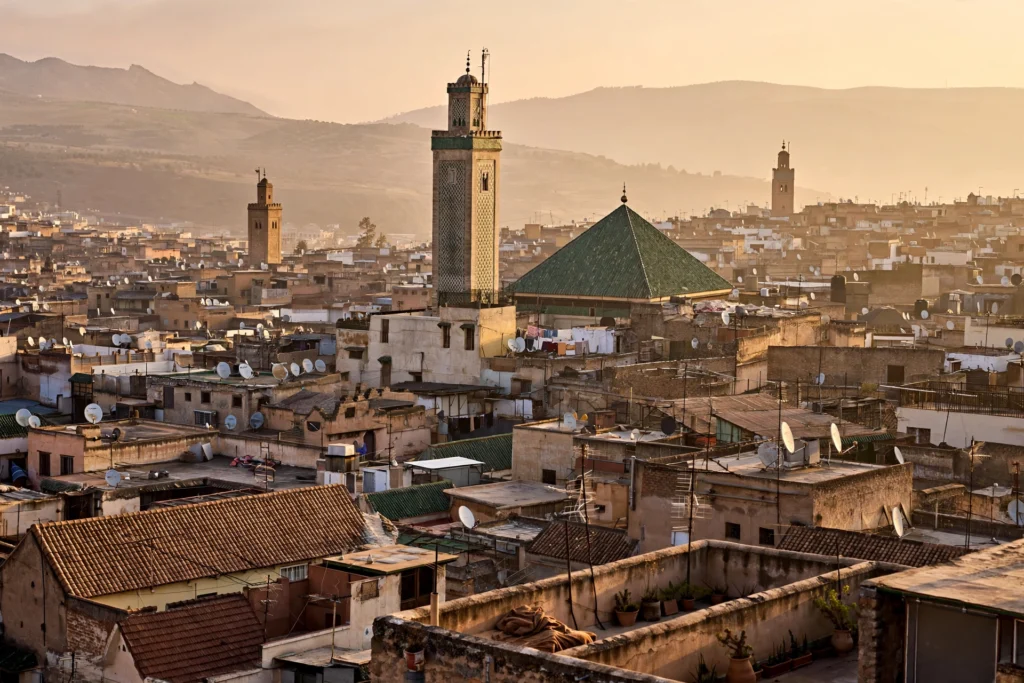
- Days 6–7 — Fes. The world’s oldest living medieval medina: the tanneries, the Bou Inania Madrasa, and the university founded in 859. Fly home from Fes, or take the train to Casablanca (~4h) for more flight choices.
Fly into Marrakech and out of Fes (an “open-jaw” ticket). The most common first-timer error is booking a return from Marrakech and donating a full day to driving back over roads already seen. Note what this route deliberately leaves out: Chefchaouen. The blue city is lovely — and a 2½–4 hour detour from Fes that a 7-day Sahara trip cannot honestly hold. Give it a 10-day trip, or a northern trip of its own.
Where to Stay: Riad, Hotel, or Kasbah?
A riad is a traditional house built inward around a courtyard garden, hidden behind an anonymous medina door. Staying in one is the Moroccan experience visitors imagine — breakfast on the roof terrace, birdsong instead of traffic — with two honest caveats: medina riads cannot be reached by car (you will walk the last alleys, ideally with the riad’s staff meeting you), and sound travels in courtyard houses. Hotels in the modern districts (Guéliz in Marrakech, Agdal in Rabat, Maarif in Casablanca) offer parking, lifts, heating and easier logistics — which is why most Moroccans travelling domestically, and most long-stay expats, choose them. In the south and the desert, family-run kasbah guesthouses are often the warmest welcome of all.
Book your first night somewhere that offers airport pickup or clear meeting-point instructions. Arriving in a medina at night, tired, with luggage, is the one moment the famous “helpful strangers” earn their commission from you.
Staying Safe and Avoiding the Small Scams
Morocco is, statistically, a safe country to visit: violent crime against tourists is rare, and Moroccans are famously protective of guests. What you should prepare for is not danger — it is friction: a steady drizzle of small, practised hustles in the most touristed medinas. Forewarned is forearmed:
- “That street is closed / the tannery is this way.” It is not closed. Smile, say la, shukran (“no, thank you”), keep walking your route.
- The unmetered taxi. Agree nothing verbally — point at the meter, or use a ride-hailing app, or have your riad state the fair price before you get in.
- The “free” guide at the medina gate. In Fes and Marrakech, use an official guide booked through your riad or the tourist office if you want one (genuinely worth it in Fes), and decline the volunteers.
- Henna, photos, monkey handlers in Jemaa el-Fna: agree the price before anything touches your hand or shoulder, or keep hands politely down.
- Dress and conduct: cover shoulders and knees in medinas and rural areas, ask before photographing people, and remember non-Muslims cannot enter most mosques — the great exception is Casablanca’s Hassan II Mosque, visitable on guided tours (~130–140 MAD).
- Water and stomachs: tap water is treated and Moroccans drink it, but first-time visitors with sensitive stomachs usually start with bottled water and ease into salads and street food over a few days.
None of this should put you off. It is the same briefing I would give my own sister — and she would still tell you the medina at dusk is worth every dirham of the learning curve.
Eating Like a Local: Five Rules
- Couscous is Friday. It is the Friday family lunch; a restaurant serving it daily is serving tourists. Order it on Friday, from the busiest place you can find.
- Follow the plastic stools. The best harira, bissara, grilled skewers and tangia (Marrakech’s slow-cooked bachelor stew, traditionally baked in the ashes of a hammam furnace) are served where there is no printed menu at all.
- Breakfast is an event: msemen and amlou, beghrir pancakes, olives, soft cheese, mint tea poured from a height. A riad breakfast done properly can carry you to dinner.
- Mint tea is not a drink, it is a punctuation mark — offered in shops, homes and negotiations. Accept the first glass; refusing reads as refusing the relationship, not the beverage.
- In the medina, eat where the smoke is. At Jemaa el-Fna’s night stalls, choose the stall crowded with Moroccan families, point at what looks good, and confirm the price of the full order before you sit.
Mistakes First-Timers Always Make (So You Don’t)
- Trying to “do” Morocco in five days, coast to desert to north. Morocco is roughly the size of Spain; pick a region or take the one-way route above.
- Driving the desert legs yourself on day one. The Tizi n’Tichka and the run to Merzouga are demanding; hire the driver or tour for the crossing, rent a car later for the easy legs if you want one.
- Believing the one-day “Sahara” trip. From Marrakech, one-day desert excursions reach the Agafay — a beautiful stone desert, with no dunes. The real dunes of Erg Chebbi need three days from Marrakech, minimum.
- Exchanging all your money at the airport and buying the airport SIM. Both are the worst-value transactions of your trip (see the arrival tip above).
- Skipping Rabat. The capital is calm, green, coastal and historic — the Kasbah of the Udayas at sunset is one of the finest hours in Moroccan travel, and almost no first-timer is there to see it.
FAQ
Do I need a visa for Morocco? Citizens of around 70 countries — including the US, UK, EU, Canada, Australia and Japan — enter visa-free for up to 90 days with no advance application. Other nationalities should check the official e-Visa (Accès Maroc) or a Moroccan consulate. Always confirm your nationality’s current status before booking, as lists change.
How much money should I bring for a week in Morocco? Excluding international flights, a realistic week costs roughly $250–420 per person on a budget style, $630–1,120 mid-range, and $1,750+ at luxury level — based on the daily budgets in this guide ($35–60 / $90–160 / $250+ per day). The desert tour is the one big variable: a shared 3-day tour runs ~900–1,800 MAD.
Is Morocco safe for tourists, including solo women? Morocco is generally safe, with rare violent crime against visitors; the realistic issues are petty scams and persistent salesmanship in the main medinas, both manageable with the counter-moves in this guide. Solo women should expect some attention, dress modestly, and use riad-arranged transport at night — standard advice Moroccan women themselves would give.
What is the best month to visit Morocco? For a combined cities–mountains–desert trip, October, followed by April and May. July and August suit the Atlantic coast and the Atlas only; December–February suit the cities and the desert if you pack for cold nights.
Can I drink the tap water and use my bank card? Tap water is treated and locals drink it, but sensitive stomachs should start with bottled water. Cards are accepted in hotels, supermarkets and larger restaurants in the cities; medinas, mountains and desert are cash territory, so withdraw dirhams from bank-attached ATMs in towns.
How many days do I need for Morocco? Seven days covers Marrakech, the Sahara and Fes on the one-way route in this guide. Ten to fourteen days lets you add Chefchaouen, Essaouira or Tangier without rushing — and is the honest minimum for “seeing Morocco” rather than sampling it.
The Short Version
Come in October or spring. Fly in one end and out the other. Ride the trains where they run and take a driver where they do not. Keep the meter on, eat where the smoke and the families are, check your entry stamp, and give the desert its three full days. Do those things and Morocco stops being the confusing country of the brochures and becomes what Moroccans know it is: one of the most rewarding journeys on earth, an hour from Europe and a world away. That is this Morocco travel guide in short.
Next steps on LahbabiGuide: our month-by-month weather guide, the detailed 7-day itinerary with booking tactics, and the full 2026 cost breakdown — all linked from this pillar as they publish.
11 thoughts on “Morocco Travel Guide for First-Time Visitors: Everything You Need to Know”