If there is one thing that catches first-time visitors to Morocco off guard, it is money. Not the prices — Morocco is still one of the best-value destinations in the Mediterranean — but the mechanics of it: a currency you cannot buy at home, cash-only souks next to card-friendly hotels, and tipping rules that nobody quite agrees on. This morocco money dirham guide is written by a Moroccan, for travellers, and it answers every money question I get asked by friends visiting my country. Read this morocco money dirham guide before you land, and you will never stand confused at an ATM in Marrakech again.
Morocco Money: The Dirham in Plain English
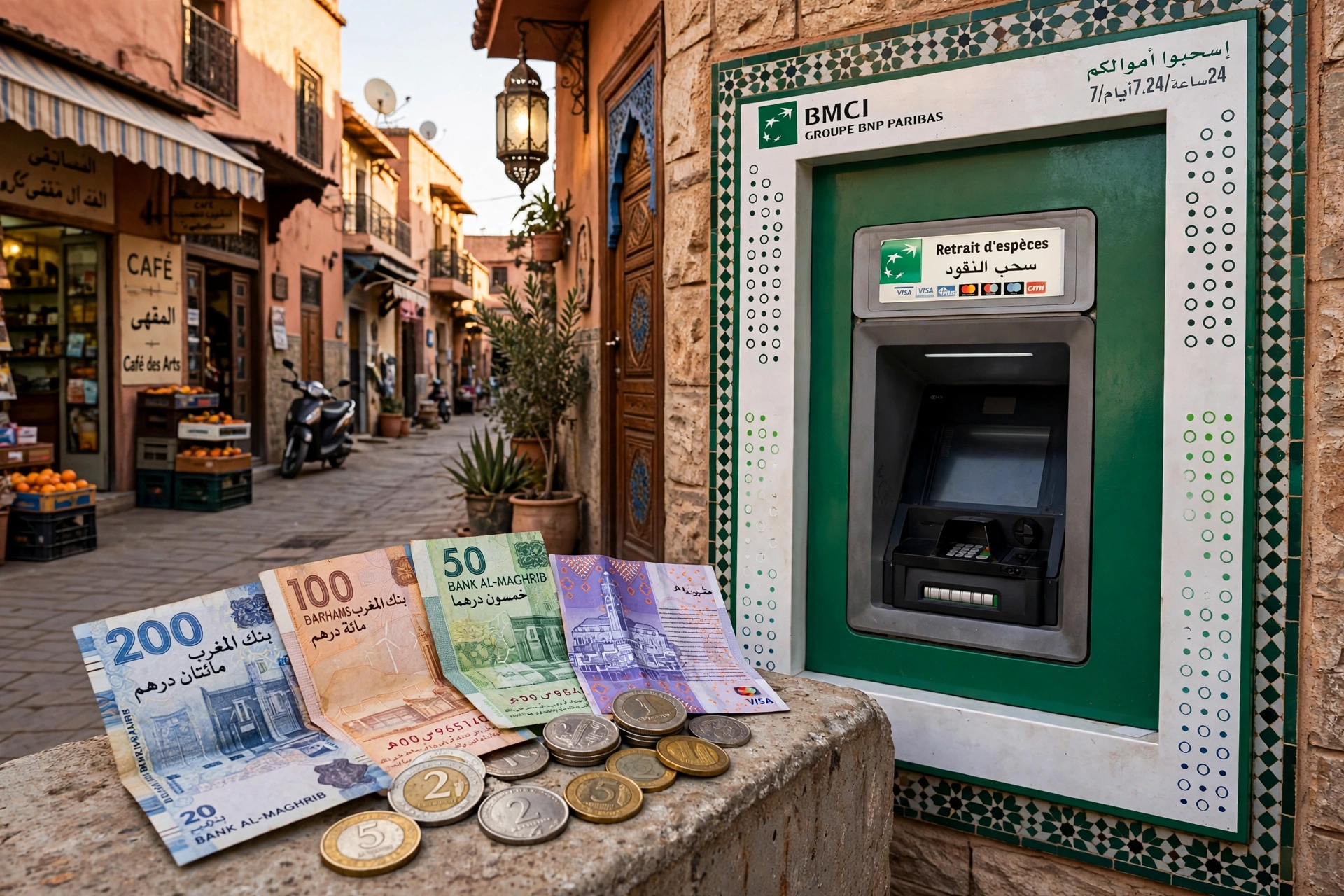
The currency of Morocco is the Moroccan dirham, written as MAD and often shown locally as DH or درهم. One dirham divides into 100 centimes, though centime coins are rarely used in daily life. Banknotes come in 20, 50, 100 and 200 dirham denominations, and coins in 1, 2, 5 and 10 dirhams, plus smaller 50-centime and 1-dirham pieces you will meet as change.
Morocco’s currency is a closed currency, which is the single most important fact in this morocco money dirham guide. You cannot buy dirhams at your home bank before you travel, and you cannot legally take large amounts of them out of the country. The export limit for tourists is generally understood to be around 2,000 MAD (about $200) — verify the current figure with Bank Al-Maghrib before you fly, because rules do change. What this means in practice is simple: arrive with euros, dollars or pounds, or a working bank card, and get your dirhams after you land.
The exchange rate floats, but for quick mental maths most travellers use 10 MAD to 1 USD (in reality it hovers a little under that, around 9.5–10 MAD per dollar). Prices in this guide use that round rate, with the real rate checked in November 2026.
Where to Get Dirhams: The Exchange Options Ranked
Not all exchange options are equal, and this morocco money dirham guide explains why: the difference between the best and the worst can cost you 10% of your money.
Banks and official bureaux de change
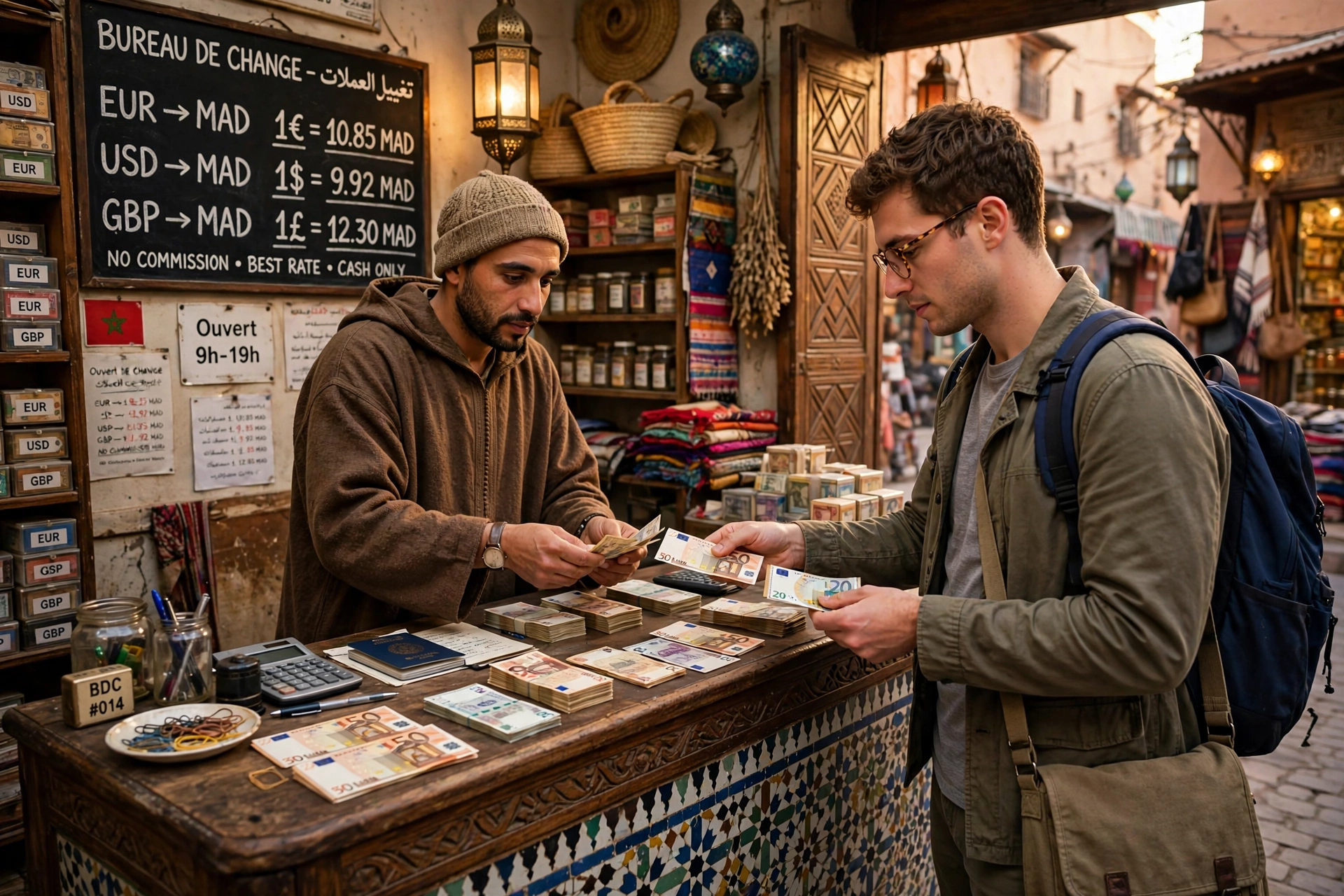
This morocco money dirham guide recommends banks first: the best rates in Morocco come from banks and licensed bureaux de change in town. Walk into any Attijariwafa Bank, BMCE Bank of Africa or CIH branch with your passport and you will get the official rate with a small, transparent commission. Licensed bureaux in the medinas and city centres are nearly as good and faster, with no queues. This is where locals exchange money, and it should be where you do too.
Airport exchange desks
The worst rate in the country is at the airport. Exchange desks at Casablanca Mohammed V and Marrakech Menara know you are tired, newly arrived and out of options, and their rates show it. If you must exchange at the airport, change only 200–300 MAD (about $20–30) for the taxi into town, then use a bank or bureau for the rest.
Hotels and riads
Hotels and riads will exchange money for you, usually at a rate between the bank and the airport. Convenient at midnight, expensive at noon. Use them only in an emergency.
| Exchange option | Typical rate | Best for |
|---|---|---|
| Bank in town | Official rate, small commission | Large amounts, best value |
| Licensed bureau de change | Near-official rate | Speed and convenience |
| Airport desk | 5–10% worse than official | Emergency taxi money only |
| Hotel / riad | 3–7% worse than official | Late-night emergencies |
ATMs in Morocco: What Works and What It Costs
This morocco money dirham guide starts with ATMs because Morocco has thousands of them, and they are the easiest way to get dirhams. Every city and most towns have them, and the machines of the big banks — Attijariwafa Bank, BMCE Bank of Africa, CIH Bank and Société Générale Maroc — reliably accept foreign Visa and Mastercard debit cards.
Fees and limits
As this morocco money dirham guide explains, your home bank may charge a foreign withdrawal fee, and the Moroccan ATM itself usually adds a local fee of 30–50 MAD (about $3–5) per withdrawal. That flat fee is why you should withdraw larger amounts less often: one 3,000 MAD withdrawal costs the same fee as a 500 MAD one. Daily withdrawal limits at Moroccan ATMs are typically 2,000–4,000 MAD (about $200–400), depending on the bank and your own card’s limit. If the machine offers to convert the withdrawal into your home currency, always decline and choose dirhams — the machine’s conversion rate is a bad deal, a trick known as dynamic currency conversion.
If your card is swallowed
It happens, rarely. Stay calm, note the ATM’s bank and location, and call the number printed on the machine or walk into the nearest branch of that bank the next morning. Your card is usually retrievable, but it can take a day or two, so always carry a backup card from a different bank and some emergency cash.
Paying by Card: Where It Works and Where It Does Not
This morocco money dirham guide is clear on cards: they work well in Morocco’s formal economy and not at all in its informal one. Hotels, larger restaurants, supermarkets, petrol stations and chain shops take Visa and Mastercard without fuss. American Express is accepted in a few high-end hotels and almost nowhere else — do not rely on it.
The souks, the petit taxis, the street food stalls, the mountain villages and most small cafés are cash-only. A good rule from this morocco money dirham guide: carry enough cash for the day’s food, transport and small purchases, and keep the card for hotels and bigger bills. If a shop’s card machine is “broken”, it often means the owner prefers cash — smile, pay cash, and move on.
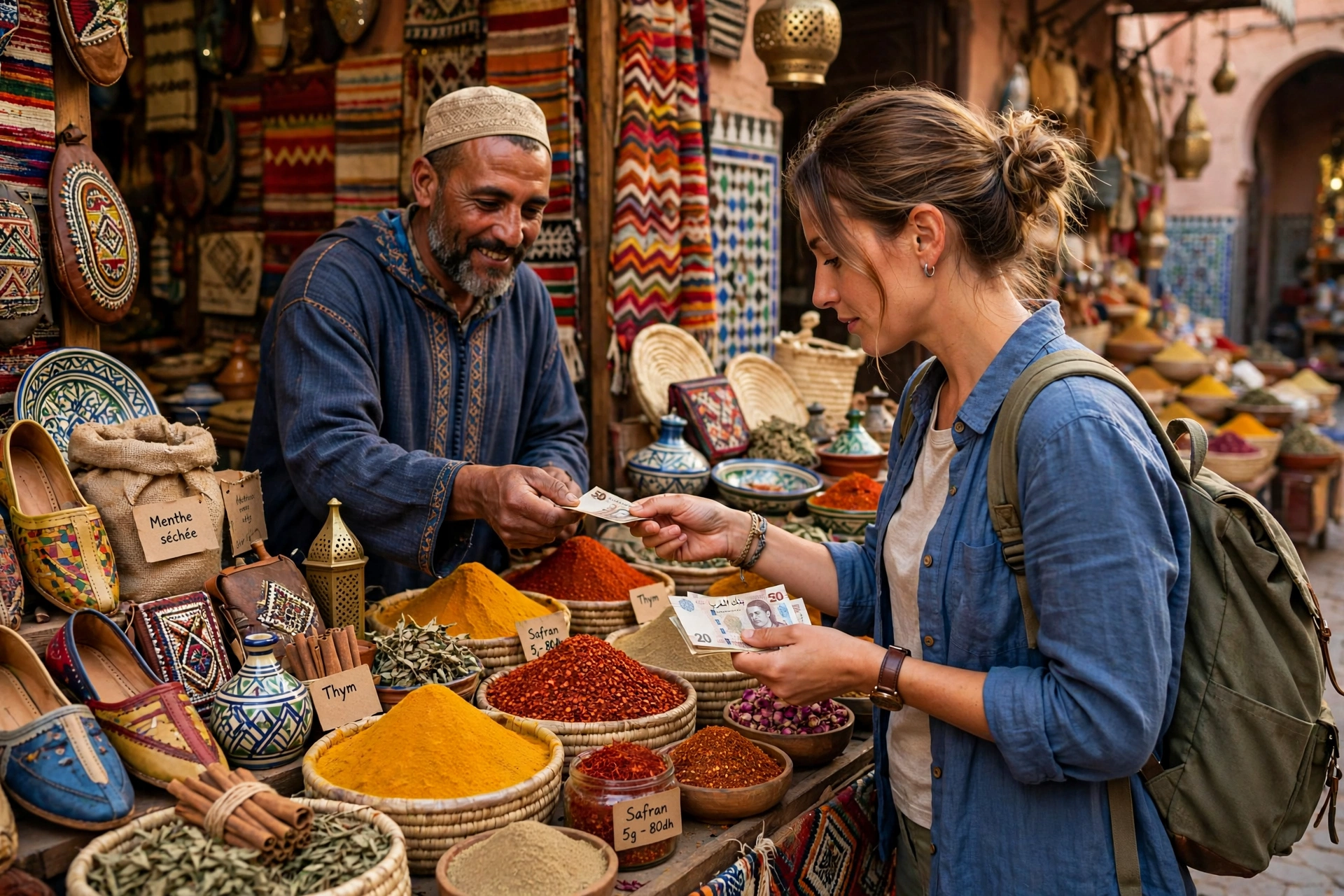
When you pay by card, always choose to be charged in dirhams (MAD), never in your home currency. The terminal will offer; the home-currency option costs you 3–5% more through a poor exchange rate.
Tipping in Morocco: The Rules Nobody Tells You
Tipping in Morocco is real, expected in service situations, and much smaller than anxious visitors assume. The insider correction in this morocco money dirham guide: tourists routinely over-tip 20% because that is the habit at home, while Moroccans themselves round up or leave a few dirhams. Over-tipping does not buy better service; it marks you as a first-timer and quietly raises the price of everything after it.
| Situation | What to tip |
|---|---|
| Petit taxi | Round up to the nearest 5 MAD |
| Restaurant (no service charge) | 10–15% of the bill, or 10–20 MAD |
| Café waiter | 2–5 MAD, or round up the bill |
| Porter / hotel staff | 10–20 MAD per bag or favour |
| Tour guide (half day) | 100–200 MAD, at your discretion |
| Hammam attendant | 20–30 MAD |
| Petrol station attendant | 5–10 MAD if they help |
As this morocco money dirham guide notes, do not tip at pharmacies, fixed-price cooperatives or supermarkets — nobody does, and trying marks you out instantly.
How Much Cash Should You Carry Each Day?
It depends on your style, but this morocco money dirham guide sets out daily cash budgets that cover food, transport and small purchases for most travellers. Hotels are usually paid by card, so they are excluded here.
| Travel style | Daily cash (MAD) | Daily cash (USD) |
|---|---|---|
| Budget backpacker | 150–300 MAD | $15–30 |
| Mid-range traveller | 300–600 MAD | $30–60 |
| Comfort traveller | 600–1,000 MAD | $60–100 |
For more detail on overall trip costs, see our guide to how much a trip to Morocco costs, and for the bigger picture of monthly life, the cost of living in Morocco pillar. If you are still planning your route, start with the Morocco travel guide for first-time visitors, and if you are arriving by train, read our guide to getting around Morocco first — it explains which journeys are cash-only and which you can book by card.
Money Scams to Watch For
Morocco is safe for money, but small scams exist. Here are the five this morocco money dirham guide warns every friend about:
- The “closed” exchange office. A stranger tells you the bureau you are walking to is closed and steers you to his friend’s shop with a terrible rate. Walk on; the bureau is open.
- The helpful ATM stranger. Someone offers to help you at the ATM. Never accept — it is a setup for card skimming or a distraction theft. Use the machine alone.
- Dynamic currency conversion. The card terminal or ATM offers to charge you in your home currency “for convenience”. It is never convenient; always choose MAD, as this morocco money dirham guide recommends.
- The torn banknote trick. A taxi driver or shopkeeper refuses your 100 MAD note, claiming it is torn or fake, and swaps it for a genuinely torn one while you are distracted. Check your change before you walk away.
- The “no change” routine. A driver claims to have no change for your 200 MAD note. Carry small notes and coins, especially 20s and 50s, for taxis and small purchases.
Frequently Asked Questions
Can I buy Moroccan dirhams before I travel?
No. The dirham is a closed currency and is not sold outside Morocco. Bring euros, dollars or pounds, or a debit card, and exchange or withdraw after you arrive.
What is the best way to get dirhams in Morocco?
As this morocco money dirham guide explains, withdraw from a bank ATM in town, or exchange cash at a bank or licensed bureau de change. Avoid airport desks except for a small emergency amount.
Do ATMs in Morocco accept foreign cards?
Yes. ATMs of Attijariwafa Bank, BMCE Bank of Africa, CIH Bank and Société Générale Maroc accept foreign Visa and Mastercard debit cards. Expect a local fee of 30–50 MAD (about $3–5) per withdrawal and daily limits of 2,000–4,000 MAD.
Can I pay by card in Morocco?
This morocco money dirham guide puts it simply: in hotels, larger restaurants, supermarkets and petrol stations, yes. In souks, petit taxis, street stalls and rural areas, no — carry cash.
How much should I tip in Morocco?
Round up petit taxi fares to the nearest 5 MAD, leave 10–15% in restaurants without a service charge, and 10–20 MAD for porters. You do not tip 20% as a rule — locals do not, and neither should you.
Can I take dirhams out of Morocco?
Only a small amount — the tourist export limit is generally around 2,000 MAD (about $200). Spend or exchange your remaining dirhams before departure, and verify the current limit with Bank Al-Maghrib.
Final Word
Money in Morocco rewards a little preparation and punishes none at all. Bring a card and some hard currency, withdraw dirhams from a proper bank ATM, pay in MAD whenever a terminal offers a choice, carry small notes for taxis and souks, and tip like a local — a few dirhams, not a percentage copied from home. Follow this morocco money dirham guide and the money side of your trip will be the least of your worries. The country is generous with its beauty; make sure your wallet is ready to enjoy it.
All prices in this morocco money dirham guide are in Moroccan dirhams with US dollar equivalents at roughly 10 MAD to 1 USD, checked November 2026.
1 thought on “Money in Morocco: The Complete Dirham Guide — ATMs, Cards, Tipping and Cash Rules”