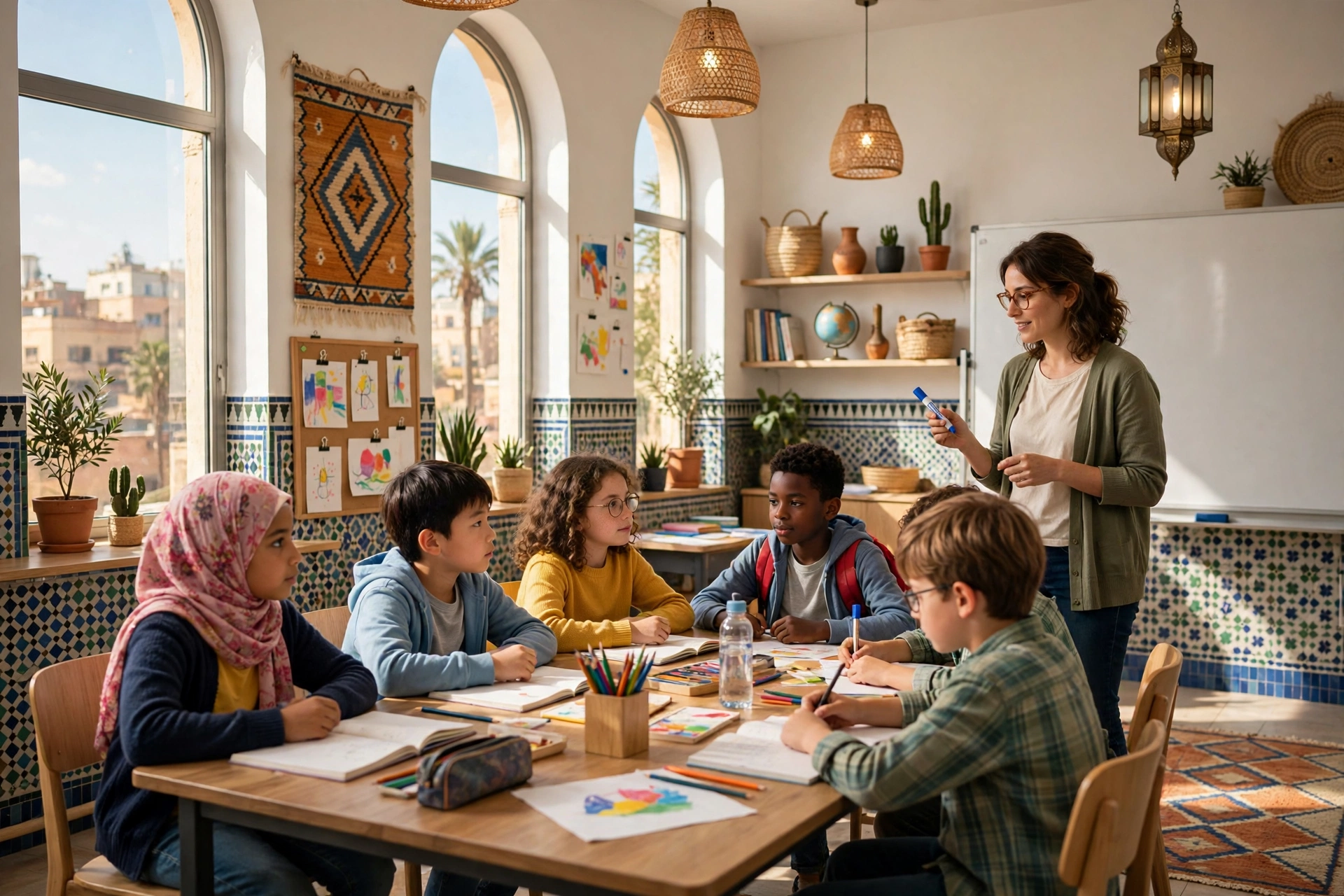
Choosing a school is usually the first big decision an expat family makes in Morocco: it shapes where you live, what language your children speak, and how quickly they settle in. This guide to schools in morocco expat families rely on is written from the inside, not from a brochure, covering the real options, costs and trade-offs.
Most guides list the same handful of big-name schools and stop there. That misses the point. In Morocco, the French mission schools dominate, good Moroccan private schools are far cheaper and often genuinely bilingual, and the real decision is not fees alone. It is the language trajectory you choose for your child, and the right choice for a two-year stay differs from the right choice for a family putting down roots.
In this guide:
- Public vs private Moroccan schools
- International schools: French, American and British systems
- School fees in MAD and USD
- Language of instruction: Arabic and French
- Admissions, timeline and documents
- School calendar and holidays
- Transport and school buses
- Special needs and learning support
- Choosing by city
- Frequently asked questions
- Conclusion
Public vs Private Moroccan Schools for Expat Families
Moroccan public schools are free, teaching in Arabic with French as a second language. For most expat families they are not the practical first choice: classes are large, often 35 to 40 pupils, and the curriculum follows the national system. A child who already speaks Arabic can make it work, especially at primary level, but a newcomer with no Arabic faces a very steep start.
Moroccan private schools are where many expat families find the best value. Fees are far lower than at international schools, classes are smaller, and many are bilingual in Arabic and French, with English growing fast. Quality varies, though, so visit before you commit, sit in on a lesson, and talk to other parents.
The trade-off: a Moroccan private school gives local friendships, Arabic and French, and a much lower bill, while an international school gives a familiar curriculum, an easier transfer abroad, and a ready-made expat community. What matters is how long you will stay, how your child learns languages, and whether integration or continuity matters most.
International Schools in Morocco: French, American and British Systems
The French system dominates expat schooling in Morocco, and any honest guide to schools in morocco expat families choose must start there. The AEFE network and the OSUI group run the best-known French schools, including the Lycée Lyautey in Casablanca, the Lycée Descartes in Rabat, and Lycée Victor Hugo in Marrakech. They follow the French national curriculum, teach in French, and lead to the baccalauréat. Places are sought after, waiting lists are real, and priority often goes to French nationals and siblings. The Agency for French Education Abroad (AEFE) publishes the official network list.
American schools are fewer but well established. The American School of Casablanca, the American School of Marrakech, and the American School of Tangier offer US-style curricula and Advanced Placement courses, and in some cases the International Baccalaureate. Teaching is in English, which suits families moving next to an English-speaking country. Fees are usually the highest in the country, and popular year groups fill fast — a fact every shortlist of schools in morocco expat families compare should note.
British schools are the smallest group. The British International School of Casablanca and a handful of smaller schools follow the English National Curriculum and Cambridge examinations, suiting families heading back to the UK. They tend to be smaller and more personal than the big French lycées. A growing number also offer the International Baccalaureate, a portable diploma. Visit more than one type: a school that looks perfect on paper can feel wrong in person.
How Much Do Schools Cost? Fees in MAD and USD
Fees vary by school, city and year, so treat the figures below as ranges, not quotes. Confirm the current schedule directly with the school, and ask what is included: transport, lunch, activities, books and exam fees are often charged separately. Prices were checked November 2026, at about 10 MAD to 1 USD, and comparing schools in morocco expat families shortlist on total cost, not headline fees, is what matters.
| School type | Typical annual fees (MAD) | Approximate USD | Language | Best for |
|---|---|---|---|---|
| Moroccan public school | Free | $0 | Arabic, French as second language | Arabic-speaking families, long-term immersion |
| Moroccan private school | 15,000–60,000 MAD | $1,500–$6,000 | Arabic and French, some English | Value, bilingualism, local friendships |
| French mission school (AEFE / OSUI) | 30,000–75,000 MAD | $3,000–$7,500 | French | French curriculum, baccalauréat, large community |
| American international school | 90,000–200,000 MAD | $9,000–$20,000 | English | US curriculum, AP, IB, English-speaking families |
| British international school | 80,000–180,000 MAD | $8,000–$18,000 | English | UK curriculum, IGCSE and A-levels |
| IB school | 90,000–200,000 MAD | $9,000–$20,000 | English, sometimes French | Portable diploma, globally mobile families |
Budget beyond tuition at schools in morocco expat families choose. Registration fees run from 2,000 to 15,000 MAD, many schools charge a one-off joining fee, and buses cost roughly 6,000 to 15,000 MAD a year. Lunch, uniforms, books, trips and clubs add up, so ask for the full annual cost in writing before you sign — a step every comparison of schools in morocco expat families make should include. Our living in Morocco expat guide sets out the wider cost of life, and our guide to opening a bank account in Morocco as a foreigner helps you plan how to pay.
Language of Instruction: The Arabic and French Reality
Language is the decision that matters most, and the one families underestimate. Morocco is multilingual: Darija is the language of the street, Modern Standard Arabic is the language of schoolbooks, French is the language of business and much of secondary education, and English is rising fast. A child in a French school lives in French all day; in an American school, in English, with French and Arabic as subjects. That contrast sits at the heart of choosing schools in morocco expat families will be happy with for years.
Be honest about your child’s starting point. A seven-year-old picks up a new language fast, with play, friends and a patient teacher. A fourteen-year-old arriving with no French into a French lycée faces a much harder year, and some schools will be frank about that. Ask how each school supports non-French speakers: a bridging class, extra French lessons, or a phased entry? The best schools have a clear answer; vague reassurance is a warning sign.
Think about the exit as well as the entry. If your child will sit exams in French, they need strong written French, not just playground French. If they will return to an English system, they need to keep their English reading and writing sharp, even if the school day is in French. Many parents keep English alive at home through reading and writing in English, which protects your child’s options later.
Admissions: Timeline, Waiting Lists and Documents
Start early. For popular French mission schools, applications for the following September often open the previous autumn, and nursery and primary places fill first. American and British schools also advise applying six to nine months ahead, and mid-year entry depends on a place opening up. Ask your employer about reserved places. Early planning widens your choice among schools in morocco expat families apply to.
Expect an assessment, not just a form. Most international schools ask for previous reports and test in maths and in the language of instruction. Younger children may have a play-based observation session instead. Prepare your child by explaining what will happen, and bring reports translated into French or English if needed.
Gather the paperwork early. Schools commonly ask for passport copies, a birth certificate, previous reports, vaccination records, photos, and proof of residence; some ask for a residence permit or employer letter. Keep digital copies and check each school’s own list. If you have not sorted housing, our guide to renting an apartment in Morocco explains the landlord paperwork, which overlaps with what schools in morocco expat families contact need for proof of address.
Waiting lists are real, and the hardest part of the process: the most popular year groups at the big French schools can have lists a year long. Apply to more than one school, accept a good second choice if you need to, and stay in touch with admissions. Families do get places over the summer as others move on, and flexibility on dates or campus helps.
School Calendar and Holidays
The school year at schools in morocco expat families use usually starts in early September and ends in late June or early July. French mission schools follow a calendar close to the French system, with autumn, Christmas, winter and spring breaks. Moroccan private schools follow the national calendar set by the Moroccan Ministry of National Education, with breaks around religious holidays. American and British schools set their own calendars.
Religious holidays shift each year with the lunar calendar. Eid al-Fitr, Eid al-Adha and the Prophet’s birthday bring closures, and during Ramadan many schools shorten hours and start later. Plan travel around the published calendar, and do not assume a holiday at home is a holiday in Morocco.
Transport, School Buses and the Daily Commute
Most expat families relying on schools in morocco expat families choose use the school bus, a private driver, or both, and transport is one of the first questions schools in morocco expat families ask about. Buses are the standard option at international schools, with set routes and a monitor on board. They are safe and social, and for many children the bus ride is where friendships form. The cost is billed separately and routes fill up, so register for transport when you register for the school place.
Traffic in Casablanca and Rabat is heavy at school-run times, so where you live matters as much as which school you choose: twenty minutes on a map can be fifty at 7:45 in the morning. Many families choose their neighbourhood after the school, not before, and that is sensible when you compare schools in morocco expat families are weighing up. Our guide to the best places to live in Morocco compares the main expat neighbourhoods by city.
Special Needs and Learning Support: An Honest Picture
This is where honesty matters most. Provision for special educational needs in Morocco is limited compared with the UK, the US or northern Europe, and varies hugely by school. Larger international schools usually have a learning support team, and some support mild dyslexia, English as an additional language, and speech and language needs. Very few are equipped for complex needs or full-time one-to-one provision, and some will be upfront that they cannot meet a child’s needs — a hard truth in any search for schools in morocco expat families with additional needs must face.
If your child has a diagnosis, an education plan, or regular therapy, talk to the school before you apply, not after. Share the reports, ask exactly what support is available, who delivers it, and what it costs. Some support is included in fees; a shadow teacher or outside therapy is usually charged extra. Check whether your health cover includes speech therapy or educational psychology in Morocco, and read our guide to healthcare in Morocco for expats before deciding what care you will need locally.
For many families the practical answer is a combination: one of the schools in morocco expat families choose, with a good support teacher, plus private therapy outside school hours. Rabat and Casablanca have the widest choice of English- and French-speaking therapists. Be realistic, ask direct questions, and do not accept a vague promise of support. A school honest about its limits is more trustworthy than one that promises everything.
Choosing by City: Casablanca, Rabat, Marrakech, Tangier and Agadir
Casablanca has the widest choice of any city: the Lycée Lyautey, the American School of Casablanca, the British International School and many strong Moroccan private schools, plus the most therapists and tutors. The trade-off is traffic and scale — commutes are long and the best schools are spread out — so choose the neighbourhood first, or be ready for a long bus ride.
Rabat suits families who want a calmer city with strong schools. The Lycée Descartes, the International School of Rabat and several good bilingual private schools serve the diplomatic community, and the city is smaller and easier to navigate than Casablanca. Many families find Rabat the easiest city to settle in with school-age children, and the choice of schools in morocco expat families consider here is strong without being overwhelming.
Marrakech has fewer international schools, but they are well regarded, including the American School of Marrakech and Lycée Victor Hugo. The city suits families who value sunshine and a slower pace, and the expat community is close-knit — check places early, as choice is narrower. Tangier has the historic American School of Tangier and a growing set of private schools, with a northern, Mediterranean feel. Agadir has the smallest international offer, with good Moroccan private schools and a relaxed coastal life, but families needing a specific curriculum should check provision carefully.
Frequently Asked Questions
Do my children need to speak French to attend school in Morocco?
Not always, but it helps enormously. American and British schools teach in English, so no French is needed to start. French mission schools teach in French and usually expect some French, or offer bridging support for younger children. Moroccan private schools vary, so ask each school directly and be realistic about your child’s age and confidence.
How much do international schools in Morocco cost?
Most of the schools in morocco expat families pay for charge 80,000 to 200,000 MAD a year, roughly $8,000 to $20,000 at the November 2026 rate of about 10 MAD to the dollar. French mission schools are usually cheaper, at roughly 30,000 to 75,000 MAD, and Moroccan private schools are cheapest, often 15,000 to 60,000 MAD. Fees vary by school and year, so confirm the current schedule and ask what is included.
What is the best school in Morocco for expat children?
There is no single best school among the schools in morocco expat families consider. The best choice depends on your child’s age, language, curriculum needs and how long you will stay. French families usually choose an AEFE or OSUI school, families heading to the US choose an American school, and families heading to the UK choose a British school. Visit at least three schools in morocco expat families recommend, talk to parents, and trust the visit more than any ranking.
When should expat families apply to schools in Morocco?
Apply six to nine months before you need a place at the schools in morocco expat families target, and earlier for the most popular French schools. Applications for September often open the previous autumn. Apply to more than one school, because waiting lists are common. Mid-year entry is possible when a place opens up, but it is never guaranteed.
Will my child learn Arabic at school in Morocco?
Yes, in most schools in morocco expat families send their children to. Moroccan private schools teach Arabic as a core subject, and the best schools in morocco expat families choose for language learning teach it every day. French mission schools teach it as a language subject, with hours varying by school and level. American and British schools usually offer Arabic as a foreign language, sometimes alongside French. If Arabic matters, ask how many hours are taught and whether the focus is Darija, Modern Standard Arabic, or both.
Can we change schools if the first choice does not work out?
Yes, and many families do. Schools are used to mid-year and end-of-year moves. The main limits are places and timing: popular year groups fill up, and a change is easier at the end of a school year than in the middle of one. Keep your child’s reports, and give the new school time to assess them properly.
Conclusion
Choosing among the schools in morocco expat families weigh up is not about finding a perfect school, and the best schools in morocco expat families settle into are the ones that fit the child, not the brochure. It is about matching a school to your child, your language plan and your length of stay. Start with the language trajectory, visit the schools, ask hard questions about support and waiting lists, and budget the full cost, not just the headline fee. Do that, and you will find a place where your child can settle, make friends and learn, and where Morocco starts to feel like home.
Sources: Agency for French Education Abroad (AEFE); Moroccan Ministry of National Education, Preschool and Sports. School fees checked November 2026; fee ranges vary by school and year — confirm the current schedule directly with each school.