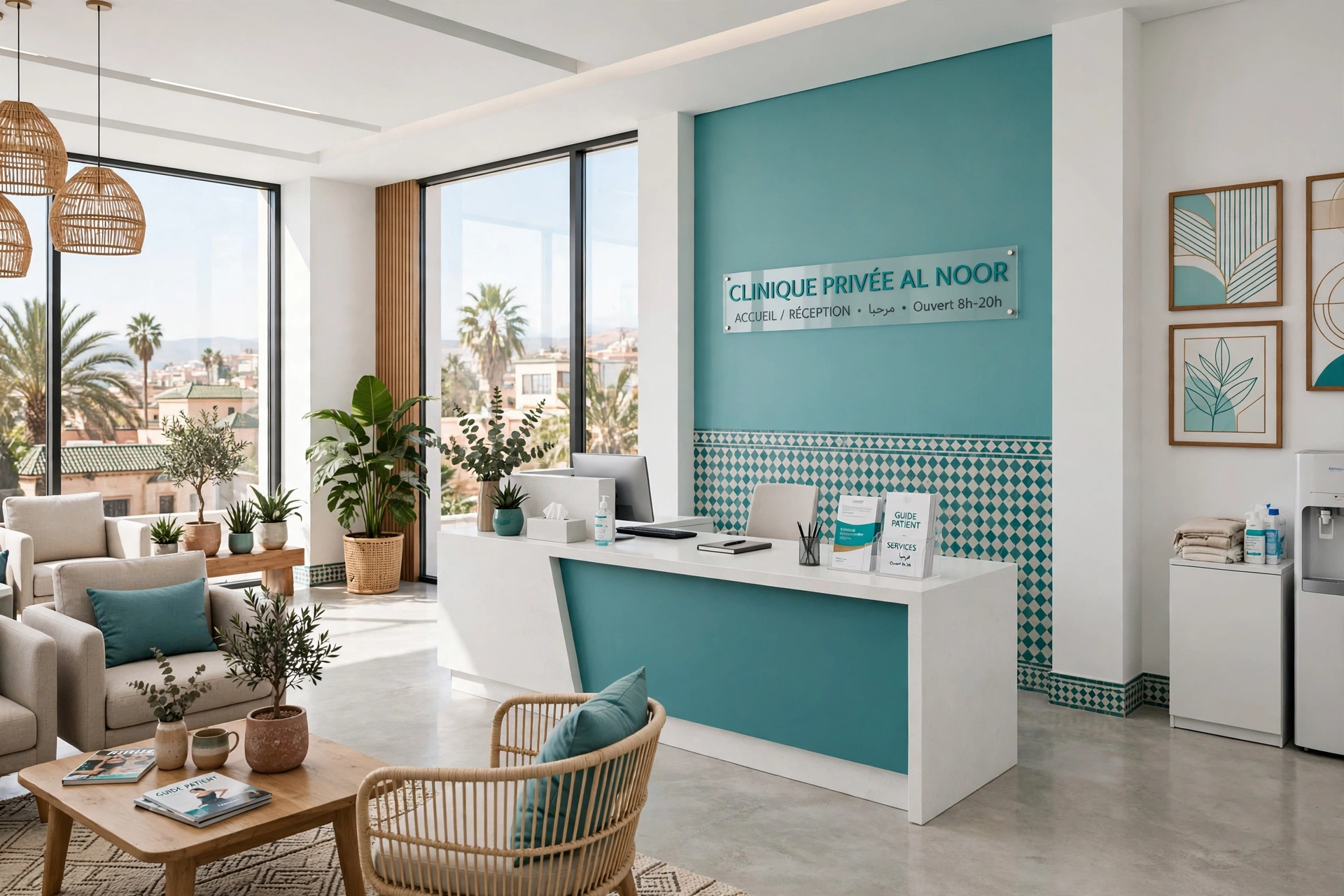
If you are planning a long stay in Morocco, understanding healthcare in Morocco expats face in practice matters more than any brochure promise. The good news is reassuring: in Casablanca, Rabat, Marrakech, Tangier and Fes, private clinics offer modern equipment, well-trained doctors and short waiting times. The real gap is not quality in the big cities. It is that public hospitals are crowded and run almost entirely in French and Arabic, while good private clinics expect payment up front — and the pharmacy on the corner is where most Moroccans go first for everyday health problems.
This guide explains how the system actually works, what it costs in dirhams, and how to protect yourself before you need care. Think of it as the practical handbook for healthcare in Morocco expats wish they had read before moving.
In this guide
- Healthcare in Morocco Expats: The Two Systems at a Glance
- Public Hospitals: Cheap, Capable, Crowded
- Private Clinics and Hospitals: Where Most Expats Go
- Health Insurance: CNSS, AMO and International Cover
- Pharmacies: Your First Port of Call
- What Healthcare Costs: Typical Prices
- Emergencies: Numbers to Save Now
- Language, Culture and Getting Seen
- Medical Evacuation: When to Leave Morocco
- A Practical Checklist Before You Arrive
- Frequently Asked Questions
- Conclusion
Healthcare in Morocco Expats: The Two Systems at a Glance
Morocco runs two parallel health systems, and knowing which one you are dealing with changes everything about your experience. The public system is run by the Ministry of Health and covers the whole country through university hospitals (CHU), regional hospitals and local health centres. Care is cheap — often nearly free for residents who hold the mandatory health cover known as AMO — but waiting rooms are crowded, appointments can take weeks, and almost nobody on staff speaks English.
The private sector, by contrast, is built around clinics and polyclinics in the big cities, many of them modern, well equipped and used to foreign patients. This is the split that shapes healthcare in Morocco expats must navigate: public care is cheap but slow, while private care is fast but paid up front. This is where most expats end up, and where the question of healthcare in Morocco expats arrange for themselves is usually answered: you pay, you get seen quickly, and you claim the money back from your insurer afterwards.
For a serious emergency, a big-city private clinic or a university hospital is your best bet. For a sore throat or a repeat prescription, the pharmacist is faster and cheaper than either.
Public Hospitals: Cheap, Capable, Crowded
Public hospitals in Morocco are staffed by capable doctors — many trained in France or Belgium — and the large university hospitals in Casablanca, Rabat, Marrakech and Fes handle complex surgery, oncology and trauma every day. They are the backbone of healthcare in Morocco expats rarely use by choice, but may need in an emergency. The problem is access, not competence.
Waiting times are long. A non-urgent specialist appointment in the public system can take weeks or even months, and consultations are brief. Wards are busy and basic: you may share a room with several other patients, and families are often expected to help with day-to-day care such as bringing food or staying overnight with a relative.
Language is the other barrier. Consultations happen in French or Darija (Moroccan Arabic). English is rare outside the big university hospitals, so bring a French-speaking friend, a translation app, or a local fixer if your French is limited. For anyone researching healthcare in Morocco expats rely on day to day, this language gap is the single most underestimated difficulty.
That said, public emergency departments do treat everyone who arrives, including foreigners, and the ambulance service will take you to the nearest public hospital. If you are seriously ill or injured and far from a private clinic, do not hesitate: go public, stabilise, and transfer later if you wish.
Private Clinics and Hospitals: Where Most Expats Go
Private clinics are the backbone of expat healthcare in Morocco. In Casablanca and Rabat especially, you will find modern polyclinics with MRI and CT scanners, laboratories that return blood results the same day, and specialists who trained abroad. Marrakech, Tangier, Agadir and Fes each have at least one well-regarded private clinic, and standards in these cities are genuinely good.
The trade-off is money. Private clinics expect payment at the time of treatment — by card or cash — and then give you an itemised invoice to claim from your insurer. A private GP consultation typically costs 150–300 MAD (about $15–30), a specialist 300–600 MAD (about $30–60), and a private hospital room 800–2,000 MAD per night (about $80–200), all checked November 2026. Surgery and imaging cost far more, which is why insurance is not optional.
Choose your clinic before you need one. For healthcare in Morocco expats who live in Casablanca or Rabat, the choice is wide; in smaller cities, research your options before you move. Ask other expats which clinic they use, check that it has a 24-hour emergency department, and save its number in your phone. In Casablanca, the big private groups have English-speaking staff at reception; in smaller cities, French remains the working language. When you compare healthcare in Morocco expats actually use, the pattern is consistent: one trusted private clinic, one trusted GP, and a pharmacy you know by name.
Health Insurance: CNSS, AMO and International Cover
AMO — the mandatory basic cover
Morocco’s mandatory health insurance scheme is called AMO (Assurance Maladie Obligatoire). Employees are covered through the CNSS (for private-sector workers) or the CNOPS (for public-sector workers), with contributions deducted from salary. AMO is part of healthcare in Morocco expats employed locally will encounter automatically, since enrolment comes with the job.
Self-employed residents can also join AMO under a separate scheme. AMO reimburses a percentage of public-sector tariffs — typically around 70% of the official rate — which means it covers much of the bill in a public hospital but leaves a significant gap in a private clinic, where real prices are higher than the official tariffs.
What AMO does not do
AMO is not a complete solution for an expat. Reimbursements are based on public tariffs, paperwork is in French and Arabic, claims can be slow, and cover for treatment abroad is very limited. Many long-stay foreigners find that AMO alone leaves them exposed to large private bills.
International health insurance
For most expats, the practical answer is an international health insurance policy taken out before arrival, ideally one that covers Morocco specifically and includes direct billing or a clear reimbursement process, emergency evacuation, and repatriation.
This is why healthcare in Morocco expats arrange for themselves usually means an international policy, not reliance on AMO alone. Check three things before you buy: that Morocco is not excluded, that the policy covers outpatient care as well as hospital stays, and that the insurer has a network or a claims process that works with Moroccan clinics. Keep your policy number and the insurer’s emergency helpline in your phone and in your wallet.
If you are employed in Morocco, ask your employer exactly what is covered — some international companies provide a top-up policy on top of CNSS that makes private care affordable. Retirees should read our guide to Retiring in Morocco for the longer-term picture, including how healthcare fits into a retirement budget.
Pharmacies: Your First Port of Call
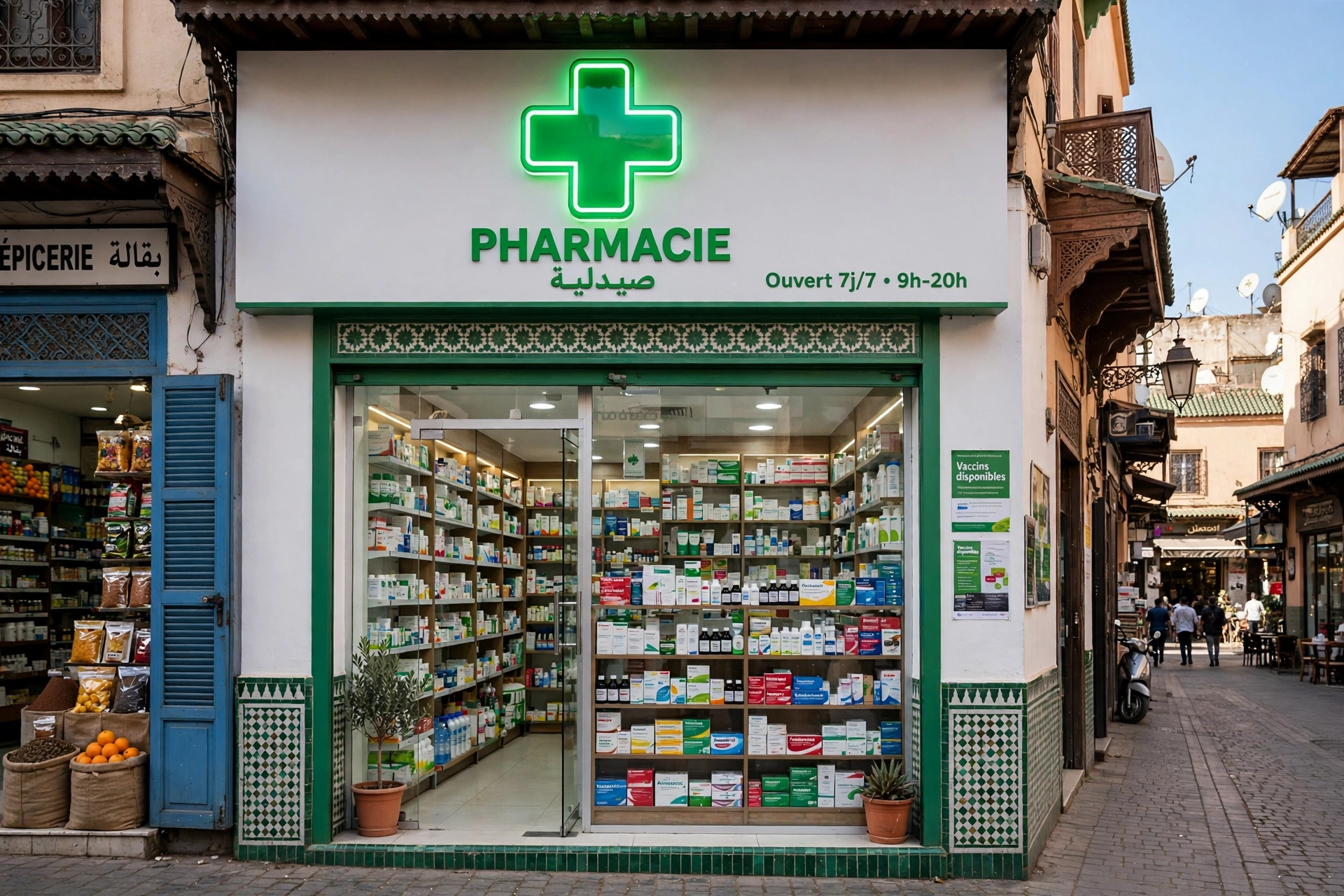
Here is the insider truth about healthcare in Morocco expats discover quickly: pharmacies are the first port of call for most Moroccans, and they should be yours too. Pharmacies are everywhere — every neighbourhood has several — and they are marked by the familiar green cross, lit up at night.
Moroccan pharmacists are well trained and, for minor ailments, they will advise you directly, sell you what you need, and tell you honestly when you need a doctor instead. For everyday problems, the healthcare in Morocco expats get from a pharmacist is often faster than a clinic visit, and far cheaper. Many common medicines are available without a prescription, and prices are regulated and low by European standards: a course of basic antibiotics or a box of common painkillers often costs 30–80 MAD (about $3–8), checked November 2026.
Most pharmacies keep long hours, and every area has a pharmacie de garde — a duty pharmacy open through the night and on holidays, listed on the door of every pharmacy and in local newspapers. Bring the brand name or, better, the generic name of any medicine you take regularly, and bring your prescription if you have one; the pharmacist can usually find the Moroccan equivalent.
One warning: do not buy medicines from street sellers or unlicensed shops. Counterfeit drugs exist, and the pharmacy green cross is your guarantee of a regulated supply.
What Healthcare Costs: Typical Prices
The table below gives the ranges you can realistically expect to pay in a private clinic in a big Moroccan city. These are the prices that shape healthcare in Morocco expats budget for once they live here. Prices in smaller towns are usually lower, and public hospitals are far cheaper. All figures checked November 2026; exact prices vary by clinic and city.
| Service | Typical price (MAD) | Approx. USD |
|---|---|---|
| Private GP consultation | 150–300 MAD | $15–30 |
| Specialist consultation | 300–600 MAD | $30–60 |
| Blood tests (basic panel) | 200–500 MAD | $20–50 |
| X-ray | 200–400 MAD | $20–40 |
| Ultrasound scan | 300–600 MAD | $30–60 |
| MRI scan | 2,000–4,000 MAD | $200–400 |
| Dental check-up and cleaning | 300–600 MAD | $30–60 |
| Private hospital room, per night | 800–2,000 MAD | $80–200 |
| Common medicines at a pharmacy | 30–150 MAD | $3–15 |
Always ask for an estimation (a written quote) before any planned procedure, and always keep the itemised invoice — your insurer will need it. If a clinic refuses to give you a written estimate, consider that a warning sign.
Emergencies: Numbers to Save Now
Save these numbers in your phone today, before you need them:
- 15 — SAMU, the medical emergency service and ambulances
- 19 — Police
- 112 — The European-style emergency number, which also works in Morocco
If you call 15, describe the location in French or Arabic if you can; the operator will dispatch an ambulance to the nearest suitable hospital, which is usually a public one. In a crisis, the healthcare in Morocco expats receive starts with the SAMU ambulance, so the number matters more than the name of the hospital. Private clinics also run their own ambulance services — ask your chosen clinic for its direct number and save that too.
In an emergency, do not worry about insurance paperwork. Go to the nearest hospital, get stabilised, and sort out the billing afterwards. Bring your passport, your insurance card and a list of your medicines and allergies — ideally written in French. If you are alone, call a friend or your embassy’s emergency line and ask them to come to the hospital: having someone who speaks French at your bedside makes an enormous difference.
Language, Culture and Getting Seen
French is the language of Moroccan medicine. Doctors, nurses, pharmacists and receptionists in the private sector almost always speak French; Arabic is universal; English is common only in the big-city private clinics and among younger doctors. Language is part of healthcare in Morocco expats must plan for, not an afterthought. If your French is weak, learn the essentials: your symptoms, your allergies, your medicines, and the phrase “Je suis allergique à…” (I am allergic to…).
Appointments work differently from northern Europe. Walk-ins are normal at GP practices and pharmacies, and private specialists often see patients the same week. Bring cash or a card — clinics rarely invoice later. Doctors are respected figures here, and a polite, patient manner gets you further than a demanding one. Dress modestly for hospital visits.
Medical Evacuation: When to Leave Morocco
For most conditions, Morocco’s big-city hospitals are more than adequate. But for very specialised treatment — complex cancer care, rare diseases, major neurosurgery — you may be better served in Europe, and your insurance should cover medical evacuation to France or Spain. Casablanca is under four hours from Paris by air, which makes evacuation a realistic option rather than a remote fear.
Check that your policy explicitly includes medical evacuation and repatriation, and that you know the procedure: usually you call the insurer’s emergency line first, and they arrange the transfer. Evacuation cover is the part of healthcare in Morocco expats most often forget to check — until they need it. Do not assume evacuation is automatic — it needs the insurer’s approval, and they will want a report from the treating doctor.
A Practical Checklist Before You Arrive
This checklist covers the essentials of healthcare in Morocco expats should sort out before arrival.
- Take out international health insurance that covers Morocco, including evacuation.
- Ask your doctor at home for a letter summarising your conditions and medicines, translated into French.
- Bring a three-month supply of any regular prescription medicine, plus the prescription itself.
- Choose a private clinic near your home before you need one; save its number.
- Find your nearest pharmacy and note the pharmacie de garde rota.
- Save 15, 19 and 112 in your phone.
- Keep a card in your wallet, in French, listing your blood group, allergies and medicines.
Getting settled also means getting the practical basics right. If you are still finding a home, read Renting an Apartment in Morocco alongside this guide — living near a good clinic is worth factoring into where you choose to live. For the full picture of settling in, start with our pillar guide Living in Morocco: The Complete Guide for Expats and Long-Stay Visitors.
Frequently Asked Questions
Is healthcare in Morocco good for expats?
Yes, in the big cities. For healthcare in Morocco expats living in Casablanca, Rabat or Marrakech, the standard of private care is genuinely high. Private clinics in Casablanca, Rabat, Marrakech, Tangier and Fes are modern and well equipped, and many doctors trained in France or Belgium. Outside the big cities, quality drops sharply, so location matters. The honest summary of healthcare in Morocco expats experience is: excellent private care where it exists, a crowded public system everywhere else.
Do I need health insurance in Morocco?
Yes. AMO cover through employment helps, but it reimburses public tariffs only and leaves a large gap on private bills. An international policy that covers Morocco, outpatient care and medical evacuation is the standard advice for healthcare in Morocco expats and long-stay visitors.
Can I use my European Health Insurance Card (EHIC) in Morocco?
No. The EHIC only works inside the EU, EEA and Switzerland, and Morocco is outside all of them. Some countries have bilateral social security agreements with Morocco — check with your home country’s authorities — but do not rely on the EHIC.
Are pharmacies open at night in Morocco?
Yes. Every area has a pharmacie de garde open all night and on holidays, and the rota is posted on every pharmacy door. The green cross sign makes pharmacies easy to spot, and many stay open late even when they are not the duty pharmacy.
How much does a doctor’s visit cost in Morocco?
A private GP visit typically costs 150–300 MAD (about $15–30) and a specialist 300–600 MAD (about $30–60), checked November 2026. These are the prices that define healthcare in Morocco expats pay out of pocket in private clinics. Public hospitals are much cheaper, but waiting times are long and English is rare. Always keep the itemised receipt for your insurer.
What should I do in a medical emergency in Morocco?
Call 15 for an ambulance (SAMU) or go directly to the nearest hospital emergency department. Bring your passport, insurance card and a list of medicines and allergies written in French. Get stabilised first and deal with insurance paperwork afterwards.
Conclusion
The honest summary of healthcare in Morocco expats need to hear is this: you can get excellent care in Morocco, but you have to arrange it deliberately. Choose a private clinic before you are ill, buy insurance that genuinely covers Morocco including evacuation, learn enough French to describe your symptoms, and make friends with your local pharmacist — the green cross is the most useful health resource in the country. Do those four things, and the health system stops being a worry and becomes one more part of a well-organised Moroccan life. For more on building that life, see our Living in Morocco: The Complete Guide for Expats and Long-Stay Visitors.
Sources: World Health Organization — Morocco country page · UK Foreign, Commonwealth & Development Office — Morocco travel health advice. Prices are typical private-sector ranges in major Moroccan cities, checked November 2026.