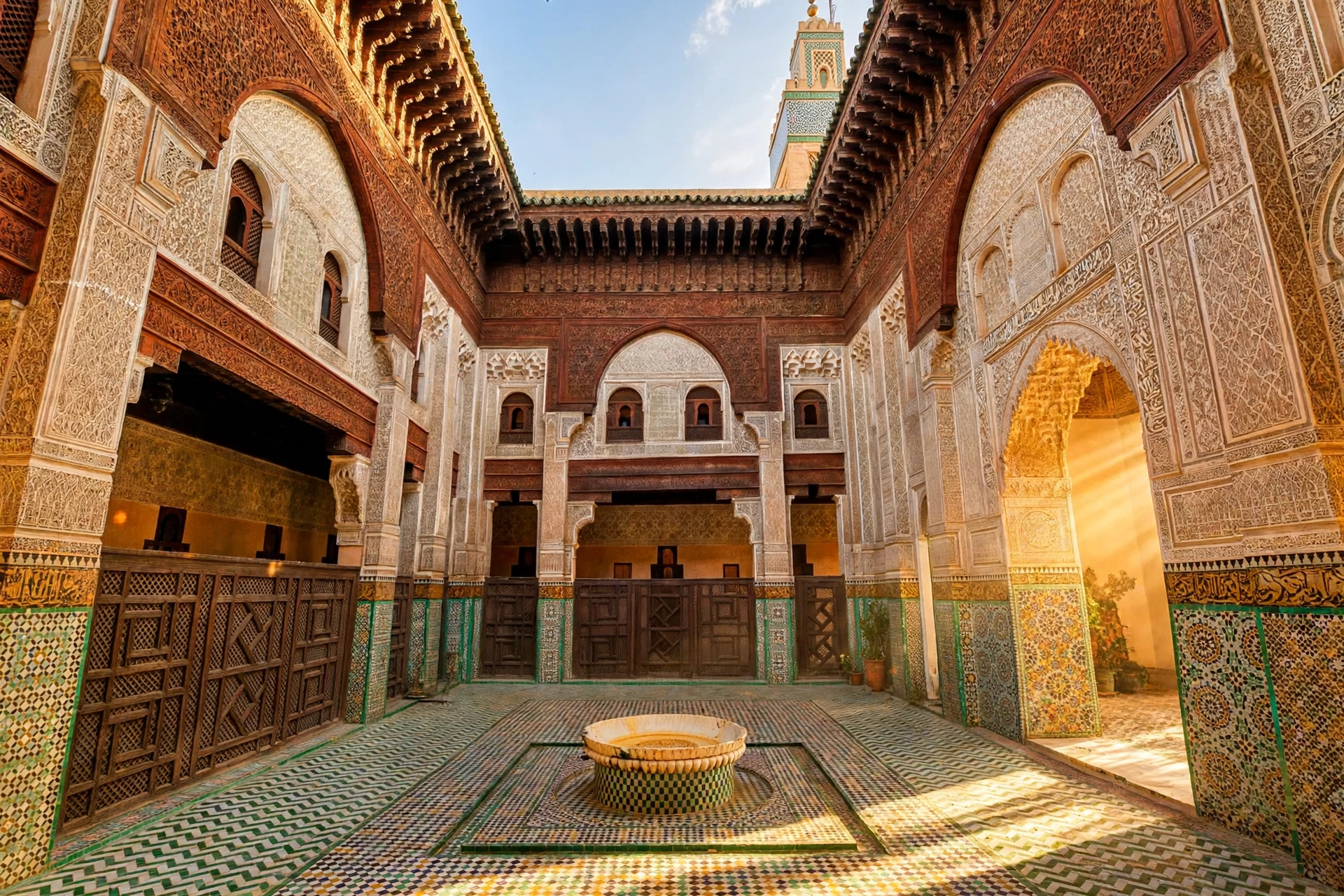
Stand in the courtyard of the Bou Inania Madrasa at golden hour, and the whole story of the Marinid dynasty Morocco is carved into the walls around you. Green and ochre tiles glitter in geometric stars, carved cedar looks like lace, and a marble fountain sits in the middle. Most visitors admire the courtyard, take a photograph, and walk on — with no idea they are standing inside a state-funded university system built by sultans who ruled Morocco for more than two centuries.
The Marinid dynasty Morocco explains why Fes looks the way it does: a second, royal city beside the old medina, madrasas that still define the skyline, and some of the most beautiful architecture in North Africa. This guide tells their story — and shows you how to walk through it today.
Contents
- The Rise of the Marinid Dynasty Morocco
- Fes el-Jdid: A Royal City Beside the Old Medina
- The Madrasas of the Marinid Dynasty Morocco
- Architecture: Zellige, Cedar and Stucco
- Expansion into Iberia — and Its Limits
- Decline and the Wattasid Succession
- Visiting the Marinid Sites in Fes Today
- Frequently Asked Questions
The Rise of the Marinid Dynasty Morocco
The Marinids began as nomadic Zenata Berbers from the Rif and the eastern plains, living for generations on the margins of the Almohad empire — herding, raiding, and hiring themselves out as soldiers. As Almohad power crumbled in the 13th century, the Marinid chiefs saw their chance: under Abu Yahya, then decisively under his brother Abu Yusuf Yaqub, they pushed westward, taking one town after another until only the great cities remained.
The turning point came in 1269, when Abu Yusuf Yaqub captured Fes — the year is widely accepted, though sources differ on the exact month and the sequence of the final siege. With Fes in their hands, the Marinids had a capital worthy of a dynasty: they were no longer desert chiefs; they were sultans. The story fits into the longer sweep of Moroccan history, which our Brief History of Morocco traces from the earliest settlements to today. For the full dynastic background, see https://en.wikipedia.org/wiki/Marinid_Sultanate.
What made the Marinid dynasty Morocco different was its method. The Almohads had ruled through a religious movement; the Marinids ruled through administration, diplomacy, and display — buying loyalty with salaries, building alliances with the northern tribes, and using architecture as propaganda. A madrasa was not just a school; it was a statement that the sultan’s power was blessed by learning.
Fes el-Jdid: A Royal City Beside the Old Medina
Walk west from Fes el-Bali today and you pass through the great Bab Bou Jeloud gate into a different world: wide streets, a royal palace behind high walls, and the mellah, the old Jewish quarter. This is Fes el-Jdid — literally “the New Fes” — and it is one of the most remarkable facts about the Marinid dynasty Morocco: rather than simply moving into the old city, they built a second city of their own.
Abu Yusuf Yaqub founded Fes el-Jdid in 1276, a few years after taking Fes: a royal and administrative city holding the sultan’s palace, the barracks, and the homes of his officials. The old medina kept its merchants, its artisans, and its famous Qarawiyyin mosque-university; the new city held the court. The two were separate, walled, and governed differently — and they remain distinct neighbourhoods today. The medina of Fes is a UNESCO World Heritage site (https://whc.unesco.org/en/list/170/).
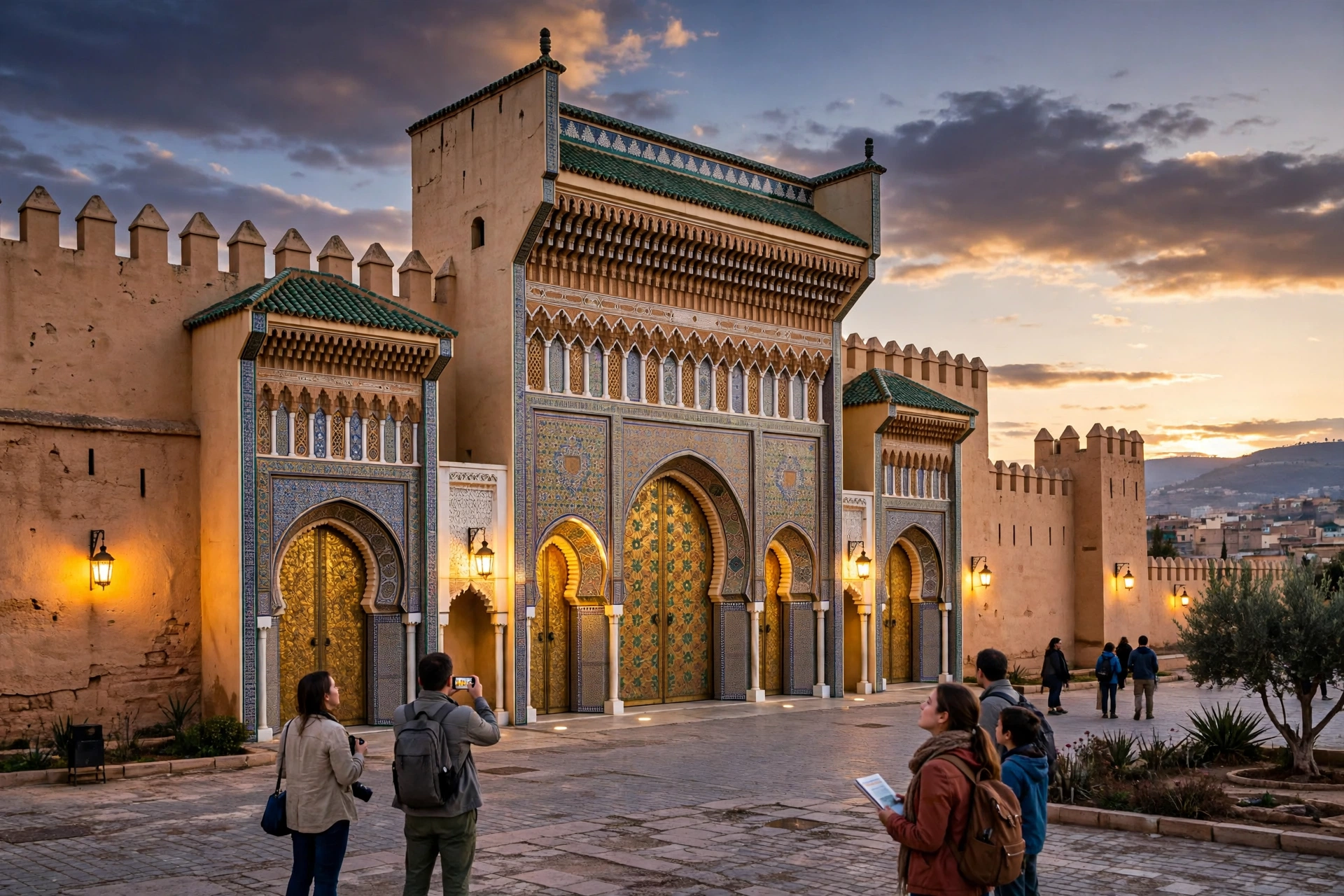
The most famous sight in Fes el-Jdid is the golden gate of the Royal Palace, the Dar el-Makhzen. The seven brass doors were largely restored in later centuries, but the palace complex is Marinid in origin, and the scale of the walls shows how the Marinid dynasty Morocco wanted to be seen: untouchable, gilded, and permanent.
The mellah and the palace
Inside the walls, the Marinids also established the mellah, the Jewish quarter, where merchants and diplomats served the court — see our Fes travel guide for a walk through it.
The Madrasas of the Marinid Dynasty Morocco
Here is the insider secret most visitors miss: under the Marinid dynasty Morocco, the madrasas of Fes were not simply beautiful old buildings but a state-funded university system. Each madrasa was a residential college, endowed by the sultan, where students from across Morocco and beyond lived, ate, and studied law, theology, grammar, and astronomy — teachers paid by the endowment, students on a stipend, and fierce competition for places.
The greatest of them is the Bou Inania Madrasa, built by Sultan Abu Inan in the 1350s — the only madrasa in Fes that was also a congregational mosque, complete with a minaret. Its courtyard is the masterpiece of Marinid art: a marble fountain, a band of carved cedar, stucco arabesques, and zellige tiling of extraordinary precision.
A short walk away stands the Al-Attarine Madrasa, built a generation earlier by Abu Said Uthman II in the 1320s. Smaller and more intimate than Bou Inania, it is often called the most beautiful madrasa in Morocco: a jewel box of tile and plaster, its prayer hall lined in carved cedar.
The Sahrij Madrasa, built by Abu al-Hasan in the 1320s, takes its name from the great basin — the sahrij — that dominates its courtyard. And the Saffarin Madrasa, one of the oldest, sits in the coppersmiths’ quarter, where the clang of metalwork still echoes. Together, these four colleges made Fes the Oxford of the medieval Maghreb. The Marinid dynasty Morocco understood that a state’s prestige rests on its schools.
Learning as state policy
Why did the Marinids spend so much on education? The answer is political as much as pious: the Almohads had claimed religious authority, and the Marinids, as Sunni rulers, needed religious scholars — ulama — on their side. By endowing madrasas, they trained a loyal class of judges, teachers, and administrators.
The system worked brilliantly for a century. Students came from as far as Timbuktu and Granada, the Qarawiyyin flourished alongside the new colleges, and the reputation of Fes as a city of learning spread across the Islamic world.
Architecture: Zellige, Cedar and Stucco
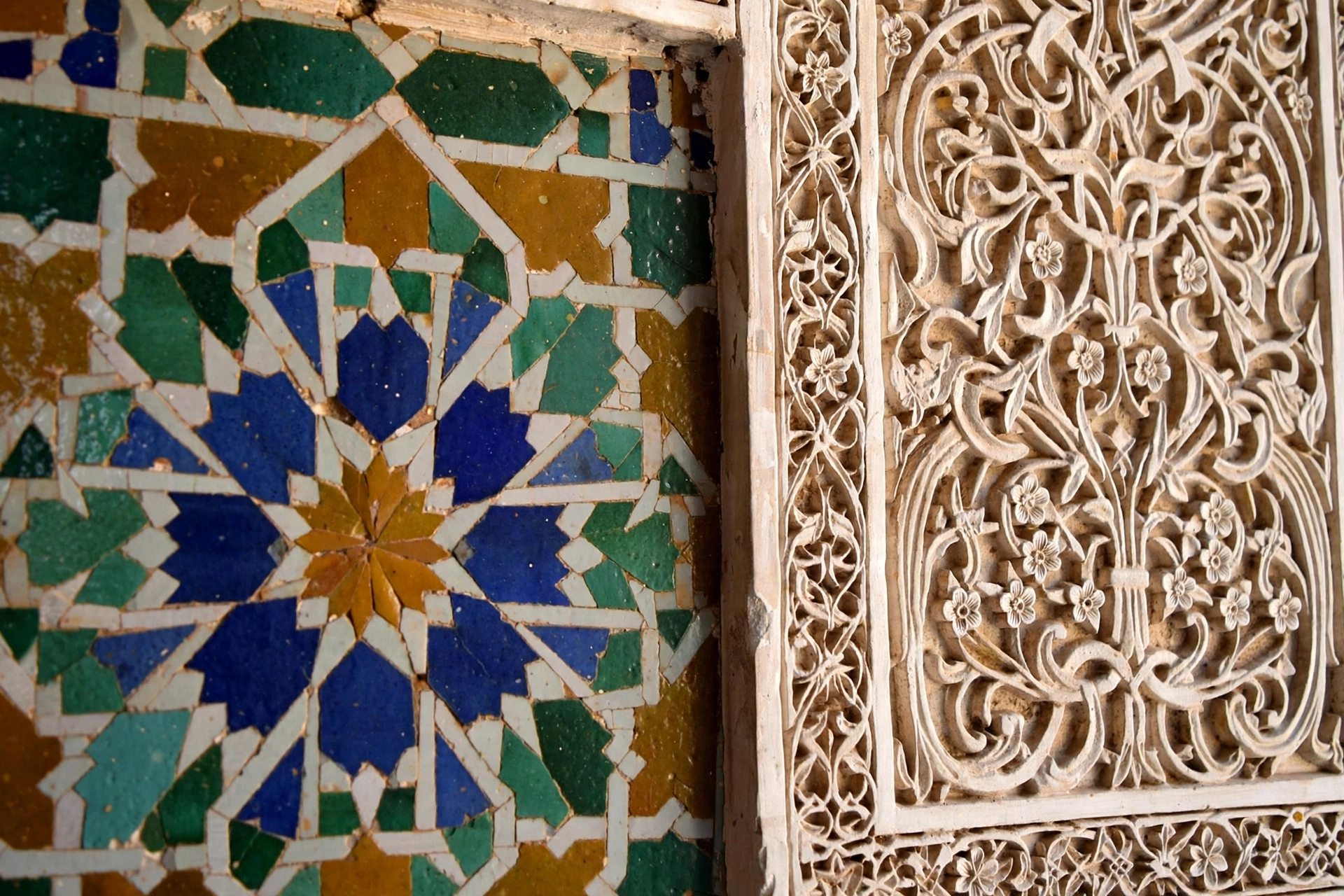
The art of the Marinid dynasty Morocco is instantly recognisable once you know what to look for. Three materials dominate: zellige, carved cedar, and carved stucco. Zellige is the mosaic of hand-cut glazed tiles fitted into geometric star patterns in green, blue, ochre, and white. Cedar from the Middle Atlas was carved into screens, doors, and eaves so fine they look like lace, while stucco — carved plaster — covered the upper walls with flowing calligraphy and arabesques.
The Marinids did not invent these crafts — they inherited them from the Almohads and the Andalusians — but they industrialised them. Royal workshops produced tiles, woodwork, and plaster on a scale never seen before, and the style spread across Morocco; the minaret of Bou Inania, with its green tiles, became the model for dozens of others.
Walk through Fes el-Bali today and you can still read this history in the walls: a green-tiled minaret usually means a Marinid foundation. The city is a museum that people still live in, and the Marinid dynasty Morocco is its most prolific curator — its building programme also shaped Morocco’s other imperial cities, as our guide to the Imperial Cities of Morocco explains.
Expansion into Iberia — and Its Limits
The Marinids did not only build. They also fought, and their ambitions stretched across the Strait of Gibraltar: Abu Yusuf Yaqub crossed into Iberia in the 1270s, answering the call of the Nasrid kingdom of Granada, the last Muslim state in Spain. For the next seventy years, the Marinid dynasty Morocco was a major player in Iberian politics, holding Algeciras and Gibraltar and fighting Castile and Aragon.
The high point came under Abu al-Hasan, who reigned from 1331 to 1348. The most ambitious Marinid sultan, he took Tlemcen in the east, briefly united the Maghreb, and then turned to Iberia. In 1340 his fleet and army met the combined forces of Castile and Portugal at the Battle of Rio Salado — a catastrophe. The Marinid army was destroyed, Abu al-Hasan’s son was killed, and the dream of a Marinid Iberia died on that battlefield. The chronicles disagree on the size of the armies at Rio Salado, so those numbers should be treated with caution; the date, 30 October 1340, is broadly accepted.
After 1340, the Marinid dynasty Morocco never again crossed the strait in force. Granada survived for another century and a half, but without its Moroccan protector it was living on borrowed time — the defeat at Rio Salado marks the turn from expansion to defence, from confidence to decline.
Abu Inan and the last flourish
Abu al-Hasan’s son, Abu Inan, ruled from 1348 to 1358 and built the Bou Inania Madrasa — the dynasty’s last great flourish, a burst of architecture and patronage that masked deep problems. The Black Death struck Morocco in 1348–1349, killing perhaps a third of the population, and Abu Inan was strangled by his own vizier in 1358. The dynasty never recovered a strong sultan.
Decline and the Wattasid Succession
After Abu Inan’s murder, the Marinid dynasty Morocco entered a long twilight. For nearly a century, sultans were puppets of their viziers, and the real power lay with the Wattasids, ministers who ran the state while Marinid princes sat on the throne. The exact chronology of these later reigns is disputed — the sources disagree on the dates of several short-lived sultans — so treat any precise year from this period as approximate.
The end came in 1465, when the last Marinid sultan, Abd al-Haqq II, was killed in a revolt in Fes. The Wattasids then took the throne openly, ruling Morocco until the Saadians overthrew them in the 16th century.
Their legacy is easy to underrate because it is so familiar: the green minarets, the zellige courtyards, the idea of Fes as a city of learning — all of it is Marinid. The dynasty lasted roughly two hundred years, and in that time it gave Morocco its most enduring urban landscape.
Visiting the Marinid Sites in Fes Today
You can see the heart of the Marinid dynasty Morocco in a single day on foot: start at Bou Inania, walk to Al-Attarine, detour to the Sahrij and the Saffarin, and finish at the golden gate of the Royal Palace in Fes el-Jdid.
| Site | What it is | Entry fee (checked November 2026) | Notes |
|---|---|---|---|
| Bou Inania Madrasa | Marinid madrasa-mosque, 1350s | 20 MAD (~$2 USD) | Courtyard only for non-Muslims; closed at prayer times |
| Al-Attarine Madrasa | Marinid madrasa, 1320s | 20 MAD (~$2 USD) | Small courtyard — visit early to avoid crowds |
| Sahrij Madrasa | Marinid madrasa, 1320s | 10 MAD (~$1 USD) | Often quiet; check hours locally |
| Saffarin Madrasa | One of the oldest madrasas | Free / small donation | In the coppersmiths’ quarter |
| Fes el-Jdid & Royal Palace gate | Marinid royal city, 1276 | Free (exterior) | Palace interior closed; the golden gate is the photo |
| Bab Bou Jeloud | Gateway between the two Fes districts | Free | Best photographed in the morning light |
Prices were checked in November 2026 and are given in Moroccan dirhams (MAD) with US dollar equivalents at roughly 10 MAD to $1. Fees can change, and some madrasas close without notice for restoration or prayer — ask your riad or a local guide on the day. Visit with respect: dress modestly and speak quietly inside.
Practical tip: hire a licensed local guide for half a day (around 200–300 MAD, roughly $20–$30, checked November 2026). The madrasas are easy to find but hard to understand without someone to read the calligraphy and explain the symbolism. A good guide will also take you to rooftop viewpoints where the minarets of the Marinid dynasty Morocco rise above the medina — the best view in Fes.
Frequently Asked Questions
When did the Marinid dynasty rule Morocco?
The Marinid dynasty Morocco ruled from the mid-13th century to 1465: it took Fes in 1269 and ended when the last Marinid sultan, Abd al-Haqq II, was killed in 1465. Its most powerful period was roughly 1269 to 1358, under Abu Yusuf Yaqub, Abu al-Hasan, and Abu Inan.
What is the Bou Inania Madrasa famous for?
The Bou Inania Madrasa, built by Sultan Abu Inan in the 1350s, is the finest surviving monument of the Marinid dynasty Morocco — the only madrasa in Fes that is also a congregational mosque, its courtyard, with marble fountain, carved cedar, and zellige tiling, considered the masterpiece of Marinid art. Entry costs around 20 MAD (about $2), checked November 2026.
Can you visit the madrasas of Fes?
Yes. Bou Inania and Al-Attarine are open for around 20 MAD each (checked November 2026). Non-Muslim visitors may enter the courtyards but not the prayer halls, and both close during prayer times. The Sahrij and Saffarin have more variable hours, so check locally.
What is Fes el-Jdid?
Fes el-Jdid, or “New Fes”, is the royal city founded by the Marinid dynasty Morocco under Sultan Abu Yusuf Yaqub in 1276 beside the old medina of Fes el-Bali. It held the royal palace, the barracks, and the homes of court officials, as well as the mellah, the old Jewish quarter. The golden gate of the Royal Palace is its most photographed sight.
Why did the Marinid dynasty decline?
The Marinid dynasty Morocco declined after the defeat at Rio Salado in 1340, the Black Death of 1348–1349, and the murder of Sultan Abu Inan in 1358. After that, weak sultans were controlled by Wattasid viziers, who eventually took the throne themselves in 1465.
How is the Marinid dynasty connected to the Kings of Morocco?
The Marinids are one of the great dynasties in the chronological story of Morocco’s kings, between the Almohads and the Wattasids — a key chapter in the history told by the Kings of Morocco channel. Read the full dynastic sweep in our Brief History of Morocco, or learn more about the project on our About page.
Conclusion
The Marinid dynasty Morocco gave Fes its skyline, its schools, and its soul. For two centuries, Marinid sultans turned a tribal confederation into a state, built a royal city beside the old medina, and filled it with madrasas that still show what a golden age of learning looked like. Their empire in Iberia failed and their dynasty ended in murder and revolt, yet walk the courtyards of Bou Inania and Al-Attarine, stand before the golden gate of Fes el-Jdid, and you are walking through their world — carved in cedar, tiled in stars, and still standing after seven hundred years. That is the legacy of the Marinid dynasty Morocco, and it is waiting for you in Fes.