
Working in Morocco is a realistic goal for thousands of foreigners every year, but you cannot simply arrive and start earning. Morocco’s job market welcomes foreigners in specific sectors and is tightly regulated elsewhere, so the difference between a smooth move and a frustrating one usually comes down to preparation. This guide explains the legal route, the jobs that genuinely hire foreigners, realistic salaries in dirhams, and the paperwork you will face, as the system works in November 2026.
If you are considering working in Morocco, the single most important thing to understand is that your employer does most of the legal heavy lifting. You cannot sponsor yourself for a work permit, and a tourist visa never becomes a right to work. Once you accept that, the path is clear: find a willing employer, let them secure the approvals, and arrive with the right visa in hand. Browse more practical guides in our Living in Morocco section.
In this guide:
- The legal route, step by step
- Jobs that actually hire foreigners
- Salaries in Morocco: what foreigners really earn
- Work permits and residence: costs and timelines
- Cost of living: what your salary buys
- Language, culture and daily work life
- What does not work: mistakes to avoid
- Frequently asked questions

Working in Morocco: The Legal Route, Step by Step
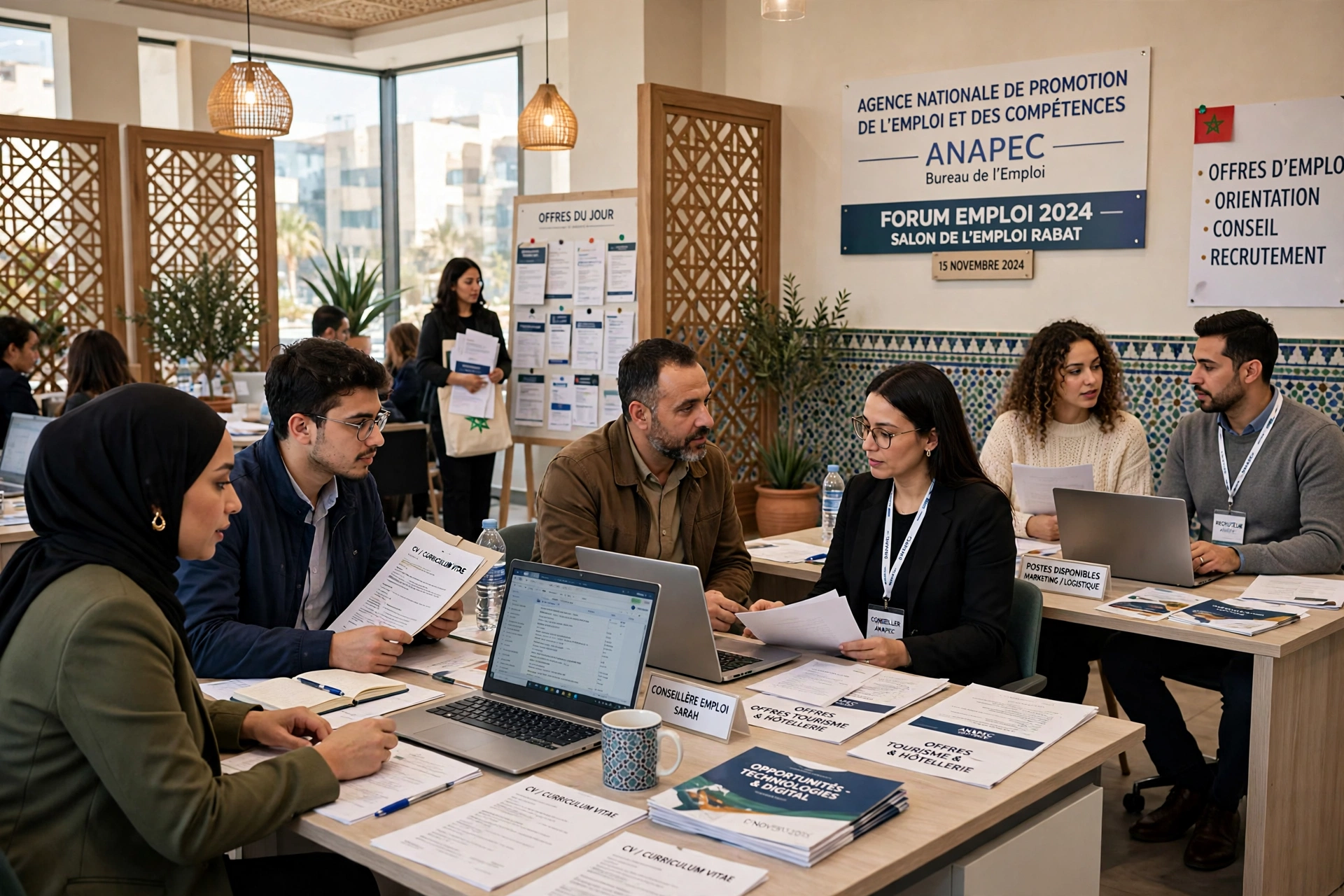
The legal route to working in Morocco runs through your employer, not through you. A Moroccan company hiring a foreigner must first prove to the employment authorities that no qualified Moroccan candidate is available for the role. That proof is the ANAPEC attestation, issued by Morocco’s national employment agency, and it unlocks everything else. Without it, there is no approved work contract and no work residence permit.
Once the attestation is granted, the employer draws up a work contract (contrat de travail) for approval by the Ministry of Employment. Only with an approved contract can you apply for a long-stay work visa at a Moroccan consulate in your home country. You then enter Morocco on that visa and apply for your carte de séjour, the residence card stating you are authorised to work. The whole sequence typically takes two to four months, so start the process long before you plan to move. The sequence is the same whether you are working in Morocco in Casablanca’s offshoring sector or teaching in a small city school.
One detail catches many people out: working in Morocco on a tourist visa is illegal, and the 90-day tourist stay cannot be converted into a work permit from inside the country. If you are already in Morocco as a tourist when a job offer appears, you will normally need to return home, apply for the work visa, and re-enter properly. Employers who know the system expect this, and a serious employer will never ask you to work while you wait on a tourist stamp.
Two narrow exceptions exist: staff of accredited international schools and recognised international organisations sometimes follow a faster track, and spouses of Moroccan citizens hold a different residence position, but both still need an approved contract and authorisation to work. For everyone else, the ANAPEC route above is standard; the permits table below sets out each step, cost and timeline.
Jobs That Actually Hire Foreigners
Foreigners do not compete for the same jobs as everyone else in Morocco. The roles open to you are the ones where your passport, your native language or your foreign qualifications are the point, so you are looking for the small set of employers who specifically need someone from outside. That is the honest starting point for working in Morocco as a foreigner, and the sectors below are where those employers sit.
Teaching English and French
Teaching is the most reliable route into working in Morocco. Private language schools in Casablanca, Rabat, Marrakech and Tangier hire native English speakers year-round, and a TEFL certificate plus a degree puts you ahead of most applicants. International schools pay considerably more but usually ask for a teaching qualification and two years of experience. French speakers have a parallel market: many private schools teach in French, and native French speakers with teaching backgrounds are in demand.

IT, Offshoring and Call Centres
Casablanca and Rabat host a large offshoring industry serving French and European clients, and it is the biggest employer of foreigners outside teaching. Call centres need fluent French or English speakers for customer service and sales, while IT companies hire developers, testers and support engineers. Salaries are modest by European standards, but many use a first call-centre job as a foothold before moving into better-paid roles.
Tourism and Hospitality
Hotels, riads and tour companies hire foreigners for management, guest relations and specialist roles, particularly in Marrakech, Fes, Essaouira and Agadir. Languages matter most here: a manager who speaks English, French and a little German or Spanish is far more employable than one who speaks only English. Seasonal work exists, but it rarely comes with a proper contract, so check the paperwork before accepting a summer-only arrangement.
NGOs, International Organisations and Remote Work
NGOs and development agencies based in Rabat employ foreign specialists in project management, communications and technical fields, usually on fixed-term contracts with proper sponsorship. Meanwhile, the fastest-growing route is not a Moroccan job at all: remote workers earning a foreign salary while living here. For many location-independent workers, remote work is the simplest way of working in Morocco, but it brings its own questions about visas and tax residence. Our digital nomad guide to Morocco explains how that lifestyle works in practice.
Salaries in Morocco: What Foreigners Really Earn
Salaries surprise most newcomers twice: the numbers look low in euros or dollars, then the cost of living makes them go further than expected. The table below shows typical monthly gross salaries for the roles foreigners most often take, checked in November 2026 at roughly 10 dirhams to the US dollar. These are the figures that define working in Morocco in practice, so treat the ranges as realistic starting points, not promises: a well-known international school or a multinational employer will pay at the top, while a small language school will pay at the bottom.
| Job / Industry | Typical monthly gross salary (MAD) | Approx. USD |
|---|---|---|
| English teacher, language school | 8,000 – 12,000 MAD | $800 – $1,200 |
| English teacher, international school | 15,000 – 25,000 MAD | $1,500 – $2,500 |
| IT / software developer | 15,000 – 30,000 MAD | $1,500 – $3,000 |
| Call centre agent (French / English) | 5,000 – 8,000 MAD | $500 – $800 |
| Hospitality / hotel manager | 10,000 – 20,000 MAD | $1,000 – $2,000 |
| Engineer (automotive / aerospace) | 18,000 – 35,000 MAD | $1,800 – $3,500 |
| NGO / development worker | 12,000 – 22,000 MAD | $1,200 – $2,200 |
| Remote worker (foreign salary, living in Morocco) | 6,000 – 10,000 MAD living-cost baseline | $600 – $1,000 |
Salary ranges checked November 2026. Figures are gross monthly pay in Moroccan dirhams, converted at approximately 10 MAD = $1 USD.
The pattern is clear: the best-paid foreigner is usually a specialist whose skills are scarce locally, not a generalist. An experienced developer or engineer in the automotive and aerospace clusters around Casablanca and Tangier can earn three to five times the national average wage, while entry-level teaching or call-centre work pays a local salary that is comfortable only if you live like a local. That gap is the reality of working in Morocco for most new arrivals. Before accepting any offer, compare it with real living costs: our cost of living in Morocco guide breaks down rent, food and transport city by city, and our rent prices guide shows what apartments cost.
Negotiate the whole package, not just the salary. Good employers often add housing assistance, health insurance, annual flights home and school fees, and those benefits can be worth more than a higher headline wage. Ask for the offer in writing, in dirhams, with benefits listed, and check whether the salary is quoted gross or net: payroll deductions for social security and income tax typically take 20 to 30 percent. That is the number that matters when you plan your life here, and a clear written offer is your best protection when working in Morocco on a first contract.
Work Permits and Residence: Costs and Timelines
The paperwork for working in Morocco costs less than most people expect; the real price is time. Government fees are low, but each step depends on the one before it, and a missing document can add weeks. The table below lists the main steps, their costs and timelines on the standard ANAPEC route in November 2026.
| Step | Cost (MAD) | Typical timeline |
|---|---|---|
| ANAPEC attestation (employer applies) | Free | 2 – 4 weeks |
| Work contract approval, Ministry of Employment | Free | 2 – 6 weeks |
| Long-stay work visa (Moroccan consulate abroad) | 600 – 900 MAD (consulate fee, varies) | 2 – 4 weeks |
| Medical certificate (Moroccan doctor) | 200 – 500 MAD | Under 1 week |
| Criminal record check (from home country) | 20 – 100 MAD equivalent | Days to 2 weeks |
| Carte de séjour, work version (stamp duty) | 100 MAD | 4 – 8 weeks after arrival |
| Total, offer to residence card | Roughly 1,000 – 1,600 MAD in fees | 2 – 4 months |
Costs and timelines checked November 2026. Consulate fees vary by country; confirm the exact fee with the Moroccan consulate where you apply.
Your employer handles the ANAPEC attestation and contract approval, but you supply the personal documents: a valid passport, degree certificates, a criminal record check from your home country, and a medical certificate from a Moroccan doctor. Get the criminal record check and degree copies legalised or apostilled before you leave home; doing it from Morocco is slow and expensive. This preparation is the part of working in Morocco that you control, so do it well. Keep certified copies of everything, and a folder, digital and paper, of every approval.
Once you hold your carte de séjour with work authorisation, the job is done until renewal. The card is usually valid for one year at first and must be renewed before it expires, with a fresh contract or proof of continued employment. Renewal is far simpler than the first application, but start at least a month early: an expired card means fines and complications at every border and bank. Staying legal is the least stressful part of working in Morocco once the first card is in your hand, and our carte de séjour renewal guide walks through the renewal process step by step. For the wider picture on visas and residence, see our moving to Morocco guide.
Sources: the official ANAPEC website and Wikipedia’s work permit page.
Cost of Living: What Your Salary Buys
A salary of 12,000 dirhams a month sounds small next to a European pay cheque, but it covers a comfortable life in most Moroccan cities. A one-bedroom apartment in a good neighbourhood of Rabat or Casablanca rents for roughly 4,000 to 6,000 dirhams, and less in smaller cities; a monthly food shop for one person runs to about 1,500 to 2,500 dirhams with market produce; and a tram or bus pass costs a few hundred dirhams. That is the first pleasant surprise for many people working in Morocco on a local contract. Our cost of living in Morocco breakdown and rent prices guide give city-by-city figures, but the short version is that one person can live well on 10,000 to 15,000 dirhams a month outside the most expensive districts of Casablanca.
The trap is the gap between a foreign lifestyle and a local salary. Imported food, international schools, frequent flights and a car will eat a teaching salary quickly, while the same salary stretches comfortably if you live in a Moroccan neighbourhood, eat local food and use public transport. Before you accept an offer, do the maths honestly: list your non-negotiable expenses, convert them to dirhams, and compare them with the net salary, not the gross. If the numbers only work with constant overtime, the job will not make you happy here. Working in Morocco rewards people who adapt to local prices rather than fighting them.
Language, Culture and Daily Work Life
French is the language of Moroccan business, and the single skill that most improves a foreigner’s job prospects. Meetings, contracts, emails and most office conversation in Casablanca and Rabat happen in French, and even in English-teaching roles the staff room runs on French. You can survive with English alone in international schools and some IT teams, but every door opens wider with conversational French, and learning it is the best career investment before arriving. It is the skill that most changes the experience of working in Morocco day to day. Darija, the Moroccan Arabic dialect, is what colleagues speak among themselves; a few phrases earn enormous goodwill even if you never become fluent.
Work culture is formal and relationship-driven. Punctuality matters, but decisions move through conversations and trust rather than email alone, so invest time in getting to know colleagues over mint tea. Hierarchies are respected, Friday afternoons are often quiet, and Ramadan brings shorter working hours across the country. None of this is difficult once you expect it; the foreigners who struggle usually expect Morocco to work like their home country. The ones who settle in treat their first year as an apprenticeship in a new way of doing things; patience and curiosity are the real qualifications for working in Morocco long term.
What Does Not Work: Mistakes to Avoid
The most common mistake is arriving on a tourist visa and hoping a job appears. It sometimes does, but the employer cannot legally hire you without the ANAPEC process, which requires you to leave and re-enter on a work visa. Months pass, savings drain, and the job goes to someone who applied from abroad with papers ready. That is the hard lesson most people learn about working in Morocco without a plan, so apply from home, with a proper CV and a clear idea of which sector wants you.
The second mistake is trusting informal offers. A handshake, a WhatsApp message or a promise of cash payment is not a contract, and without a contract there is no permit, no residence card, no health cover and no legal protection. Insist on a written contract approved by the Ministry of Employment before you travel, and walk away from any employer who asks you to start work while your papers are “being sorted”. Finally, do not pay anyone who offers to sell you a job or a permit: legitimate employers pay the small official fees themselves. Anyone charging thousands of dirhams for access to a job is running a scam, and knowing the rules is the best protection you have when working in Morocco for the first time.
Frequently Asked Questions
Can I work in Morocco on a tourist visa?
No. A tourist visa allows a stay of up to 90 days but no right to work. To work legally you need an employer-sponsored work contract approved by the Ministry of Employment, a work visa, and then a carte de séjour. Anyone offering cash work on a tourist stamp is putting you at risk.
Do I need to speak French to work in Morocco?
For most jobs, yes, or at least enough to function in an office, since French is the language of Moroccan business. English-only roles exist in international schools, some IT teams and tourism, but conversational French multiplies your options and salary prospects.
How much can I earn working in Morocco as an English teacher?
Language schools typically pay 8,000 to 12,000 dirhams a month, while accredited international schools pay 15,000 to 25,000, often with housing and flights included. A TEFL certificate and experience move you toward the top of those ranges.
How long does it take to get a work permit?
Allow two to four months from the job offer to your carte de séjour. The ANAPEC attestation takes two to four weeks, contract approval another two to six, the work visa two to four, and the residence card four to eight weeks after arrival. Start the process early, because delays are normal when working in Morocco through the official route.
Can I work remotely from Morocco for a foreign employer?
Many foreigners do; it avoids the permit process entirely, since you are not taking a Moroccan job. For location-independent workers it is often the simplest way of working in Morocco, but you still need a legal basis to stay, such as a long-stay visa or residence, and you should check the tax rules in your home country and in Morocco before settling in.
What is the ANAPEC attestation?
It is the document from Morocco’s employment agency confirming that no qualified Moroccan candidate is available for a role. Your employer applies for it, and it is the first step of the legal route to working in Morocco. Without it, no work contract can be approved.
Morocco rewards foreigners who arrive with a plan: a sector that wants them, an employer willing to do the paperwork, and realistic expectations about pay. Salaries will not match London or Paris, but the cost of living, the light, the food and the pace of life make the trade worthwhile for thousands who stay for years. Start with the ANAPEC route, get your contract in writing, learn some French, and come with your documents ready. If you do that, working in Morocco can be the start of a genuinely good chapter, not a leap in the dark, but a decision you made with your eyes open.
4 thoughts on “Working in Morocco: Jobs, Salaries and Work Permits for Foreigners”