
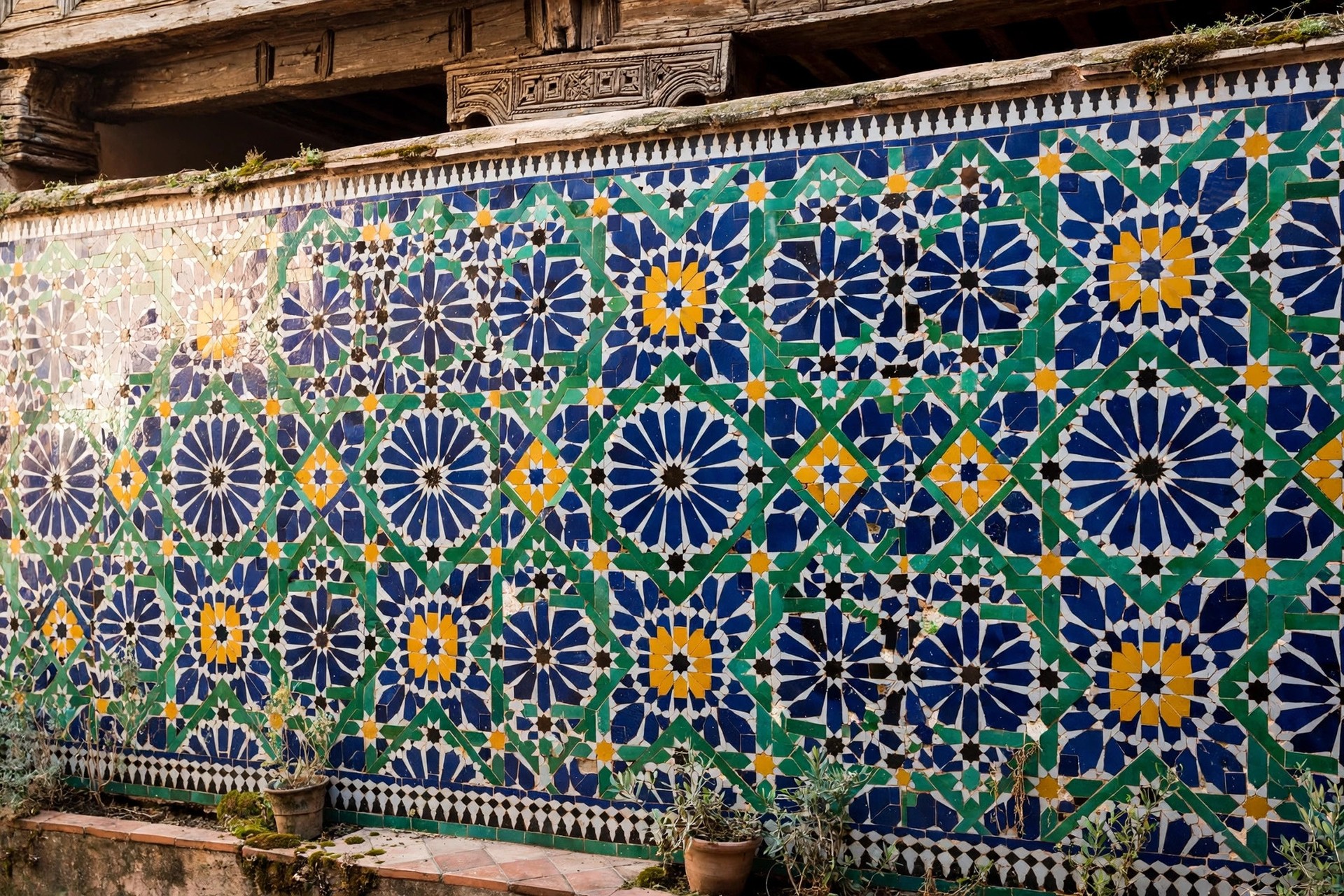
Walk into any old madrasa, palace or riad courtyard in Morocco and the walls seem to glow. Thousands of small glazed tiles lock together into stars, polygons and interlacing bands, with no two pieces quite alike, yet every piece exactly where it belongs. That glow is zellige, Morocco's great mosaic art, and the history of Moroccan zellige stretches back more than a thousand years, from Roman mosaic floors to the workshops of Fez that still cut tiles by hand today.
This guide follows that long road. We trace the craft from its Roman and Andalusian roots through its golden age under the Marinids, meet the master maalems who keep it alive, and show you where to see the finest examples. Along the way we flag the dates historians still argue about, because the history of Moroccan zellige has its share of open questions, and honest history says so.
In this guide
- Where Zellige Began: The Early History of Moroccan Zellige
- The Marinid Golden Age in the History of Moroccan Zellige
- How Zellige Is Made: Clay, Glaze and the Maalem's Hand
- Regional Styles in the History of Moroccan Zellige
- The History of Moroccan Zellige Today: Revival, Workshops and UNESCO
- Where to See the Best Zellige in Morocco
- Frequently Asked Questions
- Conclusion
Where Zellige Began: The Early History of Moroccan Zellige
Zellige, also spelled zellij, is mosaic tilework made from individually hand-cut glazed terracotta tiles set into a plaster base, as described in the Wikipedia overview of zellige. The Arabic root of the word means "little polished stone", a nod to the Roman tesserae it echoes. The history of Moroccan zellige begins not with a single inventor but with a meeting of traditions: Roman mosaic floors once covered the great houses of North Africa, including the Roman city of Volubilis, and their small cut-stone cubes were the direct inspiration for what Moroccan potters later made in glazed clay.
When and where exactly the shift happened is unresolved. Some sources place the first zellige in Fez in the 10th century, in simple white and brown tones. Others point to earlier experiments in Tunisia under the Fatimids in the mid-10th century, or to 9th-century workshops elsewhere in the Islamic world. The honest answer is that no single dated workshop or signed panel settles the question, and the early history of Moroccan zellige is best read as a slow fusion of Roman mosaic technique, Persian glazing knowledge and Andalusian taste rather than a single invention.
What is certain is the direction of travel. Tin-oxide glazing, which turns a clay surface opaque and brilliantly coloured, reached the western Mediterranean through Persian potters by the 9th century. Andalusian craftsmen in Cordoba and Granada refined the cutting and setting of small glazed pieces, and the traffic of artisans, scholars and rulers across the Strait of Gibraltar carried the technique into Morocco. By the 12th century, green and white zellige crowned the minaret of the Koutoubia Mosque in Marrakech, dated to around 1150, the oldest surviving example in the country.
Islamic art's preference for geometry over figurative images gave the craft its language. Stars with eight points, interlacing polygons and endlessly repeating bands offered a vision of order and infinity without depicting living creatures. That geometric language is the thread that runs through the whole history of Moroccan zellige, and it appears alongside the flowing scripts explored in our guide to the history of Moroccan calligraphy.
| Period | What happened | Why it matters |
|---|---|---|
| Roman era (to c. 5th century) | Stone tesserae mosaics across North Africa, including Volubilis | The visual model zellige would later imitate in glazed clay |
| 9th century | Tin-oxide glazing mastered by Persian potters; technique spreads west | Opaque, brilliant colour becomes possible on clay |
| 10th century (date disputed) | First zellige in Fez, in white and brown; parallel experiments in Tunisia | The craft's birthplace and exact date remain unresolved |
| c. 1150 | Green and white zellige on the Koutoubia minaret, Marrakech | Oldest surviving zellige in Morocco |
| 14th century | Marinid golden age; blue, green and yellow added | The classic palette and complex geometry appear |
| 16th–17th centuries | Saadian masterpieces at Ben Youssef Madrasa and the Saadian Tombs | Zellige becomes the mark of royal and sacred building |
| 20th–21st centuries | Hassan II Mosque; revival in riads, hotels and export markets | The craft enters modern architecture and design |
The Marinid Golden Age in the History of Moroccan Zellige
If zellige was born in the 10th century, it grew up under the Marinids, who ruled Morocco from the 13th to the 15th century. The dynasty poured wealth into Fez, founding madrasas that doubled as showcases for the craft. The Bou Inania Madrasa (1351–1356) and the Attarine Madrasa (1323–1325) still display the finest Marinid tilework in the country: deep blue, green and yellow panels rising beneath carved cedar and stucco, with calligraphy bands weaving through the geometry. The madrasas they built remain the reference points for the history of Moroccan zellige.
The 14th century brought the technical leap that defines the craft to this day. Craftsmen perfected double firing and polychrome glazes, adding blue, green and yellow to the older white and brown palette. Red followed in the 17th century. New cutting tools let them shape ever smaller and sharper pieces, and the repertoire of patterns exploded into the complex stars and lattices that visitors still photograph today. This is the period when the history of Moroccan zellige turned from a building technique into a national art.
Fez became the undisputed capital of the craft, and the reasons were practical as much as political. The grey Miocene clay dug around the city fires hard, cuts cleanly and takes glaze evenly, so delicate points and narrow edges survive the cutter's hammer. The potters' quarter on the edge of the old medina grew into an industrial district of kilns, glaze pits and cutting benches, and it remains the beating heart of production today.
From Fez the craft travelled with dynasties. The Saadians, who ruled from the 16th century, covered the Ben Youssef Madrasa in Marrakech and the Saadian Tombs with dazzling tilework. The Alaouites continued the tradition at Meknes under Moulay Ismail. Wherever a sultan built, the maalems followed, and the history of Moroccan zellige followed with them.
How Zellige Is Made: Clay, Glaze and the Maalem's Hand
A finished zellige panel passes through many hands, and each step is a trade of its own. It begins with the clay. Workers knead the grey Fez clay, shape it into square tiles called bejmat, and fire them once in a wood kiln. The fired tiles are then coated with coloured glaze and fired a second time, which fixes the colour and gives the surface its glassy depth. The process has barely changed in centuries, which is why the history of Moroccan zellige reads as a craft history rather than a series of styles.
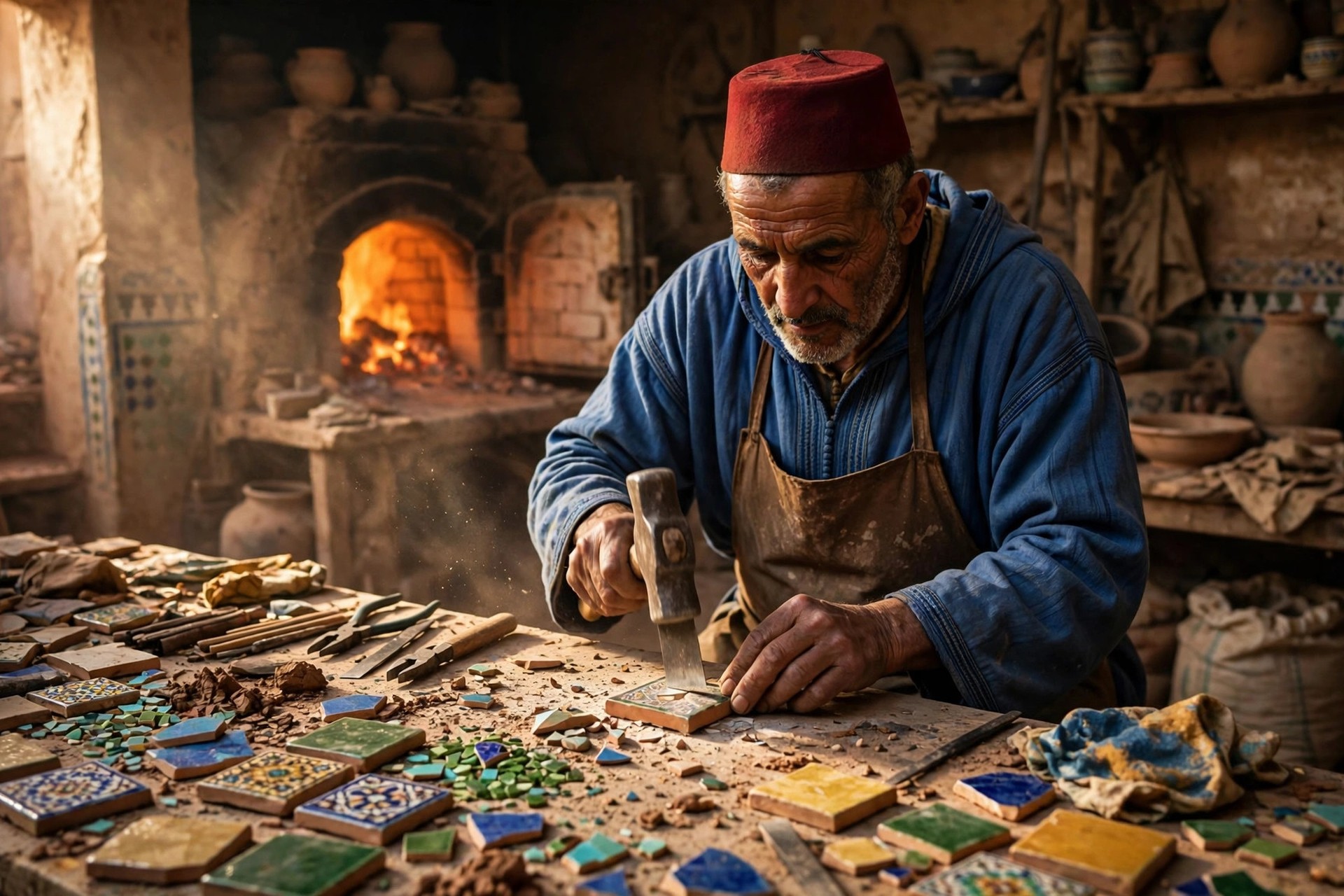
Then comes the cutting, the most admired and most feared step. A cutter marks the shape on the glazed tile with a template, then chips it free with a menqach, a sharp chisel-headed hammer. The work is done by eye and by feel, and a delicate piece can shatter at the last tap. An experienced cutter can shape dozens of pieces an hour, each one destined for a precise place in the pattern.
Assembly is the opposite of what visitors expect. The pieces are laid out glazed-side down on a flat surface, following a full-scale drawing, and then backed with plaster or cement. Only when the panel is lifted and turned over does the design appear. A master maalem oversees the whole process, from the geometry of the drawing to the final setting, and the title is earned through years of apprenticeship, not conferred by any school.
The slowness is the point, and it is also the craft's economic problem. A square metre of complex zellige can take a team two to three weeks to complete, which is why genuine handmade panels cost far more than machine-printed imitations. Visitors who watch a cutter at work in Fez usually leave with a new respect for the price tag, and with a sense of why the history of Moroccan zellige is also an economic story.
Regional Styles in the History of Moroccan Zellige
Not all zellige looks alike, and the differences map neatly onto Morocco's cities. Fez sets the standard: bold geometry, the famous Fez blue, and large panels built for madrasas and palaces. Tetouan, shaped by Andalusian families who settled in the north, favours finer pieces, softer greens and more delicate floral infill, and its workshops still supply much of the country's restoration work. The contrast between the two schools is one of the pleasures of studying the history of Moroccan zellige.
Marrakech developed its own voice under the Saadians and Alaouites, warmer in tone, with honey, ochre and deep green panels that suit the light of the south. Meknes, the imperial city of Moulay Ismail, carries a monumental style fitted to gates and mausoleums. In the 20th century the Hassan II Mosque in Casablanca added a new chapter to the history of Moroccan zellige, with a fresh palette and vast modern panels executed by traditional methods.
The regional table below gives a quick guide to telling the styles apart, which helps when you are choosing tiles for your own home or simply learning to look. For the wider ceramic tradition behind these styles, see our guide to the history of Moroccan pottery.
| City | Palette | Character | Best seen at |
|---|---|---|---|
| Fez | Deep blue, green, yellow, white | Bold geometry, large panels, the classic standard | Bou Inania and Attarine madrasas; potters' quarter |
| Tetouan | Soft greens, turquoise, fine detail | Delicate pieces, Andalusian influence, floral infill | Medina workshops and restored townhouses |
| Marrakech | Honey, ochre, deep green | Warm tones, Saadian grandeur | Ben Youssef Madrasa, Saadian Tombs, Bahia Palace |
| Meknes | Green, white, ochre | Monumental, fitted to gates and mausoleums | Mausoleum of Moulay Ismail, Bab Mansour |
| Casablanca | Modern palette, vast scale | Contemporary execution of traditional methods | Hassan II Mosque |
The History of Moroccan Zellige Today: Revival, Workshops and UNESCO
Zellige never died in Morocco, which is what makes it unusual. While similar mosaic traditions faded elsewhere after the 15th century, Moroccan workshops kept cutting by hand, and the craft survived into the modern era almost unchanged. That continuity is the central fact of the history of Moroccan zellige, and it explains why the art still feels alive rather than preserved behind glass.
Recognition, however, has become complicated. Morocco formally launched a project in November 2025 to nominate the zellige of Fez and Tetouan for UNESCO's Representative List of the Intangible Cultural Heritage of Humanity, under the framework of the UNESCO 2003 Convention, with a submission hoped for in 2027. A separate nomination for zellige was filed by Algeria, and the question of inscription remains open and contested. Reports that zellige was already inscribed in 2023 are incorrect: as of November 2026, no inscription has been decided, and the history of Moroccan zellige is still being argued in committee rooms as well as in workshops.
Whatever UNESCO decides, the craft's future rests on transmission. Training centres in Fez and Tetouan teach cutting and geometry to new apprentices, and visitor workshops let travellers try the menqach themselves. The history of Moroccan zellige depends on those apprentices more than on any prize or listing, and buying genuine handmade pieces directly from a workshop, rather than a printed copy in a souvenir shop, is the simplest way to support the trade.
The revival has also brought a debate about authenticity. Machine-cut and printed tiles now imitate zellige patterns at a fraction of the cost, and even experts sometimes need a close look to tell them apart. The tells are small: handmade pieces vary slightly in tone and thickness, their edges are never perfectly uniform, and their glaze has a depth that printing cannot match. To understand how zellige fits into the country's wider building tradition, read our guide to the history of Moroccan architecture.
Where to See the Best Zellige in Morocco
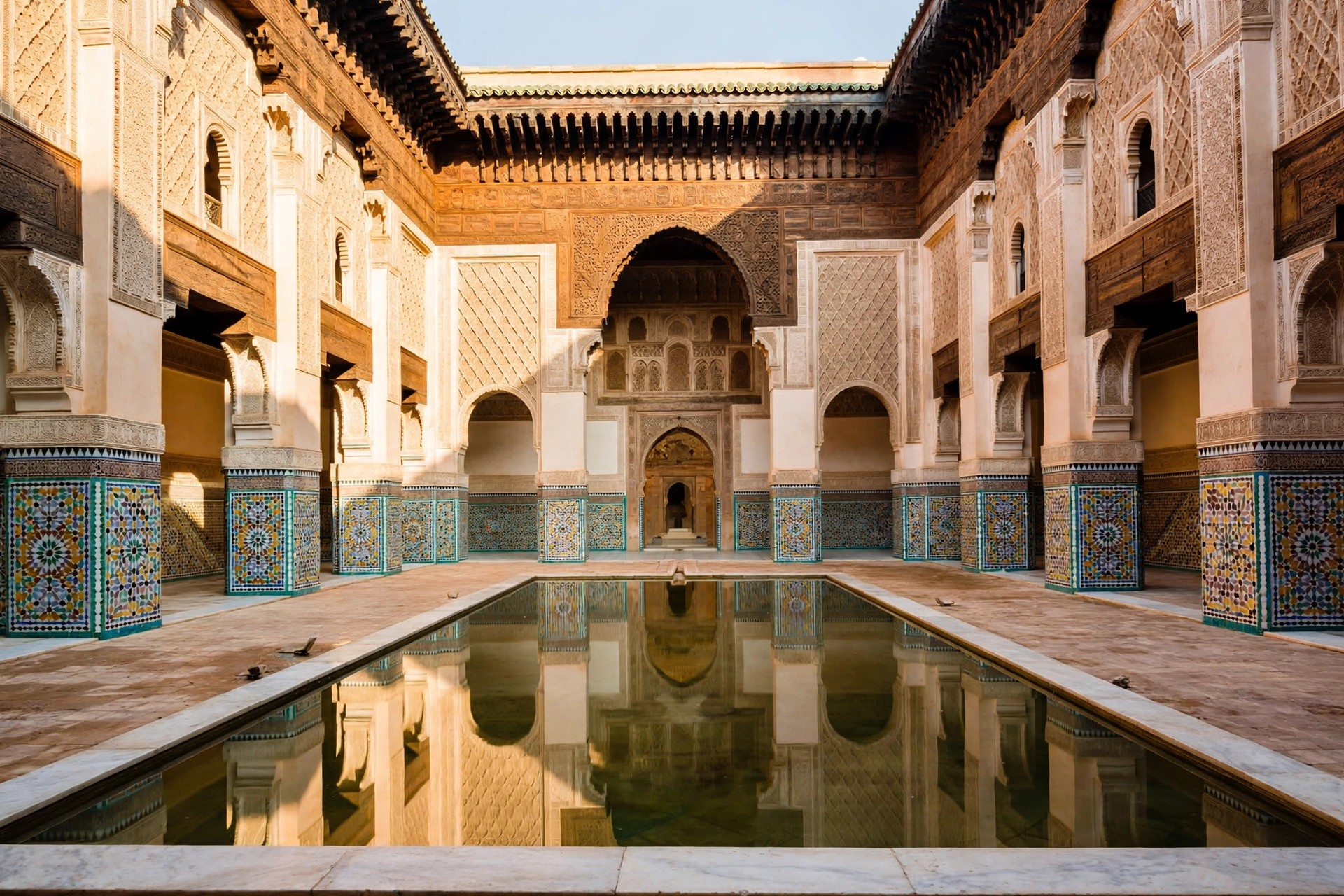
The finest zellige is not in museums but on the walls of buildings you can walk into. Start in Fez at the Bou Inania and Attarine madrasas, then cross to the potters' quarter to watch tiles being cut. In Marrakech, the Ben Youssef Madrasa is the single greatest showcase, with the Saadian Tombs and Bahia Palace close behind. Meknes offers the Mausoleum of Moulay Ismail, and Casablanca the Hassan II Mosque, where modern maalems worked at a scale never attempted before. Each of these buildings is a chapter in the history of Moroccan zellige you can walk through.
Go early in the morning, when the light is low and the courtyards are quiet. The glaze catches the sun differently at every hour, and a panel you barely noticed at noon can blaze at nine in the morning. Modest dress is expected in religious buildings, and photography rules vary, so ask before raising a camera inside a mosque or mausoleum. Our Fez travel guide and the wider Morocco travel guide will help you plan the trip around these visits.
| Place | City | What to look for | Typical entry (Nov 2026) |
|---|---|---|---|
| Ben Youssef Madrasa | Marrakech | Courtyard zellige, stucco and cedar in one composition | 50 MAD (about $5) |
| Saadian Tombs | Marrakech | 16th–17th-century tilework in a royal necropolis | 70 MAD (about $7) |
| Bahia Palace | Marrakech | Courtyards and reception rooms in warm southern tones | 70 MAD (about $7) |
| Bou Inania Madrasa | Fez | The finest Marinid panels in Morocco | 20 MAD (about $2) |
| Attarine Madrasa | Fez | 14th-century geometry and calligraphy bands | 20 MAD (about $2) |
| Mausoleum of Moulay Ismail | Meknes | Monumental Alaouite tilework | Free to enter; donations welcome |
| Hassan II Mosque | Casablanca | Vast modern zellige by traditional methods | 140 MAD (about $14), guided tour |
Entry prices are typical ranges as of November 2026 and may change; confirm on arrival.
Frequently Asked Questions
What is zellige made of?
Zellige is made from glazed terracotta tiles. Craftsmen shape local clay into squares, fire them, coat them with coloured glaze, fire them again, and then hand-cut each tile into a geometric shape before setting the pieces into a plaster base.
How old is zellige?
The short answer is that the history of Moroccan zellige begins in the 10th century, most likely in Fez, but the exact date and birthplace are unresolved. Roman mosaics provided the model, Persian glazing supplied the colour, and Andalusian craftsmen refined the technique before it took root in Morocco.
What does the word zellige mean?
It comes from an Arabic root meaning "little polished stone". The name recalls the Roman tesserae, the small cut stones of ancient mosaics, which Moroccan potters imitated in glazed clay.
Why is Fez famous for zellige?
Two reasons: the grey Miocene clay around Fez fires hard and cuts cleanly, and the city has hosted an unbroken line of workshops and master maalems since the Marinid era. The potters' quarter still produces most of the country's handmade zellige.
How long does it take to make zellige?
A square metre of complex handmade zellige can take a team two to three weeks from clay to finished panel. Simple patterns are faster, but every piece is still cut by hand, so genuine zellige is never quick or cheap.
How can I tell real handmade zellige from printed copies?
Look closely. Handmade pieces vary slightly in tone and thickness, their edges are never perfectly uniform, and the glaze has a depth that printing cannot match. Printed tiles repeat identical patterns and feel flat and flawless to the touch.
Conclusion
From Roman tesserae to Marinid madrasas, from the kilns of Fez to the walls of the Hassan II Mosque, the history of Moroccan zellige is the story of a craft that refused to become a museum piece. It survived because it was useful, beautiful and endlessly adaptable, and because generation after generation of maalems chose to teach it rather than let it go.
Stand in the courtyard of the Ben Youssef Madrasa at nine in the morning, when the light strikes the tiles, and you understand why. The history of Moroccan zellige is not finished; it is still being cut, glazed and set, one small piece at a time, by hands that learned the work from hands before them.