
The history of Moroccan dirham begins long before there was a Morocco to put on a coin. The silver in a traveller's pocket today carries a name that travelled from ancient Greece, through the markets of Fez and the gold caravans of the Sahara, before returning home in 1960 as the currency of an independent kingdom. Every Moroccan dynasty stamped its authority in metal, and every coin tells you who ruled, what they traded and what they feared. The name itself comes from the Greek drachma, borrowed through Persian and Arabic, and the caliph Abd al-Malik struck the first purely Islamic silver dirhams around 696 CE.
All prices are in Moroccan dirhams (MAD), checked in November 2026, with dollar equivalents at roughly 10 MAD to $1 and about 11 MAD to €1. They are planning ranges, not promises. This guide follows the history of Moroccan dirham from its ancient origins to the managed float of today.
In this guide
- The History of Moroccan Dirham at a Glance
- Coins Before the Dirham: Juba II and Roman Mauretania
- The First Islamic Dirhams: Idrisid Silver
- Gold of the Almoravids and the Square Coins of the Almohads
- Marinids, Saadians and the Gold of the Sudan
- The Rial, the Falus and the Chaos of the 19th Century
- Hassan I and the First Machine-Struck Coins
- The Franc Years: 1912 to 1960
- Independence and the Return of the Dirham
- The Modern Dirham: Pegs, Floats and Bank Al-Maghrib
- What the Dirham Is Worth Today
- Frequently Asked Questions
- Conclusion
The History of Moroccan Dirham at a Glance
The short version of the history of Moroccan dirham: the name is Greek, the silver is Idrisid, the gold is Saharan, and the modern coin is younger than Moroccan independence itself.
| Period | What happened |
|---|---|
| Antiquity, 1st century BCE | Kings of Mauretania strike coins at Tingis (Tangier) and Tamuda |
| 8th–9th centuries | Idrisid silver dirhams struck in Morocco, the first Islamic coinage of the land |
| 11th–12th centuries | Almoravid gold dinars flood the Mediterranean; Almohads strike square coins |
| 13th–16th centuries | Marinid silver, then Saadian gold from the Sudan trade |
| 19th century | Copper falus, silver dirham and gold benduqi circulate side by side; the rial dominates |
| 1882 | Sultan Hassan I orders Morocco's first machine-struck coins |
| 1912–1960 | The Moroccan franc replaces the old system under the protectorate |
| 1959–1960 | Bank Al-Maghrib is created; the dirham returns on 16 October 1960 |
| 2018–2020 | Managed float: the band widens from ±0.3% to ±5% |
What makes the Moroccan story different is that the name never left: in the east the dirham faded into a unit of account, while in Morocco it survived every dynasty, every invasion and one colonial currency — and when Mohammed V chose the name in 1959, he was reclaiming it.
Coins Before the Dirham: Juba II and Roman Mauretania
Long before Islam reached the Atlantic, the kings of Mauretania struck their own coins — an early chapter in the history of Moroccan dirham. Juba II, who ruled from about 25 BCE to 23 CE, minted at Tingis — the Tangier of our history of Moroccan ports — and at Tamuda near Tetouan, stamping his portrait and the lion and elephant of his kingdom.
Rome inherited the habit: after Tingis became capital of Mauretania Tingitana in 42 CE, Roman denarii circulated along the coast, and the hoards at Volubilis and Lixus show a province plugged into the Mediterranean economy. The exact date of the first coins struck on Moroccan soil is not fully settled: the Tingis mint is usually dated to Juba II, but earlier Punic issues may have circulated first.
The First Islamic Dirhams: Idrisid Silver
The first clearly Moroccan chapter in the history of Moroccan dirham opens with the Idrisids, and it is written in silver. Idris I, who fled the Abbasids, founded his state in the north and began building Fez in 789; his son Idris II made Fez a capital, and the dynasty's mints struck silver dirhams at Tudgha, near Volubilis, and later at Fez itself.
These thin silver discs are the oldest coins that can be called Moroccan in the Islamic sense: the shahada and the ruler's name in Kufic script, struck to the Abbasid standard of about three grams of good silver. The precise date of the first issue is not fully settled — some catalogues give Idris I in the 790s, others Idris II after 803 — but within a generation of Islam's arrival, Morocco was minting its own silver: silver for everyday trade, gold for long-distance commerce.
Gold of the Almoravids and the Square Coins of the Almohads
In the 11th century, the history of Moroccan dirham turned to gold. The Almoravids, who built Marrakech, controlled the Saharan gold routes, and their gold dinars — marabotins in Christian Europe — became one of the most trusted coins of the medieval Mediterranean, accepted without weighing from Genoa to Sicily. The gold came by camel caravan to Sijilmasa and paid for Andalusi silk, Italian cloth and the armies that held Spain.
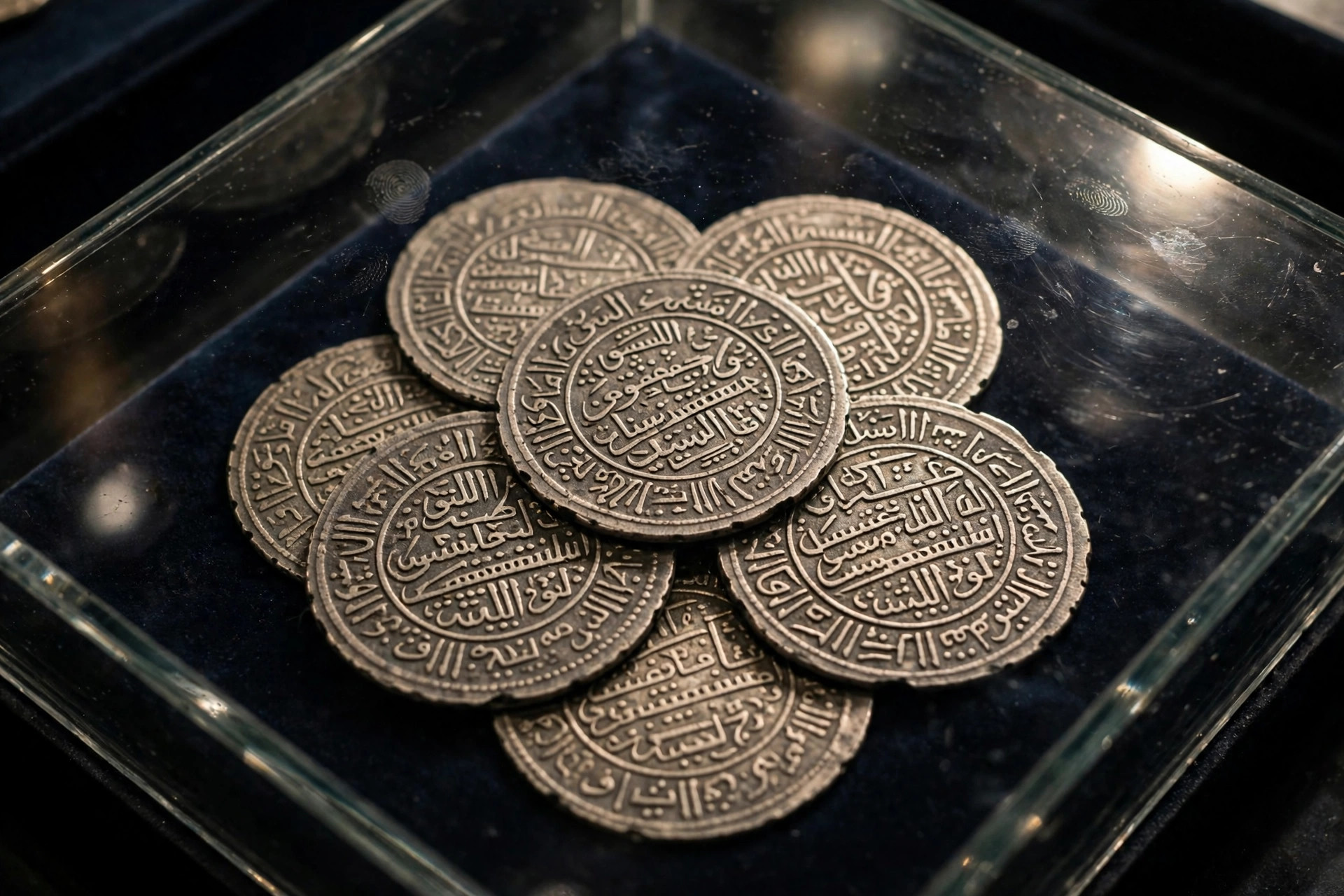
The Almohads changed the money as thoroughly as they changed the state: their caliph Abd al-Mu'min struck square silver dirhams and square gold dinars — coins with corners, inscribed with the Almohad creed, announcing that the new dynasty's money, like its doctrine, was different from everything before it. Our history of Morocco sets these dynasties inside the wider story of the country they built.
Marinids, Saadians and the Gold of the Sudan
The Marinids, who ruled from Fez in the 13th to 15th centuries, returned to round silver dirhams, but their reign shows the other side of the history of Moroccan dirham: debasement. As silver grew scarce and wars grew expensive, the sultans thinned their coins with copper until merchants complained and the good coins vanished into hoards — a medieval lesson in inflation.
The Saadians reversed the slide with gold. Ahmad al-Mansur, who conquered the Songhai Empire in 1591, flooded his mints with Sudanese gold, and for a generation Morocco struck some of the finest gold coinage in the world. But the flood did not last: the gold ran out, the dynasty split, and by the 17th century the coinage was again a patchwork of old silver, foreign coins and clipped pieces that merchants weighed rather than counted.
The Rial, the Falus and the Chaos of the 19th Century
By the 19th century the history of Moroccan dirham had become a story of three metals and no fixed rule. Before the modern coinage of 1882, Morocco issued copper falus for small change, silver dirham for daily trade, and gold benduqi for large payments. Over them all stood the rial, the silver dollar of the Spanish trade, worth ten dirhams from 1882. Foreign coins circulated freely alongside them: Spanish pesetas in the north, French francs in the ports, and Austrian Maria Theresa thalers in the south, where caravans trusted them more than the sultan's own silver.
Each sultan's mint struck coins of different weights, governors struck their own, and counterfeiters struck theirs too; a merchant in Fez might accept a coin at one value and refuse it in Tangier. The chaos was one more reason the European powers demanded financial reform — and one more lever they used to prise the country open. The merchants of the mellah, whose story we tell in our account of Morocco's Jewish heritage, were among the money-changers who made the system work, weighing and testing coins at every transaction.
Hassan I and the First Machine-Struck Coins
Sultan Hassan I (1873–1894) was the first Moroccan ruler to answer the chaos with machinery. In 1882 he ordered Morocco's first modern coinage: machine-struck coins to a fixed standard, with the dirham as a subdivision of the rial at ten dirhams to one rial. The new coins were struck abroad at first — in Paris and London, since Morocco had no modern mint — and they carried the sultan's name in clear Arabic script around a star: the five-pointed Seal of Solomon that would become Morocco's emblem.
The reform was real but partial: the old hand-struck falus and the foreign silver kept circulating, and the government still lacked the revenue to impose one money on the whole kingdom. The exact details of the 1882 issue are still debated — some catalogues date the first strikes to 1881 — but the direction was set: from Hassan I onward, Moroccan money would be made by machine, to a standard, a turning point in the history of Moroccan dirham.
The Franc Years: 1912 to 1960
The protectorate ended the struggle by ending Moroccan monetary independence — a dark chapter in the history of Moroccan dirham. After the Treaty of Fez in 1912, the State Bank of Morocco, created after the Algeciras Conference of 1906, took over the issue of money. Its franc banknotes went into circulation in November 1920, and the Moroccan franc replaced the rial and the old dirham. The coins and notes carried French and Arabic text and orientalist designs, a currency that announced, in its own imagery, who was in charge.
In the Spanish zone in the north the peseta circulated instead, so Morocco lived for decades with two colonial currencies and one border between them. Read the story of the treaty that began it all in our account of the Treaty of Fez. By the 1950s the franc was a reminder of a system Moroccans had not chosen, and replacing it was one of independence's first acts.
Independence and the Return of the Dirham
Independence came on 2 March 1956, and the money followed fast. Negotiations with France over the right to issue currency lasted four years, and the compromise was the rebirth of an old name. The central bank was created by dahir on 30 June 1959 and took over the issue of money the next day; the dirham itself was officially created on 17 October 1959, and it entered circulation on 16 October 1960 — the date most references give for the reintroduction, though some sources give April 1960, the difference being between the legal creation and the day the coins and notes actually reached people's hands.
The new dirham was divided into 100 francs at first, and the franc kept circulating as small change until 1974, when the santim replaced it. The first coins were silver one-dirham pieces in 1960, followed in 1965 by nickel one-dirham and silver five-dirham coins; the first banknotes, overprinted on old franc notes, gave way in 1965 to a 50-dirham note bearing the effigy of Hassan II. The designs were Moroccan at last: the Koutoubia, the ramparts of Rabat, calligraphed Arabic script, and no French imagery at all. Bank Al-Maghrib — the bank's name since 1987 — tells this chapter of the history of Moroccan dirham in its own museum; see the history of the Moroccan banknote on the bank's site, and the Moroccan dirham entry for the full chronology.
The Modern Dirham: Pegs, Floats and Bank Al-Maghrib
For its first six decades the modern dirham was a managed currency, and the history of Moroccan dirham in that period is a careful balancing act. The dirham was pegged to a basket of the currencies of Morocco's trading partners, and Bank Al-Maghrib set the rate and defended it with the country's foreign reserves — stability for exporters, but a value that was a policy decision, not a market price.
The balance shifted in January 2018, when the fluctuation band widened from ±0.3% to ±2.5% against a basket weighted 60% euro and 40% US dollar, and in March 2020 it widened again to ±5%, where it still stands. Within that band, supply and demand set the rate day to day; Bank Al-Maghrib intervenes only rarely — twice since the reform began. The reserves behind the peg are large: more than 400 billion dirhams, over five months of imports. The next step, a full float, has been discussed for years and repeatedly postponed; the dirham remains a managed float, neither fixed nor free.
What the Dirham Is Worth Today
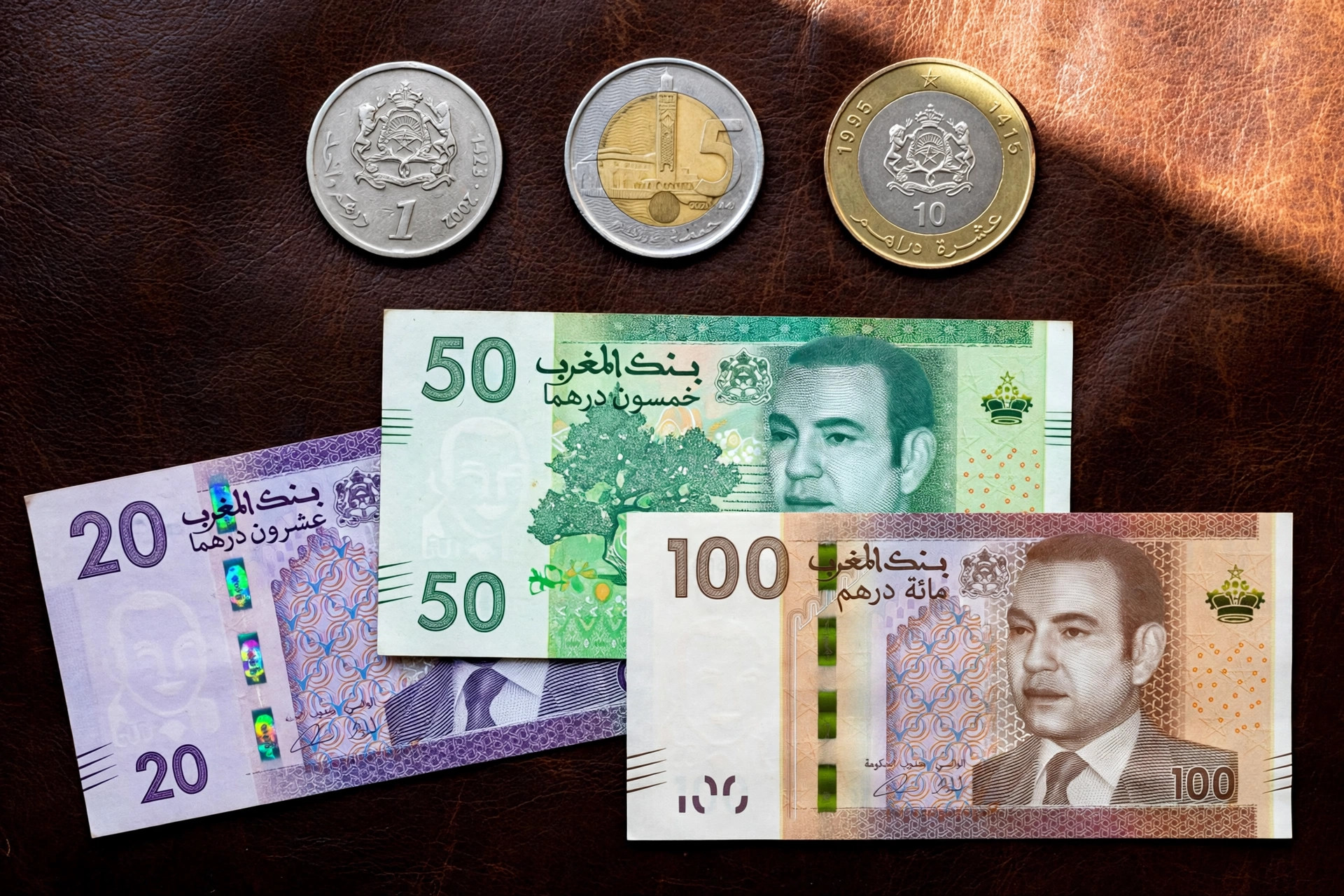
Today, at the end of the history of Moroccan dirham, the currency is a decimal one: one dirham equals 100 santimat (centimes), in coins of 10, 20 and 50 santimat and 1, 2, 5 and 10 dirhams, and banknotes of 20, 50, 100 and 200 dirhams. The 200-dirham note, worth about $20, is the largest most people ever hold. Prices on this site are quoted in dirhams for a reason: the dirham is a closed currency, not freely convertible outside Morocco, so the honest way to plan is in the money you will actually spend. Our cost of living in Morocco guide converts the daily budget into dirhams first and dollars second.
| Denomination | What it buys, November 2026 |
|---|---|
| 5 dirhams | A glass of mint tea in a popular cafe, roughly 5–10 MAD ($0.50–$1) |
| 10 dirhams | A short petit-taxi ride inside a medina, roughly 10–20 MAD ($1–$2) |
| 20 dirhams | A street-food sandwich or a kilo of oranges, roughly 15–25 MAD ($1.50–$2.50) |
| 50 dirhams | A museum entry, roughly 20–70 MAD ($2–$7) |
| 100 dirhams | A hammam session or a simple restaurant lunch, roughly 80–150 MAD ($8–$15) |
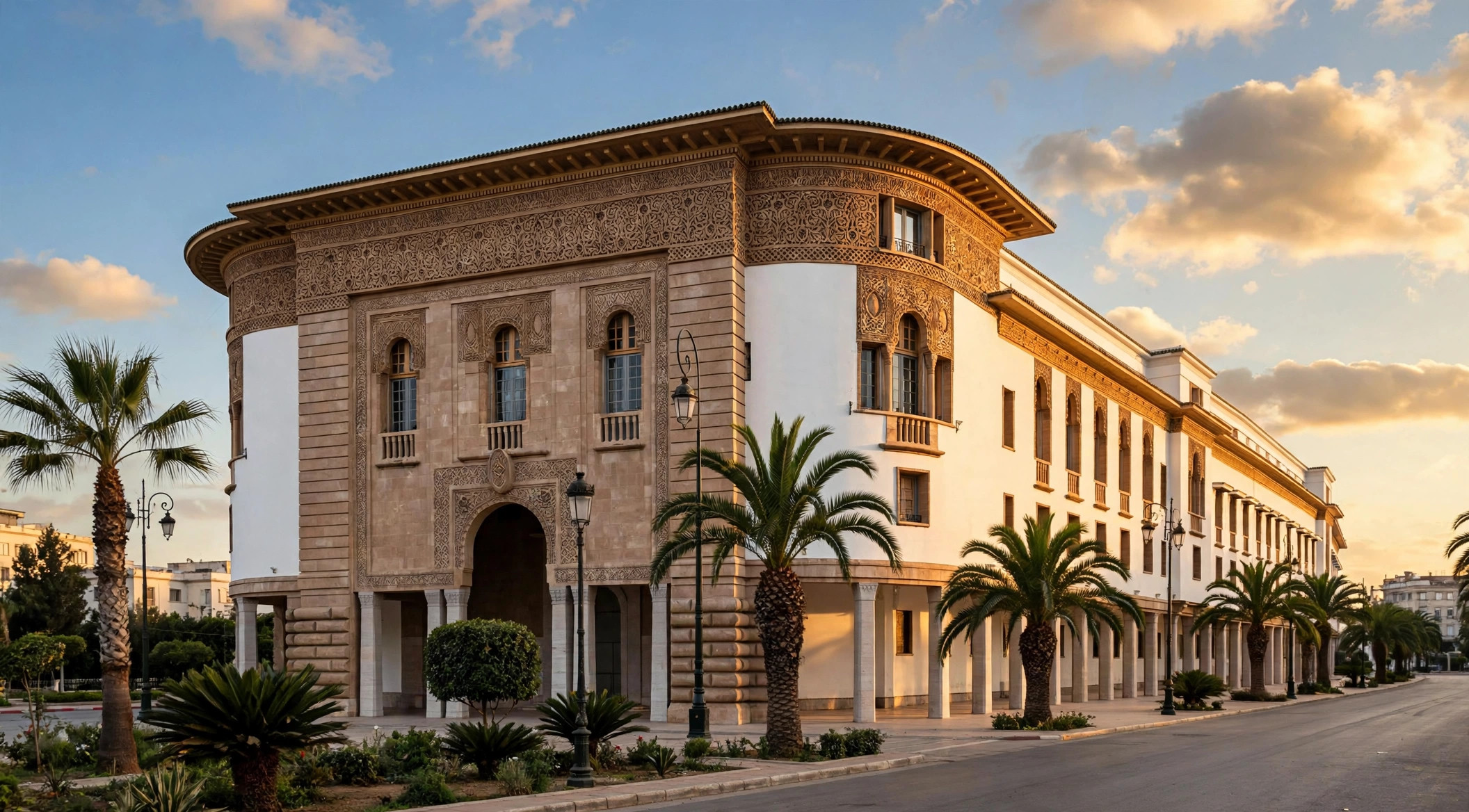
For collectors, the history of Moroccan dirham is also a market: Idrisid silver appears at auction for a few hundred dollars, Almoravid gold for thousands. The Bank Al-Maghrib museum in Rabat displays the full series, from Juba's bronze to the latest banknotes, and entry is free.
Frequently Asked Questions
What does the word dirham mean?
Dirham comes from the Greek drachma, the silver coin of the ancient Mediterranean world. The name passed through Persian and Arabic, and the history of Moroccan dirham shows it in use for silver coinage since the Idrisid dynasty in the 8th century — one of the oldest currency names still in use anywhere.
When was the modern Moroccan dirham introduced?
The modern dirham was created on 17 October 1959 and reintroduced on 16 October 1960, replacing the Moroccan franc at one dirham to 100 francs — the most famous date in the history of Moroccan dirham. The franc continued as small change until 1974, when the santim replaced it.
Why is the dirham not freely convertible?
Morocco controls capital flows: the dirham exchanges freely inside Morocco but is not freely traded on international markets, and taking large amounts out is restricted — stability first, and a gradual opening rather than a sudden one.
What was Morocco's currency before the dirham?
Before the modern dirham, Morocco used the franc under the French protectorate (1912–1960) and the peseta in the Spanish zone; before that came the rial, the silver dirham and the copper falus, with Spanish, French and Austrian coins beside them — every stage of the history of Moroccan dirham in one sentence; and before Islam, the kings of Mauretania struck their own bronze and silver.
Are old Moroccan coins valuable?
Some are. Idrisid silver dirhams and Almoravid gold dinars are collected worldwide and can be worth hundreds or thousands of dollars. But most 20th-century coins are worth little more than face value, and the market is full of copies — buy from a reputable dealer, never from a street seller.
Can I use euros or dollars in Morocco?
In practice, no — or only at a bad rate. Hotels and some tourist shops accept euros, but the dirham is the only currency that works everywhere, from the souk to the grand taxi. Change money at a bank or a licensed exchange office, keep the receipt, and change back what you do not spend.
Conclusion
The history of Moroccan dirham runs in one long line from the Greek drachma to the managed float of today: a name borrowed from antiquity, silver struck by the Idrisids, gold carried by Almoravid caravans, square coins from the Almohads, the chaos of the rial and the falus, the franc years of the protectorate, and the return of the dirham in 1960 as the money of an independent Morocco. Each chapter left something in the coin you hold now: the name from Greece, the script from the Idrisids, the star from Hassan I, and the caution of a central bank that still manages the rate by hand.
To hold the story in your hand, visit the Bank Al-Maghrib museum in Rabat, where the whole history of Moroccan dirham is laid out in glass cases — from Juba's bronze to the latest banknote — then read our history of Morocco and the cities in our Morocco Travel guides.