
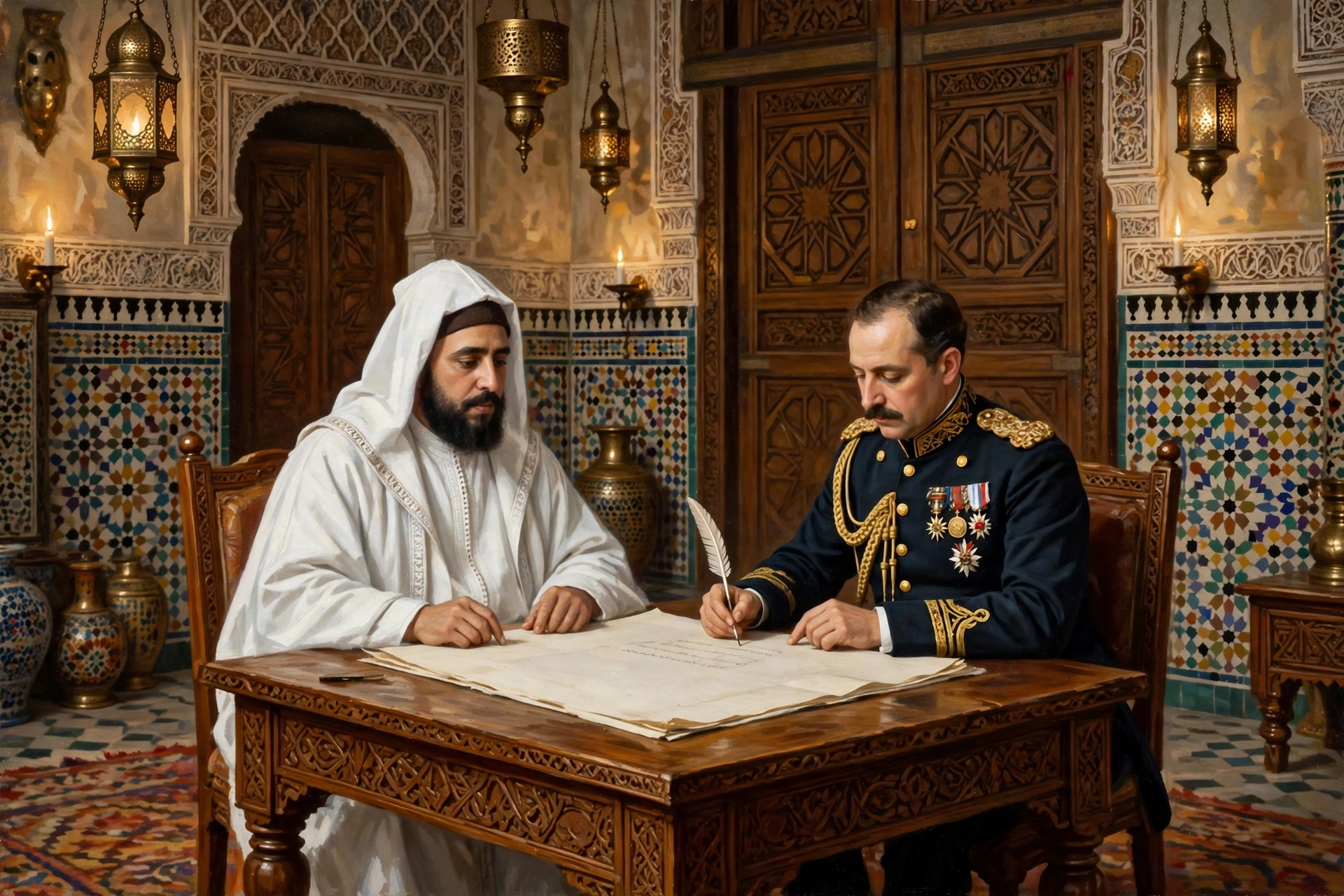
The Treaty of Fez 1912 was the document that ended Morocco's independence. On 30 March 1912, Sultan Abd al-Hafid signed it in the royal palace of Fez, and Morocco became a French protectorate. The sultan kept his throne and his title, but France took control of the army, foreign policy, finance and the courts. Morocco would not be free again for forty-four years.
This guide explains how Morocco reached that night in Fez, what the treaty's nine articles actually said, and what happened in the weeks after the signing — the uprising in Fez, the sultan's abdication, and the arrival of General Lyautey. It also explains why the Treaty of Fez 1912 still shapes how Moroccans remember the protectorate era.
The story sits in our History & Heritage section, alongside our wider history of Morocco and the Alaouite dynasty guide. For the treaty's full text, see the Treaty of Fes on Wikipedia.
In this guide
- What Was the Treaty of Fez 1912?
- Morocco Before the Treaty of Fez 1912
- The Road to Fez: Algeciras, Agadir and the 1911 Crisis
- The Night of 29–30 March 1912
- What the Treaty of Fez 1912 Actually Said
- Protectorate, Not Colony: What the Word Really Meant
- The Bloody Days of Fez: 17 April 1912
- Abdication and the Arrival of Lyautey
- Spain, Tangier and the Division of Morocco
- The Treaty of Fez 1912 at a Glance
- What Changed for Ordinary Moroccans
- The Treaty of Fez 1912 in Moroccan Memory
- Visiting Fez Today: Where It Happened
- Frequently Asked Questions
- Conclusion: The Signature That Ended an Era
What Was the Treaty of Fez 1912?
The Treaty of Fez 1912 was a short agreement — nine articles — between the Sultan of Morocco and the French Republic. Its full title was the "Treaty Concluded Between France and Morocco on 30 March 1912, for the Organization of the French Protectorate in the Sharifian Empire". In plain terms, it created a new regime: France would run Morocco's administration, army and foreign affairs, while the sultan remained the formal head of state.
The treaty was signed under duress. French troops already surrounded Fez, and the sultan's own army was falling apart. The French diplomat Eugène Regnault signed for France, and the sultan signed for Morocco after six hours of talks that ran from six in the evening until midnight. The interpreter was Abdelqader Benghabrit, a translator at the French legation in Tangier.
That is why historians usually describe the Treaty of Fez 1912 as imposed rather than negotiated. France wrote the text, France set the terms, and the sultan's signature was the price of keeping his throne for a few more months.
Morocco Before the Treaty of Fez 1912
To understand the Treaty of Fez 1912, look at Morocco in 1911. The country was the last independent state in North Africa, but its independence was paper-thin. France had occupied Oujda in 1907 and bombarded Casablanca the same year, and it had crushed the Moroccan army at Isly back in 1844. The army was weak, the treasury was empty, and the sultan's authority barely reached beyond the cities. Tribal revolts flared across the countryside, and the sultan in Fez ruled a country that was slipping from his hands.
The sultan himself was part of the problem. Abd al-Hafid had seized the throne from his brother Abd al-Aziz in 1908, promising to resist European demands. Instead he accepted the Act of Algeciras, honoured his brother's debts and paid for the French campaigns in Oujda and the Chaouia. By 1911 his own supporters in Fez had turned against him, and a new revolt threatened the capital itself. The French offered him a choice: accept their protection, or lose his throne to the rebels.
The Road to Fez: Algeciras, Agadir and the 1911 Crisis
The road to the treaty ran through two earlier crises. The first was the Act of Algeciras of 1906, when the European powers and the United States met to settle the future of Morocco. The act kept the sultan on his throne in theory, but it gave France and Spain control of the police and the customs. From that moment, Morocco's independence depended on Europe's goodwill. It was the first step toward the Treaty of Fez 1912.
The second was the Agadir Crisis of July 1911. When a revolt threatened Fez, France sent troops to the capital. Germany answered by sending the gunboat Panther to Agadir, demanding compensation in the Congo. The crisis nearly started a European war, and it ended on 4 November 1911 with a Franco-German agreement: Germany dropped its claims in Morocco, and France got a free hand. Five months later, the Treaty of Fez 1912 turned that free hand into a protectorate.
The Night of 29–30 March 1912
The signing itself took one night. On 29 March 1912, Regnault arrived at the royal palace in Fez while French troops surrounded the city. The talks began at six in the evening and lasted until midnight — six hours in which the sultan, his ministers and the French delegation argued over a text France had already written. The treaty was signed in the early hours of 30 March.
The sultan signed because he believed he had no choice. His army was mutinous, the tribes were marching on Fez, and the French presented the treaty as the only way to save his throne. The next morning, the news reached the people of Fez. Within eighteen days, the city would explode. The Treaty of Fez 1912 had been signed — but it had not been accepted.
What the Treaty of Fez 1912 Actually Said
The Treaty of Fez 1912 has nine articles, and its language is careful: it speaks of reforms, order and protection. Read closely, though, and the meaning is plain. France gained the right to run the country, and the sultan kept the right to sign the papers. The table below summarises the provisions that mattered most. Britannica's short Treaty of Fès summary tells the same story in brief.
| What changed | How it worked |
|---|---|
| Reforms | France could introduce any administrative, judicial, educational, economic, financial or military reform it judged useful (Article 1). |
| Military occupation | France could occupy any part of Morocco it deemed necessary, and exercise police powers on land and at sea (Article 2). |
| The sultan's protection | France pledged constant support to the sultan against any danger to his person, his throne or his states (Article 3). |
| Who made the laws | New measures were issued by the sultan, on the proposal of the French government (Article 4). |
| Money | Morocco lost financial autonomy: no loans or financial changes without France. |
| The Resident-General | France's representative in Morocco held full powers and alone represented Morocco abroad. |
| Ratification | The treaty was submitted to the French government for ratification (Article 9). |
Article 4 is the one to remember. It meant the sultan signed decrees that France had written — a system built on the dahir, the Arabic word for a royal decree. The Resident-General, France's man on the spot, proposed the laws, the sultan signed them, and Morocco's own government became a stamp. The Treaty of Fez 1912 did not abolish the monarchy. It emptied it.
Protectorate, Not Colony: What the Word Really Meant
France called Morocco a protectorate, not a colony, and the distinction mattered. A colony is ruled directly by the foreign power; a protectorate keeps its own ruler and government, at least on paper. The sultan stayed on his throne, the makhzen — the Moroccan government — continued to exist, and Islamic law and Moroccan courts still handled Moroccan affairs. France presented this as respect for Morocco's sovereignty.
In practice, the difference was thin. The Resident-General controlled foreign policy, the army, the police and the budget, and he was the only channel between the sultan and foreign governments. The sultan signed the laws France wrote. The protectorate was a colony with a Moroccan face — and the Treaty of Fez 1912 was the document that gave it legal form.
The Bloody Days of Fez: 17 April 1912
The treaty was signed on 30 March. On 17 April, Fez answered. That morning, French officers announced the new measures to their askar units — Moroccan soldiers under French command. Many units mutinied at once, killed their French officers and left their barracks. The rebels attacked the European quarter and the Jewish mellah, and the city lost control for two days.
The French response was brutal. General Brulard ordered his artillery to shell the mellah, believing — wrongly — that the Jews were supporting the revolt. When the fighting ended, the commonly cited death toll was around 600 Moroccan Muslims, 66 Europeans and 42 Moroccan Jews, though the exact figures are disputed and no official count was ever agreed. The rebels surrendered after two days, and the sultan, who had already fled to Rabat for his safety, was blamed by his own people for the betrayal.
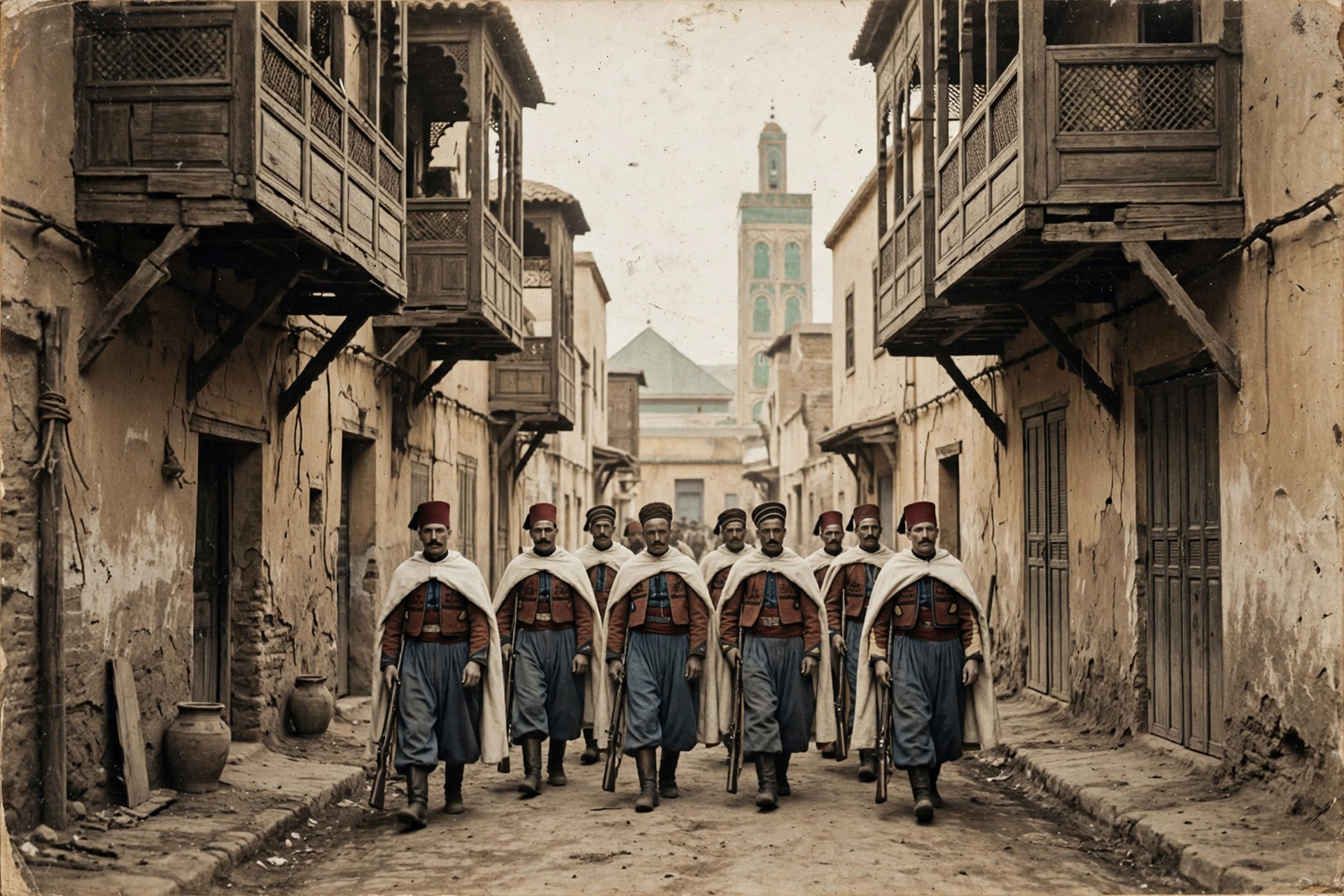
The uprising is known in Morocco as the Intifada of Fez, and in French sources as the "Bloody Days of Fez". It showed, within three weeks of the signing, that the Treaty of Fez 1912 had no support in the country it was supposed to govern. France would spend the next two decades imposing it by force.
Abdication and the Arrival of Lyautey
The Treaty of Fez 1912 was the beginning of the end for the sultan who signed it. In August 1912, Abd al-Hafid was forced to abdicate in favour of his younger brother, Moulay Youssef, who was seen as more willing to work with France. Abd al-Hafid signed his abdication on the quay in Rabat, with the ship that would take him into exile in France already waiting. He lived until 1937, but he never ruled again.
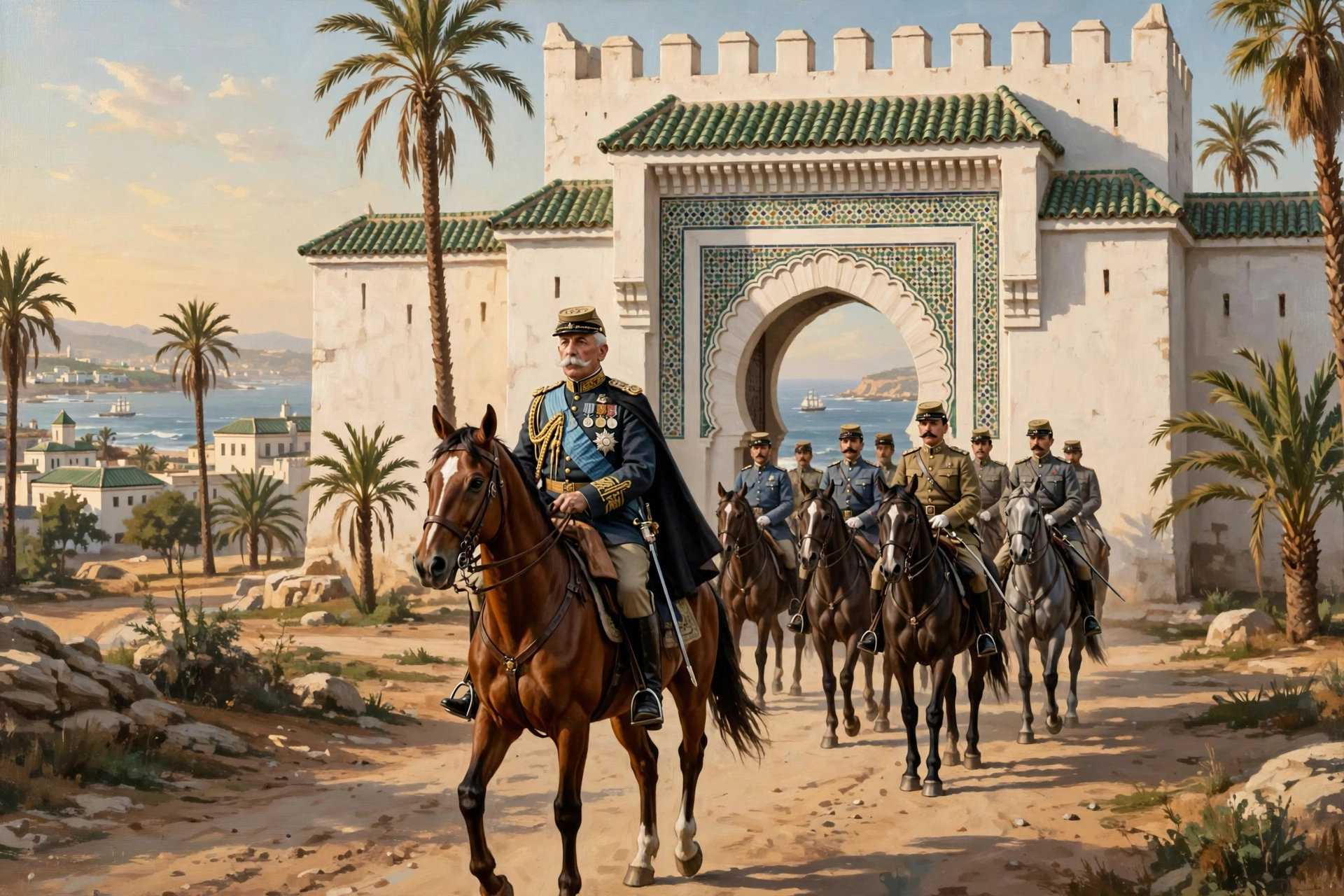
His replacement as France's man in Morocco was General Hubert Lyautey, appointed the first Resident-General. Lyautey reached Fez as tribal forces attacked the city, and he saw at once how thin French control really was. Over the next thirteen years he built the protectorate's administration, moved the capital from Fez to Rabat, and extended French control across the country — by negotiation with tribal leaders where he could, and by force where he could not.
Spain, Tangier and the Division of Morocco
The treaty with France was not the whole story. Spain had its own claims in the north, and the Treaty of Fez 1912 made provision for them. On 27 November 1912, France and Spain signed a separate agreement in Madrid: Spain received a zone in the north, around Tetouan and the Rif, and another in the south, around Tarfaya. The Spanish protectorate lasted, like the French one, until 1956.
Tangier was handled separately from the Treaty of Fez 1912. The city became an international zone under a statute agreed in 1923, governed by several European powers at once — a strange, cosmopolitan enclave that lasted until Morocco's independence. For the full story, see our guide to Tangier's International Zone, and for the war that later shook the Spanish zone, the Rif War.
The Treaty of Fez 1912 at a Glance
| Detail | Fact |
|---|---|
| Signed | 30 March 1912, after talks on the night of 29–30 March |
| Place | The royal palace, Fez |
| Signatories | Sultan Abd al-Hafid and Eugène Regnault, for France |
| What it created | The French protectorate in Morocco |
| How long it lasted | 1912–1956 (44 years) |
| The sultan's fate | Abd al-Hafid abdicated in August 1912; Moulay Youssef succeeded him |
| First Resident-General | Hubert Lyautey, appointed May 1912 |
| Spain's zone | Agreed by the Franco-Spanish treaty of 27 November 1912 |
| How it ended | The Franco-Moroccan Joint Declaration of 2 March 1956 |
The Treaty of Fez 1912 stayed in force for almost half a century. When it ended, Morocco's independence was restored by negotiation, not by the treaty itself — the protectorate system it created had to be dismantled piece by piece.
What Changed for Ordinary Moroccans
For most Moroccans, the treaty changed daily life slowly and then all at once. French administrators arrived in the cities, new taxes and land rules followed, and French became the language of government and business. Fez lost its status as capital to Rabat, and the sultan's court — the centre of Moroccan political life for centuries — moved with it.
In the countryside, the change came with soldiers. Tribes that refused the new order faced military columns, and the "pacification" of Morocco took more than twenty years. Resistance never stopped: the Rif War of 1921–1926 was its largest explosion, and the nationalist movement that finally won independence in 1956 grew out of the schools, newspapers and parties the protectorate itself had created.
That long resistance is the other half of the story of the Treaty of Fez 1912: a document signed in one night took a generation to undo.
The Treaty of Fez 1912 in Moroccan Memory
In Morocco today, the Treaty of Fez 1912 is remembered as a national humiliation and a warning. School textbooks present it as the moment Morocco lost its independence to a Europe that had been circling it for fifty years. The sultan who signed it, Abd al-Hafid, is remembered as the ruler who gave the country away — a harsh judgement, though his choices were narrow.
Historians argue about how much choice he really had. Some say he could have fought and lost; others say he should have fought anyway. The argument matters because it is really about Morocco itself: whether the country was conquered from outside, or failed from within. The Treaty of Fez 1912 sits at the centre of that argument, and it is not going away.
Visiting Fez Today: Where It Happened
You can still walk the city where the treaty was signed. The royal palace in Fez — Dar el Makhzen — stands behind its famous brass doors, though the palace itself is closed to visitors. The medina of Fes el Bali, where the April uprising raged, is a UNESCO World Heritage site, and Bab Bou Jeloud, the blue gate, marks the entrance to the old city. Stand there at dusk and 1912 feels very close.
The Treaty of Fez 1912 was signed in Fez, but its consequences played out in Rabat, the capital Lyautey chose. The Ville Nouvelle, with its broad avenues and administrative quarter, is where the protectorate governed from. For the wider story, our history of Morocco and Kings of Morocco guides cover the dynasties before and after the treaty, and our Morocco independence 1956 guide tells how it ended.
Frequently Asked Questions
When was the Treaty of Fez 1912 signed?
The Treaty of Fez 1912 was signed on 30 March 1912, in the royal palace of Fez, after six hours of talks on the night of 29–30 March between Sultan Abd al-Hafid and the French diplomat Eugène Regnault.
Who signed the treaty?
Sultan Abd al-Hafid signed for Morocco, and Eugène Regnault, France's minister plenipotentiary, signed for the French Republic. The talks were interpreted by Abdelqader Benghabrit of the French legation in Tangier.
Did the treaty make Morocco a French colony?
No. It created a protectorate: the sultan kept his throne and Morocco kept its own government in theory, while France controlled foreign policy, the army, finance and the courts. In practice, the Resident-General held the real power.
What happened in Fez after the signing?
On 17 April 1912, Moroccan soldiers mutinied and the city rose against the French and the sultan. The uprising, known as the Bloody Days of Fez, left around 600 Moroccan Muslims, 66 Europeans and 42 Moroccan Jews dead, according to the commonly cited figures.
How long did the protectorate last?
The protectorate created by the Treaty of Fez 1912 lasted 44 years, from 30 March 1912 until the Franco-Moroccan Joint Declaration of 2 March 1956, which restored Morocco's independence.
Can I visit the places connected to the treaty?
Yes. The royal palace gates and the medina of Fez are open to visitors, and Rabat — the capital Lyautey built up after 1912 — holds the protectorate-era quarters. Both cities are easy to reach by train from Casablanca and Tangier.
Conclusion: The Signature That Ended an Era
The Treaty of Fez 1912 was nine articles on a few pages, signed in a single night. It ended centuries of independence — Morocco had kept its freedom while its neighbours fell to Ottoman and then European rule — and it began forty-four years of French rule. The sultan kept his crown and lost his country; France took the country and left the crown in place.
What makes the treaty worth remembering is not the document itself but what it reveals: a country weakened from within, a Europe that had already decided its fate, and a signature given under the guns. Morocco survived the protectorate, and in 1956 it took its independence back. But the Treaty of Fez 1912 remains the date every history of modern Morocco turns on.
Last checked: November 2026
1 thought on “The Treaty of Fez 1912: How Morocco Became a Protectorate”