
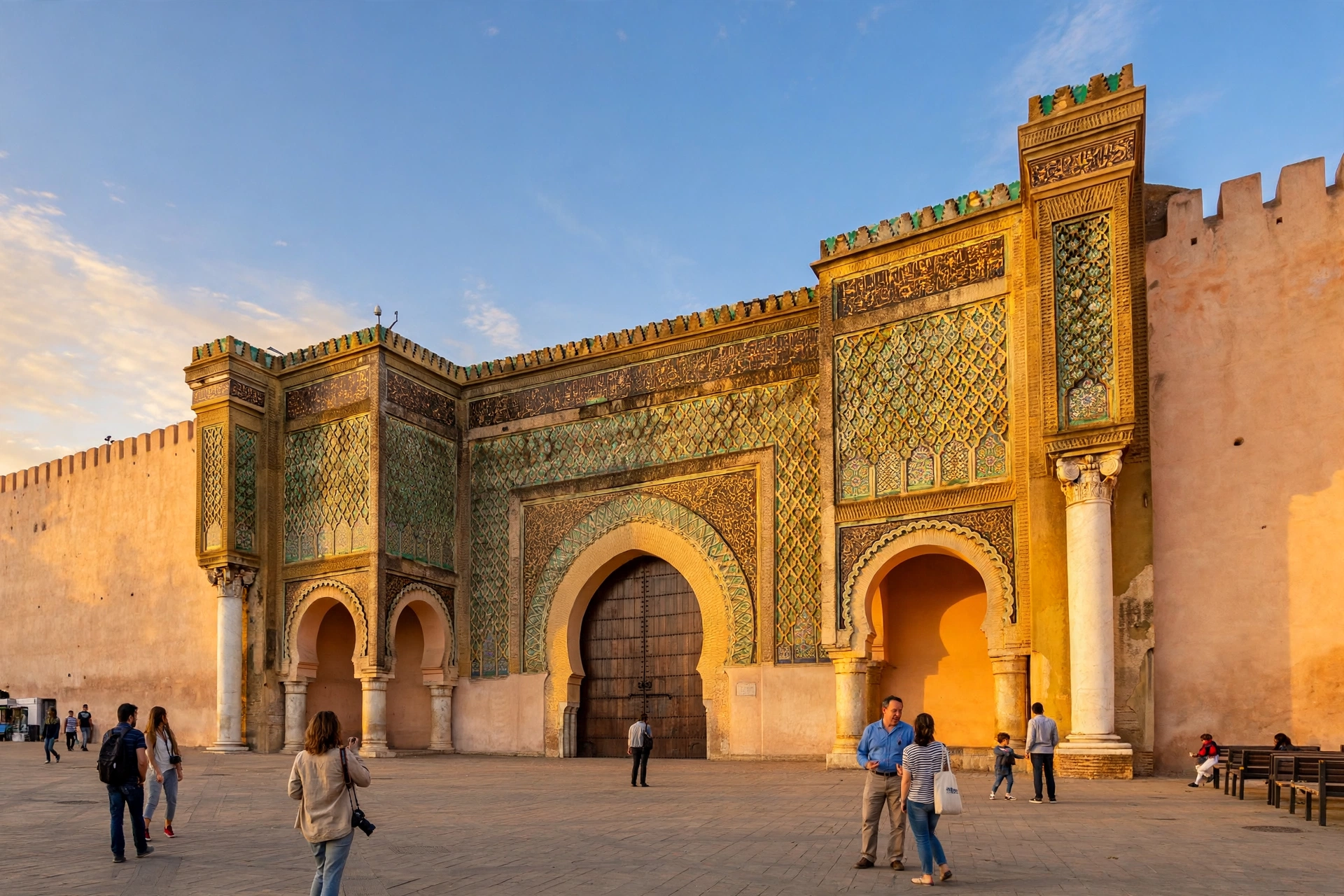
Stand in Place el-Hedim in Meknes at sunset, look up at the green-tiled arch of Bab Mansour, and you are looking at the work of the alaouite dynasty morocco, the family that has ruled this country for more than three and a half centuries. No other Moroccan dynasty has lasted so long, or left so much standing in the cities you can still walk through today. This guide tells the whole story, from a small southern oasis town to the modern kingdom of Mohammed VI.
For travellers, the Alaouites are the key to understanding Morocco. Their sultans built Meknes, rebuilt Fes, founded the modern port of Essaouira, and moved the capital to Rabat. Their story explains why Morocco stayed independent when its neighbours fell, why its kings still carry the title Commander of the Faithful, and why the country feels both traditional and modern. The alaouite dynasty morocco is not a closed chapter: it is the living present, and this article shows you where to see it.
In this guide:
- Origins in the Tafilalt and the Rise of Moulay Rashid
- Moulay Ismail and the Building of Meknes
- The Warrior Sultans and the Black Guard
- Sultans, Crises and Reform in the 18th and 19th Centuries
- Moulay Youssef, the Protectorate and Mohammed V
- Hassan II and Mohammed VI to the Present Day
- Where to See Alaouite Morocco Today
- Why the Alaouites Still Matter
- Frequently Asked Questions
Origins in the Tafilalt and the Rise of Moulay Rashid
The Alaouites came from the Tafilalt, a palm oasis in the far south-east of Morocco, on the edge of the Sahara near the town of Rissani. They were a sharifian family, tracing their descent from the Prophet Muhammad through his grandson Hassan, a lineage that gave them religious authority no rival could match. In the mid-seventeenth century Morocco was fragmented, with rival warlords, brotherhoods and the remnants of the Saadian state fighting over the cities. The alaouite dynasty morocco emerged from that chaos, and it did so from the desert edge rather than from any great city.
Moulay Rashid, who took power in the Tafilalt in the 1660s, turned a local sharifian family into a national dynasty. He was a skilled soldier and patient politician who built his power step by step: first the oasis towns, then the Middle Atlas passes, then Fes, which he entered in 1666. Two years later he took Marrakech, and Morocco had a single ruler again for the first time in a generation.
The exact dates of some of his early campaigns in the Tafilalt are not settled, and chroniclers disagree on the sequence of his first victories, so this article gives the broad shape rather than a false precision. For the wider sweep, see our brief history of Morocco and our guide to the Saadian dynasty.
Moulay Rashid died in 1672, after only a few years as sultan of a reunited Morocco, after a fall from a horse, as chroniclers describe it. His reign was short, but it was decisive. He had reunified the country and given his family the throne. The question was whether his successors could hold what he had won, and the answer came from his younger brother, a man of a very different temper who would rule for fifty-five years and rebuild Morocco in his own image. The alaouite dynasty morocco had found its founder, and it was about to find its builder.
Moulay Ismail and the Building of Meknes
Moulay Ismail ruled from 1672 to 1727, one of the longest reigns in Moroccan history, and he defines the popular image of the dynasty. Ruthless, energetic and ambitious, he set out to build a capital from scratch to rival Versailles. He chose Meknes, a modest town between Fes and Rabat, and turned it into an imperial city of palaces, granaries, stables and walls. The alaouite dynasty morocco still shows its face in Meknes more than anywhere else in the country.
The scale of the building was extraordinary, and the alaouite dynasty morocco announced itself to the world in stone. Ismail’s Meknes covered a vast area: the royal palace complex, the huge granaries of Heri es-Souani, the Agdal basin that stored water for the gardens, and Bab Mansour, completed after his death by his son Moulay Abdallah. Tens of thousands of workers, prisoners and soldiers laboured on the project for decades. European visitors wrote home in amazement at stables said to hold twelve thousand horses and walls that ran for kilometres.
The Warrior Sultans and the Black Guard
Ismail’s power rested on an army unlike anything Morocco had seen: the Black Guard, known in Arabic as the Abid al-Bukhari. These were soldiers of sub-Saharan origin, raised from childhood as a loyal standing army that owed everything to the sultan and nothing to any tribe. They let Ismail crush tribal revolts, hold the mountain passes, and keep the trade roads open from the Sahara to the Atlantic. The alaouite dynasty morocco depended on this army, and the Guard became one of the most feared and resented forces in the country.
The system worked while Ismail lived, because he controlled it personally and paid for it from trade and taxation. After his death in 1727, it became a curse. For the next thirty years Morocco fell into chaos, often called the time of troubles, as the Guard made and unmade sultans in a series of short, violent reigns.
Between 1727 and 1757 the throne changed hands many times, and the great building projects of Meknes stalled while the empire fought over itself. The alaouite dynasty morocco survived this period, but only just, and the lesson was clear: an army that answers to no one but the sultan is a danger when the sultan is weak.
Order returned with Sidi Mohammed ben Abdallah, who ruled from 1757 to 1790 and is remembered as one of the most capable sultans of the dynasty. He rebuilt the administration, restored trade, and founded the port of Essaouira in the 1760s as a new Atlantic gateway. His reign showed that the dynasty could reform itself after crisis, a pattern that would repeat across the centuries.
The Alaouite Dynasty Morocco in the 18th and 19th Centuries
The nineteenth century was the hardest test the dynasty had faced since its founding. Europe was industrialising, its armies growing stronger, and its merchants and consuls wanted ever more access to Moroccan ports, mines and markets. Sultan Moulay Abd al-Rahman (1822–1859) tried to hold the line, but in 1844 France bombarded Tangier and defeated his army at Isly, and in 1860 Spain seized Tetouan. The alaouite dynasty morocco was still independent, but its weakness was now visible to the whole world.
The sultans who followed tried to reform. Moulay Hassan I, who ruled from 1873 to 1894, was the most energetic of them, and he travelled the country in person to show the flag in regions that had barely seen a sultan in years. He tried to build a modern army and reform the tax system, but he faced resistance from the great caids of the south, scholars who distrusted foreign ideas, and European powers happy to lend him money at ruinous rates. See our guide to the Marinids and their madrasas in Fes.
By the end of the century the crisis was deepening. Moulay Hassan died on campaign in 1894, and his teenage son Moulay Abd al-Aziz came to the throne dominated by advisers who sold offices and signed concessions. France, Spain, Britain and Germany all wanted a say in Morocco’s future, and their rivalry bought the country a little time at a heavy price. The country was falling into debt, the army was weak, and the tribes were slipping beyond the sultan’s control. The alaouite dynasty morocco entered the twentieth century still sovereign, but its sovereignty was paper thin.
Moulay Youssef, the Protectorate and Mohammed V
In 1912, after years of pressure and a French advance on Fes, Sultan Moulay Abd al-Hafid signed the Treaty of Fes, and Morocco became a French protectorate, with a Spanish zone in the north and Tangier under international administration. The sultan kept his throne, court and religious authority, but real power passed to the French Resident-General. Moulay Youssef, who ruled from 1912 to 1927, had to make this humiliating arrangement work, and he did so with patience and dignity. The alaouite dynasty morocco survived the protectorate by accepting the form of rule while keeping the substance of legitimacy.
The protectorate years brought enormous change. The French built modern ports, railways and roads, founded the new cities of Casablanca and Rabat in their modern form, and moved the capital to Rabat in 1912. Moroccan cities grew fast, and a new educated class emerged in the French schools and the old universities of Fes. But the change came with expropriation, with land taken for settlers, and with a growing sense that Morocco was being run for someone else’s benefit. The alaouite dynasty morocco became, for many Moroccans, the symbol of the nation itself: the one institution that was Moroccan through and through.
Mohammed V, who came to the throne in 1927, turned that symbolism into a national movement. Young, dignified and quietly stubborn, he refused to be a puppet. During the Second World War he protected Morocco’s Jewish community from Vichy anti-Jewish laws, a stand Moroccans still remember with pride. After the war he embraced independence openly, and in 1953 the French exiled him to Madagascar, replacing him with a puppet sultan. The country rose in protest, and the exile backfired completely: it turned Mohammed V into a national hero. The alaouite dynasty morocco had become the flag of independence.
He returned in triumph in November 1955, and on 2 March 1956 Morocco became independent. Mohammed V was now king of a free country, and he set about building a modern state: a parliament, an administration, an army, and a place for Morocco in the world. He died suddenly in 1961, after an operation in Rabat, and was succeeded by his son Hassan II. See our guide to the imperial cities for how Fes, Marrakech, Meknes and Rabat each took their turn as capital.
Hassan II and Mohammed VI to the Present Day
Hassan II ruled from 1961 to 1999, in the longest and most controversial reign of the modern dynasty. He was a brilliant, ruthless operator who survived two attempted coups in the early 1970s, built a powerful security state, and kept Morocco firmly in the Western camp during the Cold War. He also presided over the Green March of 1975 and the construction of the Hassan II Mosque in Casablanca, one of the largest mosques in the world. The alaouite dynasty morocco under Hassan II was strong, centralised and feared; critics and admirers agree on one thing: he was never a figurehead.
The later years of his reign brought change. In the 1990s, under pressure at home and abroad, Hassan II opened the political system, allowed a government led by the opposition, and began to talk of human rights and reform. He died in 1999, and his son Mohammed VI came to the throne at thirty-five, promising a closer, more open style focused on development. The alaouite dynasty morocco entered the twenty-first century with a young king and a fast-changing country.
Mohammed VI has now ruled for more than a quarter of a century, his reign defined by large public works and a careful opening of society. The Al Boraq high-speed train, the Tanger Med port, the solar plants of the desert south and the modernisation of Rabat and Casablanca have all happened under his rule. He has promoted women’s rights, religious moderation and Amazigh language rights, while keeping a firm grip on power. The alaouite dynasty morocco today is a constitutional monarchy in form, but the king remains the central figure of Moroccan politics, and the palace remains the centre of decision-making.
Where to See Alaouite Morocco Today
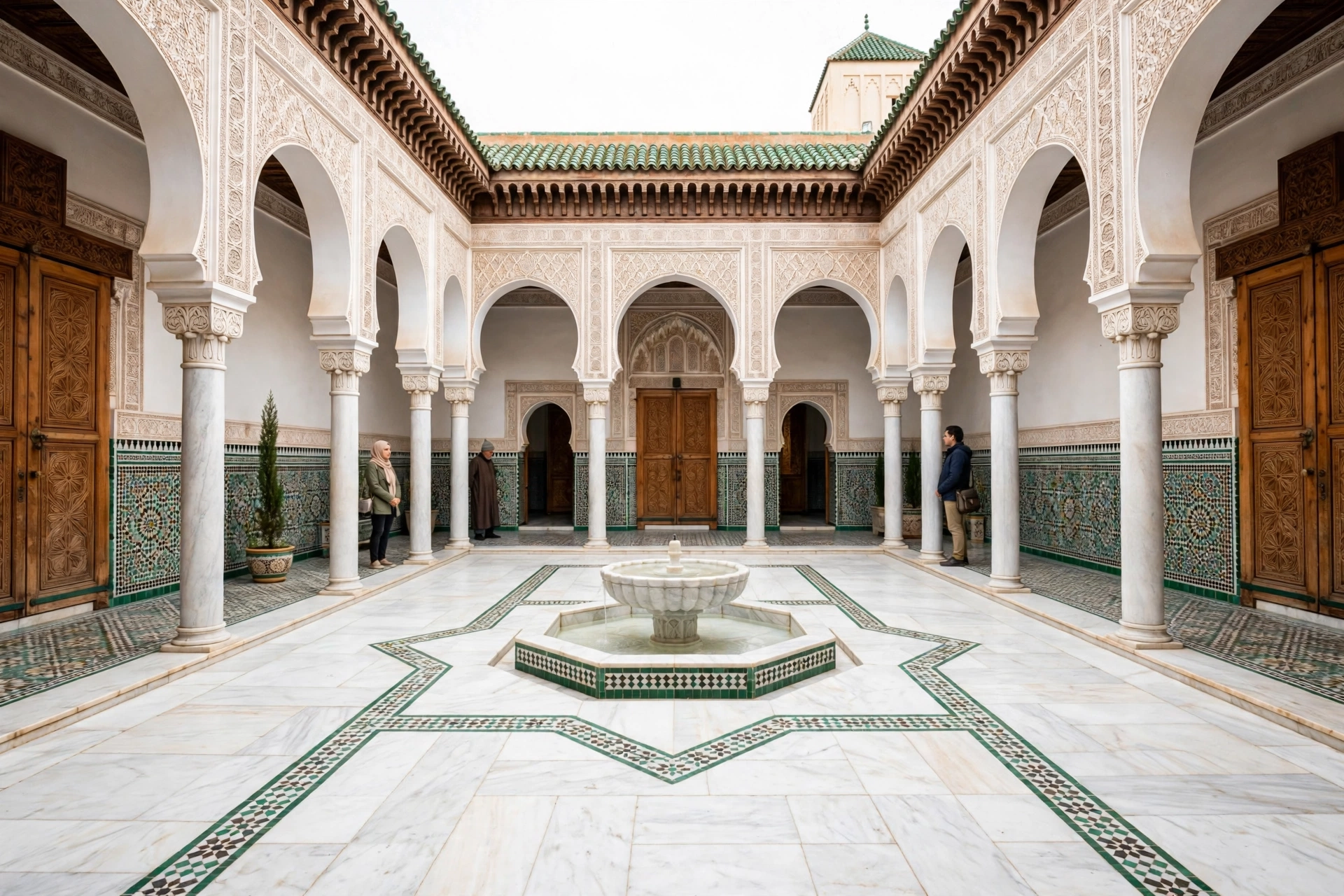
Meknes is the essential stop, and it is also the most underrated of the imperial cities. Start at Bab Mansour, the great gate of the imperial city, then walk through to Place el-Hedim, the vast square where the city gathers in the evening. Nearby, the Mausoleum of Moulay Ismail is a quiet courtyard of marble and green tile where the sultan who built Meknes is buried. The Alaouite dynasty is buried here, and the mausoleum is the most moving of its monuments. The alaouite dynasty morocco comes alive in Meknes in a way no museum can match, because the city itself is the monument.
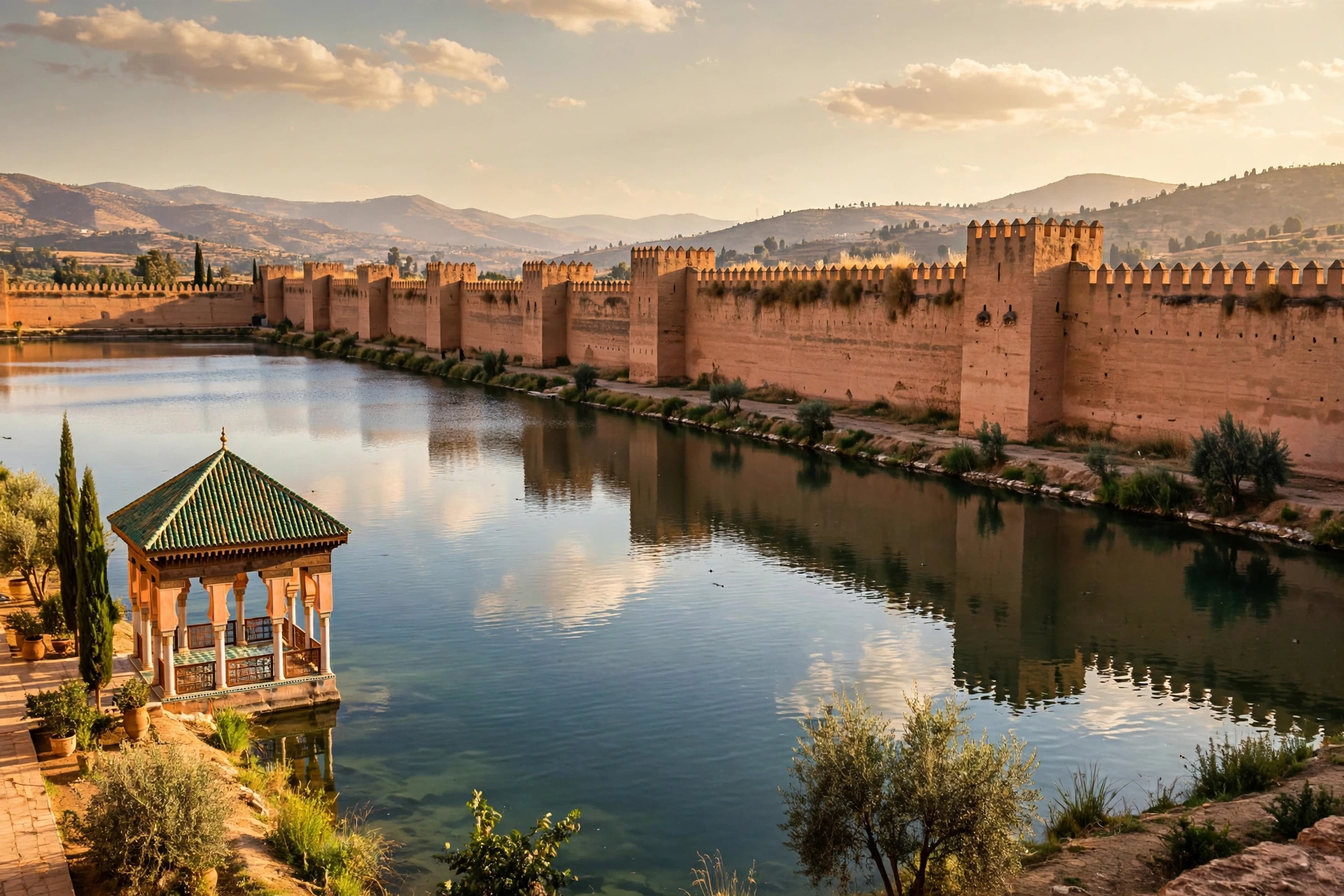
The rest of imperial Meknes rewards a full day. The granaries of Heri es-Souani, with their huge vaulted halls, show how Ismail fed his army and court. The Agdal basin, a vast rectangular reservoir beside the ramparts, stored water for the royal gardens. The UNESCO-listed Historic City of Meknes covers the whole ensemble, which takes in the imperial city, the medina and the Jewish quarter. The alaouite dynasty morocco left its grandest work in this one city, and a day here is a day inside the dynasty’s own imagination.
Beyond Meknes, the dynasty’s traces are everywhere. In Fes, the royal palace gates of Fes el-Jdid, with their great brass doors, are the finest in the country, though the palace itself is closed. In Rabat, the royal palace and the Mausoleum of Mohammed V, where the king who won independence lies beside his son Hassan II, are the ceremonial heart of modern Morocco. In Marrakech, the Saadian tombs and the El Badi palace are older, but the Alaouite sultans restored them and built around them. The alaouite dynasty morocco is a thread that runs through every imperial city, and following it is the best itinerary in the country.
| Site | Entry fee (Nov 2026) | Opening | Notes |
|---|---|---|---|
| Bab Mansour, Meknes (exterior) | Free | Always visible | Best light at sunset; Place el-Hedim beside it |
| Mausoleum of Moulay Ismail, Meknes | Free | Daily, approx. 09:00–18:00 | Dress modestly; non-Muslims may enter the courtyards, not the tomb chamber |
| Heri es-Souani granaries and stables, Meknes | 70 MAD (about $7) | Daily, approx. 09:00–18:00 | Combined ticket with the royal stables |
| Dar Jamai Museum, Meknes | 20 MAD (about $2) | Daily except Tuesdays, approx. 09:00–17:00 | Traditional arts and crafts in a 19th-century palace |
| Mausoleum of Mohammed V, Rabat | Free | Daily, approx. 09:00–18:00 | Beside the Hassan Tower; allow 30 minutes |
| Royal Palace gates, Fes el-Jdid | Free to view from outside | Always visible | Palace interior closed; the brass gates are the sight |
Prices checked November 2026; confirm on arrival. Meknes is about 40 minutes from Fes by train.
Why the Alaouites Still Matter
Three and a half centuries after Moulay Rashid rode out of the Tafilalt, his family still sits on the throne of Morocco, and that simple fact shapes everything about the country. The dynasty survived civil war, European conquest, protectorate rule, coups and the Arab Spring, by changing when it had to and holding firm when it mattered. The alaouite dynasty morocco is not only the longest chapter of Moroccan history, it is the chapter still being written, and the gates, granaries and mausoleums of Meknes are the best place to start reading it.
Frequently Asked Questions
Who founded the Alaouite dynasty?
Moulay Rashid founded it in the 1660s, taking Fes in 1666 and Marrakech in 1668. His brother Moulay Ismail ruled from 1672 to 1727 and built imperial Meknes. The alaouite dynasty morocco began in the Tafilalt oasis, near modern Rissani.
How long did Moulay Ismail rule?
Moulay Ismail ruled from 1672 to 1727, a reign of fifty-five years. He built Meknes, created the Black Guard, retook Larache and Tangier, and exchanged ambassadors with Europe.
Is it true Moulay Ismail had hundreds of children?
The often-repeated figure of more than eight hundred children is legend, not settled fact; chroniclers inflated the number and historians have not verified it. The alaouite dynasty morocco remembers Ismail as a builder and warrior, and the child count should be treated as folklore.
Why did the dynasty survive the French protectorate?
The sultans kept throne, court and religious authority while France held real power. Mohammed V turned that surviving legitimacy into the flag of independence, returning from exile in 1955 a national hero.
Where is the best place to see Alaouite history?
Meknes is the best place, with Bab Mansour, the Mausoleum of Moulay Ismail, the Heri es-Souani granaries and the Agdal basin in one walkable imperial city. The alaouite dynasty morocco is most visible there, and Fes and Rabat add the palace gates and royal mausoleums.
Who is the current king of Morocco?
King Mohammed VI has ruled since 1999, succeeding his father Hassan II. His reign has brought high-speed rail, the Tanger Med port and major solar energy projects.