
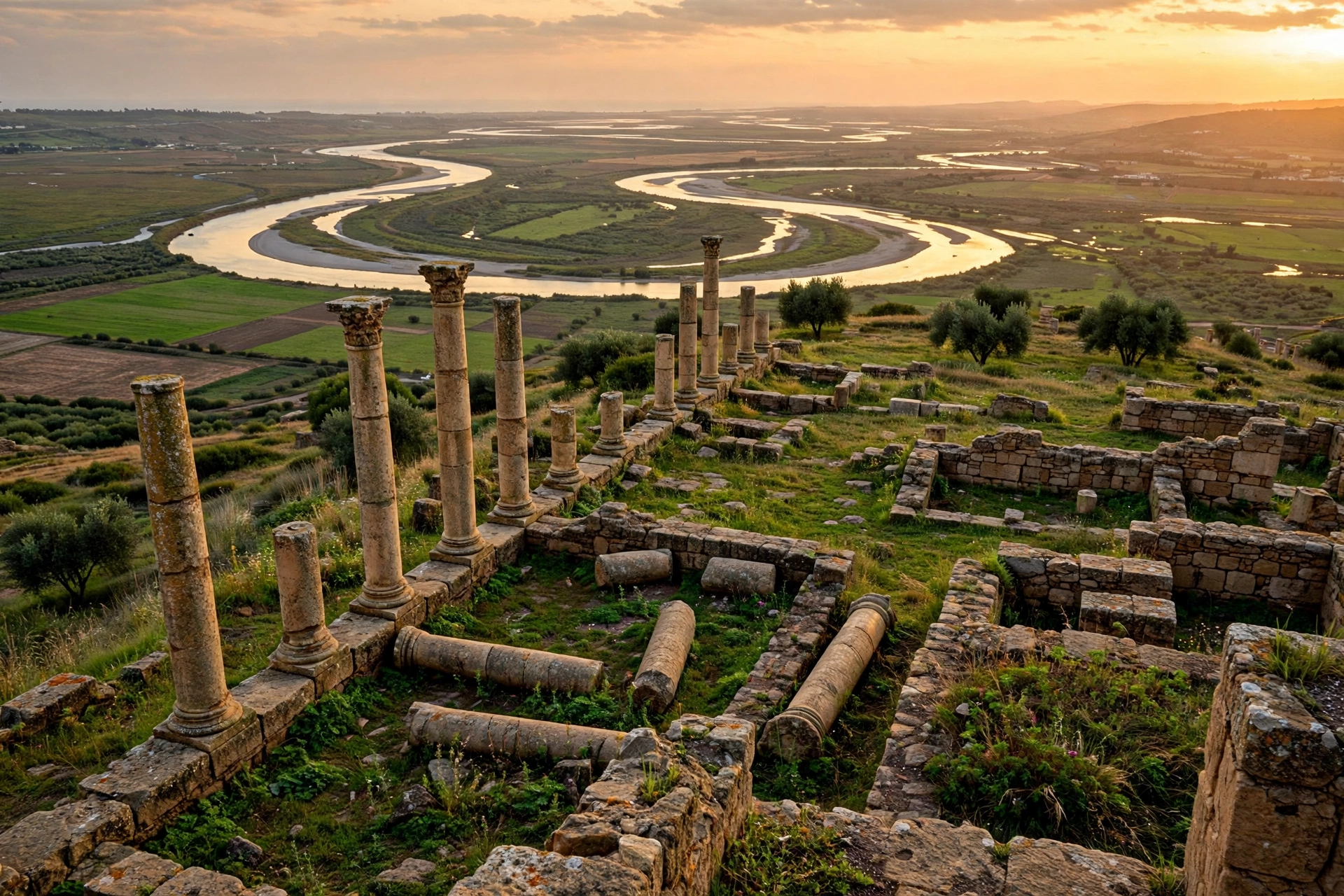
Lixus Morocco is one of the oldest and least visited archaeological sites in the country, and that is exactly why it rewards the traveller who makes the detour. On a low hill above the Loukkos river, a few kilometres from Larache, lie the remains of a port that traded with Phoenicians, Carthaginians and Romans for two thousand years. This guide to Lixus Morocco explains what the stones actually show, which stories are legend and which are archaeology, and how to plan a visit in 2026.
Most visitors to Morocco's Roman past head straight for Volubilis, and for good reason: it is grand and well preserved. But Lixus Morocco is older, quieter and stranger. You can walk its empty streets alone, stand in a theatre silent for seventeen centuries, and look across the river to the marshes where ancient writers placed a garden of golden apples. There are no crowds here — just the ruins themselves.
In this guide
- What Is Lixus Morocco and Where Is It?
- The Phoenician Foundation: A Disputed Beginning
- Lixus Morocco Under Carthage
- Roman Lixus: Annexation and Growth
- The Garum Factories: Fish Sauce and Fortune
- The Theatre and the Temple of Hercules
- The Garden of the Hesperides: Legend, Not Fact
- Mosaics and Daily Life in Roman Lixus Morocco
- Decline After Rome’s Withdrawal
- Later Occupation and a Long Silence
- Excavations: Miguel Tarradell and the Modern Rediscovery
- Lixus Morocco on the UNESCO Tentative List
- Visiting Lixus Morocco Today
- Frequently Asked Questions
- Conclusion: Why Lixus Morocco Deserves a Visit
What Is Lixus Morocco and Where Is It?
Lixus Morocco was a port city on the Atlantic coast of north-west Morocco, built on a hill called Tchemmish on the north bank of the Loukkos river, about 3 kilometres from the modern town of Larache. Its ruins run from the hilltop acropolis down to the river plain, where the factories and harbour once stood. From the top you can see the Loukkos winding toward the sea.
The Loukkos estuary gave Lixus sheltered anchorage, fresh water, fish in enormous numbers and a route inland toward the plains of the Gharb. Goods from the interior — grain, timber, hides and salt — could be loaded here for export. Browse the full History & Heritage category for the rest of our series.
The Phoenician Foundation: A Disputed Beginning
Lixus began as a Phoenician trading post, one of the oldest Phoenician settlements in the western Mediterranean. Ancient writers, above all Pliny the Elder, claimed the city was founded in the 12th century BCE, which would make it older than Carthage itself. That early date is disputed and unsettled: no archaeological evidence supports a 12th-century foundation, and most scholars place the first Phoenician presence in the 8th century BCE.
What archaeology does confirm is a small Phoenician settlement on the hilltop from the 8th century BCE onward, with imported pottery and the remains of houses and shrines. The settlers sailed from Tyre and the other Phoenician cities of the Levant seeking silver, tin and new markets. For the wider story of these first traders, see our history of Morocco. The earliest layers of Lixus Morocco show a modest port with a harbour that would serve it for two thousand years.
| Period | Dates | What happened at Lixus |
|---|---|---|
| Phoenician foundation | 8th century BCE (12th century claimed, disputed) | Trading post founded on the hill above the Loukkos |
| Carthaginian era | c. 6th–2nd century BCE | Punic control, trade and temple building |
| Roman annexation | 42 CE | Lixus joins the province of Mauretania Tingitana |
| Roman peak | 1st–3rd century CE | Garum factories, theatre, mosaics, city walls |
| Roman withdrawal | 3rd century CE (exact end unsettled) | Garrison and administration leave the south |
| Later occupation | Medieval period | Smaller settlement continues, then the site is abandoned |
| Excavations | 1940s–1950s | Miguel Tarradell uncovers the theatre and factories |
| UNESCO tentative list | Since 1995 | Lixus listed as a candidate World Heritage site |
Lixus Morocco Under Carthage
From about the 6th century BCE, Lixus Morocco fell under Carthage, the great Phoenician city of North Africa. Carthage absorbed it into its trading network: Lixus paid tribute, adopted Punic customs and coinage, and grew rich on the same trade that had drawn the first Phoenicians. Carthaginian ships carried salt, fish and grain across the Mediterranean and brought back wine and pottery.
The Carthaginian centuries left their mark on the city's religion as well. A temple on the hilltop, later rebuilt by the Romans as the Temple of Hercules, probably began as a shrine to the Punic god Melqart. Each new ruler rebuilt the shrine rather than moving it. The city was already old and respected when Rome arrived, and Roman writers treated it as a place of great antiquity.
Roman Lixus: Annexation and Growth
Rome took direct control of Lixus Morocco in 42 CE, when the emperor Claudius annexed Mauretania and created the province of Mauretania Tingitana, with its capital at Tingis, modern Tangier. Over the next two centuries it grew into one of the province's most important ports. Its merchants shipped salted fish and fish sauce to markets as far away as Rome itself.
The Romans rebuilt the city in stone. They laid out streets on a grid, built a forum, baths and a theatre, ringed the hill with walls, and expanded the factories into an industrial complex of remarkable size. Lixus never became a grand marble city like Volubilis, and that contrast is part of its interest: where Volubilis shows Rome's power inland, Lixus shows its appetite for the sea. Read the Volubilis guide alongside this one for more on the Roman world in Morocco.
| Feature | Lixus | Volubilis |
|---|---|---|
| Location | Atlantic coast, on the Loukkos near Larache | Inland, near Meknes at the foot of the Zerhoun |
| Founded | Phoenician, 8th century BCE (12th century claimed, disputed) | 3rd century BCE, as a Mauretanian town |
| Main industry | Fish salting and garum | Olive oil and grain |
| Best remains | Theatre, garum vats, temple, mosaics | Triumphal arch, basilica, great houses |
| Crowds | Almost none | Busy, especially at weekends |
| Best for | Quiet exploration and the Hesperides legend | Grand Roman architecture |
The Garum Factories: Fish Sauce and Fortune
The wealth of Roman Lixus Morocco came from garum, the fermented fish sauce the Roman world poured over almost everything it ate. The factories on the river plain were among the largest in the western empire. Workers salted tuna, mackerel and sardines in the vats, left the mixture to ferment in the sun, then drew off the liquid, sealed it in amphorae and shipped it abroad.
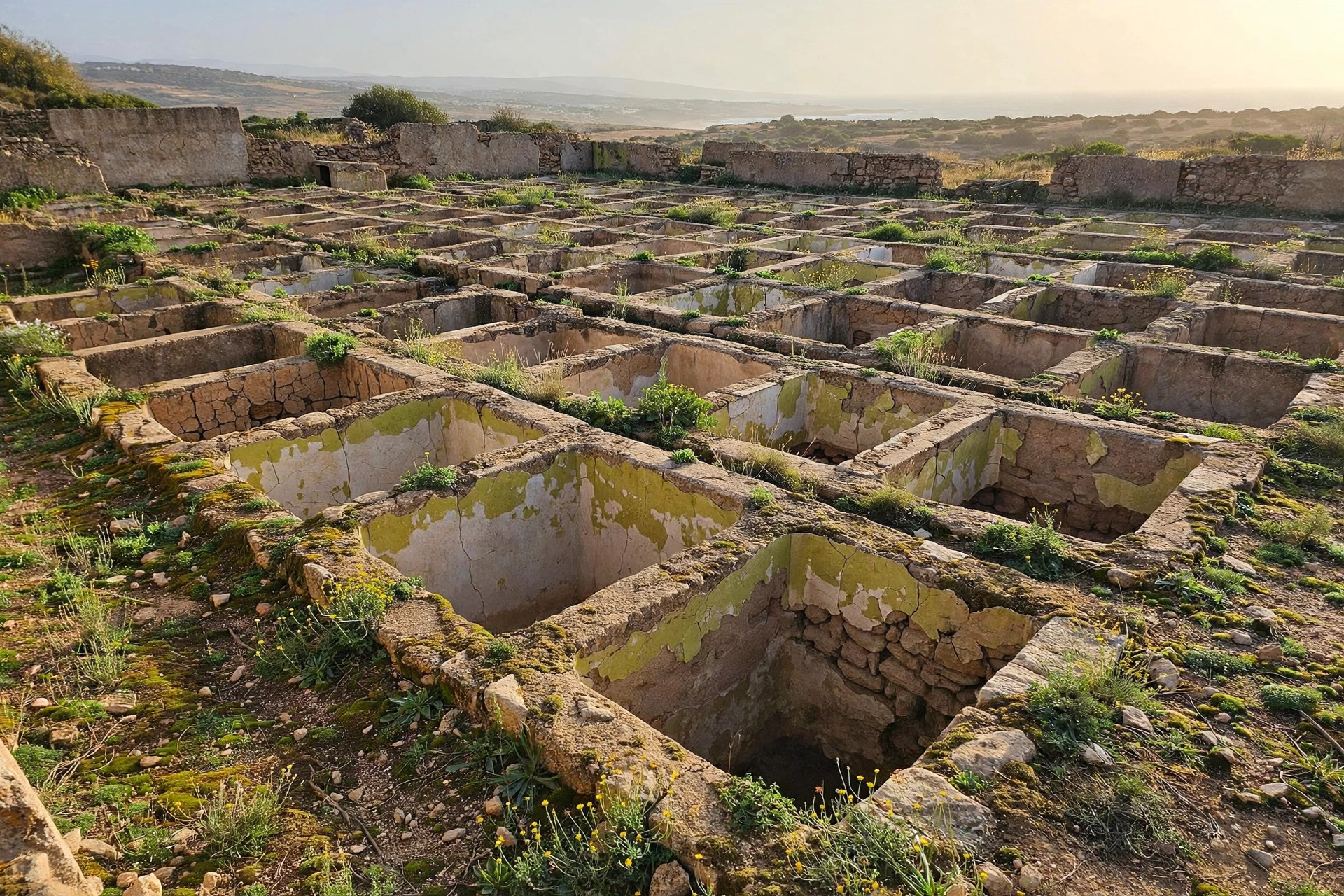
You can still walk among the vats today, the most vivid remains on the site. The tanks are lined with waterproof plaster, and the scale of the complex makes the economics plain: this was not a cottage craft but an industry, worked by hundreds of people and feeding a trade that reached the whole Mediterranean. Good garum was expensive, and Lixus Morocco grew rich on it. Stand among the vats and remember that the smell would once have been overwhelming: the town's prosperity stank of fish.
The Theatre and the Temple of Hercules
The theatre of Lixus Morocco is one of only a few Roman theatres in Morocco, and it is the most atmospheric. Built into the hillside in the 1st century CE, it could hold several thousand spectators, and its curved seats still follow the slope. The theatre was where the city gathered, festivals were held and Rome displayed its culture to a frontier town.
Above the theatre, on the summit of the hill, stood the Temple of Hercules. The Romans built it over an older Punic shrine, used for centuries before that. Little survives beyond foundations and scattered blocks, but the position is eloquent: from the summit, the priests could watch the river, the harbour and the sea. The temple linked Lixus to the oldest myth of the western Mediterranean, and that link gave the city a fame far beyond its size.
The Garden of the Hesperides: Legend, Not Fact
Every guide to Lixus Morocco mentions the Garden of the Hesperides; every honest one says at once that this is legend, not established fact. In Greek myth, the Hesperides were nymphs who guarded a garden of golden apples, and Hercules stole the apples as one of his twelve labours. Ancient writers, including Pliny, placed that garden at Lixus, on a marshy island in the Loukkos estuary.
The identification is plausible but unsettled: treat it as a story, not as history. The marshes below Lixus are strange and beautiful, and it is easy to see why ancient travellers imagined a magical garden there. The golden apples may have been a poetic way of describing the oranges and citrus fruit that grew in the valley. Enjoy the legend, and remember that the archaeology of Lixus needs no myth to be worth the visit: the vats, the theatre and the mosaics are real enough.
Mosaics and Daily Life in Roman Lixus Morocco
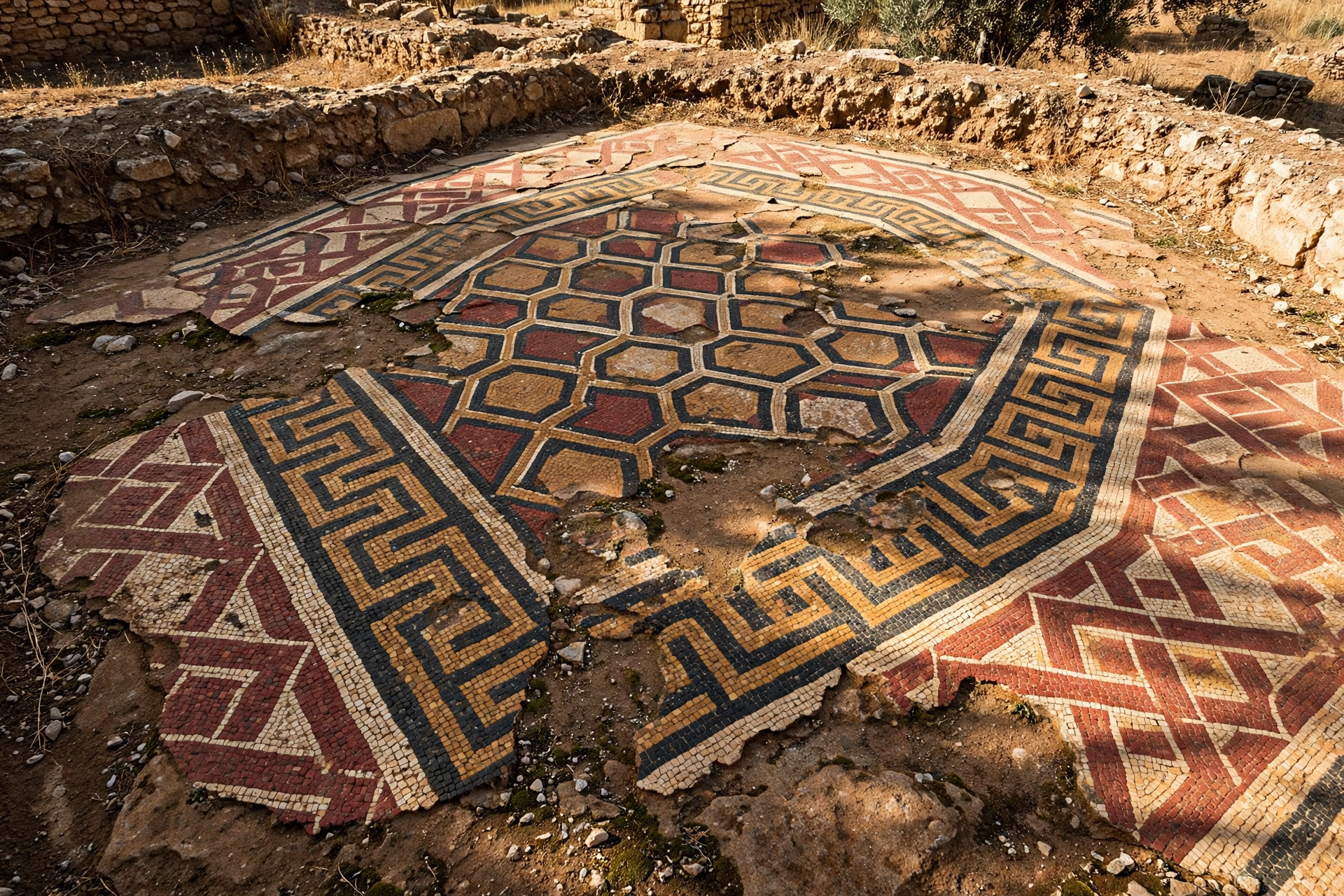
The houses of wealthy Lixus Morocco are known mainly through their mosaic floors, and the finest of them is the great Oceanus mosaic, a swirling composition of sea creatures, waves and mythological figures that once paved a rich merchant's dining room. Other floors survive in place, their red, ochre and black patterns still bright under the Moroccan sun. These were working floors, and they tell us what mattered to their owners: the sea, its creatures and its wealth.
Daily life in Roman Lixus Morocco was shaped by the port. Merchants lived on the hill, in houses with courtyards, baths and mosaic dining rooms, while fishermen, salt workers and potters lived and worked on the plain below. The city imported wine and fine pottery, and exported salted fish, garum and grain. Inscriptions record the names of freedmen, traders and officials — a reminder that this was a living town, not a stage set. For the deep past of this land, see our guide to Jebel Irhoud, the site of the oldest known Homo sapiens fossils.
Decline After Rome's Withdrawal
In the 3rd century CE, Rome withdrew its administration and garrison from southern Mauretania Tingitana, including Lixus Morocco. The exact end is unsettled: the traditional date is around 285 CE, under Diocletian, but the withdrawal may have been gradual, and some scholars argue for an earlier or later end. What is clear is that the organised Roman town faded. The factories fell silent, the theatre lost its audience, and the great houses were abandoned or reused by fewer, poorer inhabitants.
The empire was under pressure on every frontier, and a remote Atlantic port was expensive to defend. Trade routes shifted, the garrison marched north to Tangier, and the city slowly turned its back on the sea. The story of what followed belongs to the kings of Morocco, whose dynasties reshaped the country in the centuries to come.
Later Occupation and a Long Silence
Lixus Morocco did not vanish overnight. A smaller settlement continued through the medieval period, and pottery and coins show people lived and fished here long after the Roman administration had gone. The hilltop remained a landmark, and local Amazigh communities knew the ruins and reused their stone. By the later Middle Ages the town was effectively abandoned, and Larache, a few kilometres away, took over as the region's port.
Travellers knew of Lixus Morocco from ancient texts, and the site was identified in the 19th century, but no one dug systematically. The stones were quarried, the mosaics were buried under soil, and the theatre filled with earth. It was a forgotten city — famous in books, invisible on the ground — until archaeologists arrived in the 20th century. The later history of Morocco's great cities is told in our guide to the imperial cities.
Excavations: Miguel Tarradell and the Modern Rediscovery
The modern rediscovery of Lixus Morocco belongs above all to the Spanish archaeologist Miguel Tarradell, who directed excavations here in the 1940s and 1950s. He uncovered the theatre, the factories, the temple platform and stretches of the city walls, turning a name in old books into a place you could walk through. Later teams have continued the work, clarifying the Phoenician layers and the long history of the site.
Excavation here is slow: the site is large, the layers are deep, and much of it remains unexcavated. What has been dug is conserved, not rebuilt, so visitors see real walls and real vats. For background on Lixus in the wider literature, see the Lixus entry on Wikipedia. Work continues, and each season adds a little more to a story still genuinely unsettled in places.
Lixus Morocco on the UNESCO Tentative List
Since 1995, Lixus Morocco has stood on UNESCO's tentative list, the waiting room for World Heritage status. Tentative listing brings no money or protection, but it recognises the site's outstanding universal value and is the first step toward full inscription. Morocco has put Lixus forward as part of its Roman heritage, alongside Volubilis, a World Heritage site since 1997.
Full inscription would bring funding, conservation work, better visitor facilities and — inevitably — more visitors. Visit before inscription, and you will see Lixus Morocco as archaeologists see it: unpolished and half-buried.
Visiting Lixus Morocco Today
Visiting Lixus Morocco today is easy and cheap, and it fits neatly into a day trip from Larache or Tangier. From Larache, 3 kilometres away, a petit taxi costs around 15–25 MAD (about $1.50–$2.50), or you can walk in under an hour along the river road. From Tangier, buses to Larache cost around 40–60 MAD (about $4–$6) each way. Entry costs around 60 MAD (about $6), checked November 2026 — treat this as approximate, as fees can change without notice.
Allow one and a half to two hours. Start at the factories on the plain, climb through the theatre to the temple platform, and finish with the mosaics and the Loukkos marshes. Spring and autumn are the best seasons: the light is kind and the summer heat has not yet arrived. Bring water and sun protection: there is little shade. Combine the visit with Larache's old town and its long Atlantic beach, and read our Tangier International Zone history before heading north. For official visitor information, see Visit Morocco.
| Item | Cost (MAD) | Approx. USD |
|---|---|---|
| Site entry | around 60 | about $6 |
| Petit taxi, Larache to Lixus | 15–25 | $1.50–$2.50 |
| Bus, Tangier to Larache | 40–60 | $4–$6 |
| Lunch in Larache | 60–100 | $6–$10 |
| Guided tour (if available) | 150–250 | $15–$25 |
| Day trip total from Larache | 150–250 | $15–$25 |
Lixus sits well on a northern Morocco route, with the kasbahs of Ait Ben Haddou far to the south-east for those heading inland. And if your journey ends in Casablanca, the Hassan II Mosque makes a fitting final stop — a modern monument to set beside this ancient one.
Frequently Asked Questions
Where is Lixus Morocco?
Lixus Morocco stands on a hill above the Loukkos river, about 3 kilometres from Larache on Morocco's Atlantic coast, roughly 80 kilometres south of Tangier. A petit taxi from Larache takes a few minutes.
How old is Lixus?
Archaeology supports a Phoenician foundation in the 8th century BCE, making Lixus Morocco about 2,800 years old. Ancient writers claimed a 12th-century BCE foundation, but that early date is disputed and unsettled, with no archaeological evidence behind it so far.
Is Lixus the same as Volubilis?
No. Lixus is an Atlantic port near Larache, famous for garum and the Hesperides legend, while Volubilis is an inland city near Meknes, famous for its arch and great houses. Both are worth visiting.
What is garum?
Garum was a fermented fish sauce made by salting fish in stone vats and leaving it to ferment in the sun. The Romans used it in almost every dish, and the factories at Lixus were among the largest producers in the western empire.
How long do I need at Lixus?
Allow one and a half to two hours for the garum factories, the theatre, the temple platform and the mosaics. Add an hour if you want to walk down to the Loukkos marshes.
Is Lixus a UNESCO World Heritage site?
Not yet. Lixus has been on UNESCO's tentative list since 1995, the first step toward full World Heritage inscription. Volubilis, by contrast, has been inscribed since 1997.
Conclusion: Why Lixus Morocco Deserves a Visit
Lixus Morocco is not the grandest Roman site in the country, and it does not try to be. Its appeal is quieter: a hill above a river, a theatre with no audience, vats that once fed an empire, and a legend that may not be true. It is a place where the history is still half-buried, and where a visitor can feel the scale of the ancient Mediterranean without a crowd.
Go in spring or autumn, go early, and take your time. Lixus Morocco rewards the unhurried visitor — the one who climbs to the temple platform, looks across the marshes and imagines the ships coming up the Loukkos. Few places in Morocco offer so much history for so little effort, and fewer still in such silence.
Last checked: November 2026.