
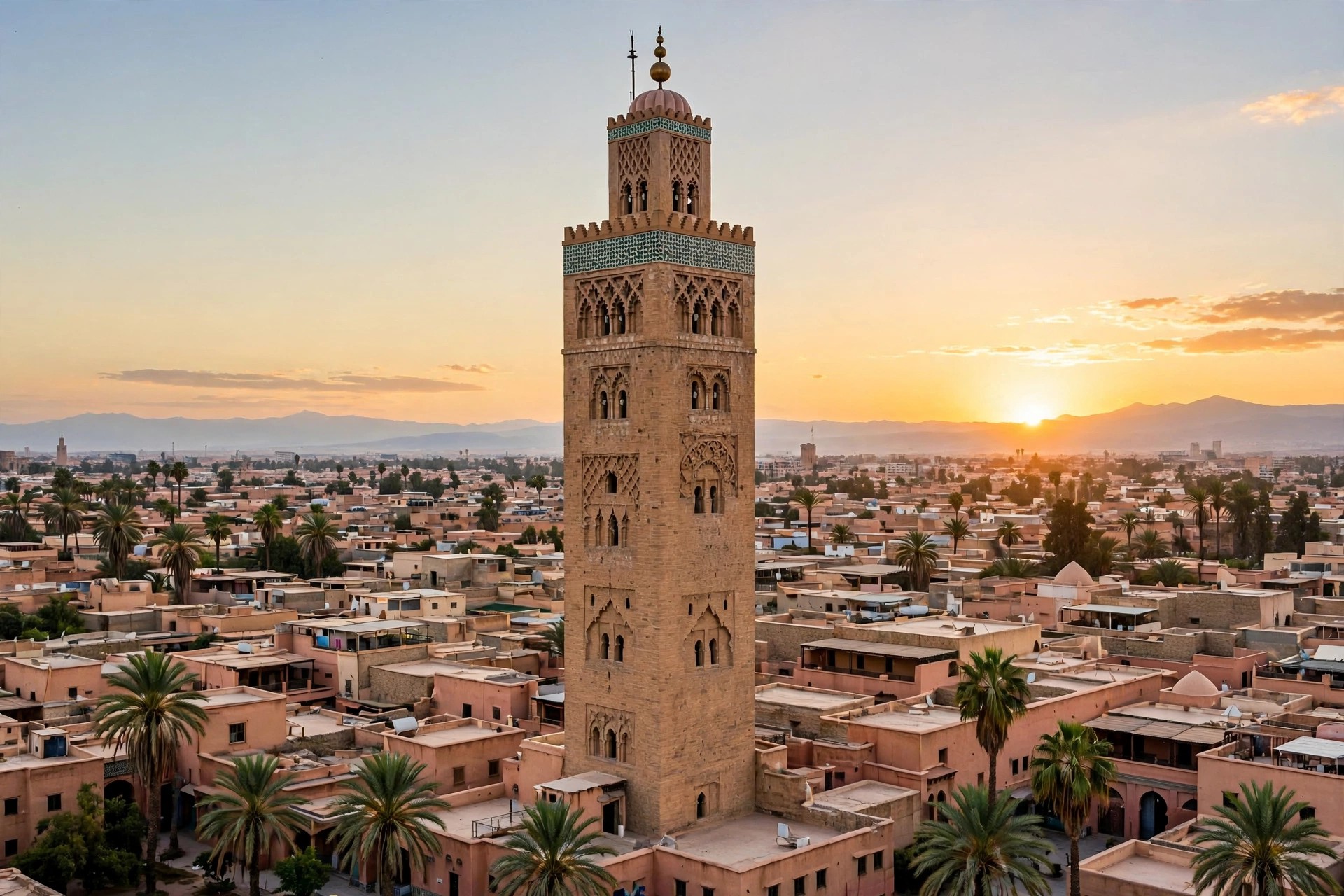
The history of Moroccan architecture is written in stone, tile, cedar and rammed earth across twelve centuries, and you can still walk through every chapter of it. Stand in the Roman ruins of Volubilis in the morning, cross a Merinid madrasa courtyard in Fes at noon, and watch the sun set behind an Art Deco tower in Casablanca.
That layering is the point. The history of Moroccan architecture is not a single style that replaced everything before it, but a conversation between builders who kept borrowing from each other. Roman columns were reused in mosques, and French planners built boulevards beside the medinas instead of through them. This guide follows the history of Moroccan architecture from its Roman and Amazigh roots to the great mosque of Casablanca.
In this guide
- The History of Moroccan Architecture at a Glance
- Before the Minarets: Roman Stones and Amazigh Earth
- Fes and the First Mosques: The Idrisid Beginning
- The Almoravids: Geometry, the Horseshoe Arch and the Square Minaret
- The Almohads and the History of Moroccan Architecture at Monumental Scale
- The Merinids: Madrasas, Zellij and the Golden Age of Decoration
- The Saadians: Marble, Cedar and the Ben Youssef Madrasa
- The Alaouites and the Imperial Machine of Meknes
- The Riad: A House Turned Inward
- Kasbahs and Ksour: Rammed Earth in the Atlas and the Sahara
- The Protectorate: Art Deco and the Neo-Moorish City
- After Independence: The Mausoleum and the Hassan II Mosque
- Seeing It in One Trip: A Six-Stop Architecture Route
- What It Costs to Visit the Great Buildings
- Practical Tips for Visiting Historic Buildings
- Frequently Asked Questions
- Conclusion
The History of Moroccan Architecture at a Glance
This table maps the history of Moroccan architecture at a glance, so you can see the whole story before we walk through it.
| Period | Dates | Signature | Best place to see it |
|---|---|---|---|
| Roman | 1st–3rd century | Basilicas, triumphal arch, mosaics | Volubilis |
| Idrisid | 789–974 | First hypostyle mosques, horseshoe arch | Fes, al-Qarawiyyin |
| Almoravid | 1040–1147 | Square minaret, geometric dome | Marrakech, Koubba Ba'adiyn |
| Almohad | 1147–1269 | Giant minarets, sebka pattern, great gates | Marrakech, Rabat, Tinmel |
| Merinid | 1244–1465 | Madrasas, zellij, carved cedar | Fes, Salé, Meknes |
| Saadian | 1554–1659 | Marble, gilded stucco, palace courts | Marrakech |
| Alaouite | 1666–today | Imperial walls, granaries, monumental gates | Meknes, Rabat |
| Protectorate | 1912–1956 | Art Deco, neo-Moorish civic buildings | Casablanca, Rabat |
| Modern | 1956–today | Monumental mosques, contemporary design | Casablanca, Rabat |
Before the Minarets: Roman Stones and Amazigh Earth
Long before the first mosque rose in Morocco, builders were already working with the two materials that would define the country: stone in the north and earth in the south. The Romans built Volubilis into one of the great cities of Mauretania Tingitana, with a basilica, a triumphal arch raised in 217 for the emperor Caracalla, and townhouses with mosaic floors. Our Volubilis Roman guide covers the visit in detail.
South of the Atlas, the building tradition was entirely local. Amazigh builders in the Atlas and the pre-Sahara raised kasbahs and fortified villages from rammed earth, straw and palm wood, shaping them to the sun and the slope. Rammed earth keeps interiors cool in the desert afternoon and warm at night, and a well-maintained earthen wall can stand for centuries. The most famous of them, Ait Benhaddou, is still inhabited, and its towers show that decoration in Morocco began as a way of working the material itself.
Fes and the First Mosques: The Idrisid Beginning
The Idrisids laid the first course of the history of Moroccan architecture when they founded Fes at the end of the eighth century, drawing scholars and craftsmen from Tunisia and al-Andalus. The two great mosques of the young city, al-Qarawiyyin and the Mosque of the Andalusians, were founded in 859 and the years that followed, and they set the pattern for the Moroccan mosque: a hypostyle hall, a courtyard for ablutions, and a square-shafted minaret. The minaret of al-Qarawiyyin, rebuilt in the tenth century, is the oldest surviving minaret in Morocco, and its plain square tower became the model every later dynasty would copy but never abandon.
Fes also established the idea that a Moroccan city is built from the inside out: blank walls on the street, and the beauty kept for the courtyard within. That principle, privacy on the outside and richness on the inside, runs through the whole story that follows. The Idrisid period left few intact buildings, but it left the plan, and the plan proved more durable than any single wall.
The Almoravids: Geometry, the Horseshoe Arch and the Square Minaret
The Almoravids gave the history of Moroccan architecture its geometry. Rising from the western Sahara in the eleventh century, they founded Marrakech as their capital around 1070. Their great contribution was the horseshoe arch, inherited from al-Andalus, and the square minaret, a tower of four equal faces that became the signature of the western Islamic world.
Almost nothing Almoravid survives above ground, which makes the one exception precious. The Koubba Ba'adiyn in Marrakech, a small domed ablutions pavilion built around 1117 to 1120, is the only Almoravid building left standing in Morocco, and it is a masterpiece of carved stucco and ribbed domes in miniature. The Koutoubia Mosque itself was begun under the Almoravids and rebuilt by their Almohad successors.
The Almohads and the History of Moroccan Architecture at Monumental Scale
The Almohads built bigger than anyone before them, and the history of Moroccan architecture reaches its monumental scale in their reign. Their successors raised the Koutoubia minaret in Marrakech to about 77 metres, a square sandstone tower covered in the sebka, the diamond-mesh pattern that became the dynasty's signature, and ringed near its summit by green tile. It was the prototype for two famous towers: the Giralda in Seville, completed in 1198, and the Hassan Tower in Rabat.
Rabat holds the Almohads' great unfinished dream. The Hassan Mosque, begun by Sultan Yaqub al-Mansur around 1195, was meant to be the largest mosque in the world, its minaret planned to rise 86 metres. The sultan died in 1199, the work stopped, and the tower stands today at 44 metres beside some two hundred roofless columns on the empty prayer ground.
Bab Oudayas still guards the old kasbah in Rabat, and the Bab Agnaou in Marrakech is the finest surviving Almohad gate. In the High Atlas, the Tinmel Mosque, built around 1156, shows the Almohad style at its most austere: plain walls and perfect proportions, restored after the 2023 earthquake. Read our guide to Tinmel, the Almohad capital before you attempt the mountain road. That trio, the tower, the gate and the mountain mosque, is the hinge of the history of Moroccan architecture, the moment when building became a statement of empire.
The Merinids: Madrasas, Zellij and the Golden Age of Decoration
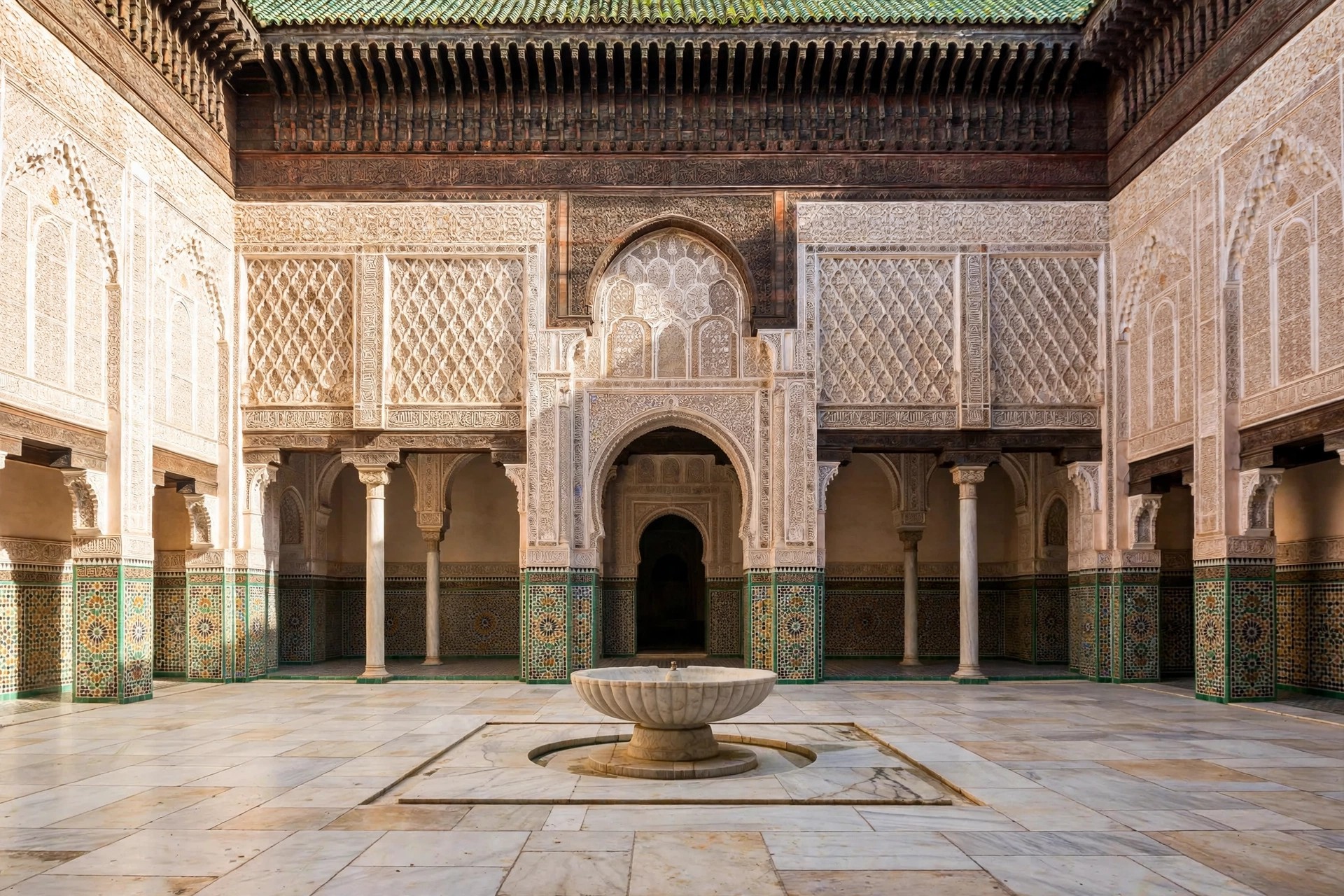
If the Almohads built big, the Merinids built beautifully, and the history of Moroccan architecture reaches its decorative peak in their madrasas. The Merinids, who ruled from Fes from the thirteenth to the fifteenth century, founded the first true madrasas in Morocco, where students lived in small cells around a central court. They also made zellij, the glazed mosaic tilework cut into tiny geometric pieces, into the defining surface of Moroccan building, with carved stucco and painted cedar in a strict programme: tile below, plaster in the middle, wood above.
The Bou Inania Madrasa in Fes, built between 1350 and 1355, is the masterpiece of the period and one of the few religious buildings in Morocco that non-Muslim visitors may enter. Its courtyard shows the Merinid system: a marble fountain at the centre, zellij in green and brown to waist height, carved stucco above, and a cedar ceiling of interlacing stars. The al-Attarine Madrasa, built between 1323 and 1325 beside the spice market, is smaller, and its bronze doors are among the finest metalwork in the country. For the dynasty behind these buildings, see our account of the Marinids of Fes.
The Saadians: Marble, Cedar and the Ben Youssef Madrasa
The Saadians wrote a chapter of the history of Moroccan architecture in marble and gold. After they took Marrakech in the sixteenth century, Sultan Ahmad al-Mansur built the El Badi Palace between 1578 and 1593, a court of Italian marble, Sudanese gold and carved cedar so splendid that a later sultan stripped it, leaving the great ruined courtyard you can walk through today. The same dynasty rebuilt the Ben Youssef Madrasa in Marrakech between 1564 and 1565, and it is the largest madrasa in Morocco.
The Saadian Tombs, hidden behind the Kasbah Mosque and only rediscovered in 1917, show the dynasty's funerary art at its finest. The Chamber of the Twelve Columns, where al-Mansur himself is buried, is roofed in carved cedar, and its stucco work is so fine that it looks like lace cut in stone. Our guide to the Saadian Tombs covers the sultans buried there and the best time of day to visit.
The Alaouites and the Imperial Machine of Meknes
Meknes is the Alaouite answer to the history of Moroccan architecture, and it is an answer written in walls. When Sultan Moulay Ismail made Meknes his capital in the late seventeenth century, he built a machine, not a city: more than twenty kilometres of ramparts, vast granaries, stables said to hold twelve thousand horses, and the great gate of Bab Mansour, completed in 1732, whose green and white zellij make it the grandest gate in Morocco.
The Alaouites, who still rule Morocco today, also restored more than they built, and that is part of their architectural legacy. They repaired the mosques and madrasas of Fes, rebuilt the royal palaces of Rabat and Marrakech, and kept the old building crafts alive. For the sultan who built Meknes, read our portrait of Moulay Ismail, the warrior sultan.
The Riad: A House Turned Inward
The riad is the quiet heart of the history of Moroccan architecture, and it is the building most visitors actually sleep in. A riad is a house organised around an open courtyard, usually with a fountain at its centre, rooms opening onto the court on two floors, and high blank walls facing the street. The design answers climate and culture at once: the courtyard draws cool air down in summer, and the blank exterior protects the privacy of the family within.
What makes the riad remarkable is that it survived the twentieth century. When wealthy families left the medinas for the new European districts, their houses were divided, rented out or left to decay. Then travellers began restoring them as guesthouses, and the riad became the most successful heritage reuse in Morocco. Staying in a riad is the most direct way to understand how Moroccan architecture works as a way of living.
Kasbahs and Ksour: Rammed Earth in the Atlas and the Sahara
The southern half of the history of Moroccan architecture is built from the earth it stands on. South of the High Atlas, where timber and stone are scarce and the sun is relentless, builders perfected the kasbah, a fortified family house of rammed earth, and the ksar, a whole village walled in the same material. The walls are thick at the base and taper as they rise, and the roofs are palm trunks covered in earth. Ait Benhaddou, the great ksar on the old caravan road to the Sahara, was inscribed by UNESCO in 1987. Our guide to Morocco's kasbahs and Ait Benhaddou explains how to visit without the crowds.
These buildings need constant care. Rammed earth melts in heavy rain, so every autumn the owners replaster the walls with fresh earth and straw. The 2023 earthquake in the High Atlas damaged many earthen villages, including Tinmel, and the rebuilding is itself part of the living tradition. A kasbah is not a ruin to be preserved behind glass; it only survives while people keep using it.
The Protectorate: Art Deco and the Neo-Moorish City
The protectorate years are the most argued-over chapter in the history of Moroccan architecture, and they left the most surprising buildings. When France established the protectorate in 1912, the resident-general Lyautey and his planner Henri Prost decided to build new European cities beside the medinas instead of demolishing them. Rabat became the administrative capital, and Casablanca, the commercial port, became the great laboratory of colonial architecture.
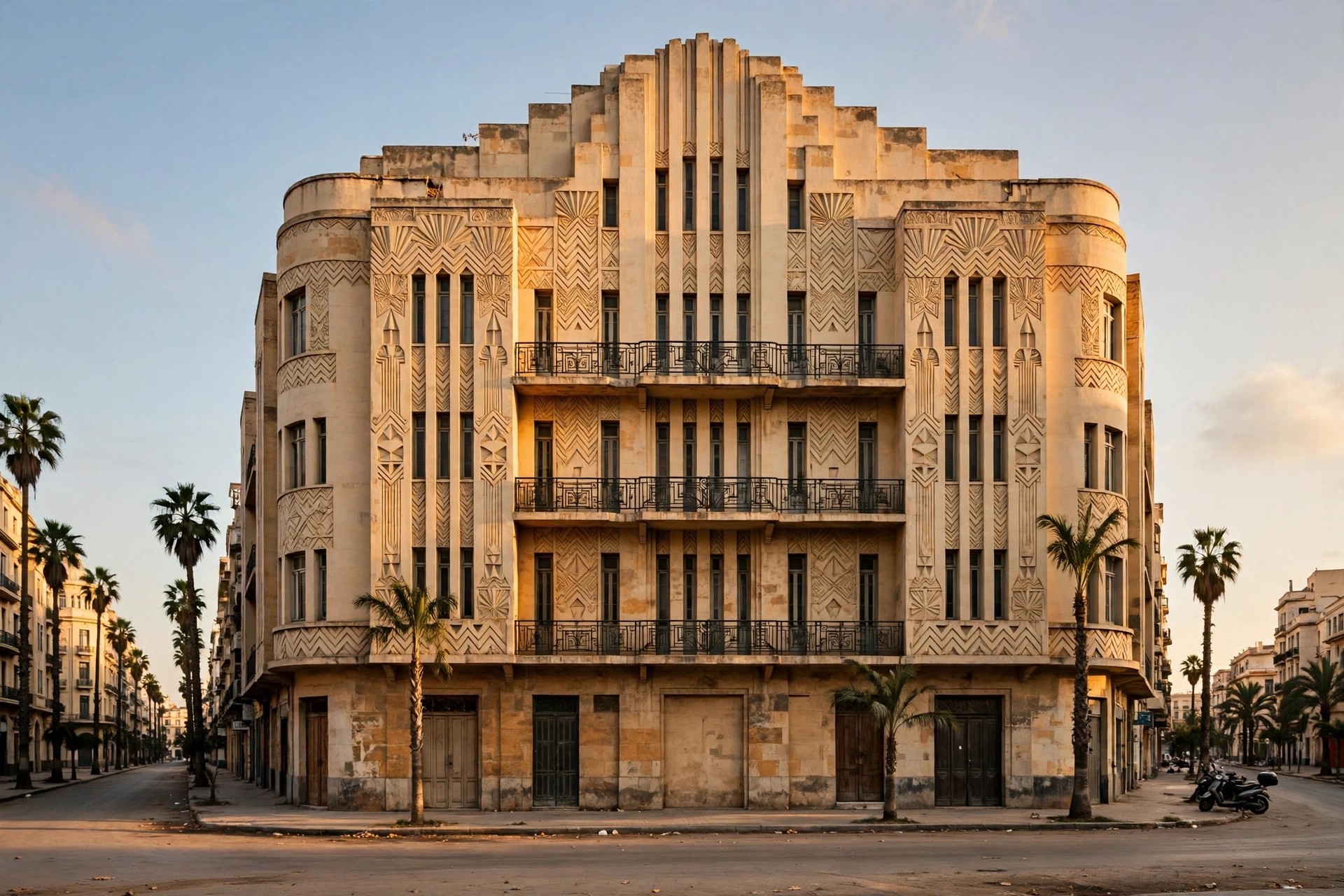
Casablanca's centre is now one of the finest Art Deco districts anywhere. The Place Mohammed V, laid out in the 1920s, is ringed by administrative buildings in a neo-Moorish style that mixes French civic planning with Moroccan arches, zellij and green tile roofs. Along Boulevard Mohammed V, apartment blocks and cinemas wear the streamlined geometry of Art Deco: stepped facades, rounded corners and wrought-iron balconies. Walk the boulevard at dusk, and you will see a city that is neither French nor Moroccan but something the two made together.
After Independence: The Mausoleum and the Hassan II Mosque
Independence in 1956 did not end the story, and the newest layer of the history of Moroccan architecture is also its most monumental. The Mausoleum of Mohammed V in Rabat, completed in 1971 beside the Hassan Tower, is a deliberate bridge between the centuries: a modern concrete structure dressed in traditional zellij, carved stucco, cedar and marble, decorated by hundreds of Moroccan craftsmen.
The Hassan II Mosque in Casablanca, completed in 1993, carries that statement to its largest scale. Its minaret rises 210 metres, the tallest in the world, and its prayer hall holds 25,000 worshippers inside. The building sits on a platform over the Atlantic, so that at high tide the waves break beneath the prayer hall, as the king wished. It is the one Moroccan mosque that non-Muslim visitors may enter, on guided tours; our Hassan II Mosque guide covers the tour times and the 130 MAD ticket.
Seeing It in One Trip: A Six-Stop Architecture Route
Follow this route from north to south. It needs six or seven days, a rental car or the train for the northern legs, and an early start at the madrasas.
| Stop | Days | What you see | Don't miss |
|---|---|---|---|
| Rabat | 1 | Hassan Tower, Bab Oudayas, Mausoleum, Art Deco centre | The tower at sunset, when the columns turn gold |
| Volubilis and Meknes | 1 | Roman mosaics, Bab Mansour, Heri es-Souani | The triumphal arch framed by the Zerhoun hills |
| Fes | 2 | Bou Inania, al-Attarine, Qarawiyyin exterior, tanneries | The Bou Inania courtyard in morning light |
| Marrakech | 2 | Koutoubia, Ben Youssef Madrasa, Saadian Tombs, El Badi | The Koubba Ba'adiyn, the oldest building in the city |
| Ait Benhaddou and Ouarzazate | 1 | The ksar, Atlas film studios, Taourirt Kasbah | The ksar from the hill across the river at dusk |
| Casablanca | 1 | Hassan II Mosque, Art Deco boulevard, Place Mohammed V | The mosque tour at the first morning slot |
What It Costs to Visit the Great Buildings
A week following the history of Moroccan architecture need not be expensive, because many of the greatest sights are free. Prices below are typical adult tickets checked in November 2026, at about 10 MAD to the dollar.
| Building | City | Adult ticket | Notes |
|---|---|---|---|
| Volubilis | Near Meknes | 70 MAD / $7 | Includes the museum; allow 2 hours |
| Bou Inania Madrasa | Fes | 20 MAD / $2 | One of the few mosques open to visitors |
| al-Attarine Madrasa | Fes | 20 MAD / $2 | Small; combine with the spice market |
| Ben Youssef Madrasa | Marrakech | 50 MAD / $5 | The largest madrasa in Morocco |
| Saadian Tombs | Marrakech | 70 MAD / $7 | Go early to avoid the queue |
| El Badi Palace | Marrakech | 70 MAD / $7 | Ruined court; storks nest on the walls |
| Bahia Palace | Marrakech | 70 MAD / $7 | The great nineteenth-century palace |
| Hassan II Mosque tour | Casablanca | 130 MAD / $13 | Guided tour only; book the morning slot |
| Ait Benhaddou | Ouarzazate | Free / $0 | The ksar is free; some kasbahs charge 20 MAD |
| Hassan Tower and Mausoleum | Rabat | Free / $0 | The mausoleum interior is open to visitors |
Practical Tips for Visiting Historic Buildings
Respect is the first rule when you walk through the history of Moroccan architecture, and it is also the most practical one. Most mosques in Morocco are closed to non-Muslim visitors; the exceptions in this guide, the Bou Inania Madrasa, the Hassan II Mosque and the Mausoleum of Mohammed V, are open because their custodians chose to open them. Dress modestly, speak quietly inside prayer halls, and never photograph people at prayer.
Timing matters as much as manners. The madrasas of Fes close for prayer times, the Saadian Tombs are quietest in the first hour after opening, and the Hassan II Mosque tours fill up on weekends, so book the first slot of the day. Friday is the holy day, and some sites open later or close for the midday prayer. Bring cash in small notes, because the ticket windows at the smaller madrasas do not take cards, and carry water in summer.
Frequently Asked Questions
What is the oldest building in Morocco?
The Roman ruins of Volubilis, from the first to third centuries. The oldest Islamic building is the Koubba Ba'adiyn in Marrakech, built around 1117 to 1120, and the minaret of the al-Qarawiyyin Mosque in Fes, rebuilt in the tenth century, is the oldest surviving minaret in Morocco.
Which Moroccan building should I visit first?
Start with the Koutoubia minaret in Marrakech: it is free, visible from everywhere in the city and the prototype for the Giralda and the Hassan Tower. Then visit the Ben Youssef Madrasa the same morning.
Can non-Muslims enter mosques in Morocco?
Almost never. The history of Moroccan architecture is best seen through the buildings that are open: the Bou Inania Madrasa in Fes, the Hassan II Mosque in Casablanca on a guided tour, and the Mausoleum of Mohammed V in Rabat.
What is zellij and where can I see the best examples?
Zellij is mosaic tilework made from individually cut and glazed pieces fitted into geometric patterns. The best examples are in the Bou Inania and al-Attarine madrasas in Fes, the Ben Youssef Madrasa in Marrakech and the Mausoleum of Mohammed V in Rabat.
How long does it take to see the main architectural sights of Morocco?
Six or seven days covers the route in this guide: Rabat, Volubilis and Meknes, two days in Fes, two in Marrakech, a day at Ait Benhaddou and a day in Casablanca. With only three days, choose Fes and Marrakech.
Is Casablanca's Art Deco district worth a special trip?
Yes, if you care about the twentieth-century chapter of the history of Moroccan architecture: the boulevards around Place Mohammed V hold one of the largest concentrations of Art Deco buildings outside Europe. Combine it with the Hassan II Mosque tour in a single day.
Conclusion
The history of Moroccan architecture survives because Moroccans never stopped building in it, restoring it and living in it. The Koutoubia still calls the faithful to prayer, the madrasas of Fes still teach, and the riads of the medinas still shelter families and guests.
Walk the route in this guide, from the Roman stones of Volubilis to the ocean mosque of Casablanca, and you will understand why the history of Moroccan architecture has lasted twelve centuries. The buildings are the memory of the country, and the story is still being written.