
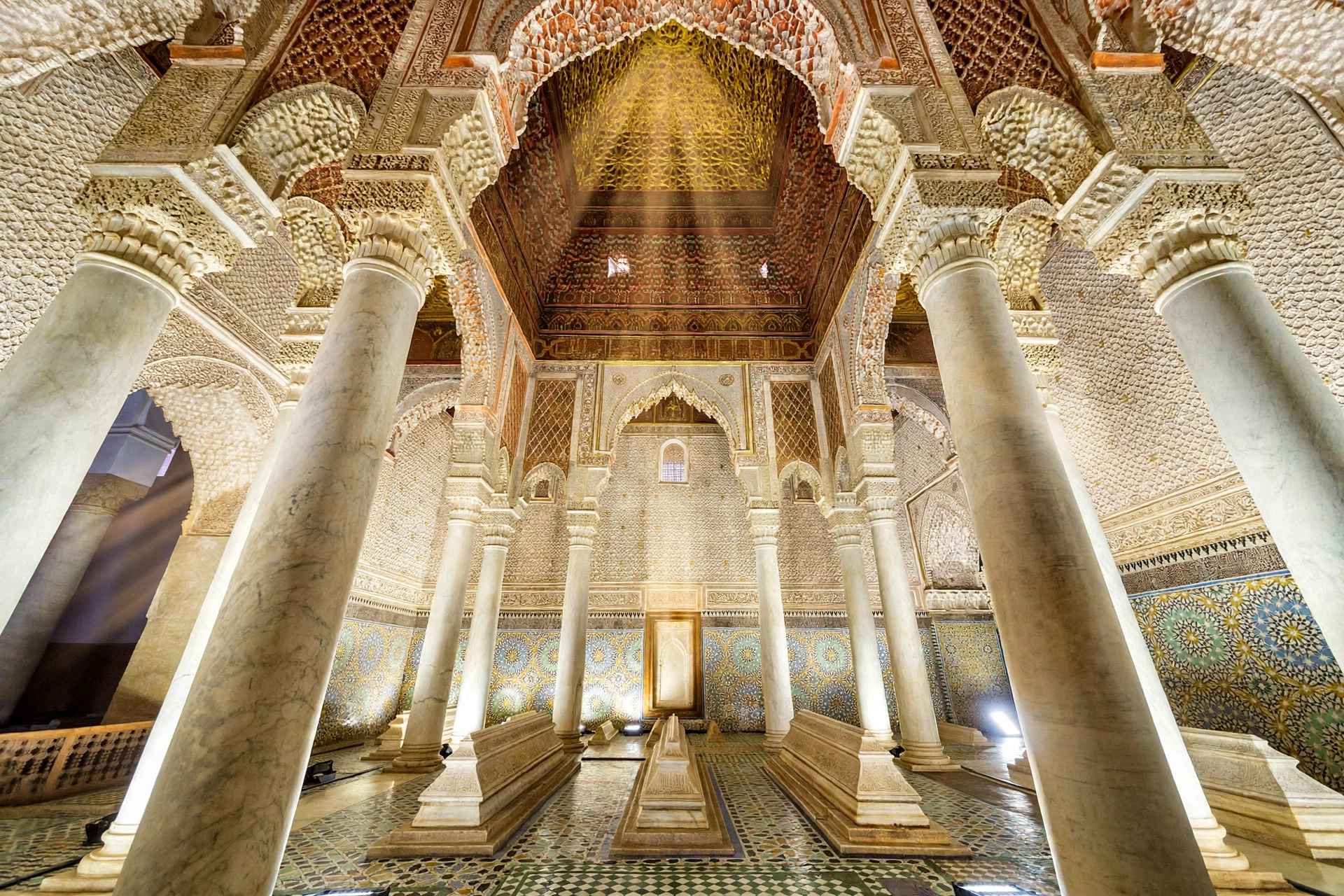
The Saadian Tombs Marrakech are the most surprising monument in the red city. Behind a plain wall beside the Kasbah Mosque, down a passage so narrow that most visitors walk past it, lies a royal necropolis of white Carrara marble, carved cedar and painted stucco — the burial place of the sultans who made Marrakech the capital of a golden age. The Saadian Tombs Marrakech were sealed for two centuries, forgotten by the city, and rediscovered in 1917, and that is why they still feel like a secret.
This guide explains what the Saadian Tombs Marrakech are, who is buried there, what you can see inside the two mausoleums and the garden, and how to visit without missing the entrance. It sits in our History & Heritage section, beside our guide to the Saadian dynasty and our Marrakech Travel Guide — read those first for the wider story.
In this guide
- What Are the Saadian Tombs Marrakech?
- The Saadians: The Dynasty Behind the Tombs
- The Chamber of the Twelve Columns
- The Garden Tombs and the Chamber of the Three Niches
- Ahmad al-Mansur: The Golden Sultan Buried Here
- What You See Today Inside the Saadian Tombs Marrakech
- Visiting the Saadian Tombs Marrakech: Tickets, Hours and Getting There
- How to Find the Entrance (and Not Miss It)
- The Tombs and El Badi Palace: A Half-Day in the Kasbah
- What Else to See Nearby
- Frequently Asked Questions
- The Bottom Line on the Saadian Tombs Marrakech
What Are the Saadian Tombs Marrakech?
The Saadian Tombs Marrakech are a 16th-century royal necropolis in the kasbah district of Marrakech, built by Sultan Ahmad al-Mansur as the burial place of his dynasty. The complex holds two mausoleums, a garden of carved tombstones and a small mosque, all enclosed behind the walls of the Kasbah Mosque. Around 66 tombs stand here, with more than 100 members of the Saadian family and their court buried across the site. The Wikipedia entry on the Saadian Tombs lists the complex among the finest examples of Saadian art in Morocco.
What makes the Saadian Tombs Marrakech remarkable is the contrast between their modesty outside and their richness inside. From the street you see nothing but a high wall and a narrow doorway. Inside, the Chamber of the Twelve Columns is one of the finest rooms in Morocco: twelve columns of Italian Carrara marble carry a carved cedar dome, the walls are covered in carved stucco and zellige tilework, and the tombs themselves are slabs of marble inlaid with Arabic calligraphy. The sultans buried their dead in the most beautiful room they could build, then hid it from the world.
The Saadians: The Dynasty Behind the Tombs
The Saadians were an Arab sharifian dynasty from the Sous valley in southern Morocco who rose in the early 16th century as the Wattasid sultans of Fes weakened. Mohammed al-Shaykh took Marrakech in 1525 — the exact year is debated among historians, with 1524 also given — and made it his capital. His son Abdallah al-Ghalib built the Kasbah Mosque beside the tombs and began the necropolis. It was his son Ahmad al-Mansur who turned the Saadian Tombs Marrakech into a masterpiece.
The dynasty's golden age lasted barely a generation. After the Battle of the Three Kings in 1578, in which the Portuguese king Sebastian died on the field, Ahmad al-Mansur took the throne and ruled until 1603. He filled the treasury with gold from the Songhai expedition and sugar from the Sous, built El Badi Palace next door, and buried his family in marble. When he died of plague in 1603, his sons fought a civil war that tore the dynasty apart, and by 1659 the Saadians were gone. Our guide to the Saadian dynasty and our account of the Battle of the Three Kings tell the full story.
| Date | What happened |
|---|---|
| 1525 | Mohammed al-Shaykh takes Marrakech and makes it the Saadian capital (1524 is also given) |
| 1557 | Mohammed al-Shaykh is assassinated; his son Abdallah al-Ghalib takes the throne |
| 1574–1576 | Abdallah al-Ghalib dies; succession struggle brings Ahmad al-Mansur to power |
| 1578 | The Battle of the Three Kings; Ahmad al-Mansur becomes sultan |
| 1578–1603 | Reign of Ahmad al-Mansur, the golden age of the Saadians |
| 1591 | The Songhai expedition brings gold from the south to Marrakech |
| 1603 | Ahmad al-Mansur dies of plague; civil war begins among his sons |
| c. 1700s | Sultan Moulay Ismail seals the tombs; the exact year is not settled |
| 1917 | The tombs are rediscovered during the French Protectorate and restored |
| Today | The tombs are one of the most visited historic sites in Marrakech |
The Chamber of the Twelve Columns
The Chamber of the Twelve Columns is the heart of the Saadian Tombs Marrakech, and it is the room every visitor remembers. Sultan Ahmad al-Mansur built it as his own mausoleum, and he spared nothing: twelve slender columns of white Carrara marble, imported from Italy, support a dome of carved cedarwood. The walls are covered in carved plaster so fine it looks like lace, and the lower walls are lined with zellige tiles in green and gold. Light falls through small openings and catches the marble, and the whole room glows.
Ahmad al-Mansur lies here under a carved marble slab, with his son Moulay Zidan and his mother Lalla Masuda beside him. The tombs are not grand monuments but low slabs, inlaid with calligraphy in Arabic, set into a floor of marble and tile. Look at the ceiling of the Saadian Tombs Marrakech before you look at the tombs: the cedar dome is carved with stars and geometry, painted in faded red and gold, and it is the finest wooden ceiling of its kind in Marrakech. Photography inside the chamber is often restricted, so check the signs at the door and respect them — the room is small and the guards enforce the rules.
The Garden Tombs and the Chamber of the Three Niches
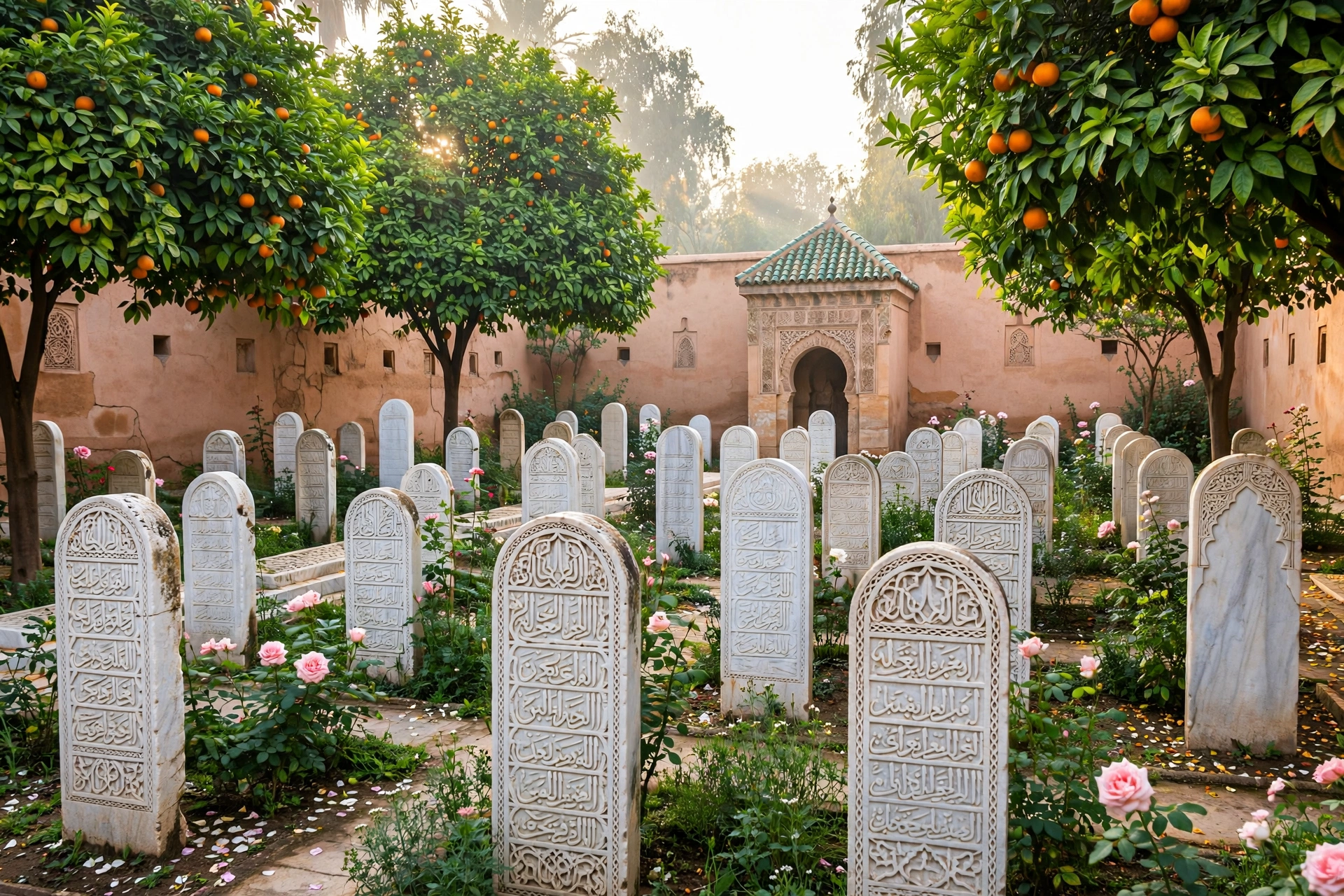
Outside the Chamber of the Twelve Columns, the Saadian Tombs Marrakech open into a walled garden where the lesser members of the dynasty are buried. Around 66 carved marble tombstones stand in rows among orange trees and roses, each one different — some plain slabs, some tall stelae carved with calligraphy and geometric patterns. The garden of the Saadian Tombs Marrakech is quiet even when the chamber is crowded, and it is the best place in the complex to slow down and look closely at the carving.
At the far side of the garden stands the older mausoleum, the Chamber of the Three Niches, built for Mohammed al-Shaykh and his sons. It is smaller and plainer than the Chamber of the Twelve Columns, with three arched niches and a simpler dome, and it shows what the necropolis looked like before Ahmad al-Mansur rebuilt it in marble. The earliest Saadian tombs are here, including the founder of the dynasty, and the chamber feels older and more solemn than the golden room next door.
Ahmad al-Mansur: The Golden Sultan Buried Here
Ahmad al-Mansur, known as al-Dhahabi, the Golden, is the sultan the Saadian Tombs Marrakech exist to honour. He came to the throne in 1578 after the Battle of the Three Kings, a battle that killed two kings and an emperor's ambitions in a single afternoon. He was a diplomat as much as a warrior: he dealt with Elizabethan England, traded sugar for English guns, and kept the Ottoman Empire at arm's length while he rebuilt his capital.
His wealth came from the south. In 1591 he sent an army across the Sahara to the Songhai Empire, and the gold that came back paid for El Badi Palace, the tombs, and a court that impressed every visitor to Marrakech. The marble of the Saadian Tombs Marrakech was paid for with that gold, shipped from Italy at a time when Morocco had no quarries of its own. When al-Mansur died of plague in 1603, the gold stopped coming, his sons fought over the throne, and within a generation the dynasty he had built was finished. The tombs are his monument, and they outlasted everything else he built.
What You See Today Inside the Saadian Tombs Marrakech
A visit to the Saadian Tombs Marrakech takes about 45 minutes, and the route is simple: you enter through the narrow passage, cross the garden, and visit the two mausoleums in turn. The Chamber of the Three Niches comes first, quiet and plain, and then the garden with its rows of carved tombstones, and then the Chamber of the Twelve Columns, which is the climax of the visit. The chamber is small and only a few visitors are allowed inside at once, so you may wait a few minutes at the door.
Look for the details that most visitors miss. The zellige tilework in the Chamber of the Twelve Columns uses a star pattern that repeats across the walls without a single break. The cedar dome above the tombs is held together without nails, fitted by carpenters who worked by geometry alone. In the garden, some tombstones carry the names of children who died young, and the small size of the slabs is a reminder that the dynasty's story is a family story as much as a royal one. The complex also has a small mosque at the entrance, still in use, which is not open to visitors as a tourist site.
| Item | Detail |
|---|---|
| Address | Rue de la Kasbah, next to the Kasbah Mosque, Marrakech medina |
| Ticket | 70 MAD (about $7) for foreign visitors, as of November 2026 |
| Hours | Daily, roughly 9:00–17:00; last entry about 30 minutes before closing |
| Time needed | 45 minutes to 1 hour |
| Best time | Early morning, before the tour groups arrive around 10:00 |
| Photography | Allowed in the garden; often restricted inside the mausoleums |
| Accessibility | Steps and narrow passages; not wheelchair accessible |
| Guide | Optional; official guides wait at the entrance for about 100–150 MAD |
Visiting the Saadian Tombs Marrakech: Tickets, Hours and Getting There
Visiting the Saadian Tombs Marrakech is straightforward once you know the entrance, and the ticket is one of the best value in the city. Tickets cost 70 MAD (about $7) for foreign visitors as of November 2026, paid in cash or by card at the small booth beside the entrance. The tombs are open daily, roughly from 9:00 to 17:00, and the last entry is about 30 minutes before closing. Prices and hours can change, so check our guide to Morocco attraction ticket prices before you go, and confirm current hours on Visit Morocco, the official tourism site.
The best time to visit is early in the morning, just after opening, when the light in the garden is soft and the Chamber of the Twelve Columns is not yet crowded. By mid-morning the tour groups arrive, and the small chamber can only hold a few people at a time, so the queue at the door can take 20 minutes. Come at 9:00 and you will have the garden almost to yourself.
Combine the visit with El Badi Palace next door and the Bahia Palace a short walk away, and the whole kasbah morning costs less than 200 MAD (about $20) in tickets. See our Marrakech Travel Guide for the full city plan, and our guide to how much a trip to Morocco costs for the wider budget.
How to Find the Entrance (and Not Miss It)
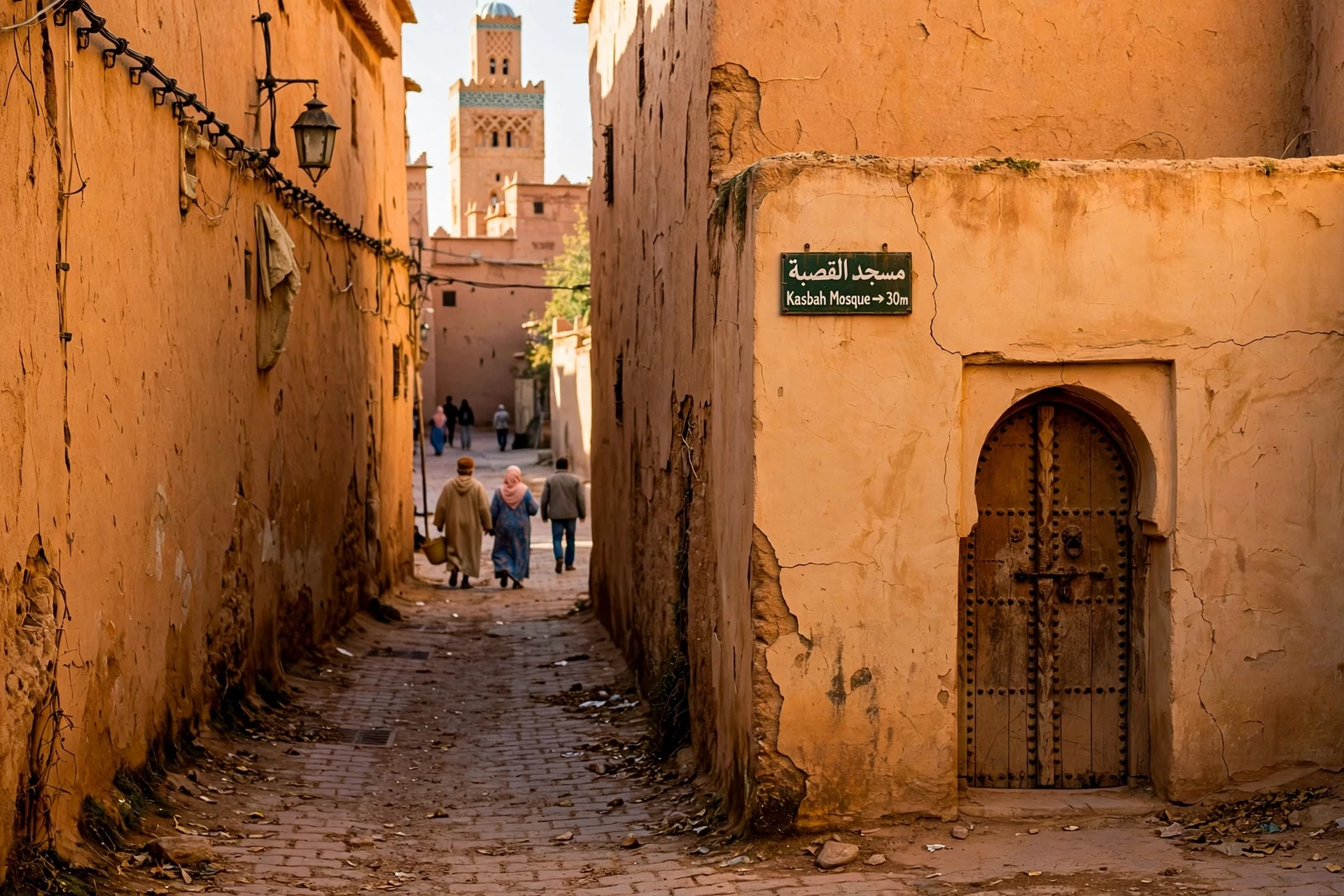
Finding the entrance to the Saadian Tombs Marrakech is the hardest part of the visit, and it defeats a surprising number of travellers. The tombs sit behind the Kasbah Mosque on Rue de la Kasbah, and the entrance is a narrow passage between the mosque wall and a row of small shops. There is a small sign, but it is easy to miss among the shopfronts, and many visitors walk straight past it and end up at El Badi Palace instead.
The simplest route is to walk from Jemaa el-Fna south through the kasbah to the Kasbah Mosque, then follow the mosque wall to your right until you see the ticket booth. If you are coming by taxi, ask for the Kasbah Mosque, not for the tombs, because drivers know the mosque and the fare is easier to agree on — a petit taxi from Jemaa el-Fna costs about 10–15 MAD (about $1–1.50) on the meter. Our guide to Morocco taxi prices explains the meter and the common scams. Once inside, the route is one-way, so you cannot get lost.
The Tombs and El Badi Palace: A Half-Day in the Kasbah
The Saadian Tombs Marrakech and El Badi Palace belong together, because they were built by the same sultan a few steps apart, and they tell the same story in opposite ways. The tombs survive in marble and cedar, restored and roofed; El Badi Palace is a ruin, stripped of its marble and gold by Moulay Ismail a century later, with only its walls, its reflecting pools and its storks left. Visit the Saadian Tombs Marrakech first, then cross to El Badi and climb its terrace for the view over the kasbah, and you will understand Ahmad al-Mansur's Marrakech in a single morning.
A half-day in the kasbah runs easily: the tombs at 9:00, El Badi Palace at 10:00, the Mellah and its synagogue at 11:00, and lunch in the kasbah before an afternoon at the Bahia Palace. The four sites sit within a 15-minute walk of each other, and the total ticket cost is under 200 MAD (about $20). The kasbah is also the quietest quarter of the medina, with fewer touts than Jemaa el-Fna, so it is the best place in Marrakech to slow down. Our guide to the Imperial Cities puts Marrakech in the wider story of Morocco's royal capitals.
| Site | What it is | Ticket (Nov 2026) | Time |
|---|---|---|---|
| Saadian Tombs | Royal necropolis, Chamber of the Twelve Columns | 70 MAD (about $7) | 45 min |
| El Badi Palace | Ruined palace of Ahmad al-Mansur | 70 MAD (about $7) | 1 hour |
| Bahia Palace | 19th-century palace of the grand vizier | 70 MAD (about $7) | 1 hour |
| Mellah and synagogue | Jewish quarter, Slat al-Azama synagogue | Free–10 MAD (about $1) | 30 min |
| Kasbah Mosque | Saadian mosque, exterior only for visitors | Free | 10 min |
| Jemaa el-Fna | The great square, a 15-minute walk north | Free | Evening |
What Else to See Nearby
The kasbah rewards a slow morning. The Mellah, the old Jewish quarter beside the tombs, is a grid of quiet streets with spice shops and the Slat al-Azama synagogue, one of the oldest in Morocco, and it shows a side of Marrakech that most visitors never see. The Bahia Palace, a 15-minute walk north, is the grandest 19th-century palace in the city, with painted ceilings and a courtyard that rivals the tombs for beauty. And the Koutoubia Mosque, the landmark of Marrakech, stands at the edge of the medina on the walk back to Jemaa el-Fna, its minaret visible from the tombs' garden on a clear day.
If you have a second day, the Ben Youssef Madrasa in the northern medina is the great companion piece to the tombs: the same carved cedar, the same zellige, the same stucco lace, built by the same dynasty a generation earlier. The two sites together are the best introduction to Saadian art in Morocco, and both are covered in our Marrakech Travel Guide.
Frequently Asked Questions
How much do the Saadian Tombs Marrakech cost to visit?
The Saadian Tombs Marrakech cost 70 MAD (about $7) for foreign visitors as of November 2026, paid at the ticket booth beside the entrance. The ticket covers the two mausoleums and the garden, and there is no separate charge inside. Prices can change, so check the ticket booth on the day.
How long do you need at the Saadian Tombs Marrakech?
Allow 45 minutes to an hour at the Saadian Tombs Marrakech. The garden and the Chamber of the Three Niches take about 20 minutes, and the Chamber of the Twelve Columns takes another 15 minutes, plus any wait at its door. Come early in the morning to avoid the queue.
Why were the Saadian Tombs Marrakech sealed for 200 years?
The Saadian Tombs Marrakech were walled up by Sultan Moulay Ismail in the early 18th century, after the Alaouite dynasty replaced the Saadians. The exact year is not settled, and historians debate whether the sealing was an act of revenge or simply a way to close a rival dynasty's monument. The tombs were rediscovered in 1917 during the French Protectorate and restored.
Can you take photos inside the Saadian Tombs Marrakech?
Photography is allowed in the garden of the Saadian Tombs Marrakech, but it is often restricted inside the Chamber of the Twelve Columns and the Chamber of the Three Niches. Check the signs at the door and follow the guards' instructions, and never use a flash inside the mausoleums.
Are the Saadian Tombs Marrakech worth visiting?
Yes. The Saadian Tombs Marrakech are one of the best historic sites in Marrakech, and the Chamber of the Twelve Columns is the finest single room in the city. The ticket is cheap, the visit is short, and the garden is one of the quietest places in the medina.
Where exactly are the Saadian Tombs Marrakech?
The Saadian Tombs Marrakech are in the kasbah district, beside the Kasbah Mosque on Rue de la Kasbah, a 15-minute walk south of Jemaa el-Fna. The entrance is a narrow passage beside the mosque wall, and the ticket booth marks it. Ask a taxi driver for the Kasbah Mosque if you are coming by car.
The Bottom Line on the Saadian Tombs Marrakech
The Saadian Tombs Marrakech are a small site with a large story: a golden age built on sugar and gold, a sultan who buried his family in the most beautiful room in Morocco, and two centuries of silence before the doors were opened again. Come early, find the narrow entrance, look up at the cedar dome before you look at the tombs, and then cross to El Badi Palace to see what the same sultan built above ground. The tombs take less than an hour, and they are the best hour in the kasbah.
Last checked: November 2026. Prices are given in Moroccan dirhams (MAD) with approximate US dollar equivalents.
1 thought on “The Saadian Tombs of Marrakech: History and Visiting Guide 2026”