
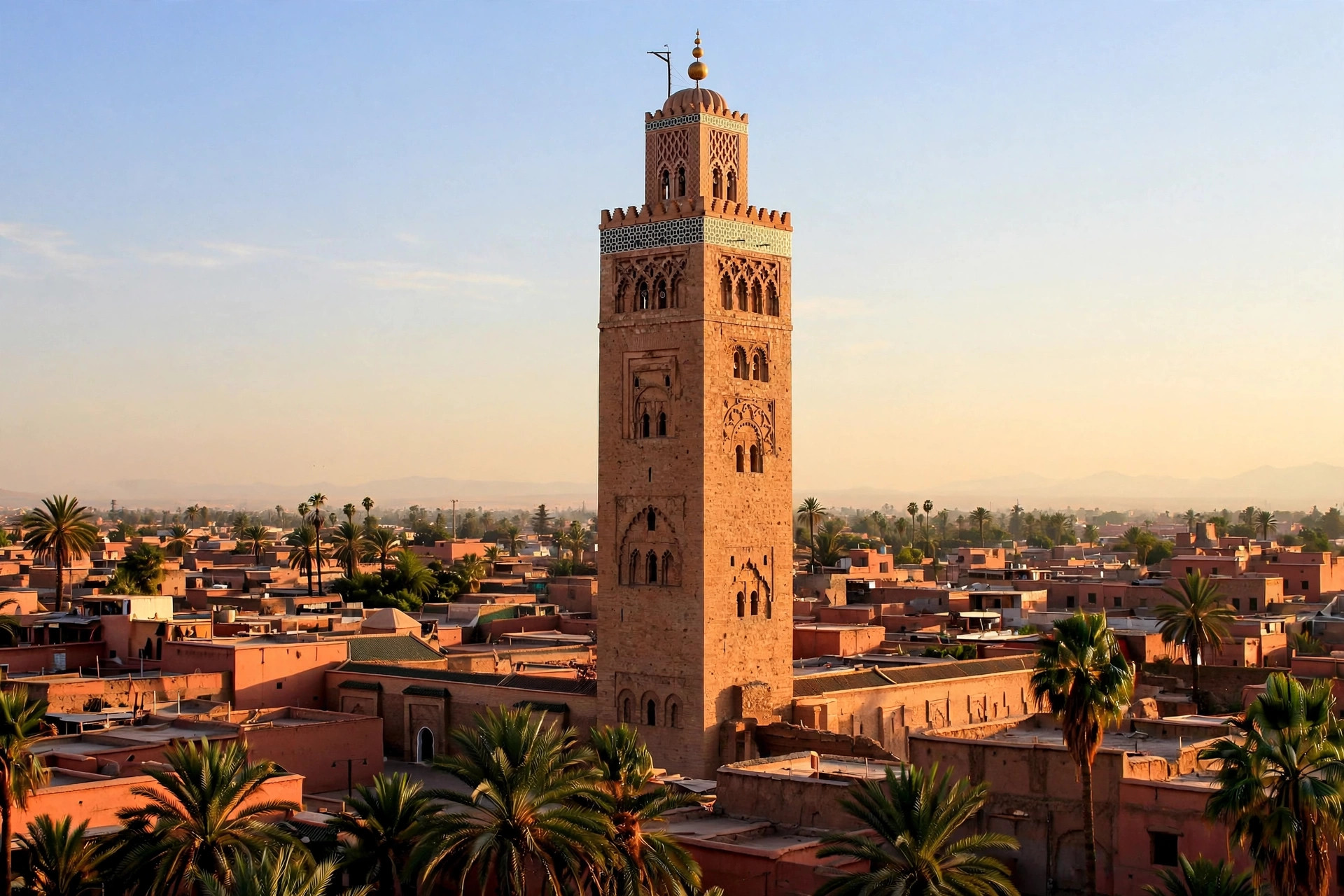
Stand in Jemaa el-Fnaa at sunset, when the square fills with smoke, drums and storytellers, and look up: the Koutoubia minaret rises above the rooftops in warm red stone, as it has for more than eight centuries. It is the proudest surviving symbol of the almohad empire morocco, a dynasty that began with a preacher in the High Atlas and ended up ruling from Tripoli to central Spain.
Most visitors photograph the Koutoubia without knowing whose tower it is, admire the Giralda without realising it is Moroccan in origin, and walk past Hassan Tower without knowing it was meant to be the tallest minaret in the world. This guide fixes that, the way a Moroccan would tell it: with the pride, the corrections and the honest gaps included.
The story of the almohad empire morocco is a story of ideas becoming stone. A reform movement became an army, the army became an empire, and the empire built towers so well that later dynasties simply built around them. By the end of this guide you will know who the Almohads were, why they fell, and where to stand to see what they left behind.
In this guide:
- How a Berber preacher from the Atlas founded an empire
- The conquest of Marrakech and the road to Seville
- The towers: Koutoubia, Giralda and Hassan Tower
- Where to see Almohad Morocco today, and what it costs
- Frequently asked questions
How the Almohad Empire Morocco Rose from the Atlas Mountains
The almohad empire morocco began not with a king but with a preacher, and not in a palace but in a mountain village. Ibn Tumart was born around 1080 in Igiliz, in the Anti-Atlas, into the Masmuda Berber confederation. He travelled east to study, and came home convinced that the Morocco of his day had lost its way.
What he found at home offended him. The Almoravids then in power ruled a vast empire, but Ibn Tumart saw rulers grown comfortable and religious practice he considered lax. He began to preach reform, bluntly. His message was simple and absolute: God is one, and that unity must shape every part of life, from prayer to politics.
Ibn Tumart and the Call for Unity
Here is the first correction outsiders usually need. “Almohad” is not the name of a tribe. It comes from the Arabic al-Muwahhidun, meaning “those who affirm the unity of God”: the Almohads were a movement before they were a dynasty, united by a doctrine rather than by blood. That explains their energy and their severity: they were not fighting for a family, but for what they believed was the truth.
Ibn Tumart gathered followers among the Masmuda tribes of the High Atlas, and his movement quickly became both a religious community and a military one. He set up his base at Tinmel, a remote valley settlement you can still visit today, organised his followers into a strict hierarchy of councils, preachers and soldiers, and declared himself the Mahdi, the awaited guided one. That claim gave his movement a power no ordinary rebellion could match.
Ibn Tumart died in 1130, or so the usual date says; the sources differ on the exact year, and historians treat 1130 as conventional rather than settled. His death could have ended the movement. Instead, his closest disciple made sure it became an empire.
Abd al-Mu’min Takes Marrakech
That disciple was Abd al-Mu’min, from the region of Tlemcen in what is now Algeria, who had joined Ibn Tumart early and earned his complete trust. He held the movement together after the founder’s death, then turned a mountain rebellion into a war of conquest. After seventeen years of hard fighting against the Almoravids, his armies entered Marrakech in 1147, and the old dynasty was finished.
By the time Abd al-Mu’min died in 1163, the almohad empire morocco controlled not only Morocco but much of Algeria and a growing foothold in southern Spain. He had turned a doctrine into a state, with governors, tax collectors, a standing army and a navy. He also made a decision that shaped everything after him: Marrakech would be the capital, and the empire would be ruled from Morocco, not from the mountains.
With a capital secured, the almohad empire morocco had a court worthy of its ambitions, and the caliphs who followed Abd al-Mu’min set out to make it the centre of the western Islamic world. They invited scholars, built mosques and laid out new quarters: the dynasty was no longer a revolt but a government, and it intended to last.
An Empire from Tripoli to Castile
At its height, the almohad empire morocco stretched from Tripoli in the east to the Atlantic in the west, and from the Sahara to the plains of Castile. No Moroccan dynasty before it had ruled so much territory, and none after it would hold so much for so long. Its armies crossed the Strait of Gibraltar routinely, and its caliphs spent as much time in Seville as in Marrakech.
Abd al-Mu’min’s son, Abu Yaqub Yusuf, who ruled from 1163 to 1184, pushed the empire deeper into Spain and built the great mosque of Seville, whose minaret still stands today. He died of wounds on campaign in the north, leaving his son an empire at the peak of its power.
That son was Yaqub al-Mansur, and under him the almohad empire morocco reached its golden age. Al-Mansur ruled from 1184 to 1199, and his reign is the one Moroccans still associate with splendour. He defeated the Castilian king Alfonso VIII at the Battle of Alarcos in 1195, a victory that secured the empire’s Spanish frontier for a generation. He built in Marrakech, Rabat and Seville, and gathered scholars at his court, including the philosopher Ibn Rushd, known in Europe as Averroes.
Then came the reversal. In 1212, al-Mansur’s son Muhammad al-Nasir led a great army against a Christian coalition at Las Navas de Tolosa, in the mountains of southern Spain. The Almohad army was destroyed and the caliph fled the field. It was not the end of the empire, but it was the end of its expansion, and in the long view, the beginning of the end. The Christian kingdoms of the north began their steady advance south.
After Las Navas, the almohad empire morocco unravelled slowly rather than collapsing all at once. The caliphs who followed al-Nasir faced revolts in Spain, rebellions among the tribes, and a rising new power in northern Morocco: the Marinids. City by city, the empire shrank. Seville fell in 1248. In 1269, the Marinids took Marrakech itself, and the Almohad caliphate was over. It had lasted barely a century.
The Architecture the Almohads Left Behind
Architecture is where the almohad empire morocco still speaks, because its buildings outlived its politics by eight hundred years. The Almohads built in a style recognisable the moment you see it: red brick and stone, tall square minarets, carved geometric patterns, and great gates with pointed horseshoe arches. Once you know what to look for, you can spot one across a crowded square.
The Koutoubia is the masterpiece. Its minaret stands 77 metres tall in the centre of Marrakech, and it sets the pattern for every great Moroccan minaret that came after it. The medina it overlooks is listed by UNESCO as a World Heritage site, fitting for a tower that has defined the city for eight centuries. It was built in two phases: a first mosque under Abd al-Mu’min after the conquest of 1147, and a second, grander mosque under his successors. The exact years of each phase are debated by historians, so any guide that gives a single confident date for the Koutoubia is simplifying the evidence. What is certain is the result: a tower of extraordinary elegance, decorated with carved bands and topped with a small dome, now the symbol of the city itself.
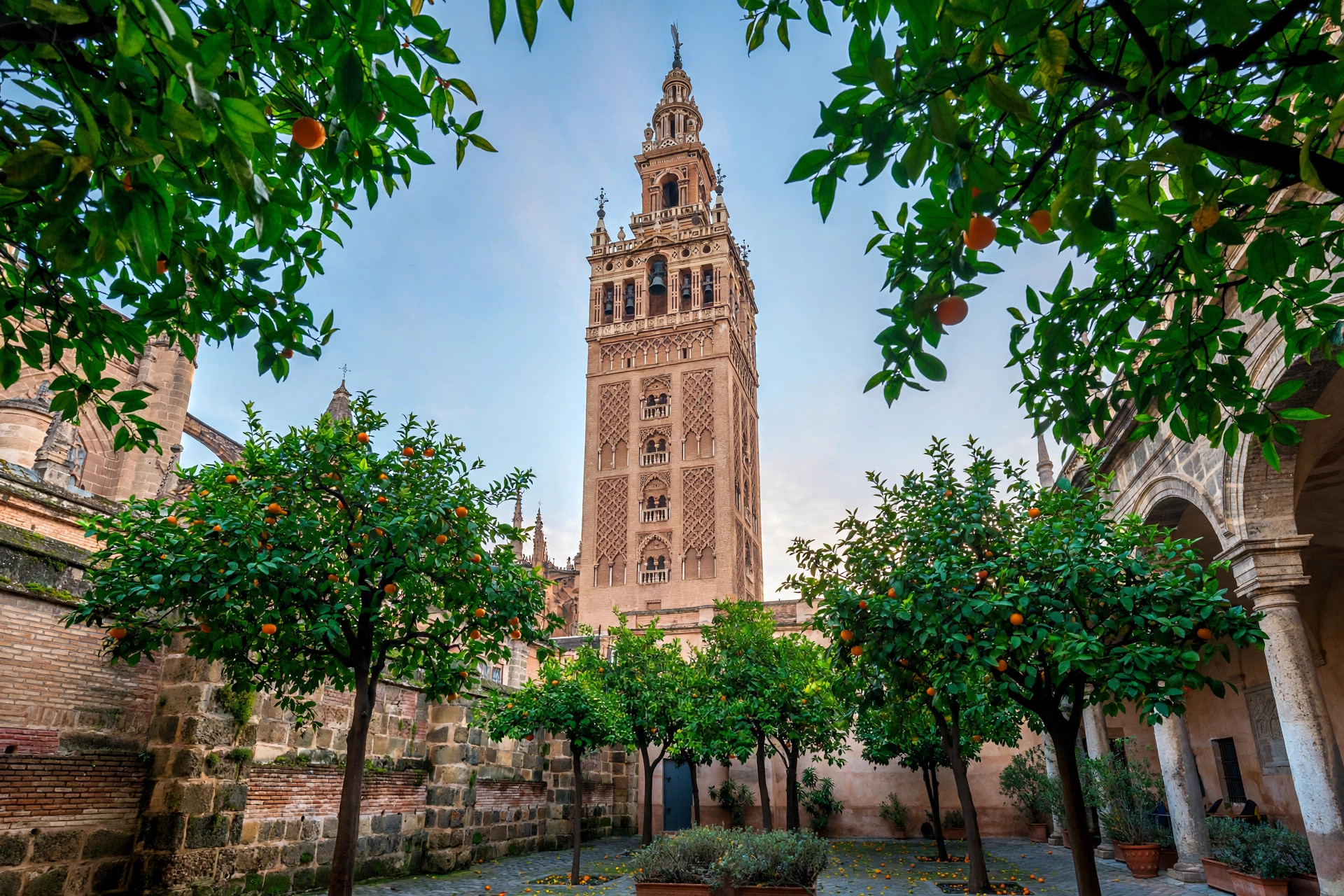
Now the correction that surprises most visitors to Spain. The Giralda, the famous bell tower of Seville Cathedral on every postcard of the city, is not a Spanish church tower. It was built as the minaret of the Almohad great mosque of Seville, and it remains the most famous monument of the almohad empire morocco outside Morocco itself. Work began under Abu Yaqub Yusuf and continued under Yaqub al-Mansur, but the exact start and completion years of the Giralda’s construction are disputed, with the sources giving different dates. The Christian belfry on top came centuries later, after the mosque became a cathedral. The tower beneath it is Almohad, brick by brick.
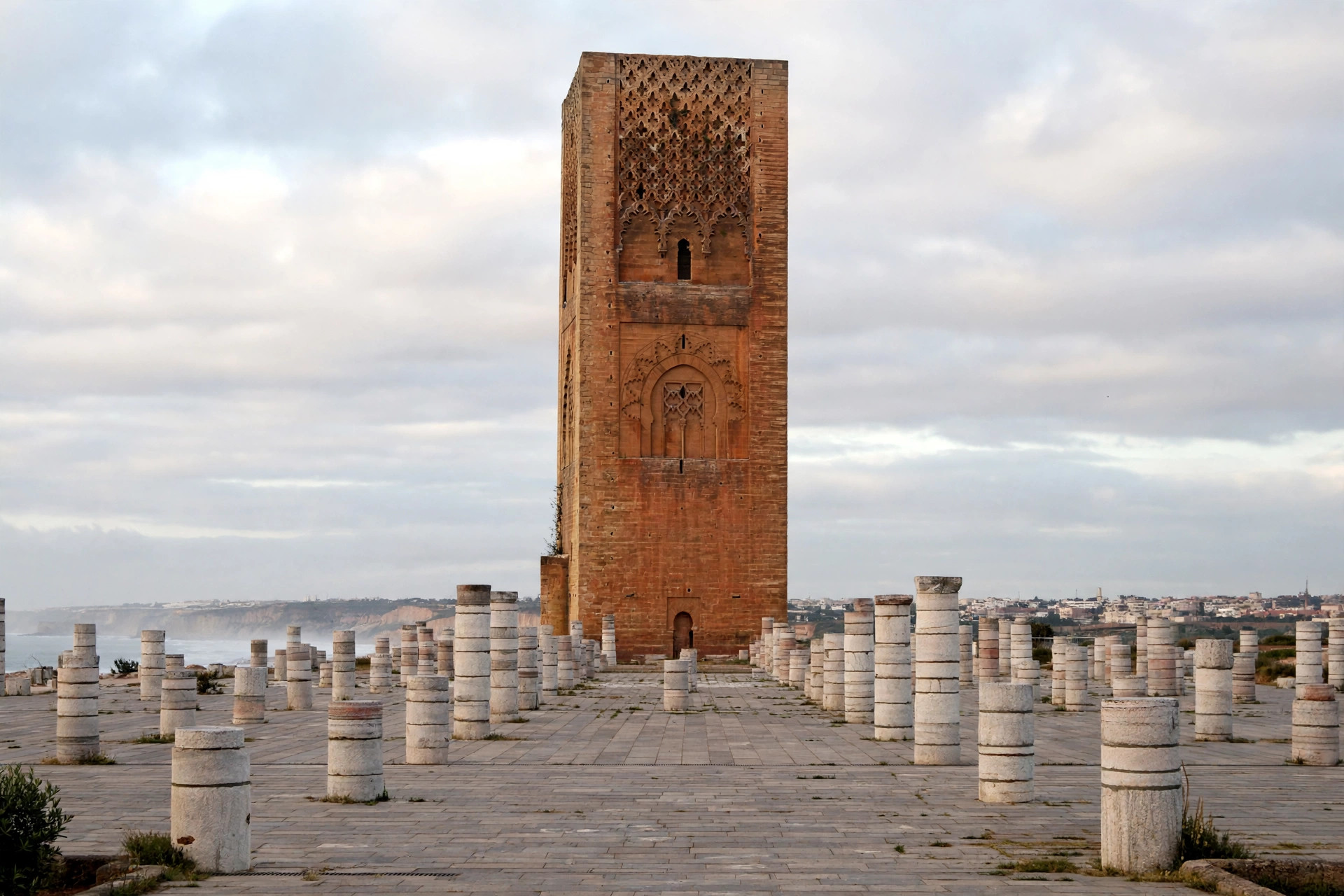
Hassan Tower in Rabat is the empire’s great unfinished dream. Yaqub al-Mansur began it around 1195 as the minaret of a mosque so large it would have been one of the biggest in the world. He died in 1199, work stopped, and the tower was left at 44 metres, less than half its intended height. The almohad empire morocco left its most poignant ruin in the capital, and among the rows of stone columns on the esplanade, you can still read the floor plan of the mosque that never was.
Tinmel and the gates of Rabat complete the picture. Tinmel mosque, in the High Atlas valley where Ibn Tumart founded his movement, is small, austere and beautiful, the closest you can get to the origins of the dynasty. Bab Oudaia, the great gate of the Kasbah of the Udayas in Rabat, shows the military side: massive, decorated and built to impress. The almohad empire morocco built for devotion and defence alike, and both kinds of building still stand.
What to See Today: Almohad Sites You Can Actually Visit
Seeing the almohad empire morocco today takes less planning than most travellers expect, because its monuments sit in the middle of the cities you are already visiting. You need a morning in Marrakech, a morning in Rabat, and, if you have the time, a day in the Atlas.
The Koutoubia in Marrakech
Start in Marrakech, where the Koutoubia dominates the skyline. Non-Muslims cannot enter the mosque itself, and that rule is firm. Walk the gardens, admire the minaret from every angle, and come back at sunset when the stone turns gold. The gardens are free, and the area is best in the early morning, before the heat and the crowds. For the wider city, our Marrakech travel guide covers the medina, the souks and where to stay.
Hassan Tower and Rabat
Rabat is the second stop, and the easier of the two. Hassan Tower stands on a wide esplanade above the Bou Regreg river, and the whole site is open and free to visit (checked November 2026). Walk among the columns and look across to the Mausoleum of Mohammed V, which stands beside the tower and is also free to enter. The contrast is the point: an unfinished twelfth-century minaret beside a twentieth-century royal mausoleum, both in white and red stone.
Hassan Tower is the almohad empire morocco in unfinished form, and that is why it moves people: the Koutoubia shows what the Almohads completed, and Hassan Tower shows what they dreamed of. Our Rabat travel guide has the practical details, including the kasbah, the medina and the tram linking the sites.
Tinmel and the High Atlas
Tinmel takes more effort, and it is worth it. The mosque sits in a High Atlas valley about 100 kilometres from Marrakech, on the road towards Taroudant. After the earthquake of September 2023 the site has needed repair work, so check access locally before you go and be ready for a detour. What you will find is the mosque where the almohad empire morocco began, in the landscape that shaped it.
The Kasbah and El Badi Palace
Back in Marrakech, finish in the kasbah district, south of Jemaa el-Fnaa. The walls and gates here are Almohad in origin, even where later rulers rebuilt them. El Badi Palace, inside the kasbah, is often described as an Almohad site, and here honesty matters: it is a Saadian palace, built in the sixteenth century on Almohad foundations within the Almohad kasbah. Go for the vast ruined courtyard and the storks, but know what you are looking at. The almohad empire morocco is under your feet there, even if the walls above ground belong to a later dynasty.
| Site | Where | What to see | Entry (checked November 2026) |
|---|---|---|---|
| Koutoubia Mosque and gardens | Marrakech | Minaret exterior and gardens; mosque interior closed to non-Muslims | Free (exterior and gardens) |
| Tinmel Mosque | High Atlas, about 100 km from Marrakech | Original Almohad mosque in its mountain valley | Free; donations welcome |
| Hassan Tower and esplanade | Rabat | Unfinished minaret and columns | Free |
| Mausoleum of Mohammed V | Rabat, beside Hassan Tower | Modern royal mausoleum next to the tower | Free |
| Kasbah of the Udayas and Bab Oudaia | Rabat | Almohad gate and kasbah walls | Free to wander |
| El Badi Palace | Marrakech kasbah | Saadian palace on Almohad foundations | 70 MAD (about $7) |
| Ruler | Reign | What mattered |
|---|---|---|
| Ibn Tumart | died 1130* | Founder of the movement; *exact year of death disputed |
| Abd al-Mu’min | 1130–1163 | Took Marrakech in 1147; first Almohad caliph |
| Abu Yaqub Yusuf | 1163–1184 | Expanded into Spain; began the Giralda in Seville |
| Yaqub al-Mansur | 1184–1199 | Golden age; victory at Alarcos 1195; Hassan Tower begun |
| Muhammad al-Nasir | 1199–1213 | Defeated at Las Navas de Tolosa in 1212 |
| Later caliphs | 1213–1269 | Slow decline; Marinids took Marrakech in 1269 |
A note on dates: three dates in this story are not settled. The exact year of Ibn Tumart’s death is disputed, with 1130 the usual date. The exact start and completion years of the Giralda’s construction are disputed, with the sources giving different dates. And the exact year the Almohad court formally moved its capital to Marrakech is also given differently, since the conquest of 1147 and the formal establishment of the capital were not the same event. For the full chronology, see the Almohad Caliphate reference on Wikipedia.
Why the Almohads Still Matter
The almohad empire morocco shaped the Maghreb long after its caliphs were gone. The idea of a single state uniting Morocco and the western Mediterranean, the style of the great minarets, the layout of the imperial capitals: all of it was inherited by the dynasties that followed. The Marinids, who overthrew the Almohads, built their madrasas in Fez in a world the Almohads had made. Even the Almoravids left their mark in the cities the Almohads rebuilt, as our guide to the Almoravid dynasty explains.
Frequently Asked Questions
When did the Almohad Empire exist?
The almohad empire morocco lasted roughly from 1147, when Abd al-Mu’min took Marrakech, until 1269, when the Marinids took the city back. Its founder, Ibn Tumart, died around 1130, and the movement began in the 1120s in the High Atlas.
Who founded the Almohads?
The movement was founded by Ibn Tumart, a Masmuda Berber preacher from the Anti-Atlas, who died before the almohad empire morocco existed. The state was built by his disciple Abd al-Mu’min, who became the first Almohad caliph and conquered Marrakech in 1147.
Is the Giralda in Seville really Almohad?
Yes. The Giralda was built as the minaret of the Almohad great mosque of Seville, and it is one of the great monuments of the almohad empire morocco. The Christian belfry on top was added centuries later, after the mosque became a cathedral.
Can non-Muslims enter the Koutoubia Mosque?
No. Like most working mosques in Morocco, the Koutoubia is closed to non-Muslim visitors. Walk the gardens freely, admire the minaret from outside, and visit at sunset for the best light. The exterior is the experience, and it is free.
What happened to the Almohads?
The almohad empire morocco declined after the defeat at Las Navas de Tolosa in 1212, then shrank city by city as Christian kingdoms advanced in Spain and the Marinids rose in Morocco. The Marinids took Marrakech in 1269, ending the Almohad caliphate. For the wider story, see our history of Morocco.
What is the best Almohad site to visit in a day?
If you have one day, spend it in Marrakech at the Koutoubia and the kasbah, where the almohad empire morocco is most visible in a living city. With two days, add Rabat for Hassan Tower and Bab Oudaia, which together show the empire’s ambition and its unfinished dream.
The Empire You Can Still Touch
The almohad empire morocco lasted a little more than a century, and it has been gone for more than seven hundred years. Yet you can still touch it: put your hand on the warm brick of the Koutoubia, walk among the columns of Hassan Tower, and stand in the Atlas valley where a preacher convinced mountain tribes they could change the world. Few empires leave so much behind in such plain sight.
Go and see it that way, not as monuments to tick off, but as the work of people who believed an idea could become a tower. The almohad empire morocco endures because its builders built for eternity, and eternity, in brick and stone, is something you can still visit before lunch.