
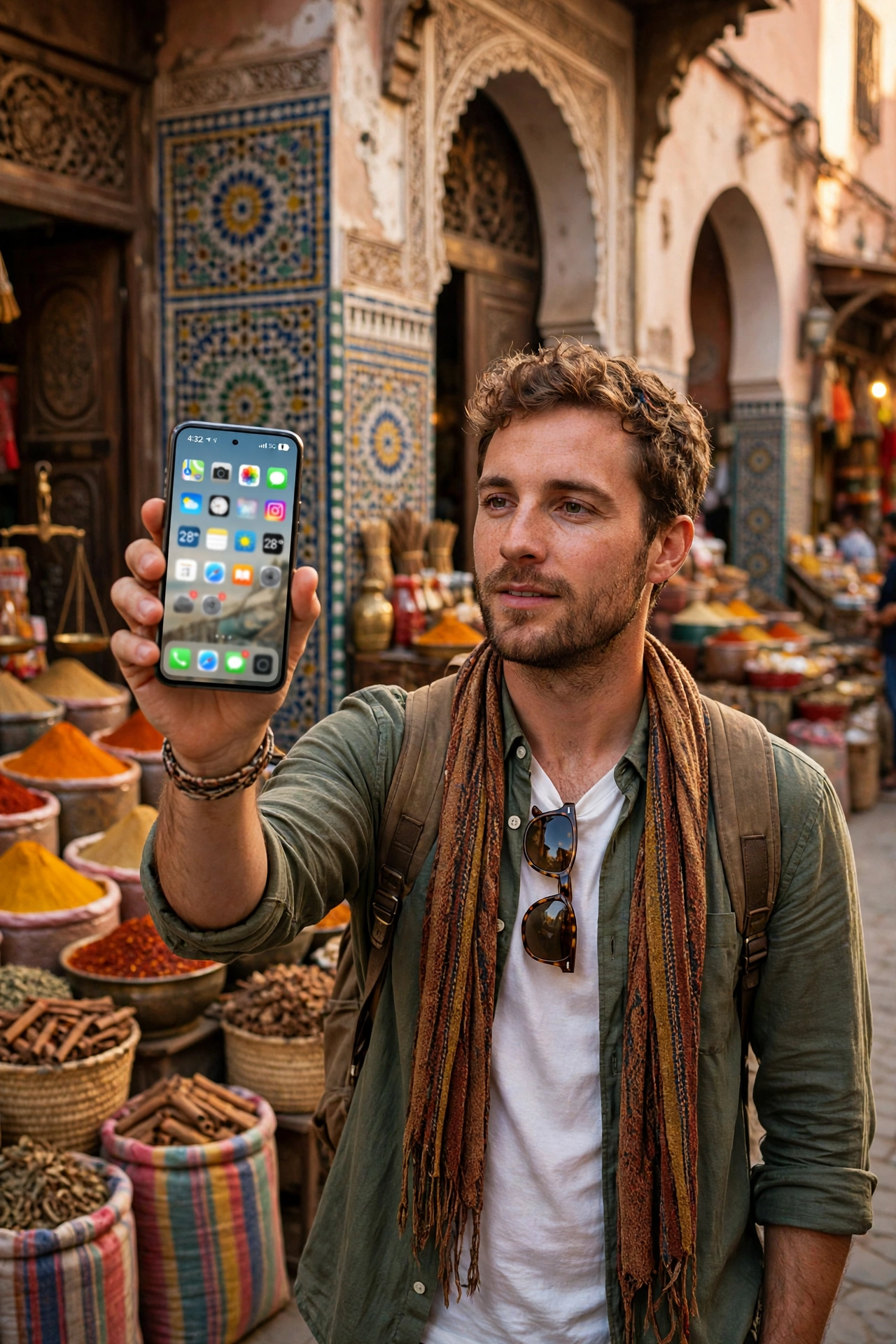
Landing in Morocco without mobile data is like arriving in a medina without a map: you still get somewhere, but far slower and with far less patience. This guide to morocco sim cards is written for short-stay visitors — a week in Marrakech, ten days driving from Tangier to the desert, or a long weekend in Casablanca — who want to be online quickly and cheaply.
The good news is that Morocco is one of the easiest countries in the world to get connected: a local SIM costs less than a coffee back home, 4G is fast in every city, and you can be online within minutes of landing. The bad news is that the easiest option is rarely the cheapest — validity days, coverage outside the cities and registration are where visitors lose money. This guide sorts morocco sim cards out properly, so you can spend your dirhams on tagines instead of overpriced data.
In this guide:
- The Three Operators for Visitors
- Airport or Town? Where to Buy Your SIM
- Tourist SIM Packs, Local SIMs and eSIMs
- Data Packages, Prices and Top-Ups
- How Much Data Does a Visitor Actually Need?
- Wi-Fi as a Backup
- Practical Tips: Activation, Top-Ups and Keeping Your Number
- Frequently Asked Questions
- Final Thoughts
Morocco SIM Cards: The Three Operators for Visitors
Morocco has three mobile networks, and every conversation about morocco sim cards starts with them: Maroc Telecom, Orange Morocco and Inwi. All three run nationwide 4G, and 5G is now live in parts of the biggest cities. For a visitor the differences are small but real, and they come down to where you are going, not city speeds.
Maroc Telecom is the historic operator and still the biggest network. Its coverage is strongest outside the big cities — on Atlas mountain roads, in small towns and in the desert around Merzouga — so if your trip goes beyond the cities, it is the safest single choice for morocco sim cards. Its shops are everywhere, including towns the others do not reach. Check current offers on the official Maroc Telecom website.
Orange Morocco is the strong all-rounder and often the fastest in the cities — in Casablanca, Rabat, Marrakech, Tangier and Agadir its 4G regularly matches or beats Maroc Telecom, though rural coverage lags behind. Inwi is the challenger brand and usually the cheapest, with fine city coverage but the weakest rural signal. The honest summary for morocco sim cards is simple: Maroc Telecom for coverage, Orange for city speed, Inwi for price. Check current offers on the official Orange Morocco website.
| Operator | Coverage for visitors | Tourist packs | Starter price | Best for |
|---|---|---|---|---|
| Maroc Telecom | Best nationwide | Yes | 20–50 MAD (~$2–5) | Beyond the cities |
| Orange Morocco | Very good in cities | Yes | 20–50 MAD (~$2–5) | City stays |
| Inwi | Good in cities | Yes | 20–30 MAD (~$2–3) | Budget data |
Prices are ranges, checked November 2026, and promotions can double your data for the same money. A starter SIM with a first bundle costs 20–50 MAD (about $2–5) at roughly 10 MAD to one US dollar. Trip costs in full: our cost of living in Morocco guide.
Airport or Town? Where to Buy Your SIM
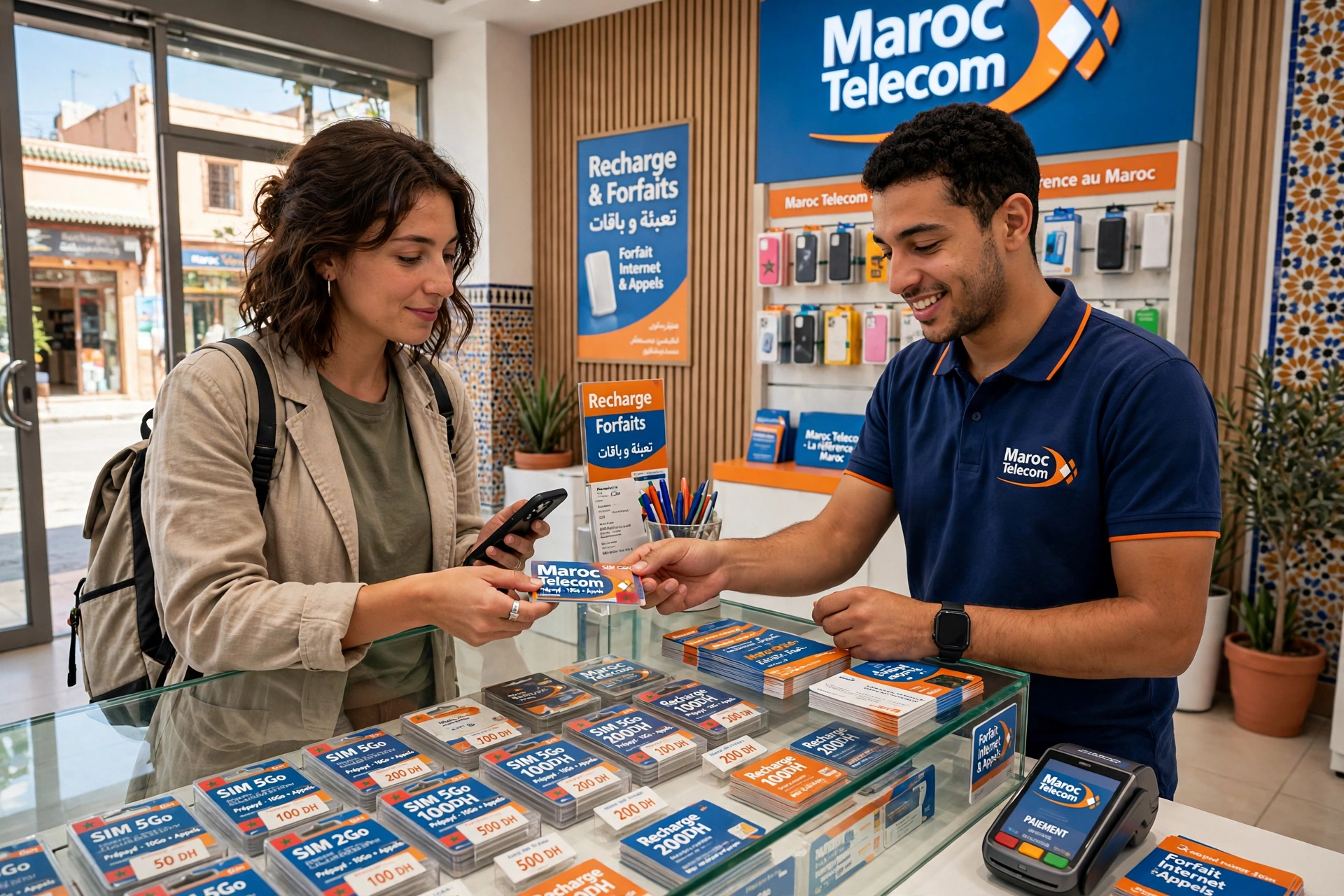
Here is the insider correction that saves most visitors money: buy your SIM at an official Maroc Telecom, Orange or Inwi shop in town, with your passport — not at the airport kiosk. The kiosk is convenient after a long flight, but a tourist pack there can cost two or three times the town price for the same data. Walk into town, find the operator’s own shop, and you get the real price for morocco sim cards, registered properly in your name.
The second correction is just as important: the so-called tourist SIM is the same SIM at a markup. There is no special tourist network, no faster speed and no extra coverage — just a normal prepaid SIM in a prettier box, sold where tired travellers cannot compare prices. Buy the same SIM in town, load the same bundle yourself, and you pay the local price: the biggest saving in this guide, and it applies to every brand of morocco sim cards sold at an airport.
Take your passport: Moroccan law requires morocco sim cards to be registered to an identity document, and official shops will photograph or copy it in a few minutes. The assistant will insert the SIM, check it works and help you choose. Confirm the balance and data allowance before you leave the shop. If your phone is locked to a carrier back home, unlock it before you travel — a locked phone cannot use any Moroccan SIM.
Tourist SIM Packs, Local SIMs and eSIMs
So which route should you take? A tourist SIM pack makes sense in exactly one situation: a stay of two or three days where you value zero hassle over money. You land, you pay, you are online. For anything longer, a local SIM bought in town is almost always better — same network, same speeds, much cheaper data, and a Moroccan number for bookings and local apps. For a week or more, that is the honest verdict on morocco sim cards for visitors.
An eSIM is the easiest option of all if your phone supports one. International providers such as Airalo and Holafly sell Morocco data plans you can install before you fly, so you land already connected — no queue, no passport photocopy, no SIM tray. Expect to pay more per gigabyte than local morocco sim cards: a typical 5–10 GB eSIM plan costs roughly $10–25. The smartest setup is a hybrid: an eSIM for the first day, then a local SIM in town. Check your phone is eSIM-compatible and unlocked before you buy anything.
Many visitors run morocco sim cards on a dual-SIM phone, keeping home SIMs active for banking codes while the Moroccan SIM handles data. Set the Moroccan SIM as your data line, and switch off data roaming on your home line before you land — roaming charges are how a cheap holiday becomes an expensive phone bill.
Data Packages, Prices and Top-Ups
Moroccan mobile data is cheap by European and North American standards. With morocco sim cards, you buy data as a bundle or recharge in the operator’s app, by USSD code, at a corner shop or at an official store. Most visitors top up 50–100 MAD (about $5–10) at a time — enough for a normal week of travel. Prices below are ranges, checked November 2026, at roughly 10 MAD to one US dollar.
| Bundle | Typical price | Validity | Best for |
|---|---|---|---|
| 2–5 GB | 20–30 MAD (~$2–3) | 7 days | Maps and messaging |
| 10 GB | 30–50 MAD (~$3–5) | 14–30 days | One week |
| 20–30 GB | 50–100 MAD (~$5–10) | 30 days | Hotspotting |
| 50 GB+ | 100–200 MAD (~$10–20) | 30 days | Streaming |
Here is the detail most visitors miss, and it matters more than the price per gigabyte: data expires, so check the validity days, not just the GB. A 20 GB bundle that lasts seven days is useless on a two-week trip, and a 10 GB bundle valid for thirty days beats a 30 GB bundle that dies in a week — and unused data does not roll over. This is the most common mistake with morocco sim cards, and shops will not warn you unless you ask.
Topping up morocco sim cards is easy once you know the routine. The fastest way is the operator’s app, where you can pay by card. You can also buy a recharge card at any hanout — the small corner shops on almost every street — and enter its code, or ask the shopkeeper to top you up directly. Ask for “recharge” plus the operator name and the amount in dirhams. Check the money side in our Morocco money and dirham guide.
How Much Data Does a Visitor Actually Need?
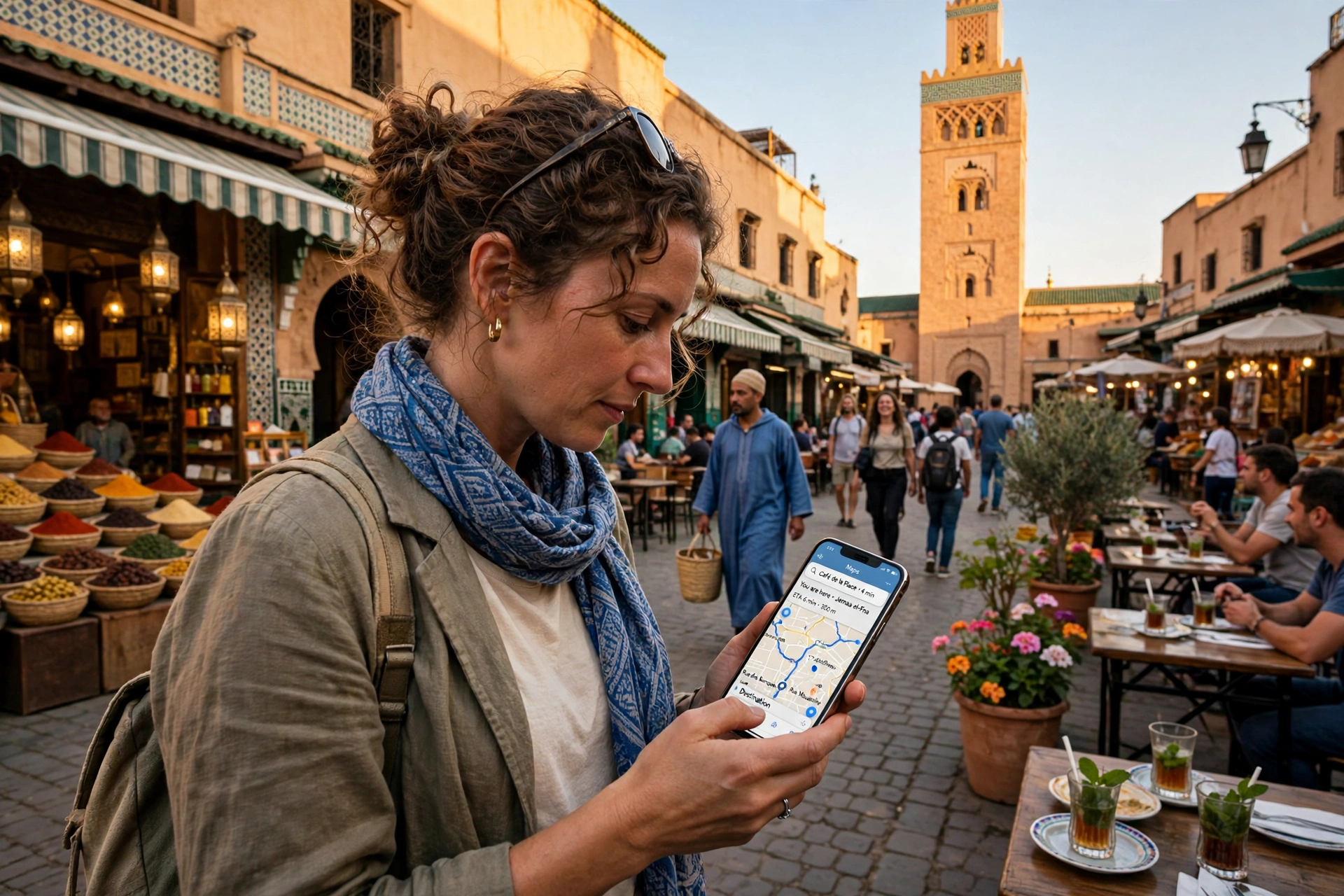
Most visitors overestimate how much data they need — and operators are happy to sell the biggest bundle. Maps, messaging and browsing use very little: Google Maps with offline areas uses almost nothing on the road, WhatsApp calls use roughly 0.5 MB per minute, and an hour of social media around 100–200 MB. The real data eaters are video — an hour of streaming at standard quality uses about 1 GB, and a video call uses 500 MB to 1 GB per hour. That split is the key to choosing the right bundle among all the morocco sim cards offers on the shelf.
For a one-week trip with normal use — maps, messages, photos and a little video — 10 GB is comfortable and 20 GB is generous. For two weeks, 20–30 GB covers most travellers. If you hotspot a laptop or stream films in the evening, budget 30–50 GB and top up as you go. Smaller bundles bought more often cost the same and mean you never pay for data that expires unused — the simplest rule for choosing between morocco sim cards bundles. Download offline maps on hotel Wi-Fi each morning and your data stretches twice as far; our Morocco by train guide covers routes, prices and booking for the long rail days between cities.
Wi-Fi as a Backup
Wi-Fi is a useful backup, not a replacement for a SIM. Almost every riad, hotel, café and restaurant offers free Wi-Fi, but quality varies wildly: excellent in a modern Casablanca hotel, a crawl two rooms from the router in an old Fes riad. Thick walls weaken the signal, and a network shared with fifty guests slows to a trickle in the evening. Treat Wi-Fi as a bonus for heavy downloads, and let morocco sim cards carry everything that matters on the move.
Do heavy work on Wi-Fi — maps, photo backups, app updates — and keep mobile data for everything on the move. Never use public Wi-Fi for banking or sensitive logins; mobile data is safer for anything involving money. For stays of a month or more, our deeper guide to SIM cards, internet and working online in Morocco covers fibre and home connections.
Practical Tips: Activation, Top-Ups and Keeping Your Number
Activation for morocco sim cards is usually instant, but allow up to an hour before you worry. If data does not work straight away, check that mobile data is on and the APN settings are correct — the shop can fix this in seconds, another reason to buy in town rather than at a kiosk. Restarting the phone solves most first-day problems. Keep the small plastic card the SIM came in: it carries your PIN and PUK codes — you need the PUK after three wrong PIN entries.
Later in the trip, most problems have a quick fix. No signal usually means the SIM is not seated properly or the phone needs a restart. Data that stops after a top-up often means the bundle has not activated yet — wait ten minutes, then restart the phone. A bundle that vanishes overnight has usually expired on its validity date, not run out of gigabytes. If you lose the phone or the SIM, an official shop can replace it with your passport. This is the unglamorous side of morocco sim cards, but it is the side that saves a trip when something goes wrong. Note your new number somewhere safe.
Frequently Asked Questions
Do I need a passport to buy a SIM card in Morocco?
Yes. SIM cards must be registered to an identity document — for visitors, your passport — and official shops will copy it in a few minutes. Unregistered SIMs from unofficial sellers can be blocked without warning, so use an official shop; this rule applies to morocco sim cards bought anywhere in the country, including the airport.
Which operator is best for tourists in Morocco?
Maroc Telecom, because it has the widest coverage, which matters the moment you leave the big cities. Orange is often faster in the cities and a fine choice for a city-only trip, while Inwi is the cheapest option.
Can I use an eSIM in Morocco?
Yes, if your phone supports eSIM and is carrier-unlocked. Providers such as Airalo and Holafly sell Morocco data plans you can install before you travel, so you land already connected. They cost more per gigabyte than local morocco sim cards, but they are ideal for your first day — many travellers switch to a local SIM once settled.
How much does a SIM card cost in Morocco?
About 20–50 MAD (around $2–5) for a starter SIM with a first bundle in an official shop in town; the same data at an airport kiosk can cost two or three times as much. A comfortable allowance for a week is roughly 30–50 MAD (about $3–5) for 10 GB. Prices are ranges, checked November 2026.
Can I keep my Moroccan SIM for my next trip?
Yes, if you keep it active: top it up at least once every few months — a 20 MAD recharge is enough — or the operator may recycle the number. Note your number somewhere safe, and keep the plastic card with the PIN and PUK codes with your travel documents.
Is mobile data fast enough for video calls and streaming in Morocco?
Yes, in the cities. 4G speeds of 20–60 Mbps are common in Casablanca, Rabat, Marrakech, Tangier and Agadir — plenty for video calls and streaming. Speeds drop in rural areas and mountains, so download films and maps on Wi-Fi before a long drive.
Final Thoughts
Staying connected in Morocco is cheap and straightforward. The whole trip comes down to three decisions: buy a local SIM in town with your passport, pick the operator that fits your route, and check the validity days on every bundle — not just the gigabytes. Get those three right and the rest takes care of itself — that is the short version of everything this guide to morocco sim cards has to say.
The country rewards travellers who arrive prepared. Fast 4G in the cities, honest prices in the shops and a SIM that costs less than lunch: connectivity fades into the background within an hour of landing. For a longer stay, our deeper guide to SIM cards, internet and working online in Morocco picks up where this one leaves off.
Prices in this guide are in Moroccan dirhams (MAD) with approximate US dollar equivalents at around 10 MAD to $1, checked November 2026. Confirm the current offer in the shop before you buy.