
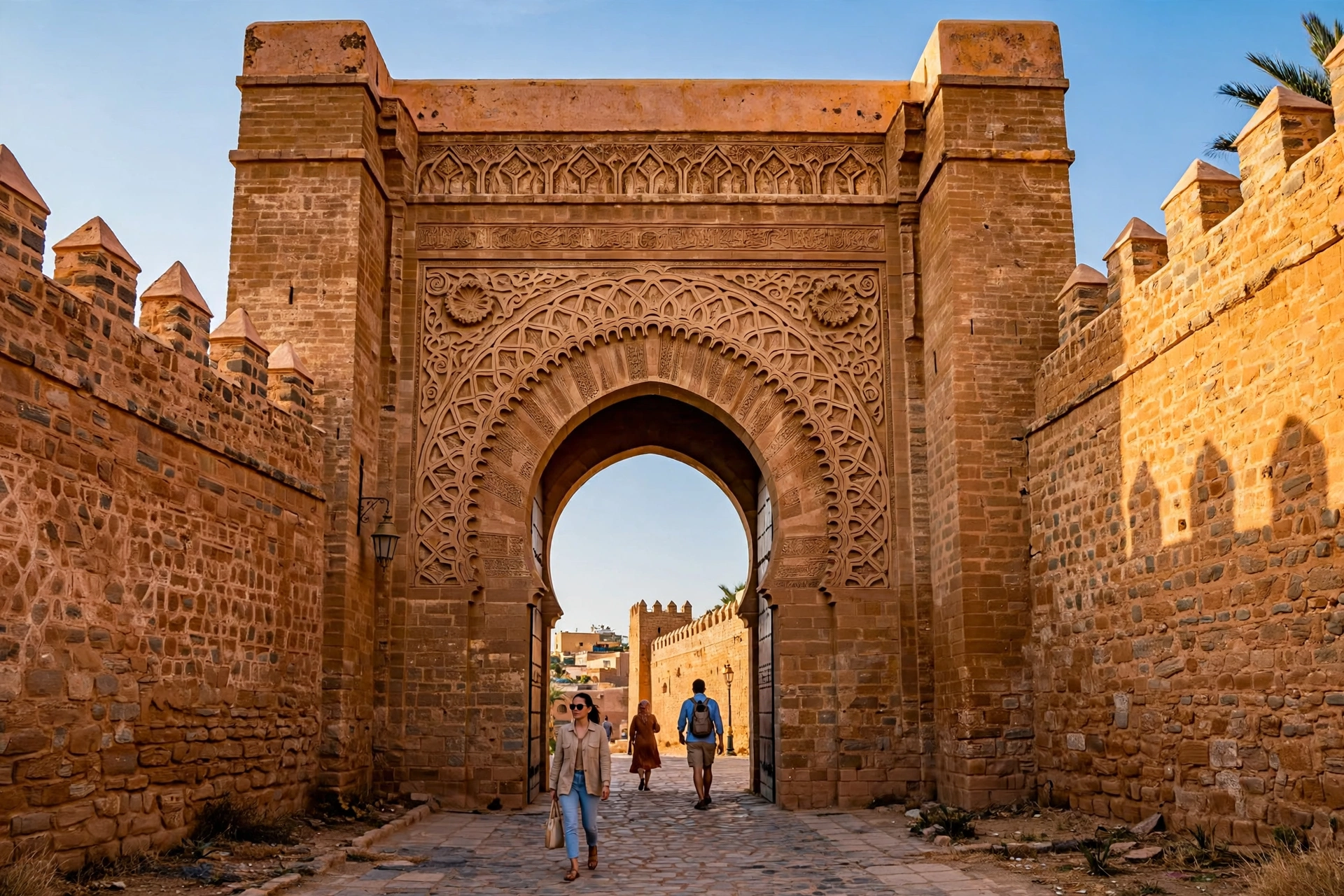
The Kasbah of the Udayas is the oldest corner of Rabat and one of the most beautiful places in Morocco. It stands on a rocky headland where the Bou Regreg river meets the Atlantic Ocean, a walled village of blue lanes, orange trees and sea views, entered through one of the great gates of the medieval world. The Kasbah of the Udayas has been a fortress, a pirate stronghold, a royal residence and a quiet residential quarter.
This guide explains what the Kasbah of the Udayas is, how it grew from a 10th-century ribat into an Almohad citadel, what to see inside, and how to visit in about an hour. It sits in our History & Heritage section, beside our guide to the imperial cities and our brief history of Morocco — read those first for the wider story.
In this guide
- What Is the Kasbah of the Udayas?
- The History of the Kasbah of the Udayas: From Ribat to Citadel
- Bab Oudaia: The Great Gate of the Kasbah of the Udayas
- The Blue-and-White Lanes: A Village Inside the Walls
- The Andalusian Garden of the Kasbah of the Udayas
- The National Museum of Adornment Inside the Kasbah of the Udayas
- Café Maure and the Platform Over the Bou Regreg
- The Kasbah of the Udayas and the Republic of Salé
- Visiting the Kasbah of the Udayas: Hours, Tickets and Prices
- How to Get to the Kasbah of the Udayas
- The Best Route Through the Kasbah of the Udayas in One Hour
- What Else to See Nearby
- Frequently Asked Questions
- The Bottom Line on the Kasbah of the Udayas
What Is the Kasbah of the Udayas?
The Kasbah of the Udayas is a fortified citadel on the Atlantic coast of Rabat, built on a hill at the mouth of the Bou Regreg river, directly opposite the city of Salé. A kasbah is a walled citadel, and this one is small enough to cross on foot in ten minutes — yet it holds a monumental gate, a mosque, a museum, a garden, a café terrace and a whole residential neighbourhood of whitewashed houses with blue doors and blue lower walls.
The Kasbah of the Udayas is also a living place, not a ruin. Families live in the lanes, and laundry hangs across the blue walls. Visitors walk the same streets as the residents, so the visit feels less like a museum and more like stepping into a quiet village that happens to sit inside a 12th-century fortress.
In 2012 it was inscribed on the World Heritage List as part of "Rabat, Modern Capital and Historic City: a Shared Heritage", together with the medina, the Hassan Tower and Chellah — Wikipedia's account of the kasbah gives the full history. Entry is free, it is open every day, and it sits a short walk from the medina.
The History of the Kasbah of the Udayas: From Ribat to Citadel
The story of the Kasbah of the Udayas begins with a ribat, a fortified monastery where warrior-monks guarded the coast. In the 10th century, the Umayyads of Cordoba or their allies founded a ribat on this headland to watch the mouth of the Bou Regreg. Historians have not confirmed that the first ribat stood on exactly this spot, so that part of the story is honestly not settled.
In the 1140s, one of the last Almoravid emirs, Tashfin ibn Ali, built a new ribat here while fighting the rising Almohad movement. The Almohads won, destroyed the ribat, and in 1150 or 1151 the Almohad caliph Abd al-Mu'min built a new citadel on the site, with a palace and a mosque inside its walls. The Kasbah of the Udayas as it survives today is fundamentally his creation.
His grandson, the caliph Yaqub al-Mansur, then built a vast new imperial capital on the plain below the kasbah, called Ribat al-Fath — the name from which modern Rabat derives — with enormous walls, a great mosque whose unfinished minaret is now the Hassan Tower, and grand gates including Bab Oudaia. Read our guide to the Almohads for the full story of the dynasty that built all of this.
After the Almohad empire faded, the kasbah was largely abandoned for centuries. Its second life began in 1609, when Spain expelled its Morisco population and thousands of Andalusian Muslim refugees settled along the Bou Regreg, many inside the kasbah walls. They rebuilt the lanes in the Andalusian style. Later, Sultan Moulay Ismail settled part of the Udaya tribe here in the late 17th century, and the tribe's name eventually stuck to the whole citadel, though it only became the common name in the 19th century.
| Period | What happened at the Kasbah of the Udayas |
|---|---|
| 10th century | A ribat is founded on the headland; its exact site is not confirmed by historians |
| 1140s | Almoravid emir Tashfin ibn Ali builds a new ribat during the war with the Almohads |
| 1150–1151 | Almohad caliph Abd al-Mu'min builds the citadel, with a palace and a mosque |
| c. 1195–1199 | Yaqub al-Mansur builds the monumental Bab Oudaia gate and the imperial capital below |
| 1609 onwards | Andalusian Morisco refugees resettle the kasbah and rebuild its lanes |
| 1627–1668 | The corsair Republic of Bou Regreg rules from Rabat and Salé |
| Late 17th century | Sultan Moulay Ismail settles the Udaya tribe in the kasbah |
| 1914–1918 | French Protectorate restoration begins; the Andalusian Garden is laid out |
| 2012 | UNESCO inscribes Rabat, including the kasbah, on the World Heritage List |
| 2023 | The National Museum of Adornment reopens in the kasbah after renovation |
Bab Oudaia: The Great Gate of the Kasbah of the Udayas
Before you enter the Kasbah of the Udayas, stop at its gate. Bab Oudaia — also called Bab el-Kebir, the Great Gate — is one of the finest Almohad monuments in Morocco: a huge pointed horseshoe arch framed by carved geometric and vegetal decoration, with a bent entrance passage that turns twice inside the walls so attackers could never charge straight through. It was built under Yaqub al-Mansur, most likely between about 1195 and 1199, though the exact date is debated among historians.
The gate was never only defensive. Its size and decoration were a statement of Almohad power, the front door of an imperial capital. Look at the carved stonework up close — the interlacing patterns are the same visual language as the Koutoubia in Marrakech and the Giralda in Seville, built by the same dynasty in the same decades.
Walk through the gate and you are in the kasbah. The passage bends, the light changes, and the noise of the city drops away.
The Blue-and-White Lanes: A Village Inside the Walls
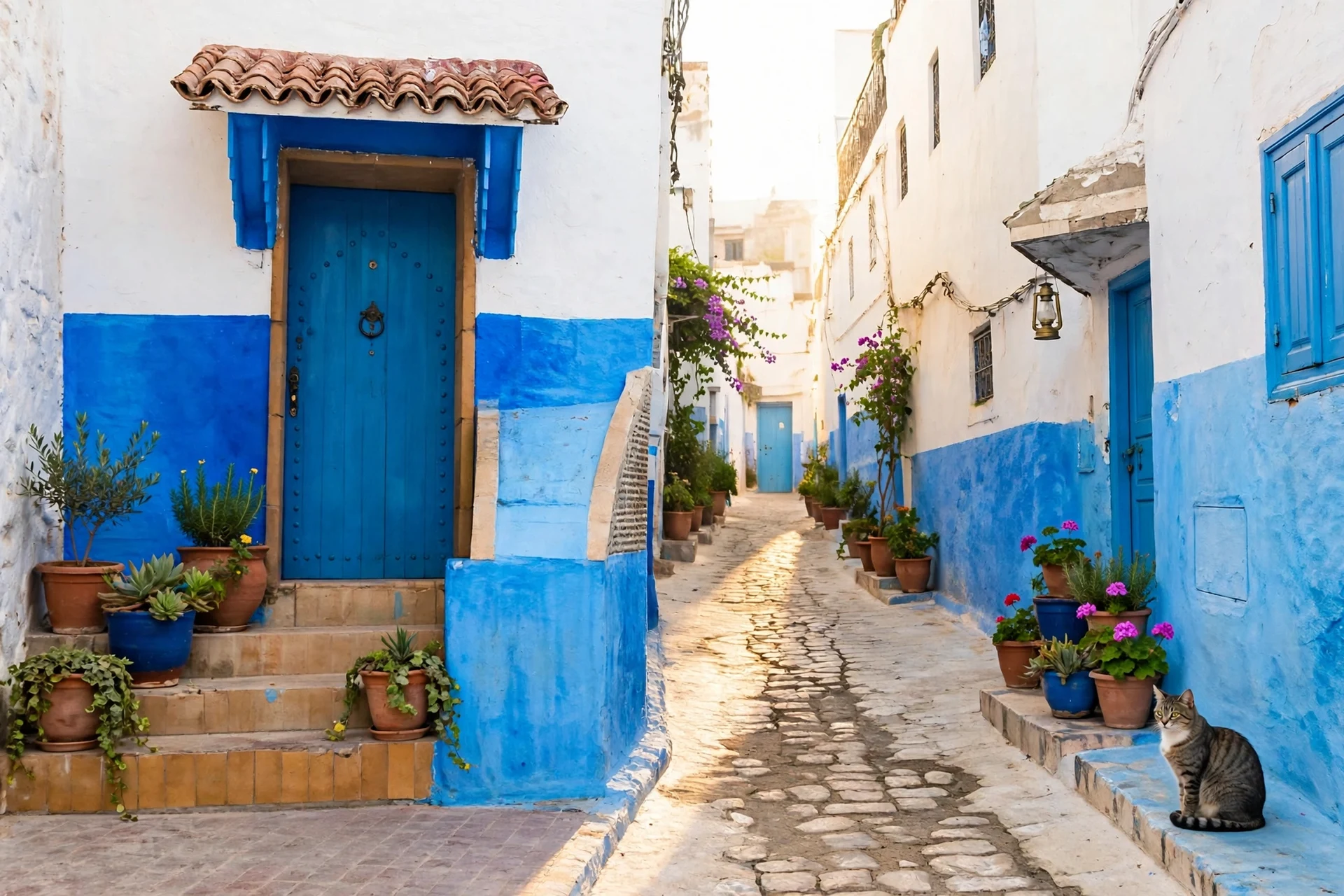
Inside the walls, the Kasbah of the Udayas is a maze of narrow lanes lined with whitewashed houses painted blue below and white above. The colour is the kasbah's signature: against the white walls and the green of the orange trees, the blue lanes photograph beautifully.
The blue-and-white look is part of the kasbah's Andalusian heritage, carried by the refugees who rebuilt the quarter in the 17th century. The lanes climb and dip between the gate and the sea, opening into small squares with fountains and cats asleep in the sun. There is no single route — wander, and every turn leads somewhere worth seeing.
Remember that this is a residential neighbourhood, not a theme park. Keep your voice down, do not photograph people without asking, and do not block doorways. A smile and a greeting in French or Arabic go a long way.
The Andalusian Garden of the Kasbah of the Udayas
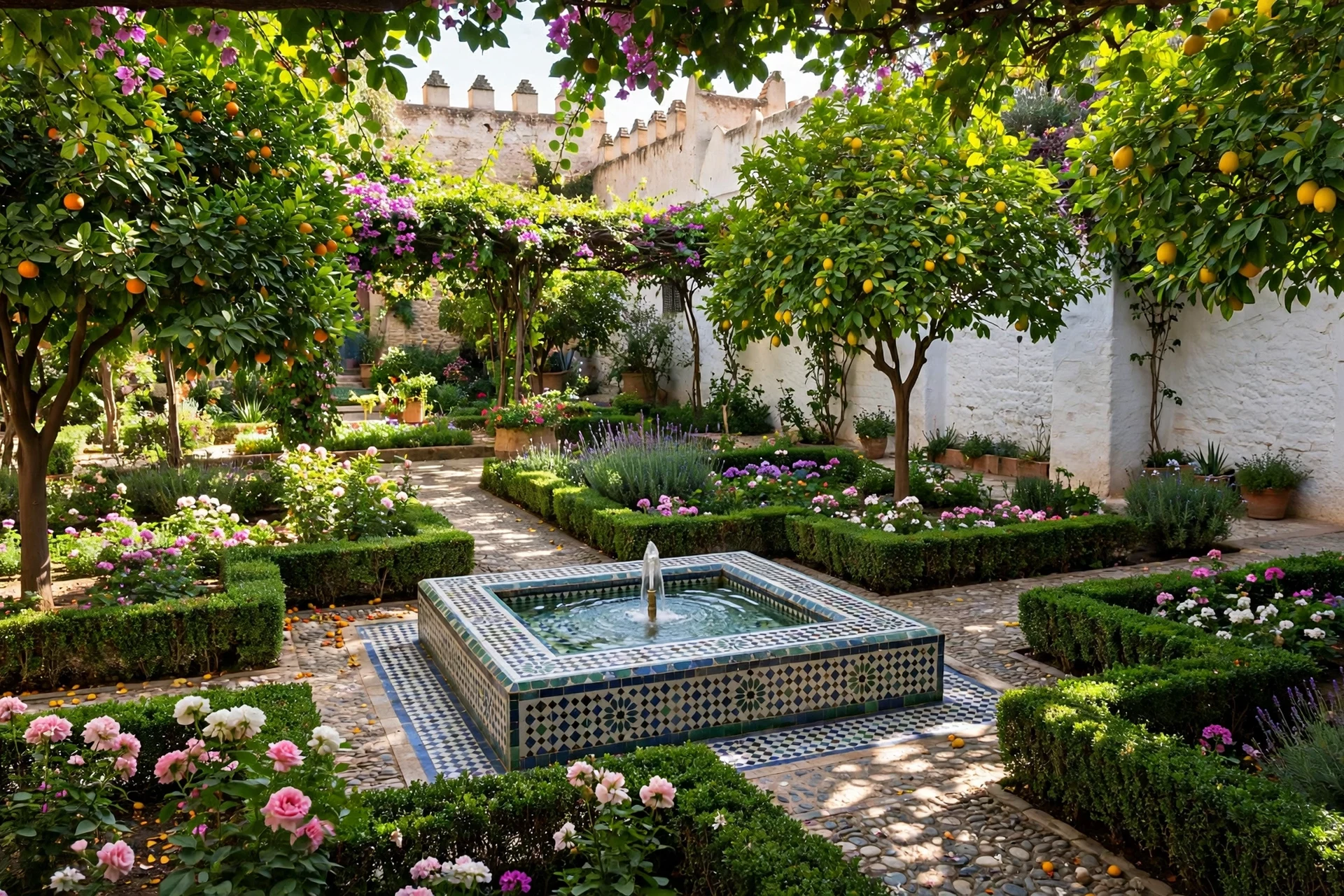
At the southern edge of the Kasbah of the Udayas, below the walls, lies the Andalusian Garden — a walled garden of orange and lemon trees, flower beds and fountains. Despite its name, the garden is not medieval: it was laid out between 1915 and 1918, during the French Protectorate, in the Andalusian style, as part of the restoration of the kasbah that began in 1914. The name describes the style, not the age.
The garden is the quietest corner of the Kasbah of the Udayas. Benches sit under the orange trees, water runs in the small channels. In spring the orange blossom fills the whole garden with scent. Entry is free, and the garden is generally open daily from about 8:00 AM to 6:30 PM, closing a little earlier in winter.
The National Museum of Adornment Inside the Kasbah of the Udayas
The kasbah's palace, built under Sultan Moulay Ismail between 1672 and 1694, now holds the National Museum of Adornment (Musée National de la Parure), run by the National Foundation of Museums. Reopened on 9 January 2023 after a long renovation, its permanent exhibition is arranged in five sections devoted to Moroccan jewellery, adornment and costume from across the country.
The collection is the reason to go inside: silver fibulae and amber necklaces, embroidered caftans, headdresses and belts, displayed in the palace rooms. The museum is small and takes about 45 minutes, and it is the only paid stop inside the kasbah. Admission is 60 MAD (about $6) for foreign visitors, 30 MAD (about $3) for Moroccan adults and 15 MAD (about $1.50) for Moroccans under 18, as listed by the National Foundation of Museums in November 2026. Hours are 10:00 AM to 6:00 PM, closed on Tuesdays — check the foundation's page before a visit made specially for the museum.
If jewellery and costume are not your interest, skip it without regret — the lanes, the garden and the views are free, and they are the heart of the visit. If they are your interest, the museum is one of the best small collections in Morocco.
Café Maure and the Platform Over the Bou Regreg
At the far end of the Kasbah of the Udayas, past the lanes, the ground opens onto a wide platform above the river mouth. This is the great viewpoint of the quarter: the Bou Regreg below, the city of Salé across the water, the Atlantic on the left, and the white houses behind you. At sunset the light turns the whole scene gold, and this is the best sunset spot in Rabat that costs nothing.
On the platform stands Café Maure, a small café with a shaded terrace that has become an institution. Order mint tea and almond pastries — a pot of tea and a plate of pastries cost around 20–30 MAD (about $2–3) — sit down, and watch the river. Nobody hurries you, and the view does the entertaining.
The Kasbah of the Udayas and the Republic of Salé
The wildest chapter in the history of the Kasbah of the Udayas belongs to the 17th century, when the kasbah was the stronghold of the Republic of Bou Regreg — a corsair state run by the Andalusian refugees of Rabat and Salé. From 1627 to 1668 the two towns on opposite banks of the river governed themselves, traded and raided across the Atlantic. Our guide to the Republic of Salé tells that story in full.
The kasbah was the republic's fortress and its seat of power. Its walls guarded the river mouth, and its captains grew rich on trade and ransom. The republic ended when the Alaouite sultan Moulay Rashid took Salé in 1668, and Moulay Ismail later rebuilt the kasbah as a royal residence — read our guide to the Alaouites for the dynasty that followed.
Visiting the Kasbah of the Udayas: Hours, Tickets and Prices
Visiting the Kasbah of the Udayas is simple, and almost everything is free. The kasbah streets are a public residential neighbourhood, so there is no ticket and no fixed closing time — come in daylight, and the quarter is open. The garden and the museum have their own hours, and only the museum charges admission. Prices below were checked in November 2026 and are given in Moroccan dirhams (MAD) with approximate US dollar equivalents. For official visitor information, check Visit Morocco.
| What | Hours | Price (November 2026) |
|---|---|---|
| Kasbah streets and lanes | Daylight, daily | Free |
| Bab Oudaia gate | Always open | Free |
| Andalusian Garden | Daily, about 8:00 AM–6:30 PM (earlier in winter) | Free |
| National Museum of Adornment | 10:00 AM–6:00 PM, closed Tuesdays | 60 MAD (~$6) foreign; 30 MAD (~$3) Moroccan adult; 15 MAD (~$1.50) under 18 |
| Café Maure | Daily, daytime to early evening | Tea and pastries about 20–30 MAD (~$2–3) |
| Platform viewpoint | Daylight, daily | Free |
| Private guide (1 hour) | By arrangement | 200–400 MAD (~$20–40) |
| Combined half-day Rabat tour | By arrangement | 500–900 MAD (~$50–90) |
The best time to visit is late afternoon, from about 4:00 PM to 6:00 PM, when the light turns golden on the blue walls and the Atlantic catches the sunset. Mornings are quieter and better for photography, and midday in summer is hot with little shade in the lanes — use the garden and the café terrace to escape the sun. Allow one to one and a half hours for the lanes, the garden, the viewpoint and the café, plus 45 minutes if you add the museum.
How to Get to the Kasbah of the Udayas
The Kasbah of the Udayas sits at the edge of the medina, a 15-minute walk from the city centre, and getting there is easy. From Rabat Ville train station, walk down Avenue Mohammed V towards the medina and the river, or take a small taxi for 15–25 MAD (about $1.50–2.50) — agree the price or check the meter before you set off. The tram line 1 stop at Bab el-Had leaves you a ten-minute walk from the gate through the medina.
From Casablanca, the train to Rabat Ville takes about one hour, then the kasbah is a short taxi ride or a pleasant walk. From the airport, a taxi to the kasbah costs around 150–200 MAD (about $15–20). There is no car access inside the kasbah: the lanes are pedestrian only, and cars stop at the gate. Wear comfortable shoes — the lanes are steep in places.
The Best Route Through the Kasbah of the Udayas in One Hour
One hour is enough for the Kasbah of the Udayas if you follow a simple route. Start at Bab Oudaia and spend five minutes at the gate. Walk through the bent passage into the lanes, wander slowly towards the sea. Turn towards the Andalusian Garden, spend twenty minutes under the orange trees, then climb back up to the platform for the view over the Bou Regreg and Salé.
- Bab Oudaia gate — five minutes at the arch and the carvings.
- The blue lanes — twenty minutes of wandering towards the sea.
- The Andalusian Garden — twenty minutes under the orange trees.
- Café Maure — mint tea and pastries on the terrace.
- The platform viewpoint — the river mouth, Salé and the Atlantic.
- The National Museum of Adornment — 45 minutes more, if you want it.
Finish at the platform for sunset if your timing allows, then walk back to the medina for dinner. The route is short, the ground is uneven, and there are steps — take it slowly.
What Else to See Nearby
The Kasbah of the Udayas is the start of a day in Rabat, not the whole day. Three more great sites sit within a short walk or taxi ride. The Hassan Tower and the Mausoleum of Mohammed V stand on the esplanade below the kasbah — the unfinished Almohad minaret and the white marble mausoleum of the king who led Morocco to independence in 1956, both free to visit. Chellah, the Roman and Marinid necropolis, is the one paid headline sight in the city. Read our guide to Morocco's independence in 1956 for the story behind the mausoleum.
| Nearby sight | Distance from the Kasbah of the Udayas | Price (November 2026) |
|---|---|---|
| Hassan Tower and Mausoleum of Mohammed V | 10-minute walk | Free |
| Rabat medina and the Mellah | 5-minute walk | Free |
| Chellah necropolis | 15-minute taxi ride | About 70 MAD (~$7) |
| Mohammed VI Museum of Modern and Contemporary Art | 10-minute walk | About 40–60 MAD (~$4–6) |
| The riverfront and the rowboat to Salé | At the foot of the kasbah | A few dirhams |
| The Andalusian Gardens and the Kasbah Mosque | Inside the kasbah | Free |
A good full day runs: kasbah in the late morning, Hassan Tower and the mausoleum after lunch, Chellah in the afternoon, and back to Café Maure for sunset tea. Two days let you add the medina, the Mohammed VI Museum and the rowboat across the river to Salé.
Frequently Asked Questions
Is the Kasbah of the Udayas free to visit?
Yes. Walking the streets of the Kasbah of the Udayas, the Andalusian Garden and the platform viewpoint are all free, and the kasbah is open daily in daylight hours. Only the National Museum of Adornment inside charges admission: 60 MAD (about $6) for foreign visitors.
How long do you need at the Kasbah of the Udayas?
Allow one to one and a half hours at the Kasbah of the Udayas: the gate, the blue lanes, the Andalusian Garden, Café Maure and the platform viewpoint. Add 45 minutes for the National Museum of Adornment. Come in the late afternoon for the best light and the sunset over the Atlantic.
What is the Kasbah of the Udayas famous for?
The Kasbah of the Udayas is famous for its monumental Almohad gate Bab Oudaia, its blue-and-white lanes, its Andalusian Garden and its views over the Bou Regreg and the Atlantic. It is a 12th-century citadel, a UNESCO World Heritage site since 2012, and still a lived-in neighbourhood.
When was the Kasbah of the Udayas built?
The Kasbah of the Udayas was built in 1150 or 1151 by the Almohad caliph Abd al-Mu'min, on the site of an earlier ribat. Its great gate, Bab Oudaia, was added under Yaqub al-Mansur, most likely between about 1195 and 1199 — though the exact date of the gate is debated by historians.
Can you take photos inside the Kasbah of the Udayas?
Yes. Photography is welcome in the lanes, the garden and on the platform of the Kasbah of the Udayas, and the blue doorways are among the most photographed scenes in Rabat. Ask before photographing residents, and check the rules inside the museum, where photography may be restricted.
Where exactly is the Kasbah of the Udayas?
The Kasbah of the Udayas is in Rabat, on a hill at the mouth of the Bou Regreg river opposite Salé, at the edge of the medina. Enter through Bab Oudaia, the great gate. It is a 15-minute walk from the city centre and a short taxi ride from Rabat Ville station.
The Bottom Line on the Kasbah of the Udayas
The Kasbah of the Udayas is a small site with a thousand years inside it: a ribat, an Almohad citadel, a pirate stronghold, a royal palace and a blue-and-white village, on one headland above the river. Come in the late afternoon, pass under Bab Oudaia slowly, wander the lanes, rest in the garden, and finish with mint tea on the platform at sunset. It costs nothing, and it is the best hour in Rabat.
Last checked: November 2026. Prices are given in Moroccan dirhams (MAD) with approximate US dollar equivalents.
1 thought on “The Kasbah of the Udayas in Rabat: History, Gardens and Visiting Guide 2026”