
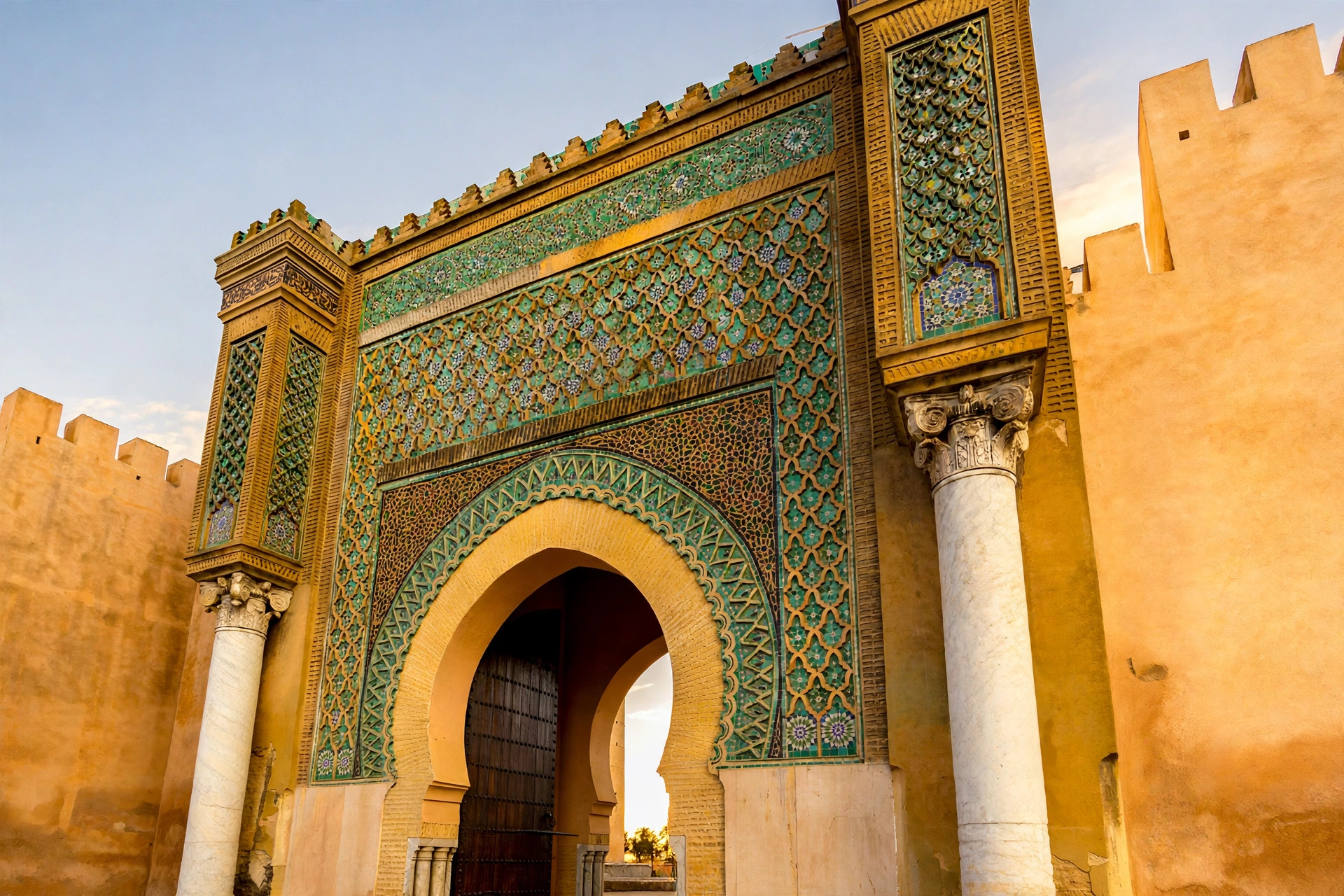
Stand before Bab Mansour as the late sun turns its green tiles to gold, and you are standing in the middle of the moulay ismail meknes story. The gate is not just a monument. It is the front door of an imperial city built by one man over a reign of 55 years, a sultan who turned a modest town on the Saiss plain into a capital meant to rival Versailles.
Moulay Ismail reigned from 1672 to 1727, the longest reign of any Moroccan sultan. He raised walls, palaces, granaries and mosques, built a new standing army, fought the Ottomans and the Spanish, and recaptured Tangier from the English in 1684.
This guide tells the story of the sultan and his city, separates documented facts from the legends around him, and ends with a practical plan for visiting his Meknes today. For the wider story, see our history of Morocco and the Alaouite dynasty; for the city, our Meknes travel guide.
In this guide
- Moulay Ismail Meknes: The Making of an Imperial Capital
- From Sharif to Sultan: The Rise of Moulay Ismail
- Bab Mansour: The Gate That Defines Meknes
- Heri es-Souani: Granaries, Stables and the Machinery of Empire
- The Black Guard: Moulay Ismail’s Army
- Wars, Diplomacy and the Recapture of Tangier
- Moulay Ismail Meknes: The Sultan’s Death and His Mausoleum
- The Reign in Dates: Timeline
- Visiting Meknes Today: A Practical Guide
- Moulay Ismail FAQ
Moulay Ismail Meknes: The Making of an Imperial Capital
When Moulay Ismail took the throne in 1672, Meknes was a small town of perhaps 20,000 people, a place of olive groves and modest houses on the road between Fez and Rabat. Fifty years later it was the capital of Morocco, ringed by some 40 kilometres of walls and filled with palaces, mosques, gardens and barracks.
The scale of the building was extraordinary. The sultan’s architects raised the royal palace complex, the Dar el-Kebira, with audience halls, courtyards and gardens fed by the Agdal basin, a great reservoir that stored water for the palace. Around it rose the walls and gates, the granaries and stables, and the kasbah quarters for the army. European visitors wrote home in awe, comparing it to Versailles.
What survives today is only part of what was built. Earthquakes, above all the great Lisbon earthquake of 1755, stripped away roofs and palaces. Yet the bones of the moulay ismail meknes project remain: the walls, the great gates, the granaries and the mausoleum. In 1996 UNESCO inscribed the historic city of Meknes on the World Heritage List, as recorded on the UNESCO page for the Historic City of Meknes.
Why Meknes, Not Fez?
The choice was deliberate. Fez was crowded with scholars, old families and rival power networks a new sultan could not easily control. Meknes offered open ground, a strategic position between Fez, Rabat and the Middle Atlas, and water nearby. The moulay ismail meknes building programme was the physical form of a political claim, written in walls and gates across an entire city.
From Sharif to Sultan: The Rise of Moulay Ismail
Moulay Ismail was born in 1645 at Sijilmasa, the oasis town on the edge of the Sahara where the Alaouite family had its roots. He was the son of Moulay Sharif, the founder of the dynasty’s fortunes, and the younger brother of Moulay Rashid, the sultan who first united much of Morocco under Alaouite rule. He was a younger son and a provincial governor of Meknes under his brother, and his path to power ran through a sudden death and a contested succession.
When Moulay Rashid died in a riding accident in 1672, Ismail moved quickly, seized the treasury at Fez, and was proclaimed sultan in his brother’s place. He was 27 years old. The first years of his reign were a fight for survival: rival claimants, rebellious tribes, and cities that had grown used to ruling themselves all had to be brought back under central authority. He did it with relentless campaigning and a genius for playing factions against one another, and the moulay ismail meknes story begins with those early wars.
The Alaouite Inheritance
The Alaouites claimed descent from the Prophet Muhammad through his grandson Hassan, and this sharifian lineage was the foundation of their legitimacy. Moulay Ismail presented himself not only as a king but as a sharif, and he expected obedience as a religious duty as much as a political one.
Bab Mansour: The Gate That Defines Meknes
No single monument captures the ambition of Moulay Ismail’s reign like Bab Mansour, the great gate at the entrance to the imperial city. Built in the 1730s — begun under the sultan and completed by his son Moulay Abdallah — it is the largest and most famous gate in Morocco. Its facade of green zellige tiles, carved marble and inscriptions has become the symbol of Meknes itself.
The gate was designed to overwhelm. The arch is flanked by columns of Italian marble, said to have been taken from the ruins of the Roman city of Volubilis, and the tilework glows green in the afternoon light. The inscription across the facade praises the sultan and his work. Visitors arriving from Place el-Hedim, the great square at the edge of the moulay ismail meknes imperial city, pass through a space built to make them feel small. Crossing it meant entering the sultan’s world.
The Walls and Gates of the Imperial City
Bab Mansour is the showpiece, but it is only one of many gates. The walls run for kilometres, pierced by gates such as Bab el-Khemis and Bab Berdaine, each built to a different purpose. Walk them in the late afternoon, from Bab Mansour south toward the Agdal basin: an hour’s walk, free, and the best way to grasp the layout of the imperial city.
Heri es-Souani: Granaries, Stables and the Machinery of Empire
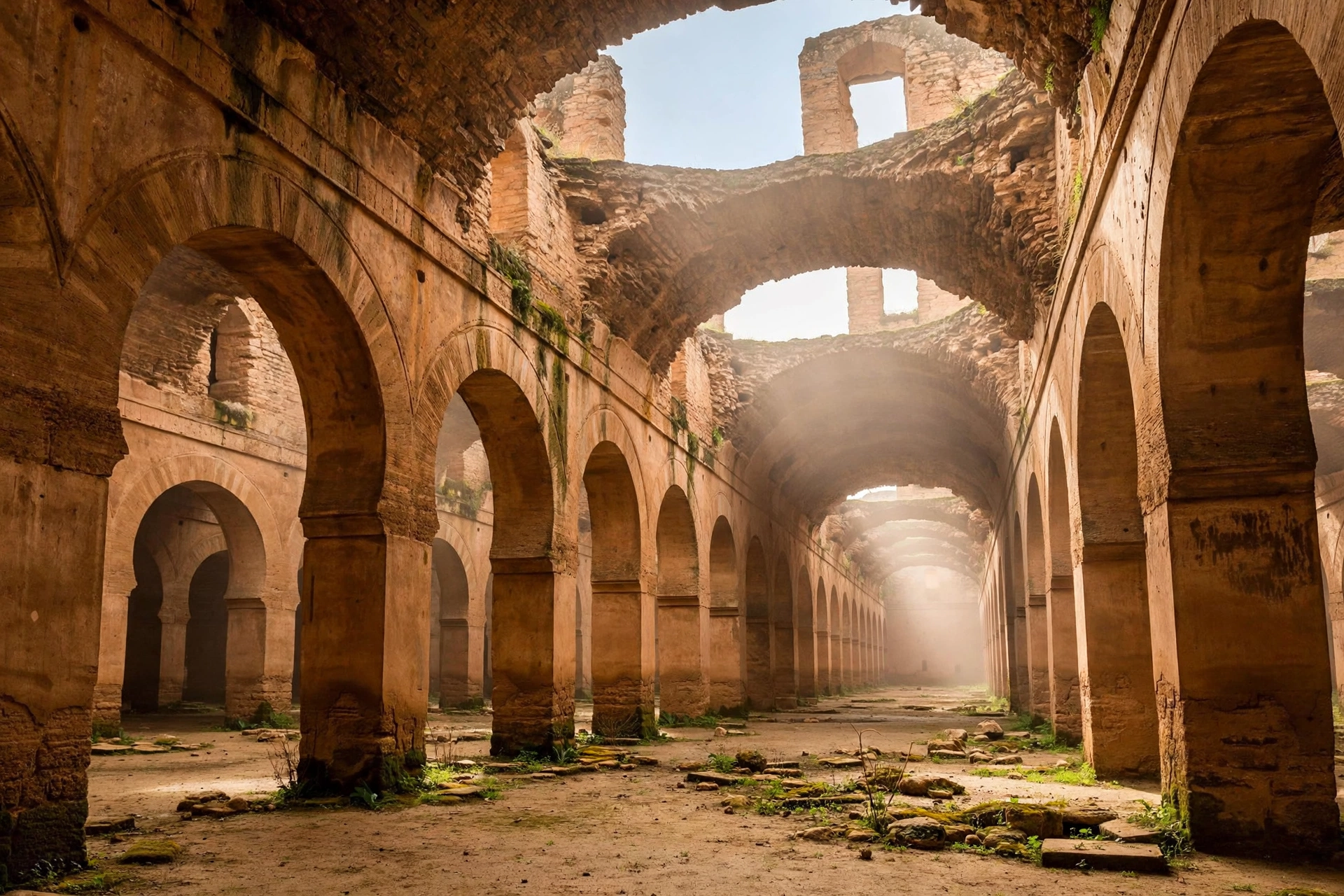
If Bab Mansour is the face of Moulay Ismail’s Meknes, Heri es-Souani is its engine room. Built in the early 18th century, it is a vast hall of vaulted chambers that served as both granary and royal stable. Ten naves of arches run in parallel, each lined with columns, and the scale of the moulay ismail meknes granaries still stuns first-time visitors: it was built to store enough grain to feed the city and the army for years, and to stable thousands of the sultan’s horses.
The Agdal Basin and the Royal Gardens
Next to the granaries lies the Agdal basin, a vast rectangular reservoir that stored water for the palace gardens and the royal stables. It covers about four hectares, and it is still one of the most peaceful places in Meknes. The moulay ismail meknes building programme was, at its core, a programme of logistics — the unglamorous work of feeding, watering and housing an empire. The Moulay Ismail article on Wikipedia gives a useful overview of the reign and its building works for readers who want the wider picture.
The Black Guard: Moulay Ismail’s Army
No institution of Moulay Ismail’s reign is more famous, or more misunderstood, than the Black Guard. Known in Arabic as the Abid al-Bukhari, the “Slaves of al-Bukhari”, the guard was a standing army of soldiers of sub-Saharan African origin, raised, trained and armed by the sultan himself. Its members swore an oath on the Sahih of al-Bukhari and owed their loyalty to the sultan alone. It was the first professional standing army in Moroccan history, and the instrument that made the moulay ismail meknes reign possible.
Here honesty requires a warning about the numbers. The figure most often quoted for the Black Guard is about 150,000 men, and you will find it in guidebooks and popular histories. That number is not reliably documented, and historians treat it with deep scepticism: the sources are late and inconsistent. What can be said with confidence is that the guard was large and the backbone of the sultan’s army, and that its true size remains unresolved. The moulay ismail meknes story is remarkable enough without inflated numbers.
The Human Cost
The soldiers were recruited, often forcibly, from enslaved people and their descendants brought across the Sahara, and their service was a form of military slavery. The sultan’s system offered them status, pay and a respected place in the army, but it was built on coercion, and the men who served in it had not chosen their fate. After the sultan’s death in 1727, the guard’s commanders became kingmakers, and their rivalries helped plunge Morocco into three decades of civil war.
Wars, Diplomacy and the Recapture of Tangier
Moulay Ismail’s reign was a reign of war, fought on three fronts. To the east, the Ottoman regency of Algiers backed rival claimants to the Moroccan throne. To the north, Spain held the presidios of Ceuta, Melilla and other coastal enclaves. And on the Atlantic coast, the English held Tangier. The sultan fought all of them, and the moulay ismail meknes wars lasted for more than fifty years.
On the coast, the sultan’s greatest triumph was Tangier. The English had held the city since 1661, and they had fortified it heavily. Moulay Ismail besieged it, and in 1684 the English evacuated the city and destroyed its harbour works as they left. The sultan rebuilt its defences and restored the city to Moroccan rule. To the east, he campaigned repeatedly against the Ottoman regency of Algiers, winning the battle of the Moulouya river in 1692 and keeping the Ottomans out of Morocco.
The Sultan and Europe
The sultan was also a diplomat. He exchanged embassies with Louis XIV of France, with whom he shared an admiration for grand building and absolute rule, and he negotiated with Spain and England over prisoners, trade and the coastal enclaves. European accounts of his court, written by ambassadors and freed captives, are some of the best sources we have for his reign — and some of the most hostile. The moulay ismail meknes court was, to European eyes, both magnificent and terrifying.
Moulay Ismail Meknes: The Sultan’s Death and His Mausoleum
Moulay Ismail died in Meknes in 1727, at the age of about 82, after a reign of 55 years — the longest in Moroccan history. He died in the moulay ismail meknes capital he had built and was buried in the city he had made. The succession was contested, and the decades that followed were among the most chaotic in Moroccan history, as his sons fought for the throne and the Black Guard’s commanders chose sides.
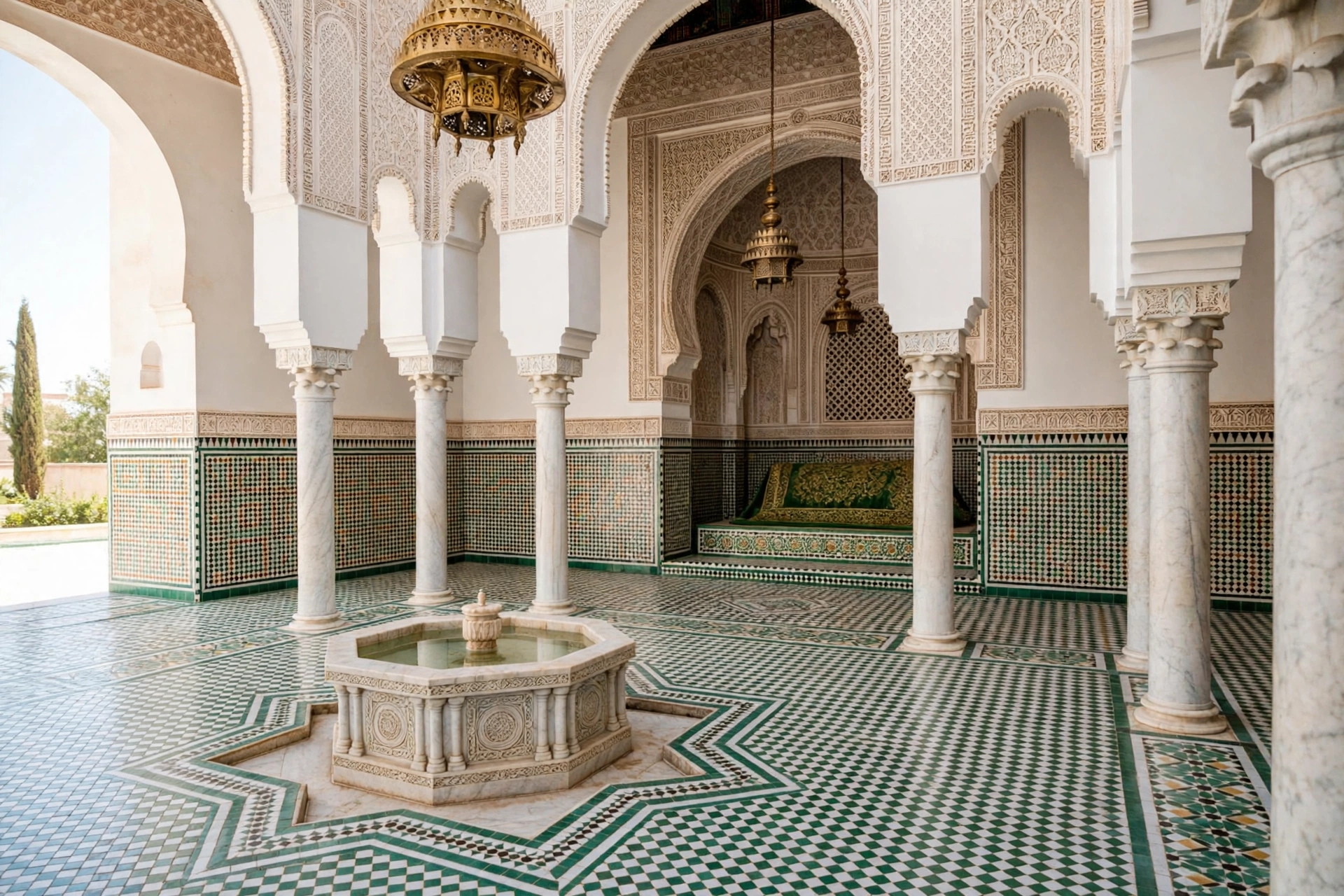
His tomb is one of the great sights of Meknes, and it is still a place of pilgrimage. The mausoleum stands in the old city, a quiet complex of courtyards, prayer halls and tiled chambers, and it is open to visitors of all faiths — one of the few royal tombs in Morocco where non-Muslims are welcome inside. The interior is a masterpiece of Moroccan craft: zellige tilework in green and white, carved plaster, painted cedar ceilings and a great brass chandelier. The tomb chamber itself, where the sultan lies, is a serene and beautiful room, and it is the fitting end to the moulay ismail meknes story.
The Legends: Wives, Children and the Numbers That Don’t Add Up
The most famous legends concern his family. Popular accounts credit the sultan with hundreds of wives and more than a thousand children, and the figures are repeated so often that they have become part of his popular image. They should be treated with caution. The often-cited counts of wives and children are not reliably documented: the sources are late, anecdotal and inconsistent, and no contemporary record supports the spectacular totals. The exact numbers remain unresolved, and the honest guide says so plainly rather than repeating a legend as fact. The moulay ismail meknes story needs no exaggeration: the 55-year reign, the recapture of Tangier and the building of an imperial capital are documented achievements enough.
The Reign in Dates: Timeline
The reign is easier to follow as a timeline, because the moulay ismail meknes story spans more than half a century of building, campaigning and diplomacy. The dates below are the ones historians generally accept; a few are approximate.
| Year | Event | Why it matters |
|---|---|---|
| 1645 | Moulay Ismail born at Sijilmasa | Born a younger son of Moulay Sharif, founder of the Alaouite fortunes |
| 1664 | Moulay Rashid takes power | Ismail’s elder brother unites much of Morocco under Alaouite rule |
| 1672 | Ismail proclaimed sultan | Seizes the treasury at Fez after Rashid’s death in a riding accident |
| 1672–1680 | Early campaigns | Subdues rebellious tribes and cities; secures the throne |
| 1684 | Recapture of Tangier | The English evacuate Tangier; the sultan restores it to Moroccan rule |
| 1692 | Battle of the Moulouya | Defeats an Ottoman-backed force; secures the eastern frontier |
| 1700s | Building of imperial Meknes | Bab Mansour, Heri es-Souani, the palace and the walls take shape |
| 1727 | Death of Moulay Ismail | Dies in Meknes aged about 82, after a 55-year reign; succession disputed |
| 1727–1757 | Civil war and decline | Sons fight for the throne; the court returns to Fez; Meknes declines |
| 1755 | Lisbon earthquake | Damages the palace and granaries; much of the imperial city is never rebuilt |
| 1996 | UNESCO inscription | The historic city of Meknes is inscribed on the World Heritage List |
Visiting Meknes Today: A Practical Guide
Meknes is one of Morocco’s most rewarding cities, and the moulay ismail meknes monuments are its heart. The city is smaller and quieter than Fez or Marrakech, and that is its charm: you can see the great sights of the imperial city in a single full day, and a second day gives you time for the medina, the markets and a trip to Volubilis. Start at Place el-Hedim, the great square, and work outward from there.
Begin at Bab Mansour in the morning, when the light is best and the crowds are thin. From the gate, walk through to the royal city and the mausoleum, which is open to all visitors and free to enter. Then head south to Heri es-Souani, the granaries and stables, and the Agdal basin beside them. The granaries are the single most impressive interior in the city, and they take about an hour to see properly. Finish the afternoon in the medina, which is smaller and easier to navigate than the medina of Fez, and eat in the square as the evening stalls open. For the full city guide, see our Meknes travel guide, and for more of Morocco’s past, browse the History & Heritage section.
Where to Stay and How Much It Costs
Meknes is one of the best-value imperial cities. A bed in a medina riad costs from about 300 MAD (about $30) a night, a comfortable mid-range hotel or riad runs 500 to 900 MAD (about $50 to $90), and a meal in a local restaurant costs 60 to 120 MAD (about $6 to $12). A grand taxi to Volubilis and back costs roughly 300 to 400 MAD (about $30 to $40) for the car. Prices checked: November 2026.
| Site or service | Where | What to see | Entry / price (Nov 2026) |
|---|---|---|---|
| Bab Mansour | Place el-Hedim | The great gate of the imperial city, green tiles and marble columns | Free to view from the square |
| Mausoleum of Moulay Ismail | Old city, near the palace | Tiled tomb chamber, courtyards and prayer halls | Free; donations welcome |
| Heri es-Souani | Imperial city, south | Vaulted granaries and royal stables | About 70 MAD (about $7) |
| Agdal basin | Imperial city, south | Vast reservoir beside the granaries | Free to view |
| Dar Jamai Museum | Place el-Hedim | Moroccan arts and crafts in a 19th-century palace | About 20 MAD (about $2) |
| ONCF train, Fez–Meknes | Fez Ville to Meknes | Direct train, about 40 minutes, second class | About 30–50 MAD (about $3–$5) |
| Grand taxi, Meknes–Volubilis | Meknes to Volubilis | Return trip to the Roman ruins, about 30 km | About 300–400 MAD (about $30–$40) |
| Licensed city guide | Meknes | Half-day guided walk of the imperial city and medina | About 200–350 MAD (about $20–$35) |
Moulay Ismail FAQ
Who was Moulay Ismail?
Moulay Ismail was the sultan of Morocco from 1672 to 1727, the longest-reigning sultan in the country’s history. A member of the Alaouite dynasty, he united Morocco, built the imperial capital of Meknes, created the Black Guard army, and recaptured Tangier from the English in 1684.
How long did Moulay Ismail rule?
He ruled for 55 years, from 1672 until his death in 1727. No other Moroccan sultan has ruled so long, and the length of his reign is one of the reasons his building programme was so extensive: he had half a century to reshape a city.
What did Moulay Ismail build in Meknes?
He built the imperial city: the royal palace complex, the walls and gates including Bab Mansour, the Heri es-Souani granaries and stables, the Agdal basin, mosques and gardens. The historic city of Meknes was inscribed by UNESCO on the World Heritage List in 1996, and its great monuments are the essential sights of any visit to the city today.
How big was the Black Guard?
This is genuinely unresolved. The figure most often quoted, about 150,000 men, is not reliably documented, and historians treat it with deep scepticism. What is documented is that the Abid al-Bukhari was a large professional standing army, the backbone of the sultan’s forces, and that its commanders became powerful kingmakers after his death.
Can I visit the mausoleum of Moulay Ismail?
Yes. The mausoleum in the old city of Meknes is open to visitors of all faiths, which is unusual for a royal tomb in Morocco, and entry is free. Dress modestly, keep your voice down, and visit in the morning for the quietest experience. The moulay ismail meknes mausoleum is one of the most beautiful interiors in the city.
How do I get to Meknes from Fez?
Take the train. ONCF runs direct trains from Fez Ville to Meknes in about 40 minutes, with a second-class ticket costing roughly 30 to 50 MAD (about $3 to $5), checked November 2026. From Rabat the train takes about two and a half hours, and from Casablanca about three and a half hours.
Conclusion
Moulay Ismail ruled Morocco for 55 years, longer than any sultan before or since, and he spent that half-century building a capital to match his ambition. The gates, granaries, stables and mausoleum of Meknes are his monument, and they survive because they were built on a scale that outlasted the dynasty, the earthquake and the centuries of neglect that followed. The moulay ismail meknes story is a story of ambition, of logistics and of war — and of a city that still carries one man’s signature in its walls.
Go and see it for yourself. Stand at Bab Mansour at golden hour, walk the vaulted halls of Heri es-Souani, and step quietly into the tiled chamber where the warrior sultan lies. The moulay ismail meknes experience is not a museum visit: it is a walk through the capital of a man who ruled for half a century and built for eternity.
Last checked: November 2026