
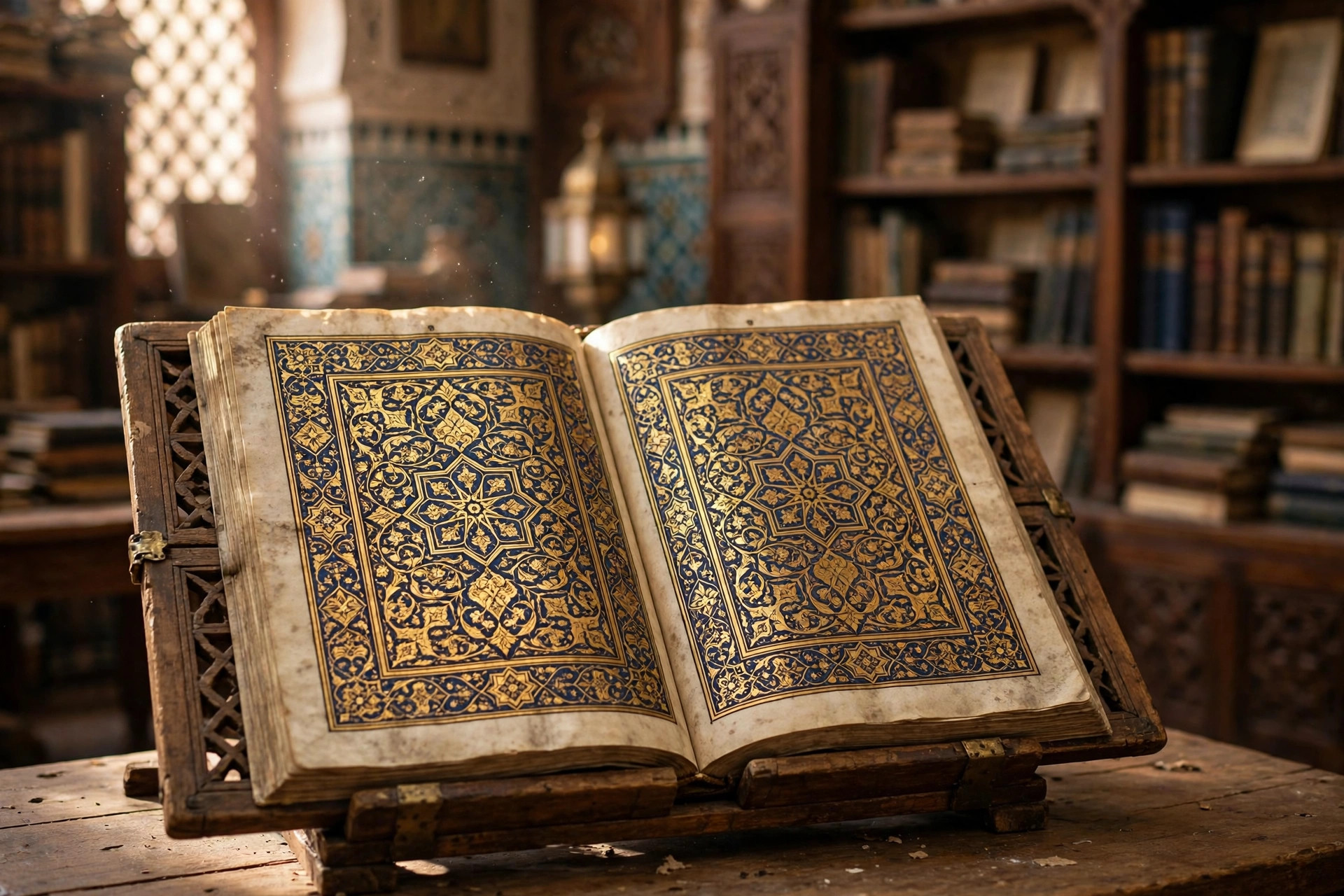
The history of Moroccan calligraphy begins with a pen, a reed cut to a point, and a Qur'an that had to be copied by hand. For more than a thousand years, Moroccan scribes wrote the holy text and their scholars' books in a hand of their own, rounded and sweeping, unlike eastern scripts.
This guide follows the history of Moroccan calligraphy from its Kufic roots to the Maghrebi script of today: the dynasties, the manuscripts of Fes, the inscriptions on mosques, and the calligraphers who still practise it.
In this guide
- The Short Answer: Moroccan Calligraphy in One Page
- The History of Moroccan Calligraphy at a Glance
- Kufic Roots: The First Scribes of Morocco
- The Andalusi Turn in the History of Moroccan Calligraphy
- How to Read Maghrebi Script: Letterforms and Marks
- Dynasties, Mosques and Madrasas: Calligraphy in Stone
- Manuscripts and Libraries: The Qur’ans of Fes
- Where to See Moroccan Calligraphy Today
- Revival: The History of Moroccan Calligraphy in the Modern Era
- Frequently Asked Questions
- Conclusion: Why the History of Moroccan Calligraphy Still Matters
The Short Answer: Moroccan Calligraphy in One Page
Moroccan calligraphy is the Maghrebi script, a family of rounded Arabic hands that grew in North Africa and al-Andalus from early Kufic. The history of Moroccan calligraphy is the story of how that angular eastern hand softened into deep curves, a pointed reed pen and dots and vowels all its own.
Its great works are Qur'an manuscripts copied in Fes, inscriptions on Almohad minarets and Marinid madrasas, and the printed Mushaf Muhammadi of 2010. The script never died: it is still written, taught and honoured with a national prize, and the history of Moroccan calligraphy is still being written by living hands.
The History of Moroccan Calligraphy at a Glance
| Period | What happened |
|---|---|
| 643–709 | Arabic script reaches the Maghreb with the Islamic conquests |
| 711 | Coins minted under Musa ibn Nusayr show Hijazi and Kufic hands |
| 788–974 | Idrisid Fes develops its own Kufic from Iraqi models |
| 9th–10th centuries | Round Maghrebi book hands take shape in al-Andalus and the Maghreb |
| 886–940 | Ibn Muqla of Baghdad sets out the proportioned script in the east |
| 1019–1020 | The Nurse's Qur'an is copied in Qayrawan |
| 1144 | Almoravid minbar given to the Qarawiyyin Mosque in Fes |
| 1147–1195 | Koutoubia Mosque and its minaret rise in Marrakech |
| 1244–1465 | Marinid Fes: madrasas covered in carved calligraphy |
| 1350–1355 | Bou Inania Madrasa built in Fes |
| 1564–1565 | Ben Youssef Madrasa rebuilt in Marrakech |
| 1865 | Lithographed books begin in Fes in Maghrebi script |
| 1949 | Five booklets teach Maghrebi script to a new generation |
| 2008 | Mohammed VI Prize for Maghrebi script founded |
| 2010 | Mushaf Muhammadi printed in Maghrebi script |
| 2021 | Arabic calligraphy inscribed on UNESCO's Intangible Heritage list |
Kufic Roots: The First Scribes of Morocco
Arabic writing arrived in Morocco with the Islamic conquests, between 643 and 709. The first scribes wrote in Hijazi and Kufic hands, angular scripts of straight strokes and right angles, and the history of Moroccan calligraphy starts with those early letters. Coins struck in 711 under Musa ibn Nusayr already show both hands in use.
Fes Under the Idrisids
Fes, the Idrisid capital, became Morocco's first great centre of writing. Under the Idrisid dynasty (788–974), the script of the far west developed on its own lines, from the Kufic of the Maghrawa and Bani Ifran, and it gained eastern features under Imam Idris I, who had come from Arabia. For the dynasty behind this early chapter, see our guide to the Idrisid dynasty.
The Idrisid dirham carries the evidence in metal. Its legends are written in Iraqi Kufic, plain and unembellished, and the history of Moroccan calligraphy can be read in miniature on those small coins. The hand of this period was a working hand, made for coins, contracts and Qur'an copies.
A Disputed Origin
Scholars disagree about exactly how the round Maghrebi hand was born, and this part of the history of Moroccan calligraphy is not settled. The older view, following the French scholar Octave Houdas, derives Maghrebi script directly from Kufic. A newer view, argued by Umberto Bongianino from more than two hundred dated manuscripts of the 10th to 12th centuries, holds that the round hand grew in the late 9th century from the plain book hands of al-Andalus.
Both views agree on the result: by the 11th century, the west had a script of its own.
The Andalusi Turn in the History of Moroccan Calligraphy
Two early schools shaped the western hand. The African script grew in Ifriqiya, in modern Tunisia, from Iraqi Kufic by way of Qayrawan, and it spread across the Maghreb first. The Andalusi script grew in Iberia from Damascene Kufic, under the Caliphate of Cordoba, and it was noted for its rounded letters. The history of Moroccan calligraphy owes its curves above all to this Andalusi school.
Under the Almoravids, the Andalusi hand crossed the strait and spread through the Maghreb; see our guide to the Almoravid dynasty. Cordoba's scribes set the standard that Fes and Marrakech followed for centuries.
The Qarawiyyin Minbar of 1144
The finest early witness to the new hand stands in Fes. In 1144, the Almoravids gave the Qarawiyyin Mosque a minbar, a pulpit, made in a Cordoba workshop from 1137. It carries a curved display script now called Maghrebi thuluth and was used in the mosque until 1962. Today it stands in the El Badi Palace in Marrakech, restored with the Metropolitan Museum of Art in 1996 and 1997.
How to Read Maghrebi Script: Letterforms and Marks
Set a Moroccan Qur'an beside an Egyptian one and the differences jump out. The history of Moroccan calligraphy is written in these small, consistent choices, and once you know them you can recognise a Maghrebi page anywhere. The bowls of the letters dive deep below the line and the spacing is wide.
The most famous mark is the dotting of two letters. In the east, fa carries one dot above and qaf two dots above. In traditional Maghrebi script the habit is different: fa carries a single dot below the letter, and qaf a single dot above. That single switch is the quickest test of a western manuscript.
The Pointed Pen
Eastern calligraphers wrote with a broad-edged reed, which gives thick and thin strokes. Moroccan scribes wrote with a pointed tip, the pointed pen, which gives a line of almost even thickness. Without the broad edge, the letters could not swell and taper, so they grew rounder and more even.
Vocalisation in the history of Moroccan calligraphy followed the old system of Abu al-Aswad al-Du'ali, who died in 688: short vowels as red dots, fatha above the line and kasra below it, with shadda written like a small w. Later manuscripts added fuller vowel marks and gold rosettes.
The Five Moroccan Hands
| Hand | Arabic name | Used for | Character |
|---|---|---|---|
| Mabsut | المبسوط | Qur'ans and book texts | Plain, round, even book hand |
| Mujawhar | المجوهر | Court decrees and letters | Quicker, joined, flowing |
| Maghrebi thuluth | الثلث المغربي | Titles, headings, walls | Loose display hand, often in gold |
| Musnad (zimami) | المسند | Notaries and contracts | Slanting, compact, documentary |
| Maghrebi Kufic | الكوفي المغربي | Ornament, coins, inscriptions | Angular, decorative, monumental |
Dynasties, Mosques and Madrasas: Calligraphy in Stone
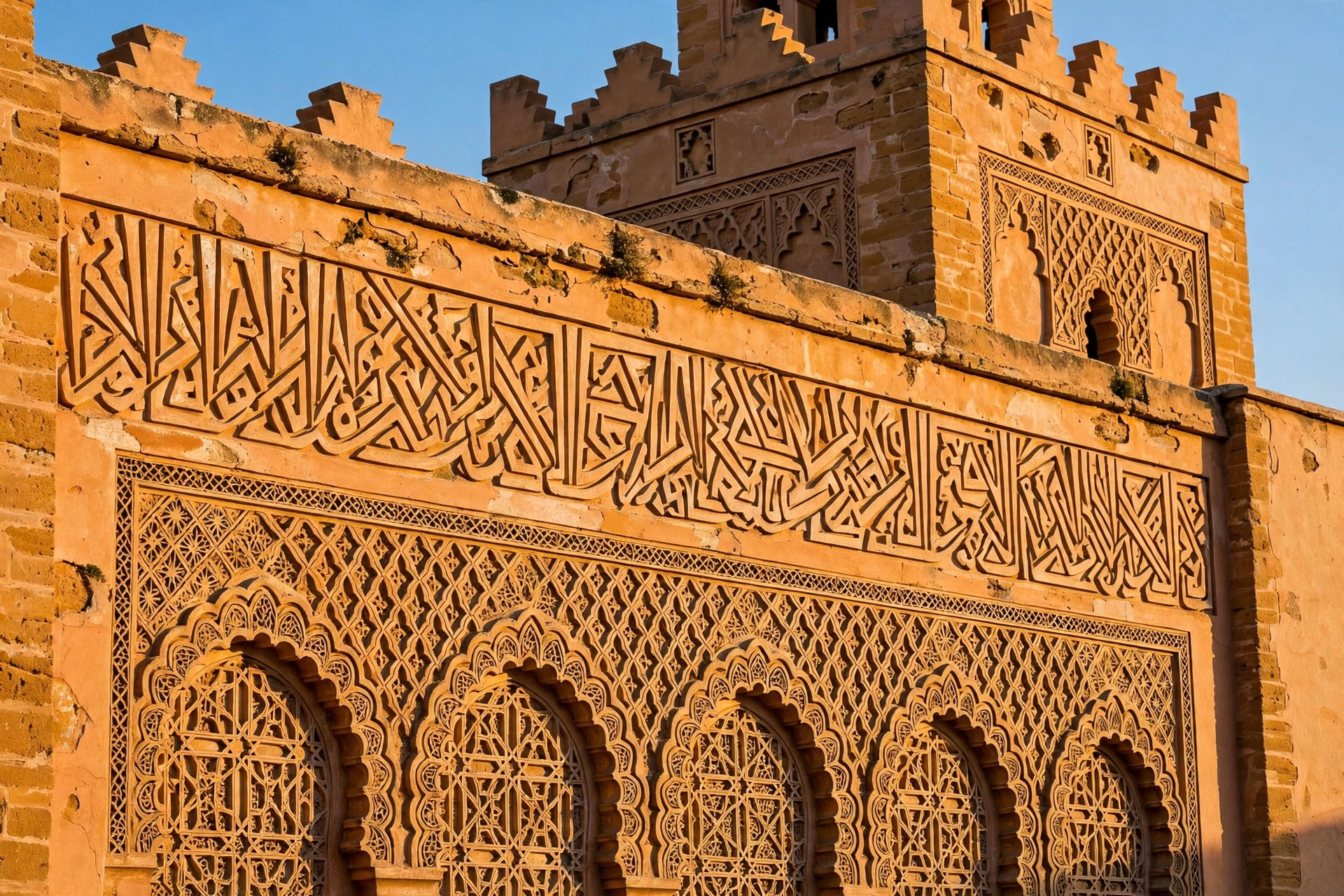
The Almohads made calligraphy a dynastic emblem. The history of Moroccan calligraphy moves from the page to the wall in the 12th century, written in gold on books, struck on coins and carved on the great mosques of Marrakech. Their style was severe: plain walls and letters bold enough to read from the ground.
The Koutoubia Mosque in Marrakech is the great example. Founded in 1147 by the Almohad caliph Abd al-Mu'min, it was rebuilt around 1158, and its minaret was possibly finished under Ya'qub al-Mansur around 1195. The 77-metre tower still carries traces of painted decoration, including medallions with stylised Kufic inscriptions reading "al-Mulku Lillah" (sovereignty belongs to God) and "al-'izzu Lillah" (glory belongs to God).
Tinmel and the Almohad Capitals
Tinmel, where the Almohad movement began, holds the dynasty's other great mosque, built in 1148. Its calligraphy is part of the same programme as the Koutoubia: short sacred phrases in Kufic, set where worshippers would see them. Our guide to Tinmel, the Almohad capital hidden in the Atlas tells the story of the place, and our history of the Almohad dynasty covers the rulers behind it.
Marinid Madrasas and Ben Youssef
Under the Marinids of Fes (1244–1465), the script took its settled form. Ibn Khaldun noted how much it owed to Andalusi scribes who had moved to the city. The Bou Inania Madrasa, built for Sultan Abu Inan Faris between 1350 and 1355, still carries its monumental calligraphy, and the history of Moroccan calligraphy is nowhere more public than on a Marinid facade. See our guide to the Marinids and the madrasas of Fes.
The tradition flowered at the Ben Youssef Madrasa in Marrakech, rebuilt in 1564–1565 by the Saadian sultan Abdallah al-Ghalib. Calligraphic friezes run around its courtyard walls at eye height, and a large Kufic inscription around the mihrab quotes the basmala and verses 36 and 37 of the Sura of Light. It held 130 rooms for up to 800 students, closed as a school in 1960, and reopened as a historic site in 1982.
Manuscripts and Libraries: The Qur'ans of Fes
The finest pages in the history of Moroccan calligraphy were written in Fes, and many remain there. The library of the Qarawiyyin, the university founded in 859 by Fatima al-Fihri, holds about four thousand manuscripts, among them a 9th-century Qur'an on leather in Kufic script, a copy of Ibn Khaldun's history signed by the author, and a 12th-century medical treatise by Ibn Tufayl found nowhere else.
The library building on Place Seffarine was first built under the Saadian sultan Ahmad al-Mansur in the late 16th century and reopened in 2016; the mosque beside it remains closed to non-Muslims.
A second treasure is in Rabat. The National Library holds two volumes of a multi-volume Qur'an of the 9th or 10th century, probably from Fes, in Maghrebi Kufic in brown ink on parchment. Its square pages and red-dot vowels show the western hand already mature, and the history of Moroccan calligraphy can be dated from pages like these. Its exact date is not settled: it rests on the style of the script, not on a colophon, and scholars place it by comparison with dated pieces.
Gold, Indigo and the Illuminator's Art
A Moroccan Qur'an was a work of two arts. The scribe wrote the text in black or brown ink, and the illuminator added gold rosettes between the verses, coloured medallions at every tenth verse, and painted headpieces at the opening of each sura. Gold and indigo were the favoured pair, and the finest pages glow still, like the gold of Moroccan jewellery and the blue of Moroccan pottery.
The most famous western Qur'an of all is the Blue Qur'an, written in gold and silver Kufic on indigo-dyed parchment, probably in Qayrawan in the 9th or 10th century. Its exact origin is also disputed, but its pages show the Kufic ancestor of the Maghrebi hands. An earlier masterpiece, the Nurse's Qur'an of 1019–1020, was given to the Great Mosque of Qayrawan by Fatima, nurse of the Zirid prince al-Mu'izz ibn Badis.
Where to See Moroccan Calligraphy Today
You need no library card to meet this script: it is written across the country, on walls, doors and coins. The history of Moroccan calligraphy is best learned on foot, standing in front of the work itself, and the table below gives the best places to start. Look first for the Kufic bands high on the walls, then the cursive friezes at eye level.
| Place | What to look for | Notes for visitors |
|---|---|---|
| Qarawiyyin Library, Fes | 9th-century Qur'an, 4,000 manuscripts | Library visits are limited; mosque closed to non-Muslims |
| Koutoubia Mosque, Marrakech | Kufic medallions on the 77 m minaret | View from outside; prayer hall closed to non-Muslims |
| Ben Youssef Madrasa, Marrakech | Qur'anic friezes, Kufic mihrab inscription | Open as a historic site since April 2022 |
| Bou Inania Madrasa, Fes | Marinid monumental inscriptions | In the medina, near the Qarawiyyin |
| Tinmel Mosque, Atlas | Almohad Kufic of 1148 | Mountain road from Marrakech |
| Hassan Tower, Rabat | Unfinished Almohad minaret | Open site beside the Mausoleum of Mohammed V |
| Kasbah of the Udayas, Rabat | Almohad gate inscriptions | See our guide to the Kasbah of the Udayas |
| El Badi Palace, Marrakech | Qarawiyyin minbar of 1144 | Displayed after restoration |
The Fes medina rewards a slow walk. The Fes travel guide plans the route, and the madrasas, fondouks and mosque doors along it carry centuries of lettering. For the wider story of the country, see our brief history of Morocco, and for the crafts that shared these walls, our histories of Moroccan carpets, the Moroccan caftan, Moroccan music and Moroccan mint tea.
Revival: The History of Moroccan Calligraphy in the Modern Era
Print nearly killed the hand, and then it saved it. Maghrebi script entered print in 1864, when Muhammad al-Tayyib al-Rudani brought lithography to Morocco, and from 1865 Fes lithographed its books in cursive mujawhar. The history of Moroccan calligraphy continued on the press as well as the page.
The French Protectorate was a crisis for the script, as Latin letters spread through the schools. In 1949, Muhammad ibn al-Husayn al-Susi and Antonio García Jaén published five teaching booklets, "Ta'lim al-khatt al-maghribi", to teach it to a new generation.
The revival is now official. In 2007, Muhammad al-Maghraoui and Omar Afa published a history of the script; in 2008, the Ministry of Islamic Affairs founded the Mohammed VI Prize for the art of Maghrebi script; and in 2010 the kingdom issued its own printed Qur'an, the Mushaf Muhammadi, in Maghrebi letters and the Warsh reading long established in Morocco. In 2021, Arabic calligraphy joined UNESCO's Representative List of the Intangible Cultural Heritage of Humanity.
Calligraphers at Work Today
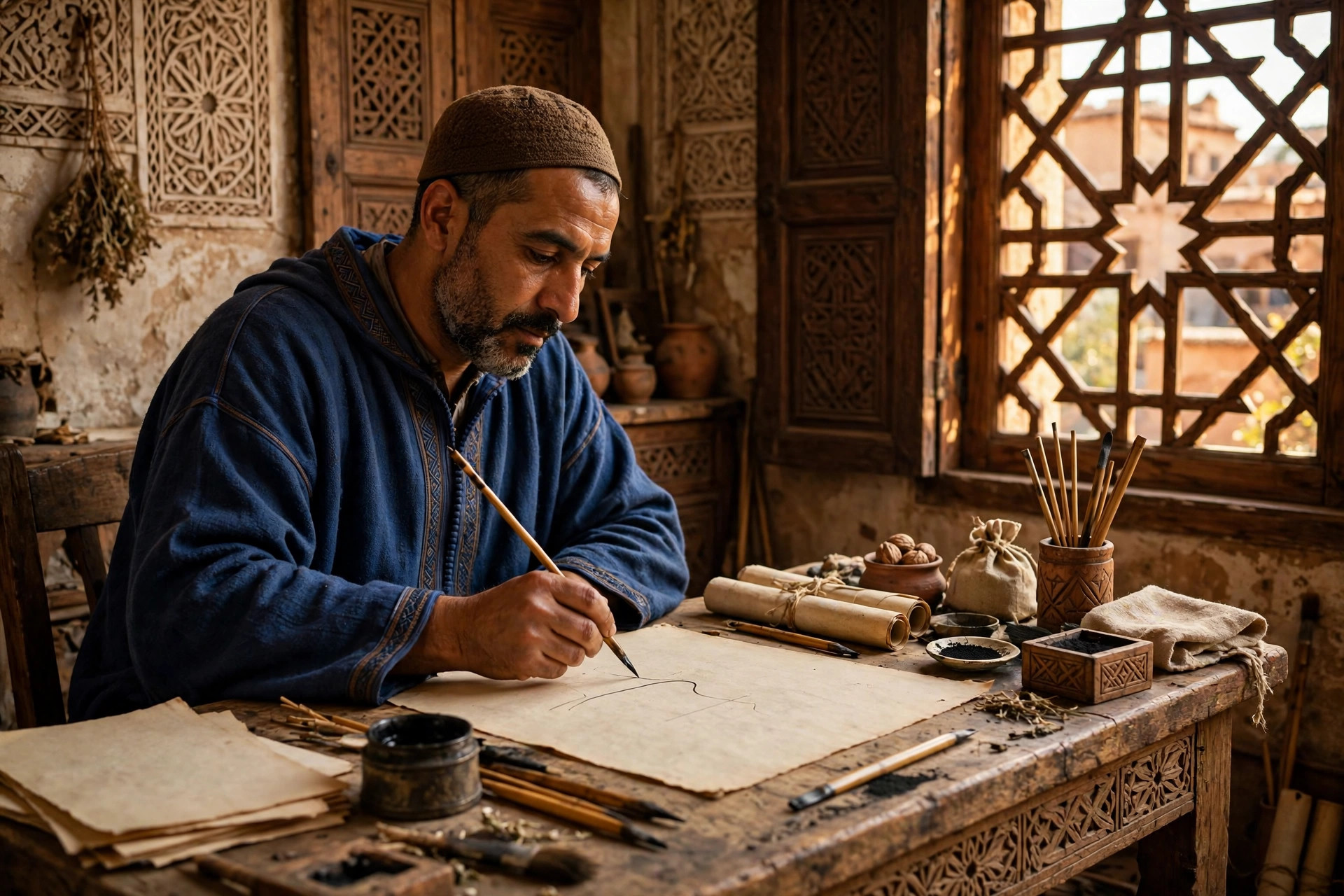
The craft lives in workshops as well as prizes. In Fez, Mohamed Serghini works daily in his studio, making inscriptions from Qur'anic verses to modern commissions. In the north, Mohamed Charqaoui runs a small workshop teaching calligraphy to children and young people, and in Rabat, Mohamed Meslouhi teaches small groups of five to ten students. The Sahrij School in the old city of Fes is one of two dedicated schools keeping it alive.
Contemporary artists carry the letters further. Moroccan calligraphy now appears in galleries in Marrakech and on streetwear in Casablanca. The script that once copied Qur'ans in Fes now appears at the 1-54 Contemporary African Art Fair, and the history of Moroccan calligraphy is a living art.
Frequently Asked Questions
What is Maghrebi script?
Maghrebi script is the family of Arabic hands that developed in North Africa, al-Andalus and the West African Sahel, directly derived from Kufic, and it is the heart of the history of Moroccan calligraphy. It is written with a pointed reed pen, has deep rounded bowls, and dots fa below and qaf above. For the full technical picture, see Wikipedia's article on Maghrebi script.
How is Maghrebi script different from Naskh?
Naskh, the eastern book hand, is compact and even, written with a broad-edged pen that gives thick and thin strokes. Maghrebi script is rounder and more open, written with a pointed pen, and its vowels and dots follow older western habits. The two hands descend from different branches of one Kufic ancestor.
Where can I see original Moroccan Qur'an manuscripts?
The Qarawiyyin Library in Fes holds about four thousand manuscripts, including a 9th-century Qur'an, but access is limited. The National Library in Rabat holds 9th- and 10th-century Qur'an volumes. Museums abroad display Moroccan pages to the public.
What is the Mushaf Muhammadi?
The Mushaf Muhammadi is Morocco's official printed Qur'an, issued in 2010 by the Mohammed VI Foundation for the Publication of the Holy Qur'an. It is written in Maghrebi script, follows the Warsh reading used across Morocco and West Africa, and carries Moroccan illumination. A million copies a year were later planned for mosques in Morocco, West Africa and abroad.
Did Ibn Muqla invent Moroccan calligraphy?
No. Ibn Muqla, the 10th-century vizier of Baghdad, set out the proportioned script and the six pens of the east, but Maghrebi script predates his reforms in the west. Moroccan scribes kept their own hand while the east standardised on his system. See Wikipedia's article on Arabic calligraphy for the wider tradition.
Can I learn Moroccan calligraphy as a visitor?
Yes. Small workshops in Fes and Rabat teach the script to beginners, and the Sahrij School in Fes is a centre. Short courses start with the pointed reed pen, the cutting of the qalam, and the mabsut letters.
Conclusion: Why the History of Moroccan Calligraphy Still Matters
A script is a country writing itself, and Morocco wrote itself in rounded letters. From the Kufic of the first conquerors to the minarets of the Almohads and the printed Mushaf of 2010, the letters carried the Qur'an, the law and the poetry of a civilisation.
If you visit Morocco, look up at the walls before you look at your map. The history of Moroccan calligraphy is written above the doors, around the courtyards and across the pages of Fes.
Last checked: November 2026
1 thought on “The History of Moroccan Calligraphy: From Kufic to Maghrebi Script”