
The history of Moroccan jewellery begins long before silver, with pierced shells strung on a cord in a cave near the Atlantic coast. It continues through Phoenician gold, Roman workshops, the silver fibulae of the Atlas, the gold of Fes, and the amber necklaces that crossed the Sahara. Jewellery in Morocco has never been decoration alone.
This guide follows the history of Moroccan jewellery from the oldest shell beads yet found anywhere to the silversmiths still hammering in Tiznit today: the peoples and faiths who made it and the materials that travelled far to reach it.
In this guide
- The Short Answer: Moroccan Jewellery in One Page
- Moroccan Jewellery at a Glance
- Prehistoric Adornment: Shells, Stone and Bone
- Phoenician and Roman Jewellery on the Moroccan Coast
- Amazigh Silver Traditions
- Islamic Goldsmithing and the Workshops of Fes
- Jewish Silversmiths of the Mellahs
- Amber and Coral: The Long Trade Routes
- Enamel, Niello and Granulation: How the Silver Was Worked
- The Khmissa and Protective Motifs
- Wedding and Dowry Jewellery
- Regional Styles Across Morocco
- Buying Moroccan Jewellery: Prices in 2026
- Where to See and Buy Moroccan Jewellery
- How to Spot Fakes
- Caring for Silver Jewellery
- Frequently Asked Questions
- Conclusion: Why Moroccan Jewellery Still Matters
The Short Answer: The History of Moroccan Jewellery in One Page
Moroccan jewellery is above all the silver jewellery of the Amazigh peoples of the mountains and the south: great triangular fibulae, heavy bracelets, necklaces of amber and coral, and head ornaments that announced a woman's village, her marital state and her family standing. The history of Moroccan jewellery is therefore a story of identity worn on the body, not only of ornament.
Two metals divide the story. Silver belonged to the countryside and to Amazigh women, who valued its white colour as a sign of purity and protection, while gold belonged to the cities, above all Fes, where Jewish goldsmiths worked filigree and set pearls, emeralds and rubies. Amber came from the Baltic and coral from the Mediterranean.
The History of Moroccan Jewellery at a Glance
| Era | What happened |
|---|---|
| At least 142,000 years ago | Perforated shell beads made at Bizmoune Cave, near Essaouira |
| About 82,000 years ago | Shell beads at Taforalt in eastern Morocco |
| First millennium BCE | Phoenician traders active on the Moroccan coast |
| Early Iron Age | Baltic amber buried in graves at Djebila and Ain Dalia Kebira |
| Roman period | Morocco as Mauretania Tingitana, with Roman workshops and gold chains |
| 7th century | Islam reaches Morocco, and silver and gold divide between country and city |
| 8th century | Sijilmassa founded as the northern port of the Sahara |
| 13th century | Hamsa amulet documented in al-Andalus |
| 1492 | Jews expelled from Spain settle in Fes and Tetouan |
| 18th–19th centuries | Gold finery of Fes and Tetouan at its height |
| 1881 or 1882 | Sultan Hassan the First founds walled Tiznit |
| 1934–1939 | Jean Besancenot photographs Moroccan dress and jewellery |
| Mid-20th century | Departure of most of Morocco's Jewish community, and workshops close |
| 2012 | About 150 silver shops and workshops counted in Tiznit |
| Today | Silversmiths still work in Tiznit, Taroudant and the Atlas |
Prehistoric Adornment: Shells, Stone and Bone
The history of Moroccan jewellery starts earlier than in almost any other country. In Bizmoune Cave, near Essaouira, archaeologists found 33 perforated shells of the sea snail Tritia gibbosula, dated to at least 142,000 years ago, making them the oldest shell beads yet recovered anywhere in the world. The shells were pierced and worn strung together as necklaces or pendants.
Scholars read these beads as the first messages people wore about themselves: a sign of group, of life stage, or of connection to distant people. For the wider story of the country behind the craft, see our brief history of Morocco.
Phoenician and Roman Jewellery on the Moroccan Coast
By the first millennium BCE, Phoenician traders were active along the Moroccan coast, and their jewellery came with them. The history of Moroccan jewellery enters the written record here, in gold earrings, glass beads and amulets buried with their owners on the Atlantic coast.
The most striking evidence comes from the Phoenician and Punic necropolises of Djebila and Ain Dalia Kebira near Tangier, where graves held silver rings with amber inlay and necklaces of amber beads. Recent laboratory tests identified some of those beads as Baltic amber, the oldest evidence of Baltic amber yet found in Africa.
Under Rome, Morocco became the province of Mauretania Tingitana, and Roman workshops added finger rings, bracelets, brooches and gold chains. Yet the fibula, the great dress pin, survived every change of ruler.
Amazigh Silver Traditions: The Heart of the History of Moroccan Jewellery
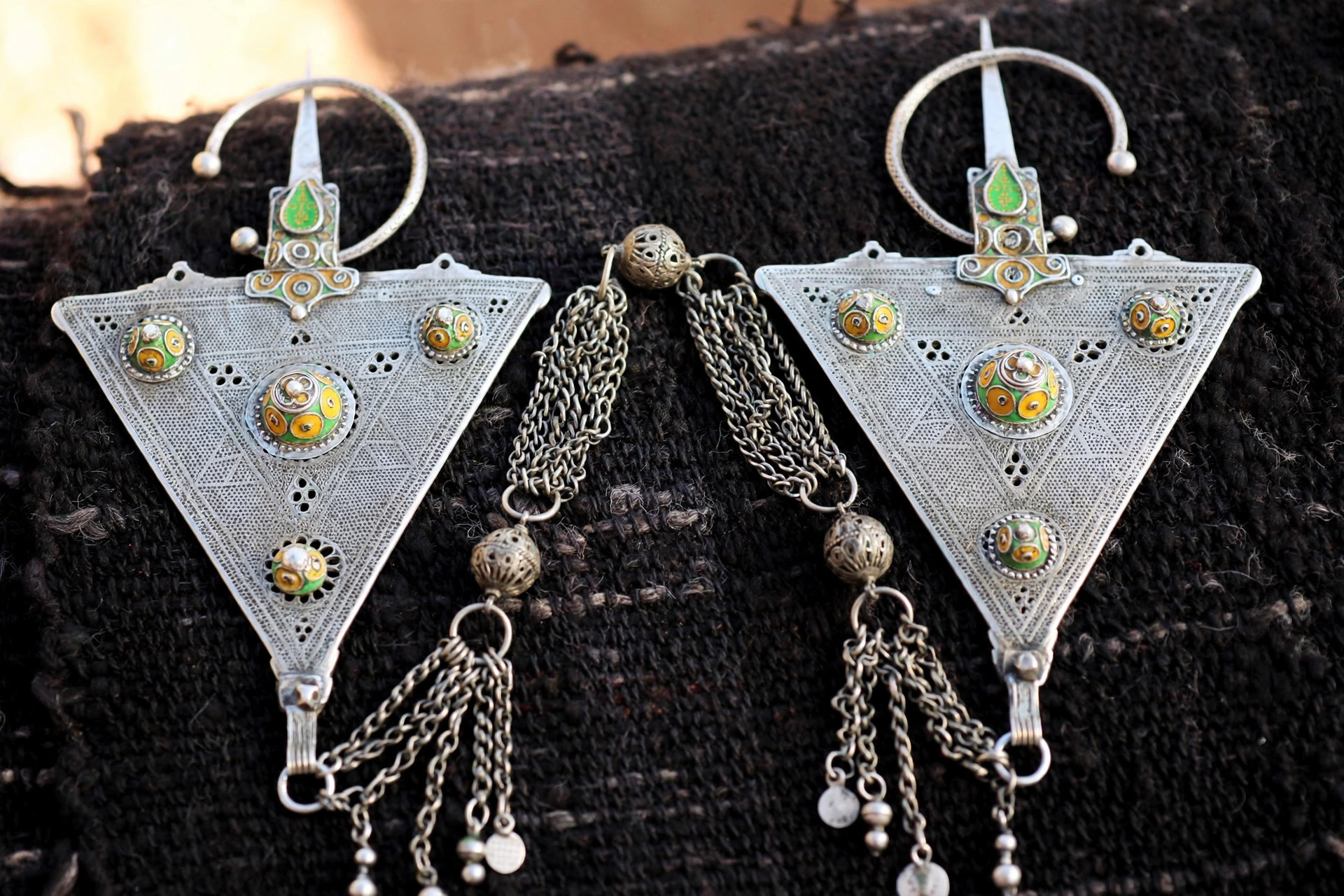
The great silver fibula, the tizerzai, is the emblem of Amazigh jewellery. Worn in pairs at the shoulders, two triangular plates joined by chains across the chest, it held a woman's draped garment in place and announced her home region at a glance. The history of Moroccan jewellery is written most clearly in these pieces, in their size, their enamel and their weight.
The finest enamelled silver came from the Anti-Atlas and the Souss valley, above all from Tiznit, the walled town founded by Sultan Hassan the First in 1881 or 1882 as a base for his campaigns in the south. Inside its walls, the jewellers' souk held about 150 shops and workshops when counted in 2012. See Wikipedia's page on Tiznit for the town itself.
Tiznit silver, a high point in the history of Moroccan jewellery, is recognised by its three colours: blue from copper oxide, green from chromium oxide and yellow from lead chromate, laid into cells of silver and fired. The Draa Valley and the High Atlas worked plainer, heavier silver, cast and engraved rather than enamelled, while the Ida Ou Semlal smiths of the Anti-Atlas powdered green and yellow glass beads from Bohemia and Murano to make their enamel.
Silver was also a savings account. In a world that often ran without banks, a woman's jewellery was the family portable wealth, to be sold piece by piece in hard times. Coins were melted for metal or worn whole on headdresses and necklaces.
Islamic Goldsmithing and the Workshops of Fes
Islam reached Morocco in the 7th century, and with it came a new division of metals that shaped the history of Moroccan jewellery for a thousand years. Texts of the Quran discouraged men from wearing gold, and selling worked metal above the price of its weight was treated as usury, so Muslim craftsmen largely left the precious metal trades to Jewish smiths.
Fes became the capital of urban gold. In its kissaria, the covered jewellers' market, goldsmiths drew fine wire into filigree, set pearls and coloured stones, and made the heavy earrings, diadems and necklaces of city weddings. The Marinid tombs above the city look down on a medina where the workshops still stand.
The arrival of Jews expelled from Spain in 1492 renewed the craft. Sephardi silversmiths and goldsmiths settled above all in Fes and Tetouan, bringing Andalusi techniques, and the two cities remained the principal centres of urban jewellery. The Almohad capital at Tinmel, hidden in the High Atlas, shows the same taste for geometry in stone.
Jewish Silversmiths of the Mellahs
For centuries, most of the precious metalwork in Morocco was made by Jewish craftsmen, and the history of Moroccan jewellery cannot be told without them. They worked in the mellahs, the Jewish quarters of the towns, in small premises that served as both workshop and shop, making finery for Jewish and Muslim clients alike.
The division of labour was practical as well as religious. In the southern Amazigh regions, Muslim jewellers also worked, above all around Tiznit and Tafraout, and the two communities worked side by side in villages such as Tahala.
The great departure of Morocco's Jewish community in the middle of the 20th century changed the craft for ever. Many workshops closed, and techniques that had lived only in the hands of masters came close to being lost. Much survives because apprentices learned the work. The gold diadems and ear ornaments of Fes and Tetouan, made in the late 18th and early 19th centuries, are now among the treasures of the Museum of Jewish Art and History in Paris.
Amber and Coral: The Long Trade Routes
No material in the history of Moroccan jewellery travelled further than amber. Baltic amber reached Morocco by the Early Iron Age, as the beads of Djebila prove, and later it came south across the Sahara with the caravans, passing through Sijilmassa, the great oasis market founded in the 8th century near present-day Rissani.
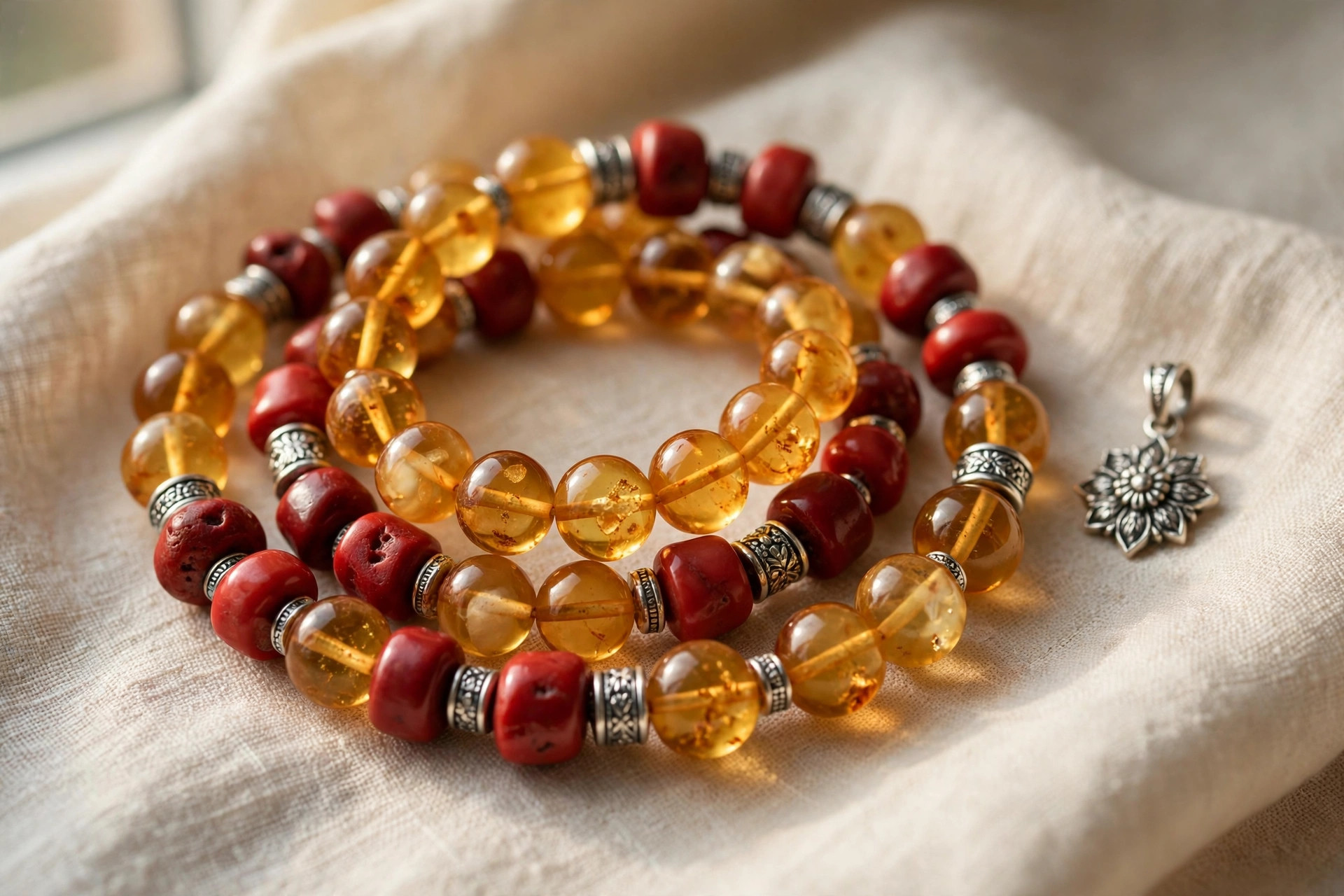
Amber was valued as medicine as well as ornament. People believed it drew out sickness, protected the throat, and kept its wearer safe, and its warm honey colour suited the silver it was strung with. Coral was its red partner, fished from the Mediterranean and prized as a sign of life and fertility, above all in the Anti-Atlas.
The trade ran in both directions. From the south came gold, salt, gum arabic and hides, and from the north came cloth, dates and jewellery, carried by caravans of hundreds or even thousands of camels. The necklaces of the Atlas still carry the map of that trade in their beads: Baltic amber, Mediterranean coral, Bohemian glass and Saharan silver in a single strand. For a stay on the Atlantic coast, see our guide to living in Safi.
Enamel, Niello and Granulation: How the Silver Was Worked
Enamel gave southern Moroccan silver its colour, and the history of Moroccan jewellery is inseparable from the technique. The smith soldered thin twisted wire onto the silver to form little walled cells, filled them with powdered coloured glass, and fired the piece until the glass melted into a smooth, jewel-like surface.
Niello was the dark partner of enamel. A black mixture of silver, copper, lead and sulphur was rubbed into engraved lines and fired, leaving crisp black patterns against polished silver. Granulation and filigree belonged above all to the goldsmiths of Fes and Tetouan.
Much of the silver itself began as coin. Smiths melted down Spanish reales, French francs and Maria Theresa thalers, so the silver content of old pieces varies widely and is often low.
The Khmissa and Protective Motifs
The khmissa, the open hand known in English as the hamsa or the Hand of Fatima, is the most recognised protective motif in the history of Moroccan jewellery. The palm-shaped amulet is believed to defend its wearer against the evil eye, and it is worn as a pendant, a bracelet charm and an earring, in silver for the countryside and in gold for the cities.
The hand is older than Islam in North Africa. Its earliest echoes appear in Carthaginian amulets, and its use is documented in al-Andalus from the 13th century onward. In Morocco it acquired the name khamsa, meaning five, and the popular link to Fatima, daughter of the Prophet Muhammad. The link to the Five Pillars came later, and the exact date of its first use in Morocco is not settled. For the wider story of the symbol, see Wikipedia's article on the hamsa.
Amazigh women made the motif their own in a distinctive form, the foulet khmissa, in which five fava bean shapes stand for the five fingers and signify fertility, abundance and good fortune.
Wedding and Dowry Jewellery
A Moroccan wedding was the great occasion for jewellery, and the history of Moroccan jewellery reaches its fullest expression in the bride's parure. A bride's set could include a diadem, heavy ear ornaments, fibulae, necklaces of amber and coral, bracelets and rings, worn for the first time on the wedding day and kept afterward as the married woman's ceremonial dress.
The jewellery was also a contract. A dowry in silver gave a bride security of her own, wealth she could carry and, if need arose, sell. Communities kept institutions that lent jewellery to modest families for weddings, so that no bride need appear without it.
The pieces were worn with the dress of each region, and the match mattered. A Tiznit bride pinned her draped cloth with enamelled fibulae and wore chains across her chest, while a bride of the High Atlas wore heavy cast bracelets and a headdress of coins. The caftan followed the same regional rules, and the music of Morocco played at those same weddings.
Regional Styles Across Morocco
No two valleys made the same silver, and the history of Moroccan jewellery is best read region by region. The table below gives the broad picture, but every village had its own hand, and the finest pieces are those that break the pattern in some small way.
| Region | Metal and colours | Signature pieces | Character |
|---|---|---|---|
| Tiznit | Silver, blue, green and yellow enamel | Enamelled tizerzai fibulae, bracelets | The silver capital, fine and bright |
| Taroudant | Silver, coral and amber | Necklaces, fibulae, bracelets | Souss valley work, warm and generous |
| Fes | Gold, filigree, pearls and coloured stones | Diadems, heavy earrings, necklaces | Urban, jewelled, Andalusi in taste |
| Marrakech | Silver and gold, enamel and coins | Fibulae, coin necklaces, bracelets | Market city, mixed styles |
| High Atlas | Heavy cast silver, engraved | Thick bracelets, fibulae, head ornaments | Bold, plain, massive |
| Rif | Silver, amber and coral | Fibulae, necklaces, bracelets | Northern work, heavy and bright |
| Sahara | Silver, large amber beads | Long amber necklaces, bracelets | Nomad trade silver, amber-led |
Buying Moroccan Jewellery: Prices in 2026
Prices for Moroccan silver jewellery are fair by international standards, and the table below gives typical fair prices for genuine handmade pieces in November 2026. The history of Moroccan jewellery has always been priced by weight and by work, and the same rule applies today: ask the weight in grams, ask the purity, and then judge the craftsmanship. At about 13 dirhams per gram for fine silver, a light bracelet holds about 200 dirhams of silver before work is counted.
Bargaining is expected in the souks, and a first price can be double the fair one. Old amber is the dearest material, and its price depends on the size, colour and age of the beads, so two necklaces that look alike can differ tenfold in price.
| Piece | Fair price in Morocco (MAD) | Approx. USD |
|---|---|---|
| Simple silver bracelet, light | 150–300 | $15–$30 |
| Enamelled Tiznit fibula, single | 300–800 | $30–$80 |
| Pair of enamelled fibulae with chain | 800–2,500 | $80–$250 |
| Amber bead necklace, medium beads | 500–2,000 | $50–$200 |
| Large old amber bead necklace | 2,000–8,000 | $200–$800 |
| Coral and silver necklace | 400–1,500 | $40–$150 |
| Silver khmissa pendant | 150–500 | $15–$50 |
| Gold filigree earrings, Fes | 1,500–6,000 | $150–$600 |
| Antique 19th-century fibula pair | 3,000–12,000 | $300–$1,200 |
Where to See and Buy Moroccan Jewellery
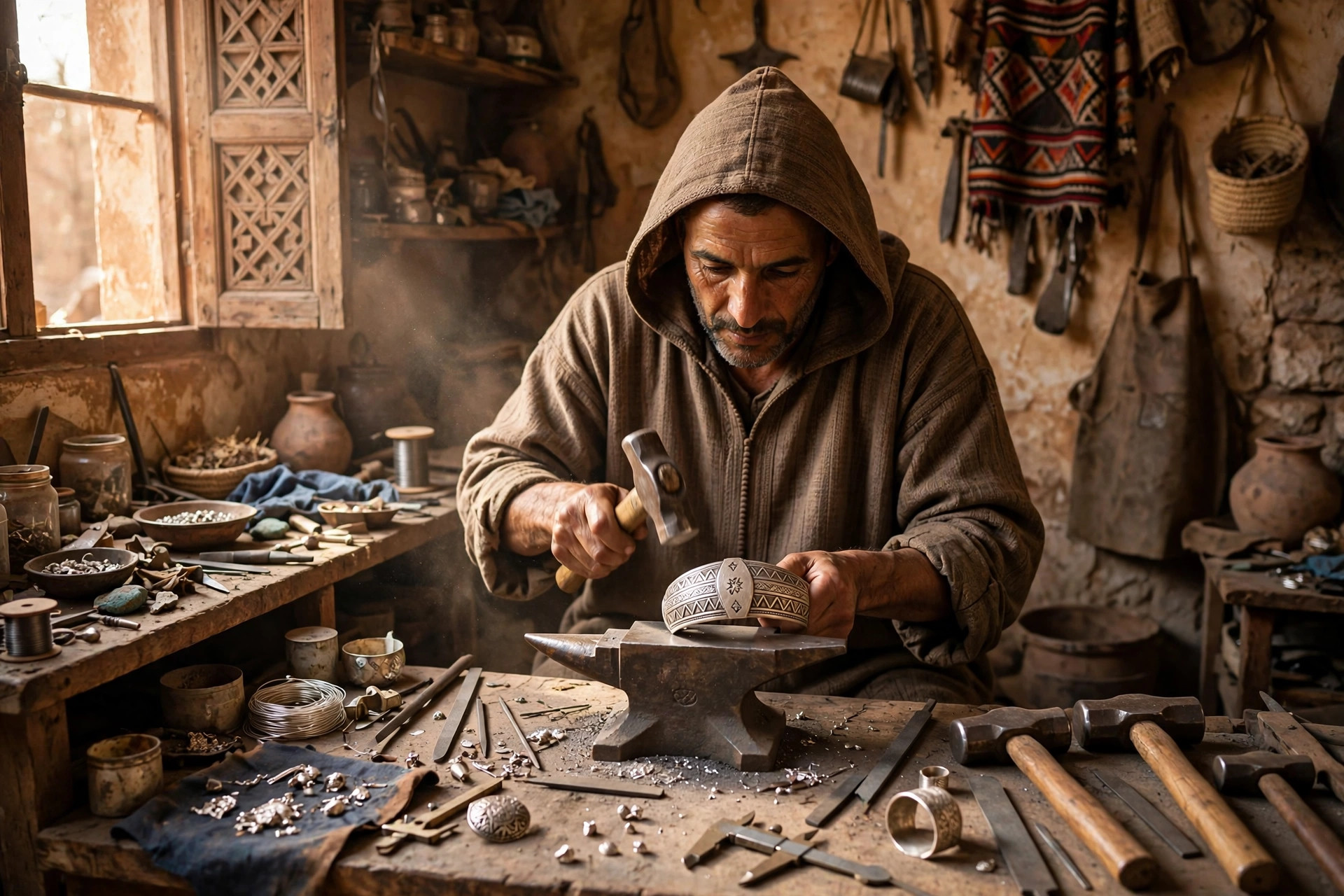
Tiznit is the best place to start, and the history of Moroccan jewellery is still a living trade there. Go to the jewellers' souk inside the walls, where about 150 shops and workshops sell silver, and buy from the bench where the piece was made. In Fes, the kissaria in the medina is the place for urban gold.
Museums are the best classrooms. The Metropolitan Museum of Art in New York holds fine Moroccan fibulae and ear ornaments from the 19th and 20th centuries. Browse our History & Heritage category — including the history of Moroccan carpets and the history of Moroccan pottery — and plan the trip around the workshops rather than the souvenir shops.
How to Spot Fakes
The commonest fakes are new pieces sold as old, and the history of Moroccan jewellery is full of pieces that look older than they are. Real wear is uneven: the high points shine and the hollows keep their patina.
Test the materials. Silver is soft enough to mark with a fingernail in a hidden spot, and a magnet should not stick to it. Real amber is warm to the touch, light for its size, and floats in salt water, while glass and plastic copies feel cold and heavy. A perfect surface on a supposedly 19th-century piece is a warning, not a reassurance.
Caring for Silver Jewellery
Silver tarnishes, and Moroccan silver tarnishes faster in damp air. Keep pieces in a dry place, wrapped in soft cloth or in separate pouches so that enamel is not scratched by neighbouring metal. A soft silver cloth restores the shine, and a mild soap wash with warm water is enough for most pieces.
Never dip enamelled or niello pieces in chemical silver dips, which can dull the enamel and blacken the niello unevenly. Amber needs still gentler care: warm water and a soft cloth only, kept away from perfumes, solvents and hard knocks.
Frequently Asked Questions
What is a tizerzai?
A tizerzai is the great triangular silver fibula worn by Amazigh women in pairs at the shoulders to hold a draped garment in place. The two pins are joined across the chest by chains, often with a large central ball.
Why is Moroccan jewellery mostly silver?
Silver was the metal of the countryside, valued for its white colour as a sign of purity and protection, while gold belonged to the cities. Religious rules on selling worked metal also left the trade largely to Jewish smiths.
Where does Moroccan amber come from?
The oldest Moroccan amber came from the Baltic, carried by Phoenician traders and later by Saharan caravans through Sijilmassa. Its warm honey colour and lightness made it prized for necklaces and as a protective material.
What is a khmissa?
A khmissa is an open hand amulet, also called the hamsa or Hand of Fatima, worn to protect against the evil eye. The hand predates Islam in North Africa, and its popular link to Fatima came later.
How much does Moroccan silver jewellery cost?
A simple handmade bracelet costs roughly 150 to 300 dirhams in Morocco in 2026, a single enamelled fibula 300 to 800 dirhams, and an amber necklace 500 to 2,000 dirhams or far more for large old beads.
Where is the best place to buy Moroccan jewellery?
Buy in Tiznit in the jewellers' souk, directly from the workshops, and in Fes in the kissaria for urban gold. Ask the weight and purity first, and bargain firmly in the souks.
Conclusion: Why the History of Moroccan Jewellery Still Matters
The history of Moroccan jewellery is not a museum story. It is a living craft, still hammered in Tiznit, still enamelled in the Anti-Atlas, still worn at weddings from the Rif to the Sahara. Each piece carries the metal of its place and the hand of its maker.
If you travel to Morocco, watch a silversmith at work before you buy. The piece you bring home will be more than a souvenir: a fragment of the history of Moroccan jewellery, begun with pierced shells more than a hundred thousand years ago and still being shaped today.
Last checked: November 2026