
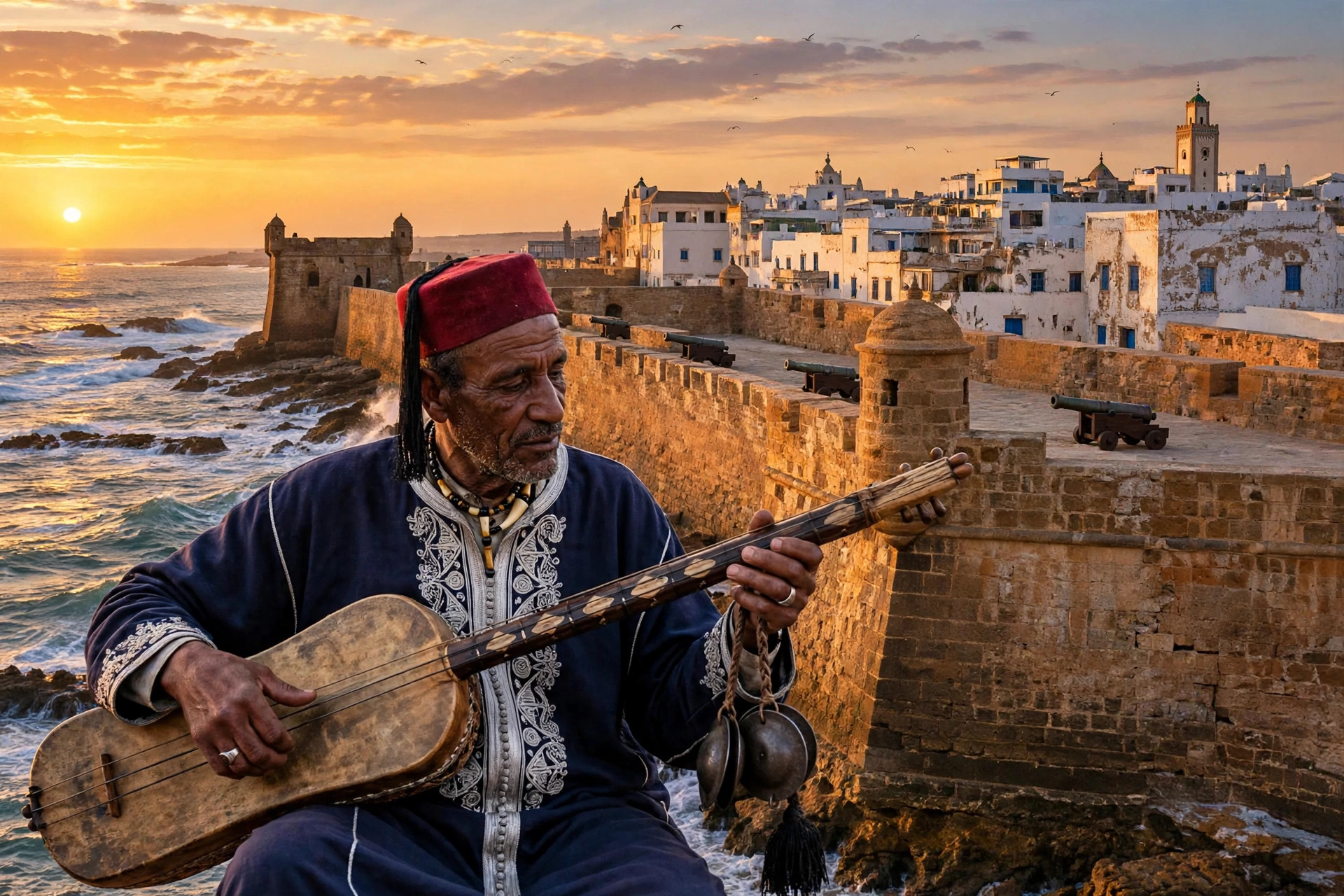
The history of Moroccan music begins before Morocco had a single capital, a single language or a single court. One evening in Marrakech, you can hear a Gnawa maalem bend a low note out of a three-stringed guembri while, a few streets away, an Andalusi orchestra tunes up for a suite composed eight centuries ago. Neither sound is a museum piece. Both are played every week, at weddings, in cafés and on public squares, by musicians who learned them by ear, sitting close to a master.
This guide follows the history of Moroccan music the way a traveller actually hears it: layer by layer. The oldest layer is the communal song of the Atlas and the Souss. Over it came the court music of Muslim Spain, the sung poetry of craftsmen, the trance music of West Africa, the street songs of the Atlantic plains and, finally, the pop and hip-hop of Casablanca. Each layer kept its own instruments and occasions, and that is why Morocco still sounds like several countries at once.
In this guide
- The Short Answer: The History of Moroccan Music in One Page
- The History of Moroccan Music at a Glance
- The Oldest Layer: Amazigh Music of the Atlas and the Souss
- Andalusi Classical Music: The Court of Granada in Exile
- Malhun: The Sung Poetry of the Craftsmen
- Gnawa: The Lila, the Guembri and the Road from West Africa
- Aita and Chaabi: The Voice of the People
- Reggada, Dakka Marrakchia and the Music of Celebration
- Hassani Music and the Guedra of the Sahara
- Rai, Nass El Ghiwane and the 1970s Revolution
- Hip-Hop and the New Sound of Casablanca
- The Instruments You Will Hear
- Where to Hear It: Festivals, Squares and Cafés
- How to Listen Well: Etiquette for Visitors
- Frequently Asked Questions
- Conclusion: Why the History of Moroccan Music Still Matters
The Short Answer: The History of Moroccan Music in One Page
The history of Moroccan music is the story of four currents meeting in one country. Amazigh communal song is the oldest, carried for centuries in the mountains. Andalusi classical music arrived with Muslim and Jewish families who left Spain after the fall of Granada in 1492, settling in Fes, Tetouan, Rabat and Oujda. Gnawa came north with West Africans from the 16th century onwards and became a healing ceremony, the all-night lila. Chaabi grew out of rural song and city weddings.
No single style ever replaced the others. A Moroccan wedding can move from an Andalusi suite at dinner to chaabi after midnight, and a festival in Essaouira can put a Gnawa master on stage with a jazz band. Think of the history of Moroccan music as a shelf of living traditions, each with its own instruments and masters, rather than a single timeline with one winner. More in our History & Heritage section.
The History of Moroccan Music at a Glance
| Tradition | Heartland | Sound in one line | UNESCO status |
|---|---|---|---|
| Amazigh ahidous and ahwash | Middle Atlas, High Atlas, Souss | Communal dance, call and response, frame drums | Living oral tradition |
| Andalusi al-Ala | Fes, Tetouan, Meknes, Rabat | Orchestral nuba suites, oud, violin, qanun | National heritage |
| Gharnati | Rabat, Salé, Oujda | Lyrical Grenadan style, chorus and improvisation | Shared Maghrebi heritage |
| Malhun | Fes, Meknes, Marrakech | Sung dialectal poetry, rebab and oud | UNESCO 2023 |
| Gnawa | Essaouira, Marrakech, Khamlia | Guembri bass, iron qraqeb, trance chant | UNESCO 2019 |
| Aita and chaabi | Atlantic plains, then everywhere | Loud, percussive, made for dancing | Living popular tradition |
| Reggada | Beni Snassen, Oujda, Berkane | Fast bendir rhythms, group dance | Living folk tradition |
| Hassani and guedra | Sahara, Dakhla, Laayoune | Desert chant, handclaps, dance | Living oral tradition |
The Oldest Layer: Amazigh Music of the Atlas and the Souss
Long before any court orchestra reached Morocco, the Amazigh communities of the mountains sang together. Ahidous in the Middle Atlas and ahwash in the Souss are not performances for an audience. They are communal events in which men and women form lines or circles, clapping and stamping in rhythm, answering a lead singer with a chorus. The bendir frame drum sets the pulse, and the poetry — about harvests, weddings and village news — is passed on without writing.
The wandering rways, poet-singers of the Souss, carried news and satire from village to village. Their songs were the newspaper and the court of public opinion at once. This layer matters because it never disappeared: ahwash still closes weddings in the Souss, ahidous still marks the moussem festivals of the Middle Atlas, and the rhythms of both feed directly into modern Moroccan pop — the oldest thread in the history of Moroccan music.
Andalusi Classical Music: The Court of Granada in Exile
Andalusi classical music, called al-Ala in Morocco, is the most formal tradition in the country. It grew out of the music of al-Andalus, Muslim Iberia, between the 9th and 15th centuries, and it reached Morocco with the families who crossed the strait — above all after the fall of Granada in 1492. Fes, Tetouan, Meknes and Rabat became its conservatories, and the tradition survived there in a form that is in some ways older than anything still performed in modern Spain — one of the oldest survivals in the history of Moroccan music. See our guide to the imperial cities and our history of Morocco for the cities that sheltered it.
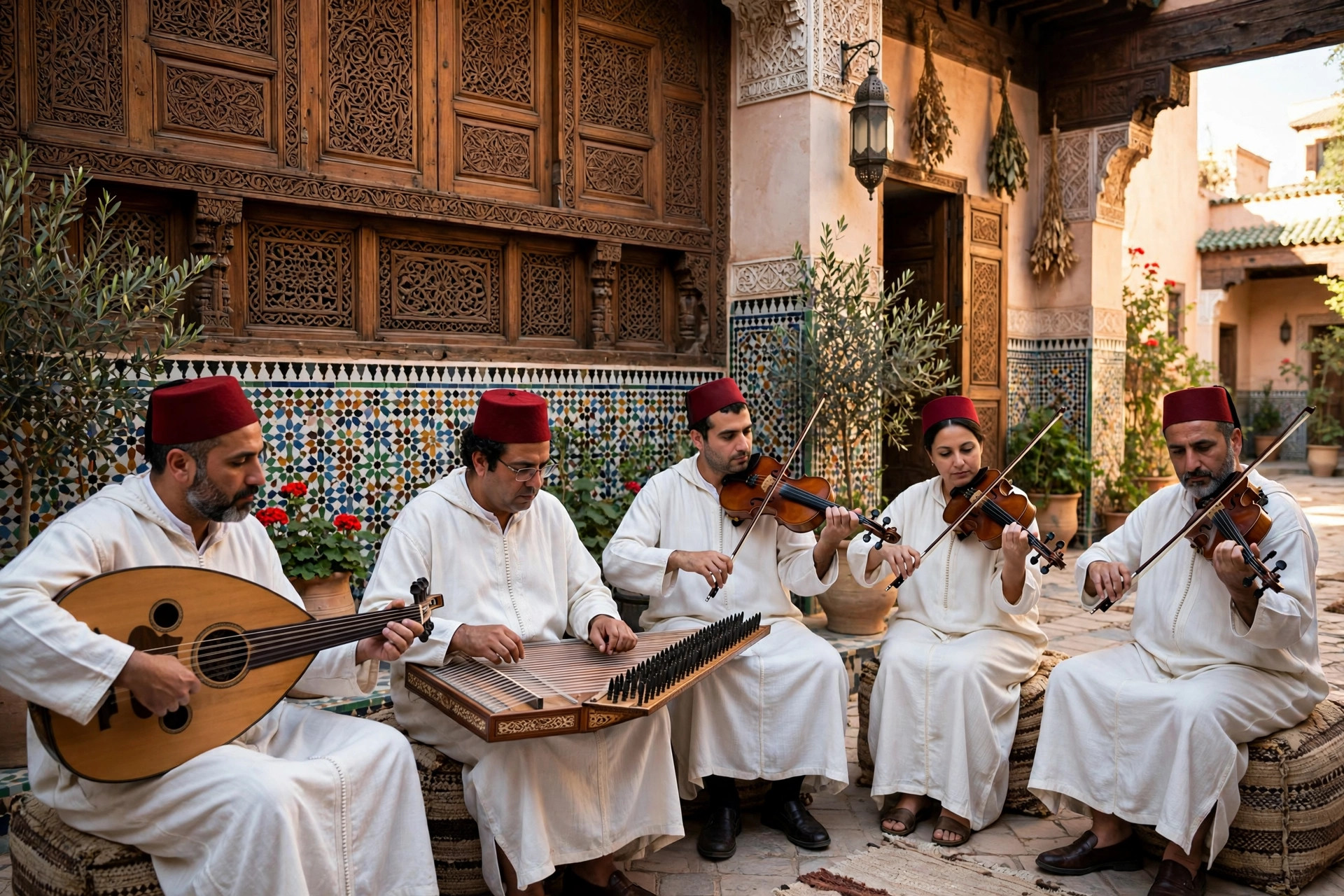
The heart of the tradition is the nuba, a long suite in one melodic mode, lasting for hours. Eleven nubat survive of twenty-four traditionally counted. An orchestra gathers oud, qanun, violin, rebab and percussion, singers in white djellabas and red fezzes. The music is slow to unfold, sung to poetry by Andalusian poets — which is why an evening of al-Ala feels closer to a classical concert than to a party, and why this court tradition anchors the history of Moroccan music.
One famous origin story deserves a caution. Andalusi music is often credited to Ziryab, a freed musician at the court of Córdoba in the early 9th century, said to have added a fifth string to the oud and founded a conservatory. The story is famous, but the details are not settled: historians debate how much of the later tradition can really be traced to one man. What is certain is that the courts of Córdoba, Seville and Granada refined it over centuries before its exiled musicians carried it to Morocco.
A sister style, gharnati — "of Granada" — took root in Rabat, Salé and Oujda: the same roots as al-Ala, but more lyrical, with more chorus and improvisation. Both styles are still taught in conservatories and played at weddings and concert halls; see the Wikipedia article on Andalusi classical music.
Malhun: The Sung Poetry of the Craftsmen
Malhun is the cousin of Andalusi music that chose the workshop over the court. It emerged from the artisan guilds of Fes and Meknes, traditionally dated to the 12th century, setting dialectal Arabic poetry to Andalusian melodies. The singers were craftsmen — weavers, tanners, metalworkers — and their songs carried love, satire and social commentary in everyday language.
The rebab, a bowed lute with a small skin soundboard, is the voice of malhun, supported by oud and percussion. In 2023 UNESCO added malhun to its Intangible Cultural Heritage list, recognising a tradition that survived for centuries without a court or conservatory behind it. Today you can hear it in Fes and Meknes at festivals and in old medina cafés, where the audience knows the refrains — a craftsman's chapter in the history of Moroccan music.
Gnawa: The Lila, the Guembri and the Road from West Africa
Gnawa is the tradition most visitors remember, and the most misunderstood. It began with West Africans brought across the Sahara from the 16th century onwards — from present-day Mali, Senegal and Guinea — who fused the rhythms of their homelands with North African Sufism, and so a new chapter in the history of Moroccan music began. Over centuries of the trans-Saharan trade, their descendants built a spiritual practice in which music heals: the lila, an all-night ceremony of song, dance and incense.
The sound is unmistakable. The guembri, a three-stringed bass lute covered in camel skin, plays a deep, repeating line. Against it clatter the qraqeb, large iron castanets, and the tbel, a big double-headed drum. The maalem, the master musician, leads the chant, and the ceremony builds slowly until dancers fall into trance. A genuine lila is a healing ritual, not a show, and visitors attend as guests, not as an audience.
In 2019 UNESCO inscribed Gnawa as Intangible Cultural Heritage of Humanity. The Gnaoua and World Music Festival in Essaouira — founded in 1998 — was already one of the most famous world-music festivals on earth, putting Gnawa masters on stage with jazz, blues and African artists in fusion concerts running until dawn. The history of Moroccan music changed permanently when Gnawa stepped out of the lila and onto the world stage: a ceremony of memory became Morocco's best-known sound abroad.
Aita and Chaabi: The Voice of the People
If Andalusi music belongs to the court, aita and chaabi belong to the street. Aita — the name means a call or a lament — is the rural sung style of the Atlantic plains: Doukkala, Abda, Chaouia and Rehamna. Traditionally sung by women, the shikhat, with violin, oud and heavy percussion, aita carried the news and desires of the countryside in a raw, direct voice.
Chaabi, literally "popular", grew out of aita and other folk forms and became the music of weddings, moussems, cafés and family gatherings across the whole country. A chaabi orchestra — synthesiser, electric oud, percussion and a lead singer — plays loud and fast, because its job is to get a room dancing. The style exploded in the 1970s to 1990s, mixing Moroccan folk rhythms with Egyptian and Algerian pop, and it has never left the wedding hall since — the loudest chapter in the history of Moroccan music.
Reggada, Dakka Marrakchia and the Music of Celebration
Every region has a dance music of its own, and two of the loudest come from opposite ends of the country. Reggada comes from the Beni Snassen region around Oujda and Berkane. Dancers in white move to fast bendir rhythms while the group chants in chorus — the sound of the eastern borderlands, still the first choice for weddings there.
Dakka Marrakchia belongs to Marrakech, heard in Jemaa el-Fna square most evenings. Groups of drummers play long, rolling rhythms while dancers spin and clap, and the crowd closes in to watch. The square itself was inscribed by UNESCO as a masterpiece of oral heritage, and its musicians are part of the reason why. Together, reggada and dakka show the side of the history of Moroccan music that is not about courts or ceremonies at all: music as a public party, played in the open air.
Hassani Music and the Guedra of the Sahara
South of the Atlas, the music changes with the landscape. Hassani music is the tradition of the Saharan provinces, sung in the Hassaniya dialect: chant, handclaps and a drum, sometimes a tidinit lute. The guedra is its most famous dance — a woman kneels, covered in indigo, moving only her hands and shoulders as the group sings. In Khamlia, near Merzouga, Gnawa and Hassani traditions meet at a desert camp. Here the history of Moroccan music runs all the way to the sand, and it sounds nothing like the orchestra in Fes — which is exactly the point.
Rai, Nass El Ghiwane and the 1970s Revolution
The 1970s remade Moroccan popular music. Rai, the cross-border genre shared with Algeria, brought a new voice about love, migration and city life, sung in dialect over accordion and synthesiser. At the same time, Nass El Ghiwane and Jil Jilala turned folk rhythms, Gnawa bass lines and aita melodies into modern songs with electric instruments.
Nass El Ghiwane, formed in Casablanca in 1971, became icons: their songs were poetry set to banjo and guembri. They sang about unemployment, exile and the price of bread in a way no newspaper could. This was the moment the history of Moroccan music stopped being only a story of old traditions and became a story of protest, identity and the modern city — and those groups are still covered and sampled by younger artists today.
Hip-Hop and the New Sound of Casablanca
The newest layer is the fastest. Casablanca's hip-hop scene grew from the 2000s into one of the most streamed sounds in the Arab world, rappers switching between Darija, French and English over trap beats. L'Boulevard festival in Casablanca, running since 1999, gave the scene a stage, and social media gave it an audience far beyond Morocco.
The interesting thing is how little the new sound broke with the old. Rappers sample chaabi hooks, Gnawa bass lines and ahidous rhythms, filming in the medinas and housing blocks their parents grew up in. The history of Moroccan music did not end with the traditions above — it absorbed them into a new language, and a teenager in Casablanca today can quote Nass El Ghiwane and a trap chorus in the same breath.
The Instruments You Will Hear
Every tradition in the history of Moroccan music has a signature sound; the instruments below are the quickest way to tell them apart.
| Instrument | What it is | Where you hear it |
|---|---|---|
| Guembri (gimbri) | Three-string bass lute, camel-skin body | Gnawa lila and festival stages |
| Qraqeb | Large iron castanets, played in pairs | Gnawa |
| Tbel | Large double-headed drum | Gnawa, folk celebrations |
| Bendir | Round frame drum with snares | Amazigh music, reggada, chaabi |
| Oud | Short-necked lute, the prince of Arab instruments | Andalusi, malhun, chaabi |
| Qanun | Trapezoid zither, plucked with picks | Andalusi orchestras |
| Rebab | Small bowed lute with a skin soundboard | Malhun, Andalusi, rways songs |
| Violin | Western violin, played upright on the knee | Andalusi, aita, chaabi |
| Tarija and darbouka | Goblet drums, clay or metal | Chaabi, aita, celebrations |
| Tidinit | Four-string lute of the Sahara | Hassani music |
Where to Hear It: Festivals, Squares and Cafés
You do not need a ticket to hear most of Moroccan music: the best listening is free, in a square or a café, and the festivals below are the exceptions worth planning a trip around.
| Place or event | Where | When | Entry |
|---|---|---|---|
| Gnaoua and World Music Festival | Essaouira | 25–27 June 2026 (27th edition) | Most stages free; main stage ticketed via festival-gnaoua.net |
| Jemaa el-Fna square | Marrakech | Every evening, all year | Free |
| Fes Festival of World Sacred Music | Fes | Every June, dates confirmed in spring | Ticketed concerts; some free events |
| Timitar Festival | Agadir | Every July, dates confirmed in spring | Mostly free open-air stages |
| Andalusi evening in a medina café | Fes, Tetouan, Rabat | Weekends, all year | Free; a glass of tea costs about 7–15 MAD (about $0.70–$1.50) |
| Desert camp evening | Merzouga, Khamlia | All year, booked with a camp | Included in the camp stay |
The Gnaoua Festival deserves planning: the 2026 edition runs 25–27 June with more than 400 artists, including 42 maalems, and small Essaouira fills up, so book months ahead. For the rest, follow the drums: in Marrakech the music finds you in the square; in Fes, in a café where an old man tunes an oud at dusk. A short history of Moroccan music is best learned this way, one evening at a time.
How to Listen Well: Etiquette for Visitors
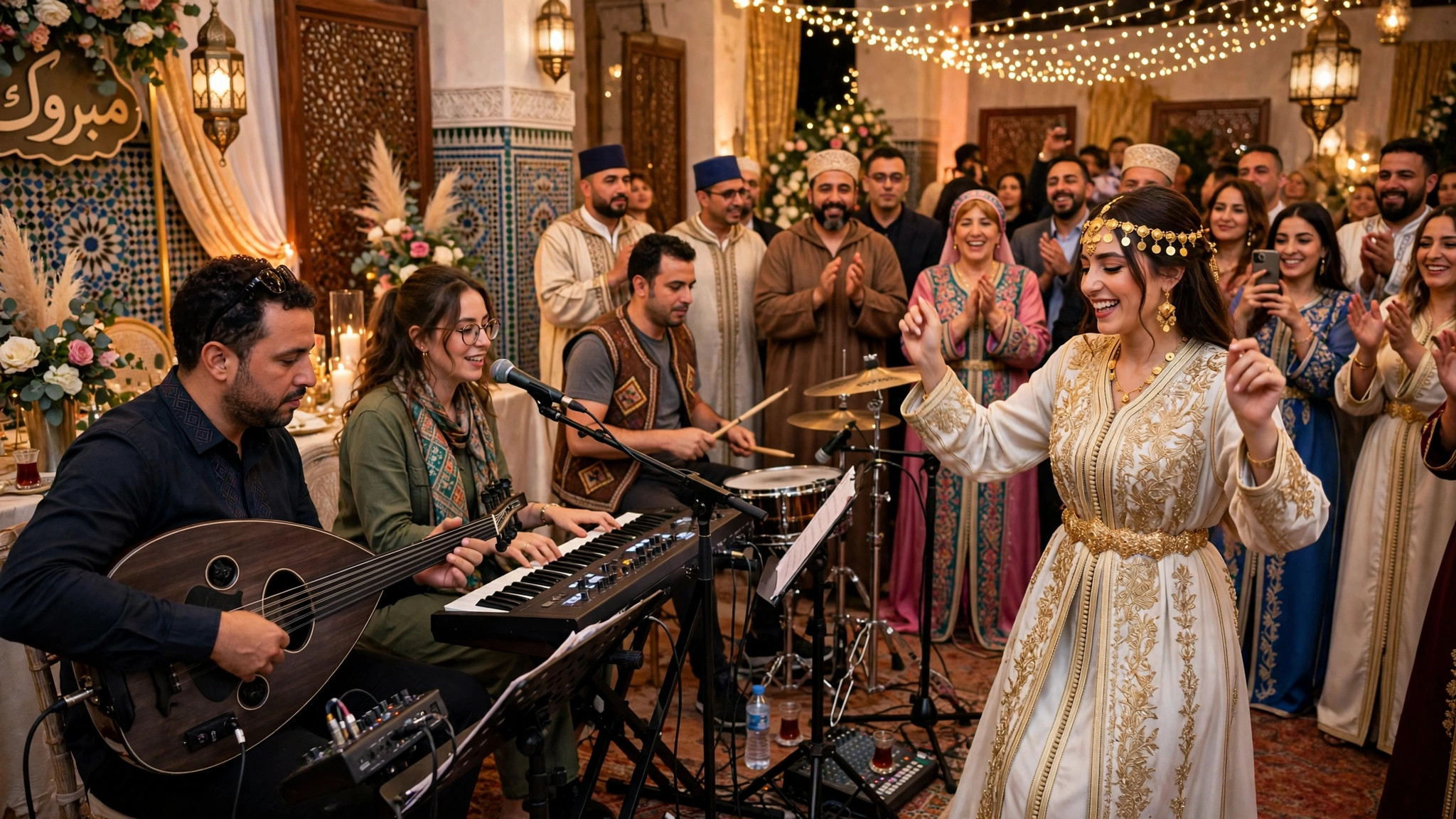
Moroccan music has rules of respect, and visitors who follow them are welcomed. At a lila, remember you are a guest at a healing ceremony: sit where you are placed, do not photograph faces without asking, and never touch the guembri or step into the dancers' circle. At an Andalusi concert, the audience listens in silence and applauds between movements, not during them. At a wedding, the opposite applies: clapping, ululating and dancing are expected.
Money matters too: musicians in Jemaa el-Fna and in cafés play for tips, and 10 to 20 MAD (about $1 to $2) is generous. For more on the cities behind these sounds, see our history of Moroccan architecture and our guide to the caftan.
Frequently Asked Questions
What is the oldest style in the history of Moroccan music?
The Amazigh communal traditions — ahidous in the Middle Atlas and ahwash in the Souss — are the oldest layer, older than Islam in North Africa. They are sung and danced communally, without written scores, and still performed at weddings and moussems today.
What is Gnawa music, and why is it famous?
Gnawa is a spiritual music of West African origin, played on the guembri bass lute with iron qraqeb castanets. It is performed at the lila, an all-night healing ceremony; UNESCO listed it as Intangible Cultural Heritage in 2019. The Gnaoua Festival in Essaouira made it the most famous export in the history of Moroccan music.
What is the difference between al-Ala and chaabi?
Al-Ala is the classical Andalusi tradition: orchestral nuba suites, formal and slow, sung to classical poetry, mainly in Fes, Tetouan and Rabat. Chaabi is popular music: loud and percussive, made for dancing at weddings and cafés. One belongs to the concert hall, the other to the dance floor.
Where is the best place to hear live Moroccan music?
Jemaa el-Fna square in Marrakech every evening is the easiest introduction. The Gnaoua and World Music Festival in Essaouira (25–27 June 2026) is the single best weekend, and the Fes Festival of World Sacred Music every June is the best place for Andalusi and sacred styles.
Can visitors attend a real Gnawa lila?
Sometimes, with an invitation through a riad or a local guide — but a lila is a healing ceremony, not a concert. Ask permission before photographing and sit where you are placed. The public alternative is the Gnaoua Festival, where maalems play on open stages.
Is Moroccan music the same as rai?
No. Rai is a separate genre shared with Algeria, sung in dialect about love and city life. It influences modern Moroccan pop, alongside Gnawa, Andalusi, Amazigh and chaabi traditions, but it is not itself Moroccan in origin.
Conclusion: Why the History of Moroccan Music Still Matters
The history of Moroccan music is not a closed chapter. One week can hold an Andalusi suite in Fes, a lila in Essaouira, a chaabi orchestra at a Casablanca wedding and a rap cypher in a housing block — and none of them is performing the past for tourists. Each answers the same question: how does a country of mountains, desert, coast and old imperial cities sound like itself?
For a traveller, the answer is practical. Learn the names — guembri, nuba, lila, chaabi — and the country opens up. A café owner who sees you recognise the song on his radio will pour a second glass. The history of Moroccan music is, in the end, an invitation: sit down, listen properly, and let a thousand years of arrivals sing to you in a single evening.
Last checked: November 2026. Prices in dirhams with a dollar equivalent at about 10 MAD to $1.
2 thoughts on “The History of Moroccan Music: Gnawa, Andalusi, Chaabi and the Sounds of the Kingdom”