
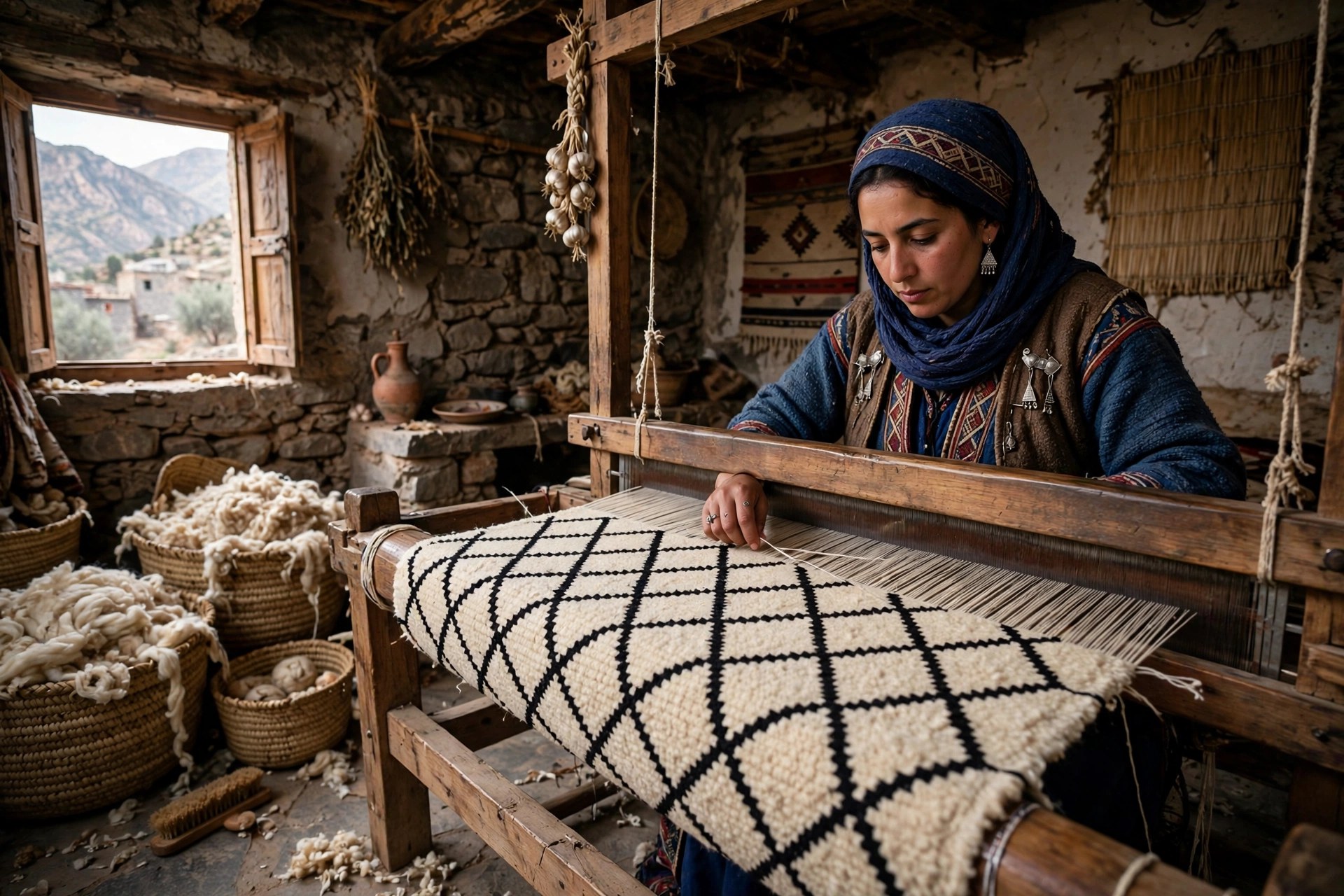
The history of Moroccan carpets begins at a wooden loom in a mountain village, where an Amazigh woman knots wool into warmth. For centuries these carpets were bedding and blankets before they were decoration, and every region wove its own visual language into them.
This guide follows the history of Moroccan carpets from its earliest roots to the souks of Marrakech today: the disputed first dates, the women behind the looms, the motifs and what they mean, the great regional families, and what a real carpet costs in 2026.
In this guide
- The Short Answer: The History of Moroccan Carpets in One Page
- The History of Moroccan Carpets at a Glance
- Ancient Roots: Weaving Before Written History
- The 8th Century and the Arrival of the Knot
- Andalusi Influence and the Urban Carpet
- The Weavers: Women, Memory and the Loom
- How a Moroccan Carpet Is Made
- The Language of Motifs: Diamonds, Zigzags and Protection
- Beni Ourain: The White Giants of the Middle Atlas
- Azilal: Colour and Storytelling from the High Atlas
- Boujad: Warmth and Patina from the Haouz Plains
- Taznakht and the South: Saffron Country Carpets
- Hanbel, Kilim and Boucherouite: The Flatweaves and Rag Rugs
- Rabat and the Urban Workshops
- The 20th-Century Discovery: Designers and the World Market
- Buying a Moroccan Carpet Today: Prices and How to Spot a Fake
- Where to See and Buy Moroccan Carpets
- Caring for a Moroccan Carpet
- Frequently Asked Questions
- Conclusion: Why the History of Moroccan Carpets Still Matters
The Short Answer: The History of Moroccan Carpets in One Page
The history of Moroccan carpets is the story of Amazigh women in the Atlas Mountains turning sheep’s wool into shelter, identity and art. Hand-knotting is documented in Morocco as early as the 8th century, although the exact beginnings are not settled, and for most of that long story carpets were made for family use, not for sale. Each region developed its own style: ivory Beni Ourain, colourful Azilal, and warm faded Boujad.
Cities added their own chapter. Andalusi refugees brought Persian-influenced knotting and formal designs to urban workshops, and Rabat became known for dense, elegant carpets quite unlike the tribal pieces of the mountains. Today the craft survives in village cooperatives and in the souks of Marrakech and Fez — but it also faces machine-made copies at a fraction of the price.
The History of Moroccan Carpets at a Glance
| Era | What happened |
|---|---|
| Before the 8th century | Amazigh communities weave wool for daily life; exact origins not settled |
| 8th century | Hand-knotting documented in Morocco; knotted carpets develop |
| 15th–17th centuries | Andalusi refugees bring Persian-influenced techniques to Moroccan cities |
| 17th century onwards | Beni Ourain and other tribal styles take their classic forms |
| 19th century | Regional styles fully distinct; carpets traded through Fez and Marrakech |
| Mid-20th century | Wright, Le Corbusier and other designers bring tribal rugs to world fame |
| Late 20th century | Boucherouite rag rugs appear; cooperatives organise weavers |
| Today | Village cooperatives, fair-trade platforms and souks; fakes compete with handmade work |
Ancient Roots: Weaving Before Written History
Long before anyone wrote about Moroccan carpets, Amazigh communities were already weaving. Sheep provided wool, and wool provided almost everything a household needed: blankets, floor coverings, wall insulation, tent dividers and cloaks.
Because wool decays, very old carpets rarely survive, so much of the early history of Moroccan carpets has been passed down orally rather than through objects. Historians therefore disagree about the first dates. Some sources trace weaving to the 7th century, others point to the 8th century as the first documented knotting, and still others date the tribal tradition to the 16th century. None of these dates is settled. For the wider story, see our brief history of Morocco.
The 8th Century and the Arrival of the Knot
The knotted pile carpet — wool tied knot by knot around warp threads — is the technique behind Morocco’s most famous rugs. Guides to the history of Moroccan carpets record hand-knotting in Morocco as early as the 8th century.
The key difference from the great carpet centres of Persia and Anatolia was purpose. Moroccan tribal rugs were not made to order for a court or a merchant, but for the weaver’s own family, from her own flock’s wool — and that freedom explains their asymmetry: a tribal rug is rarely perfectly symmetrical, because the weaver worked from memory rather than from a drawn design.
Andalusi Influence and the Urban Carpet
A second strand of the history of Moroccan carpets begins in the cities. When Andalusi Muslims fled Iberia, first in the 15th century and in far greater numbers after the fall of Granada in 1492, they brought with them the carpet knowledge of al-Andalus, shaped by Persian weaving traditions. In Fez, Tetouan and Rabat, urban workshops began producing denser, more formal carpets than the tribal rugs of the mountains.
These urban carpets used finer wool, more colours and often a central medallion or a repeating floral lattice, reflecting the tastes of wealthy households and the court. The Andalusi influence is also visible in Moroccan dress: the caftan followed a similar path from Andalusi courts to Moroccan cities. The city carpet and the tribal carpet thus developed side by side for centuries, borrowing from each other but never merging — a split that still shapes the Moroccan market today.
The Weavers: Women, Memory and the Loom
Weaving in Morocco has always been, overwhelmingly, women’s work. A girl learned at her mother’s loom, and by marriage she was expected to have woven the rugs for her new home.
The knowledge was carried entirely in memory: no written patterns, no design books, no measurements beyond the span of a hand. This oral tradition is also why so much of the early history of Moroccan carpets is uncertain: when knowledge lives in hands rather than archives, dates blur. Today many weavers work in cooperatives, where they set their own prices and sign their work.
How a Moroccan Carpet Is Made
A handmade carpet begins with the sheep: wool is sheared, washed, carded and spun into yarn, traditionally by hand. The yarn may be left in its natural ivory, brown or black, or dyed with natural colour: madder for red, indigo for blue, saffron for yellow, henna for orange-brown.
The weaver then warps a wooden loom and knots or weaves the woollen weft through it, row by row. A knotted rug like a Beni Ourain is built knot by knot, and a large one can take a skilled weaver two to three months. When the weaving is finished, the rug is cut from the loom, washed and dried in the sun. The result is never machine-perfect: slight unevenness and a motif drifting off-centre are the marks of a hand, and collectors value them.
- Shear and wash the wool, then card and spin it into yarn.
- Dye the yarn with natural dyes, or leave it in its natural colours.
- Warp the wooden loom with strong cotton or wool threads.
- Knot or weave row by row, following a pattern held in memory.
- Cut the rug from the loom, wash it and dry it in the sun.
The Language of Motifs: Diamonds, Zigzags and Protection
In the history of Moroccan carpets, rugs are not decorated at random. Their geometric motifs form a visual language, although meanings vary from tribe to tribe. The diamond is the most common motif, generally read as a symbol of protection, fertility and the female body. The zigzag is read as water, or as movement and the path of life.
Colours speak too. Undyed ivory wool means purity and the mountain winter; black lines give the Beni Ourain lattice its graphic force. Red, from madder, is the colour of life and celebration, and it dominates the rugs of the plains. Buyers should be cautious about over-reading: motif meanings were never written down, and a dealer who confidently translates every symbol is usually inventing.
Beni Ourain: The White Giants of the Middle Atlas
No Moroccan carpet is more famous than the Beni Ourain. The name covers 17 tribes in the Middle Atlas, and their rugs are instantly recognisable: thick, soft pile in natural ivory wool, crossed by a spare lattice of black lines on a cream field.
Beni Ourain rugs were woven from at least the 17th century in their classic form, although — like everything in the history of Moroccan carpets — the first date is not settled. Their fame came in the mid-20th century, when architects including Frank Lloyd Wright and Le Corbusier began placing them in modern interiors. Today Beni Ourain is also the most copied Moroccan rug, and the buying section below explains how to tell a real one from a machine-made copy.
Azilal: Colour and Storytelling from the High Atlas
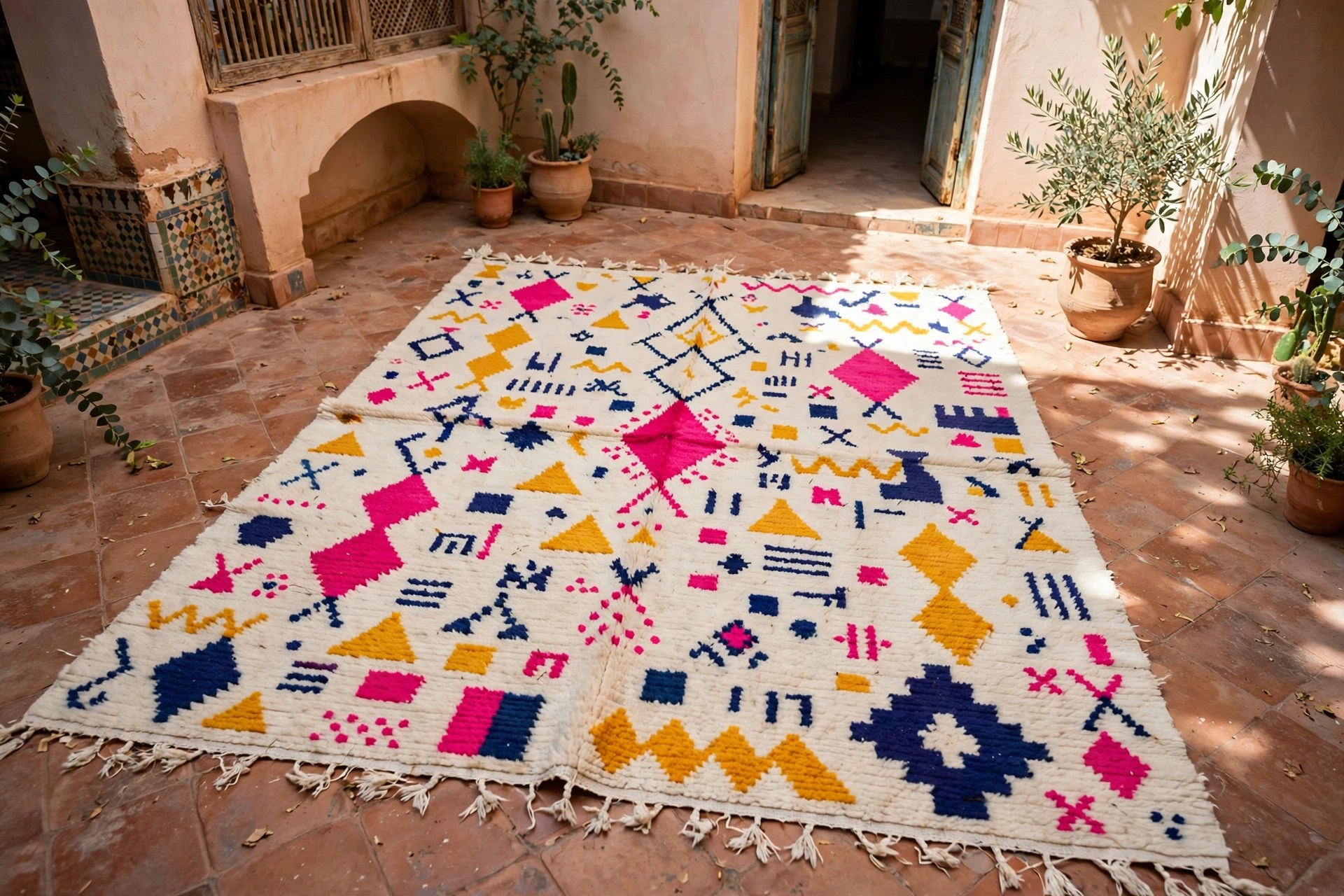
If Beni Ourain whispers, Azilal sings. From the province of Azilal in the High Atlas, these single-knotted rugs explode with colour on a milky-white ground: hot pinks, saffron yellows and indigo blues in playful, abstract compositions.
An Azilal rug is often described as a diary: the weaver sets down the events of her life — a birth, a marriage, a journey, a loss — in symbols only her community would fully read. Whether or not every reading is accurate, the effect is unmistakable: where Beni Ourain is restrained and monumental, Azilal is spontaneous and intimate — the most personal chapter in the history of Moroccan carpets.
Boujad: Warmth and Patina from the Haouz Plains
Boujad carpets come from the Haouz plains around the town of Boujad, in Khouribga province, between the Middle Atlas and the Atlantic coast — a quieter corner of the history of Moroccan carpets. Their palette is warm and sun-faded: dusty rose, terracotta, burnt orange and deep red, softened by age and by natural dyes that mellow rather than fade.
The Boujad style reflects its landscape. The plains are warmer than the Atlas, so the rugs are lighter than Beni Ourain, and the colours come from madder and henna above all. They are also, for now, less expensive than Beni Ourain of the same size, which makes them one of the best values in Moroccan carpets for a first-time buyer.
Taznakht and the South: Saffron Country Carpets
South of the High Atlas, between Ouarzazate and the town of Taznakht, lies a carpet country that many visitors never see — and a little-known chapter in the history of Moroccan carpets. Taznakht is famous above all for saffron, but its looms are just as important. Taznakht carpets are typically flatweaves or low-pile rugs in warm reds and deep pinks, with bold geometric borders and a finer weave than the rugs of the north.
The south’s weaving reflects the caravan routes that crossed it: Taznakht sits on the road from Marrakech to the Sahara, and its rugs absorbed the bold stripes and reds of Saharan weaving. The nearby ksar of Ait Ben Haddou stands on the same route. Cooperatives in Taznakht sell directly to visitors, at roughly 30% less than the same rug in Marrakech.
Hanbel, Kilim and Boucherouite: The Flatweaves and Rag Rugs
Not every carpet in the history of Moroccan carpets has a pile. The flatweaves, woven without knots, are lighter, cheaper and easier to carry, and they have their own history. The Hanbel is the best-known flatweave, a tightly woven woollen rug with stripes and bands, traditionally used as a blanket or tent covering. The kilim, from the Zemmour and Boujaad regions, is embroidered as well as woven, with patterns echoing the tattoos of the tribe that made it.
The youngest member of the family is the Boucherouite, or rag rug. It appeared in the late 20th century among modest families who could not always afford wool, and it is woven from strips of recycled fabric — old clothes, offcuts, rags — knotted into wildly colourful abstract designs.
| Style | Region | Construction | Character |
|---|---|---|---|
| Beni Ourain | Middle Atlas | Thick knotted pile | Ivory wool, black diamond lattice |
| Azilal | High Atlas | Single-knotted pile | Colourful abstract motifs on white |
| Boujad | Haouz plains | Knotted pile | Warm reds and oranges, soft patina |
| Taznakht | South, near Ouarzazate | Flatweave or low pile | Bold reds, tight weave, saffron country |
| Hanbel | Atlas and south | Flatweave | Stripes and bands, light and portable |
| Kilim | Zemmour, Boujaad | Flatweave, embroidered | Tattoo-like motifs, no pile |
| Boucherouite | Near Beni Mellal | Rag rug | Recycled fabric, wild colour |
Rabat and the Urban Workshops
Rabat, the capital, developed its own chapter in the history of Moroccan carpets, quite different from the tribal rugs. Its workshops produced dense, finely knotted carpets with formal layouts — central medallions and repeating floral lattices.
The contrast with tribal rugs is instructive: an urban Rabat carpet is a product of a workshop, with a design drawn in advance and several hands at one loom, while a Beni Ourain is the work of one woman, from memory. The city’s architecture and its Kasbah of the Udayas show the same blend of Andalusi refinement and Moroccan craft.
The 20th-Century Discovery: Designers and the World Market
For most of their history, Moroccan tribal rugs were invisible to the outside world. That changed in the mid-20th century, when architects and designers began bringing them into modern interiors. Frank Lloyd Wright and Le Corbusier are the names most often cited: a rug made for a mountain winter suddenly appeared in houses in Paris, New York and Los Angeles, and its simplicity was read as modernism.
The discovery brought fame and demand, which lifted prices and brought income to weaving regions. It also brought imitation: factories from Turkey to China began producing machine-made copies of the Beni Ourain lattice. That tension — a living craft with a world market, and a flood of copies — still defines the history of Moroccan carpets today. Fair-trade platforms now sell rugs priced by the artisans themselves: Anou, for example, passes 70% of the price to the makers.
Buying a Moroccan Carpet Today: Prices and How to Spot a Fake
Prices vary enormously with size, age, knot density and tribe, so the table below gives fair tourist prices for good-quality handmade pieces in 2026. Prices were checked in November 2026.
| Rug | Size | Fair price in Morocco (MAD) | Approx. USD |
|---|---|---|---|
| Small kilim or Hanbel | 1 × 1.5 m | 800–2,500 | $80–$250 |
| Boucherouite rag rug | 1.5 × 2 m | 700–1,200 | $70–$120 |
| Boujad, medium | 2 × 3 m | 2,500–5,000 | $250–$500 |
| Beni Ourain, medium | 2 × 3 m | 5,000–9,000 | $500–$900 |
| Beni Ourain, large | 3 × 4 m | 9,000–15,000 | $900–$1,500 |
| Azilal, medium | 2 × 3 m | 3,500–7,000 | $350–$700 |
| Vintage or antique piece | Any | 12,000 and above | $1,200 and above |
Bargaining is expected in the souks, and a first asking price can be double the fair price. The most reliable checks are simple: look at the back, where the knots should be visible and slightly irregular; smell the wool; and remember that a handmade carpet never has two perfectly identical halves.
Age is the hardest claim to verify: a genuinely old rug commands a premium, but “antique” is the most abused word in the souk. Unless you are buying from a dealer you trust, pay for the rug in front of you, not for the story attached to it. The music and cinema of Morocco followed similar paths from village craft to world fame.
Where to See and Buy Moroccan Carpets
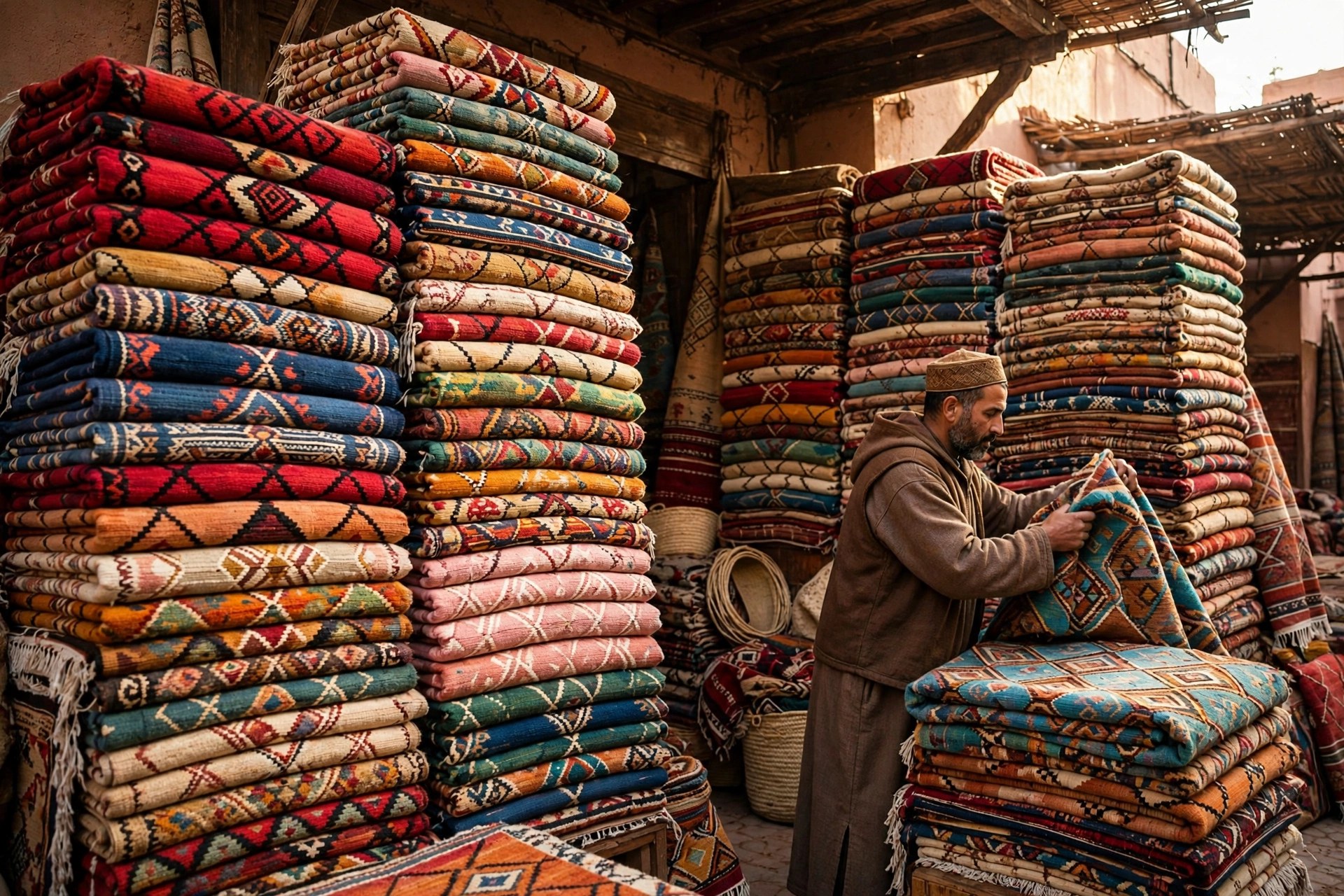
Marrakech is the easiest place to start exploring the history of Moroccan carpets: Souk Zarbia, the carpet souk off the main lanes of the medina, holds dozens of shops, and an hour there teaches more than any guidebook. For the best prices, go to the source: the cooperatives of Taznakht and the villages of the Middle Atlas and the Azilal region — or combine the trip with Tinmel, the Almohad capital hidden in the Atlas.
Museums are the best place to study old pieces before spending money. The carpet collections in Marrakech and Rabat show the regional styles side by side, and an hour with them will train your eye far better than photographs can. Marrakech itself rewards a slow visit, and a carpet bought at the end of a trip is a better souvenir than one bought in the first hour.
Caring for a Moroccan Carpet
A handmade Moroccan carpet will last for decades if treated as wool rather than decoration. Vacuum it regularly without a beater bar, shake it outside a few times a year, and rotate it often. Spills should be blotted, never rubbed, and cleaned with cold water and mild soap.
Moths are the real enemy, especially in a damp house. A rug stored rolled, clean and dry, with cedar or lavender, is safe; folded damp in a cupboard, it is not. A carpet bought with this knowledge is not a souvenir but a piece of Morocco that will outlast the trip that brought it home.
Frequently Asked Questions
What is the history of Moroccan carpets in short?
The history of Moroccan carpets is the story of Amazigh women weaving wool into rugs for daily life, documented from at least the 8th century, before designers brought them to world fame in the 20th century.
How old are the oldest Moroccan carpets?
No very old tribal rug survives, because wool decays, so the earliest dates in the history of Moroccan carpets are not settled. Hand-knotting is documented from the 8th century, and the classic styles took shape from the 17th century onwards.
What is the difference between Beni Ourain and Azilal?
Beni Ourain rugs are thick, ivory-white pile with a spare black diamond lattice, from the Middle Atlas. Azilal rugs are lighter, single-knotted and wildly colourful, from the High Atlas.
How much does a real Moroccan carpet cost?
A good handmade Beni Ourain of 2 × 3 m costs roughly 5,000–9,000 MAD ($500–$900) in Morocco in 2026 after bargaining, a small kilim 800–2,500 MAD ($80–$250), and a Boucherouite 700–1,200 MAD ($70–$120). Prices were checked in November 2026.
How can I tell a handmade Moroccan carpet from a fake?
Check the back: the knots should be visible and slightly irregular. Smell the wool: it should smell of wool, not chemicals. Perfect symmetry and a stiff uniform backing usually mean machine-made.
Where is the best place to buy a Moroccan carpet?
The souks of Marrakech and Fez are the easiest places, but the best prices are at the source: the weaving cooperatives of Taznakht and the villages of the Middle Atlas and the Azilal region.
Conclusion: Why the History of Moroccan Carpets Still Matters
The history of Moroccan carpets is not a museum story. It is a living craft, still practised on wooden looms in the Atlas and still learned from mothers rather than from books. Each carpet carries the place that made it and the hands that wove it — and that is why a handmade Moroccan rug is worth many times the price of its machine-made copy.
If you travel to Morocco, see a loom at work before you buy. The carpet you bring home will then be more than decoration: a piece of the history of Moroccan carpets, begun over a thousand years ago and still being woven today.
Last checked: November 2026
1 thought on “The History of Moroccan Carpets: Weaving, Motifs and Regions”