
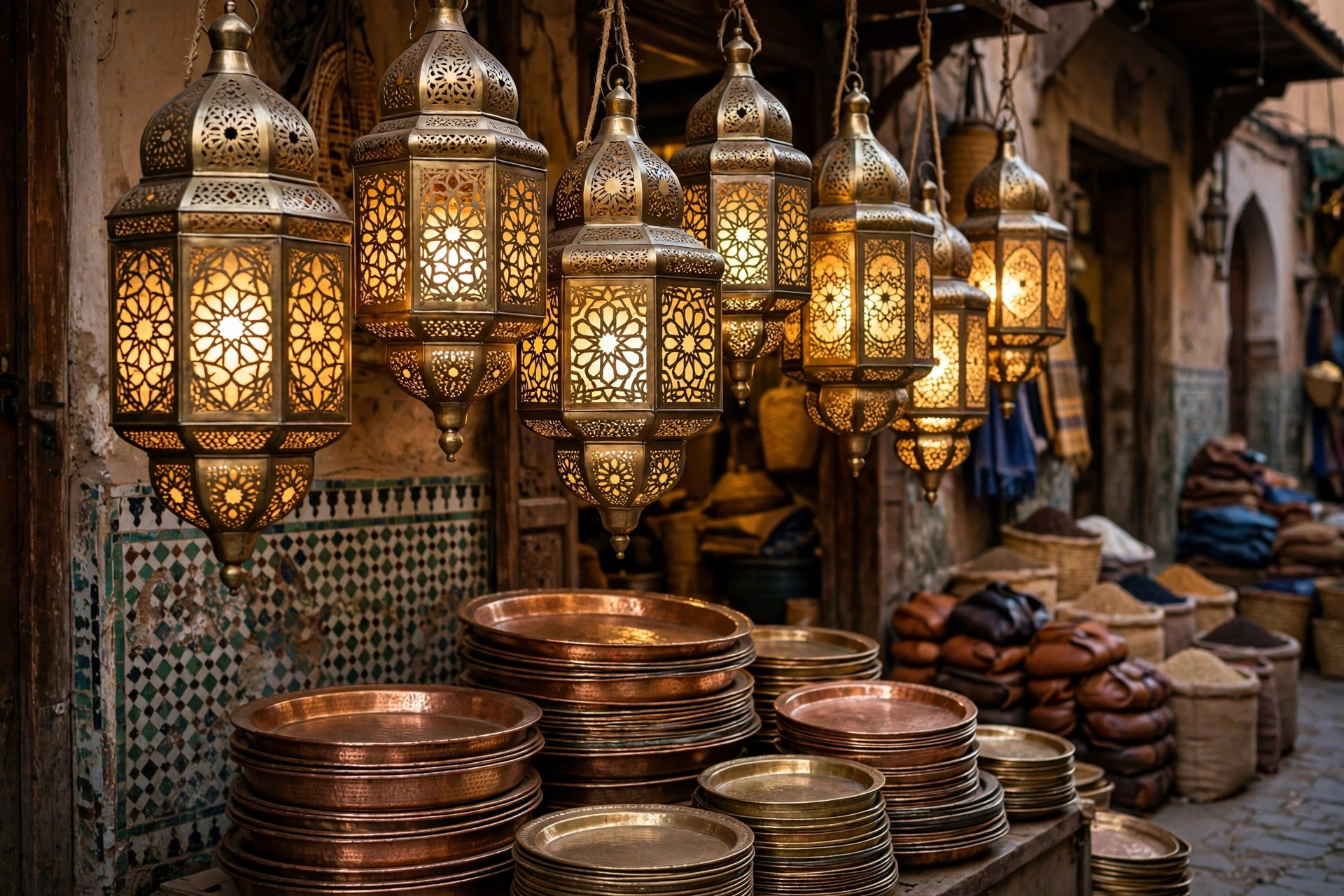
The history of Moroccan metalwork begins with a hammer strike you can still hear today. In Seffarine Square in Fez, coppersmiths beat brass trays into shape with their grandfathers’ rhythm, echoing through the medina for centuries. From Idrisid silver coins to Almohad brass doors, from the silver jewellery of the Atlas to the curved koummya dagger at a man’s belt, metal has always been how Morocco showed its wealth, its faith and its skill. All prices are in Moroccan dirhams (MAD), checked in November 2026, with dollar equivalents at roughly 10 MAD to $1. They are planning ranges for the souk, not fixed prices — bargaining is part of the craft. This guide follows the history of Moroccan metalwork from the bronze of the ancient ports to the workshops of today.
In this guide
- The History of Moroccan Metalwork at a Glance
- Bronze and Iron Before Islam
- Idrisid Silver and the First Moroccan Mints
- Almohad Brass: Minbars, Doors and Geometry
- Marinid Metalwork: Lanterns, Doors and the Madrasas
- Seffarine Square: The Coppersmiths of Fez
- Silver of the Atlas: Tiznit and Amazigh Adornment
- The Koummya Dagger and the Arms of the Makhzen
- Teapots, Trays and the Ritual of Mint Tea
- Metalwork Today: Workshops and the Souk
- Where to See Moroccan Metalwork
- Frequently Asked Questions
- Conclusion
The History of Moroccan Metalwork at a Glance
The short version of the history of Moroccan metalwork: the Phoenicians brought bronze to the Atlantic coast, the Idrisids struck it into silver coins, the Almohads and Marinids turned brass into sacred geometry, and the coppersmiths of Fez never stopped hammering.
| Period | What happened |
|---|---|
| Antiquity, before 100 BCE | Phoenician and Roman bronze, iron tools and coinage at Lixus, Tingis and Volubilis |
| 8th–9th centuries | Idrisid silver dirhams struck at Tudgha and Fez, the first Islamic coinage of Morocco |
| 12th century | Almohad brass: the minbar of the Kutubiyya mosque and the great doors of Marrakech |
| 13th–15th centuries | Marinid bronze lanterns, doors and astrolabes in the madrasas of Fez |
| 16th–19th centuries | Seffarine Square becomes the copper quarter of Fez; Tiznit silver flourishes in the Souss |
| 19th century | The koummya dagger reaches its classic form; brass teapots arrive with the tea trade |
| 20th century | Colonial workshops and Art Deco ironwork in Casablanca and Rabat |
| Today | Family workshops, cooperatives and a busy tourist souk keep the hammering alive |
What makes the history of Moroccan metalwork different is continuity: the same squares, the same alloys and often the same families have worked metal for eight centuries, and a tray bought in Fez today is made the way it was made when the Marinids ruled.
Bronze and Iron Before Islam
Long before the first mosque rose in Fez, the Atlantic coast of Morocco already rang with the hammer, an early chapter in the history of Moroccan metalwork. The Phoenicians, who founded Lixus around the 8th century BCE, brought bronze tools, fish hooks and ornaments to the Loukkos estuary, and their smiths worked the copper and tin that arrived by sea. Archaeologists have found bronze fibulae, mirrors and small votive figures in the old ports, proof that metal was traded here centuries before Rome. The Romans industrialised the habit. After Tingis became the capital of Mauretania Tingitana in 42 CE, iron tools, bronze vessels and military fittings circulated through Volubilis and the coastal towns, and the province exported metalwork alongside its famous garum and olive oil. The exact date metalworking first reached the Moroccan coast is not fully settled: Phoenician traders were certainly here by the 8th century BCE, but whether they smelted on site or only imported finished bronze remains debated. What is certain is that when the Idrisids founded their state, they inherited a land that already knew the forge — the first, unrecorded chapter in the history of Moroccan metalwork.
Idrisid Silver and the First Moroccan Mints
The first clearly Moroccan chapter in the history of Moroccan metalwork is written in silver. Idris I founded his state in the north in 789, and his son Idris II built Fez into a capital; their mints struck silver dirhams at Tudgha, near Volubilis, and later at Fez itself. These were not crude lumps of metal: elegant Kufic inscriptions, the name of the ruler and the mint, and a weight standard copied from the eastern Islamic world. You can read the full story of the coinage in our history of Moroccan dirham. Silver mattered because it was the metal of legitimacy. A dynasty that could strike its own dirhams could pay its soldiers, collect its taxes and announce its independence to the world. The Idrisid mints also trained the first generation of silversmiths in the history of Moroccan metalwork, men who learned to assay, melt and strike — skills that later moved from the mint into the jeweller’s workshop. The exact date of the first Idrisid minting is not fully settled: Idris I in 790 or Idris II after 803 are both argued, and the coins themselves do not settle the question.
Almohad Brass: Minbars, Doors and Geometry
Under the Almohads, Moroccan metalwork stopped being only money and became architecture. The dynasty that built the Koutoubia in Marrakech and the Giralda in Seville understood that brass could carry geometry the way stone could not: it could be pierced, engraved and gilded, and it caught the light of a mosque courtyard. The great minbar of the Kutubiyya mosque, built in Cordoba around 1137–1139 and moved to Marrakech, is wood inlaid with ivory and metal, its brass fittings showing the Almohad taste for eight-pointed stars and endless interlace. The doors tell the same story. The great bronze doors of Almohad mosques and palaces were cast in sections, chased by hand and studded with bosses that repeated the geometry of the zellige on the walls beside them. Brass was the perfect metal for this work in the history of Moroccan metalwork: harder than copper, brighter than bronze, and willing to take a polish that glowed in the dark of a prayer hall. The Almohads also struck square silver coins — a shape no other Islamic dynasty used — proving that even their money was designed.
Marinid Metalwork: Lanterns, Doors and the Madrasas
The Marinids, who made Fez the capital of learning in the 13th and 14th centuries, turned metalwork into a science. Their madrasas — the Bou Inania, the Attarine, the Sahrij — needed bronze doors, pierced lanterns, astrolabes and inkwells, and the workshops of Fez supplied them all. A Marinid mosque lantern is a small building in metal: pierced brass panels, calligraphy in reserve, and a dome that throws patterned light across the prayer hall. The Marinids also loved the astrolabe, the brass instrument that told the time of prayer and the direction of Mecca. Fez astrolabes, engraved with the latitude of the city and the names of the stars in Arabic, were among the finest in the Islamic world. Their makers were scholars as much as smiths, and their work shows that in the history of Moroccan metalwork, craft and knowledge were never separate trades.
Seffarine Square: The Coppersmiths of Fez
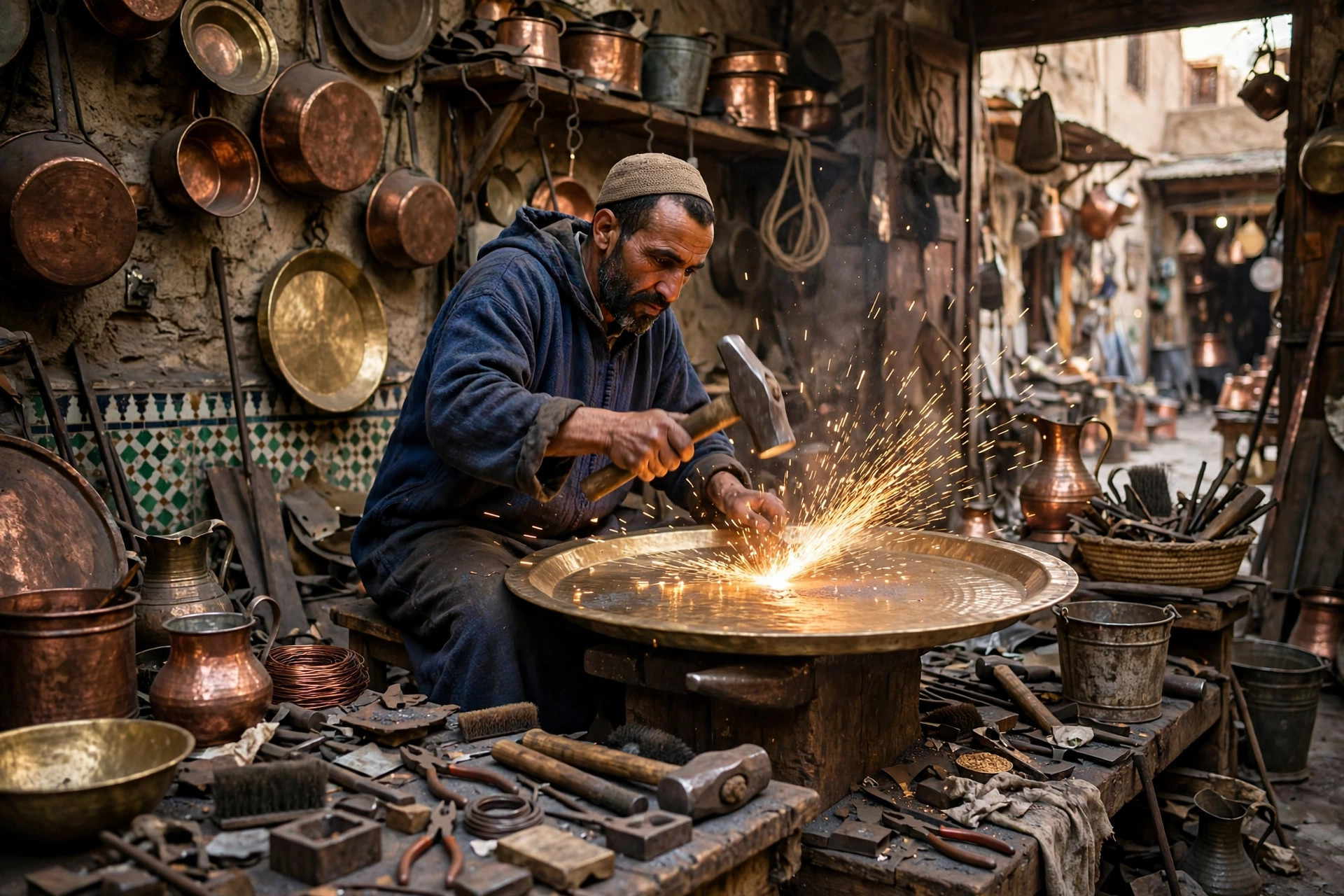
If one square holds the whole history of Moroccan metalwork, it is Seffarine Square in Fez el Bali. For centuries this small plaza at the edge of the medina has been the copper quarter, where smiths sit cross-legged on the floor and beat brass and copper into trays, teapots, lanterns and kettles. The rhythm never stops: the hammer falls, the metal is turned, the hammer falls again, and a flat sheet slowly becomes a bowl. The craft is organised the old way, as it has been through the whole history of Moroccan metalwork. A master smith buys sheets of brass and copper, cuts them with shears, and shapes them over stakes and anvils; an engraver then chases the surface with fine lines of geometry and calligraphy, and a polisher brings up the shine. Apprentices start by sweeping the floor and learn by watching, and the best workshops are still family businesses where the trade passes from father to son. The exact date Seffarine became the copper quarter is not fully settled — the square is named for the seffarine, the coppersmiths, but whether the workshops gathered here in the Marinid period or later is debated. What visitors see today is the living end of an eight-century chain. A handmade brass tray in Seffarine Square costs roughly 150–400 MAD ($15–40) depending on size and engraving, and a large engraved teapot runs 200–500 MAD ($20–50). Machine-made copies in the tourist souk cost a third as much, so look for the uneven hammer marks and the sharp engraving — they are the signature of the hand.
Silver of the Atlas: Tiznit and Amazigh Adornment
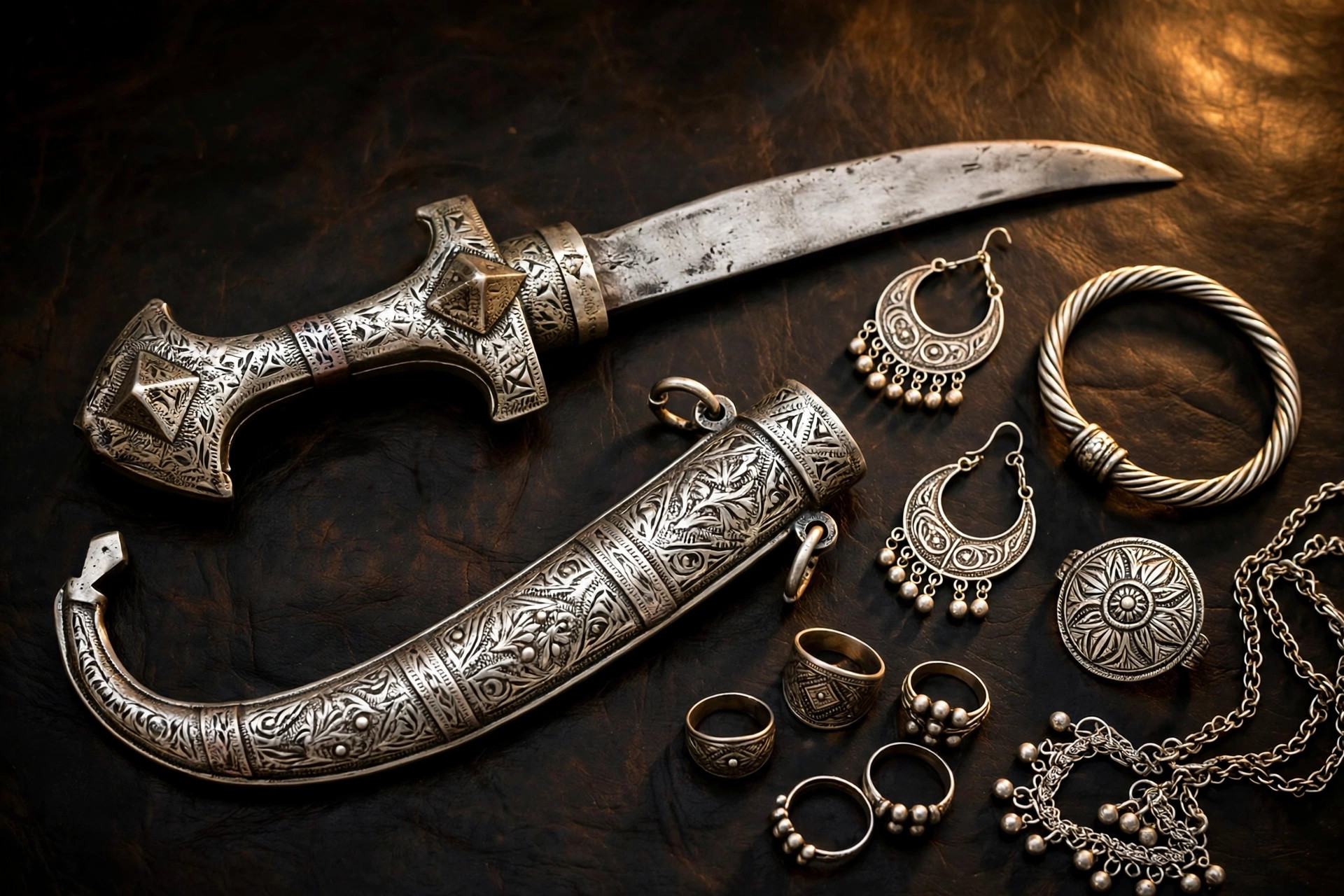
While Fez worked in brass, the south worked in silver. Tiznit, the walled town of the Souss, became the great silver centre of Morocco, and its Jewish and Amazigh silversmiths produced the jewellery that marked every stage of a woman’s life: fibulae to fasten a cloak, bracelets for a wedding, earrings for a daughter. The silver is heavy, bold and unmistakably Amazigh — large forms, niello inlay, amber and coral beads, and the geometric motifs of the mountains. In the history of Moroccan metalwork, silver carried meaning, not just beauty. A fibula was a dowry object, a bracelet was savings a woman could wear, and the designs announced which valley or tribe she came from. The craft survives today in Tiznit’s silver souk and in the workshops of Agadir, and you can see the finest old pieces in the history of Moroccan jewellery. A pair of handmade silver fibulae in Tiznit costs roughly 400–1,200 MAD ($40–120) today, and antique pieces in the collectors’ shops of Marrakech run far higher.
The Koummya Dagger and the Arms of the Makhzen
No object sums up the history of Moroccan metalwork like the koummya, the curved dagger worn at the belt. Its blade sweeps forward like a beak, its hilt is carved from wood or bone, and its sheath is sheathed in silver or brass chased with niello. For centuries it was the sidearm of the makhzen, the sultan’s government, and of the caids and horsemen who rode with it — a weapon, a badge of rank and a piece of jewellery in one. The origin of the koummya’s curved blade is not fully settled: some historians trace it to Ottoman and Balkan daggers that reached Morocco through the Mediterranean trade, while others argue for a local design that grew out of the older straight daggers of the Atlas. Either way, by the 19th century it had reached its classic form, and the best examples were made in Fez and the Souss. Swords, powder flasks and gun fittings followed the same logic — steel for the blade, silver for the show — and the armouries of Meknes under Moulay Ismail were famous across North Africa. A modern decorative koummya in the souk costs roughly 300–900 MAD ($30–90) depending on the silver work; antique pieces sell for several thousand dirhams, and exporting genuine antiques needs a permit, so buy new and keep the receipt.
Teapots, Trays and the Ritual of Mint Tea
The most famous object in the history of Moroccan metalwork is also the most recent: the brass teapot. Tea reached Morocco in the 18th and 19th centuries, first as a luxury of the court and the ports, and by the late 19th century the ritual of mint tea — poured from a height into small painted glasses — had become the national ceremony. The teapot, tray and glasses became the centrepiece of every Moroccan home, and the smiths of Fez supplied them all. The design is pure function turned into beauty: a long spout for the high pour, a hinged lid, a heat-proof handle, and a body engraved to catch the light. The tray, round and wide, holds the glasses and the sugar bowl, and the best ones are spun and hammered by hand, not pressed by machine. Today the teapot is Morocco’s most exported craft object, and a good hand-engraved brass teapot set — pot, tray and six glasses — costs roughly 400–900 MAD ($40–90) in the Fez souk.
Metalwork Today: Workshops and the Souk
The history of Moroccan metalwork did not end with the machine; the craft adapted. The workshops of Fez, Marrakech, Tiznit and the Souss still hammer by hand, but they also supply the riads, hotels and restaurants that want lanterns, mirrors and railings in the old style, and the best smiths now sign their work and sell it online. Cooperatives, often supported by the state craft agency, train young smiths and help them reach buyers beyond the souk, and the annual craft fairs in Casablanca and Marrakech show the trade at its best. The pressure is real: cheap pressed brass from Asia undercuts the hand-hammered tray, and young people leave the forge for steadier jobs. But every restored riad needs a hundred lanterns, every wedding needs a tea set, and every visitor wants to carry a piece of the craft home. The hammering in Seffarine Square, which has never stopped, is the sound of a trade that refuses to become a museum piece.
Where to See Moroccan Metalwork
The best place to see the history of Moroccan metalwork is where it is made. Seffarine Square in Fez is first on any list: arrive in the morning, watch the smiths work, and buy from the workshop door. In Marrakech, the metal souk near the Rahba Kedima sells lanterns, teapots and trays by the hundred, and the Dar Si Said museum holds the finest old pieces in the country. In Tiznit, the silver souk inside the walls is the place for Amazigh jewellery. For the grandest old work, visit the madrasas of Fez — the Bou Inania and the Attarine — and look up at the lanterns and the bronze doors, the high art of the history of Moroccan metalwork, then compare them with the brass in the shops outside. Admission to the madrasas runs 10–20 MAD ($1–2), and the museums charge 20–70 MAD ($2–7). The craft is free to watch.
Frequently Asked Questions
What is the most famous Moroccan metalwork?
The brass teapot and tray set, followed by the pierced brass lantern and the silver koummya dagger. All three are still made by hand in Fez, Marrakech and Tiznit, and they are the objects most visitors carry home.
Where is the centre of Moroccan metalwork?
Fez, above all Seffarine Square, is the historic centre for brass and copper. Tiznit is the centre for Amazigh silver, and Marrakech is the biggest market for lanterns, teapots and decorative brass.
Is Moroccan brass real brass?
Yes — in the history of Moroccan metalwork, traditional Moroccan brass is an alloy of copper and zinc, hammered and engraved by hand. Cheaper tourist pieces may be thin pressed metal or brass-plated steel, so check the weight and look for hammer marks.
How can I tell handmade from machine-made?
Handmade pieces have uneven hammer marks, slightly irregular engraving and a good weight. Machine-pressed pieces are perfectly regular, very light and often have a lacquered shine that never tarnishes.
Can I export a koummya dagger or an antique?
New decorative daggers are fine in checked luggage with the blade sheathed, but genuine antiques need an export permit from the Moroccan authorities. Buy new pieces and keep the receipt.
What is the best souvenir to buy?
A hand-engraved brass teapot or a small pierced lantern from the workshop that made it. Expect 150–500 MAD ($15–50), bargain politely, and remember that the price should reflect the hours of hammering, not just the metal.
Conclusion
The history of Moroccan metalwork is the story of a country that never put the hammer down. From Phoenician bronze on the Atlantic coast to Idrisid silver, Almohad brass, Marinid lanterns, the copper squares of Fez and the silver of Tiznit, every dynasty left its mark in metal — and the smiths are still at work. Go to Seffarine Square in the morning, listen to the hammering, and buy a tray from the man who made it: you will be holding eight centuries in your hands. More Moroccan crafts and dynasties wait in our History & Heritage section.
1 thought on “The History of Moroccan Metalwork: Brass, Copper and the Souk Smiths”