
This El Jadida travel guide is for travellers who want history and the sea in the same day. El Jadida is a relaxed Atlantic port city about 100 kilometres southwest of Casablanca, and its old town is one of the great survivals of the Portuguese age in Morocco. Inside a star-shaped fortress are a dark underground cistern lit by a single shaft of light, a Manueline church, and ramparts where the ocean breaks against the stones. Outside the walls are wide sandy beaches, a working fishing port, and some of the freshest seafood on the Moroccan coast.
The city is easy to reach by train and easy to walk. One full day covers the fortress, the beaches and the port, and two days let you add Azemmour, 17 kilometres north. This El Jadida travel guide follows that plan, from the cistern to the fish restaurants.
All prices are in Moroccan dirhams (MAD), checked in November 2026, with dollar equivalents at roughly 10 MAD to $1. They are planning ranges, not promises.
In this guide
- El Jadida at a Glance
- A Short History of El Jadida
- The Portuguese City: Cistern, Church and Ramparts
- The Beaches of El Jadida: Deauville, Sidi Bouzid and Haouzia
- The Fishing Port and the Medina
- El Jadida Travel Guide: A One-Day Walking Route
- Where to Eat in El Jadida
- Where to Stay in El Jadida
- Getting to El Jadida
- El Jadida and Azemmour in One Day
- When to Visit El Jadida
- Practical Tips for Visiting El Jadida
- Frequently Asked Questions
- Conclusion
El Jadida at a Glance
El Jadida is a city of about 200,000 people on the Atlantic coast, in the Doukkala plain between Casablanca and Safi: a modern town of avenues and cafés, and a small walled fortress on the shore that UNESCO listed as a World Heritage site in 2004. The fortress draws most travellers, but the beaches and the port make them stay a second day.
| Fact | Detail |
|---|---|
| Location | Atlantic coast, about 100 km southwest of Casablanca, 17 km south of Azemmour |
| Population | About 200,000 |
| Best for | Portuguese fortress and cistern, Atlantic beaches, seafood, an easy day trip from Casablanca |
| Time needed | One full day for the fortress, beaches and port; two days with Azemmour |
| Getting there | Train from Casablanca, about 1.5 hours; car about 1–1.5 hours via the A1 motorway |
| Budget | 200–400 MAD ($20–40) per person for a day trip without a hotel |
The plan in this El Jadida travel guide is simple: fortress in the morning, ramparts before the heat, fish at the port for lunch, and the beach in the afternoon.
A Short History of El Jadida
The coast here is old: Phoenician traders worked this shore centuries before the Romans, and a settlement stood here long before the Portuguese arrived. The town that visitors see today, however, begins with Portugal. In the summer of 1514 the Portuguese built a small citadel here, at a place they called Mazagan, or Mazagão in Portuguese, to guard the sea route to India. The fortress was enlarged into the great walled city of the 1540s, and it became the last Portuguese stronghold in Morocco.
The Portuguese held Mazagan for more than two and a half centuries, until 1769, when they left under pressure from Sultan Sidi Mohammed Ben Abdellah. For decades it stood empty and ruined, known as al-Mahdouma, "the Ruined". It was resettled in the early nineteenth century and renamed al-Jadida, "the New" — commonly dated to 1820, although the exact chronology is not fully settled, and some guides credit the rebuilding to Sultan Sidi Mohammed Ben Abdellah while others place it under his successors. The new town then grew quickly as a commercial port, with Muslim, Jewish and Christian merchants trading with Europe, and the French Protectorate later added the modern city and beach resort.
The fortress survived all of this almost intact, which is why UNESCO inscribed the Portuguese City of Mazagan in 2004. UNESCO praises it as an outstanding example of the exchange between European and Moroccan cultures from the sixteenth to the eighteenth centuries, and one of the earliest Renaissance fortress designs adapted to firearms. The walls, the cistern and the church tell that history better than any book.
The Portuguese City: Cistern, Church and Ramparts
The Cité Portugaise is a compact walled quarter on the shore, walkable in an hour, with quiet streets, low whitewashed houses, and the sea never far away. This El Jadida travel guide starts with the three sights that matter most.
The Portuguese Cistern
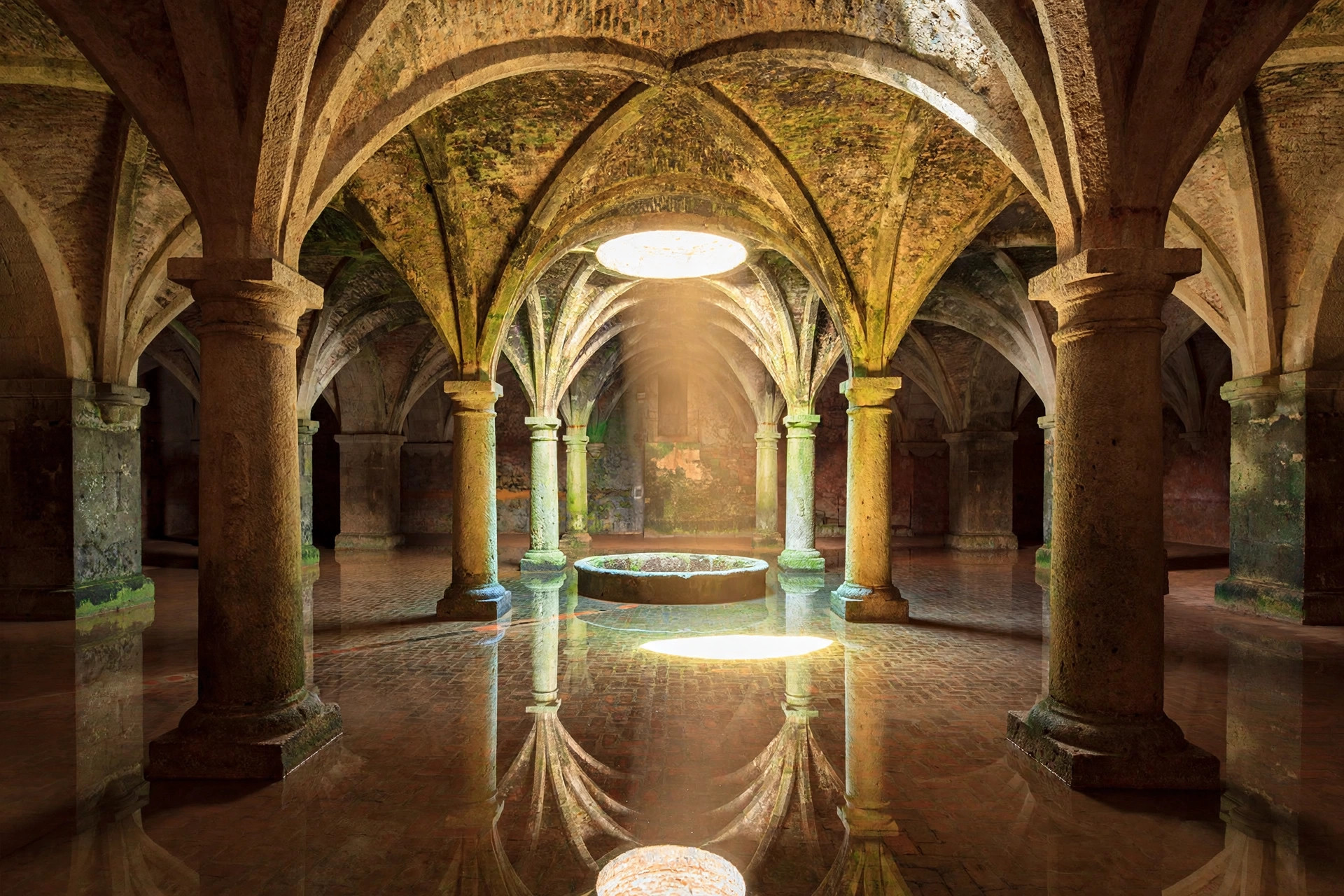
The cistern is the most famous room in Morocco. It is a vast, semi-underground chamber about 33 by 34 metres, held up by five rows of five stone pillars under brick vaults, its floor covered by a thin sheet of water. A single shaft of light falls from a hole in the ceiling and moves across the water as the day passes. Orson Welles filmed Othello (1952) here, and photographers have followed ever since.
One detail needs care: the chamber was built beneath the citadel of 1514, but its original purpose is not settled — it may have been an armoury, a barracks or a granary — and it is recorded as having been converted into a cistern in 1541, with some sources dating the works to 1541–1547. Go early, when the light is strongest and the room is quiet.
The Church of the Assumption
Facing the cistern across the main square stands the Church of the Assumption, built in the early sixteenth century in the late Gothic Manueline style, after King Manuel I of Portugal. It is a simple, rectangular building with a single nave and a square bell tower, and one of the two great Portuguese monuments that UNESCO singles out, alongside the cistern. It no longer holds services, but its plain stone interior is the calm centre of the old city.
The Ramparts and Bastions
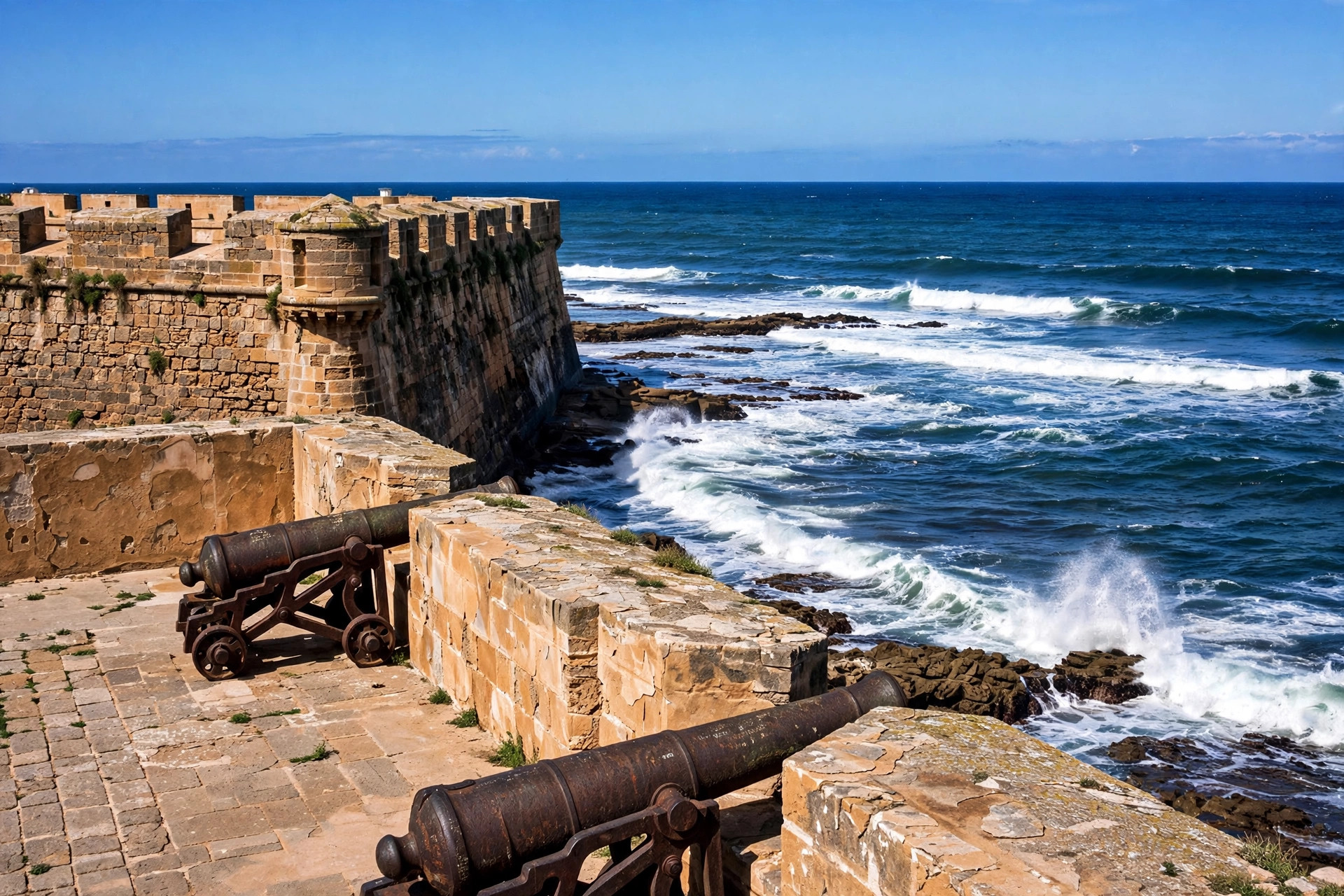
The ramparts are the third reason to come. The fortress walls, built in two phases in 1510–1514 and 1541–1548, run in a star shape with broad bastions at the corners, including the Bastion of the Angel and the Bastion of Saint Sebastian with its small chapel. Walk the full circuit slowly: the Atlantic breaks against the stones, the fishing boats come and go below, and the view runs north towards Azemmour. The ramparts are free, and at their best in the late afternoon, when the light turns the stone gold.
The Beaches of El Jadida: Deauville, Sidi Bouzid and Haouzia
El Jadida is a real beach town, and this El Jadida travel guide treats the beaches as half the trip, not an afterthought. The main city beach, Deauville, is a wide stretch of sand a short walk north of the fortress, named after the French resort town. It has a promenade of cafés, lifeguards in summer, and gentle water for families. On summer weekends it fills with families from Casablanca, so arrive early.
Sidi Bouzid, about five kilometres south of the centre, is the beach the locals prefer: longer and wider than Deauville, with rock pools at low tide and cafés along the cliff-top road. When the swell is up, surfers gather here, and there are lessons in summer. A petit taxi takes a few minutes and costs 10–15 MAD ($1–1.50) — the easiest beach hop in this El Jadida travel guide.
Haouzia, north of the city on the road towards Azemmour, is the quiet escape in this El Jadida travel guide: a long, open stretch of sand with almost no facilities. Bring water, a hat and a picnic, and you may have a whole section to yourself. Do not swim when the red flag is flying, and beware of strong currents on rough days. The Atlantic here is cooler and rougher than the Mediterranean, and children should stay in the shallows.
The Fishing Port and the Medina
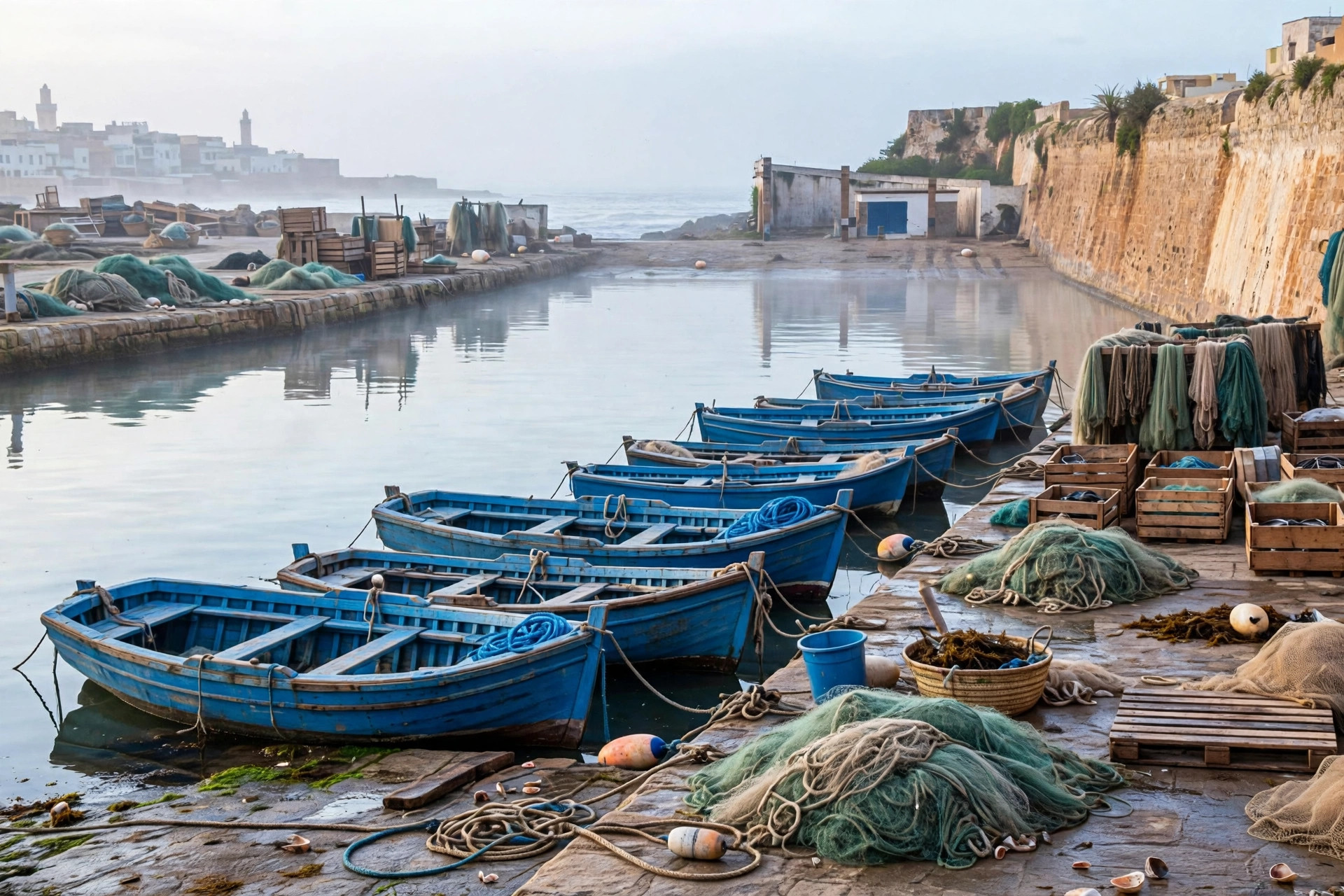
The fishing port sits just below the fortress walls, and it is the working heart of El Jadida. Come in the morning, when the blue wooden boats come in with sardines, sea bass and sole and the quays fill with crates, gulls and buyers. The fish market beside the port is loud, wet and wonderful.
The medina next to the port is the Moroccan town rather than the Portuguese one: a compact grid of lanes with bakeries, spice shops and cafés, much smaller and calmer than the medinas of Fez or Marrakech. Walk through it slowly to find the covered market, the old mellah quarter that once housed the city's Jewish community — our guide to Morocco's Jewish heritage tells that wider story — and the cafés where fishermen drink coffee before dawn. The port and the medina are the living half of this El Jadida travel guide, and they cost nothing to enjoy.
El Jadida Travel Guide: A One-Day Walking Route
You do not need a guide in El Jadida, but you do need a plan: the fortress is small and the beaches are spread out. This route takes a full day at a slow pace.
- Start at the Portuguese City (9:00): enter the fortress, visit the cistern first while the light is strong, then the Church of the Assumption and the main square.
- Walk the ramparts (10:00): circle the walls for the sea views and the bastions, finishing at the Bastion of the Angel.
- Coffee in the old city (11:00): sit in the square with a coffee for 8–12 MAD and watch the fortress wake up.
- The fishing port and fish market (11:30): walk down to the port, watch the boats and the market, and choose a restaurant for lunch.
- Lunch at the port (13:00): grilled fish with bread, salad and mint tea, 60–120 MAD ($6–12).
- The medina (14:30): wander the lanes, the covered market and the old mellah for an hour.
- Deauville Beach (16:00): walk north along the promenade to the main beach for a swim or a long walk.
- Sunset from the ramparts (18:00): return to the fortress walls for the best light of the day, then dinner in the modern town.
Wear good shoes: the ramparts are uneven and the fortress lanes are cobbled. If you have a second day, spend it at Sidi Bouzid in the morning and take the short trip to Azemmour in the afternoon.
Where to Eat in El Jadida
Every El Jadida travel guide starts with the fish, and the port restaurants are the place to eat it. A grilled lunch with bread, salad and mint tea costs 60–120 MAD ($6–12) near the port, and the catch of the day is usually sardines, sea bass or sole, grilled over charcoal and served whole. Order the fish of the day and ask the price first.
In the modern town, restaurants serve the usual standards: tajines 50–80 MAD ($5–8), pastilla 60–90 MAD ($6–9), harira with bread under 20 MAD ($2). Breakfast is bread, olive oil and eggs for 15–25 MAD ($1.50–2.50); coffee 8–12 MAD and mint tea 6–10 MAD. The cafés along the Deauville promenade charge a little more for the view, and they are worth it at sunset — a tip this El Jadida travel guide stands by.
Where to Stay in El Jadida
El Jadida has a wider choice of places to stay than Azemmour, and most visitors sleep here — the first tip of this El Jadida travel guide for overnight stays. A guesthouse or small riad inside or near the Portuguese City costs 300–600 MAD ($30–60) a night, usually with breakfast, a minute from the ramparts. Simple hotels in the modern town run 250–450 MAD ($25–45), and mid-range hotels near the beach run 500–900 MAD ($50–90).
For a splurge, this El Jadida travel guide points to the Mazagan Beach & Golf Resort, about ten kilometres south, with a golf course, a spa and a long private beach; rooms typically start above 1,500 MAD ($150) a night. Book ahead in summer, when Casablanca families fill the beach hotels, and ask for a sea-facing room: the Atlantic at night is the city's free luxury.
Getting to El Jadida
Getting here is easy: El Jadida is one of the simplest historic cities in Morocco to reach without a car. The train is the best option from Casablanca, and the drive is short and flat.
| From | How | Time | Cost |
|---|---|---|---|
| Casablanca | Train from Casa Voyageurs or Casa Port | About 1.5 hours | 50–70 MAD ($5–7) |
| Casablanca | Car via the A1 motorway | 1–1.5 hours | 70–100 MAD fuel and tolls ($7–10) |
| Casablanca | Bus from the main station | About 2 hours | 50–70 MAD ($5–7) |
| Marrakech | Car via the motorway | 2.5–3 hours | 150–200 MAD fuel and tolls ($15–20) |
| Rabat | Train via Casablanca | About 3 hours | 90–120 MAD ($9–12) |
| Azemmour | Train or grand taxi | 20–30 minutes | 10–20 MAD ($1–2) |
The station is about three kilometres from the fortress, so take a petit taxi for 15–20 MAD ($1.50–2) — the last detail this El Jadida travel guide needs before you arrive. ONCF trains run several times a day from Casablanca, roughly every two hours, continuing south towards Safi. Our Casablanca travel guide covers where to start if you are based in the city.
El Jadida and Azemmour in One Day
El Jadida and Azemmour belong together. Azemmour is 17 kilometres north, twenty minutes by road or a short train hop, and its small walled old town, painted walls and river estuary make a quiet contrast to El Jadida's fortress and beaches. Our Azemmour travel guide covers the river town in detail.
Do El Jadida in the morning, as this El Jadida travel guide recommends, when the cistern light is at its most dramatic, and Azemmour in the afternoon, when the light is best on the ramparts and the murals. Lunch in El Jadida, where the fish restaurants are bigger; coffee in Azemmour before the train home. The two towns were both Portuguese, both abandoned and retaken — the same history twice, once as a fortified port city, once as a quiet river town. For the wider coast, browse our Morocco Travel guides, and our history of Moroccan ports puts both towns inside the story of Morocco's Atlantic coast.
When to Visit El Jadida
El Jadida is a year-round city, but this El Jadida travel guide rates spring and autumn highest: warm days, cool evenings, and the best beach light. Summer is hot and busy, especially on weekends, when Casablanca families arrive in force. Winter is mild and very quiet, with rain and a cold Atlantic wind.
| Season | Weather | What to expect |
|---|---|---|
| Spring (March–May) | 20–26°C, sunny | Best walking weather, green countryside, few crowds |
| Summer (June–August) | 26–32°C, humid | Hot but breezy; beaches busy, especially on weekends |
| Autumn (September–November) | 22–28°C, sunny | Warm sea, quiet lanes, the best light for photos |
| Winter (December–February) | 15–20°C, some rain | Mild and very quiet; the Atlantic at its wildest |
The best time of day is the last two hours before sunset, when the light on the ramparts is at its finest. Avoid midday in summer for the fortress walk: there is little shade on the walls.
Practical Tips for Visiting El Jadida
The practical advice in this El Jadida travel guide comes down to five points:
- Cash is king. Bring dirhams: the medina's small shops and the fish restaurants near the port rarely take cards, and the ATMs are in the modern town, not inside the fortress.
- French and Darija open doors. English is understood in the beach hotels and the resort, but less so in the medina and the port — a few words of French go a long way.
- Check the sea before swimming. The Atlantic here has strong currents and sudden waves. Swim only where lifeguards are present in summer, and stay out of the water when the red flag is flying.
- Go early to the cistern. It is the city's most visited room, and the light shaft is strongest in the morning. Arrive at opening time for the quietest visit.
- Stay for sunset if you can: the light over the Atlantic from the ramparts in the last hour is the best thing in the city, and it costs nothing.
Frequently Asked Questions
Is El Jadida worth visiting?
Yes, and this El Jadida travel guide says so plainly: a UNESCO-listed Portuguese fortress with a famous cistern, ramparts above the Atlantic, three beaches and a working fishing port, all in one walkable city 1.5 hours from Casablanca.
How do I get to El Jadida from Casablanca?
The train: ONCF trains from Casa Voyageurs or Casa Port take about 1.5 hours and cost 50–70 MAD ($5–7). By car, the A1 takes 1–1.5 hours; buses about 2 hours for 50–70 MAD.
What is El Jadida famous for?
The short answer of this El Jadida travel guide: the Portuguese City of Mazagan, listed by UNESCO in 2004, with its underground cistern, the Church of the Assumption and the star-shaped ramparts — plus the beaches of Deauville and Sidi Bouzid and fresh seafood from the port.
How much time do I need in El Jadida?
One full day is enough, as this El Jadida travel guide shows, for the fortress, the cistern, the ramparts, the port, the medina and one beach. Two days add Sidi Bouzid and Azemmour, 17 kilometres north.
Can I visit El Jadida and Azemmour in one day?
Yes, easily: 17 kilometres apart, about 20 minutes by car or train. Do El Jadida in the morning and Azemmour in the afternoon, and you will see two Portuguese towns in a single day.
Is El Jadida safe for tourists?
It is one of the calmest cities on the Moroccan coast, and this El Jadida travel guide rates it among the safest: the fortress and beaches are safe to walk day and night. The main risks are the strong Atlantic currents when swimming and the uneven stones on the ramparts.
Conclusion
This El Jadida travel guide ends where the city begins: on the ramparts above the Atlantic. El Jadida will not overwhelm you — no grand palace, no famous square, no crowds — and that is precisely why it stays with you. In one day you walk through five centuries, from a Portuguese fortress to a Moroccan fishing port.
Come for the cistern and the ramparts, stay for the fish lunch and the sunset over the ocean, and pair the city with Azemmour for the same Portuguese history at a quieter scale. Now you know the way — and, as this El Jadida travel guide showed, the train from Casablanca takes barely ninety minutes.