
The history of Moroccan surf culture is only about sixty years old, yet it runs from a handful of foreign boards on a quiet Atlantic beach to a Moroccan surfer on the world Championship Tour. It is a story of fishermen who watched strangers ride waves, of hippies who stayed, of local boys who learned on tree bark, and of a fishing village that became a famous surf town.
This guide traces the history of Moroccan surf culture in order, from the first boards at Mehdia to the professional era at Anchor Point, with the dates that are verified — and the ones that are still unresolved.
In this guide
- Before the Boards: Fishing Villages on the Atlantic
- The First Waves at Mehdia in the Early 1960s
- The Hippie Trail Reaches Taghazout
- Lahcen and the First Moroccan Surfers
- Anchor Point, Killer Point and the Naming of the Breaks
- Imsouane and the Longest Wave in Africa
- Essaouira: Wind, Kites and a Different Surf Scene
- The First Championships and the Surf Federation
- The History of Moroccan Surf Culture: A Timeline
- The Pro Era: Quiksilver Pro Casablanca and the WSL
- Ramzi Boukhiam: Morocco's First Championship Tour Surfer
- Surf Schools, Camps and the Modern Surf Economy
- The Surf Spots of Morocco Today
- Frequently Asked Questions
- Conclusion
Before the Boards: Fishing Villages on the Atlantic
Before surfing arrived, Morocco's Atlantic coast belonged to fishermen. Villages like Taghazout, Imsouane and Essaouira lived from the sea — boats, nets, sardines and salt — and the waves were something to respect, not ride. The coast had no surfing tradition of its own, and no local word for the sport. Morocco's craft heritage — from the metalworkers of Fes to the potters of Safi — was already centuries old when the first surfboard arrived, but nobody in these villages had seen a board.
That is what makes the history of Moroccan surf culture so unusual: the sport was imported whole, by strangers, and then adopted so completely that within two generations it became part of the villages themselves. The sea did not change. The relationship with it did.
The First Waves at Mehdia in the Early 1960s
The first boards in Morocco appeared in the early 1960s at Mehdia Plage, near Kenitra, where American servicemen stationed at a nearby military base surfed during their time off. Local accounts of the history of Moroccan surf culture agree on this much: the servicemen brought their boards, rode the beach break, and puzzled the onlookers. The exact year of those first sessions is unresolved — sources say only "the early 1960s", and no contemporary record names a precise date.
From Mehdia the idea spread south. French and American surfers stationed at bases or working in Casablanca rode the sand-bottom waves at Bouznika and the Casablanca city beaches. Casablanca and Mohammedia were Morocco's first surf centres, because they had the people, the roads and the beach access. The waves were smaller and friendlier than the points further south, and a small local scene began to form there by the late 1960s.
The Hippie Trail Reaches Taghazout
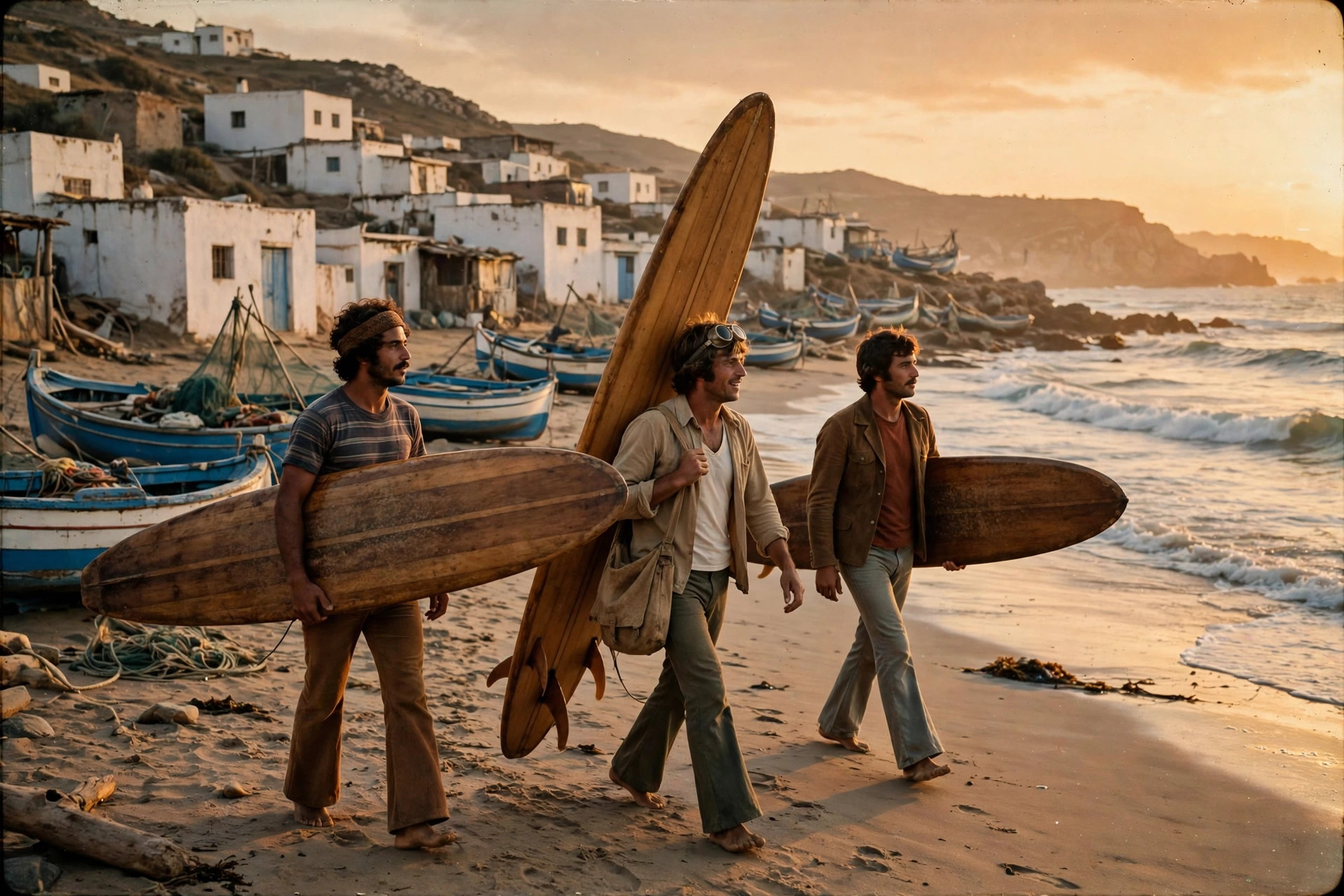
By the late 1960s, the travelling surfers arrived. Californian and European surfers driving down in camper vans followed the hippie trail into Morocco, drawn by rumours of perfect right-hand waves and 300 days of sunshine. Taghazout, then a sleepy fishing village about 20 km north of Agadir, became the focal point of the history of Moroccan surf culture.
Some of these early surfers camped on the beach for months, even years. They traded necklaces and jeans for fish, lived with local families, and taught curious Moroccan youths to surf. A number stayed for good, marrying local partners or opening small businesses. In 1973 the Moroccan military arrived with trucks and deported the hippies — the villagers, by one well-known account, cried and protested, because the visitors had become friends and family. The surfers who came in the 1970s were met with the same affection.
Lahcen and the First Moroccan Surfers
The first Moroccan surfers learned with almost nothing. Lahcen Aitidir, one of Taghazout's earliest local surfers, remembered surfing before he owned a board at all: "We surfed on tree bark or pieces of palm trees. But it wasn't so nice. It cut your skin." He got his first real surfboard from an Australian in 1971. That date is one of the few firmly documented moments in the early history of Moroccan surf culture.
Who exactly was the first Moroccan surfer is unresolved — different accounts name different young men from Taghazout and Casablanca in the same years, and no written record settles it. What is certain is that by the mid-1970s, shortboards and wetsuits were being imported into Taghazout regularly, gear became easier to find, and more local youths joined in. The first generation of the history of Moroccan surf culture learned by watching, borrowing and copying.
Anchor Point, Killer Point and the Naming of the Breaks
The breaks around Taghazout got their names from the travelling surfers of the 1970s. Anchor Point, the famous right-hand reef break at the north end of the village, was named for the anchors of wrecked ships below. Killer Point, Boilers, Hash Point and Panorama followed — names that still appear in surf magazines and travel guides today.
These names matter, because they show how the history of Moroccan surf culture was written by outsiders first. The points were already known to locals as fishing landmarks, not surf spots. The surfers renamed them in English, and the English names stuck — even now, Moroccan surf schools use them. Anchor Point remains the crown of the history of Moroccan surf culture: a long right that works best on a big north-west swell and now hosts international competitions.
Imsouane and the Longest Wave in Africa
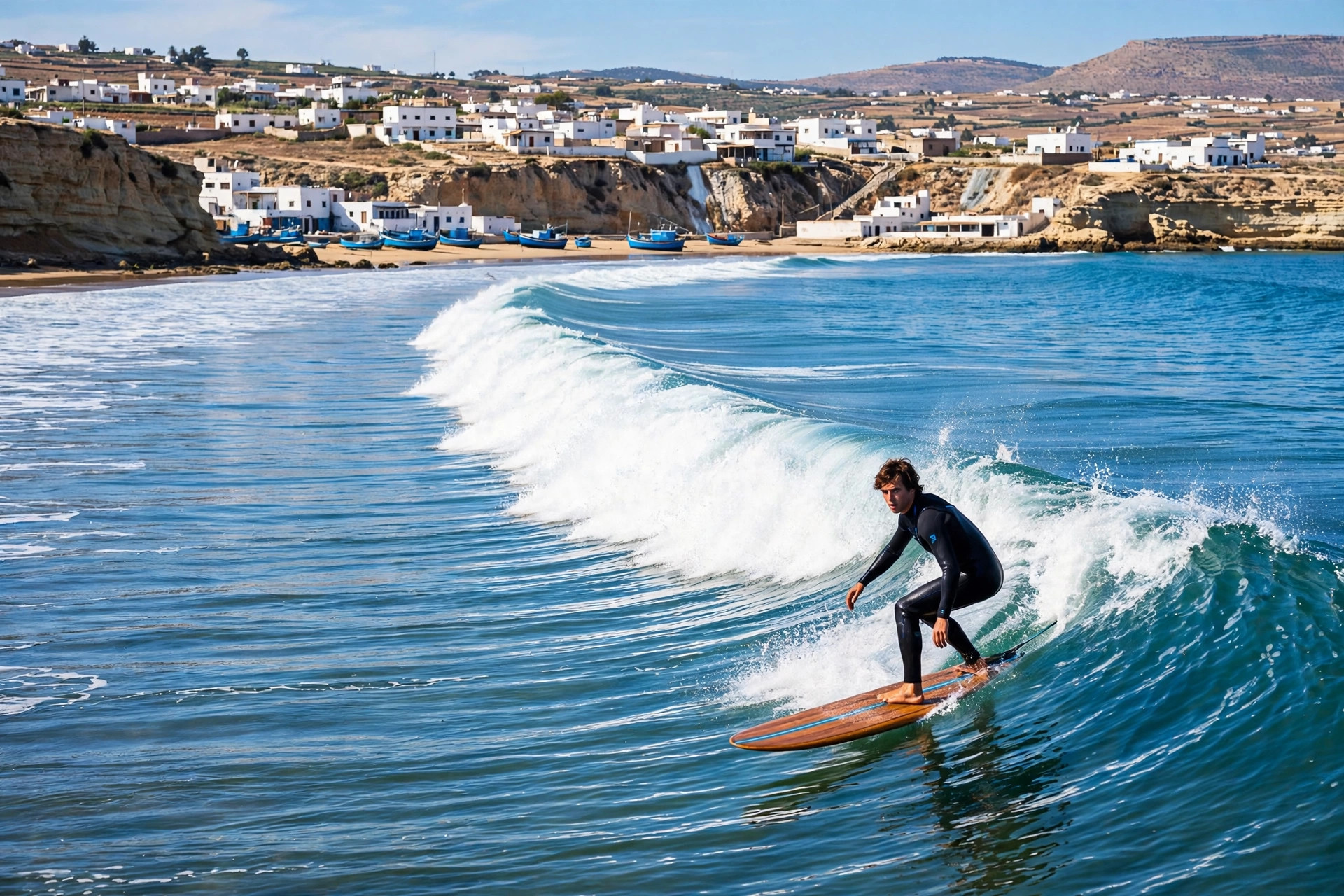
About 80 km north of Agadir, the fishing village of Imsouane holds the longest rideable right-hand wave in Africa. On a clean swell, the Bay peels for up to 800 metres — a ride that can last a minute or more — and it is gentle enough for beginners and longboarders. The neighbouring break, Cathedral Point, is faster and hollower and suits experienced shortboarders.
Imsouane's surf history is quieter than Taghazout's. It stayed a working fishing port first and a surf spot second, reached by a rough road that kept the crowds down. In early 2024 the authorities cleared many beachfront structures in the village, so it looks different from older photos — check current conditions before you book. The wave itself, of course, is unchanged, and it is the reason Imsouane now appears in every serious account of the history of Moroccan surf culture.
Essaouira: Wind, Kites and a Different Surf Scene
Essaouira, further north, took a different path. Its beach is windy — the town is famous for its trade winds — so it became a windsurfing and kitesurfing centre rather than a classic surfing town. The nearby break at Sidi Kaouki offers cleaner waves for surfers, while Essaouira itself suits a mixed trip: surfing in the morning, the medina in the afternoon.
The wind shaped the town's whole place in the history of Moroccan surf culture. Where Taghazout built surf schools and camps around point breaks, Essaouira built kite schools and windsurf centres around its wide, windy bay. Our Essaouira travel guide covers the town in full. No verified date marks when windsurfing first arrived in Essaouira, so this guide does not claim one.
The First Championships and the Surf Federation
For thirty years Moroccan surfing was informal: no clubs, no contests, no federation. That changed in 1993, when Dar Bouazza, about 20 km from Casablanca, hosted the first surf championships ever held in Morocco. Nine years later, in 2002, the Fédération Royale Marocaine de Surf et de Bodyboard was founded, and a pastime became a sport with results, rankings and a national team.
The federation's arrival mattered for the history of Moroccan surf culture because it gave local surfers a path beyond their home break: national competitions, coaching courses and, eventually, international selection. Its long-serving president, Mohamed Kadmiri, learned to surf in 1984 at Oued Echarat north of Casablanca. By the 2010s the federation counted more than 245 instructors and 53 Moroccan-run surf schools — a measure of how far the sport had come from a few borrowed boards.
The History of Moroccan Surf Culture: A Timeline
| Year | Event |
|---|---|
| Early 1960s | American servicemen surf at Mehdia Plage near Kenitra — the first boards in Morocco (exact year unresolved) |
| Late 1960s | Travelling surfers reach Taghazout; Anchor Point and Killer Point become known internationally |
| 1971 | Lahcen Aitidir gets his first surfboard from an Australian in Taghazout |
| 1973 | Moroccan military deports the hippie community from Taghazout |
| Early 1980s | Taghazout's first surf-camp infrastructure appears; surf magazines feature Morocco |
| 1993 | First Moroccan surf championships held at Dar Bouazza near Casablanca |
| 2002 | Fédération Royale Marocaine de Surf et de Bodyboard founded |
| 2015 | First Quiksilver Pro Casablanca brings a WSL event to Morocco |
| 2019 | Ramzi Boukhiam qualifies for the Tokyo 2020 Olympics at the ISA World Surfing Games |
| 2022 | Boukhiam becomes the first Moroccan to qualify for the WSL Championship Tour |
| 2026 | Junior Pro Taghazout Bay held at Anchor Point, 11–15 November |
The Pro Era: Quiksilver Pro Casablanca and the WSL
The professional era arrived in 2015, when the Quiksilver Pro Casablanca brought a World Surf League event to Morocco for the first time. The contest ran at Anfaplace in Casablanca, with the federation's backing, and returned in 2016, drawing international names to a Moroccan beach. For local surfers, seeing a world tour event at home was a turning point in the history of Moroccan surf culture: the sport they had learned on borrowed boards now had a stage.
Since then Morocco has become a regular stop on the WSL's Qualifying Series. The Pro Taghazout Bay, held at Anchor Point, is now a co-sanctioned Europe and Africa event — a QS 3,000 in February–March 2025, and a QS 4,000 in March 2026. The Junior Pro Taghazout Bay ran at Anchor Point from 11 to 15 November 2026, crowning Portugal's Jaime Veselko and Spain's Sol Borelli and deciding the European junior titles. The history of Moroccan surf culture now plays out on the world stage.
Ramzi Boukhiam: Morocco's First Championship Tour Surfer
No single person matters more to the modern history of Moroccan surf culture than Ramzi Boukhiam. Born in Agadir, he grew up surfing the right-hand points around Taghazout and spent a decade on the Qualifying Series, never cracking the top ten. Things turned in 2019, when he earned an Olympic slot at the ISA World Surfing Games and became Morocco's first Olympic surfer at Tokyo 2020.
In December 2022, at Haleiwa in Hawaii, he became the first Moroccan — and the first North African — ever to qualify for the WSL Championship Tour. He was due to debut at the Billabong Pro Pipeline in January 2023 as the first surfer to represent Morocco on the CT, but a broken ankle kept him out and Carlos Muñoz of Costa Rica replaced him. The qualification itself still stands as the high point of Moroccan surfing: a boy from Agadir's points had reached the sport's elite.
Surf Schools, Camps and the Modern Surf Economy
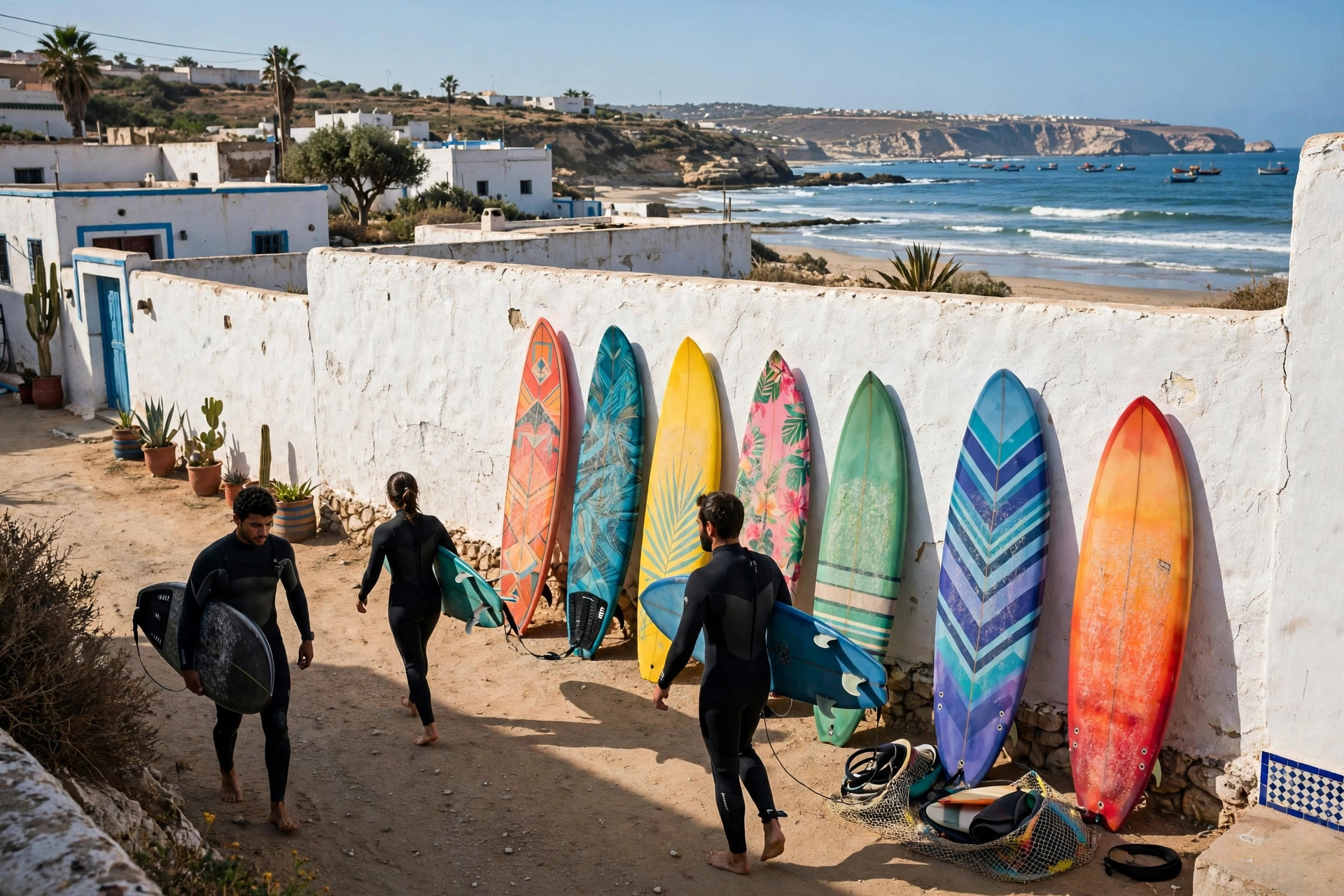
Today surfing is Taghazout's main industry. Surf schools, camps and hostels line the village, and the economy that once depended on fishing now depends on waves. A two-hour group lesson typically costs 250–350 MAD ($25–$35), a private lesson 500–700 MAD ($50–$70), and a seven-night surf camp package 4,500–12,000 MAD ($450–$1,200) — prices checked in November 2026; check on arrival, as they rise in the October–March swell season.
The big resort project at Taghazout Bay, launched under the national Plan Azur tourism programme in the 2000s, brought hotels and new infrastructure to the coast south of the old village. Some locals welcomed the jobs; others worried about the village's character. Our surf trip cost guide breaks down the full budget for a week of surfing in Morocco. The history of Moroccan surf culture is now, for better and worse, also an economic story — and the money arrives on every swell.
The Surf Spots of Morocco Today
| Spot | Best for | Wave | Best season |
|---|---|---|---|
| Anchor Point, Taghazout | Experienced surfers, contests | Long right-hand reef point | October–March |
| Killer Point, Taghazout | Intermediates | Right-hand reef, heavier | October–March |
| Imsouane Bay | Beginners, longboarders | Gentle right, up to 800 m | October–April |
| Cathedral Point, Imsouane | Experienced shortboarders | Fast, hollow right | October–March |
| Banana Beach, Tamraght | Beginners | Soft beach break | All year |
| Sidi Kaouki, near Essaouira | Intermediates, mixed trips | Clean beach and point waves | October–April |
The swell season of the history of Moroccan surf culture runs from October to March, when long-period swells roll in from the North Atlantic. Summer brings smaller, gentler waves — the best time to learn. Water temperatures run about 17–19°C in winter and 20–22°C in summer, so a 3/2 mm wetsuit is standard all year. The history of Moroccan ports explains how these coastal towns grew up around fishing and trade long before surfboards arrived, and the history of the Moroccan dirham covers the currency you will pay with in every surf town.
Frequently Asked Questions
When did surfing start in Morocco?
The history of Moroccan surf culture begins in the early 1960s, when American servicemen stationed near Kenitra surfed at Mehdia Plage. The exact year is unresolved — sources agree only on "the early 1960s". Travelling surfers reached Taghazout in the late 1960s, and the first Moroccan surfers learned there in the early 1970s.
Who was the first Moroccan surfer?
There is no agreed answer, and this guide marks it unresolved. Different accounts name different young men from Taghazout and the Casablanca beaches in the same years. Lahcen Aitidir of Taghazout is the best documented of the pioneers — he surfed on tree bark before receiving his first board from an Australian in 1971.
Where is the best surf in Morocco?
Taghazout is the capital of the history of Moroccan surf culture: a dozen breaks within walking distance, led by Anchor Point. Imsouane has the longest wave in Africa, and Essaouira is best for windsurfing and kitesurfing. Beginners do best at Banana Beach near Tamraght or the Bay at Imsouane.
How long is the wave at Imsouane?
The Bay at Imsouane peels for up to 800 metres on a clean swell — one of the longest right-hand point breaks in Africa, and a ride that can last a minute or more. On an average day the ride is shorter, around 500–600 metres.
Who is Ramzi Boukhiam?
Ramzi Boukhiam, from Agadir, is Morocco's most successful competitive surfer. He represented Morocco at the Tokyo 2020 Olympics and, in December 2022, became the first Moroccan to qualify for the Championship Tour. A broken ankle kept him from his debut at Pipeline in January 2023.
Can beginners learn to surf in Morocco?
Yes — the history of Moroccan surf culture makes Morocco one of the best places in the world to learn. Group lessons in Taghazout cost about 250–350 MAD ($25–$35) for two hours including board and wetsuit, and the gentle beach breaks at Banana Beach and Imsouane Bay suit first-timers. Summer is the easiest season to start.
Conclusion
The history of Moroccan surf culture runs from a few American servicemen at Mehdia to a Moroccan on the Championship Tour in sixty years. It passed through hippie camps on Taghazout beach, a deportation in 1973, a first board in 1971, a federation in 2002, a first WSL event in 2015 and a qualification in 2022.
What changed most in the history of Moroccan surf culture is who surfs. The first boards belonged to visitors; today the line-ups at Taghazout and Imsouane are full of Moroccans — instructors, camp owners, competitors and children learning where their parents fished. Plan a trip around the October–March swell, take a lesson or two, and watch the sunset from the point. Browse the History & Heritage section for more Moroccan stories.