
The history of Moroccan glass begins in a shard. Hold a fragment of Roman glass up to the Moroccan sun and it glows green-blue, two thousand years after it was blown. Glass has been part of Morocco longer than almost any craft you can buy in the souks today — longer than the brass teapot or the stained windows of the great riads. It arrived with Phoenician traders, flourished in Roman villas, survived the fall of an empire, and was reborn in medieval furnaces.
All prices are in Moroccan dirhams (MAD), checked in November 2026, with dollar equivalents at roughly 10 MAD to $1. They are planning ranges — check on arrival, and expect to bargain in the souks. This guide follows the history of Moroccan glass from Roman Volubilis to the recycled-glass workshops of Marrakech today.
In this guide
- The History of Moroccan Glass at a Glance
- Roman Glass at Volubilis and Lixus
- Glass After Rome: The Quiet Centuries
- Islamic Glass: Andalusian Masters and Marinid Patronage
- Stained Glass in Moroccan Architecture
- Glass Beads, Trade and the Caravan Routes
- Beldi Glass: The Tea Glass Born from Recycling
- Modern Workshops: Fez, Marrakech and Beyond
- Where to See Historic Glass Today
- Buying Moroccan Glass: What to Pay and What to Avoid
- Frequently Asked Questions
- Conclusion
The History of Moroccan Glass at a Glance
The short version of the history of Moroccan glass: Phoenician traders brought glass to the Atlantic coast, Roman workshops turned it into tableware, medieval artisans coloured it for mosques and palaces, and modern glassblowers melt old bottles into the tea glasses Moroccan homes still use.
| Period | What happened |
|---|---|
| Before 100 BCE | Phoenician traders bring glass beads and vessels to Lixus and the Atlantic coast |
| 1st–3rd centuries CE | Roman glass workshops supply Volubilis and the coastal towns with blown vessels |
| 5th–8th centuries | Glass survives the end of Roman rule; small workshops serve the new Islamic cities |
| 13th–15th centuries | Marinid patronage brings coloured glass into madrasas, palaces and mosques |
| 16th–19th centuries | Glass beads travel the caravan routes; stained glass becomes a hallmark of the riad |
| 1940s | Beldi glass is born near Marrakech, mouth-blown from recycled bottles |
| Today | Family workshops in Marrakech and Fez keep the craft alive beside factory glass |
What makes the history of Moroccan glass different is how much of it vanished. Pottery and metal survive in heaps; glass breaks, melts and is remade.
Roman Glass at Volubilis and Lixus
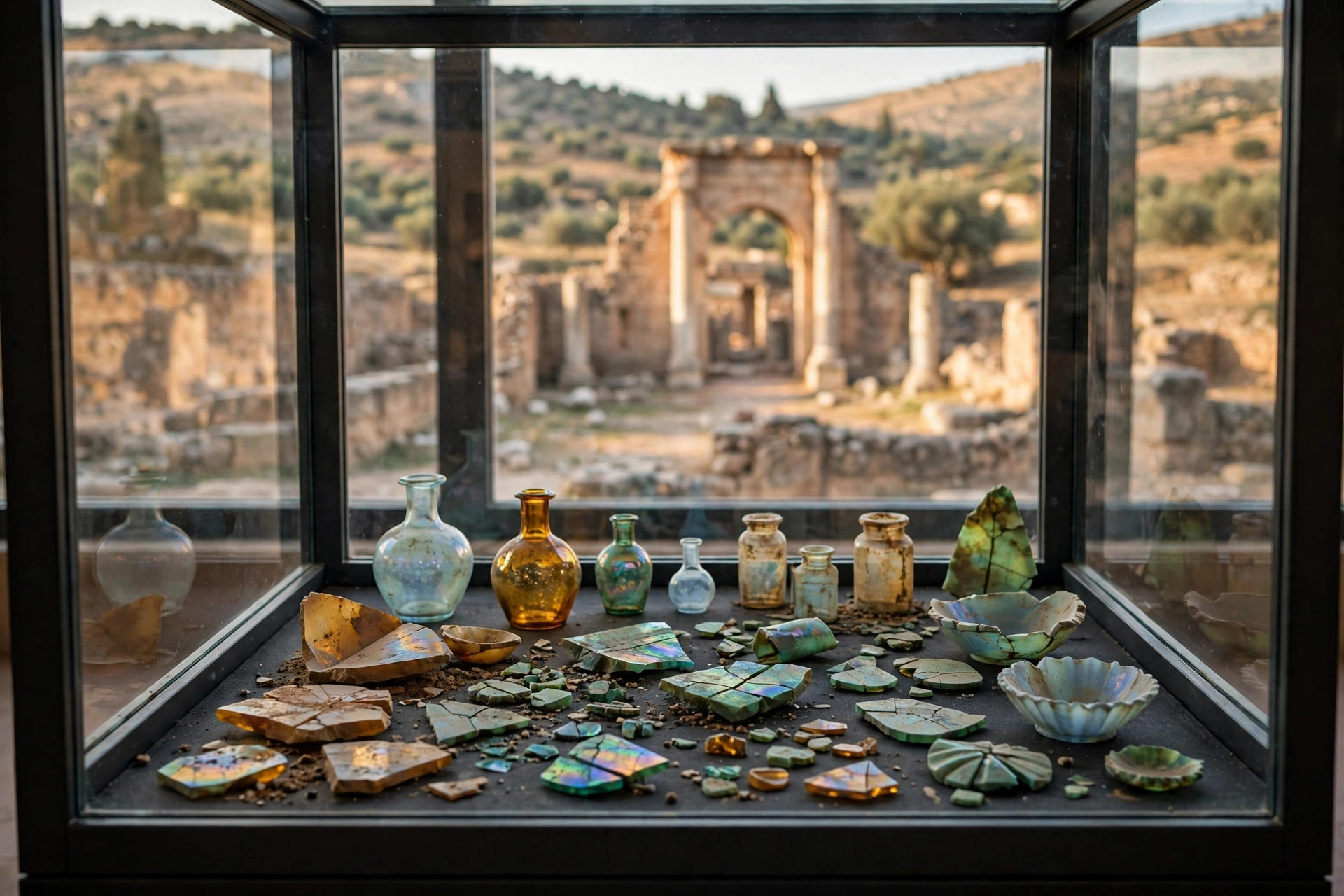
The first great chapter in the history of Moroccan glass is written in the ruins of Volubilis. When Rome made Tingis the capital of Mauretania Tingitana in 42 CE, Volubilis became a rich provincial city of olive oil, mosaics and villas — and its tables were set with glass. Excavations have turned up blown bottles, drinking cups, small perfume flasks and window panes in the pale green-blue of Roman glass, coloured by the iron in the sand.
Lixus, the older Phoenician port on the Loukkos estuary, tells an even older story. Glass reached Morocco by sea long before Rome: Phoenician traders carried glass beads and small vessels along the Atlantic coast from the 8th century BCE, and the earliest glass in Morocco was probably imported. Whether the first glass was blown on Moroccan soil in the Roman period is not fully settled — no Roman glass furnace has been firmly identified in Morocco. What is certain is that Roman Morocco was full of glass, and that the taste for it never left. It is the first import in the history of Moroccan glass.
The Romans also used glass as architecture: flat window panes lit the villas of Volubilis, and coloured glass inlays decorated walls and furniture. You can read more about the city itself in our Volubilis guide, and the story of the site’s later life is told in the history of Moroccan pottery, its sister craft in the same kilns and workshops.
Glass After Rome: The Quiet Centuries
When Roman rule ended in the 3rd century and Volubilis was abandoned after an earthquake around 425 CE, the history of Moroccan glass did not stop — it went quiet. The city was reoccupied in the 6th century and flourished again until the 9th, serving as home to Morocco’s first king, Idris I. It is a quiet, overlooked chapter in the history of Moroccan glass: the fragments that survive show the craft continuing in smaller, humbler forms — beads, small bottles, and the plain vessels of daily life.
This is the hardest part of the history of Moroccan glass to write, because so little evidence survives: early excavators at Volubilis favoured the Roman city and largely neglected the medieval layers. The exact dates of the post-Roman glass workshops are not fully settled. What the fragments prove is continuity: glassmaking in Morocco was never entirely lost, even when the cities changed hands, languages and faiths.
Islamic Glass: Andalusian Masters and Marinid Patronage
The next great flowering of the history of Moroccan glass came with the medieval dynasties. One often-repeated account credits Andalusian artisans, fleeing the Reconquista, with bringing refined glassmaking to Morocco under the Marinids in the 13th century — but the exact moment and the exact route are not fully settled, and the story may owe as much to legend as to record. What is not in doubt is that the Marinid sultans, who covered Fez with madrasas, were great patrons of coloured glass.
The Islamic world had already made glass an art of light. In the great cities of the east, glassmakers produced enamelled mosque lamps, lustre-painted vessels and gilded bottles among the finest objects of medieval art, and enamelled lamps hung in chains from the ceilings of prayer halls. Morocco's version was quieter but no less skilled: coloured glass for windows, small perfume bottles, and the drinking vessels of the court.
The craft sat beside the other arts of the medina — the zellige tile-cutters, the brass founders of our history of Moroccan metalwork, and the jewellers of the history of Moroccan jewellery — and it borrowed their geometry and colours. Few medieval Moroccan lamps survive intact, but the flared, handled vessel made to hold oil and flame is one of the most recognisable forms in the history of Moroccan glass.
Stained Glass in Moroccan Architecture
If one image sums up the history of Moroccan glass, it is a window. In the riads, palaces and madrasas of Fez and Marrakech, coloured glass is set into carved plaster and wooden lattice, turning daylight into pools of blue, green, amber and red on the floor. The technique is simple and ancient: small panes of coloured glass fitted into a pierced plaster screen, so the wall itself becomes a lantern.
The finest examples are in the old madrasas of Fez — the Bou Inania, built between 1350 and 1355, and the Attarine — where stained glass shares the walls with zellige, carved cedar and calligraphy. In Marrakech, the Bahia Palace and the old riads use the same language on a domestic scale: a coloured window over a courtyard, a fanlight above a door, a small dome of glass above a stair. In the history of Moroccan glass, the colours are never random. Blue cools a hot room, amber warms a winter morning, and green — the colour of Islam — appears in almost every window.
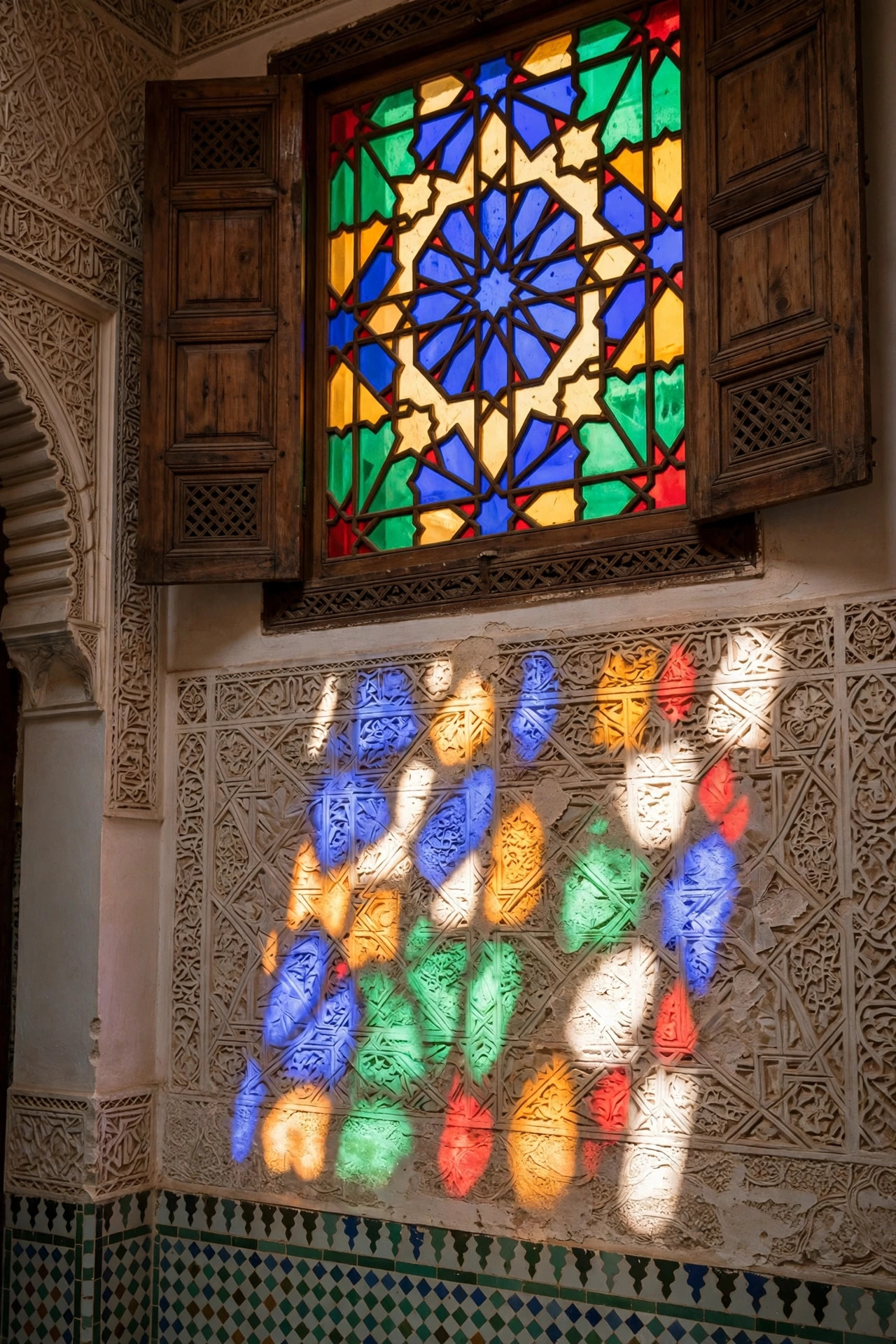
Making these windows is slow work. The plaster screen is carved by hand, the glass is cut to fit each opening, and the pieces are set without putty, held by the plaster itself. A single window can take a craftsman a week. A window in a restored riad today is the most visible surviving chapter in the history of Moroccan glass — a craft that almost disappeared when cheap factory glass arrived in the 20th century.
Glass Beads, Trade and the Caravan Routes
Glass also travelled. For centuries, glass beads were currency, ornament and trade good all at once in the history of Moroccan glass. Beads made in the Mediterranean and in Venice crossed the Sahara on the caravan routes, and Amazigh women of the Atlas and the Souss sewed them into necklaces, headdresses and dowry pieces alongside silver, amber and coral. A strand of old beads could be a woman's savings, worn on the body and sold in hard times.
The bead trade ran both ways. Moroccan ports exported glass, and the beads that came back carried the colours of distant workshops: the deep blue of the Mediterranean, the white of Venice, the amber of the east. Antique shops in Marrakech and Essaouira still sell strands of 19th-century beads — though many are modern copies, and a genuine old bead should come with a story you can check.
The same bead that hung in a necklace in the High Atlas might have been made in Venice, traded in Timbuktu and carried north by a caravan — a small, bright proof that Morocco has always been a crossroads, and that the history of Moroccan glass is a world story.
Beldi Glass: The Tea Glass Born from Recycling
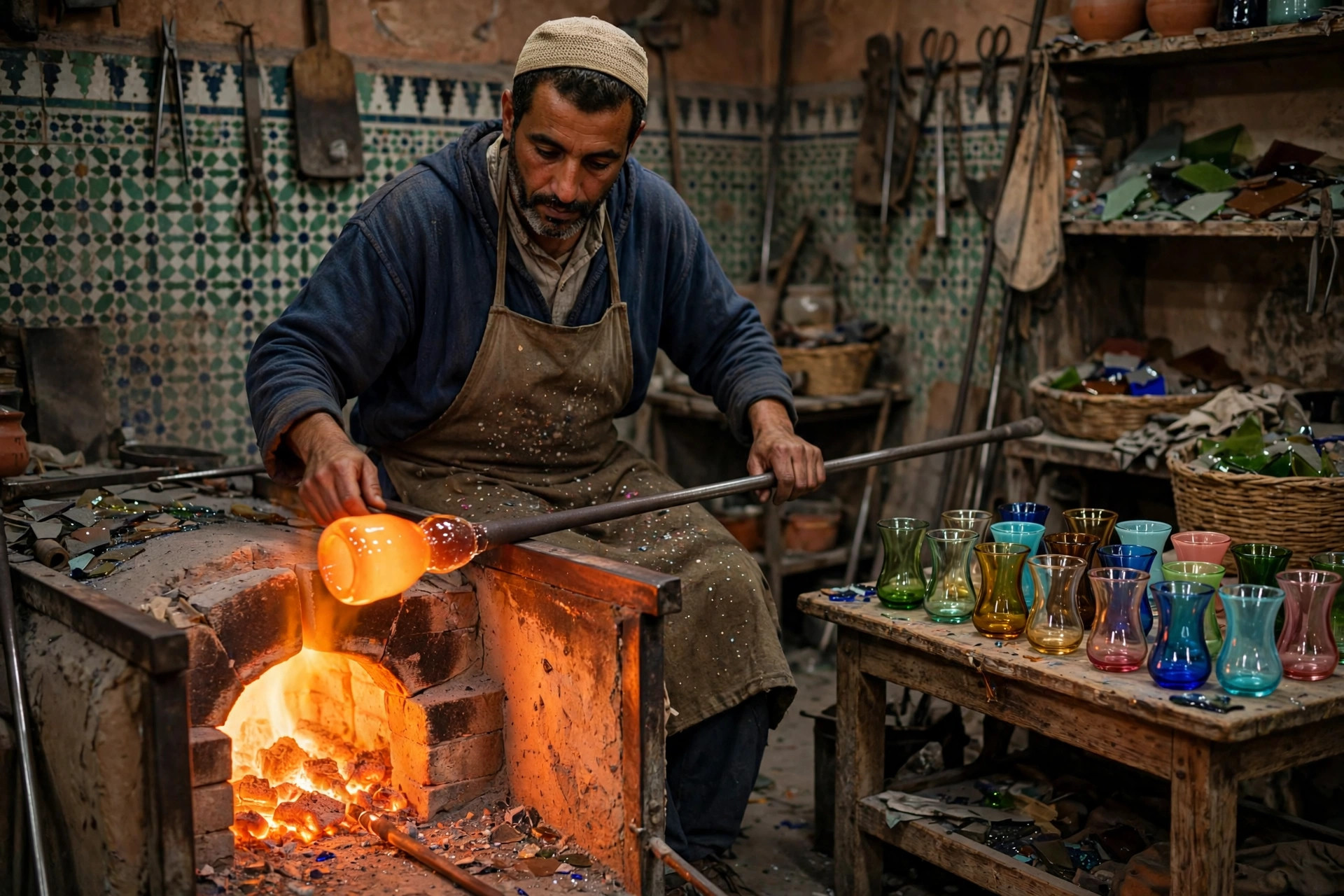
The most Moroccan chapter in the history of Moroccan glass is also the newest. Beldi glass — the hand-blown tea glass with a bump at its waist, found in almost every Moroccan home — was first created in the 1940s, outside Marrakech, from recycled glass bottles. The story is well documented: a workshop began melting down old bottles collected from hotels and restaurants, and mouth-blowing them into a new shape. The result was a glass that was cheap, sturdy and unmistakably local.
Each beldi glass is mouth-blown by hand, and no two are exactly alike. The production runs in four stages: reclaiming and recycling the old bottles, heating the cullet in the furnace, blowing and shaping each piece on the pipe, then finishing and cooling. The glass is full of tiny imperfections — a bubble here, a wobble there — and those imperfections are the point: they prove the glass was made by a person, not a machine.
The beldi glass belongs to the ritual of mint tea, and it changed the way Moroccans drink. Before it, tea was served in porcelain cups; the beldi glass, with its wide mouth and thick base, was made for tea poured from a height, and it spread from Marrakech across the whole country. A set of six beldi glasses costs roughly 60–150 MAD ($6–15) in the Marrakech souks, a single glass 10–30 MAD ($1–3). In the history of Moroccan glass, the beldi glass is the chapter that is still being written — in every kitchen, every day.
Modern Workshops: Fez, Marrakech and Beyond
The history of Moroccan glass continues in the workshops of today. Outside Marrakech, the beldi glass factories still run on recycled bottles, their furnaces burning day and night, turning out thousands of glasses a week. The workshops welcome visitors, and you can buy directly from the workshop door.
Fez has its own chapter in the history of Moroccan glass, smaller and quieter, tied to the city's madrasas and riads: stained-glass windows for restorations, coloured panes for courtyard houses, and decorative pieces for the hotels of the old city. Contemporary artisans in both cities are experimenting too — fusing old techniques with new designs for the design shops of Casablanca and abroad. The best new work keeps the old colours — cobalt blue, bottle green, amber — and gives them modern shapes.
The pressure on the craft is real. Factory glass from Asia is cheaper, thinner and perfectly regular, and it undercuts the hand-blown piece on price. But the workshops survive for the same reason the beldi glass survived in the history of Moroccan glass: Moroccans prefer the glass with a bubble in it. A handmade piece carries the hand of its maker.
Where to See Historic Glass Today
The best way to read the history of Moroccan glass is to go and look at it. The fragments are scattered — in museums, in madrasas, in workshops — but a short tour of them covers two thousand years.
| Place | What to see | Cost |
|---|---|---|
| Volubilis | Roman glass fragments and vessels in the site museum and on display near the ruins | Site entry 70 MAD ($7) |
| Rabat Archaeology Museum | Phoenician, Roman and Islamic glass from Volubilis, Lixus and Chellah | 20–30 MAD ($2–3) |
| Bou Inania Madrasa, Fez | Marinid stained glass in a 14th-century madrasa | 20 MAD ($2) |
| Attarine Madrasa, Fez | Stained glass, zellige and carved cedar in one courtyard | 20 MAD ($2) |
| Bahia Palace, Marrakech | Stained glass windows in the courtyards of a 19th-century palace | 70 MAD ($7) |
| Beldi glass workshop, Marrakech | Mouth-blown tea glasses made from recycled bottles, watch the furnace work | Free to visit |
| Dar Si Said Museum, Marrakech | Historic Moroccan crafts including glass, jewellery and woodwork | 30 MAD ($3) |
Prices are planning ranges checked in November 2026 — check on arrival. The workshops are the most rewarding stop: the glass is still hot, and the history of Moroccan glass is happening in front of you.
Buying Moroccan Glass: What to Pay and What to Avoid
A hand-blown beldi glass costs 10–30 MAD ($1–3) in the souk, and a set of six 60–150 MAD ($6–15). A small hand-blown vase or pitcher runs 80–250 MAD ($8–25), and a larger piece 200–600 MAD ($20–60). Stained glass is priced by the window: a small restored panel starts around 500 MAD ($50), and a full courtyard window runs into the thousands. These are planning ranges checked in November 2026 — check on arrival.
Buy the imperfections, not against them. A genuine hand-blown piece has bubbles, an uneven rim and a base that is never perfectly flat; a factory copy is flawless, light and cold to the touch. Hold the glass up to the light: old and hand-blown glass has depth — the oldest test in the history of Moroccan glass — with the colour changing as you turn it.
Avoid anything sold as ancient. Real Roman glass is a protected antiquity, and exporting it without a permit is illegal; the fragments in the shops are modern copies. Buy new glass from the workshop that made it, keep the receipt, and enjoy the one craft in the history of Moroccan glass that you can still take home for the price of a lunch.
Frequently Asked Questions
When did glassmaking begin in Morocco?
Glass arrived with Phoenician traders from the 8th century BCE, and Roman workshops were supplying Volubilis and Lixus with blown vessels by the 1st century CE. Whether the earliest glass was made in Morocco or imported is not fully settled, but the history of Moroccan glass stretches back nearly three thousand years.
What is beldi glass?
Beldi glass is the hand-blown Moroccan tea glass, first made in the 1940s near Marrakech from recycled bottles. It has a characteristic bump at its waist and tiny imperfections from mouth-blowing, and it is the glass in which mint tea is served across the whole country.
Where can I see Roman glass in Morocco?
Volubilis, where Roman glass vessels and fragments are displayed near the ruins, and the Archaeology Museum in Rabat, which holds glass from Volubilis. Volubilis itself is a UNESCO World Heritage site, listed in 1997.
Is Moroccan stained glass old?
The tradition is medieval — the great examples in the history of Moroccan glass are in 14th-century Marinid madrasas in Fez — but most stained glass in riads today is either restored or newly made in the old style. The technique, coloured glass set in carved plaster, has barely changed.
How can I tell handmade Moroccan glass from factory glass?
Handmade glass has bubbles, an uneven rim and a good weight; factory glass is perfectly regular, very light and flawless. A beldi glass should cost 10–30 MAD ($1–3) — far less, and it is probably machine-made.
Can I visit a glass workshop in Morocco?
Yes. The beldi glass workshops outside Marrakech welcome visitors and let you watch the blowing, and the stained-glass workshops of Fez take orders for restoration work. Visits are free.
Conclusion
The history of Moroccan glass is the story of a material that refuses to disappear. It arrived by sea with Phoenician traders, glowed on Roman tables at Volubilis, survived the fall of an empire, coloured the windows of Marinid madrasas, crossed the Sahara as beads, and was reborn in the 1940s as the beldi tea glass. That is the history of Moroccan glass in one sentence: the glass in every Moroccan home. Go to Volubilis in the morning, look at the fragments, then drive to a workshop outside Marrakech and watch a blower turn an old bottle into a new glass. Two thousand years, one craft, and the furnace is still lit. More Moroccan crafts and dynasties wait in our History & Heritage section.