
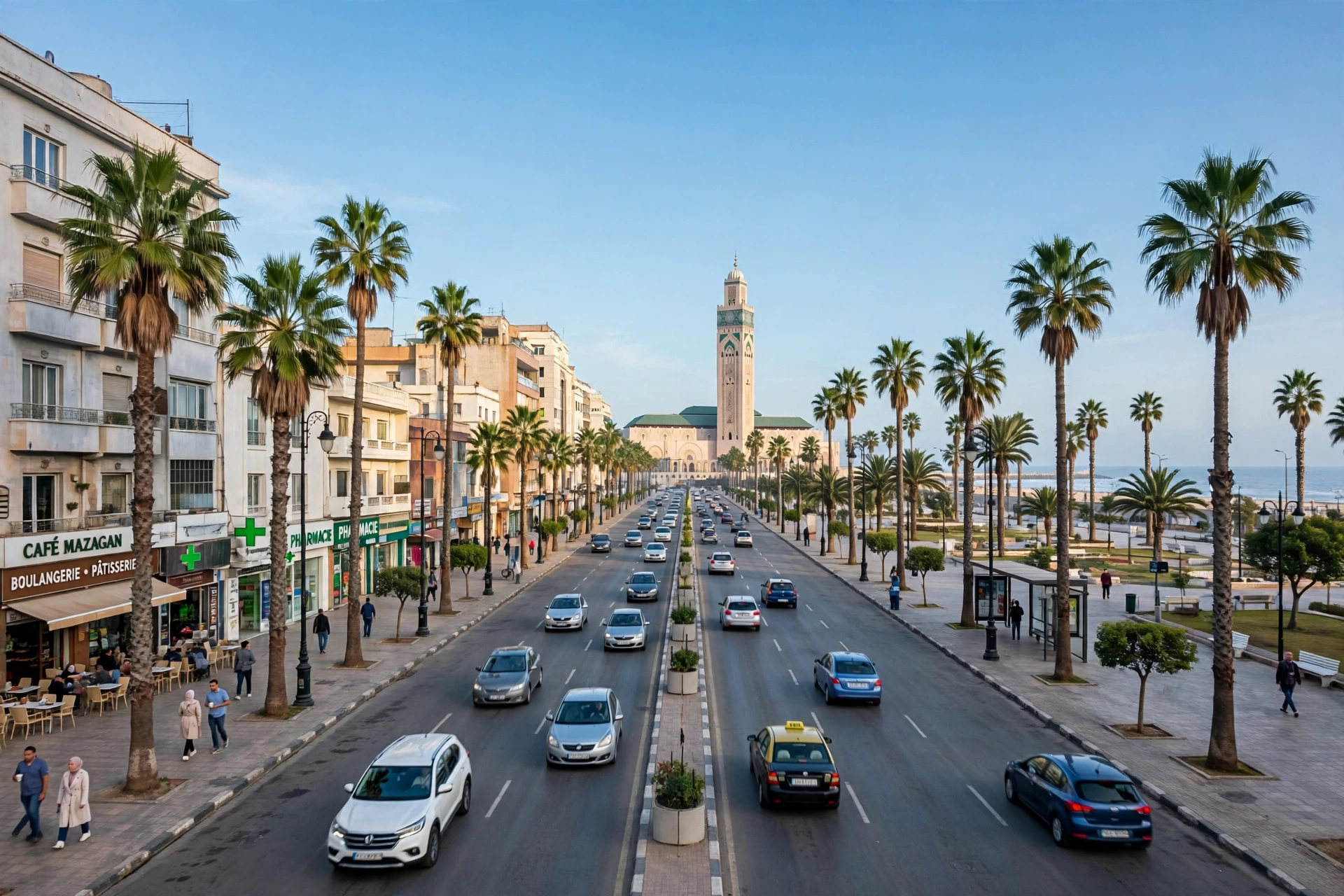
Moving to Morocco is exciting until the paperwork starts, and few pieces of paperwork matter as much as a morocco driving licence. Whether you have just rented a flat in Casablanca, settled in Marrakech, or moved to a quiet town in the Atlas foothills, a car quickly becomes the difference between exploring the country and being stuck in it. This guide explains how to get a morocco driving licence as an expat, step by step, in plain English: the two routes open to you, the documents to prepare, the real costs in dirhams, and the mistakes that catch newcomers out.
Every price in this guide is in Moroccan dirhams (MAD) with a dollar equivalent, checked in November 2026 at roughly 10 MAD to the dollar. The rules come from Law 52-05, the Moroccan Highway Code, and the procedures of NARSA, the National Road Safety Agency, which runs licensing. Where a fact is disputed or unpublished — and there are a few — this guide says so plainly rather than guessing. If you already hold a licence from your home country, start with the exchange route; if you have never held a licence, or your country has no agreement with Morocco, the test route is your path to a morocco driving licence. Either way, plan early: the one-year clock on your foreign licence starts sooner than most expats expect.
In this guide
- The Two Routes to a Morocco Driving Licence
- Driving on Your Foreign Licence: The One-Year Window
- Exchanging a Foreign Licence for a Morocco Driving Licence
- Taking the Moroccan Driving Test
- Exchange Route Costs
- Test Route Costs
- Driving in Morocco with Your New Morocco Driving Licence
- Common Mistakes Expats Make
- Renewals, Lost Licences and Moving On
- Morocco Driving Licence FAQ
The Two Routes to a Morocco Driving Licence
There are exactly two ways for an expat to end up with a morocco driving licence, and which one applies to you depends on one question: do you already hold a valid licence from your home country, and does Morocco recognise it? If the answer to both is yes, you can exchange your foreign licence for a Moroccan one without sitting any test. If you have no licence, or your country has no reciprocal agreement with Morocco, you must take the Moroccan driving test from scratch — theory and practical — through a licensed driving school.
The exchange route is faster and cheaper, and it is the route most long-term expats take. The test route is slower and costs more, but it is open to everyone who is legally resident and at least 18 years old. This guide covers both in full, because many expats start down one route and discover halfway that they belong on the other. Before you spend a dirham on a morocco driving licence, check which route is yours: it saves weeks of wasted effort and, in the case of the test route, thousands of dirhams.
Driving on Your Foreign Licence: The One-Year Window
When you first arrive in Morocco as a resident, your foreign licence is perfectly legal to drive on — for up to one year. That one-year window comes from Law 52-05, the Highway Code, and it runs from the start of your stay or residency. During that year you can drive any vehicle your foreign licence covers, as long as the licence itself stays valid. Carry your passport with the licence, because police checks often ask for both together, and keep an International Driving Permit (IDP) with you as well: it is not legally required for most licences, but it translates your licence into French and smooths every conversation at a checkpoint.
What happens when the year ends matters more than the year itself. After twelve months you can no longer legally drive on the foreign licence, and you need a morocco driving licence of your own. Whether the exchange application itself must also be filed within that first year is not settled — sources disagree, and NARSA does not publish a clear answer — so do not leave the application to the last month. Start the exchange in month six or seven, while your foreign licence is still comfortably valid, and keep driving on your provisional licence while the file is processed.
Exchanging a Foreign Licence for a Morocco Driving Licence
Exchanging a foreign licence for a morocco driving licence is handled by NARSA, the National Road Safety Agency, through its provincial registration centres. You apply in person, with your originals, at the centre covering the area where you live — there is no fully online exchange, and you should plan on attending the counter yourself. The first condition is the one that catches people out: the exchange is only possible if your country has a reciprocal recognition agreement with Morocco. Morocco has signed such agreements with around 20 countries — reported as eight Arab, six African and six European states as of 2024 — but the list changes as new agreements are signed, so confirm your country's position with NARSA before you plan around it.
Once your file is accepted as complete, you are issued a provisional licence valid for 60 days, so you are not left unable to drive while the exchange is processed. NARSA then contacts the authorities in the country that issued your original licence to verify that it is genuine and has not been suspended or withdrawn. The stated processing time is 30 to 60 days, though in practice it can run longer if the verification reply is slow. Your original foreign licence is kept by the administration during the exchange, which is why the provisional licence matters — do not plan a trip abroad by car in that window without checking what documents you will need.
- The exchange application form, completed and signed
- Your residence card (or its receipt) and a copy
- A certificate of residence less than three months old
- A medical certificate less than three months old, from an approved doctor
- Two recent passport photos, 35 x 45 mm, on a blue background
- Your original foreign licence, still valid
- A certified translation of the licence if it is not in French or Arabic
- The stamp duty receipt, paid at the Treasury office
- Proof of your right to drive in your home country, if your centre asks for it
Requirements vary slightly between centres, and the person at the counter has the final say on whether your file is complete. Bring originals and copies of everything, and keep a copy of the whole file for yourself: if anything is questioned later, you will be glad you did. Fees are another point to treat with care. Specialist websites quote around 700 MAD in stamp duty and fees for the exchange, but NARSA does not publish this figure, so treat it as a guide rather than a promise and confirm the amount at your centre before you pay.
Taking the Moroccan Driving Test
If you cannot exchange — because you have never held a licence, or your country has no agreement with Morocco — you take the Moroccan test, and a morocco driving licence earned this way is exactly the same document as one obtained by exchange. The route runs through a licensed driving school (auto-école), which handles your file, your lessons and your exam bookings. You must be at least 18 years old and legally resident, and you need a medical certificate confirming you are fit to drive. The standard licence is category B, which covers cars and light vehicles up to 3.5 tonnes.
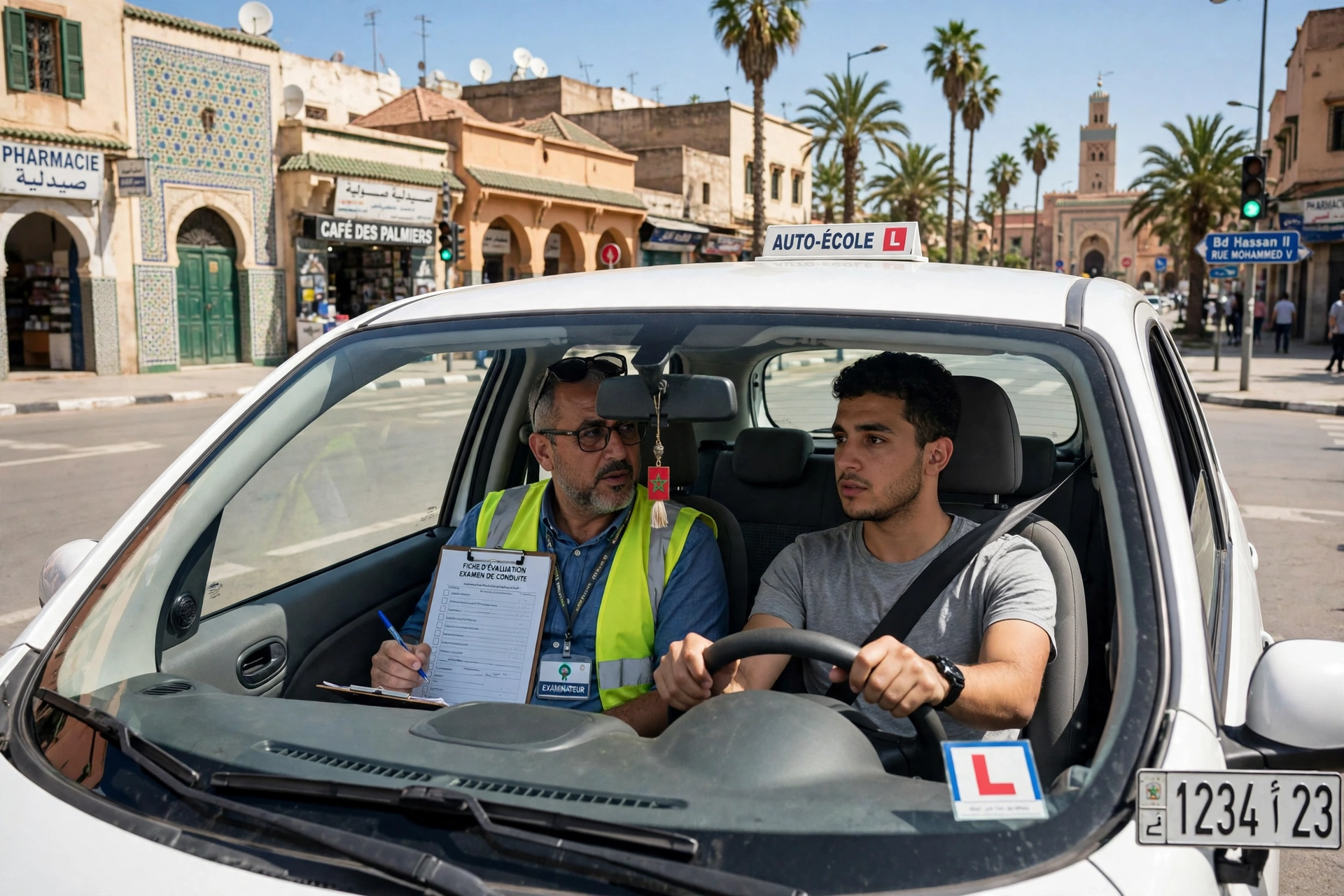
The theory test comes first. It covers the code de la route — road signs, priorities, speed limits and safe driving — and it is taken on a computer at an approved centre: 40 multiple-choice questions in 40 minutes. The exact pass mark is one of the disputed points in this guide: some sources describe it as a maximum of 10 error points, others as 35 correct answers out of 40, and NARSA's own published material does not settle it in a form an English speaker can easily check. Treat the test as demanding — your driving school will drill you with practice sets — and confirm the current pass mark with your school before exam day.
After the theory comes the practical training: a minimum of 20 hours of driving lessons with your school, covering city driving, parking and the manoeuvres the examiners test. The practical exam itself is a road test with a licensing official, usually with your instructor in the car. Most schools quote a total package for category B of 2,650–3,550 MAD, which typically bundles the lessons, the theory and practical exam fees and the file handling; always ask for the contract in writing and check exactly what is included before you sign.
Language is the practical problem most expats underestimate. The theory test is administered in Arabic and French, and while some centres offer other languages, that is decided by NARSA and varies — check the current options with your school before you book, and do not assume an English paper will be available. If your French is shaky, budget extra weeks for the theory: the questions use formal road-safety vocabulary, and the practice sets your school gives you are the best preparation there is.
Exchange Route Costs
The exchange is the cheap route, and most of its cost is stamp duty and paperwork rather than lessons or exams. The table below uses the figures most commonly quoted by specialist sources, checked in November 2026; the stamp duty figure is not published by NARSA, so confirm it at your centre. At roughly 10 MAD to the dollar, a morocco driving licence by exchange should cost well under $100 if no translation or extra document is needed.
| Exchange route item | Cost in MAD | Cost in USD |
|---|---|---|
| Stamp duty and NARSA fees | ~700 | ~$70 |
| Medical certificate (approved doctor) | 100–200 | $10–$20 |
| Passport photos, 35 x 45 mm, blue background | 30–50 | $3–$5 |
| Sworn translation of licence (if needed) | 150–300 | $15–$30 |
| Residence certificate | 20–50 | $2–$5 |
| Typical total | 1,000–1,300 | ~$100–$130 |
Test Route Costs
Getting a morocco driving licence by the test route costs several times more, because you are paying for lessons as well as exams. The table below is built from the driving-school totals quoted for category B in 2026 and the official fees listed on the government's procedures portal. Schools in Casablanca and Rabat tend to charge the top of the range, while smaller towns are cheaper — but a cheap school with a poor pass rate is the most expensive choice of all.
| Test route item | Cost in MAD | Cost in USD |
|---|---|---|
| Driving school package, category B (lessons + exams) | 2,650–3,550 | $265–$355 |
| NARSA exam fee | 250 | $25 |
| Tax administration fees | 100–200 | $10–$20 |
| Medical certificate (approved doctor) | 100–200 | $10–$20 |
| Passport photos | 30–50 | $3–$5 |
| Extra driving hours (if needed, per hour) | 100–150 | $10–$15 |
| Typical total | 3,130–4,250 | ~$313–$425 |
Driving in Morocco with Your New Morocco Driving Licence
Morocco drives on the right, and the rules on paper will look familiar to any European or North American driver: 60 km/h in towns, 100 km/h on open roads, 120 km/h on motorways. The alcohol limit is 0.02% — effectively zero tolerance — and the points system gives new drivers 20 points during a two-year probation period, rising to 30 afterwards. Fixed speed cameras are everywhere on main roads, and mobile police checks with radar are common at the entrance to towns; the fine for speeding is usually 300–700 MAD ($30–$70), payable on the spot with a receipt.
Two rules catch newcomers more than any others. The first is priorité à droite: at unmarked intersections, traffic coming from your right has priority, and in older neighbourhoods unmarked junctions are everywhere. The second is the roundabout, where traffic already in the circle has priority — go slowly, commit to your exit early, and do not stop inside the circle. Our Morocco road trip guide covers these rules in the context of a long drive, and our Morocco taxi prices guide is worth reading before your first weeks, when you will still be mixing driving with taxis.
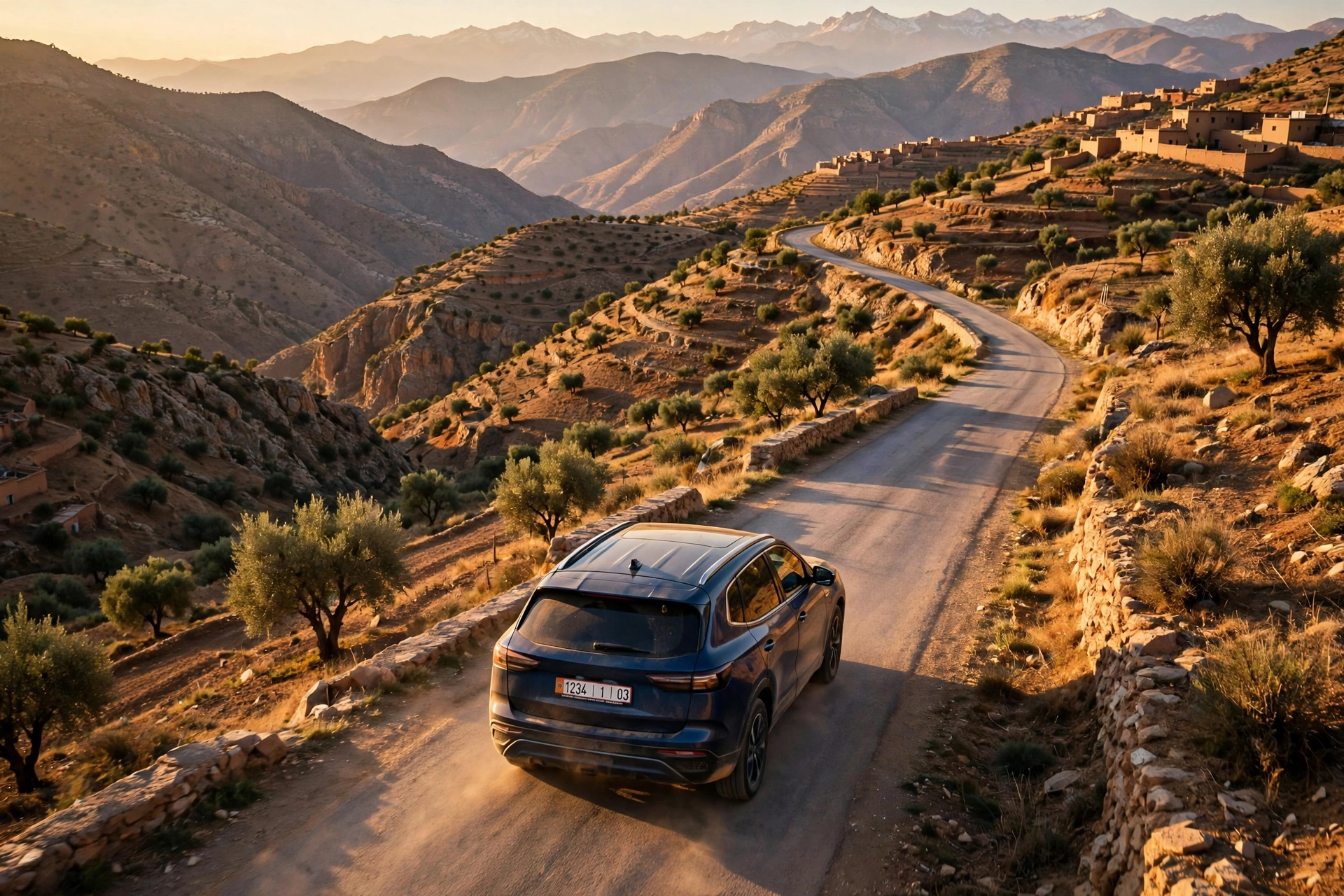
Keep your licence, passport or residence card and car papers in the vehicle at all times; police checks ask for them often, and documents in order end the stop in two minutes. Never drive at night on mountain roads if you can avoid it: outside the cities the roads are poorly lit, animals cross without warning, and unlit carts and parked trucks appear where you least expect them. The background to all of this — the motorways, ports and railways that shape Moroccan driving — is well summarised in Wikipedia's overview of transport in Morocco.
Common Mistakes Expats Make
The first mistake is waiting too long. Expats who plan to exchange often discover in month eleven that their file needs a document from home — a driving-rights certificate, a certified translation — that takes weeks to obtain, and then the one-year window closes while they are still waiting. Start in month six. The second mistake is assuming your country's agreement covers you: a licence from a country without a reciprocal agreement cannot be exchanged at any price, and the test route is the only option.
The third mistake is buying a car before the licence is sorted. Dealers and private sellers will happily take your money, but registering a car and insuring it in your name is far simpler once your morocco driving licence exists. The fourth is skipping the medical certificate's three-month rule: both the medical certificate and the residence certificate must be less than three months old when you file, and an expired certificate is the most common reason a file is sent back. If you are still setting up your life in Morocco, our Living in Morocco section covers the practical side of settling in, from internet and mobile to gyms and fitness.
Renewals, Lost Licences and Moving On
A morocco driving licence is valid for 10 years for drivers under 65 — the shorter two-year validity reported for drivers over 65 is one more figure to confirm with NARSA, since official sources do not state it consistently. Renewal uses a similar file to the exchange: a fresh medical certificate, photos, your residence card and the old licence, filed at your local NARSA centre before the expiry date. Do not let it lapse: driving on an expired licence carries the same penalties as driving without one.
If your Moroccan licence is lost or stolen, report it to the police and apply for a duplicate at the NARSA centre that issued it, with the police report, your residence card and fresh photos. If you leave Morocco permanently, your Moroccan licence remains valid in Morocco, and several countries — France, Spain and Italy among them — allow you to exchange it for a local licence when you move there, under their own reciprocal agreements. The exact procedure for taking the Moroccan test is set out on the government's official Idarati procedure page, which is the most reliable place to check the current document list before you file.
Getting a morocco driving licence as an expat is a bureaucratic process, not a difficult one: check your country's agreement, gather the file early, and choose the exchange route if you can and the test route if you must. Do it in your first six months, while your foreign licence still gives you the freedom to drive, and the Moroccan roads — from the Casablanca corniche to the Atlas passes — open up to you for the next ten years.
Morocco Driving Licence FAQ
Can I drive in Morocco with my foreign licence?
Yes, for up to one year from the start of your stay or residency, as long as the licence itself stays valid. Carry your passport with it, and an International Driving Permit as well. After that year you need a Moroccan licence.
Can I exchange my licence without taking a test?
Only if your country has a reciprocal recognition agreement with Morocco. Around 20 countries are reported to have such agreements, but the list changes, so confirm your country's position with NARSA before you apply. If there is no agreement, you must take the Moroccan theory and practical tests.
How much does a morocco driving licence cost for expats?
By exchange, typically 1,000–1,300 MAD ($100–$130) including the medical certificate, photos and any translation. By the test route, typically 3,130–4,250 MAD ($313–$425) for a driving school package plus official fees.
Do I need an International Driving Permit in Morocco?
It is strongly recommended but not legally required for most foreign licences. An IDP translates your licence into French, which helps at police checks, and it is essential if your licence is not written in the Latin alphabet.
How long does it take to get a morocco driving licence?
An exchange is officially stated at 30 to 60 days, with a provisional licence valid for 60 days issued when you file. The test route usually takes two to four months, depending on your driving school's schedule and how quickly you pass the theory test.
What happens if my foreign licence expires before I exchange it?
You cannot legally drive in Morocco until the situation is resolved. Renew your licence in your home country if you can, or take the Moroccan test route instead. Never drive on an expired licence: the fines are heavy, and your insurance will not cover you.
Last checked: November 2026.