
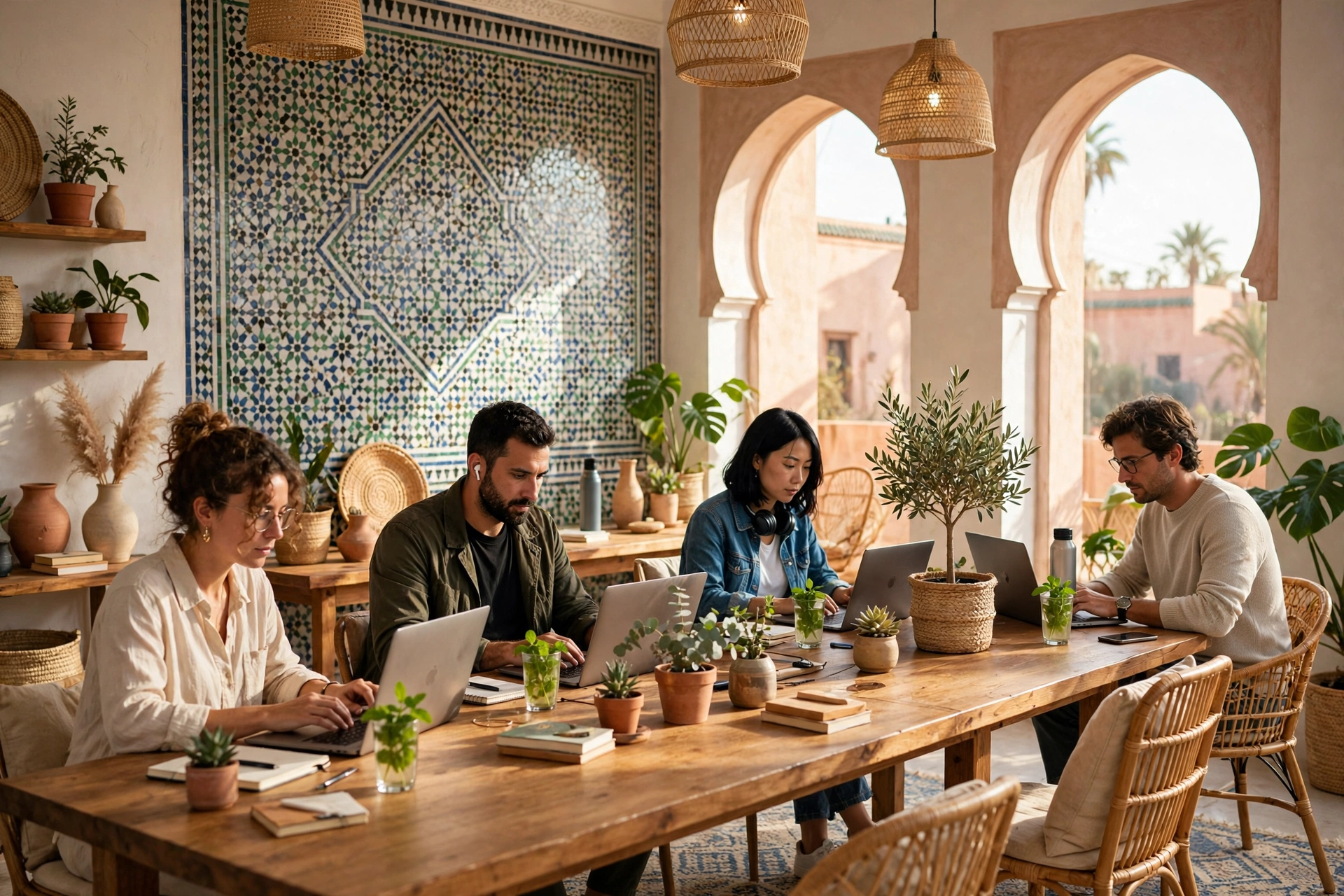
The best morocco coworking spaces solve the one problem every remote worker meets in this country: the wifi in your riad is fine until it is not. Morocco has fast fibre in the big cities and a deep café culture, but a reliable desk, a quiet call room and a backup connection still matter when your income depends on it. This guide compares the real options city by city, with honest prices in dirhams, so you can pick a base and start fast.
Morocco's remote-work scene has changed fast. Five years ago a "coworking space" here usually meant a friendly café with a power socket. Today Marrakech and Casablanca have proper shared offices, Tangier has spaces aimed at the European remote crowd, and even Essaouira has laptop-friendly cafés that work as informal offices. The digital nomad lifestyle fits Morocco well: low costs, a European-overlapping time zone, and sunshine that makes a lunch break feel like a holiday.
This guide is for people who actually need to work, not just post about it. Every price below was checked in November 2026, and every space type is one you can walk into this month. For the wider picture, start with our Living in Morocco section, our Digital Nomad Guide to Morocco for visas and bases, and the official Visit Morocco portal for the cities themselves.
In this guide
- Why Morocco Coworking Spaces Work So Well
- The Best Morocco Coworking Spaces by City
- What Morocco Coworking Spaces Cost in 2026
- Day Passes, Hot Desks and Dedicated Desks
- What to Check Before You Pay
- Coworking Cafés: The Moroccan Alternative
- A Realistic Work Week from Morocco
- Practical Tips for Working from Morocco
- Morocco Coworking Spaces FAQ
Why Morocco Coworking Spaces Work So Well
Morocco sits in almost the same time zone as London and one hour behind most of continental Europe, so your working day lines up with your clients. That explains much of the country's appeal, and morocco coworking spaces handle the rest: stable internet, a desk for eight hours, and a room for video calls.
The second reason is cost: a monthly hot desk in Marrakech or Casablanca costs less than a week of coworking in London or Paris, and the saving goes far where lunch is 60 dirhams. Many nomads find the membership is their only fixed work expense. Our Best Places to Live in Morocco guide compares the cities if you have not chosen a base yet.
The third reason is community. Working alone from a flat in a foreign city gets lonely fast, and morocco coworking spaces are where the informal network happens: the designer who knows a good accountant, the developer who can recommend a landlord, the writer who invites you to the desert. Most spaces run a weekly lunch or Friday social, often worth more than the desk itself. Stay for months, and that network becomes your social life.
There is also a practical argument: Moroccan flats, especially in the old medinas, were not built for remote work. Thick walls eat wifi signals, riad courtyards echo, and the nearest café may close at 8 p.m. A coworking space gives you a professional address and somewhere to go every morning that is not your bedroom.
The Best Morocco Coworking Spaces by City
No city has a monopoly on good workspaces: Marrakech has the most spaces and the liveliest community, Casablanca the most professional offices, Tangier the fastest route to Europe, Rabat calm and good connections, and Essaouira quality of life over desk count.
Marrakech
Marrakech is the capital of Morocco's nomad scene, with the widest choice of morocco coworking spaces, from slick offices in Guéliz to converted riads in the medina with rooftop desks. Expect hot desks from around 1,200 dirhams a month, day passes around 120 to 150 dirhams, fibre of 100 Mbps and above, and a young, international, entrepreneurial crowd.
The trade-off is the summer heat: from June to September, strong air conditioning is the difference between working and melting. The city also has the best café backup in the country — a dozen laptop-friendly cafés nearby.
Casablanca
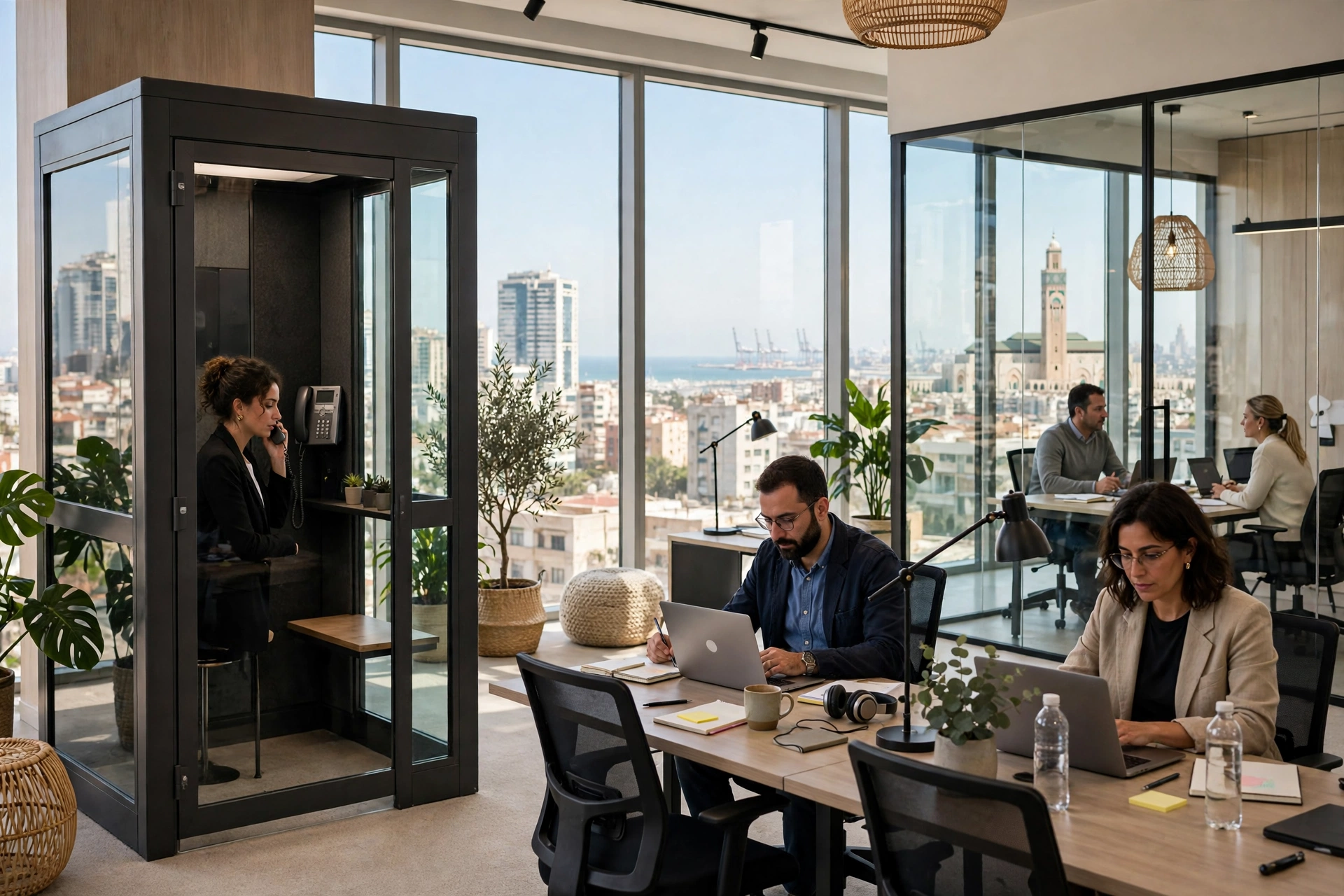
Casablanca is the business city, and its coworking spaces reflect that: more corporate, more expensive and more reliable than anywhere else in Morocco, with proper meeting rooms, reception staff, working printers, and internet with a service-level agreement rather than a shrug. Day passes run 150 to 200 dirhams and monthly hot desks 1,800 to 2,500 — roughly double Marrakech. The crowd mixes Moroccan startups, freelancers and remote employees of European companies.
To impress a client on a video call, Casablanca is the safest choice, with the best transport links in the country: the Al Boraq high-speed train and an international airport. The downside is atmosphere — a working city, not a holiday town.
Tangier
Tangier has quietly become one of the best bases for remote workers in Morocco: 14 kilometres from Spain, an hour by ferry to Tarifa, and just over two hours by high-speed train to Casablanca. Its coworking spaces are smaller and newer than Marrakech's, with monthly hot desks around 1,000 to 1,500 dirhams, aimed at European remote workers who want a cheap base with easy access home.
Tangier's medina and corniche give you a beautiful walk after work, for less than living in Casablanca. The community is smaller — people remember your name — but choice is limited: a handful of proper spaces, so if one does not suit you, the fallback is cafés.
Rabat
Rabat is the calm, green capital, and its coworking spaces suit people who want quiet focus rather than buzz. Expect prices similar to Tangier — monthly hot desks around 1,200 to 1,600 dirhams — with reliable fibre and very few tourists, mostly in Agdal and Hay Riad near the tram and train station.
Rabat suits long stays: safe, walkable, an hour from Casablanca by train. It is less exciting than Marrakech and the nomad community is thin — but for deep work, few cities in Morocco beat it.
Essaouira and Agadir
Essaouira has no big coworking chains, and that is part of its charm. The work scene runs on a handful of small spaces and many laptop-friendly cafés on the beachfront and in the medina, where a coffee buys three hours of fast wifi. Expect 80 to 120 dirhams for a day in a small space, or just the price of a coffee in a café.
Agadir is similar but more practical: a modern city with wide streets, reliable internet and growing numbers of small offices for remote workers, priced between Essaouira and Marrakech.
What Morocco Coworking Spaces Cost in 2026
Prices vary by city and by what is included, but the pattern is consistent across morocco coworking spaces: Morocco is cheap next to Europe and the United States, and the biggest saving comes from committing monthly. The table below shows typical prices checked in November 2026, with dollar equivalents at roughly 10 dirhams to the dollar.
| City | Day pass | Hot desk / month | Dedicated desk / month |
|---|---|---|---|
| Marrakech | 120–150 MAD ($12–15) | 1,200–1,800 MAD ($120–180) | 2,000–2,800 MAD ($200–280) |
| Casablanca | 150–200 MAD ($15–20) | 1,800–2,500 MAD ($180–250) | 2,800–4,000 MAD ($280–400) |
| Tangier | 100–150 MAD ($10–15) | 1,000–1,500 MAD ($100–150) | 1,800–2,500 MAD ($180–250) |
| Rabat | 120–150 MAD ($12–15) | 1,200–1,600 MAD ($120–160) | 2,000–2,800 MAD ($200–280) |
| Essaouira | 80–120 MAD ($8–12) | 800–1,200 MAD ($80–120) | 1,500–2,000 MAD ($150–200) |
| Agadir | 100–150 MAD ($10–15) | 1,000–1,500 MAD ($100–150) | 1,800–2,400 MAD ($180–240) |
| Fes | 80–120 MAD ($8–12) | 900–1,400 MAD ($90–140) | 1,600–2,200 MAD ($160–220) |
Most prices include wifi, coffee or tea, small amounts of printing and meeting-room access by the hour. What usually costs extra: a private office, a locker, 24-hour access, and meeting room time beyond a couple of hours a week. Always ask what the headline price leaves out. A monthly hot desk at 1,500 dirhams that charges 100 dirhams an hour for meeting rooms can cost more than a 2,000-dirham plan that includes them — morocco coworking spaces differ widely in what they bundle.
Negotiation is normal, especially outside the big cities: a three-month commitment often earns 10 to 20 percent off, and some spaces waive the joining fee if you ask. Prices here are typical ranges, not quotes — expect firmer prices from October to April, when Europe's nomads arrive for the winter.
Day Passes, Hot Desks and Dedicated Desks
Choosing a membership at one of the morocco coworking spaces is choosing how fixed your routine is. A day pass suits passing through a city for a few days, when you need a desk tomorrow, not a community: walk in, pay, work, leave with nothing to cancel. The downside is the price — five day passes a week cost more than a monthly hot desk in most cities.
A hot desk is the standard choice for stays of a month or more: a different desk each day in a shared room, a locker if you are lucky, and full access to the kitchen, meeting rooms and events — the best value in the country. The risk is a busy week when the good seats are gone by 9 a.m.: arrive early or ask whether members can reserve a spot.
A dedicated desk suits stays of three months or longer, when you want your monitor and keyboard to stay put: roughly 50 percent more than a hot desk for a desk that is always yours. Private offices start around 4,000 to 6,000 dirhams a month in Casablanca and 3,000 to 4,500 in Marrakech, for small teams rather than solo workers.
| Membership | Best for | Typical monthly cost | Watch out for |
|---|---|---|---|
| Day pass | Short stays, 1–3 days | 500–1,000 MAD ($50–100) for a week | No locker, no guaranteed seat |
| Hot desk | Stays of 1–3 months | 1,000–2,500 MAD ($100–250) | Busy mornings, no fixed spot |
| Dedicated desk | Stays of 3+ months | 1,800–4,000 MAD ($180–400) | Paying for days you travel |
| Private office | Teams of 2–4 people | 3,000–6,000 MAD ($300–600) | Cleaning and utility extras |
One tip: do not buy a monthly pass in your first week. Buy day passes in two or three spaces, work a day in each, then commit to the one you liked — and check the cancellation terms before you sign, since a space needing thirty days' notice to cancel expects you to forget.
What to Check Before You Pay
A coworking space is only as good as its internet: test it yourself rather than trust the advertised speed. Run a speed test on your own laptop and join a video call from the desk you would actually use. Fibre is widespread in the big cities, but the last stretch of cable into an old building can be slow, and a space that advertises 200 Mbps may deliver 20 at your desk — a common complaint about morocco coworking spaces in older medina buildings. Our Morocco Internet for Expats guide explains the fibre and 4G picture, including the backup SIM every remote worker should carry.
Noise is the second test: visit at 10 a.m. on a weekday, when the space is full, and listen. Open-plan rooms in converted riads echo badly, and a space next to a busy street fights traffic noise all day. Check for a quiet room or call booth, and whether people respect it.
Chairs and desks matter more than décor: you will sit in that chair eight hours a day, so try it for twenty minutes before you pay. Look for adjustable chairs, desks at the right height and room for a laptop and a notebook. Power sockets are another easy check: one per desk, not one per four desks with cables across the floor.
Ask about the practical details, too: opening hours, 24-hour access and its cost, a kitchen fridge, receiving mail, and what happens when the internet goes down — is there a 4G backup router? The answers separate the professional spaces from the pretty ones.
Coworking Cafés: The Moroccan Alternative
Morocco's café culture is so strong that many remote workers never buy a coworking membership at all, even though morocco coworking spaces keep growing. In every city there are cafés with fast wifi, power sockets and owners who are happy to have you work for three hours over two coffees. This is the cheapest way to work in Morocco, and in Essaouira, Chefchaouen and the smaller towns often the only way. The unwritten rule: order regularly, tip decently, and leave when the lunch crowd arrives.
Cafés suit flexible work — writing, email, planning, calls with headphones — but not confidential calls, long meetings or anything needing a big screen. The wifi handles browsing but can struggle with large uploads, and the socket you need may be taken. Treat cafés as your second office, and keep a coworking day pass in reserve for the days that matter.
Some cafés are famous among nomads for a reason. In Marrakech, the cafés around Guéliz and the medina rooftops combine reliable wifi with views that make the working day feel like a reward. In Tangier, the cafés of the Grand Socco and the corniche have been meeting places for writers for a century, and they still are.
A Realistic Work Week from Morocco
A sensible week: Monday to Wednesday in your coworking space, with heavy calls and deep work while the connection is guaranteed; Thursday in a café, working lightly. Most morocco coworking spaces are quietest on Friday mornings — a good day for planning rather than calls — and the weekend is yours: the Atlas two hours from Marrakech, the beach an hour from Casablanca, the desert an overnight trip from Fes.
Budget-wise, a month built this way is cheap: a hot desk at 1,500 dirhams, a 4G backup SIM at 100, coffees at 20 each and lunches at 50 to 80 put working costs around 2,500 to 3,000 dirhams a month — roughly $250 to $300 — before rent. Add a flat at 4,000 to 7,000 dirhams and you live well for the price of a studio in a European capital. Our Renting an Apartment in Morocco guide covers deposits, contracts and traps to avoid, and Working in Morocco: Jobs and Work Permits explains the legal side if you plan to work for a Moroccan employer rather than remotely.
The rhythm takes a week or two to settle: the dawn call to prayer, the afternoon heat and business over mint tea change how your day flows. Most nomads work slightly fewer hours and enjoy them more — not a failure of discipline, but the reason you came.
Practical Tips for Working from Morocco
Carry a backup connection everywhere: a local SIM with a data bundle costs 50 to 100 dirhams and has saved more working days than any of the morocco coworking spaces ever will. When the fibre drops, tether to your phone and keep working.
Protect your equipment: Moroccan summers are hot and dusty, and a laptop left in a car or a sunny terrace will overheat. Bring a laptop stand and a cable lock for lunch breaks in a shared room. Power cuts are rare in the cities but do happen; a charged laptop and a power bank turn a blackout into a coffee break.
Mind the time zones and the calendar: Morocco switches between GMT and GMT+1 for Ramadan, which can shift your meetings by an hour with little warning — check the clock that week and warn your clients.
Learn a little French or Darija: you can work entirely in English in the big coworking spaces, but the landlord, the café owner and the plumber will not speak it. A few phrases open doors and cut prices.
Finally, respect the space: calls in the booths, clean up after lunch, introduce yourself to your neighbours, and say yes to the occasional invitation. The people you meet will shape your time in Morocco far more than the desk.
Last checked: November 2026. Prices are typical ranges gathered from coworking spaces and remote workers in Morocco; confirm the current price with the space before you pay, as rates change with the season.
Morocco Coworking Spaces FAQ
How much do Morocco coworking spaces cost per month?
A monthly hot desk typically costs 1,000 to 2,500 dirhams ($100–250) depending on the city, with Casablanca the most expensive and Essaouira and Fes the cheapest. Day passes run 80 to 200 dirhams. A dedicated desk adds roughly 50 percent, and a private office starts around 3,000 dirhams a month in Marrakech and 4,000 in Casablanca.
Which city in Morocco is best for digital nomads?
Marrakech has the most coworking spaces and the biggest nomad community, Casablanca has the most professional offices, and Tangier offers the easiest access to Europe. For the best quality of life, Essaouira wins; for the calmest working days, Rabat wins. The right city depends on whether you need community, professionalism or sunshine most.
Is the internet fast enough for video calls in Morocco?
Yes, in the big cities. Fibre connections of 100 Mbps and above are standard in proper coworking spaces in Marrakech, Casablanca, Tangier and Rabat, and video calls work well. Always run a speed test from your own desk before paying, and carry a 4G SIM as a backup for the occasional outage.
Can I just work from cafés instead of a coworking space?
Yes, and many remote workers do, especially in Essaouira, Chefchaouen and the smaller towns. Cafés are cheap and everywhere, but they are bad for confidential calls, long meetings and large uploads. The best routine for most people is a coworking space for serious work and cafés for light work.
Do Morocco coworking spaces have meeting rooms and call booths?
The better ones do. Spaces in Marrakech and Casablanca usually include a few hours of meeting room time in the monthly price, with extra hours charged at 50 to 100 dirhams. Small spaces and café-style venues may have no private room at all, so check before you pay if calls are a big part of your work.
Do I need a visa to work remotely from Morocco?
Most visitors enter visa-free for up to 90 days, and remote work for a foreign employer from Morocco is widely tolerated in practice, though the rules are not written for digital nomads specifically. For stays beyond 90 days, or for any work for a Moroccan employer, check the visa and permit rules in our digital nomad guide before you travel.
In short: morocco coworking spaces give you a cheap, reliable base in a country built for slow mornings and long lunches. Pick your city for the life you want, test two or three spaces on day passes, and let the desk be the smallest part of the decision.
2 thoughts on “Morocco Coworking Spaces: Where Digital Nomads Work in 2026”