
This sidi ifni travel guide is for travellers who like their Morocco quiet, salty and a little strange. Sidi Ifni is a small Atlantic town about 170 kilometres south of Agadir, built by Spain in the 1930s as the capital of its Ifni enclave and handed back to Morocco in 1969. The Spanish left behind something no other Moroccan town has: a complete Art Deco town centre of whitewashed curves and wide boulevards, set above a wild ocean beach.
Sidi Ifni is not a resort and it does not try to be one. There are no big hotels, no nightclubs and no crowds — just a slow town to walk, a beach to surf and a port to watch at dawn. This sidi ifni travel guide covers the Art Deco centre, Legzira beach, where to sleep and eat, how to get here by bus, and what a trip costs in 2026.
All prices are in Moroccan dirhams (MAD), checked in November 2026, with dollar equivalents at roughly 10 MAD to $1. They are planning ranges, not promises — confirm prices on arrival.
In this guide
- Sidi Ifni at a Glance
- Why Sidi Ifni Is Worth the Detour
- A Short History of Sidi Ifni
- Art Deco Sidi Ifni: The Spanish Town That Time Forgot
- The Beaches: Legzira and the Wild Atlantic Coast
- Things to Do in Sidi Ifni
- Where to Stay in Sidi Ifni
- Where to Eat: Fish, Tajine and the Sunday Souk
- Getting to Sidi Ifni
- When to Visit Sidi Ifni
- Day Trips from Sidi Ifni
- Frequently Asked Questions
- Conclusion
Sidi Ifni at a Glance
| Fact | Detail |
|---|---|
| Location | Atlantic coast, Guelmim-Oued Noun region, about 170 km south of Agadir |
| Population | About 21,600 (2014 census) |
| Founded as a Spanish town | 1934, as capital of the Spanish territory of Ifni |
| Returned to Morocco | 30 June 1969 |
| Nearest airport | Agadir Al Massira (AGA), about 170 km north |
| Nearest big towns | Tiznit about 65 km north-east, Guelmim about 115 km south-east |
| Best months | April to June and September to November |
| Budget | About 250–450 MAD ($25–$45) a day for a comfortable independent traveller |
Why Sidi Ifni Is Worth the Detour
Most travellers racing south from Agadir drive straight past the turn-off for Sidi Ifni — which is exactly why it still feels like a discovery. Fishermen still mend nets on the beach, the port auction still starts at dawn, and the grandest buildings still stand in their 1930s whitewash. This sidi ifni travel guide exists because this is one of the few places on the Moroccan coast where the pace has barely changed in fifty years.
Three things make the detour worthwhile. First, the architecture: Sidi Ifni is the only Moroccan town built almost entirely in one Art Deco campaign, and its wide central avenue feels like a 1930s postcard. Second, the coast: Legzira beach, ten kilometres north, has red sandstone cliffs and a natural arch that draws photographers from across the world. Third, the price: a grilled fish dinner, a room with an ocean view and a day of surfing cost a fraction of Agadir or Essaouira prices.
Sidi Ifni also works as a base: day-trip to the surf village of Mirleft, the walled silver town of Tiznit, the camel market of Guelmim or the Anti-Atlas granaries, all within two hours. If your Morocco trip has room for one slow, atmospheric stop between the Souss and the Sahara, this sidi ifni travel guide recommends this town above all others.
A Short History of Sidi Ifni
The land around Sidi Ifni belonged for centuries to the Ait Baamrane, a confederation of Amazigh tribes, and the town takes its name from a local saint, Sidi Ifni, whose shrine stood near the shore. For a long time it was little more than a fishing anchorage for traders working the coast between Agadir and the Sahara.
Spain's claim dates to the Treaty of Tetouan of 1860, when Morocco ceded the area around Ifni to Spain, but Madrid did not occupy the town until 6 April 1934, when Colonel Capaz landed with his troops. Over the next three decades the Spanish built a complete colonial town from scratch: wide avenues, whitewashed Art Deco buildings, a church, a cinema, a hospital and a lighthouse, and Ifni became the capital of the Spanish territory of the same name.
The Spanish chapter ended in violence, then negotiation. In late 1957 the Ifni War broke out, when Moroccan irregular forces attacked Spanish positions across the territory, including Sidi Ifni itself; the town was besieged but held, while Spain lost most of the surrounding countryside (see the Ifni War). Under the Treaty of Fez of 4 January 1969 Spain agreed to hand the territory back, and the formal retrocession took place on 30 June 1969. The Spanish left, leaving their town largely intact — which is why Sidi Ifni looks the way it does today.
Art Deco Sidi Ifni: The Spanish Town That Time Forgot
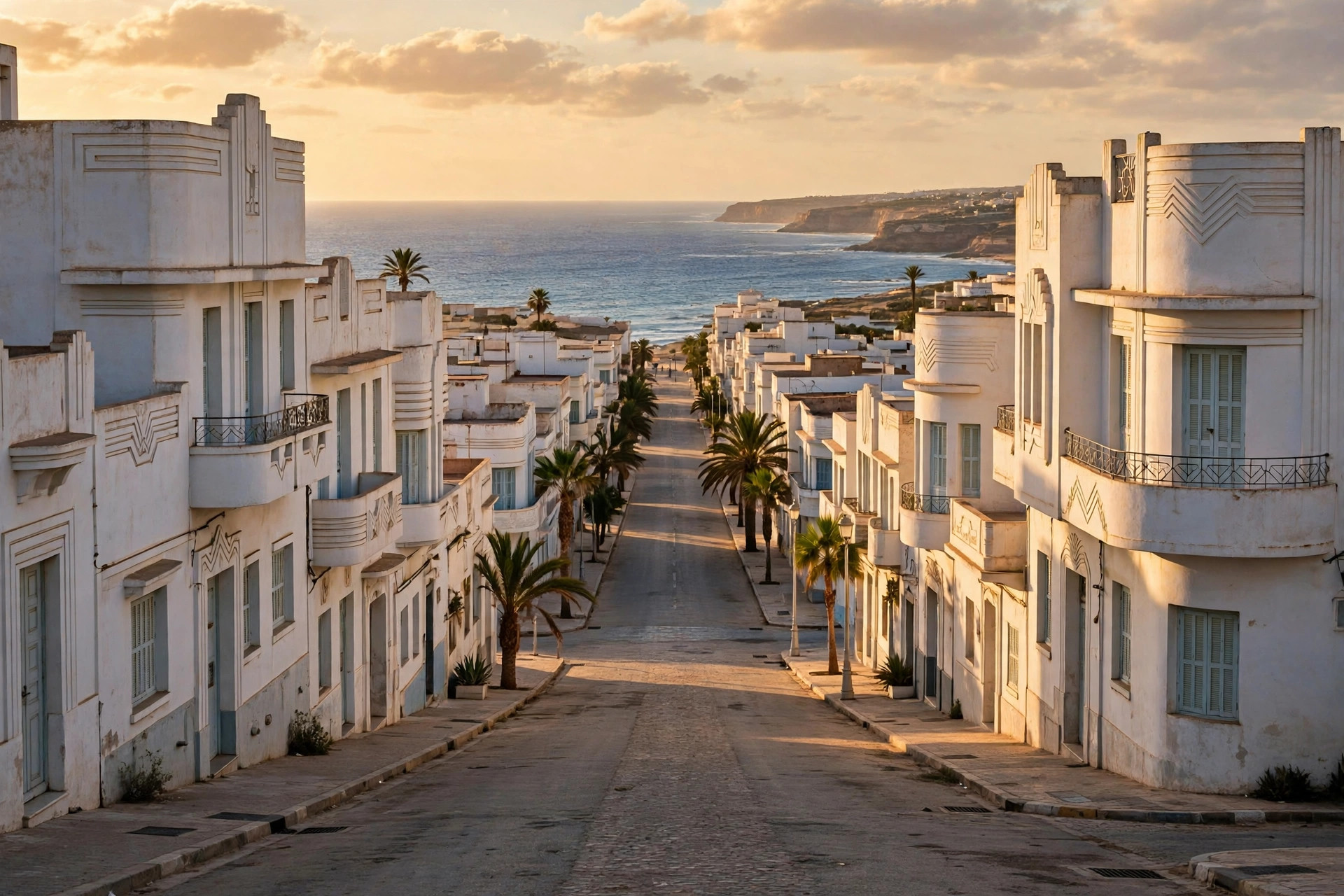
The centrepiece of any sidi ifni travel guide is the town itself, best seen on foot. Start at the top of the hill and walk down the wide central boulevard toward the sea. The street plan is Spanish, not Moroccan: straight avenues, a formal square, and low whitewashed buildings with rounded corners, stepped rooflines and the geometric decoration of 1930s Art Deco, documented in detail on the Art Deco movement's history. You do not need the theory — the effect is immediate.
Look first for the old Spanish consulate, a grand white building with curved balconies above the upper town, and the former church, a simple Art Deco building that now serves as the town's courthouse. Nearby stands the old cinema, its facade still carrying the clean lines of its era, and the former hospital buildings, now schools and offices. None is a museum and none charges an entry fee; they are working buildings, which is part of their charm.
Continue down to the Plaza de Espana, now Place Hassan II, where the cafes fill in the late afternoon. From there the avenue runs to the lighthouse, built in the Spanish period to guide ships along this fog-prone coast, and to the cliff edge above the port. The light is best at golden hour, when the whitewash turns honey-coloured. Allow an hour for this walk, wear proper shoes — the streets are steep — and carry water in summer.
The Beaches: Legzira and the Wild Atlantic Coast
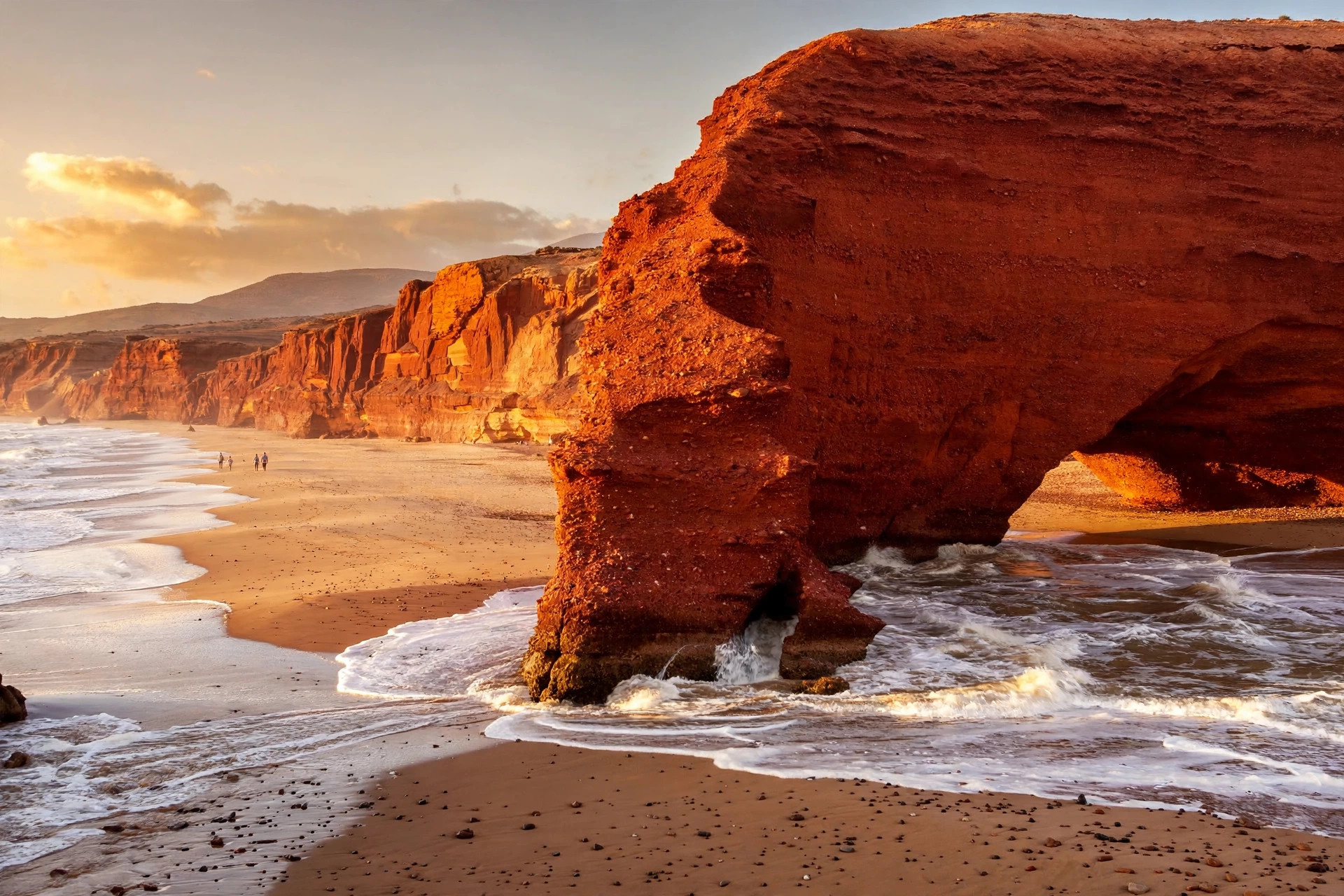
No sidi ifni travel guide is complete without Legzira beach, ten kilometres north on the road to Mirleft. Legzira is famous for its red sandstone cliffs, carved by the Atlantic into two natural arches. The larger arch collapsed in September 2016 after years of erosion; the second still stands, and at low tide you can walk beneath it as the red rock glows in the late afternoon light.
Legzira is a wild beach, not a resort beach. The Atlantic swell is strong, the sand is fine and red-tinted, and there is very little shade. A handful of small cafes and surf camps sit at the top of the cliff. Swimming is possible on calm days, but the currents are real: swim where the local surfers swim, never alone, and never at high tide near the arch, where the sea closes the gap and the cliffs offer no exit. Check the tide times before you go.
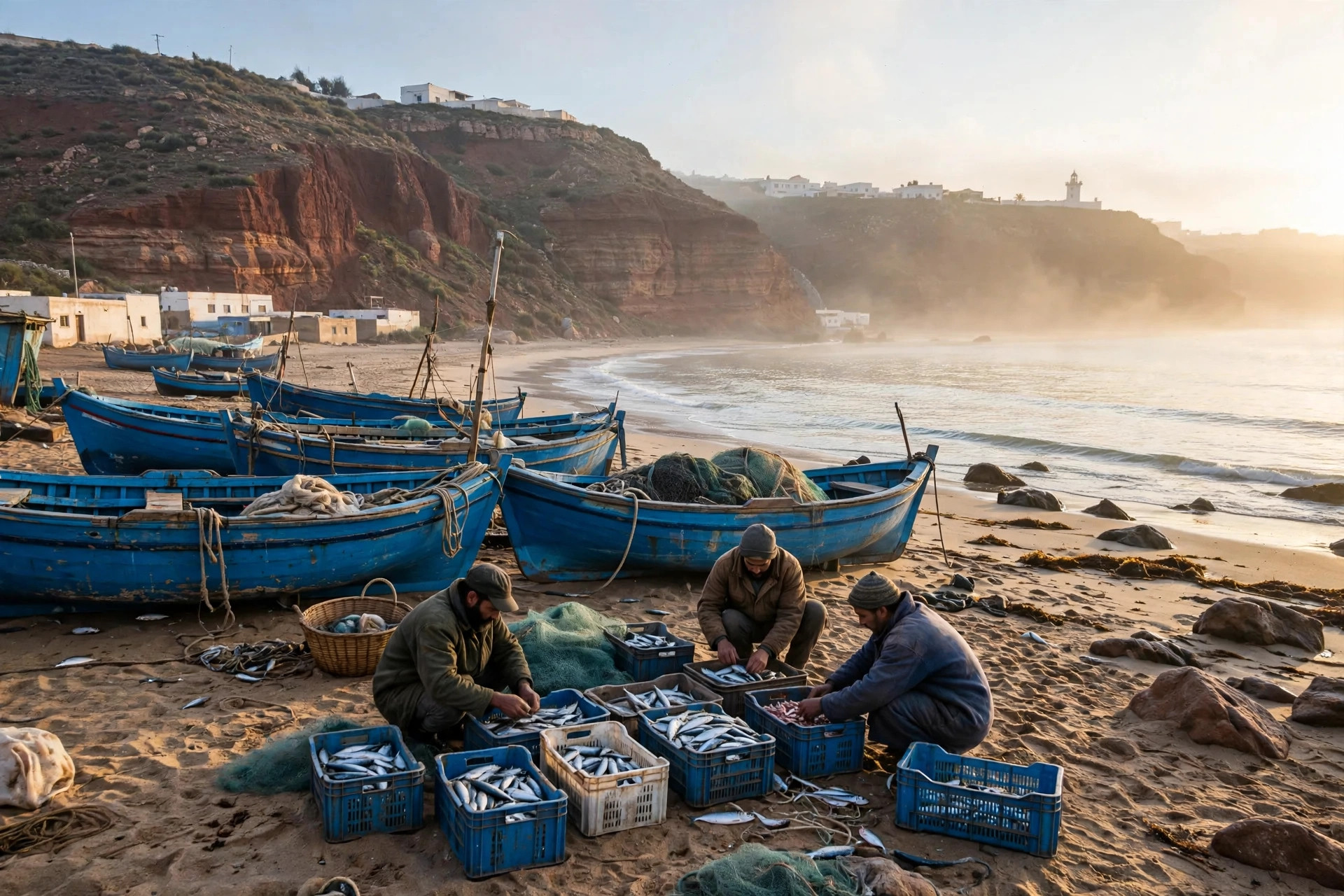
Sidi Ifni's own beach, below the town at the foot of the cliffs, is smaller and more sheltered. Fishermen launch their blue wooden boats from the sand in the morning, children play football in the afternoon, and surfers paddle out when the swell is right. It is also the best place in town to watch the sunset, with the lighthouse above and the fishing boats silhouetted on the water.
As this sidi ifni travel guide notes, the coast between Sidi Ifni and Mirleft is one of Morocco's least crowded surf zones, with beach breaks for beginners and intermediates and a handful of point breaks for experienced surfers. Board rental in town costs about 100–150 MAD ($10–$15) a day, and a two-hour lesson with a local instructor costs about 200–300 MAD ($20–$30), board included. The water is cool year-round, so a 3/2 mm wetsuit is the norm, and the best swell arrives between October and April.
Things to Do in Sidi Ifni
Sidi Ifni rewards slow travellers, and two full days is the right amount of time. This sidi ifni travel guide suggests four essentials. Walk the Art Deco centre at golden hour, from the upper town down to the lighthouse and the port, with a cafe stop in the main square. Morning fog makes the early hours grey; the light improves from mid-afternoon.
Watch the port at dawn. Boats land from about 6 a.m., the catch is sorted on the quay, and the small auction sets the day's fish prices. Visitors are welcome to watch, but keep clear of the working fishermen and ask before photographing people closely.
Spend a morning at Legzira. Take a grand taxi or a hired car for the ten-kilometre drive, arrive before the midday heat, walk the beach at low tide and lunch at a cliff-top cafe. The return trip is easy to arrange with the same driver.
Visit the Sunday souk, and hike the cliffs south of town. The weekly souk is the town's social event: traders from surrounding villages bring vegetables, spices, livestock, textiles and household goods. Go early and bargain politely. The coastal path above the port is an easy walk of an hour or two, best in the late afternoon — keep well back from the cliff edge.
Where to Stay in Sidi Ifni
Sidi Ifni has no large hotels and no international chains, which is part of its appeal — just a handful of small hotels and guesthouses, mostly in the old Spanish buildings of the centre or on the cliff above the port. Book ahead in spring and autumn, when the town's few good rooms fill quickly. This sidi ifni travel guide lists the realistic options below.
| Option | What you get | Price per night |
|---|---|---|
| Budget guesthouse | Simple room, shared bathroom, often family-run | 120–250 MAD ($12–$25) |
| Mid-range hotel | Private room with bathroom, breakfast, sea view at the better ones | 250–600 MAD ($25–$60) |
| Apartment or surf camp | Self-catering flat or a bed in a surf camp with board storage | 200–500 MAD ($20–$50) |
| Legzira cliff-top stay | Basic rooms and camps above the beach, popular with surfers | 150–400 MAD ($15–$40) |
The best-known address in this sidi ifni travel guide is the Hotel Suerte Loca, a Spanish-era hotel on the cliff above the port with a terrace restaurant and the town's most photographed view. Smaller guesthouses in the centre offer better value and a warmer welcome, several with rooftop terraces facing the ocean. Wherever you stay, confirm whether breakfast is included, whether hot water is reliable, and whether the room has heating — winter nights here are damp and cool, and many older buildings have none.
Where to Eat: Fish, Tajine and the Sunday Souk
Sidi Ifni is a fishing town, and the food follows the boats. The best meal in this sidi ifni travel guide is the simplest: grilled sardines or a whole grilled fish, eaten at a small restaurant near the harbour the same day it was caught. A full grilled fish meal with salad, bread and mint tea costs about 40–80 MAD ($4–$8) per person. Restaurants near the port are the freshest and the cheapest; the hotel terraces above the cliff charge more for the view and serve the same fish.
Beyond fish, the town's restaurants serve the Moroccan standards: chicken and vegetable tajine for about 40–60 MAD ($4–$6), couscous on Fridays, harira soup in the evenings, and omelettes and pastries for breakfast for about 20–30 MAD ($2–$3). Mint tea costs about 5–10 MAD ($0.50–$1) in a local cafe, and alcohol is not served in the town's restaurants, so plan accordingly. The Sunday souk is the place to eat like a local: grilled sardines, wood-oven bread, olives and dates, and the region's argan oil — about 200–300 MAD ($20–$30) a litre for genuine cold-pressed culinary argan oil.
Getting to Sidi Ifni
There is no train to Sidi Ifni and no airport with commercial flights, so every traveller arrives by road. The road from Agadir is good and scenic, running south along the coast through Ait Melloul and Tiznit, then west to the sea — part of the town's charm, and the reason this sidi ifni travel guide spends a paragraph on the journey.
| Route | How | Time | Cost |
|---|---|---|---|
| Agadir to Sidi Ifni | CTM or Supratours bus | 3–4 hours | 80–110 MAD ($8–$11) |
| Agadir to Sidi Ifni | Grand taxi, shared, from the main taxi station | 3 hours | 100–150 MAD ($10–$15) per seat |
| Tiznit to Sidi Ifni | Local bus or grand taxi | About 1 hour | 25–40 MAD ($2.50–$4) |
| Guelmim to Sidi Ifni | Grand taxi via the N1 | About 1.5 hours | 40–60 MAD ($4–$6) |
| Sidi Ifni to Legzira | Grand taxi or hired car, return | 20 minutes each way | 100–150 MAD ($10–$15) return |
| Sidi Ifni to Mirleft | Grand taxi or local bus | About 40 minutes | 20–30 MAD ($2–$3) |
Buses leave Agadir in the morning and early afternoon; the last bus usually departs before 4 p.m., so do not plan a late arrival. Grand taxis leave when full, usually within an hour at the Agadir station. If you are driving, the N1 is in good condition, fuel costs about 13–15 MAD ($1.30–$1.50) a litre, and street parking is free throughout the town. From Agadir, many travellers combine Sidi Ifni with our Agadir travel guide for a longer southern coast trip.
When to Visit Sidi Ifni
Sidi Ifni has a mild Atlantic climate all year, but the seasons feel very different. The best months, and this sidi ifni travel guide's pick, are April to June and September to November, when the days are warm (22–27°C), the fog lifts by mid-morning and the sea is at its calmest — also the best months for surfing the smaller, cleaner waves and walking the cliff paths.
Summer is cooler than inland Morocco — daytime temperatures rarely pass 28°C — but the coastal fog is at its thickest, often lasting until noon, and the town fills with Moroccan families on holiday. Winter brings the biggest surf and the fewest visitors, but also rain, strong winds and damp, chilly nights (10–15°C); bring a warm layer and confirm your room has heating. In every season the fog usually burns off by late morning, and the Atlantic breeze is constant, so pack a windproof jacket even in summer.
Day Trips from Sidi Ifni
Mirleft (about 30 km north). A smaller, quieter surf village with a string of beaches, a laid-back cafe scene and a weekly market. Many travellers prefer its beaches to Legzira's for swimming, and the coastal road between the two towns is one of the prettiest drives in southern Morocco.
Tiznit (about 65 km north-east). A walled town famous for its silver jewellery, its ochre ramparts and its calm medina. The silver souk is the main attraction, and the town is the transport hub for buses north to Agadir and east to the Anti-Atlas.
Guelmim (about 115 km south-east). The gateway to the Sahara, home to a famous Saturday camel market where traders from the desert still bring camels, goats and handicrafts. Arrive early on Saturday morning — the market winds down by midday.
The Anti-Atlas (1–2 hours east). The painted rocks of Tafraoute, the granaries of Amtoudi and the palm oasis of Ait Mansour are all within reach on a long day trip by hire car — the most ambitious outing in this sidi ifni travel guide — though the mountain roads demand an early start.
Essaouira and the north. If you are heading back north after Sidi Ifni, Essaouira is about five hours by road. Our Essaouira travel guide covers the wind, the medina and the fishing port that make it Morocco's most popular Atlantic town — a useful contrast to Sidi Ifni's quiet, and a natural next stop on any sidi ifni travel guide itinerary.
Frequently Asked Questions
Is Sidi Ifni worth visiting?
Yes, if you like quiet towns, Art Deco architecture, wild beaches and surfing. This sidi ifni travel guide is honest about what the town is not: it is not a resort, it has no nightlife and it has very few tourist facilities. What it has is atmosphere, history and some of the cheapest seafood on the Moroccan coast. Travellers who want a slow, photogenic stop between Agadir and the Sahara will love it; travellers who want entertainment should stay in Agadir.
How many days do I need in Sidi Ifni?
This sidi ifni travel guide recommends two full days: one for the Art Deco centre, the port and the town beach, and one for Legzira and the coast. Add a third day to surf properly or day-trip to Mirleft or Tiznit. One night is enough for a quick look, but the town reveals itself slowly, and the best light is in the late afternoon.
How do I get from Agadir to Sidi Ifni?
By bus or grand taxi. CTM and Supratours buses take 3–4 hours and cost 80–110 MAD ($8–$11); a shared grand taxi takes about 3 hours and costs 100–150 MAD ($10–$15) per seat. Buses leave in the morning and early afternoon, so plan to arrive before dark. There is no train and no airport at Sidi Ifni.
Can you swim at Legzira beach?
Yes, on calm days and at low tide, but the Atlantic currents are strong and the beach is unsupervised. Swim where the local surfers swim, never alone, and never near the arch at high tide. Check tide times at your hotel before you go — the first rule of this sidi ifni travel guide for Legzira. The main arch collapsed in 2016; the second arch still stands.
Is Sidi Ifni safe for solo travellers?
Yes. Sidi Ifni is a small, quiet town with a low crime rate, and solo travellers — including solo women — generally feel comfortable walking the centre and the beach during the day. Take the usual precautions at night, keep valuables out of sight, and dress modestly in the town centre, as anywhere in Morocco. Our Morocco travel guide for first-time visitors covers safety and etiquette across the country.
What is the best time of year to visit Sidi Ifni?
This sidi ifni travel guide picks April to June and September to November, when the days are warm, the fog lifts by late morning and the sea is calm. Summer is cool but foggy and busy; winter has the best surf but also rain, wind and cold nights. Whenever you come, pack a windproof jacket — the Atlantic breeze never really stops.
Conclusion
Sidi Ifni is the Morocco most travellers never see: a Spanish Art Deco town frozen in the 1960s, a working fishing port, and a wild Atlantic coast with one of the country's great natural arches just up the road. It asks little — two days, a bus ticket from Agadir, a modest budget — and gives back a place that stays in the memory long after the bigger names have blurred together. This sidi ifni travel guide has given you the history, the beaches, the hotels, the food and the transport; the rest is the walk down the avenue at golden hour, the fish on the grill at the port, and the fog lifting off the ocean in the morning. Go slowly, and Sidi Ifni will reward you. For more southern coast ideas, browse the full Morocco Travel section.