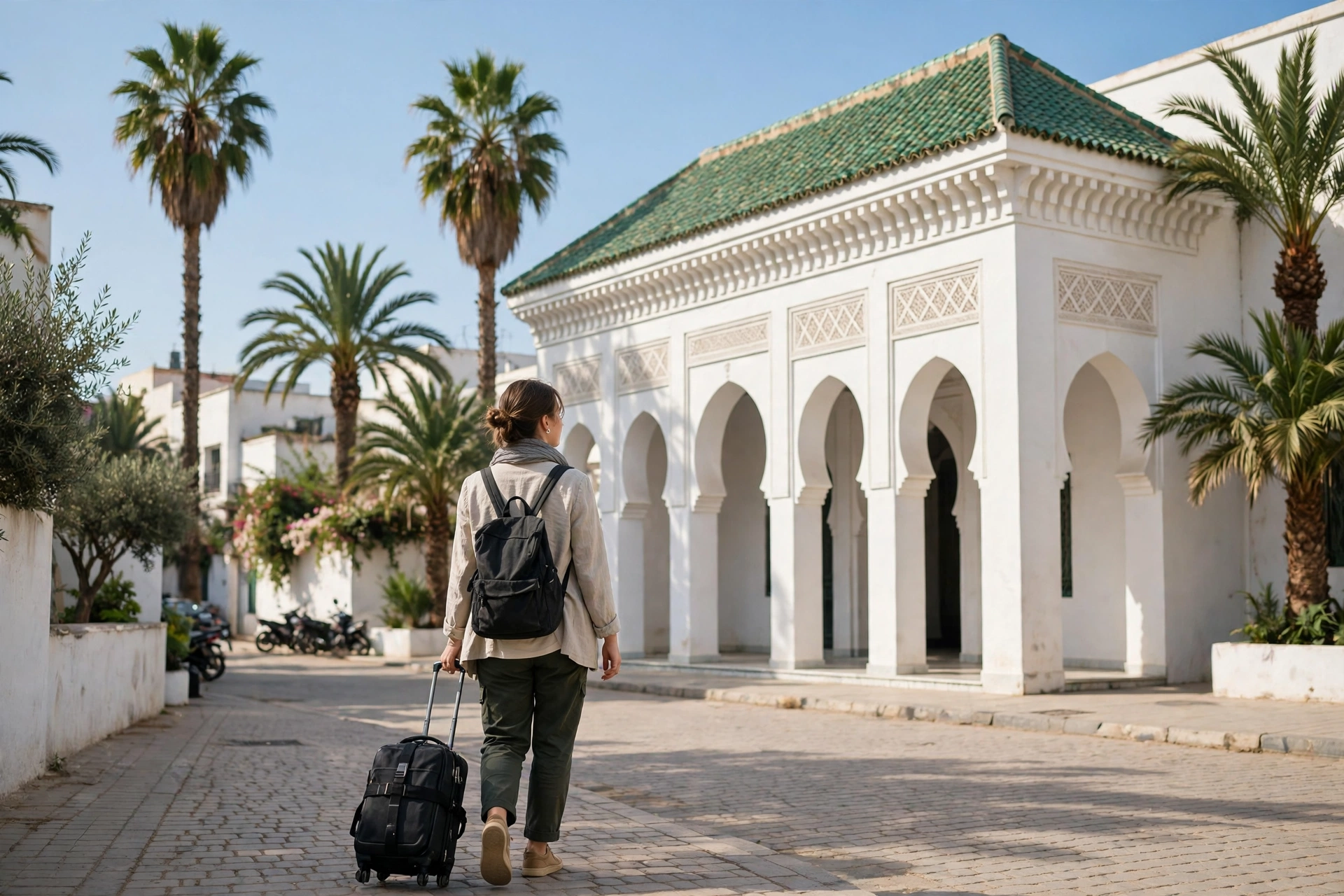
Moving to Morocco? Start with this rule. Here is the sentence that will save you the most trouble: the 90 days you get at the border are not residency. They are a visit. Residency is separate, it happens after you arrive, and it runs through a Moroccan office called the Préfecture — not through an embassy, and not online.
I am Moroccan, and I have watched newcomers learn this the hard way: they arrive on a tourist stamp, rent a flat, and only in month three discover that “living here” and “being allowed to live here” are two different things. Here is the real sequence.
The Insider Correction: 90 Days Is a Visit, Not a Life
Outsiders routinely say “I moved to Morocco” when they mean “I flew in and got a 90-day stamp.” Those are not the same thing, and Moroccan officials do not treat them as the same thing.
Most nationalities — US, UK, Canada, Australia, EU citizens — enter Morocco visa-free for up to 90 days. You get a stamp on arrival. It lets you travel and rent short-term. It does not give you the right to work or to stay beyond 90 days.
Residency means holding a Carte de Séjour (residence card), applied for after arrival at the Préfecture de Police — Service des Étrangers in the city where you live. You cannot get one from abroad. Anyone selling you a “residency visa” from overseas is selling you something that does not exist.
Insider correction: a “visa run” — leaving for a weekend in Spain and coming back for a fresh 90 days — is not a residency strategy. Border officers notice the pattern. It leaves you with no legal status, no right to work, and no protection if anything goes wrong. Do the paperwork instead.
Step 1: Enter Morocco Properly
If your nationality needs a visa to enter Morocco — citizens of many African, Asian, and some Latin American countries — apply at a Moroccan consulate in your home country before travelling, with your passport, photos, and proof of accommodation and funds. That entry visa gets you in the door; the Carte de Séjour is still a separate step once you are here. Visa-free nationalities should still confirm their status with a Moroccan consulate before booking.
At the border, your passport must be valid for at least six months beyond arrival, with at least one blank page. Keep your return ticket and first accommodation address handy. The 90 days run from the date stamped in your passport — put a reminder in your phone for day 60, when your residency application should already be in motion.
| Entry route | Who it suits | What you get |
|---|---|---|
| Visa-free entry (90 days) | US, UK, EU, Canada, Australia, etc. | A passport stamp; no card, no work right |
| Consular visa before travel | Nationalities that need a visa | Entry permission; residency still applied for in Morocco |
| Carte de Séjour | Anyone staying beyond 90 days | A residence card, usually valid 1 year at first |
Step 2: Choose Your City Before You Apply
You apply in the city where you live; your file is tied to that Préfecture, so moving mid-process means starting over. Rabat’s offices are organised and calm; Casablanca’s handle more volume and longer queues; smaller cities can be slower. Your rental contract (or a host’s attestation d’hébergement) must show an address there. If you have not chosen yet, our Morocco Travel Guide for First-Time Visitors will help you feel the difference.
Step 3: Gather Your Paperwork (Bring Double Copies)
The honest truth about Moroccan administration: the paperwork list differs slightly by city and even by office. The list below is the standard core every Préfecture asks for; your local office may ask for one or two extra documents. That is normal, not a scam.
Bring double the copies requested, plus the originals. This is the single best piece of advice in this article. Photocopy shops sit on nearly every street near a Préfecture for a reason — but arriving with your file already duplicated saves you a return trip, and return trips are where weeks disappear.
The standard file
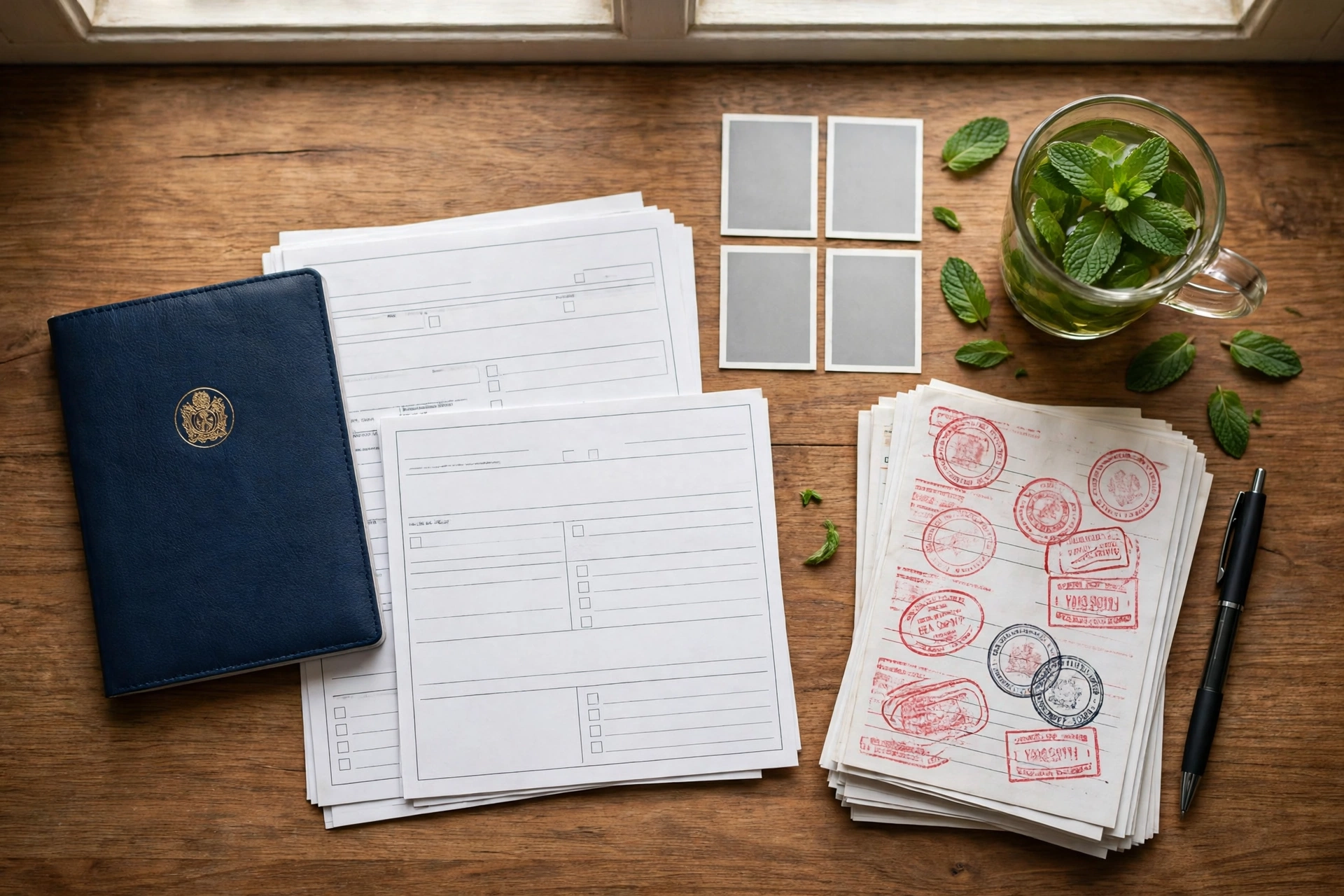
- Passport — original plus copies of the identity page and the Moroccan entry stamp page
- Passport photos — 4 to 8 recent photos, white background, 35 × 45 mm (some offices ask for 4, others for 8 — confirm at your Préfecture)
- Proof of address — a rental contract (contrat de bail) in your name, or a host’s attestation d’hébergement stamped at the local Moqataâ, plus a utility bill if you have one
- Proof of income or funds — bank statements, a work contract, or proof of pension/remote income
- Criminal record check — a casier judiciaire from your home country (requirements vary by prefecture)
- Medical certificate — a basic health certificate from a Moroccan doctor (not required in every prefecture)
- Marriage/birth certificates — if applying as a spouse or dependent: legalised copies with a French translation
- Application form — provided at the Préfecture; fill it in French if you can
What it costs
Expect fees and fiscal stamps (timbres fiscaux) of roughly 100–300 MAD (about $10–30) for a first application; the exact amount varies by prefecture — confirm the current stamp fee at your Préfecture. Buy stamps at a tabac or tax office, never from anyone outside the Préfecture.
| Item | Typical range | Notes |
|---|---|---|
| Fiscal stamps & admin fees | 100–300 MAD (~$10–30) | Varies by prefecture; official counters only |
| Passport photos | 30–60 MAD (~$3–6) | Any photo studio; white background |
Prices checked 18 November 2026. Exchange rate: roughly 10 MAD ≈ $1 USD. Treat every figure as a range, not a quote.
Step 4: Go to the Préfecture
The Préfecture de Police, Service des Étrangers, is the office. Go early — doors typically open around 8:30 a.m. Bring your file, your passport, a pen, and patience.
- Reception — state your purpose (demande de carte de séjour) and take a ticket number.
- Document check — an officer reviews your file. Missing a copy? This is where double copies save you. Incomplete file? You will be told exactly what is missing — write it down.
- Submission — your file is accepted and logged. You may be fingerprinted and photographed on the spot.
- The récépissé — you receive a récépissé de dépôt, a stamped receipt proving you have applied.
- Waiting — processing commonly takes several weeks to a few months; the récépissé (usually valid around 3 months) can be renewed if the card is not ready — validity and renewal practice vary by prefecture.
Dress neatly, greet the officer in French or Arabic (Salam, s’il vous plaît goes a long way), and never offer money to speed anything up — it will not help and it can hurt. If your French is weak, bring a translator for the first visit: the file is processed in French and Arabic.
Step 5: The Récépissé — Your Legal Shield
This is the most misunderstood part of the whole process: the récépissé is not a consolation prize. It is your legal status while you wait.
With a valid récépissé and your passport, you are legally in Morocco beyond your original 90 days. Without it, you are in the country illegally — risking fines, problems at the airport when you leave, and difficulty ever getting a card later. Carry it with your passport, always, and renew it before it expires if your card is not ready.
Step 6: Collecting Your Carte de Séjour
When your card is ready, check back in person with your passport and récépissé to collect it. The first card is commonly valid for one year. Renewal is similar but smoother: same office, updated documents, proof you lived at the address you gave. After several years of continuous legal residence, longer cards and eventually permanent residence become possible — the path varies by nationality and situation.
| Stage | What you hold | Valid for |
|---|---|---|
| Entry stamp | Passport stamp | Up to 90 days |
| Récépissé | Stamped receipt | Usually ~3 months, renewable |
| First Carte de Séjour | Residence card | Usually 1 year |
| Renewals | Residence card | 1 year, then longer durations possible |
Working in Morocco: A Separate Permission
The Carte de Séjour lets you live in Morocco. Working is separate — and where newcomers get tripped up most.
- Employed by a Moroccan company: your employer must obtain a work authorisation (autorisation de travail) for you, usually through the Ministry of Employment (ANAPEC). Your residence file and your work file run in parallel.
- Self-employed / freelancing: you generally need to register a business or self-employed status (auto-entrepreneur is one route many foreigners use) and show income from it.
- Remote work for a foreign employer: the grey zone. Morocco has no dedicated digital-nomad visa, so remote workers typically reside on a standard Carte de Séjour supported by proof of foreign income. Get local legal advice — rules are applied case by case and remote-work treatment varies by prefecture.
- Retirees: proof of pension income is usually the cleanest route.
Do not start working — especially in a formal job — before the authorisation is in place. Employers who tell you “just start, we’ll sort the papers later” are transferring their risk onto you.
Renewal, Family, and If Things Go Wrong
Renewal: start at least a month before expiry. The file is lighter the second time — updated proof of address, proof of income, your old card, photos. A renewed récépissé covers you while the new card is processed.
Spouses and children: they apply as part of a family file, with marriage and birth certificates (legalised, with French translations). Children born in Morocco to foreign parents do not automatically acquire Moroccan nationality.
Overstaying: expect a fine when you leave and a note on your record that can complicate future applications. If you have already overstayed, go to the Préfecture and explain honestly — starting late is far better than leaving it.
Changing address: if you move to a different city, tell your Préfecture and expect to transfer your file. An address that no longer matches reality is the most common reason renewals get bounced back.
The Realistic Timeline
| Week | What to do |
|---|---|
| Before travel | Check visa requirements; book first accommodation |
| Week 1 in Morocco | Settle, sign a rental contract, open a bank account |
| Weeks 2–4 | Gather documents, photos, medical certificate, translations |
| Around day 45–60 | Submit your file at the Préfecture; receive your récépissé |
| Months 2–5 | Wait; renew the récépissé if needed |
| When called | Collect your Carte de Séjour (usually 1 year) |
| Month 11 | Start renewal |
Total out-of-pocket cost for a straightforward first application, excluding translations, is typically 300–1,000 MAD (about $30–100). The real cost is time: half-days at offices, waiting, and one or two return visits. For the full monthly budget behind these figures, see Cost of Living in Morocco in 2026.
Moving to Morocco: Practical Tips From a Local
- Learn basic French before you arrive. Fifty phrases change everything at the Préfecture, the bank, and the rental agency. Arabic (Darija) helps socially; French runs the paperwork.
- Keep a “Morocco file” at home — originals in one folder, copies in another, phone photos of everything.
- Rent first, buy nothing until your residency is settled. Your rental contract is your proof of address.
- Open a Moroccan bank account once you have your récépissé — some banks accept it, others want the card itself; bank policies differ, so ask at the branch.
- Do not trust “fixers” outside the Préfecture. Anyone offering to speed up your file for cash is either useless or dangerous.
- Stay in one city for the first year. It keeps your file simple and your renewal painless.
FAQ
Do I need a visa to move to Morocco?
Most nationalities (US, UK, EU, Canada, Australia) enter visa-free for up to 90 days. But entry is not residency: to stay longer you must apply for a Carte de Séjour at the Préfecture after arrival. Confirm your nationality’s status with a Moroccan consulate before booking.
What is a Carte de Séjour?
Morocco’s residence card. Apply at the Préfecture de Police (Service des Étrangers) in the city where you live, after arrival. The first card is usually valid for one year.
What is a récépissé, and why does it matter?
The stamped receipt you receive when your file is accepted. It is your legal proof of status while the card is processed, covering you beyond your original 90 days. Carry it with your passport.
How long does the Carte de Séjour take?
Several weeks to a few months, depending on the prefecture and the completeness of your file — processing times vary by city.
How much does residency cost?
Roughly 100–300 MAD (~$10–30) in official stamps and fees, plus photos, copies, and translations — typically 300–1,000 MAD (~$30–100) all in. Prices checked 18 November 2026.
Can I work in Morocco with a Carte de Séjour?
Separate. Employment needs a work authorisation, usually arranged by your employer; self-employed people register a business or auto-entrepreneur status. Remote workers typically reside on a standard card backed by proof of foreign income — get local advice.
Can I just leave every 90 days and come back?
You can, but it is not residency, it gives you no work rights, and border officers notice repeated patterns. If Morocco is home, do the paperwork.
What happens if I overstay my 90 days?
You risk a fine on departure and a mark on your record. If you have overstayed, go to the Préfecture and start the process — late is far better than never.
Which city should I apply in?
The city where you actually live, with a rental contract or host attestation showing an address there. Choose your base before you apply — moving mid-process means starting over.
Do I need to speak French or Arabic?
For daily life, no — but for the Préfecture, basic French makes everything easier. The file is processed in French and Arabic.
Moving to Morocco rewards the patient. Once that first Carte de Séjour is in your hand, the country opens up in a way a tourist stamp never allows. Next step: Living in Morocco: The Complete Guide for Expats and Long-Stay Visitors. Learn more about us on our About page.