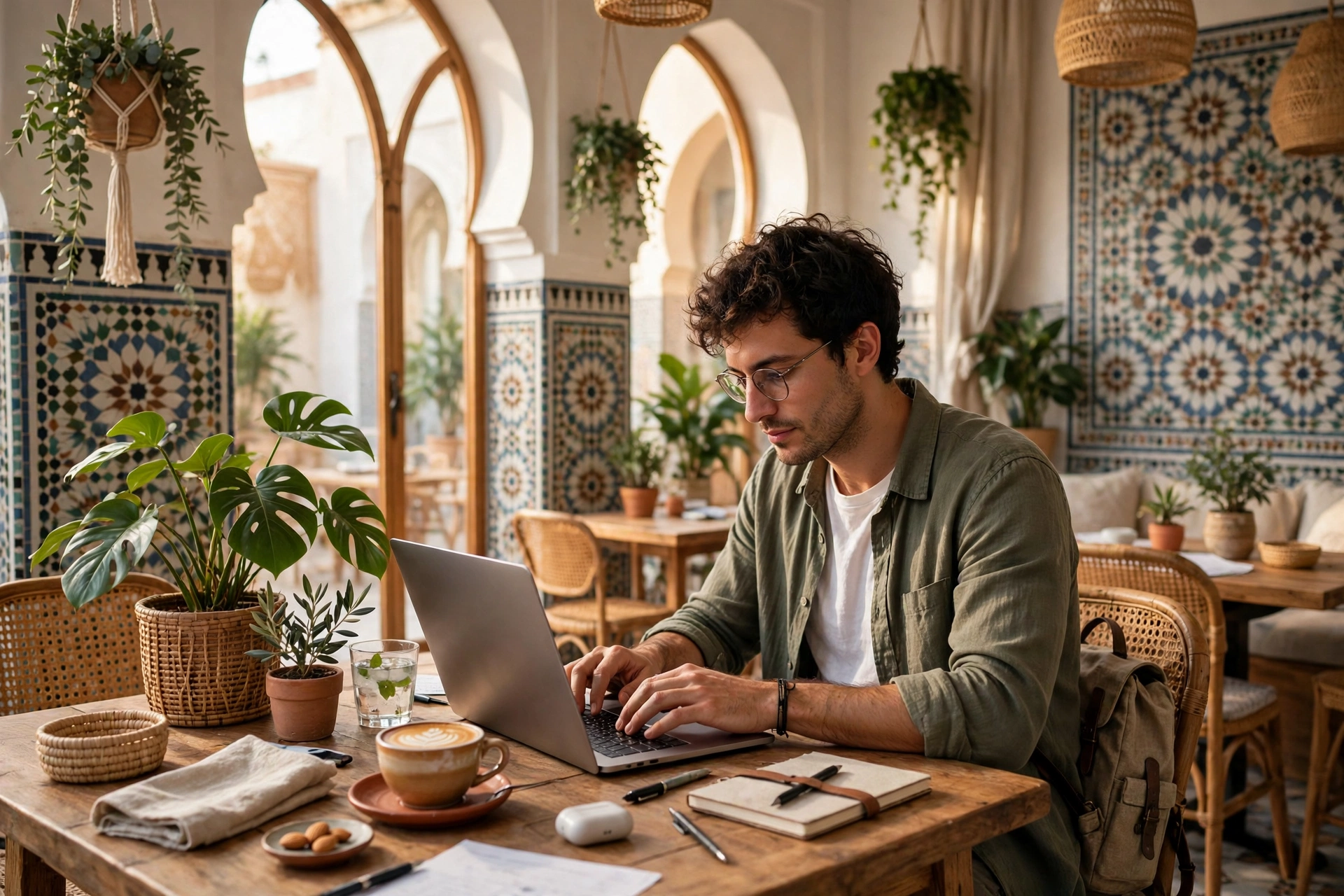
If you are weighing Morocco as your next remote-work base, this morocco digital nomad guide starts with the honest picture, not the Instagram version. Morocco offers low living costs, warm winters, fast trains, and a café culture that makes working outside the flat easy. It also has no dedicated digital nomad visa and fibre that varies street by street.
That contrast is the whole story. Choose the right city, check the exact internet connection before you sign anything, and understand the 90-day rule before you arrive, and Morocco can be one of the best-value bases in the Mediterranean world. This morocco digital nomad guide explains the visa rules, the internet reality, the coworking scene, the real monthly costs, and which city fits which kind of remote worker.
Table of Contents
The Visa Reality: No Nomad Visa — and How to Stay Legally
The first fact every morocco digital nomad guide must state plainly is this: Morocco has no dedicated digital nomad visa. There is no special remote-work permit, no nomad residence card, and no official programme that lets you live in Morocco for a year simply because you work online for a foreign employer.
What Morocco does offer most nationalities is generous visa-free entry. Citizens of the European Union, the United Kingdom, the United States, Canada, Australia, New Zealand and many other countries can enter without a visa and stay for up to 90 days. Your passport must be valid for the duration of your stay, and border officers may ask for proof of onward travel and accommodation, so carry a return booking and a hotel or rental address.
The 90-Day Rule and Visa Runs
For a short stay, the system is simple, and this morocco digital nomad guide recommends it as a trial: you arrive, you get a 90-day entry stamp, and you work remotely while you are here as a visitor. That covers a winter month in Marrakech, a surf season in Taghazout, or a trial run in Rabat. It does not cover a permanent move, and it does not give you the right to work for a Moroccan employer.
For longer stays, nomads commonly do a visa run: leave before the 90 days expire — a short hop to Spain, to Ceuta or Melilla, or a flight home — and re-enter for a fresh 90-day period. This is widely done, but it is not a guaranteed right. Re-entry is at the discretion of the border officer, and repeated back-to-back stays can attract questions. Never overstay: it can bring fines and problems on your next entry, so set a reminder for day 80, not day 89.
Carte de Séjour: The Long-Stay Option
If you want to live in Morocco for more than a few months, the legal route is the carte de séjour, the residence card issued by the local prefecture. It is not a nomad visa, and it is not granted simply for working online. Applicants usually need a recognised basis for residence, such as employment with a Moroccan company, self-employment registered in Morocco, study, family ties, or sufficient documented income and a rental contract.
The process is bureaucratic and slow, and requirements vary by prefecture and nationality. For the full step-by-step picture, read Moving to Morocco: Visas, Carte de Séjour and Residency, which covers the paperwork and common mistakes, so this morocco digital nomad guide can stay focused on the day-to-day reality of working here.
Who Needs a Visa Before Arrival?
Not every nationality enjoys visa-free entry. Citizens of many African and Asian countries need a visa in advance, and Morocco now offers an electronic visa for many of them. Before you book anything, check your nationality on the official Accès Maroc eVisa portal and the official Visit Morocco site.
Morocco Digital Nomad Guide to Internet: Fibre, 4G and the Building-by-Building Trap
Internet is the make-or-break question for any morocco digital nomad guide, and Morocco’s answer is complicated. The country has real fibre-optic broadband — fibre optique — in its major cities, with advertised speeds of 100 Mbps and higher from Maroc Telecom, Orange and Inwi. At the same time, fibre coverage is building-by-building, even in wealthy districts.
That matters more than any national average. Two apartments on the same street in Casablanca can have completely different internet: one wired for fibre, the other still on ADSL at 10 or 12 Mbps. A modern tower in Agdal, Rabat, may have fibre in every flat, while a beautiful old riad in the Fes medina may struggle to reach 20 Mbps. Never sign a lease on the basis of the neighbourhood: ask which provider and technology serve that exact building, and ask for a speed test from inside the flat before you pay a deposit.
Fibre, ADSL and 4G: What to Expect
Fibre is the gold standard in this morocco digital nomad guide. Where it exists, it is reliable, fast enough for video calls and large uploads, and reasonably priced. ADSL is the older copper technology, still common in older buildings and smaller towns. It can handle email and browsing, but it will frustrate you on video calls. If a listing says “Wi-Fi included” without naming the technology, assume ADSL until proven otherwise.
Mobile data is the safety net: 4G coverage is good in cities, and a local SIM with a generous bundle can carry you through a fibre outage. Buy it from an official Maroc Telecom, Orange or Inwi shop with your passport, and choose a monthly bundle.
How to Test Internet Before You Commit
Test before you pay — the single most valuable rule in this morocco digital nomad guide. When you view a flat, run a speed test on its Wi-Fi at the time of day you normally work, and ask neighbours which provider they use. In a coworking space, take a trial day and test a video call at peak hours.
Carry a backup: a second SIM from a different provider and a list of nearby cafés with reliable Wi-Fi will save a workday when the fibre goes down. The nomads who thrive in Morocco treat internet as something to verify, not something to assume.
Where to Base: The Eight Cities Compared
Choosing a base is a trade-off between bandwidth, cost, climate and lifestyle, and no single city wins on all four. This morocco digital nomad guide compares the eight places nomads actually choose, so you can match the city to your work, not to someone else’s photographs. For a wider look, see Best Places to Live in Morocco.
Casablanca is the business capital, with the deepest fibre, the most coworking spaces and the best flights — but also the highest prices and worst congestion. Rabat is calmer and greener, well connected by the Al Boraq high-speed train, with good fibre in Agdal and Hay Riad. Marrakech is the most fun, but its medina riads often have poor internet and summer heat is brutal without air conditioning.
Agadir is the quiet achiever: a modern coastal city with reliable fibre in newer districts and a growing coworking scene, plus easy access to Taghazout. Fes is the cheapest of the imperial cities, but base in the Ville Nouvelle, not the old medina, if you work online.
| Base city | 1-bed flat, city centre (MAD / month) | Fibre reliability | Coworking depth | Best for |
|---|---|---|---|---|
| Casablanca | 6,000–9,000 MAD ($600–$900) | Excellent | Deep | Full-time work, flights, business |
| Rabat | 5,000–8,000 MAD ($500–$800) | Very good | Good | Calm base, trains, families |
| Marrakech | 4,500–7,500 MAD ($450–$750) | Mixed | Good | Lifestyle, winter sun, social life |
| Agadir | 4,000–6,500 MAD ($400–$650) | Good | Growing | Beach life with reliable internet |
| Taghazout | 3,500–6,000 MAD ($350–$600) | Weak to fair | Thin | Surf season, short stays |
| Essaouira | 3,500–5,500 MAD ($350–$550) | Fair to good | Small | Artists, writers, slow living |
| Tangier | 4,000–7,000 MAD ($400–$700) | Good | Growing | Spain trips, fast-growing scene |
| Fes | 3,000–5,000 MAD ($300–$500) | Mixed | Small | Budget base, culture, history |
Prices checked November 2026. Rents are indicative ranges for a furnished one-bedroom flat; prices vary by building, season and negotiation. Always confirm fibre at the exact address before signing.
The Postcard vs the Bandwidth
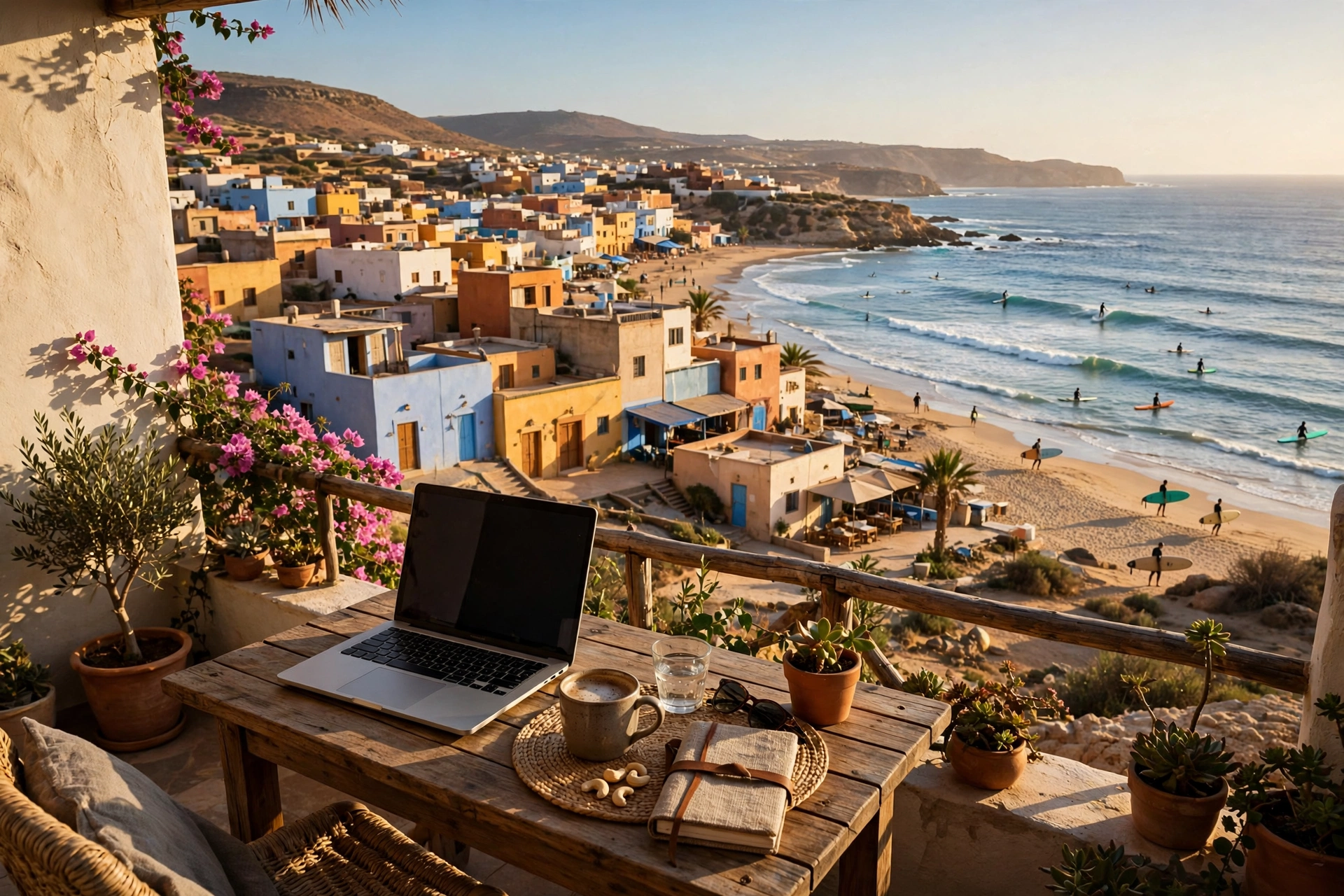
Taghazout deserves a closer look, because it is the place where the postcard and the bandwidth diverge most sharply. The surf-nomad scene there is real: morning surf, sunset yoga, communal dinners, and a friendly international crowd. For a month of writing, surfing and recharging, it is wonderful. For a month of back-to-back video calls, it is a gamble.
The honest strategy in this morocco digital nomad guide is to split your time. Base in Agadir city, where the fibre and coworking are reliable, and spend weekends in Taghazout, twenty minutes up the coast. You get the waves without betting your income on a village connection.

Coworking, Cafés and How to Work Well in Morocco
Morocco’s coworking scene is young but growing fast, and this morocco digital nomad guide finds it concentrated where the fibre is: Casablanca, Rabat, Marrakech and Agadir. A dedicated desk typically costs 1,500–3,000 MAD ($150–$300) per month, with day passes around 100–200 MAD ($10–$20) and hot-desking from about 1,000 MAD ($100) per month.
Coworking buys you three things a café cannot: guaranteed bandwidth, a quiet place for calls, and a community. If your work depends on video meetings, budget for a membership, at least for your first month. Test two or three spaces on trial days, and ask about upload speed and 4G backup — not just download speed.
Café Working: The Unwritten Rules
Café working is a Moroccan tradition, and most cafés welcome laptop workers, especially in the morning. The etiquette is simple: order regularly, do not occupy a four-person table alone at lunchtime, keep calls short and quiet, and use headphones. A coffee costs 12–25 MAD ($1.20–$2.50) in most neighbourhood cafés, and 25–40 MAD ($2.50–$4) in a smart café in Guéliz or Agdal.
Not every café is a good office: the best have stable Wi-Fi, plug sockets and a calm atmosphere; the worst have loud music and no sockets. Build a list of three or four reliable spots near your flat, and keep a coworking day pass in reserve for call-heavy days. Moving between coworking hubs is easy by train — see Getting Around Morocco: Trains, Buses, Taxis and the Al Boraq for routes and fares.
What It Really Costs: A Monthly Budget for a Digital Nomad
Morocco is affordable, but it is not free, and the gap between a careful budget and a comfortable one is mostly about housing and eating out. The table below gives honest monthly ranges for a single nomad in this morocco digital nomad guide, with prices in dirhams and US dollar equivalents. For a full household breakdown, see Cost of Living in Morocco.
| Monthly expense | Budget (MAD) | Comfortable (MAD) | Notes |
|---|---|---|---|
| Rent, furnished 1-bed | 3,500–5,000 MAD ($350–$500) | 6,000–9,000 MAD ($600–$900) | Cheaper in Fes, dearer in Casablanca |
| Utilities + fibre internet | 400–700 MAD ($40–$70) | 700–1,000 MAD ($70–$100) | Fibre 100–200 Mbps where available |
| Mobile SIM + data | 100–200 MAD ($10–$20) | 200–300 MAD ($20–$30) | Official shop, monthly bundle |
| Coworking membership | 0–1,000 MAD ($0–$100) | 1,500–3,000 MAD ($150–$300) | Café working is the budget option |
| Groceries + markets | 1,500–2,500 MAD ($150–$250) | 2,500–4,000 MAD ($250–$400) | Souks are cheaper than supermarkets |
| Eating out + cafés | 800–1,500 MAD ($80–$150) | 2,000–3,500 MAD ($200–$350) | Local restaurants vs tourist menus |
| Transport (tram, taxis, trains) | 300–600 MAD ($30–$60) | 600–1,200 MAD ($60–$120) | Includes occasional intercity trains |
| Health insurance | 500–1,000 MAD ($50–$100) | 1,000–2,000 MAD ($100–$200) | International cover recommended |
| Leisure + weekend trips | 500–1,000 MAD ($50–$100) | 1,500–3,000 MAD ($150–$300) | Surf, desert trips, city breaks |
| Total per month | 8,600–13,500 MAD ($860–$1,350) | 15,500–25,500 MAD ($1,550–$2,550) | Single person, no car |
Prices checked November 2026. Exchange rate: approximately 10 MAD to $1 USD. Your total depends above all on your city and your flat — rent is the single biggest variable.
Saving Money Without Suffering
Shop at the souk, not only at the supermarket: fresh produce there costs a fraction of imported supermarket prices. Cook at home most nights and eat at small local restaurants — a filling neighbourhood lunch costs 40–70 MAD ($4–$7), while the same meal in a tourist square can cost three times as much. Negotiate rent for longer stays, ask what is included, and get the agreement in writing before you pay.
Practical Setup: SIM, Housing, Banking and Health
A smooth first week in this morocco digital nomad guide comes down to four tasks: a SIM card, a flat with proven internet, a way to access your money, and health cover. For the wider settling-in picture, the Living in Morocco: The Complete Expat Guide covers housing, healthcare and daily life in more depth.
Buy your SIM on day one, from an official shop, with your passport — the first practical step in this morocco digital nomad guide. Maroc Telecom has the widest coverage, Orange is strong in cities, and Inwi is competitive on price. A 20–50 GB monthly bundle is usually enough for a working nomad with fibre at home. Keep your foreign SIM for banking verification codes.
For housing, prefer a short first booking — a week or two in an apartment hotel — while you test the internet and the neighbourhood. Then sign a longer lease once you know the flat and the connection. Never pay months in advance to a landlord you have never met, or send money for a flat you have not seen in person.
Banking is straightforward if you plan ahead, and this morocco digital nomad guide keeps it simple: Morocco is cash-heavy, and dirhams are the only currency you can use day to day. International cards work at ATMs in cities, but fees add up, so use a travel-friendly card with low foreign transaction fees. Most short-stay nomads manage fine with foreign cards and cash.
Health cover is not optional: treatment at private clinics is paid for upfront, so take out international health insurance before you travel.
Frequently Asked Questions
Does Morocco have a digital nomad visa?
No. Morocco has no dedicated digital nomad visa, and this morocco digital nomad guide is clear about that because the claim appears often online. Most nationalities can enter visa-free for up to 90 days. For a longer stay, you need to leave and re-enter, or apply for a carte de séjour on another basis, such as employment or self-employment.
How long can I stay in Morocco as a digital nomad?
Up to 90 days per visa-free entry for most nationalities, including citizens of the EU, UK, US, Canada and Australia — the key number in this morocco digital nomad guide. You must leave before the 90 days expire; many nomads take a short trip to Spain or Ceuta and re-enter, but re-entry is not guaranteed, so never overstay.
Is the internet in Morocco fast enough for remote work?
Yes, where fibre is available. Fibre of 100–200 Mbps is common in Casablanca, Rabat, Agadir and newer districts, and handles video calls well. The catch, as this morocco digital nomad guide stresses, is that fibre is building-by-building, so test the exact flat before signing, and keep a 4G SIM as backup.
Which city is the best base for digital nomads in Morocco?
It depends on your work. Casablanca has the best fibre and coworking, Rabat is the calmest well-connected base, Agadir balances beach life with reliable internet, and Marrakech wins on lifestyle and winter sun. Taghazout is best as a surf-season second base. This morocco digital nomad guide compares all eight cities in the table above.
How much does it cost to live in Morocco as a digital nomad?
Roughly 8,600–13,500 MAD ($860–$1,350) per month on a careful budget, or 15,500–25,500 MAD ($1,550–$2,550) with a better flat, coworking membership and regular eating out, per this morocco digital nomad guide. Prices checked November 2026. Rent is the biggest variable.
Can I work from cafés in Morocco?
Yes. Café working is normal and welcome in Morocco, especially in the mornings, and this morocco digital nomad guide lists it as a real workspace, not a fallback. Order regularly, keep calls short and quiet, and use headphones. A coffee costs 12–25 MAD ($1.20–$2.50) in most neighbourhood cafés. For call-heavy days, a coworking space is a better choice than a busy café.
Conclusion
Morocco rewards the nomad who plans like a resident and travels like a visitor, and this morocco digital nomad guide ends where it began: there is no special visa, so enter visa-free for up to 90 days and leave before it expires. The internet question matters more, and its answer is simple: check the fibre at the exact address, test it before you pay, and keep a 4G backup.
Choose your base with the same honesty. Casablanca, Rabat and Agadir city give you the reliable fibre and coworking depth that full-time remote work needs, while Taghazout gives you the surf and the sunsets — best enjoyed as a second base, not as a gamble on your income. Budget 8,600–13,500 MAD ($860–$1,350) a month if you live carefully, and you will live well on far less than a European capital costs.
That is the promise of this morocco digital nomad guide: a country where the light is warm, the costs are low, the trains are fast, and the work gets done — as long as you separate the postcard from the bandwidth before you book. Arrive with a SIM card, a tested connection and a 90-day plan. For your first trip, start with the Morocco Travel Guide for First-Time Visitors to plan your arrival, then settle in and make one of these eight cities your base.