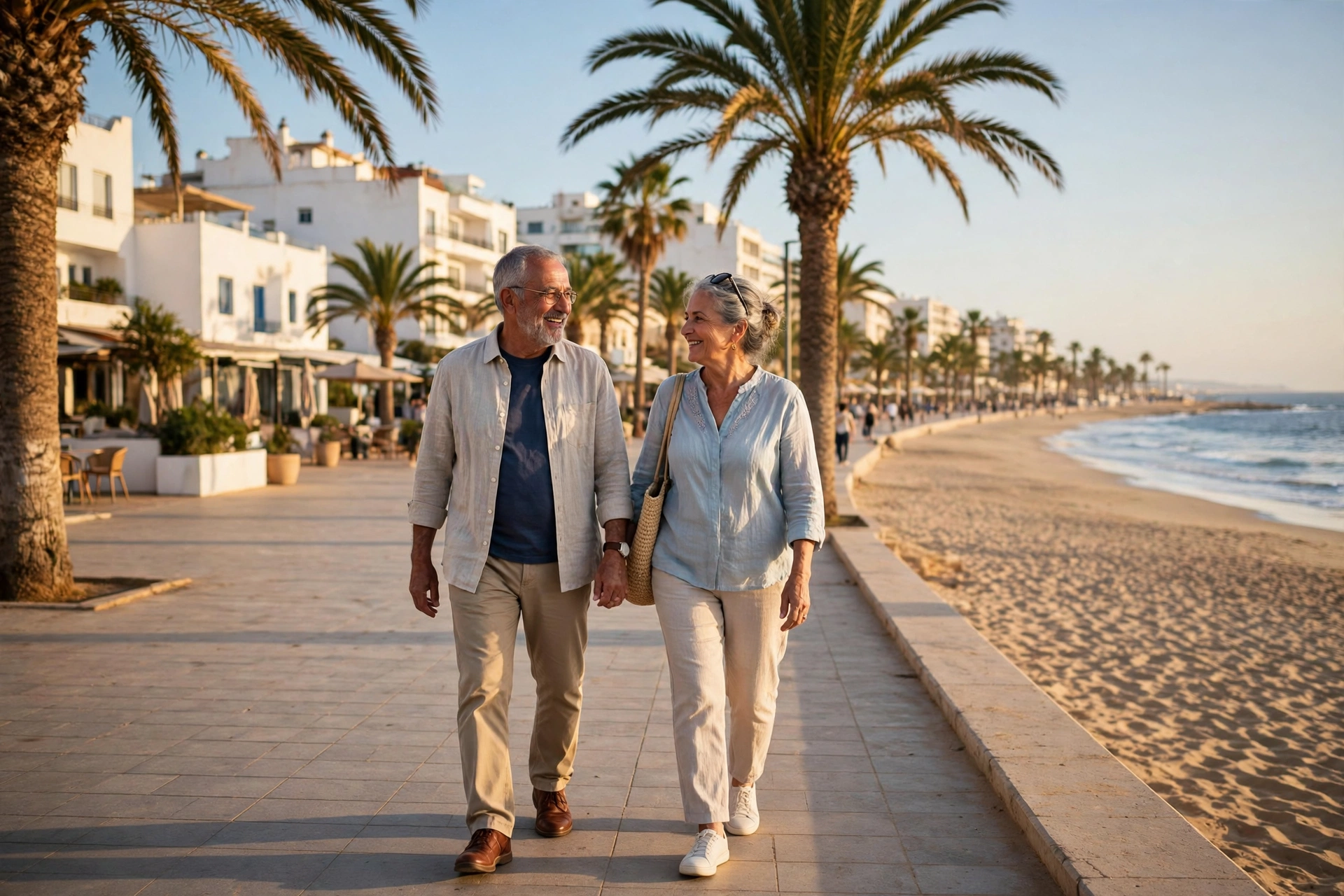
Retiring in Morocco is one of the best-kept secrets of European retirement — and not really a secret at all. French pensioners have been quietly moving to Agadir and Essaouira for decades. They came for the winter sun, a cost of living far below France or Britain, and a slower pace of life.
But retiring in Morocco is not a postcard. The bureaucracy is real, the summer heat inland is punishing, and you will need French or Arabic to get anything done. This guide gives you the honest picture: real budgets by town, visas and residency, healthcare costs, and the best towns for each kind of retiree. Prices are in Moroccan dirhams (MAD) with US dollar equivalents at roughly 10 MAD to $1, checked November 2026.
Table of Contents
Why Retire in Morocco
The first reason people choose retiring in Morocco is the climate. Agadir and Essaouira enjoy more than 300 days of sunshine a year, with winter temperatures rarely below 15°C (59°F). The Atlantic coast is the sweet spot: mild summers, cool breezes, and none of the 45°C furnace heat that Marrakech and Fes endure in July and August.
The second reason is money. A comfortable life for anyone retiring in Morocco costs roughly half of what the same life costs in France, Britain, or the United States. A decent two-bedroom flat in Agadir or Essaouira rents for 5,000–8,000 MAD ($500–$800) a month, and a good restaurant meal costs 80–150 MAD ($8–$15).
The third reason is harder to measure: Morocco respects age. Older people are treated with visible courtesy, neighbours check on you, and café culture gives retirees a daily social life for the price of a 10 MAD coffee. Many say the same thing after a year here: they found a fuller social life than the one they left behind.
There are real drawbacks too. French is essential, and Arabic (Darija) helps even more. The administration moves slowly and loves paper stamps. Summer heat inland is genuinely dangerous for older people, and complex medical care means being near Casablanca, Rabat, or Marrakech. Retiring in Morocco works best for people who arrive with open eyes.
The Cost of Retiring in Morocco
So what does retiring in Morocco actually cost? A single person retiring in Morocco can live comfortably on 12,000–18,000 MAD ($1,200–$1,800) a month in a coastal town, while a couple should budget 18,000–28,000 MAD ($1,800–$2,800). The table below shows realistic monthly budgets for a couple, checked November 2026.
| Expense | Agadir | Essaouira | Marrakech | Rabat | Fes |
|---|---|---|---|---|---|
| Rent (2-bed flat) | 6,000 MAD ($600) | 5,500 MAD ($550) | 7,000 MAD ($700) | 8,000 MAD ($800) | 4,500 MAD ($450) |
| Food & groceries | 4,000 MAD ($400) | 3,800 MAD ($380) | 4,200 MAD ($420) | 4,500 MAD ($450) | 3,500 MAD ($350) |
| Utilities & internet | 1,200 MAD ($120) | 1,100 MAD ($110) | 1,500 MAD ($150) | 1,300 MAD ($130) | 1,100 MAD ($110) |
| Transport | 800 MAD ($80) | 600 MAD ($60) | 1,000 MAD ($100) | 1,200 MAD ($120) | 700 MAD ($70) |
| Health insurance | 2,500 MAD ($250) | 2,500 MAD ($250) | 2,500 MAD ($250) | 2,500 MAD ($250) | 2,500 MAD ($250) |
| Leisure & eating out | 3,000 MAD ($300) | 2,500 MAD ($250) | 3,500 MAD ($350) | 3,000 MAD ($300) | 2,000 MAD ($200) |
| Total per month | 17,500 MAD ($1,750) | 16,000 MAD ($1,600) | 19,700 MAD ($1,970) | 20,500 MAD ($2,050) | 14,300 MAD ($1,430) |
Rent varies enormously by neighbourhood: a sea-view flat on the Agadir corniche can cost double the figure above, while a flat a ten-minute walk inland costs half. Food prices assume you shop at the souk; imported cheese, wine, and branded goods cost European prices or more.
One more insider point about the cost of retiring in Morocco: the biggest surprise expense is the “settling in” year. Flights home, furnishing a flat, residency fees, and a car add up — budget an extra 30,000–50,000 MAD ($3,000–$5,000) for your first year. A pension of €1,500–€2,000 a month (roughly 16,000–22,000 MAD) buys a genuinely comfortable life in Agadir or Essaouira. For a deeper breakdown, see our cost of living in Morocco guide and our living in Morocco expat guide.
Visas and Residency for Retirees
Citizens of the EU, the UK, the US, Canada, and Australia enter Morocco visa-free for up to 90 days. Many retirees spend their first winter this way — a three-month trial run before committing, and a sensible way to test a town before signing a lease.
Staying longer means getting a carte de séjour, the Moroccan residency card. You apply at the local police station (the Bureau des Étrangers) in the city where you live, usually within the first 90 days. The standard documents are: a valid passport, proof of address (a rental contract in your name), proof of income (pension statements, typically showing at least 10,000–15,000 MAD per month), a bank statement, a criminal record check from your home country, passport photos, and a medical certificate from a local doctor. The first card is usually valid for one year and can be renewed.
Here is the honest part: the process is slow and inconsistent. One prefecture asks for a document another never mentions, files go missing, and appointments get postponed. Retirees who succeed start early and bring a French-speaking helper to the police station. Expect several visits, and keep a folder with certified copies of everything: passport, birth certificate, pension letters, and your criminal record check.
What do people retiring in Morocco actually do in practice? Most follow one of three paths: the “snowbird” pattern of up to 90 days, then leaving and returning; the full carte de séjour route, the right choice if Morocco will be your main home; or a hybrid long-stay visa from a Moroccan consulate before travelling. Never overstay the 90 days without a pending application — fines and entry problems follow. For the full process, read our guide to moving to Morocco: visas, carte de séjour and residency, and check the UK Foreign Office’s Morocco travel advice before you travel.
Healthcare in Morocco
Healthcare is the question every retiree asks first. Morocco has two systems: a public one that is cheap but crowded and under-equipped, and a private one that is modern, fast, and affordable by European standards. For anyone retiring in Morocco, the real answer is private. The insider correction is simple: do not judge Moroccan healthcare by the public hospital in a small town — the private clinics in Casablanca, Rabat, Marrakech, and Agadir are genuinely good, with French-trained doctors and short waiting times.
A private GP consultation costs 200–400 MAD ($20–$40), a specialist 300–600 MAD ($30–$60), and a private hospital room 1,000–2,500 MAD ($100–$250) a night. Dental work and eye care are notably cheap, and medicines are sold at regulated prices, generally much cheaper than in Europe or the US.
| Service | Typical private cost | Notes |
|---|---|---|
| GP consultation | 200–400 MAD ($20–$40) | Same-day appointments are normal |
| Specialist consultation | 300–600 MAD ($30–$60) | Cardiologists, dermatologists widely available |
| Blood tests (basic panel) | 300–800 MAD ($30–$80) | Results often same day |
| MRI scan | 2,500–4,500 MAD ($250–$450) | Available in major cities |
| Dental cleaning | 300–500 MAD ($30–$50) | Much cheaper than Europe |
| Private hospital room / night | 1,000–2,500 MAD ($100–$250) | Big-city clinics |
| Emergency ambulance | 300–1,000 MAD ($30–$100) | Private services faster |

Insurance: arrange it before you move
Do not arrive without health insurance. Morocco has no reciprocal healthcare agreement with most countries, so your European health card will not cover you here. The standard choice is an international policy (Cigna, Allianz, or April International) or a Moroccan private insurer such as AtlantaSanad or RMA. Expect 2,000–4,000 MAD ($200–$400) a month for solid cover at age 65–75. Apply before you move, while still resident in your home country — it is far harder and more expensive to arrange from inside Morocco.
Keep your prescriptions and a translated summary of your medical history with you, and identify your nearest good clinic before you need it. For very complex treatment, some retirees still fly back to Europe — a realistic limit, and one more reason to keep a return ticket fund.
The Best Towns to Retire In
There is no single best town for retiring in Morocco — the right choice depends on whether you want winter sun, a big-city life, or a quiet medina. Here is the honest picture of the six towns retirees actually choose.
Agadir — the winter-sun capital
Agadir is the default answer for a reason. It is the sunniest big city in Morocco, with a long sandy beach, a flat and walkable corniche, and the largest French retiree community in the country. Rebuilt after the 1960 earthquake, it feels modern and spacious, with good private clinics, supermarkets, golf, and direct flights to Europe. Downsides: it can feel soulless next to the imperial cities, and the popular neighbourhoods are now priced for Europeans. Best for sun, sea, and an easy expat life.
Essaouira — the gentle bohemian choice
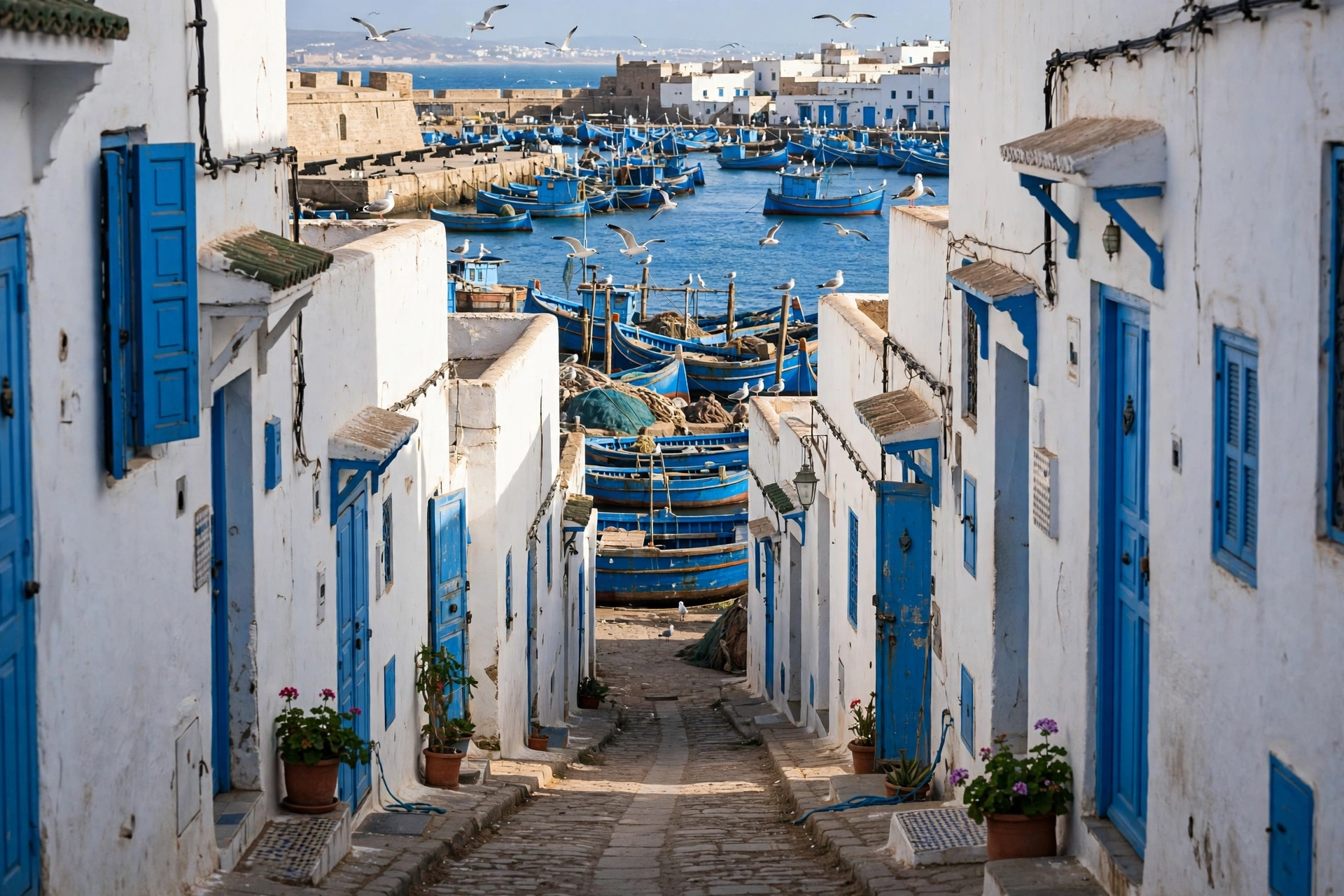
Essaouira is smaller, windier, and more charming than Agadir. The whitewashed medina, the blue fishing boats, and the café terraces give it a relaxed, artistic atmosphere. Rents are lower, and the famous afternoon wind keeps summers cool. The trade-offs: limited specialist healthcare, a wind that bothers some people, and damp winters. Best for anyone retiring in Morocco who values charm and community over convenience.
Marrakech — the exciting, exhausting option
Marrakech offers the richest life: world-class restaurants, culture, an international airport with cheap flights, and excellent private hospitals. But be honest about the heat — summers regularly pass 40°C (104°F), and that is genuinely hard on older bodies. The medina is noisy and crowded, and the “tourist price” follows you everywhere. Best for active retirees who visit in winter and escape the summer, or who live in quieter suburbs like Targa or the Palmeraie.
Rabat — the calm, green capital
Rabat is the choice retirees overlook and then love. It is greener, calmer, and cleaner than Casablanca, with the best public hospitals in the country, beautiful parks, and a long Atlantic corniche. Services work a little better here. Rents are higher than in Fes or Essaouira, and the social scene is quieter. Best for retirees who prioritise healthcare access and a calm, well-organised daily life.
Tangier — the gateway with a view
Tangier has changed fast: a new marina, a renovated medina, fast trains to Casablanca, and a ferry to Spain in just over an hour. It is the only Moroccan city where Europe feels next door, which matters when family visits or a medical trip home is needed. Downsides: the city is hilly, which matters if walking is hard, and prices in the renovated areas have risen sharply. Best for retirees who want a foot in both continents.
Fes — the cheapest and most atmospheric
Fes is the most beautiful and the most demanding choice. The old medina is a UNESCO-listed maze of craftsmen, madrasas, and donkey lanes — and not an easy place to live with limited mobility. Rents are the lowest on this list, the food is excellent, and the cultural depth is unmatched. But summers are brutally hot, winters are cold, and the best healthcare is a train ride away. Best for independent, culturally curious retirees on a tighter budget.
For a broader comparison, see our best places to live in Morocco guide — the same towns from a working-age perspective — and the official Visit Morocco site for tourism information.
Renting and Daily Life
Renting is where most people retiring in Morocco make their first expensive mistake, so take this slowly. The key figure is the semsar — the local intermediary who finds flats, negotiates with landlords, and takes a fee, usually one month’s rent. A good semsar is worth every dirham. Ask other expats for a recommendation, and never pay the fee before you have signed a contract and hold the keys.
Most flats rent unfurnished or semi-furnished, and “furnished” often means a bed, a table, and a tired sofa. Inspect water pressure, hot water, and window seals, and ask who pays the building charges. Get the contract in your name — you need it for the carte de séjour — and keep a copy of the landlord’s ID. Deposits are usually one to two months’ rent.
Neighbourhoods matter more than towns. In Agadir, Cité Founty and the marina area suit retirees for their flat streets and cafés. In Essaouira, many retirees choose the quieter streets near the beach over the medina’s stairs and noise. In Marrakech, Guéliz and Targa are calmer than the medina. Visit a neighbourhood at night before you commit. Daily life then settles into a pleasant rhythm: mornings at the souk, coffee at the same café, a walk on the corniche. Retiring in Morocco rewards routine — the same baker, the same taxi driver, the same neighbours.
Practicalities: Banking, Driving, Language and Community
Banking is straightforward but slow. Open a Moroccan account (Attijariwafa Bank, BMCI, and Bank of Africa are the most foreigner-friendly) with your passport, proof of address, and residency documents. Most people retiring in Morocco keep their home account and transfer a monthly lump sum — and tell your home bank you live in Morocco, or your card will be blocked at the worst moment.
Driving is possible but not something to rush into. Your home licence is valid for a year, after which you need a Moroccan licence. Driving here is assertive — unexpected stops, scooters everywhere, roundabouts with local rules. Many retirees never drive: petit taxis cost 10–20 MAD a trip, and intercity trains are comfortable.
Language is the real test of retiring in Morocco. French opens every door: administration, doctors, landlords. Arabic (Darija) opens the rest — the souk, the taxi driver, your neighbours. You can live in the expat bubble with English alone, but it is a smaller, more expensive life. Take French classes before you move, and learn a dozen Darija phrases in your first month.
Community matters more than most retirees expect. French retiree associations in Agadir run social events, trips, and practical help, and English-speaking groups exist in Essaouira, Marrakech, and Rabat. Loneliness is the quiet risk of retiring in Morocco, and it hits hardest in the second winter, not the first. A weekly routine — a class, a club, a café table with regulars — is the best insurance against it. If you work remotely in retirement, our digital nomad guide to Morocco has useful tips on coworking spaces and internet reliability.
Frequently Asked Questions
How much money do I need for retiring in Morocco?
A couple needs roughly 16,000–21,000 MAD ($1,600–$2,100) a month for a comfortable life in a coastal town, including rent, food, health insurance, and leisure. A single retiree can manage on 12,000–18,000 MAD ($1,200–$1,800). Add 30,000–50,000 MAD ($3,000–$5,000) for first-year settling-in costs.
Can I fund retiring in Morocco on a UK or US pension?
Yes. There is no special retirement visa, but the standard route works well: enter visa-free for 90 days, then apply for a carte de séjour with proof of pension income, usually at least 10,000–15,000 MAD a month. Your pension is paid into your home bank account, and you transfer or withdraw what you need.
Is healthcare good enough for retiring in Morocco?
Private healthcare in the big cities is good and affordable — GP visits from 200 MAD ($20), specialists from 300 MAD ($30). The catch is location: serious or complex care means being near Casablanca, Rabat, Marrakech, or Agadir. Arrange international health insurance before you move, and identify your nearest good clinic in advance.
Which is the best town for retiring in Morocco?
Agadir is the safest all-round choice for winter sun, healthcare, and an established retiree community. Essaouira suits those who want charm and a slower pace. Rabat is best for healthcare access and calm, Marrakech for energy and flights, Tangier for proximity to Europe, and Fes for the lowest costs. Try before you commit — spend a winter in your top choice first.
Do I need to speak French or Arabic for retiring in Morocco?
You can survive with English in tourist areas, but daily life is much harder and more expensive without French. Administration, doctors, and landlords all work in French. Learning French before you move, plus a little Darija, is the single best investment you can make in your retirement here.
Can I buy property in Morocco as a foreign retiree?
Yes, foreigners can buy property in Morocco, though agricultural land has restrictions. Most retirees rent for the first year or two before buying. Renting first lets you test a town and a neighbourhood, and it keeps your options open if your plans change.
Conclusion
Retiring in Morocco is not a fantasy of endless sunshine and zero problems. It is a real country with real friction — paperwork, heat, language, and healthcare limits to plan around. But for retirees who arrive with honest expectations, the rewards are large: a warm climate, a modest pension that goes far, good private healthcare in the big cities, and a daily life rich in human contact.
The smartest way to start is a trial winter. Rent a flat in Agadir or Essaouira for three months, live like a local, visit the police station, meet a doctor, and see how the place feels in February rather than in a holiday brochure. If it feels right — and for thousands of French, British, and American retirees, it has — then retiring in Morocco could be the best decision of your retirement. Start with the visa rules, sort your health insurance early, and let the town choose you.