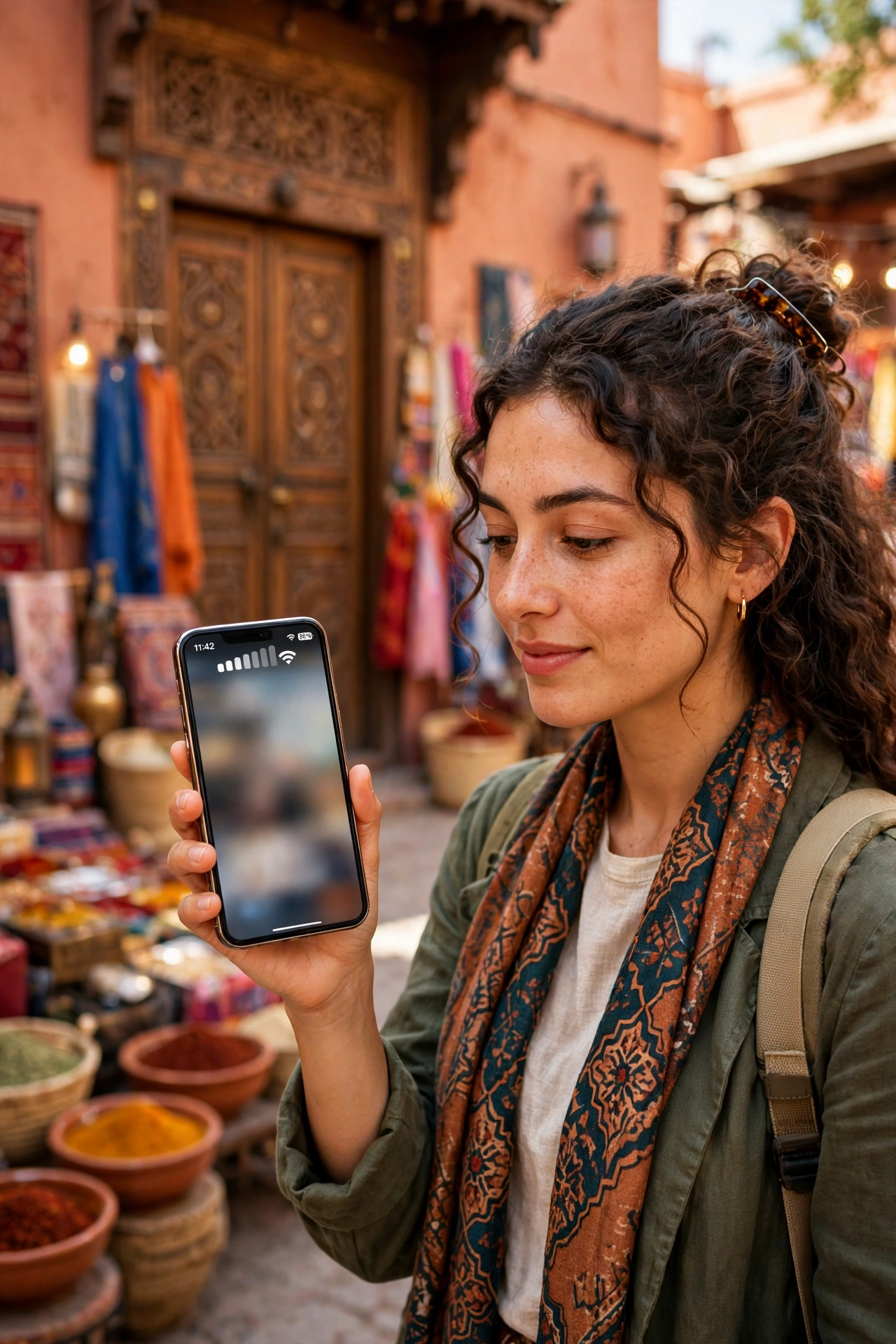
Arriving in Morocco with no data is the fastest way to turn a smooth trip into a stressful one. This morocco sim card internet guide covers everything you need to stay connected, from buying a local SIM in town to choosing fibre for a month of remote work. The right setup costs very little and saves hours of frustration. Prices below are in Moroccan dirhams (MAD) with US dollar equivalents, checked November 2026.
Morocco has three mobile networks, good 4G in cities and towns, and growing fibre — but the details matter more than the headlines. This morocco sim card internet guide covers the practical side: which operator to pick, where to buy, fair prices, and how to check a flat’s internet before you sign a lease.
In this guide:
- The Three Operators Compared
- Buying a SIM in Morocco
- Tourist SIMs, Local SIMs and eSIMs
- Data Packages, Prices and Top-Ups
- Wi-Fi: Riads, Cafés and Coworking
- Fibre, ADSL and 4G/5G for Remote Work
- Working Online: Speed, VPNs and Video Calls
- Practical Tips for Digital Nomads
- Frequently Asked Questions
- Final Thoughts
Morocco SIM Card Internet Guide: The Three Operators Compared
Morocco has three mobile operators: Maroc Telecom, Orange Morocco and Inwi. All three run nationwide 4G, and 5G is rolling out in the biggest cities. The differences are small for most visitors, but they matter if you work online, drive into the Atlas Mountains, or stay for months. This morocco sim card internet guide compares them honestly, without crowning one winner for everyone.
Maroc Telecom is the historic operator and the largest network. Its coverage is strongest outside the big cities — on mountain roads, in small towns and in the desert around Merzouga — so if your trip goes beyond the cities, it is the safest single choice. City speeds are solid and its fibre network is the most widespread. Check current offers on the official Maroc Telecom website.
Orange Morocco is a strong all-rounder. In Casablanca, Rabat, Marrakech, Tangier and Agadir its 4G is often as fast as Maroc Telecom’s, sometimes faster, and its prepaid bundles are competitive. Rural coverage is good but a step behind. It suits travellers who spend most of their time in cities. The regulator ANRT publishes coverage data for independent comparison.
Inwi is the challenger brand, popular with students and budget-conscious users, with often the cheapest data bundles. City coverage is fine and speeds handle video calls and streaming easily, but rural coverage is the weakest — think twice before long drives through remote areas. Many long-stay visitors carry Inwi as a cheap second SIM.
| Operator | Best coverage | City 4G speed | Typical prepaid data | Best for |
|---|---|---|---|---|
| Maroc Telecom | Best nationwide | Fast and reliable | 10 GB from around 50 MAD (~$5) | Beyond the cities |
| Orange Morocco | Very good in cities | Often fastest in cities | 10 GB from around 50 MAD (~$5) | City stays, remote work |
| Inwi | Good in cities | Good | 10 GB from around 30–50 MAD (~$3–5) | Budget data, second SIM |
Prices change often, and promotions can double your data for the same money. Treat the figures in this morocco sim card internet guide as ranges, checked November 2026: roughly 20–100 MAD (about $2–10) for a starter SIM with a first bundle, and 50–100 MAD (about $5–10) a month for a comfortable allowance.
Buying a SIM in Morocco
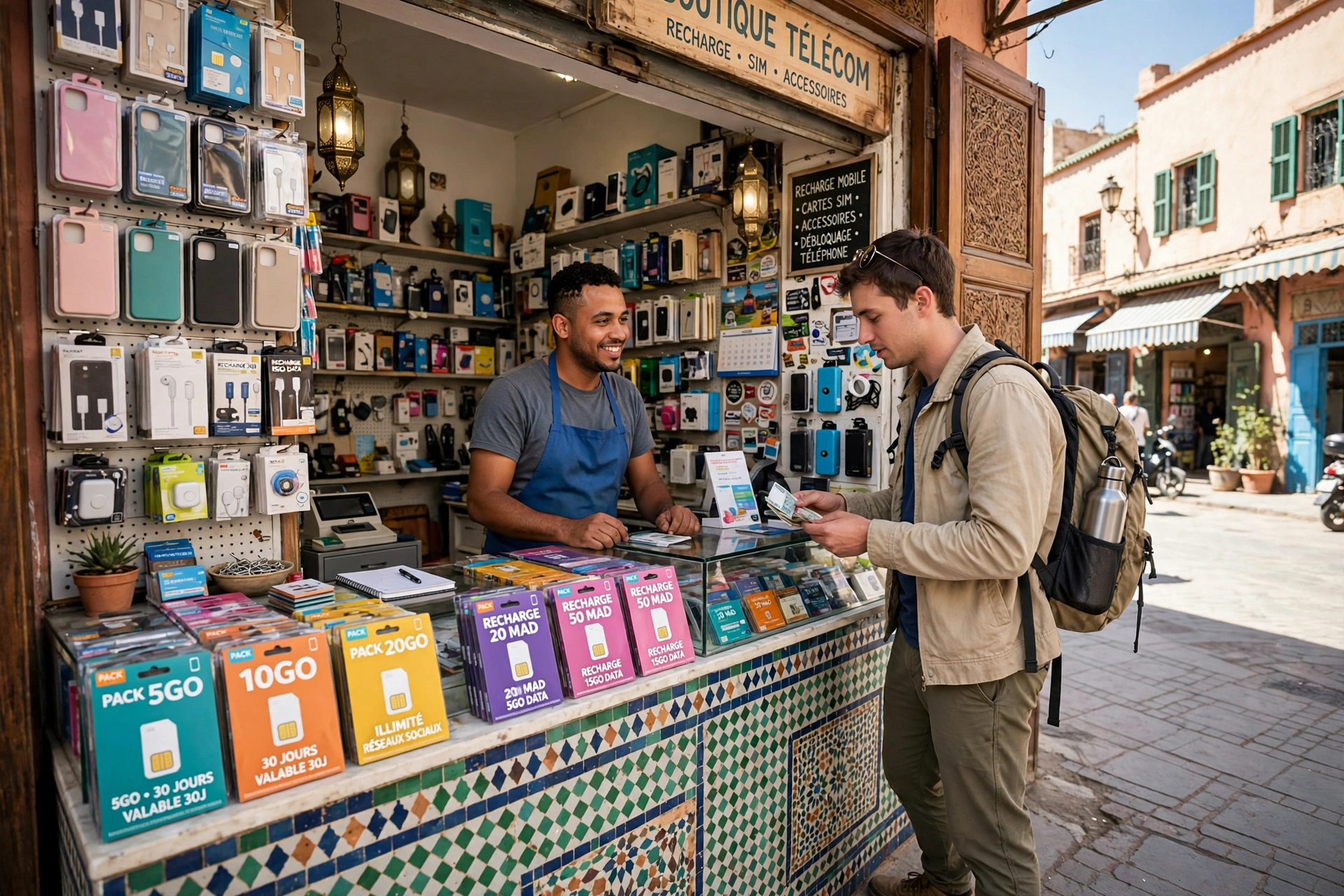
Buy your SIM at an official Maroc Telecom, Orange or Inwi shop in town, with your passport — not at the airport kiosk. Airport kiosks sell tourist packs at inflated prices, sometimes two or three times the town price. A short walk into town saves you money and gets you a proper local SIM registered in your name — the best value in this morocco sim card internet guide.
Take your passport: Moroccan law requires SIM cards to be registered, and shops will photograph or copy it in a few minutes. The assistant will insert the SIM, check it works, and help you choose your first bundle. Confirm the balance and data allowance on the spot, before you leave.
Activation is usually instant, but allow up to an hour. If data does not work straight away, check mobile data is on and the APN settings are correct — the shop can fix this in seconds. Keep the small plastic card the SIM came in: it carries your PIN and PUK codes, and you need the PUK if you enter the wrong PIN three times. If your phone is locked to a carrier back home, unlock it before you travel.
Tourist SIMs, Local SIMs and eSIMs
Tourist SIMs are sold at airports, in some hotels and at medina kiosks. They work fine, but you pay for the convenience: a tourist pack with 10–20 GB might cost 100–200 MAD (about $10–20), while the same data on a local SIM costs half as much. For two or three days, a tourist SIM is acceptable. For a week or longer, a local SIM is almost always better — same network and speeds, much cheaper data, and a Moroccan number for bookings and local apps — and this morocco sim card internet guide recommends it for nearly every traveller.
eSIMs are the easiest option if your phone supports them. International providers such as Airalo and Holafly sell Morocco data plans you can install before you fly, so you land already connected — a handy first step in any morocco sim card internet guide. Expect to pay more per gigabyte than a local SIM: a typical 5–10 GB eSIM plan costs roughly $10–25. Many travellers use a hybrid: an eSIM for the first day, then a local SIM bought in town. Check your phone is eSIM-compatible and carrier-unlocked before you buy.
Data Packages, Prices and Top-Ups
Moroccan mobile data is cheap by European and North American standards. Buy it as a recharge, or top-up, in the operator’s app, by USSD code, at a corner shop, or at an official store. Most visitors top up 50–100 MAD (about $5–10) at a time. Prices here are ranges, checked November 2026; the dirham trades at roughly 10 MAD to one US dollar.
| Bundle | Typical price | What it suits |
|---|---|---|
| 2–5 GB, valid 7 days | 20–30 MAD (~$2–3) | Light use: maps, messaging, email |
| 10 GB, valid 14–30 days | 30–50 MAD (~$3–5) | A normal week of travel |
| 20–30 GB, valid 30 days | 50–100 MAD (~$5–10) | Heavy use, hotspotting a laptop |
| 50 GB and above | 100–200 MAD (~$10–20) | Remote work without Wi-Fi |
Topping up is easy once you know the routine. The fastest way is the operator’s app, where you can pay by Moroccan card or, on some networks, by international card. You can also buy a recharge card at any hanout — the small corner shops on almost every street — and enter its code. Ask for ‘recharge’ plus the operator name.
One caution from this morocco sim card internet guide: bundles expire. A 30-day bundle will not roll over, so buy the size you will actually use, not the biggest one. If your data runs out mid-journey, a small top-up buys enough to reach your hotel. For longer stays, ask about monthly plans: 20–50 GB often costs 100–150 MAD (about $10–15) and beats repeated small top-ups. See how connectivity fits a monthly budget in our cost of living in Morocco guide, and our Morocco money and dirham guide for paying day to day.
Morocco SIM Card Internet Guide to Wi-Fi: Riads, Cafés and Coworking
Wi-Fi in Morocco is everywhere and nowhere at the same time. Almost every riad, hotel, café and restaurant offers free Wi-Fi, but quality varies wildly: excellent in a modern Casablanca hotel, a crawl two rooms from the router in a centuries-old Fes riad. This part of the morocco sim card internet guide shows how to work around that.
In riads, choose a room near the router if you need to work. Many riads now put a repeater on each floor — ask staff which floor has the strongest signal. For a longer stay, message the riad before arrival and ask for a recent speed test.
Cafés are Morocco’s unofficial offices. In Marrakech, Casablanca, Rabat and Tangier you will find cafés with fast Wi-Fi, good coffee and a tolerant attitude to laptops — a favourite working setup in this morocco sim card internet guide. Order regularly and nobody will mind you working for a couple of hours. Speeds in a good café are often 20–50 Mbps down, plenty for calls and cloud work, but avoid peak times for important calls, as the network slows when the room fills up.
Coworking spaces are the most reliable option for serious work. Marrakech, Casablanca, Rabat, Agadir and Taghazout all have spaces with fibre, backup power and quiet call rooms. A day pass typically costs 100–200 MAD (about $10–20); monthly membership is usually 1,000–2,000 MAD (about $100–200). Our digital nomad guide to Morocco covers the best bases for a longer stay.

Fibre, ADSL and 4G/5G for Remote Work
If you rent a flat for a month or more, the internet in the building matters more than the internet in the city. Fibre availability is building-by-building, even in wealthy districts of Casablanca and Marrakech — one street can have it while the next does not. Check the exact address before you sign a lease, not the neighbourhood. This is the second most important lesson in this morocco sim card internet guide, after buying your SIM in town.
Ask the landlord three questions before you commit: is fibre installed in this building, and which operator provides it? What speed does the current subscription actually deliver — ask for a speed-test screenshot, not the advertised speed. And is there a 4G router as backup if the fixed line goes down? Clear answers are a good sign; evasive ones are a warning.
Fibre packages typically offer 50–200 Mbps down for around 200–500 MAD (about $20–50) a month. Installation takes a few days to two weeks, so for a one-month stay ask whether the flat already has an active subscription. ADSL still exists in older buildings and is noticeably slower — often 10–20 Mbps down, with much slower uploads — so it suits email and browsing, but video calls can stutter.
If a flat only has ADSL, your phone’s 4G hotspot becomes your real connection; many remote workers in Morocco work this way full-time at 20–60 Mbps in cities. Keep a charged power bank and a spare data bundle, as this morocco sim card internet guide advises, and you will rarely be offline.
Working Online: Speed, VPNs and Video Calls
For most remote work, Moroccan internet is more than good enough. A fibre connection of 50 Mbps or a solid 4G signal handles video calls and cloud work without drama. Upload speed matters more than download speed for calls, so look for at least 10 Mbps up if you present or teach online. This morocco sim card internet guide recommends testing your connection with a real call before an important meeting, not just a speed-test website. Morocco runs on Western European Time, the same as London.
VPNs are widely used by remote workers in Morocco, and there is no ban on personal VPN use for ordinary work; a company VPN will normally work fine too. Some streaming services and banking apps behave differently with a VPN or a Moroccan IP address, so test your essential tools in the first day or two — one more check this morocco sim card internet guide recommends. For video calls, close other apps, sit near the router, and keep your phone hotspot ready: if the Wi-Fi drops mid-call, switching to 4G takes seconds. Evenings between 8 and 11 pm are the busiest time on residential networks, so schedule critical calls earlier when you can.
Practical Tips for Digital Nomads
A little preparation turns Morocco from a place with good internet into a place where you can rely on it. Start with redundancy: a local SIM, decent Wi-Fi where you sleep, and a café or coworking space you trust. When one fails, the other two carry you. This morocco sim card internet guide is built on that principle — never depend on one connection for work that matters.
If things go wrong, most problems have a quick fix. No signal usually means the SIM is not seated properly or the phone needs a restart. Data that stops after a top-up often means the bundle has not activated yet — wait ten minutes, then restart the phone. A SIM asking for a PUK code needs the plastic card it arrived on, or a visit to an official shop with your passport. Slow evenings are usually congestion, not a fault: switch to 4G, move nearer the router, or try again in the morning.
Keep your number active if you plan to return — top it up at least once every few months or the operator may recycle it — and note your nearest official shop in advance, as this morocco sim card internet guide suggests.
Frequently Asked Questions
Do I need a passport to buy a SIM card in Morocco?
Yes. SIM cards must be registered to an identity document — for visitors, your passport. Official shops will copy or photograph it in a few minutes. Unregistered SIMs from unofficial sellers can be blocked without warning, so use an official shop.
Which is the best SIM card for tourists in Morocco?
A local Maroc Telecom or Orange SIM bought in town is the best value for most tourists. Maroc Telecom has the widest coverage, which matters outside the cities, while Orange is often fastest in the cities, and Inwi is the cheapest option as a second SIM. This morocco sim card internet guide recommends a local SIM over a tourist pack for any stay longer than a few days.
Can I use an eSIM in Morocco?
Yes, if your phone supports eSIM and is carrier-unlocked. International providers such as Airalo and Holafly sell Morocco data plans you can install before you travel — the fastest start this morocco sim card internet guide offers. They cost more per gigabyte than a local SIM, but they are ideal for your first day; many travellers switch to a local SIM once settled.
How much does mobile data cost in Morocco?
A comfortable allowance is roughly 50–100 MAD (about $5–10) a month for 10–30 GB. A starter SIM with a first bundle costs about 20–50 MAD (about $2–5). Prices are ranges, checked November 2026.
Is the Wi-Fi in Moroccan riads good enough to work from?
Sometimes. Modern riads and hotels in big cities often have good Wi-Fi, but thick walls in old buildings can weaken the signal badly. Ask for a room near the router, or a recent speed test, before booking. For important calls, use a coworking space or your phone’s 4G hotspot as backup.
Is fibre internet available everywhere in Morocco?
No. Fibre is building-by-building, even in wealthy districts, so check the exact address before signing a lease. Ask the landlord which operator serves the building and what speed it delivers. Without fibre, a 4G router with a large data bundle is a practical alternative, and this morocco sim card internet guide covers it in the fibre section above.
Final Thoughts
Staying connected in Morocco is cheap, straightforward and — with the right preparation — reliable. Buy your SIM in town with your passport, pick the operator that fits your route, and check the internet at the exact address before committing to a flat. That is the whole of this morocco sim card internet guide in three sentences.
The country rewards travellers who come prepared: fast 4G in the cities, fibre in more buildings every year, and coworking spaces full of people doing the same. Keep a backup connection, keep your data topped up, and watch the practical details — dirham prices, expiry dates, the router in the riad. Do that, and connectivity fades into the background, leaving you free to enjoy the food, the cities and the road. For a longer stay, our Moroccan food guide covers the eating side, and our cost of living in Morocco guide helps you budget the trip.
Prices in this morocco sim card internet guide are in Moroccan dirhams (MAD) with approximate US dollar equivalents at around 10 MAD to $1, checked November 2026. Confirm the current offer in the shop before you buy.