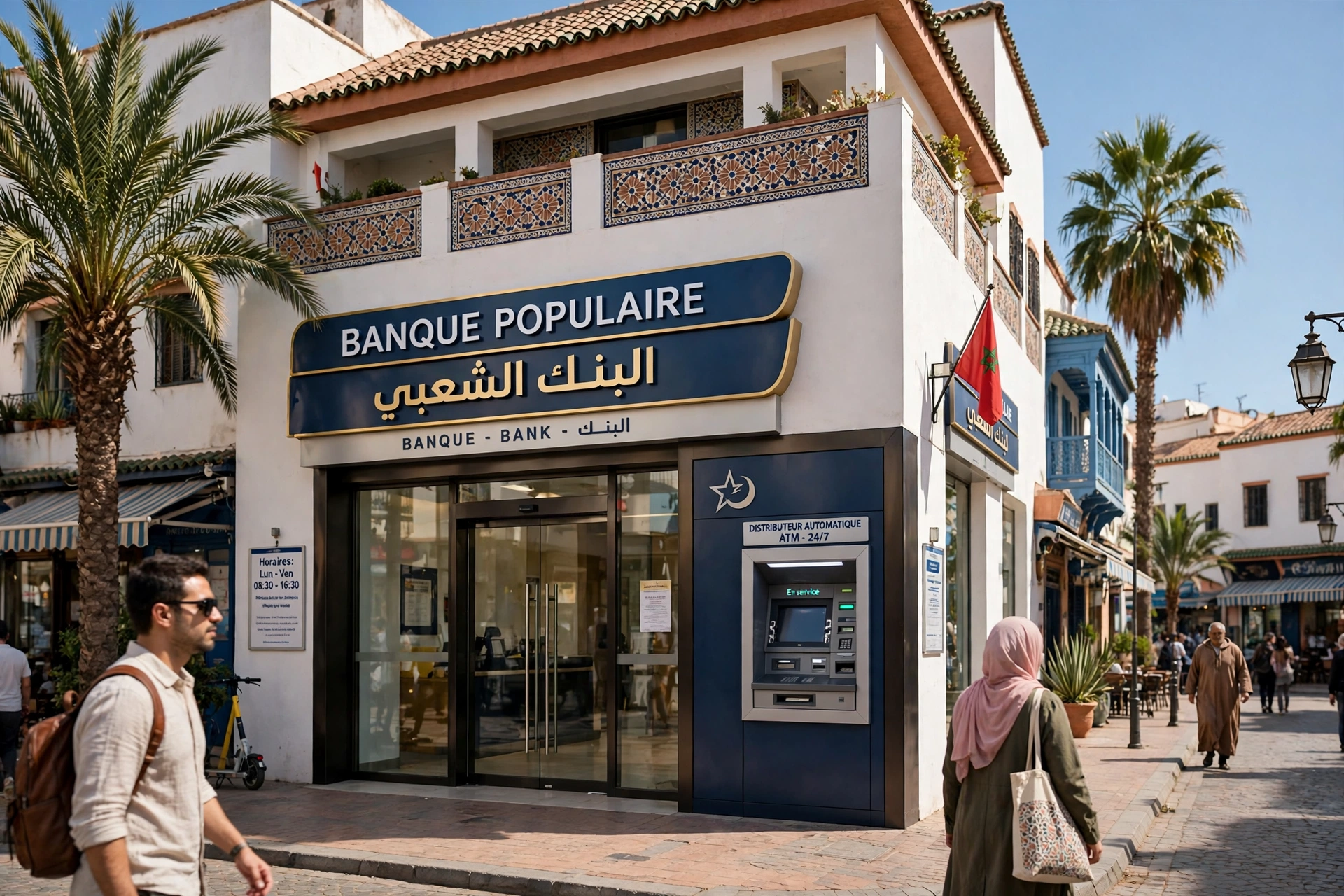
If you are planning a move to Morocco, learning how to open bank account morocco foreigner accounts actually work is one of the first steps you should take. A local account makes daily life far easier: you can pay rent, receive a salary or pension, and avoid the fees of withdrawing cash from a foreign card every week. Anyone who plans to open bank account morocco foreigner services should sort this out early — signing a lease and paying bills are simpler with a Moroccan account.
The good news is that Morocco’s banks are used to foreign customers. The country has a large expat community, and most major banks have French- or English-speaking staff in larger cities. All fees below are in Moroccan dirhams (MAD) with US dollar equivalents, checked November 2026.
- Can a Foreigner Open a Bank Account in Morocco?
- Resident vs Non-Resident Accounts: The Convertible Dirham Difference
- Best Banks in Morocco for Foreigners
- Documents Required to Open Bank Account Morocco Foreigner
- How to Open Bank Account Morocco Foreigner: Step by Step
- Fees and Charges: What It Really Costs
- Sending Money In and Out: SWIFT, Limits and Bank Al-Maghrib Rules
- Online Banking, Mobile Apps and Cards
- If Your Application Is Refused — and Common Traps to Avoid
- FAQ: Opening a Bank Account in Morocco as a Foreigner
Can a Foreigner Open a Bank Account in Morocco?
Yes. Foreigners can open bank accounts in Morocco, both as residents and as non-residents. You do not need Moroccan citizenship, and you do not even need to live in the country full time. What changes with your status is the account type, the documents required, and how freely you can move money abroad. So the first question before you open bank account morocco foreigner options is simple: are you a resident, or not yet?
Residents holding a carte de séjour can open a standard dirham current account almost exactly like a Moroccan citizen. Non-residents, including tourists and property buyers, can also open an account — normally a convertible dirham account, explained in the next section. Banks are generally welcoming, but the experience varies by branch: one in a big city that serves many expats will usually process your file in one visit.
The process to open bank account morocco foreigner accounts is quickest in these city branches. If you are still planning your move, read our Living in Morocco: The Complete Guide for Expats first.
Resident vs Non-Resident Accounts: The Convertible Dirham Difference
This is the single most important distinction in Moroccan banking. The dirham is not fully convertible, so the central bank, Bank Al-Maghrib, controls how money leaves the country, and your account type decides how much freedom you have. This guide explains how to open bank account morocco foreigner accounts for both residents and non-residents.
Resident accounts
If you hold a carte de séjour, you open a standard dirham account: salary in, bills out, debit card, online banking, and local transfers. You can add a savings account and, in most banks, a foreign-currency account. Resident accounts face the same exchange controls as Moroccan citizens for money sent abroad, so outward transfers need a justification. Spending inside Morocco is unrestricted.
Non-resident convertible dirham accounts
If you do not yet have residency, the bank will normally open a convertible dirham account for you. This is the standard solution when you need to open bank account morocco foreigner services before your residence permit is ready.
The account is held in dirhams, but it is funded from abroad, and the money in it can be transferred back out of Morocco without the usual exchange-control justification. That convertibility is the whole point: the account suits people whose money comes from outside Morocco, such as foreign salaries, pensions, or savings for a property purchase. If you later become a resident, the bank can convert it into a standard resident account. Some banks also offer euro or dollar accounts, but you will still need a dirham account for daily spending.
Best Banks in Morocco for Foreigners
Six banks dominate the market and are the realistic choices for most foreigners. Attijariwafa Bank is the largest bank in the country, with the biggest branch network. BMCE Bank of Africa has a strong international presence. CIH Bank is popular with younger customers and has one of the best mobile apps. Société Générale Maroc (SGMB) and Crédit du Maroc are the main French-linked banks. For a full list of licensed banks, see the Wikipedia list of banks in Morocco.
Fees vary by package, so treat the table below as a guide. All figures are checked November 2026, and the dollar equivalents use an approximate rate of 10 MAD to 1 USD. When you open bank account morocco foreigner packages, compare the whole package — not just the monthly fee — because transfer charges and card fees abroad matter far more over a year.
| Bank | Typical account for foreigners | Monthly account fee | Debit card (per year) |
|---|---|---|---|
| Attijariwafa Bank | Current account + savings | 5–15 MAD ($0.50–$1.50) | 60–150 MAD ($6–$15) |
| BMCE Bank of Africa | Current account + savings | 5–20 MAD ($0.50–$2) | 60–150 MAD ($6–$15) |
| CIH Bank | Online current account | 0–10 MAD ($0–$1) | 50–120 MAD ($5–$12) |
| Banque Populaire | Current account + savings | 5–15 MAD ($0.50–$1.50) | 60–140 MAD ($6–$14) |
| Société Générale Maroc (SGMB) | Current account + savings | 10–25 MAD ($1–$2.50) | 80–180 MAD ($8–$18) |
| Crédit du Maroc | Current account + savings | 5–20 MAD ($0.50–$2) | 60–150 MAD ($6–$15) |
Monthly fees are low by European or North American standards, and many banks waive them for the first year or for online-only accounts. Choose a bank with a branch near your home and an app in English or French. Take your time deciding where to open bank account morocco foreigner accounts, since switching banks later means repeating the paperwork. See our guide to renting an apartment in Morocco.
Documents Required to Open Bank Account Morocco Foreigner
Banks ask for more paperwork from foreigners, and the list varies by bank and branch. Bring originals plus one photocopy of everything. Having them ready is what turns a two-week process into a single visit, which is exactly why preparation matters when you open bank account morocco foreigner files.
Your passport is the starting point. It must be valid for at least six months, and the bank will copy the photo page and your latest entry stamp. If you are a resident, bring your carte de séjour as well, or the receipt (récépissé) if it is still being processed — many banks accept it as temporary proof.
Proof of address is the document that causes the most delays. The bank wants a Moroccan address: a rental contract, a utility bill in your name, or an attestation d’hébergement if you are staying with someone. A hotel booking is not enough for most banks.
Proof of income comes next: an employment contract, a recent payslip, a pension statement, or an employer letter. Self-employed people and freelancers can usually show bank statements from their home country or client contracts. Finally, some banks ask for a tax number — your home-country tax ID is usually enough at first, and your Moroccan tax ID once you are a tax resident.
Documents for non-residents
If you are opening a convertible dirham account as a non-resident, you will need your passport, proof of address in your home country, and proof of the source of the funds you plan to transfer in — a foreign bank statement or a sale contract, for example. Non-residents who open bank account morocco foreigner accounts cannot always get a chequebook or overdraft, but a debit card and online banking are normally available.
How to Open Bank Account Morocco Foreigner: Step by Step
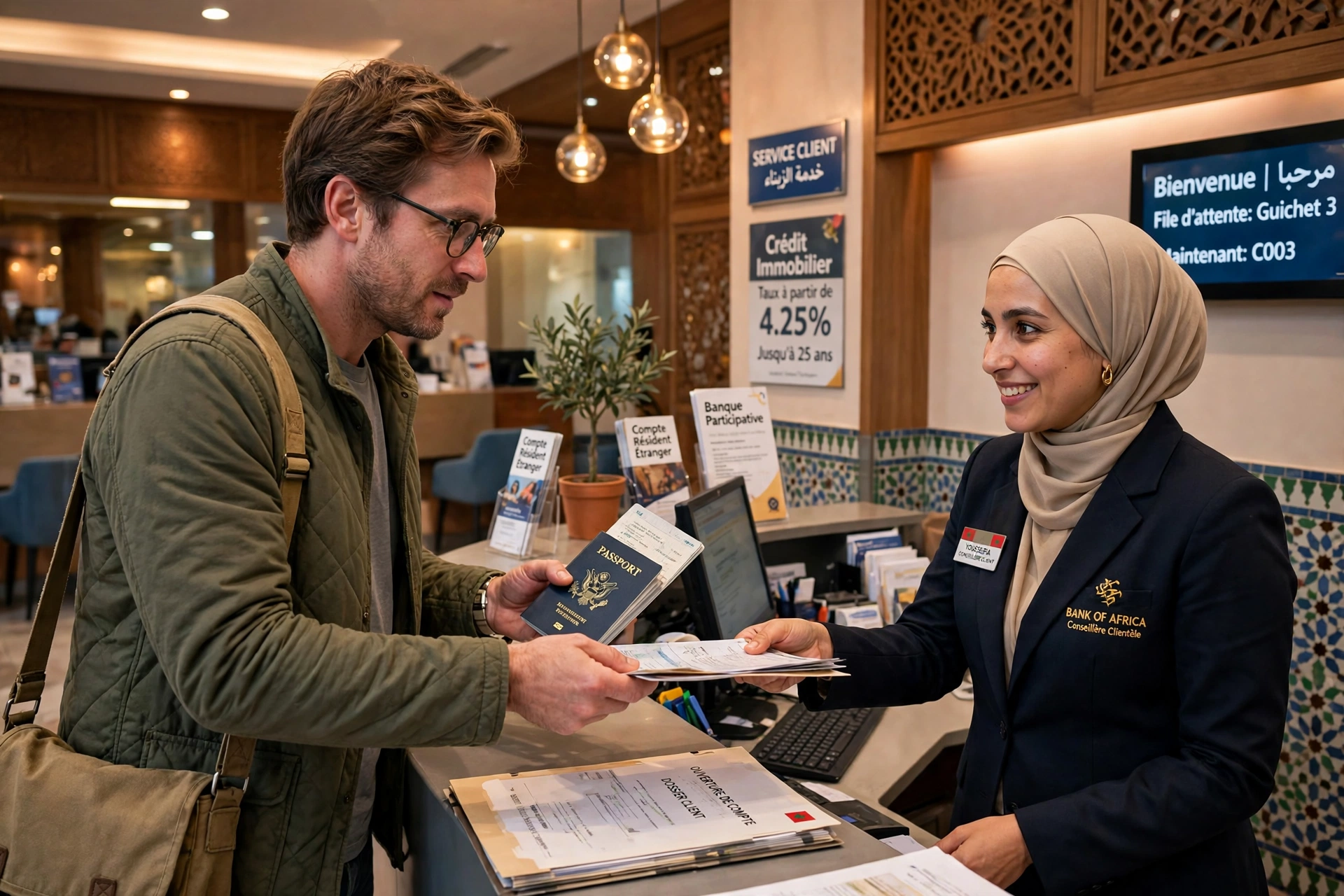
The process is simple, but it almost always happens in person: online-only opening for foreigners is still rare, and even CIH Bank, the most digital of the big banks, usually wants to see you once in a branch. Go on a weekday morning, when branches are quieter.
First, choose your bank and branch. Visit two or three branches and ask for the person who handles foreign clients. Compare their answers, because they genuinely differ from branch to branch. This comparison is the most useful hour you will spend before you open bank account morocco foreigner paperwork anywhere.
Second, gather your documents using the checklist above, with photocopies and a French translation of anything not in French, Arabic, or English.
Third, go to the branch and ask to open the account. You will fill in an application form, sign a specimen signature card, and choose your package and card type. The adviser may ask about the origin of your funds and your expected monthly turnover — standard compliance questions.
Fourth, make your first deposit — usually 100–500 MAD ($10–$50), waived entirely for some online accounts — and keep the receipt, since your account number is printed on it. Fifth, wait for activation: the account is usually open the same day, but the debit card takes five to ten working days to arrive, and online banking credentials often arrive by SMS. Confirm that your Moroccan phone number is the one on file.
Fees and Charges: What It Really Costs
Banking in Morocco is cheap compared with most of Europe, but the fees that catch foreigners out are rarely the monthly charge. Here are the ones to ask about before you open bank account morocco foreigner accounts.
International transfers are the biggest cost. An incoming SWIFT transfer typically costs 50–150 MAD ($5–$15) at the Moroccan end, plus your sending bank’s charge, and an intermediary bank may take 100–300 MAD ($10–$30). Outgoing transfers cost roughly 100–250 MAD ($10–$25) plus a small percentage.
Prefer euros or dollars, which clear faster. The cheapest way to open bank account morocco foreigner accounts is usually an online package with low transfer fees — compare that line, not just the monthly charge.
ATM withdrawals from other banks’ machines cost around 5–10 MAD ($0.50–$1) inside Morocco, and using your Moroccan card abroad costs roughly 20–35 MAD ($2–$3.50) per withdrawal plus about 2% for currency conversion.
Ask about dormancy fees when you open bank account morocco foreigner accounts — they are the charge most newcomers miss. An account untouched for a year or more can attract a quarterly charge of roughly 25–50 MAD ($2.50–$5). If you leave Morocco for a long period, keep the account alive with a small transfer every few months, or close it. See our cost of living in Morocco guide and our Moroccan dirham money guide for how these costs fit a monthly budget.
Sending Money In and Out: SWIFT, Limits and Bank Al-Maghrib Rules
Moving money into Morocco is easy. Any bank can send a SWIFT transfer to your Moroccan account using your IBAN, which starts with MA, and your bank’s SWIFT/BIC code. Transfers in euros or dollars usually arrive within two to five working days, and the bank converts them into dirhams at its daily rate unless you hold a foreign-currency account. There is no limit on how much you can bring in, but large transfers trigger a source-of-funds check, so keep the paperwork.
Sending money out is where the rules matter. Morocco controls foreign exchange through Bank Al-Maghrib, and banks must justify every outward transfer. If you hold a convertible dirham account as a non-resident, repatriating your funds is straightforward: the money came from abroad, so it can go back abroad.
If you are a resident, outward transfers need a justification, such as a tuition invoice or a medical bill. Understand this rule before you open bank account morocco foreigner accounts and move large sums.
Residents also have an annual travel allowance for foreign spending, set by Bank Al-Maghrib. Your bank can tell you the current amount; the Bank Al-Maghrib website publishes the official rules.
Retirees on a foreign pension should talk to their bank early — a regular pension transfer into a convertible account is one of the smoothest arrangements; see our guide to retiring in Morocco. Digital nomads should keep invoices for every payment, since banks sometimes freeze an incoming transfer while they check its origin; see our digital nomad guide to Morocco.
Online Banking, Mobile Apps and Cards
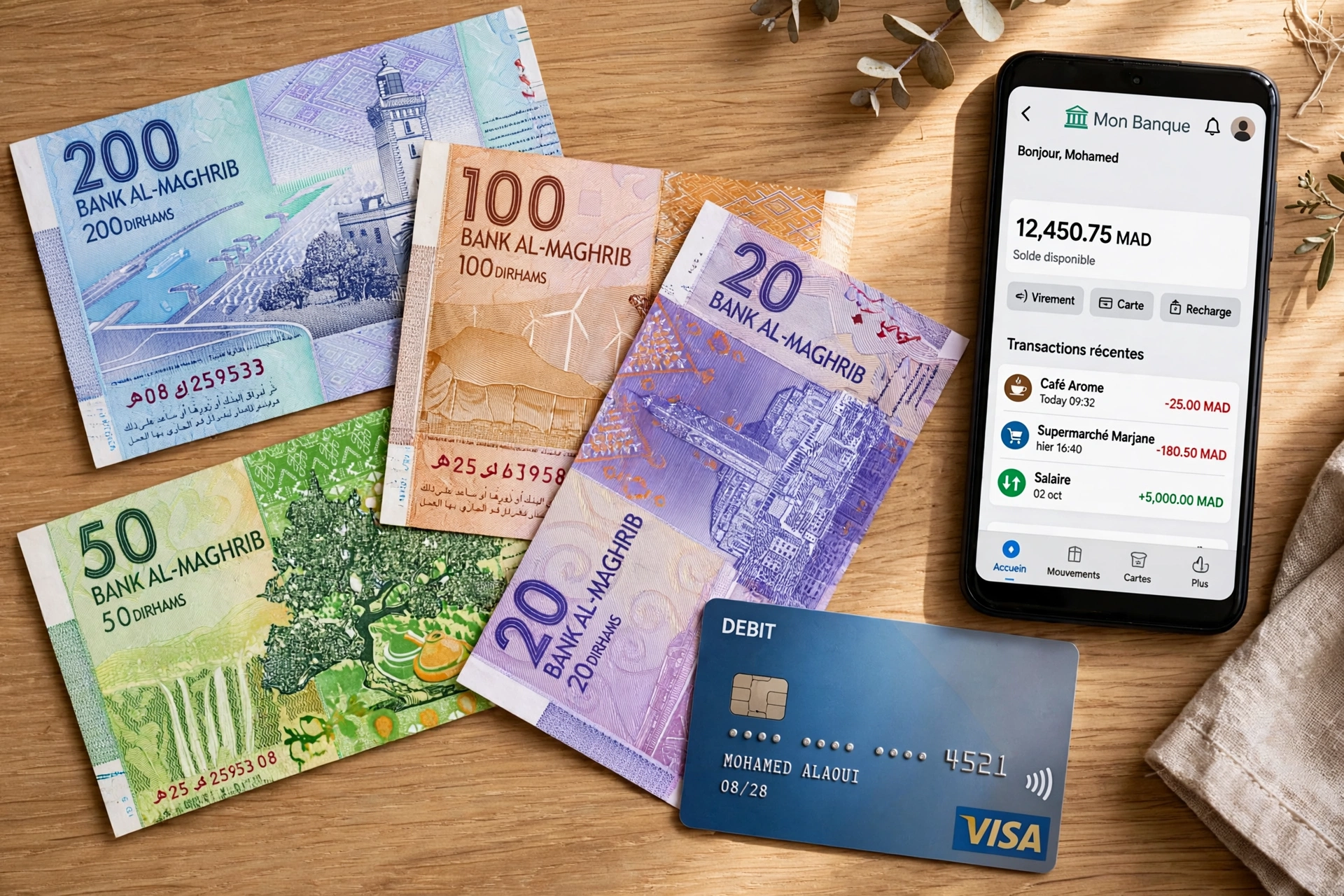
Moroccan banks have invested heavily in their apps. CIH Bank’s app is widely considered the most modern, Attijariwafa’s covers the most services, and BMCE’s is strong for international transfers. All major banks offer balance checks, transfers, bill payments, and mobile top-ups from the app.
Cards are Visa or Mastercard debit cards, accepted across the country. Contactless payment is standard in city supermarkets, though small shops and souks still prefer cash. Apple Pay and Google Pay support is patchy — do not rely on phone payments alone.
One practical point matters more than any app feature: almost every online banking action is confirmed by SMS, so you need a Moroccan phone number registered with the bank, and you need to keep that SIM active. If you change your number, update it at the branch in person — banks will not change it by email or phone. Buy a local SIM on arrival and register it the same week you open bank account morocco foreigner services.
If Your Application Is Refused — and Common Traps to Avoid
A refusal is frustrating, but rarely final. The most common reason is an incomplete file: a missing proof of address, an expired passport, or an unverifiable document. Ask the adviser what is missing, fix it, and come back. If the branch still refuses, try another branch of the same bank — managers have real discretion, and a different branch often says yes.
Beyond refusals, a few traps catch newcomers again and again. Dormancy fees quietly eat a forgotten account, so close accounts you no longer use. A local phone number is not optional — without it, you cannot receive the SMS codes that unlock online banking.
Branch-level differences are real: fees, documents, and opening hours vary, so confirm everything at your own branch. Never leave Morocco without closing your account or leaving it funded and active; a negative balance from unpaid fees can cause problems if you return. Keep this in mind when you open bank account morocco foreigner accounts, and the process stays simple.
FAQ: Opening a Bank Account in Morocco as a Foreigner
Can I open a bank account in Morocco as a tourist?
Yes, tourists can open a convertible dirham account as non-residents. You need your passport, proof of address at home, and proof of where the money comes from. The easiest way to open bank account morocco foreigner services as a tourist is to visit a large-city branch with all three documents ready. Chequebooks and overdrafts are not normally included, but a debit card is.
How long does it take to open a bank account in Morocco as a foreigner?
The timeline to open bank account morocco foreigner accounts depends on your documents. If they are complete, the account is usually opened the same day, and the debit card takes five to ten working days to reach the branch. If the bank sends your file to head office, allow two weeks in total.
Can I open a Moroccan bank account online before arriving?
Not really. To open bank account morocco foreigner accounts, even the most digital banks want to verify your passport in person at least once. Research banks and prepare documents from abroad, but plan a branch visit in your first week.
What is the minimum deposit to open an account?
Most banks ask for 100–500 MAD ($10–$50) as a first deposit, and some online accounts have no minimum. There is usually no minimum balance, but falling below zero triggers fees, so keep a small buffer.
Can I receive my salary or pension into a Moroccan account?
Yes. Salaries from a Moroccan employer go into a resident dirham account, and foreign pensions or salaries can go into a convertible dirham account or a foreign-currency account. Tell the bank the payments are regular when you open bank account morocco foreigner accounts, so they are not flagged as unusual.
Can I keep my Moroccan bank account after leaving Morocco?
Yes, but tell the bank your new address and keep the account active to avoid dormancy fees. If you will not use it, close it properly at the branch before you leave — closing an account from abroad is slow and sometimes impossible without a power of attorney.
Opening a bank account in Morocco as a foreigner is straightforward once you know the rules, so prepare before you arrive. Choose a bank near you, bring a complete set of documents, ask for a convertible dirham account if you are not yet a resident, and get a local phone number for online banking from day one.
Anyone who plans to open bank account morocco foreigner accounts and follows the steps above will find rent, bills, and daily spending become simple. If you need medical cover while you settle in, our guide to healthcare in Morocco for expats is the next step.