
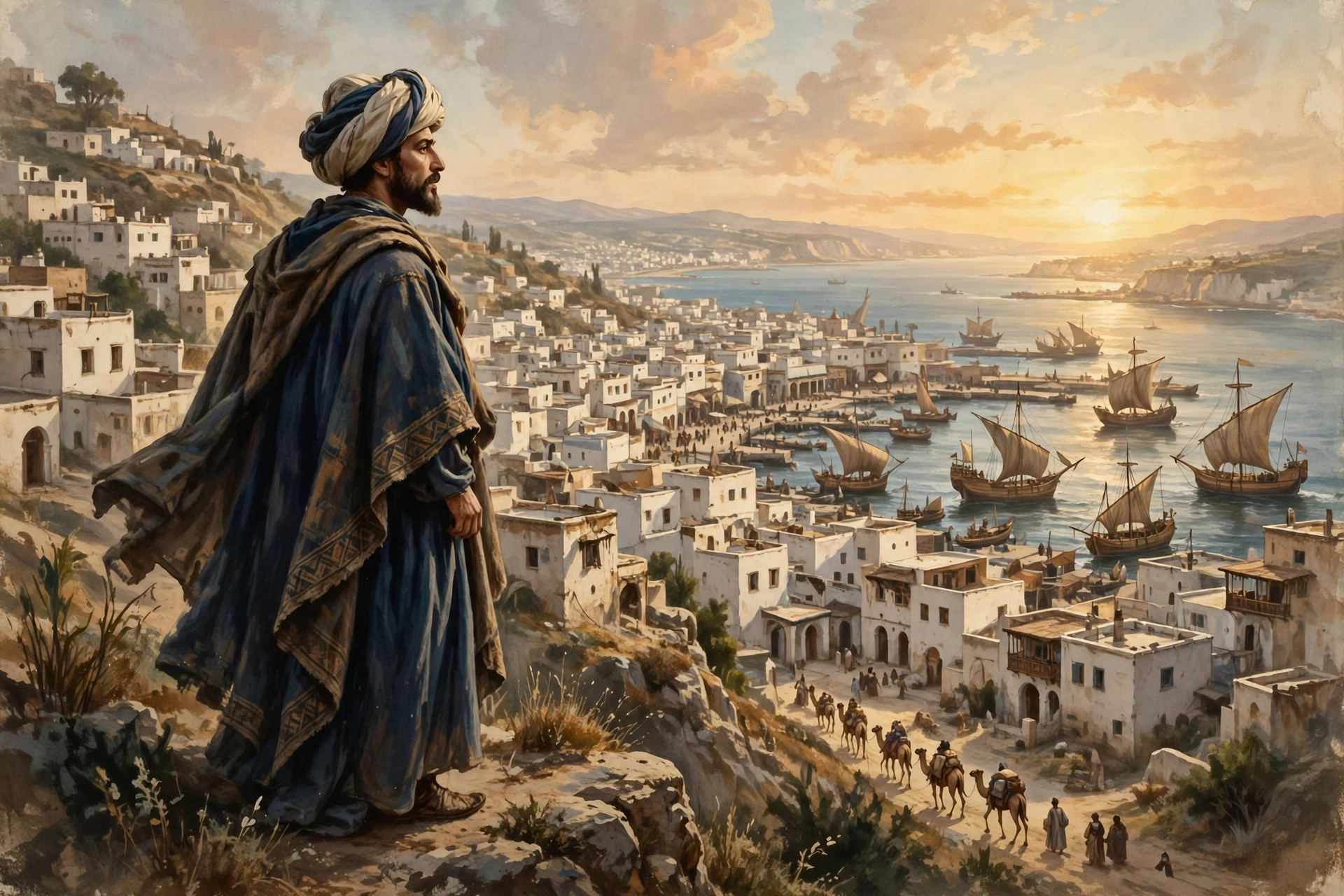
In 1325, a 21-year-old law student from Tangier set out on the pilgrimage to Mecca and did not come home for nearly three decades. By the time he returned, he had crossed some 120,000 kilometres — further than Marco Polo, and further than any other traveller of the medieval world. This is the story of the ibn battuta morocco traveller whose journey became the Rihla, one of the great travel books of all time, and of how you can still follow in his footsteps in Morocco today.
The Rihla — literally "the journey" — is the account he dictated after his return, at the court of the Marinid sultan in Fez. It is part travelogue, part geography, part gossip, and it remains the single best window into the 14th-century Muslim world: its courts and caravanserais, its scholars and sultans, its ports and deserts. Yet the ibn battuta morocco traveller is not only a figure from a book: his tomb stands in the old medina of Tangier, and Fez still keeps the madrasas and streets of his age.
This guide tells his story from Tangier to Mecca, Delhi, the Maldives and Mali, separates what historians accept from what they still argue about, and finishes with a practical plan for visiting his Morocco. For the wider story, see our history of Morocco; for the cities, our Tangier travel guide and Fez travel guide.
In this guide
Tangier 1325: A Young Man Leaves Home
Tangier in 1325 was a busy port at the meeting point of the Atlantic and the Mediterranean, ruled — like the rest of northern Morocco — by the Marinid dynasty from Fez. It was a city of merchants, sailors and scholars, and it shaped the young ibn battuta morocco traveller from birth. Born there in 1304, the date most commonly given, he came from a family of Amazigh origin that had produced judges for generations. The sea was at his doorstep, and the wider Muslim world was, for an educated young man, a single connected space.
He did not leave as an adventurer. He left as a pilgrim and a student, and that matters for everything that followed. His training was in Islamic law, and wherever he went — Cairo, Damascus, Delhi, the Maldives — he found work as a judge, a teacher or a diplomat, because a trained jurist from Morocco was employable across the whole Muslim world. The journey was possible because the world the ibn battuta morocco traveller crossed was, in a real sense, his own professional network.
A Family of Judges
The Battuta family belonged to Tangier's learned class. His father was a qadi, a judge of the Maliki school of law that dominated North Africa, and the young Ibn Battuta was educated to follow him. He studied the Quran, Islamic jurisprudence and Arabic literature, the standard curriculum of a Moroccan scholar of his day.
That background explains the shape of his travels. He did not cross continents to trade or conquer; he moved from court to court and mosque to mosque, and his account is full of the things a jurist notices: who appointed the judges, how the law was applied, which scholars were respected. The ibn battuta morocco traveller saw the world through a judge's eyes, and that is what makes his book so useful to historians.
Why He Left — and Why He Kept Going
In June 1325, at the age of 21, he set out alone for Mecca to perform the Hajj. He travelled overland through North Africa and Syria, reaching Mecca in 1326. The pilgrimage itself should have taken a year or two. Instead, he kept going — to Persia, to East Africa, to Anatolia, to India — and did not see Morocco again for 24 years.
There is no single reason he stayed away so long. Curiosity played its part, and so did employment: sultans kept offering him posts, and he kept accepting them. But there was also a simpler truth, which he admits in the Rihla. He loved the road.
Ibn Battuta Morocco Traveller: The Rihla in Brief
The numbers alone are staggering. Over about 29 years, the ibn battuta morocco traveller covered roughly 120,000 kilometres — three times the distance Marco Polo is credited with — across North Africa, the Middle East, East Africa, Central Asia, India, Southeast Asia and, if his account is taken at face value, China. He visited the equivalent of more than 40 modern countries, mostly on foot, by horse, by camel or by ship.
What makes the journey extraordinary is not only its length but its range. He prayed in Mecca and Medina, dined with sultans in Delhi and the Maldives, crossed the Sahara with a salt caravan, sailed the Indian Ocean in a dhow, and walked the streets of Cairo, Baghdad and Constantinople — and, he claimed, Beijing. He met plague, pirates and rebellion along the way, and recorded it all with a judge's eye for detail — the lasting gift of the ibn battuta morocco traveller to history.
The book that came out of it all, the Rihla, was not written by Ibn Battuta himself. It was dictated after his return to Fez and written down by a court scholar named Ibn Juzayy, because the Marinid sultan ordered it to be recorded. Without that command, the greatest journey of the Middle Ages might have survived only as family legend.
Eight Years in India
The longest single chapter of the journey was India, where the ibn battuta morocco traveller spent about eight years, from 1333 to 1341. The Sultan of Delhi, Muhammad bin Tughluq, welcomed foreign scholars and appointed Ibn Battuta as a judge in the capital, with a generous salary and a house. Delhi was then one of the largest cities in the world, and his account of its court, mosques and markets is one of the most vivid descriptions of medieval India that survives.
India also nearly killed him. He was caught up in court intrigues, fell out of favour, was imprisoned for a time, and survived a rebellion and a shipwreck on the Malabar Coast. When the sultan sent him as an ambassador to China in 1342, the mission collapsed: his ship was wrecked off Calicut, his goods were lost, and he fled into the hills fearing the sultan's anger. It was a disaster — and it set the ibn battuta morocco traveller on the road to the Maldives and Southeast Asia instead.
The Maldives, China and Home
From India, the ibn battuta morocco traveller sailed to the Maldives, where he spent about eighteen months as a judge — and, by his own account, married into a prominent local family before leaving. He visited Sri Lanka, sailed on to Sumatra, and then, he claimed, reached China, visiting the great port of Quanzhou and travelling inland to Beijing, where he says he met the Mongol emperor. The China chapters are the most disputed part of the whole book.
What is certain is the road home. By 1349 he was back in Damascus, and in 1350 he returned to Morocco for the first time in 24 years — only to find that the Black Death had taken his mother. He made the Hajj once more, then in 1352 set out on his final journey: south across the Sahara with a salt caravan to the Mali Empire, visiting Timbuktu and Gao, before returning to Fez in 1354.
The 29-Year Journey: Timeline
The journey is easier to follow as a timeline than as a story, because the ibn battuta morocco traveller crossed the same seas and deserts several times. The dates below are the ones most commonly given by historians; a few are approximate, and the China leg is disputed.
| Period | Where he travelled | What happened |
|---|---|---|
| 1325–1326 | Tangier to Mecca via North Africa, Cairo and Syria | Leaves Tangier aged 21; first Hajj in Mecca, 1326 |
| 1326–1327 | Iraq and Persia | Visits Baghdad, Isfahan and Shiraz; returns to Mecca |
| 1327–1330 | Arabia, East Africa and Anatolia | Second and third Hajj; sails to Mogadishu, Mombasa and Kilwa; crosses Anatolia |
| 1330–1333 | Constantinople and Central Asia | Visits the Byzantine court; crosses the steppe to Samarkand and Afghanistan |
| 1333–1341 | India | Eight years in Delhi as a judge under Sultan Muhammad bin Tughluq |
| 1342–1345 | Maldives, Sri Lanka and Southeast Asia | Judge in the Maldives; sails to Sumatra; claims to reach China |
| 1345–1349 | China (claimed), then back west | Quanzhou and Beijing, if the account is believed; returns via Syria |
| 1349–1352 | Morocco, then the Hajj again | Returns to Tangier after 24 years; his mother has died of plague |
| 1352–1354 | Across the Sahara to Mali | Salt caravan to Sijilmasa, Timbuktu and Gao; returns to Fez in 1354 |
Return to Fez: The Marinid Court
When the ibn battuta morocco traveller finally reached Fez in 1354, the city was at the height of its power. The Marinid sultan Abu Inan Faris ruled an empire that stretched from the Atlantic to the edge of Algeria, and Fez was its glittering capital of madrasas, mosques and palaces. It was the fitting place for the journey to end, and for the book to begin.
The result was the Rihla, written down by the court scholar Ibn Juzayy in 1355 and 1356. Its full title is "A Gift to Those Who Contemplate the Wonders of Cities and the Marvels of Travelling", and it runs to hundreds of pages of courts and caravans, saints and sultans, deserts and monsoons. Ibn Juzayy polished the language and added verses of his own — one reason scholars still argue over which words are the traveller's and which are his editor's. It is a book the ibn battuta morocco traveller dictated, not one he wrote. For the city that produced it, see our guide to the Marinid madrasas of Fez.
Ibn Battuta spent his last years in Morocco as a judge, first in Fez and then, by some accounts, back in Tangier. The date of his death is not settled: the commonly given years are 1368 or 1369, and this remains unresolved — the sources disagree, and no firm date can be given. He was buried in Tangier, in the small domed tomb in the old medina that visitors can still see today.
What Scholars Debate About the Rihla
For all its fame, the Rihla has always had its doubters, and an honest guide should say so. The first doubts were raised within a century of the book's writing, and modern scholars have sharpened them. The central question is simple: did he really go everywhere he says he went? For several famous episodes, the answer remains unresolved.
The China chapters are the most questioned. Some historians argue that Ibn Battuta never reached China at all, and that the passages about Quanzhou and Beijing were borrowed from earlier writers or from stories he heard in India. Others defend the visit, pointing to details that match 14th-century Chinese sources. The evidence cuts both ways, and the claim that the ibn battuta morocco traveller reached China should be treated as debated, not settled. Similar doubts attach to parts of the Anatolia and Central Asia chapters, where his chronology is sometimes impossible.
What is not in doubt is the core of the journey. His accounts of Mecca, Cairo, Damascus, Delhi, the Maldives and Mali are full of precise, first-hand detail that no armchair writer could have invented. The consensus today is that the ibn battuta morocco traveller really did travel for some 29 years across Africa and Asia, and that some episodes — above all China — were probably embellished or heard second-hand.
Visiting Ibn Battuta's Morocco
You can follow the ibn battuta morocco traveller in a long weekend, and the two cities you need are the two that bookend his life: Tangier, where he was born and is buried, and Fez, where his story was written down. Start in Tangier, take the train south to Fez, and finish in the medina where the Rihla was dictated.
Tangier is the essential stop. The traveller's tomb stands in the old medina, a small whitewashed domed shrine that is easy to miss and all the more moving for it. The city has changed beyond recognition since 1325, but the medina's lanes, the port and the view across the strait are the same geography he grew up with. Our Tangier travel guide covers the city in full, and the history of Morocco puts his age in context.
The Tomb and the Old City
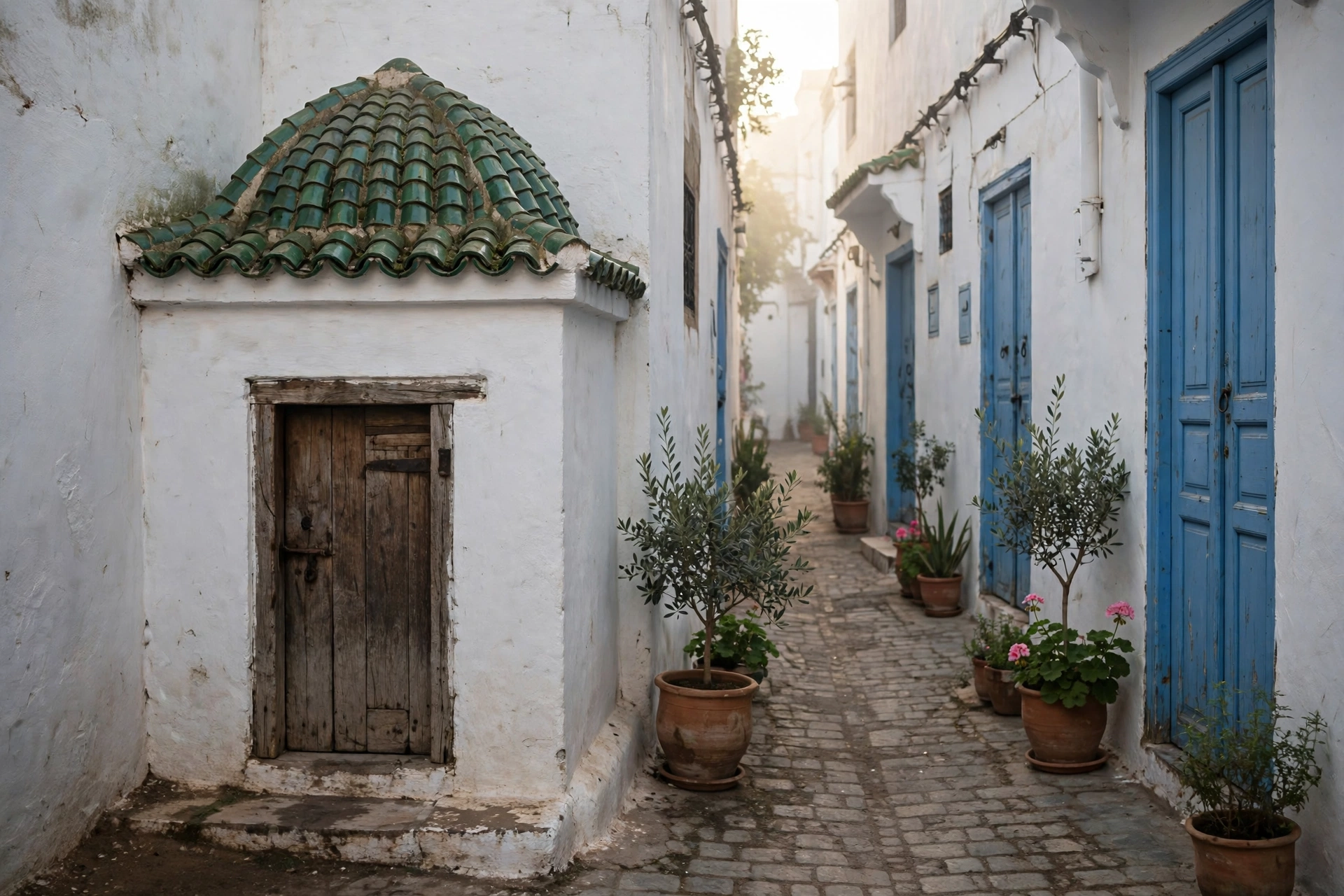
The tomb of Ibn Battuta sits in the old medina, near the Rue de la Kasbah, in a modest whitewashed building with a green-tiled dome. It is a working shrine as much as a monument: locals come to pray, and visitors are welcome to step inside quietly, remove their shoes, and leave a small donation — 10 to 20 MAD (about $1 to $2) is customary, checked November 2026. The visit takes ten minutes.
Pair the tomb with the Kasbah Museum, which covers Tangier's history from Phoenician times to the present. Entry is about 60 MAD (about $6) for foreign visitors, checked November 2026. Then walk down through the medina to the port and look across the strait: the ibn battuta morocco traveller left from a harbour much like this one, on a road that would take him 29 years to finish.
Fez: The City That Wrote the Story
Fez is where the journey became a book. Start at the Bou Inania Madrasa, the great Marinid theological school built in the 1350s — the very decade the ibn battuta morocco traveller was dictating his account a few streets away. Its carved cedar, zellige tilework and quiet courtyard are the finest surviving setting of his world. Entry is about 20 MAD (about $2) for foreign visitors, checked November 2026.
From there, walk the medina of Fez el-Bali — the old city, inscribed by UNESCO as a World Heritage site, as listed on the UNESCO page for the Medina of Fez — and climb to the Marinid Tombs above the city, where the sultans who ordered the Rihla are buried. The tombs are free and give the best view over the medina at sunset. A licensed medina guide costs roughly 200 to 400 MAD (about $20 to $40) for a half day, checked November 2026, and is worth it: the medina has some 9,000 lanes. Browse the full History & Heritage section for more of Morocco's past.
Getting Between Tangier and Fez
The train is the easy choice. ONCF runs direct trains from Tangier Ville to Fez, taking about three and a half to four hours, with a second-class ticket costing roughly 150 to 190 MAD (about $15 to $19), checked November 2026. Travel in the morning so you arrive in Fez with the afternoon free. CTM buses run the same route for a similar price, and a grand taxi costs far more — expect 800 to 1,200 MAD (about $80 to $120) for the whole car — so the train wins on price and comfort, on a road the ibn battuta morocco traveller himself knew well.
| Site or service | City | What to see | Entry / price (Nov 2026) |
|---|---|---|---|
| Tomb of Ibn Battuta | Tangier medina | Small domed shrine where the traveller is buried | Free; donation of 10–20 MAD (about $1–$2) customary |
| Kasbah Museum | Tangier kasbah | Tangier's history from Phoenician times to today | About 60 MAD (about $6) for foreign visitors |
| Bou Inania Madrasa | Fez el-Bali | Great Marinid madrasa of the 1350s, carved cedar and zellige | About 20 MAD (about $2) for foreign visitors |
| Marinid Tombs | Fez, hill above the medina | Ruined tombs of the Marinid sultans, best sunset view | Free |
| Licensed medina guide | Fez el-Bali | Half-day guided walk through the 9,000 lanes | About 200–400 MAD (about $20–$40) |
| ONCF train, Tangier–Fez | Tangier to Fez | Direct train, about 3.5–4 hours, second class | About 150–190 MAD (about $15–$19) |
Ibn Battuta FAQ
When was Ibn Battuta born?
He was born in Tangier in 1304, the date most commonly given for his birth. He came from a family of Amazigh origin that had produced judges for generations, and he was educated in Islamic law before leaving for Mecca at the age of 21.
How far did Ibn Battuta travel?
About 120,000 kilometres over roughly 29 years, from 1325 to 1354 — further than Marco Polo, and further than any other known medieval traveller. His route took him across North Africa, the Middle East, East Africa, Central Asia, India, Southeast Asia and, he claimed, China, before a final journey across the Sahara to Mali.
Did Ibn Battuta really reach China?
This is genuinely debated and remains unresolved. Some historians argue he never reached China and borrowed the passages from earlier writers; others defend the visit with details that match 14th-century Chinese sources. His accounts of Mecca, Cairo, Delhi, the Maldives and Mali are widely accepted as first-hand.
Where is Ibn Battuta buried?
In a small domed tomb in the old medina of Tangier, near the Rue de la Kasbah. It is a working shrine, free to visit, with a small donation of 10 to 20 MAD (about $1 to $2) customary. The visit takes about ten minutes.
What is the Rihla?
The Rihla, or "the journey", is the account of Ibn Battuta's travels, dictated in Fez in 1355–1356 to the court scholar Ibn Juzayy on the orders of the Marinid sultan Abu Inan Faris. Its full title is "A Gift to Those Who Contemplate the Wonders of Cities and the Marvels of Travelling". For background on the man himself, see the Ibn Battuta article on Wikipedia.
Can I visit Ibn Battuta's tomb and the places from his life?
Yes. His tomb in Tangier is free to visit, the Bou Inania Madrasa in Fez costs about 20 MAD (about $2), and the train between the two cities takes three and a half to four hours for roughly 150 to 190 MAD (about $15 to $19), all checked November 2026. A long weekend covers both cities comfortably.
Conclusion
The ibn battuta morocco traveller left Tangier as a 21-year-old pilgrim and came home at 50 as the most travelled man of his age. His book, the Rihla, is still read today because it is more than a list of places: it is a portrait of a whole world — its courts and markets, its scholars and sultans — seen by a Moroccan judge who kept walking until there was nowhere left to go.
Go and see his Morocco for yourself. Stand at his tomb in the Tangier medina, ride the train south to Fez, and walk the lanes where his journey was written down. The ibn battuta morocco traveller has been dead for more than six and a half centuries, but in Tangier and Fez, his road is still there to walk.
Last checked: November 2026