
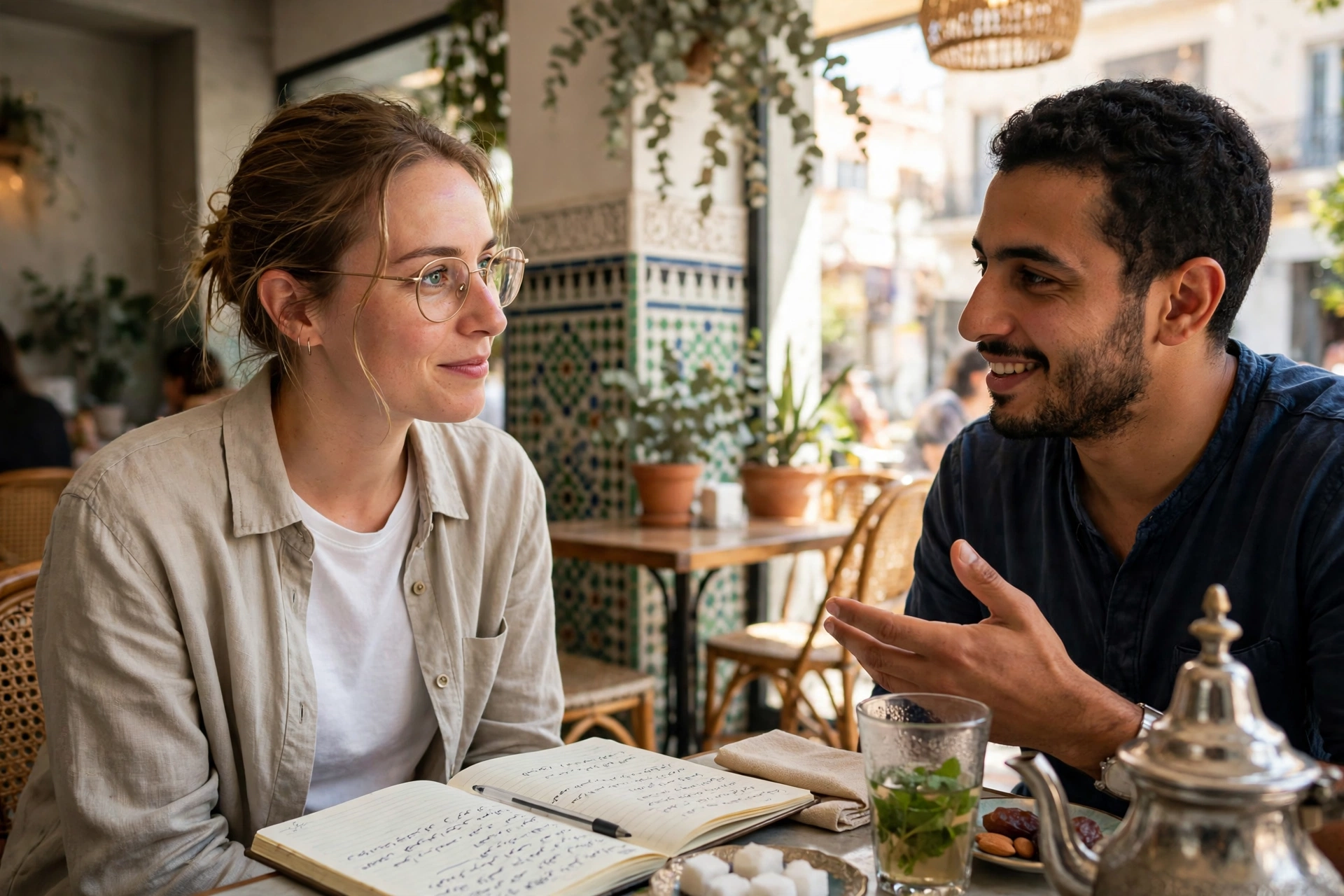
Learning Moroccan Arabic Darija is the most useful thing an expat can do after moving to Morocco. You can survive for months on French and English in Casablanca or Rabat, but in a neighbourhood souk, a small-town taxi, or a family home, it is Darija that opens doors. Shopkeepers quote you the local price, neighbours invite you in for tea, and everyday problems get solved in minutes.
The good news: learning Moroccan Arabic Darija is far more forgiving than most newcomers expect. The dialect drops the complicated grammar of classroom Arabic, borrows generously from French and Spanish, and rewards even a small vocabulary with warm reactions. Moroccans love hearing a foreigner try, and a shaky greeting often earns more goodwill than perfect French ever will. This guide, part of our Living in Morocco section, explains how the language really works, what it costs to learn, and the twenty phrases that will carry you through your first year.
In this guide
- Learning Moroccan Arabic Darija: How It Differs from Modern Standard Arabic
- The Sounds and Script That Trip Expats Up
- How Long Does It Take to Learn Darija?
- Learning Methods Compared: Tutors, Classes, Apps and Immersion
- 20 Essential Darija Phrases Every Expat Needs
- Greetings, Politeness and the Rituals That Matter
- When French Works Better, and When It Does Not
- Common Mistakes Expats Make, and How to Avoid Them
- Building a Daily Practice Routine That Actually Sticks
- Frequently Asked Questions
Learning Moroccan Arabic Darija: How It Differs from Modern Standard Arabic
The first honest correction outsiders get wrong is assuming that learning Moroccan Arabic Darija means learning Arabic with an accent. It is not. Darija is a distinct spoken dialect, shaped by centuries of contact with Amazigh languages, French, and Spanish, and it differs from Modern Standard Arabic (MSA) in vocabulary, grammar, and pronunciation. A student fluent in textbook MSA can still freeze at a market stall, because the words on the street are often completely different.
Grammar is where learning Moroccan Arabic Darija feels easier than expected. Darija has no case endings, no dual number, and a much simpler verb system than MSA. The verb "to be" largely disappears in the present tense, so "I am tired" becomes something close to "ana ayyan". Word order is flexible, and speakers mix French verbs with Arabic endings. What you lose in precision, you gain in speed: useful sentences come within weeks, not months.
Vocabulary is the bigger shock when learning Moroccan Arabic Darija. Darija uses "bghit" for "I want" where MSA says "uridu", "shhal" for "how much" instead of "kam", and "fin" for "where" instead of "ayna". French loanwords fill everyday gaps: "tomobil" for car, "biro" for pen, and "sbitar" for hospital. In the north, around Tangier and Tetouan, Spanish loans are even more common. For background on how the dialect developed, see the overview of Moroccan Arabic.
The Sounds and Script That Trip Expats Up
Pronunciation causes more confusion than grammar, and learning Moroccan Arabic Darija means retraining your ear before your tongue. The dialect is famous for consonant clusters and "sh" sounds: "shnu" means "what", "shhal" means "how much", and "shukran" means "thank you". Words often drop short vowels entirely, so a word that looks long on paper comes out as a quick burst of consonants. Listen for a week before worrying about speaking perfectly: recognising the rhythm matters more than getting every sound right.
The letter qaf is another surprise. In much of Morocco it is pronounced as a hard "g", so the word for heart sounds like "gelb" rather than "qalb". The letter jim often softens towards "zh", and the throaty sounds that scare beginners — "ayn" and "kha" — appear far less often in Darija than in MSA. You can be understood without mastering them, though Moroccans appreciate the effort.
Should you learn the Arabic script while learning Moroccan Arabic Darija? Yes, eventually, but transliteration will carry you through the first months. Most expat learning materials use Latin letters, and that is fine for speaking and listening. The script becomes valuable for reading street signs, menus, and messages from Moroccan friends, who often write Darija in Latin letters on WhatsApp. Learn to read the script slowly, alongside speaking, rather than treating it as a gate to pass before opening your mouth.
How Long Does It Take to Learn Darija?
Honest timelines matter more than promises, so here is what learning Moroccan Arabic Darija actually looks like month by month. With an hour of daily practice, most expats handle greetings, numbers, directions, and bargaining within six to eight weeks. After three to four months, you can manage everyday conversations: ordering food, explaining a problem to a landlord, chatting with neighbours. Real fluency, following a fast family dinner debate, usually takes a year or more of steady exposure.
Your starting point changes the maths. French speakers learning Moroccan Arabic Darija have a clear head start, because so much Darija vocabulary comes from French, and they already know words like "tomobil" and "la poste" without studying. Spanish speakers get a smaller boost in the north. English-only speakers start from zero on vocabulary, but they often progress fast because Darija grammar is simple and Moroccans are patient.
The variable that matters most in learning Moroccan Arabic Darija is not talent but contact hours. An expat who lives among Moroccan neighbours, shops in the local souk, and takes a weekly tutor lesson will outpace someone who studies an app alone for a year. If you are planning your move, read our guide to moving to Morocco: visas, carte de séjour and residency first, because your visa situation decides how much time you get to settle in and practise. Daily life in Darija is the real classroom, and the table below shows what each route costs.
Learning Methods Compared: Tutors, Classes, Apps and Immersion
There is no single best way of learning Moroccan Arabic Darija, only the method that fits your budget and schedule. A private tutor gives the fastest progress, because every minute targets your gaps, but it is also the most expensive option. Group classes are cheaper and more social, though you share speaking time with ten other students. Apps cost almost nothing and fit into dead time, but they rarely teach real Darija, since most teach MSA and label it "Arabic".
Language exchange is the hidden bargain: you teach an hour of English or French, and a Moroccan partner teaches you an hour of Darija, for free. Quality varies, but the cultural payoff is enormous, and many exchanges turn into genuine friendships. Full immersion — living in a Moroccan neighbourhood, shopping locally, refusing the English-speaking bubble — costs nothing extra and multiplies the value of every other method. Most successful learners combine two or three approaches rather than betting on one.
| Method | Typical cost | Best for | Watch out for |
|---|---|---|---|
| Private tutor (1-to-1) | 150–300 MAD/hour ($15–30) | Fast progress, speaking confidence | Quality varies; ask for a trial lesson |
| Group classes | 1,000–2,500 MAD/month ($100–250) | Structure, meeting other expats | Slow pace; often MSA-heavy |
| Language apps | 0–150 MAD/month ($0–15) | Vocabulary, daily habit | Most teach MSA, not Darija |
| Language exchange | Free | Real conversation, friendships | Needs a reliable partner |
| Full immersion | Free (daily life) | Listening, natural phrases | Exhausting without a base first |
Last checked: November 2026. Prices are typical ranges in Casablanca and Rabat; smaller cities are often 20–30% cheaper. USD equivalents use roughly 10 MAD to $1.
Tutors for learning Moroccan Arabic Darija are easy to find once you know where to look. Language schools in the big cities employ Darija specialists, and many tutors advertise in local Facebook groups for expats. Expect to pay 150 to 300 dirhams per hour, with experienced tutors in Casablanca at the top of that range. Two lessons a week plus daily self-study is the sweet spot: enough structure to progress, enough freedom to live your life. Before committing, ask whether the course teaches Darija specifically, because many "Arabic courses" in Morocco still teach MSA by default.
20 Essential Darija Phrases Every Expat Needs
A phrasebook is no substitute for learning Moroccan Arabic Darija properly, but twenty well-chosen phrases will carry you through almost any first-month situation. Learn pronunciation first, then worry about spelling. The transliteration below uses a simple Latin system: "kh" is the throaty sound in "loch", "gh" is a soft gargled "r", and "sh" is the sound in "shoe".
Practise these out loud, in real situations, rather than memorising them silently — that is how learning Moroccan Arabic Darija actually works. Say "labas?" to your building guard every morning, thank the baker with "shukran bezaf", and ask "shhal?" before you buy anything. Moroccans will correct you gently, and each correction is a free lesson. Within a month, these twenty phrases will feel automatic, and you will start combining them into your own sentences.
| # | Darija (transliteration) | English meaning |
|---|---|---|
| 1 | Salam | Hello / peace |
| 2 | Labas? | How are you? |
| 3 | Labas, hamdullah | I am fine, thank God |
| 4 | Shukran | Thank you |
| 5 | Shukran bezaf | Thank you very much |
| 6 | Afak | Please |
| 7 | Smeh liya | Excuse me / I am sorry |
| 8 | Bghit… | I want… |
| 9 | Shhal? | How much is it? |
| 10 | Ghali bezaf | It is too expensive |
| 11 | Wakha | OK / alright |
| 12 | Inshallah | God willing |
| 13 | Fin…? | Where is…? |
| 14 | Ma fhemtesh | I did not understand |
| 15 | Awd liya afak | Please repeat that |
| 16 | Bslama | Goodbye |
| 17 | Tbarkellah alik | Well done / bless you |
| 18 | Yallah | Let us go |
| 19 | Saha | Cheers / to your health |
| 20 | Shnu hadshi? | What is this? |
Greetings, Politeness and the Rituals That Matter
Greetings in Morocco are a ritual, not a formality, and getting them right is the first win in learning Moroccan Arabic Darija. A proper greeting runs through several rounds: "salam", "labas?", "labas alik?", then questions about family, health, and work. Rushing past this with a single "hi" feels abrupt, even rude, and Moroccans will notice. Give it thirty seconds: it costs nothing and buys enormous goodwill.
Physical greetings follow the same generous logic. Men shake hands and often exchange cheek kisses with friends, while greetings between men and women depend on the setting — wait for the other person to extend a hand first. Use your right hand for giving and receiving, especially with food and money: the left hand is considered impolite in traditional settings. These details sound small, but they are exactly what learning Moroccan Arabic Darija is for: the words are the easy part, and the social code is the real lesson.
Politeness phrases do heavy lifting in daily life. "Afak" softens every request, "smeh liya" smooths every interruption, and "inshallah" is a normal, respectful way of talking about the future, not a vague maybe. When someone compliments your home or children, "tbarkellah" is the expected reply. None of this appears in textbooks, because textbooks teach sentences, and Morocco runs on relationships.
When French Works Better, and When It Does Not
Every expat eventually asks the same question, so here is the honest answer: French is the language of administration, business, and the professional class, and it carries you through banks, hospitals, and government offices. If you already speak French, use it shamelessly in those settings. Doctors, notaries, and senior officials work in French daily, and insisting on beginner Darija in a medical consultation helps nobody.
But French has clear limits, and learning Moroccan Arabic Darija is what gets you past them. Taxi drivers, market sellers, plumbers, building guards, and most people over fifty outside the big cities speak little or no French. The price you pay in the souk, the speed of a repair, and the warmth of your neighbourhood all depend on Darija, not French. The smart approach is both languages at once: French for paperwork, Darija for people. If you are weighing a move, our guide to working in Morocco: jobs for foreigners explains where French is a job requirement and where Darija matters more.
One warning: never assume a Moroccan speaks French just because they look educated or urban. Asking "kat-hdar l-fransawiya?" — do you speak French? — in Darija is itself a compliment. It shows you respect their language first, even when you are about to switch to yours.
Common Mistakes Expats Make, and How to Avoid Them
The most expensive mistake in learning Moroccan Arabic Darija is studying the wrong Arabic. Countless expats spend a year on MSA apps, arrive in Morocco, and discover that nobody speaks that way. Check every resource before you pay: if it teaches "ayna" for where and "uridu" for I want, it is MSA, and it will not help you in the souk. Good Darija resources say "fin" and "bghit", and they teach the French loanwords that Moroccans actually use.
The second mistake in learning Moroccan Arabic Darija is staying silent until you feel ready. You will never feel ready, and Moroccans do not expect perfection, so speak from week one. A wrong word said with a smile teaches you more than a perfect sentence rehearsed alone, because people correct you and remember you next time. Shame is the only real barrier, and it fades fast once you realise how kindly corrections are given.
The third mistake is learning Moroccan Arabic Darija only from other expats. Expat Darija is a dialect of its own, full of fossilised errors that everyone in the bubble repeats and nobody corrects. Practise with Moroccans whenever you can, even if it is only the shopkeeper or the taxi driver. Record new words on your phone, review them nightly, and test them the next day. Your monthly budget for all of this stays modest: see our cost of living in Morocco guide for what lessons and daily life add up to.
Building a Daily Practice Routine That Actually Sticks
Motivation fades, so a routine has to carry you when enthusiasm does not. The learners who succeed in learning Moroccan Arabic Darija treat it like brushing their teeth: a small daily habit, not a heroic weekend effort. Twenty minutes a day beats three hours on Sunday, every time. The routine below takes about an hour a day, spread across moments you already have.
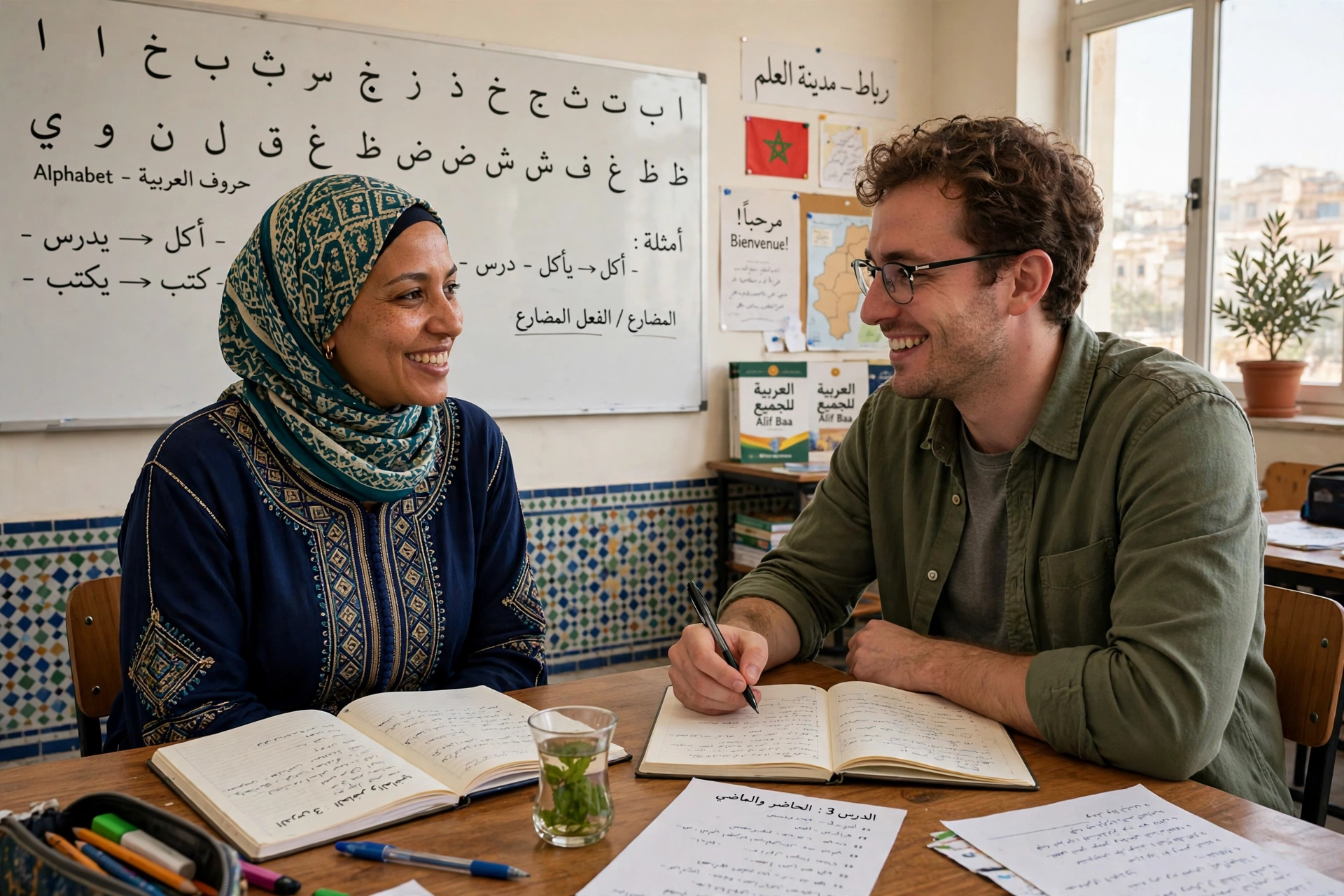
Start each morning by reviewing five new words, then use at least one before noon. Eat lunch somewhere local and order in Darija, even if you point at the menu. In the evening, watch ten minutes of a Moroccan series or YouTube video with subtitles, and write down three phrases you heard. Once a week, sit with your tutor or exchange partner and talk about your real week: the plumber, the visa office, the noisy neighbour. Real topics beat textbook dialogues, because you remember what you actually needed to say.
After three months of learning Moroccan Arabic Darija, add a weekly challenge: a whole morning conducted in Darija, or a phone call to a Moroccan service without switching to French. These small tests show how far you have come and expose exactly what to study next. If your housing is still unsettled, our guide to rent prices in Morocco helps you pick a neighbourhood where daily Darija practice comes naturally.
Frequently Asked Questions
Is Darija the same as Modern Standard Arabic?
No. Darija is Morocco's spoken dialect, with different vocabulary, simpler grammar, and heavy French and Spanish influence. MSA is used in news, formal writing, and education, but almost nobody speaks it at home. For daily life, general information about the Arabic language helps, but you need Darija to talk with Moroccans.
Can I live in Morocco without learning Darija?
You can, especially in Casablanca or Rabat, where French and English cover work life. But daily life stays shallow and expensive without it: you pay tourist prices, depend on others for errands, and miss the social life that makes Morocco rewarding. Even basic Darija transforms the experience within weeks.
How long does it take to learn Darija?
With an hour of daily practice, learning Moroccan Arabic Darija delivers basic conversation in six to eight weeks and comfortable everyday fluency in three to four months. French speakers progress faster thanks to shared vocabulary. Full fluency, including fast group conversations, usually takes a year or more.
Should I learn Darija or French first?
If you plan to live in Morocco, learn Darija first for daily life and add French for administration and work. If you already speak French, keep using it for paperwork while you build Darija on the side. The two languages reinforce each other, because so much Darija vocabulary comes from French.
Are there good apps for learning Darija?
A few apps and YouTube channels teach real Darija, but most popular "learn Arabic" apps teach MSA instead. Check any resource for Darija markers like "bghit" and "shhal" before committing. Apps work best as a supplement to a tutor or language exchange, not as your only method.
Do I need to learn the Arabic script to speak Darija?
No, you can speak Darija fluently using Latin transliteration, and many Moroccans write Darija that way on WhatsApp. Learning the script is still worthwhile for signs and menus, so study it gradually alongside speaking rather than as a prerequisite.
Conclusion
Learning Moroccan Arabic Darija is not about passing an exam; it is about belonging. The grammar is forgiving, the vocabulary borrows from languages you may know, and Moroccans reward every attempt with patience. Start with the twenty phrases above, find a tutor or exchange partner, and use the language daily, even badly. A year from now, the neighbour who once quoted you the tourist price will invite you in for tea, and you will wonder why you waited so long.
2 thoughts on “Learning Moroccan Arabic (Darija): A Practical Guide for Expats”