
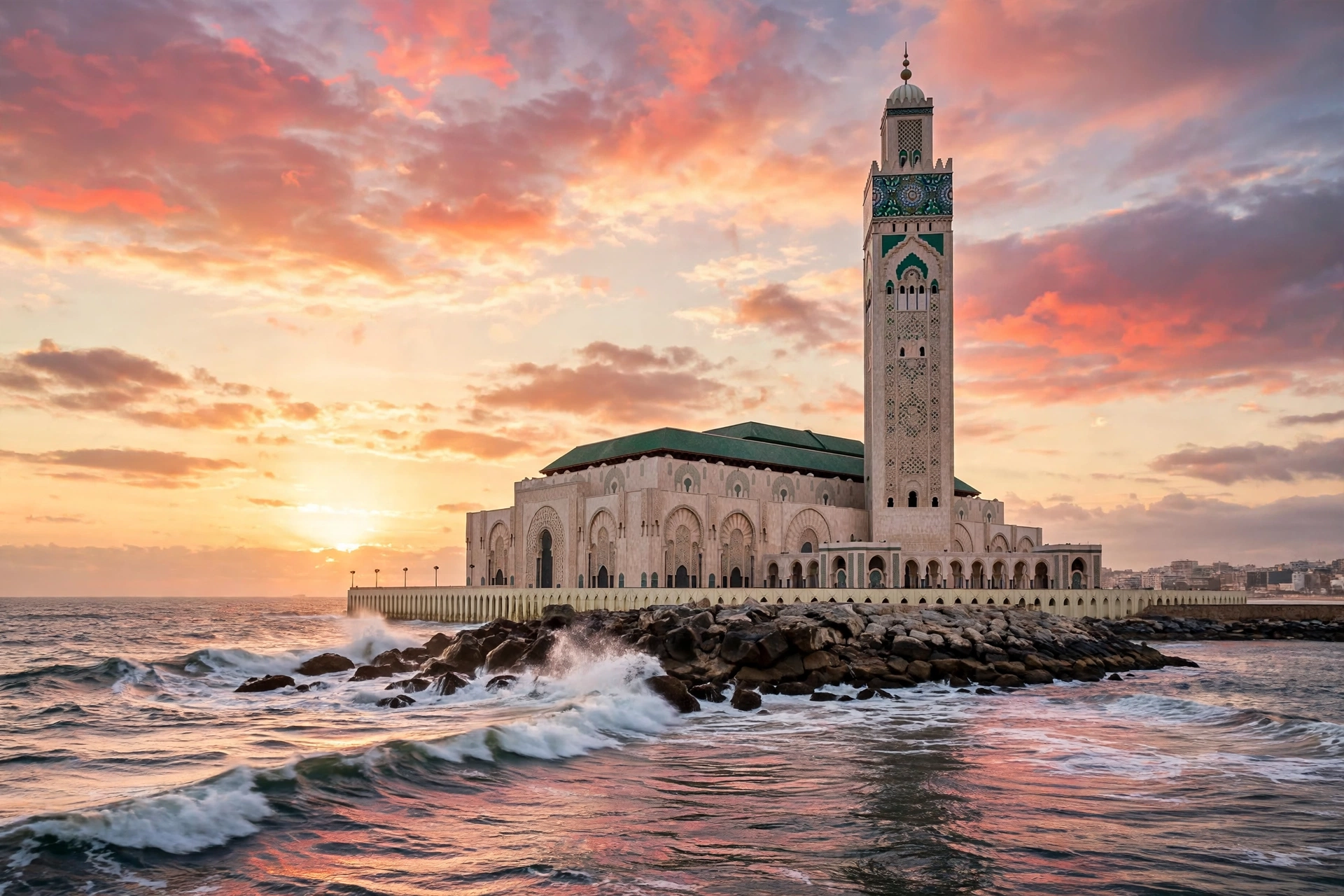
The first time you see it, the scale does not quite make sense. A mosque the size of a small town rises out of the Atlantic on the edge of Casablanca, its 210-metre minaret the tallest in the world. This is the hassan ii mosque casablanca, the most impressive building in modern Morocco.
King Hassan II ordered it built as a gift to mark his 60th birthday, and construction ran from 1986 until its inauguration on 30 August 1993. It was designed by the French architect Michel Pinseau, but built by Moroccan hands: craftsmen carved its cedar ceilings, laid its zellige tilework and polished its marble. It looks both ancient and new.
This guide explains why the hassan ii mosque casablanca was built, what makes its architecture extraordinary, how to visit inside, what it costs, and how to fit it into a day in Casablanca. For the wider story, see our history of Morocco; for the city, our Casablanca travel guide.
In this guide
- Why the Hassan II Mosque Casablanca Was Built
- The Architecture of the Hassan II Mosque Casablanca
- The Minaret of the Hassan II Mosque Casablanca
- Visiting the Hassan II Mosque Casablanca: Inside the Guided Tour
- Tickets, Times and Prices at the Hassan II Mosque Casablanca
- A Half Day Around the Hassan II Mosque Casablanca
- Hassan II Mosque Casablanca FAQ
Why the Hassan II Mosque Casablanca Was Built
Casablanca is Morocco's economic capital, but unlike the old imperial cities it had no great mosque to match its size, and King Hassan II wanted a landmark worthy of the country's largest city. He announced the project in 1980 as a personal gift for his 60th birthday, a lasting symbol of the kingdom — see our guide to the imperial cities of Morocco for the dynastic background.
The site was deliberate. The mosque stands on the Atlantic shore, on a platform partly reclaimed from the sea, so it appears to rise directly from the water. The idea came from a verse of the Quran, which says that God's throne was upon the water. That is why the hassan ii mosque casablanca feels so different: the ocean is not a backdrop, it is part of the design.
Construction began in 1986 and took seven years. Around 6,000 Moroccan craftsmen are commonly said to have worked on it, though exact figures vary by source. They came from every region, and the materials came with them: cedar from the Middle Atlas, marble from Agadir, granite from Tafraoute, and zellige tiles from Fez. Ordinary Moroccans contributed through a public subscription alongside the state.
The cost is one of the facts visitors hear most often, and one of the least settled. Figures commonly cited range roughly from $500 million to $800 million, but no official figure is published and sources disagree widely. What is certain is that the hassan ii mosque casablanca was one of the most expensive religious buildings of the twentieth century, paid for as a national effort, not only by the state.
The Architecture of the Hassan II Mosque Casablanca
The mosque covers about nine hectares; its scale is hard to grasp until you walk across the vast esplanade. The prayer hall alone is enormous: roughly 200 by 100 metres, commonly said to hold 25,000 worshippers inside the hassan ii mosque casablanca, with room for about 80,000 more in the courtyard. These figures are commonly cited rather than official.
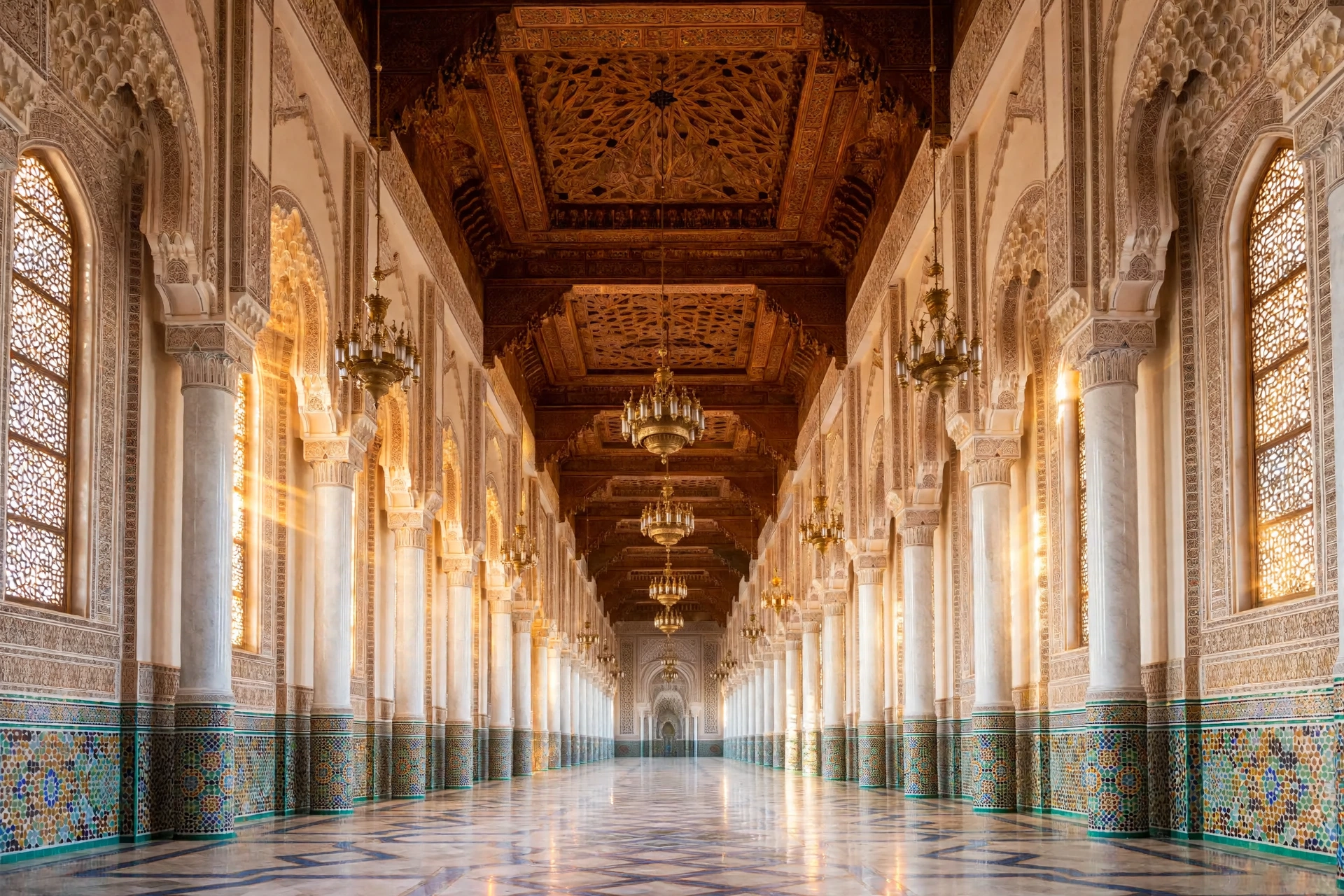
Step inside and the first thing you notice is the light. The carved cedar ceiling, painted green and gold, opens in the middle: a retractable roof weighing hundreds of tonnes slides back in minutes so the hall can open to the sky. It is modern engineering dressed in medieval craft, and on a clear day the hall of the hassan ii mosque casablanca fills with Atlantic light.
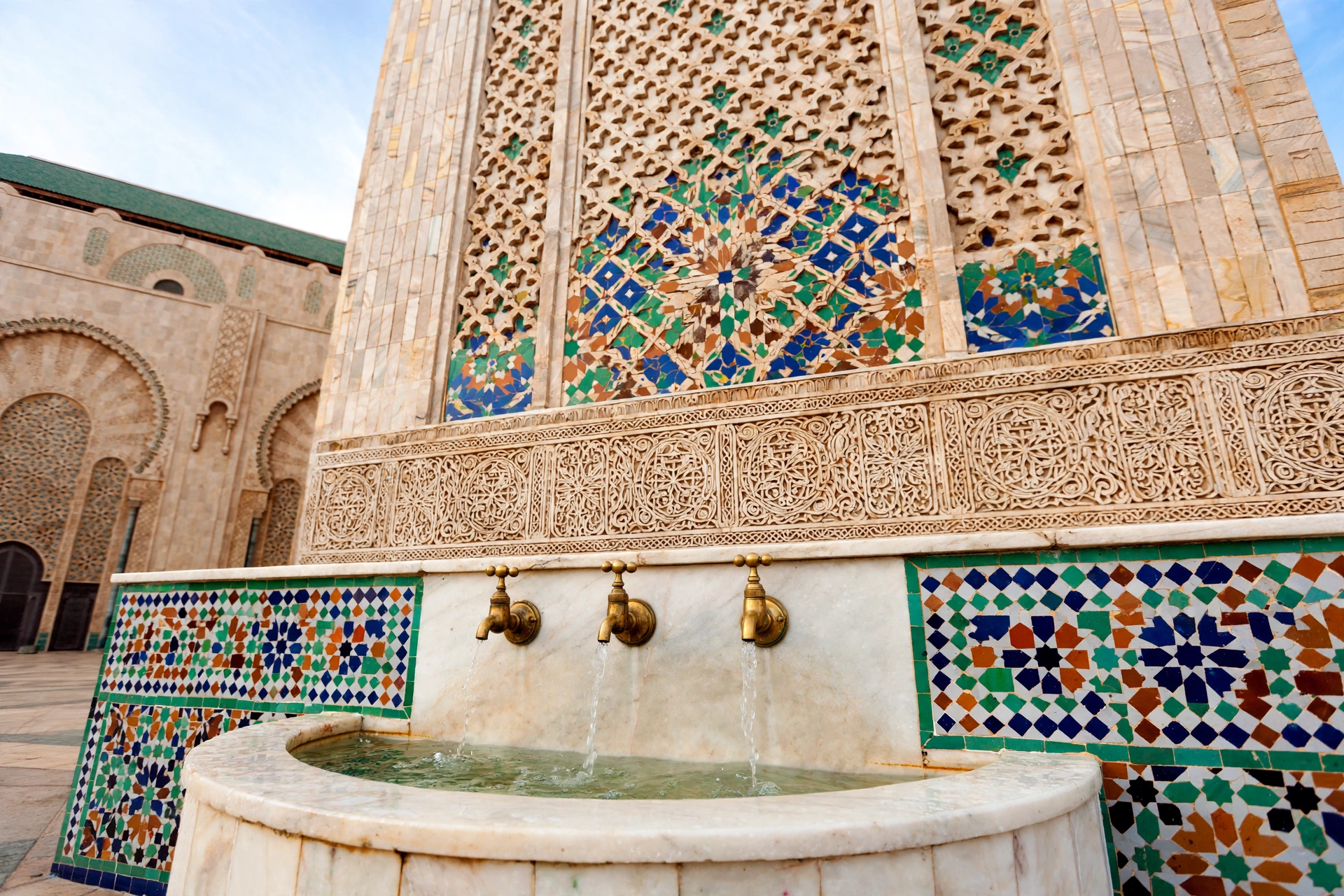
The materials tell the story of the whole country. Marble columns, marble and granite floors, hand-laid zellige mosaics, and carved plaster and painted wood made by artisans in the styles of their home regions. Nothing was imported that Morocco could make itself. The building is a map of Moroccan craft, and the hassan ii mosque casablanca shows it at a scale no medieval sultan could have attempted.
A Mosque Built Over the Ocean
About a third of the prayer hall stands on a platform over the Atlantic, and part of the floor is glass: you can look down and see the sea moving beneath the building — the detail visitors remember most. Beneath the prayer hall are vast ablution rooms, with marble fountains built to serve thousands at once. The complex also holds a hammam, a Quranic school, a library and a museum of Moroccan art, so the hassan ii mosque casablanca is not a single building but a small city of religious and cultural spaces.
The Details to Look For
Look closely at the details. The mihrab — the niche marking the direction of prayer — is carved marble and painted wood, and the minbar, the pulpit, is a masterpiece of carved cedar. The doors are carved and inlaid, and the calligraphy around the walls was executed by Moroccan master calligraphers.
The Minaret of the Hassan II Mosque Casablanca
The minaret of the hassan ii mosque casablanca is the building's signature: 210 metres tall, the tallest minaret in the world, visible across Casablanca on a clear day. It is a square tower, in the Moroccan tradition, crowned with a green-tiled pyramid and a lantern. At night, a laser beam from its summit points toward Mecca.
Climbing the minaret is not part of the public tour; most visitors experience it from the esplanade, where its scale is best appreciated. Stand at the base and look up: carved stone and zellige bands grow simpler as they rise, a trick that makes the tower look taller than it is. Its square form descends from the Almohad towers of the twelfth century — the Koutoubia in Marrakech and the Giralda in Seville — as our guide to the Almohad Empire explains. The Koutoubia stands 77 metres tall, so the minaret of the hassan ii mosque casablanca is nearly three times its height, and taller than the Great Pyramid of Giza.
Visiting the Hassan II Mosque Casablanca: Inside the Guided Tour
The hassan ii mosque casablanca is one of the very few mosques in Morocco open to non-Muslim visitors, and that alone makes it worth the trip. Most mosques in Morocco are closed to non-Muslims, so this is the one place to see a great Moroccan mosque from the inside. The catch is that you can only visit on a guided tour: there is no self-guided entry.
Tours run several times a day, typically at 9:00, 10:00, 11:00 and 14:00, with an extra afternoon tour in the busier months, but times change with the seasons and prayer times — check the board at the entrance of the hassan ii mosque casablanca when you arrive. There are no tours during Friday prayers or other prayer times. Arrive at least 20 minutes early: tours leave on time and the morning tours are the busiest.
The tour lasts about 45 minutes to an hour, and it is genuinely informative. Your guide will show you the prayer hall, the retractable roof, the glass floor and the ablution rooms below. You will also see the hammam and the library, and the tour usually ends in the small museum. The guides speak English and French — ask them about the hassan ii mosque casablanca and they will have stories to tell.
What to Wear and How to Behave
Dress modestly for the hassan ii mosque casablanca, as you would for any mosque: shoulders and knees covered, for men and women alike. Women need not cover their hair, but a scarf is respectful. Shoes come off before entering the prayer hall — wear socks and shoes that slip off easily. Photography is allowed in most areas, but be discreet: no flash, no tripods, and no photographing people at prayer. Be quiet in the prayer hall: it is a working mosque, used by worshippers every day.
Tickets, Times and Prices at the Hassan II Mosque Casablanca
Tickets are bought at the entrance on the day; no need to book ahead unless you are coming with a large group. Prices are in Moroccan dirhams; the table gives dollar equivalents at roughly 10 dirhams to the dollar (checked November 2026). Prices can change, so treat these as the figures to expect at the hassan ii mosque casablanca rather than a guarantee.
| Ticket or tour | Who it is for | Price (checked November 2026) |
|---|---|---|
| Guided tour, adult | Foreign visitors aged 12 and over | 130 MAD (about $13) |
| Guided tour, student | Students with a valid student card | 65 MAD (about $6.50) |
| Guided tour, child | Children under 6, with an adult | Free |
| Moroccan resident | Moroccan nationals and residents, with ID | 65 MAD (about $6.50) |
| Private group tour | Groups of 10+, booked in advance | About 120 MAD (about $12) per person |
| Museum entry | Included with the guided tour ticket | Included |
The hassan ii mosque casablanca is open for tours every day except prayer times and Friday midday prayers. The ticket office opens around 9:00 and the last tour usually leaves in the mid-afternoon. If the next tour is full, the wait is rarely more than an hour. Bring dirhams to be safe: the small cafes around the mosque are cash-only.
A Half Day Around the Hassan II Mosque Casablanca
The mosque deserves a morning; Casablanca deserves the rest of the day. Start with the first tour of the day, when the light in the prayer hall is best and the crowds are thinnest. Give the tour an hour, then half an hour on the esplanade, where the hassan ii mosque casablanca shows its full scale against the ocean.
From the hassan ii mosque casablanca, walk or take a short taxi south along the Corniche to Ain Diab, the beach district. The Corniche is lined with cafes, the city's favourite place for a slow lunch by the Atlantic. Expect 100 to 200 MAD (about $10 to $20) for a good lunch for one person, checked November 2026. Afterwards, head into the city centre: the Twin Center, the Art Deco streets around Place Mohammed V, and the Old Medina.
| Stop | When to go | What to do | Time needed |
|---|---|---|---|
| Hassan II Mosque, guided tour | 9:00 tour, first of the day | Prayer hall, ablutions, hammam, museum | About 1 hour |
| Esplanade and seafront | Late morning | Photographs of the mosque and minaret | 30 minutes |
| Corniche and Ain Diab | Midday | Lunch and a walk by the sea | 1.5 to 2 hours |
| Old Medina and the port | Late afternoon | Lanes, old walls, fishing port | 1 to 1.5 hours |
| Back to the mosque at sunset | Dusk | The minaret at dusk | 30 minutes |
For more on the city, our Casablanca travel guide covers transport, hotels and restaurants in full, and the History & Heritage section has more of Morocco's past, from the Almohads to the Alaouites.
Hassan II Mosque Casablanca FAQ
Can non-Muslims visit the Hassan II Mosque Casablanca?
Yes. The hassan ii mosque casablanca is one of the very few mosques in Morocco open to non-Muslim visitors, but only on a guided tour. You cannot enter on your own. Tours run several times a day except during prayer times, and tickets cost 130 MAD (about $13) for foreign adults, checked November 2026.
How tall is the minaret of the Hassan II Mosque?
The minaret of the hassan ii mosque casablanca is 210 metres tall, making it the tallest minaret in the world. It is nearly three times the Koutoubia (77 metres) and taller than the Great Pyramid of Giza.
How long does the guided tour take?
About 45 minutes to an hour. It covers the prayer hall, the retractable roof, the glass floor over the sea, the ablution rooms, the hammam and the library, and usually ends in the small museum. Arrive at least 20 minutes early, as groups are capped and tours leave on time.
What is the Hassan II Mosque famous for?
The hassan ii mosque casablanca is famous for its 210-metre minaret, the tallest in the world; its prayer hall built partly over the Atlantic, with a glass floor above the sea; and its Moroccan craftsmanship, from carved cedar ceilings to hand-laid zellige tilework.
Is the Hassan II Mosque the third-largest mosque in the world?
It is often described that way, but the ranking varies by measure. By the size of its prayer hall and esplanade it is among the largest in the world; by other measures, such as total capacity, other mosques are larger. The claim depends on what is counted, so treat "third-largest" as a commonly repeated description rather than a settled fact. The Hassan II Mosque page on Wikipedia sets out the figures.
When is the best time to visit the Hassan II Mosque?
The first tour of the day, at around 9:00, is the best: the light in the prayer hall of the hassan ii mosque casablanca is at its finest and the crowds are smallest, leaving the rest of the day for the Corniche and the city. Sunset is best for photographs. Avoid Friday midday, when the mosque is closed for prayers. For trip planning, see Visit Morocco, the Moroccan National Tourist Office.
Conclusion
The hassan ii mosque casablanca is the building that makes Casablanca worth a stop. It is a mosque built on the ocean, with the tallest minaret in the world, a roof that opens to the sky and a floor of glass above the sea — and it is one of the very few mosques in Morocco that a visitor can walk inside. Go for the first tour of the day, take your time in the prayer hall, and come back at sunset.
The hassan ii mosque casablanca was built to be a gift and a landmark, and thirty years after its inauguration it is both — the single most memorable sight in Morocco's largest city.
Last checked: November 2026