
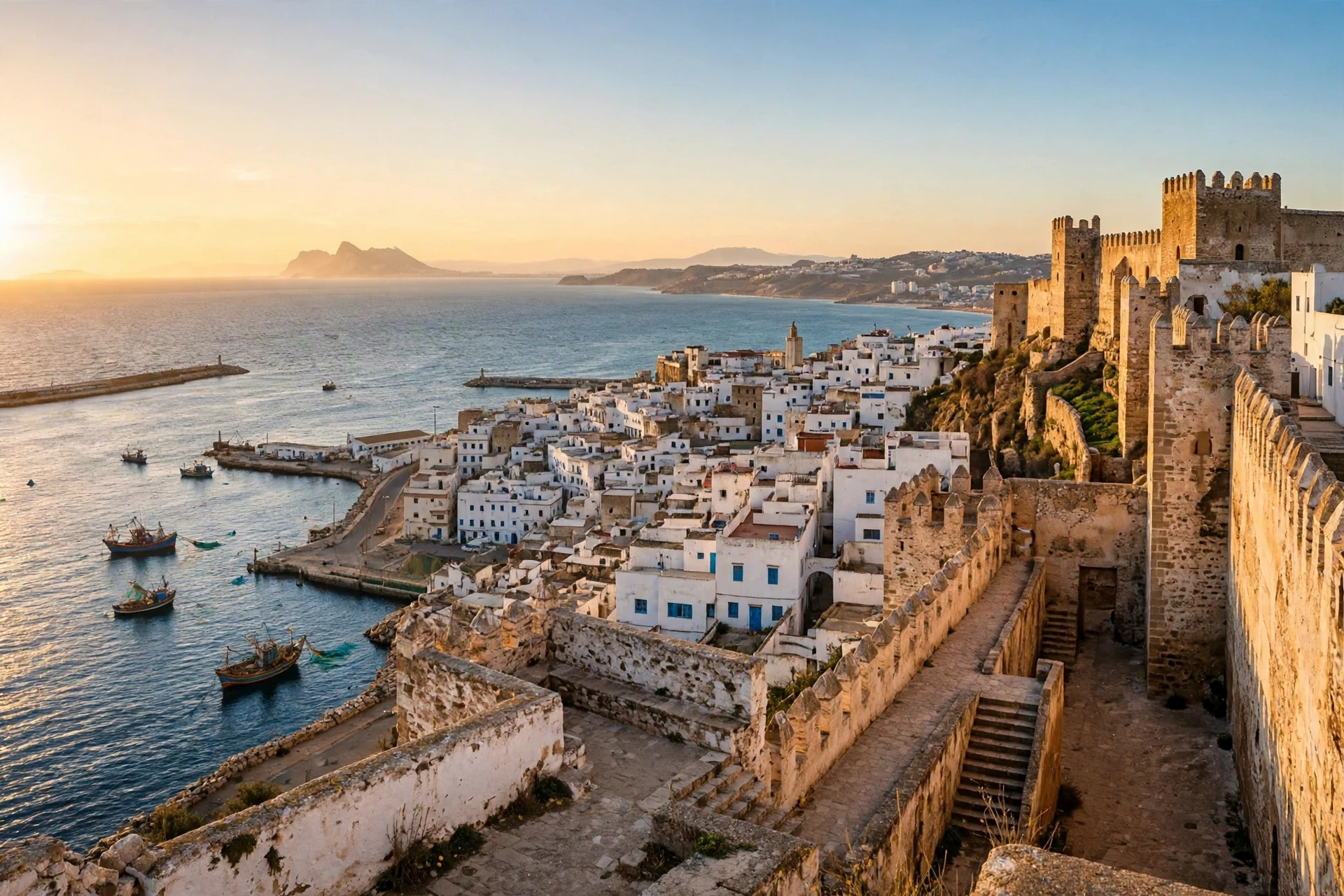
Stand on the kasbah terrace at dusk and you can see why the tangier international zone history still matters. Spain is a pale line across the water, the port hums below, and the white medina folds down the hill much as it did when this city belonged to no one. For thirty-three years, from 1923 to 1956, Tangier was an international zone: a city run by a committee of foreign powers, policed by an international force, and used by everyone with business in the western Mediterranean. This guide tells the story of the tangier international zone history in plain terms — how the zone was created, who ran it, what daily life felt like, and why the writers and the spies came.
The first thing outsiders get wrong is calling Tangier a colony. It never was one. While the rest of Morocco fell under French and Spanish protectorates in 1912, Tangier was carved out as something else entirely: a neutral, international city where no single power ruled and every power watched. That strangeness is the whole story — the money, the courts, the newspapers in four languages, the writers who came to disappear, and the spies who came to listen. Walk the medina today with this history in mind and the city reads differently: every consulate plaque and faded hotel sign is a clue.
In this guide
- How the Tangier International Zone History Began
- Who Ran the Tangier International Zone History
- Daily Life in the Zone: Currencies, Languages and Courts
- The Writers of Tangier: Bowles, Burroughs and the Beats
- Spies and the Second World War in the Tangier International Zone History
- The End of the Tangier International Zone History: 1956 and After
- What Survives Today: A Walking Route Through the Old Zone
- Tangier International Zone FAQ
How the Tangier International Zone History Began
The story starts in Algeciras, across the strait in Spain, in 1906, where the great powers of Europe met to settle who controlled Morocco and produced a compromise that satisfied nobody: Morocco stayed formally independent under the Sultan, but European powers gained commercial and police rights. Tangier, the Sultan’s diplomatic capital and the port every power needed, was too valuable to hand to any one of them. The story of the zone begins with that deadlock — a city everyone wanted and no one could have. Six years later, the Treaty of Fes (1912) divided Morocco into French and Spanish protectorates, yet Tangier was left out of both, pending a special statute. Our history of Morocco overview covers the sultans who ruled into the modern era, from the Saadian dynasty onward.
The statute finally came in December 1923, when Britain, France and Spain signed the Statute of Tangier, creating the international zone. Exactly when it took practical effect is disputed: some histories date the zone from 1923, others from 1924, and the statute itself only entered into force in 1925 — so you will see all three dates in print, and none is simply wrong. The tangier international zone history is full of these small uncertainties, and honest guides admit them. What is certain is the shape of the deal: Tangier and a belt of land around it became a neutral zone under joint international administration, with the Sultan represented by his delegate, the Mendoub. The full chronology is well summarised on Wikipedia’s page on the Tangier International Zone.
The arrangement was revised in 1928, when Italy joined the administering powers and the zone’s institutions were tightened up. By then Tangier had already become what it would remain for three decades: a free port, a tax haven, a city of consulates, banks and newspapers, where a resident could live outside the law of any single state. The revision confirmed that character rather than changing it — the powers had built a machine for keeping Tangier neutral, and until the Second World War tested it, the machine worked.
Who Ran the Tangier International Zone History
Nobody ruled Tangier alone, and that was the point. At the top sat a Committee of Control of the administering powers’ consuls — Britain, France, Spain, and after 1928, Italy — which set policy and approved the budget. Day-to-day government was in the hands of an Administrator, a senior official appointed with the committee’s agreement, who ran the municipal services, the port and the police: an international force, recruited from several countries, whose unwritten rule was to stay out of politics. Beneath them sat a Legislative Assembly of twenty-seven members, a mix of foreign residents and Moroccans, which voted on local laws and taxes. The tangier international zone history is, at its core, the story of this strange committee government: slow, quarrelsome, and remarkably effective at keeping the peace for a city of its size.
In practice his power was ceremonial, but his presence mattered: Tangier was still, legally, Moroccan soil, and the zone was an administration, not an annexation. Moroccans in the zone lived under a dual system — the Mendoub’s courts for personal matters, the international courts for everything else — while foreigners answered to their own consular courts. The tangier international zone history cannot be understood without this split: two legal worlds, side by side, in one small city.
Daily Life in the Zone: Currencies, Languages and Courts
Daily life in the zone was a juggling act in several currencies at once. The Moroccan franc circulated alongside the Spanish peseta, the British pound and the French franc, and shopkeepers quoted prices in whichever money the customer carried. Money changers on the Grand Socco did a roaring trade, and the city’s dozen-plus banks made it a quiet offshore centre decades before the term existed. The zone’s history is partly a money story: low taxes, no exchange controls and a free port drew traders, bankers and, inevitably, smugglers, who moved cigarettes and currency through the harbour at night.
Languages overlapped the same way. French was the language of administration, Spanish the language of the street — Tangier’s Spanish community was large and long-established — and Arabic and Tamazight the languages of home for most Moroccans. English arrived with the diplomats, the writers and the businessmen, and Italian with the merchants. Newspapers appeared in French, Spanish and English, and a shopkeeper who spoke three languages was unremarkable. The tangier international zone history survives in those newspapers: the best record of what the zone felt like, full of shipping notices, court reports and advertisements for hotels that no longer exist.
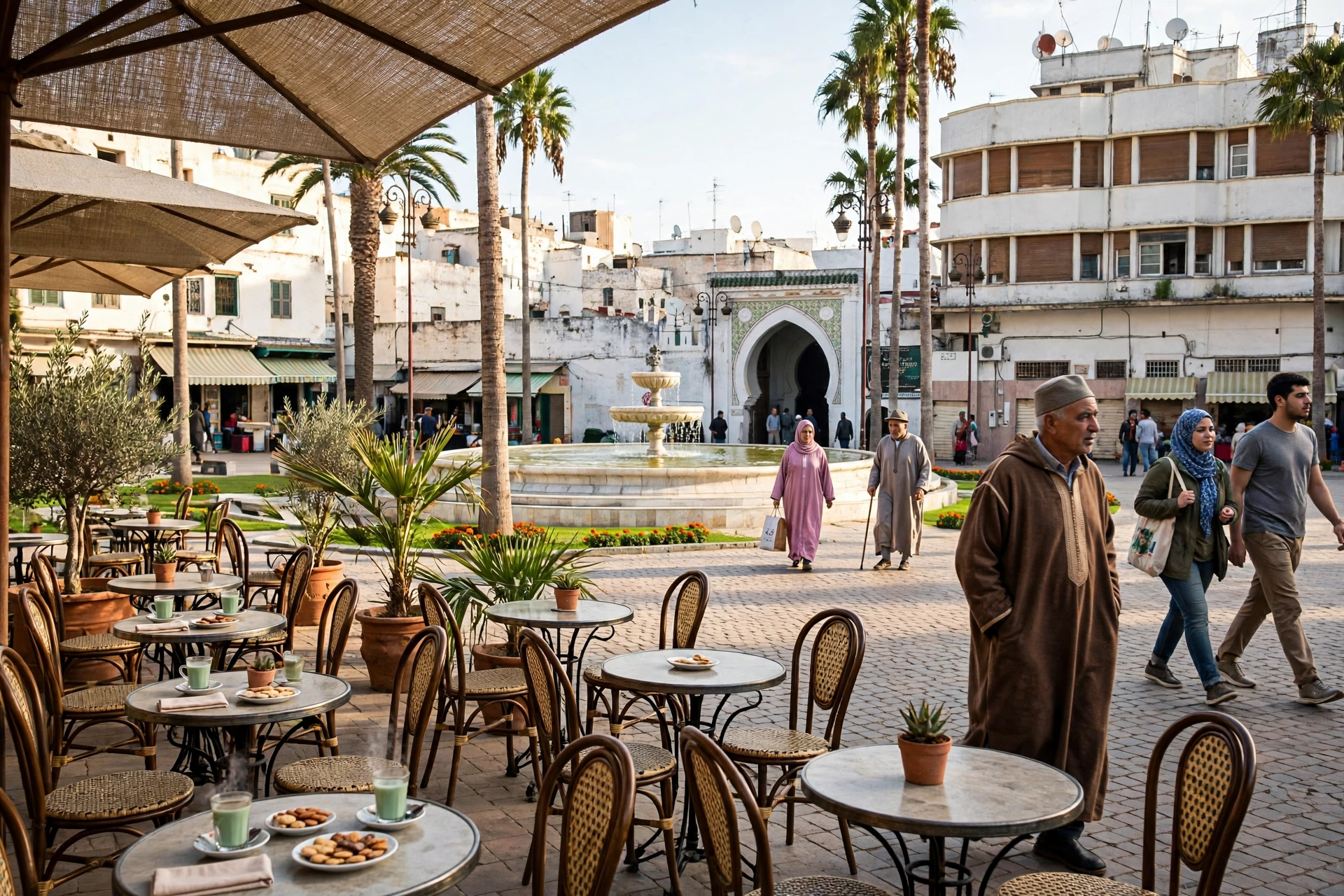
The port was the city’s engine. Ferries crossed to Spain in under an hour, cargo ships loaded phosphates and cork, and the free-port status meant goods passed through Tangier duty-free. How many people actually lived in the zone is disputed: estimates range widely, from around 60,000 in the 1930s to perhaps 150,000 by the early 1950s, and the figures depend on who counted and when. What nobody disputes is the mix: Moroccans, Spaniards, French, Italians, Britons, Americans and a large Jewish community, all within a few square kilometres of medina, European town and hillside villas. The tangier international zone history is the story of that crowded, polyglot few square kilometres.
The Writers of Tangier: Bowles, Burroughs and the Beats
The writers came for the freedom and stayed for the light. Paul Bowles first visited Tangier in 1931 and settled there in 1947, buying a flat in the old town and writing most of his work — including The Sheltering Sky — within earshot of the medina. Bowles is the writer most visitors ask about, and he did most to fix Tangier in the English-speaking imagination: a beautiful, decaying, morally ambiguous city at the edge of the world. The tangier international zone history runs through his books, but read them as novels, not guidebooks — Bowles loved Tangier precisely because it refused to be explained.
William Burroughs arrived in 1954 and wrote Naked Lunch in a room above the medina, fuelled by cheap drugs and cheaper rents the zone’s lax policing made possible. Tennessee Williams passed through; the heiress Barbara Hutton bought a palace in the kasbah and threw parties mixing diplomats, writers and anyone interesting enough to be invited. Later came the Beats — Ginsberg, Kerouac, Corso — drawn by Burroughs and by the rumour of a city where anything went. The zone’s story in the 1950s is inseparable from this scene, and the cafés of the Petit Socco still trade on it today.
Here is the second correction outsiders need: the writers did not invent Tangier, and they did not own it. Moroccans were writing, painting and composing in the city all along — Mohamed Choukri, whose For Bread Alone became the most famous Moroccan book of the century, grew up in the Tangier of the zone years and wrote about its streets from the inside. Bowles himself translated Choukri into English, and the two men’s friendship is a better symbol of the city than any spy story. The tangier international zone history belongs as much to Choukri’s Tangier — hungry, crowded, Arabic-speaking — as to the expatriate cafés.
Spies and the Second World War in the Tangier International Zone History
If the writers gave Tangier its legend, the spies gave it its wartime purpose. As the only neutral port on the western Mediterranean during the Second World War, Tangier became a listening post for everyone: German agents watched Allied shipping from the hills above the strait, while British and American intelligence ran networks from the consulates and hotels. The exact number of agents in the city is unknown — estimates run from dozens to hundreds, and nobody kept a reliable count. What is documented is the traffic: couriers, codes, smuggled gold and refugees moving through a port no army controlled. The tangier international zone history of the war years reads like a novel because, in many details, it was one.
The neutrality ended, abruptly, in June 1940, when Spanish troops occupied Tangier as France fell. Spain held the city for five years, until October 1945, imposing Spanish law, currency and flag on a city that had been international for nearly two decades. The occupation is remembered in Tangier as a hard, grey interval: the free port closed, the press was censored, and many foreign residents left. When the Allies restored the zone in 1945, the old machinery was reassembled — the committee, the administrator, the assembly — but the world around it had changed. After 1945, the zone’s story is one of a system that worked again on paper while its reason for existing quietly disappeared.
The spy bars of legend were real, but they were not where most visitors look. Café Hafa, the clifftop café every guidebook mentions, was a writers’ and locals’ place; the real listening happened in the hotel bars — the El Minzah, the Rif, the Parade Bar — where consuls, journalists and agents drank side by side and traded gossip sometimes worth money. If you sit in the Minzah bar today, you are sitting where the war was quietly fought, one overheard conversation at a time.
The End of the Tangier International Zone History: 1956 and After
Moroccan independence changed everything, and Tangier fastest of all. In March 1956, France and Spain recognised Moroccan independence, and the powers that ran Tangier agreed the zone had no future: in October 1956 a conference at Fedala — present-day Mohammedia — formally abolished the international statute and returned Tangier to Moroccan sovereignty. The tangier international zone history ends, formally, on that date: the committee dissolved, the administrator packed his files, and the city that had belonged to everyone belonged, at last, to one country.
The transition was not instant: some of the zone’s institutions — its courts, free-port privileges and foreign banks — were wound down over the following years, with the final arrangements only completed around 1960. Thousands of foreign residents left in those years, selling villas and closing businesses, as the city’s population shifted decisively toward its Moroccan majority. Tangier shrank, in a sense: the international city became a Moroccan provincial capital, quieter and poorer. The late 1950s in Tangier are a story of departure — of a city saying goodbye to the world that had made it famous.
What Survives Today: A Walking Route Through the Old Zone
The best way to understand the zone is to walk it — the route takes about half a day. Start at the Grand Socco, the great square where the medina meets the modern city — in the zone years the city’s living room, full of money changers, cafés and newspaper sellers. From there climb into the kasbah, past the old consulates and the Mendoub’s palace, to the terrace above the port. The tangier international zone history is written into these streets: the plaques, the architecture and the names on the doors tell you who lived here and what they were doing. For practical details on getting to the city and getting around it, see our Tangier travel guide.
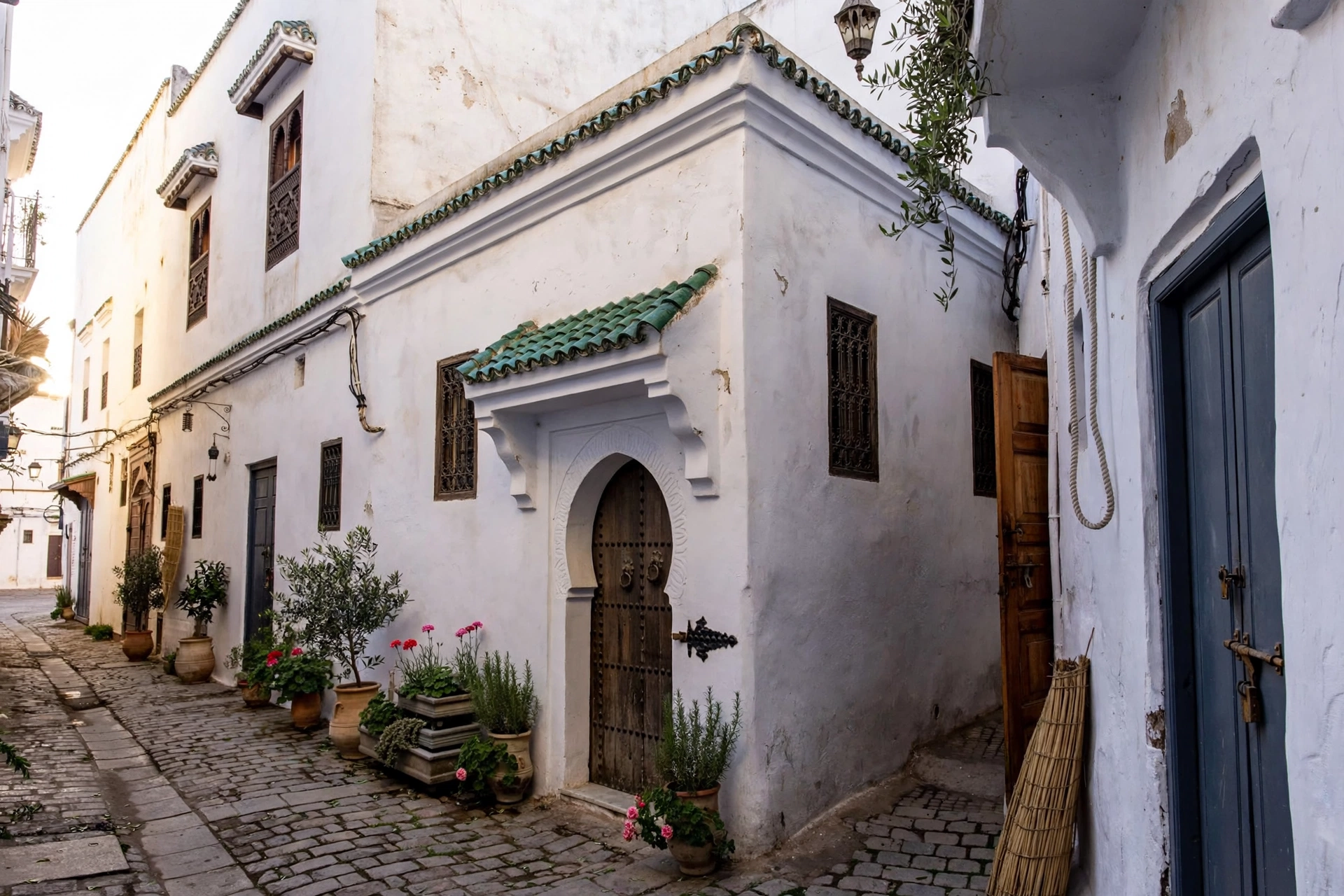
Do not miss the American Legation, the handsome whitewashed building in the medina that has served the United States since 1821 — the only US National Historic Landmark on foreign soil, its museum tells the Moroccan-American story better than any other single stop in the city. The Legation’s own site, legation.org, lists current exhibitions and opening hours. Finish at Café Hafa, on the cliffs west of the medina, with mint tea and the strait view Bowles and Burroughs drank in every afternoon. The tangier international zone history ends, for the walker, where it began: looking across the water at Europe, from a city that belonged to neither side and, for thirty-three years, to both.
The kasbah itself is the work of sultans — its palace, Dar el-Makhzen, was built under Moulay Ismail, the warrior sultan who fortified Morocco’s northern coast — and it belongs to the same family of fortress-palaces as the kasbahs of the south. The table below lists every stop in order, with the entry fees you will actually pay.
| Stop on the route | What to see | Entry fee |
|---|---|---|
| Grand Socco | The great square, cafés and the medina gate | Free |
| American Legation Museum | Morocco–US history, art and the Paul Bowles wing | 20–30 MAD (~$2–$3, approximate) |
| Kasbah Museum (Dar el-Makhzen) | The sultan’s palace, archaeology and the terrace view | 60 MAD (~$6, foreign adults) |
| St Andrew’s Church | The Anglican church of the old foreign community | Free (donations welcome) |
| Old consulates quarter, Marshan | Consulate plaques, the Mendoub’s palace exterior | Free (exteriors only) |
| Café Hafa | Clifftop mint tea above the Strait of Gibraltar | Free entry; tea 15–25 MAD (~$2) |
| A day in the old zone | Cost in MAD | Cost in USD |
|---|---|---|
| Kasbah Museum entry | 60 | ~$6 |
| American Legation Museum entry | 20–30 | ~$2–$3 |
| Guided half-day walking tour | 300–500 | ~$30–$50 |
| Mint tea at Café Hafa | 15–25 | ~$2 |
| Coffee at a Grand Socco café | 15–20 | ~$2 |
| Lunch in the medina | 80–150 | ~$8–$15 |
| Petit taxi within the city | 10–20 | ~$1–$2 |
| Typical day total | 500–800 | ~$50–$80 |
All prices checked November 2026 at roughly 10 MAD to the dollar. Museum fees are approximate — the Legation’s entry is a small donation-style fee that varies, so treat 20–30 MAD as a range, not a fixed ticket price.
Tangier’s zone years were an accident of diplomacy that made it, for a generation, the freest city in the Mediterranean. The committees and courts are gone, the currencies are gone, and the spies have moved on to other ports — but the city they made is still there, in the consulate plaques, the hotel bars and the view from the kasbah. The tangier international zone history is not a museum piece; it is why Tangier still feels different from every other Moroccan city — a place where the world once met and never quite left. Walk it slowly, ask the old café owners, and you will find that the tangier international zone history is still being told — one story at a time, over mint tea.
Tangier International Zone FAQ
When did the Tangier International Zone exist?
The zone was created by the Statute of Tangier, signed in December 1923 by Britain, France and Spain, and abolished in October 1956, when Morocco regained full sovereignty over the city after independence. When exactly it took practical effect is debated — some sources say 1923, others 1924 or 1925 — so you will see different start dates in different books.
Was Tangier a French or Spanish colony?
No. Tangier was never a colony of any power. While the rest of Morocco was divided into French and Spanish protectorates in 1912, Tangier was run by an international administration — a Committee of Control, an Administrator and a Legislative Assembly — with the Sultan represented by his delegate, the Mendoub.
Why did so many spies operate in Tangier?
Because it was the only neutral port on the western Mediterranean during the Second World War. No single army controlled it, so German, British and American agents could all operate in the same small city, watching the shipping through the Strait of Gibraltar. The exact number of agents is unknown and probably unknowable.
Which writers lived in Tangier?
Paul Bowles settled there in 1947 and wrote most of his work in the old town. William Burroughs wrote Naked Lunch there in the 1950s, and Tennessee Williams, Allen Ginsberg and Jack Kerouac all passed through. The Moroccan writer Mohamed Choukri, author of For Bread Alone, grew up in the Tangier of the zone years and wrote about it from the inside.
Can I visit the American Legation today?
Yes. It is a museum in the medina, open to visitors for a small entry fee of around 20–30 MAD, and it is the only US National Historic Landmark on foreign soil. Check legation.org for current opening hours and exhibitions before you go.
How much does a day exploring the old zone cost?
Budget 500–800 MAD ($50–$80) for a full day: museum entries, a guided half-day walking tour at 300–500 MAD, mint tea at Café Hafa, coffee on the Grand Socco, lunch in the medina and a petit taxi or two. Without a guide, a self-guided day costs under 300 MAD.
Last checked: November 2026.
1 thought on “Tangier’s International Zone 1923–1956: Spies, Writers and a City Between Worlds”