
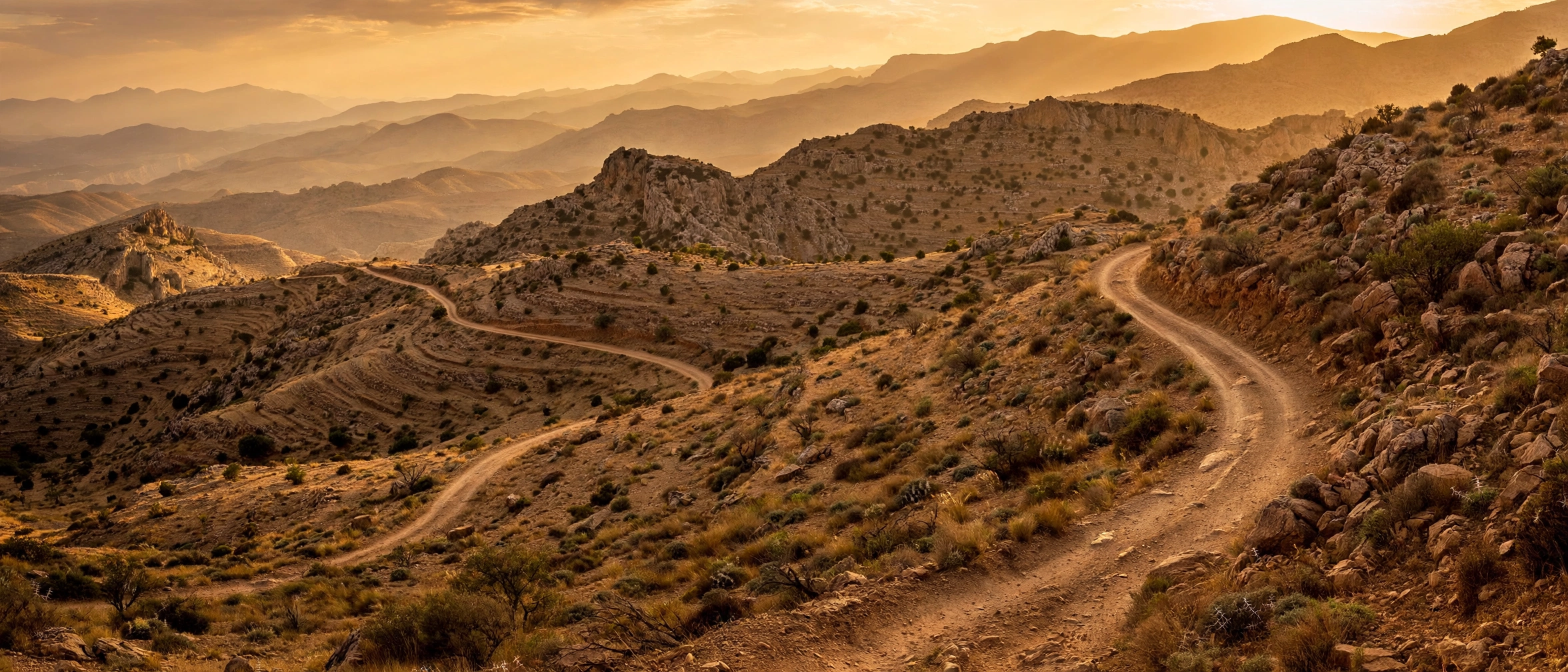
On 22 July 1921, a Spanish army of thousands collapsed in the dry hills of the Rif, and the shockwave reached Madrid and Paris. The man who made it happen was Abd el-Krim, a Rif Amazigh leader who had spent his early life working inside the Spanish system, and the story of the Rif War Abd el-Krim shaped is one of the most extraordinary chapters in Moroccan history.
This guide tells that story in full: the Spanish protectorate that set the trap, the Battle of Annual that sprang it, the mountain republic Abd el-Krim built, the joint French-Spanish campaign that crushed it, and the exile that followed. It also flags the points where historians still disagree, and ends with a guide to visiting the Rif War Abd el-Krim sites today.
In this guide
- Why 1921 Still Matters
- The Rif Before the War
- Who Was Abd el-Krim?
- The Battle of Annual: July 1921
- The Rif Republic: A State in the Mountains
- France Joins the War
- Chemical Weapons and the War’s Darkest Chapter
- The End of the War: Surrender in 1926
- Abd el-Krim in Exile
- What the Rif War Changed in Morocco
- Visiting the Rif War Sites Today
- Frequently Asked Questions
- Conclusion: The Legacy of the Rif War
The Rif War Abd el-Krim: Why 1921 Still Matters
The Rif War Abd el-Krim led lasted from 1921 to 1926, and it changed how the whole world thought about colonial war. Before Annual, European armies assumed that a modern colonial force with artillery and aircraft could not be beaten by mountain tribesmen. After Annual, that assumption lay in ruins alongside the Spanish dead, and the Rif War Abd el-Krim won at Annual became the textbook example of a guerrilla army defeating a European power.
The war matters in Morocco for a second reason. It was the first time a Moroccan leader built a modern state outside the sultan's authority, with a flag, a government, a currency and a regular army, and it did so in the Rif, a region the makhzen had never fully controlled. The Rif War Abd el-Krim story therefore sits at the crossroads of two Moroccan histories: the story of resistance to foreign rule, and the story of how the modern Moroccan state took shape.
The Rif Before the War: Spain's Protectorate and the Tribes
The Rif War Abd el-Krim would fight was born from the Treaty of Fez in 1912, which divided Morocco into French and Spanish protectorate zones. Spain received the northern strip: the Rif mountains, the Atlantic coast around Larache, and the Mediterranean coast from Tangier to the Algerian border. On paper, the sultan remained sovereign. In practice, Spanish officers ruled the north.
By 1920, the Spanish commander in Melilla, General Manuel Fernández Silvestre, was under pressure from Madrid to advance faster. Silvestre was a bold, impulsive officer who believed the Rif tribes would fold before a determined push. He planned a rapid advance from Melilla towards Al Hoceima Bay, a natural harbour on the Mediterranean coast that would give Spain a deep-water port in the heart of the Rif. The plan ignored the warnings of his own officers, who knew the supply lines could not hold. In the summer of 1921, Silvestre pushed his army far beyond its last secure base, into the hills around Annual, and the Rif War Abd el-Krim had been waiting for began there.
Who Was Abd el-Krim?
Muhammad ibn Abd al-Karim al-Khattabi, known to the world as Abd el-Krim, was born in 1882 in Ajdir, a village near Al Hoceima in the Rif. His father was a qadi — a judge — of the Ait Waryaghar tribe, and Abd el-Krim grew up bilingual in Tamazight and Arabic, then studied at the University of al-Qarawiyyin in Fez. He was not a mountain bandit. He was an educated man who had worked as a teacher, edited the Arabic section of a Spanish newspaper in Melilla, and served as a qadi in the Spanish administration. He knew the Spanish system from the inside, and that knowledge became his greatest weapon in the Rif War Abd el-Krim would soon lead.
Abd el-Krim's break with Spain was gradual. He watched Spanish officers treat Rif tribesmen with contempt, and he watched the protectorate's promises — schools, roads, fair courts — evaporate. When his father died in 1920, Abd el-Krim inherited his position as a tribal leader, and he began to do something no Rif leader had done before: he built a disciplined army out of rival tribes. He banned the blood feuds that had divided the Rif for generations, imposed a tax system to fund his forces, and drilled his fighters in the guerrilla tactics the mountains demanded — ambushes on narrow passes, night attacks, and the cutting of supply lines.
The Battle of Annual: July 1921
The Battle of Annual began on 22 July 1921, when Abd el-Krim's fighters attacked the Spanish positions around the village of Annual, about 60 kilometres west of Melilla. Silvestre had advanced with roughly 20,000 men spread across a thin chain of forts, and his supply line ran back to Melilla through hostile country. Abd el-Krim's force was smaller — perhaps 3,000 fighters at the start — but it held the high ground, knew the terrain, and attacked in waves.
The Spanish collapse in the Rif War Abd el-Krim was directing was fast and total. The fort at Annual fell first, and the retreat became a rout. Soldiers fled along the roads towards Melilla, and Abd el-Krim's men cut them down at the mountain passes. General Silvestre died in the fighting — his body was never recovered, and the exact circumstances of his death are still disputed. Within three weeks, the Spanish position in the eastern Rif had disintegrated. The disaster at Annual is remembered in Spain as the Desastre de Annual, and it remains one of the worst defeats a European colonial army ever suffered.
How many Spaniards died at Annual is one of the war's contested numbers, and this guide states it as historians do: the death toll is not settled. Spanish official figures put the dead at around 13,000, including soldiers and the civilians who had followed the army. Other estimates range from 10,000 to 18,000. What is certain is the scale: in three weeks, Spain lost more men than in any single battle of its colonial wars, and the Rif War Abd el-Krim had won at Annual forced a political crisis in Madrid that brought down governments.
The Rif Republic: A State in the Mountains
The Rif Republic was a remarkable creation. Abd el-Krim set up a government with ministries for war, foreign affairs and finance, introduced a tax system, built schools, raised a flag, and minted his own coins — the rifan. He created a regular army of about 10,000 men, organised into units with European-style ranks, and he enforced a ban on the inter-tribal feuding that had kept the Rif divided. For the first time, the Rif had a single political authority.
| Feature | The Rif Republic | The Spanish Protectorate |
|---|---|---|
| Capital | Ajdir, near Al Hoceima | Tetouan |
| Leader | Abd el-Krim, President | High Commissioner in Tetouan |
| Army | About 10,000 regulars plus tribal levies | 100,000+ troops by 1925 |
| Currency | The rifan (minted 1923) | The Spanish peseta |
| Recognition | None — no state recognised it | Recognised by treaty (1912) |
| Lifespan | 1921–1926 | 1912–1956 |
France Joins the War
The turning point of the Rif War Abd el-Krim fought came in 1924, when his forces pushed south into the Ouergha valley, threatening Fez and the French protectorate — the same protectorate that ended with Moroccan independence in 1956. France, which had watched the Spanish disaster with a mixture of relief and contempt, suddenly faced the same threat. In 1925, Paris sent Marshal Philippe Pétain — the hero of Verdun — with an army that eventually reached 160,000 men, and France and Spain agreed to fight the Rif War Abd el-Krim had started together.
The joint campaign began with the Al Hoceima landing on 8 September 1925. Spanish troops, with French naval and air support, landed by sea at Al Hoceima Bay, behind Abd el-Krim's lines, in one of the first large-scale amphibious landings of the twentieth century. About 13,000 Spanish soldiers came ashore under the guns of the fleet, and the landing split the Rif Republic in two. Abd el-Krim's forces, already stretched thin against the French advance from the south, could not hold both fronts.
Chemical Weapons and the War's Darkest Chapter
The darkest chapter of the Rif War Abd el-Krim fought was Spain's use of chemical weapons. From 1923 onwards, Spanish aircraft dropped mustard gas — yperite — on Rif villages, markets and water sources. The gas was intended to break the resistance by making the mountains uninhabitable, and it was used with the knowledge of the Spanish high command. The practice is documented in Spanish military archives and in the records of the German firms that supplied the gas, and it is one of the earliest uses of chemical weapons against a civilian population.
The human cost of the gas attacks is another contested figure, and this guide is honest about that. There was no systematic counting of the dead, and the Rif's own records were lost in the war. Historians estimate the victims in the thousands, with many more left blinded or scarred, and the effects lingered for generations — families in the Rif still tell of relatives who died years later from the gas. The exact number will probably never be known, and any source that gives a precise figure should be treated with suspicion.
The End of the War: Surrender in 1926
By the spring of 1926, Abd el-Krim's position was hopeless. The French had taken the Ouergha valley and were advancing on Ajdir from the south, the Spanish held the coast, and his army was down to its last supplies. On 27 May 1926, Abd el-Krim surrendered — not to the Spanish, whom he despised, but to the French, whom he considered the more honourable enemy. It was a deliberate choice, and it saved his life: the Spanish had made clear they wanted him dead.
The surrender ended the Rif War Abd el-Krim had led for five years, and it ended the Rif Republic. Spain and France reimposed the protectorate over the north, and the Rif was divided between them once more. The Spanish protectorate would last another thirty years, until Moroccan independence in 1956, but the war had broken Spain's confidence in the Rif, and the region was governed with a lighter hand afterwards — a tacit admission that the tribes could not be ruled by force alone.
| Date | Event |
|---|---|
| 30 March 1912 | Treaty of Fez — Spain gets the northern protectorate |
| 22 July 1921 | Battle of Annual — Spanish army destroyed |
| September 1921 | Rif Republic proclaimed at Ajdir |
| 1923–1924 | Spain begins mustard gas attacks |
| April 1925 | Abd el-Krim's forces attack French positions in the Ouergha |
| 8 September 1925 | Al Hoceima landing — Spain lands behind Rif lines |
| 27 May 1926 | Abd el-Krim surrenders to France |
| 1926–1947 | Exile on Réunion island |
| 1947 | Escapes to Cairo; dies there in 1963 |
Abd el-Krim in Exile
France exiled Abd el-Krim to Réunion, a French island in the Indian Ocean, where he lived for twenty-one years. He was not a prisoner in a cell, but he was thousands of kilometres from the Rif, and his political life was over. He followed the news from Morocco, and the Rif War Abd el-Krim had fought remained his defining achievement; when the independence movement gathered strength in the 1940s and 1950s, he supported it from afar.
In 1947, France agreed to transfer him to the south of France, but his ship stopped in Egypt, and Abd el-Krim — with the help of the Egyptian authorities — walked off the boat in Port Said and claimed asylum. He settled in Cairo, where he lived until his death in 1963, and he became a symbol of anti-colonial resistance across the Arab world. The Rif War Abd el-Krim had fought was over, but his name travelled further in exile than it ever had in the mountains.
What the Rif War Changed in Morocco
The Rif War Abd el-Krim led changed Morocco in ways that are still visible. First, the Rif War Abd el-Krim led proved that colonial armies could be beaten, and that proof inspired resistance movements far beyond Morocco — from Vietnam to Algeria, military thinkers studied Annual as a model of guerrilla warfare. The Rif War was, in that sense, one of the first modern anti-colonial wars, fought a generation before decolonisation became a global movement.
Finally, the war changed Spain. The disaster at Annual was a political earthquake in Madrid, contributing to the fall of governments and, indirectly, to the military coup of 1923 and the Spanish Civil War of 1936–1939. The officers who had served in the Rif — the so-called Africanistas — became a powerful faction in Spanish politics. The Rif War Abd el-Krim fought thus helped to decide the fate of two countries, not one.
Visiting the Rif War Sites Today
The Rif War Abd el-Krim sites are not on the standard tourist circuit, and that is part of their appeal. The main base is Al Hoceima, a relaxed Mediterranean town with good beaches and a small, friendly medina. From there you can reach Ajdir, Abd el-Krim's capital, in about fifteen minutes by taxi, and the hills around Annual — roughly 60 kilometres west, towards Nador — in about an hour. The landscapes have not changed much: the same dry hills, the same mountain passes, and the same views over the Mediterranean that shaped the war.
| Place | What to see | Getting there | Typical cost |
|---|---|---|---|
| Al Hoceima | Base town, beaches, medina | Bus or grand taxi from Tangier or Nador | Hotel 300–700 MAD/night |
| Ajdir | Abd el-Krim's capital village | 15 min by petit taxi from Al Hoceima | Taxi 10–15 MAD |
| Annual battlefield | The 1921 battlefield hills | 1 hour by grand taxi towards Nador | 50–80 MAD each way |
| Tetouan | Spanish protectorate capital | 3 hours by bus from Al Hoceima | Bus 80–120 MAD |
| Chefchaouen | Rif mountain town, war-era routes | 2.5 hours by bus from Tetouan | Bus 60–90 MAD |
| Nador | Port city near Melilla | 1.5 hours by bus from Al Hoceima | Bus 50–70 MAD |
Last checked: November 2026. Prices are ranges for independent travellers; confirm fares at the station before travelling.
Frequently Asked Questions
Who was Abd el-Krim?
Abd el-Krim (1882–1963) was a Rif Amazigh leader who defeated the Spanish army at the Battle of Annual in 1921 and founded the Rif Republic. He had been educated at al-Qarawiyyin in Fez and had worked as a journalist and qadi in the Spanish administration in Melilla before leading the resistance.
What was the Battle of Annual?
The Battle of Annual, fought on 22 July 1921, was the decisive battle of the Rif War, in which Abd el-Krim's fighters destroyed a Spanish army of roughly 20,000 men in the hills west of Melilla. Spanish losses are estimated at 10,000 to 18,000 dead — the exact figure is disputed — and the defeat is remembered in Spain as the Desastre de Annual.
How long did the Rif War last?
The Rif War lasted from 1921 to 1926. It began with the Battle of Annual in July 1921 and ended with Abd el-Krim's surrender to France on 27 May 1926, after a joint French-Spanish campaign that included the Al Hoceima landing of September 1925.
Did Spain use chemical weapons in the Rif War?
Yes. From 1923 onwards, Spanish aircraft dropped mustard gas on Rif villages, markets and water sources. The practice is documented in Spanish military archives. The number of victims is not settled — historians estimate thousands dead, with many more injured — and no precise figure should be trusted.
What happened to Abd el-Krim after the war?
Abd el-Krim surrendered to France in 1926 and was exiled to Réunion island in the Indian Ocean, where he lived for twenty-one years. In 1947 he escaped to Cairo, where he lived until his death in 1963. He never returned to Morocco.
Can I visit the Rif War battlefields today?
Yes. Al Hoceima is the best base, with Ajdir — Abd el-Krim's capital — fifteen minutes away by taxi. The battlefield at Annual is about an hour towards Nador. The sites are unmarked, so read up before you go and travel with a local guide if you want the full story.
Conclusion: The Legacy of the Rif War
The Rif War Abd el-Krim led is one of the great stories of Moroccan history, and it deserves to be better known. In five years, a mountain leader with no state, no industry and no allies defeated a European army, built a republic, and forced two colonial powers to join forces to stop him. He lost in the end, but the war he fought changed the rules of colonial warfare forever, and it changed Morocco, Spain and the Rif in ways that are still visible today.
If you travel in the Rif, you will see the landscape that made the war possible — the steep valleys, the narrow passes, the villages that cling to the hillsides — and you will meet people for whom the Rif War Abd el-Krim story is not history but family memory. That is the best way to understand it: not as a battle in a textbook, but as a living part of Morocco's story. Read the history of Morocco for the wider picture, and the story of Morocco's independence in 1956 for what came next.