
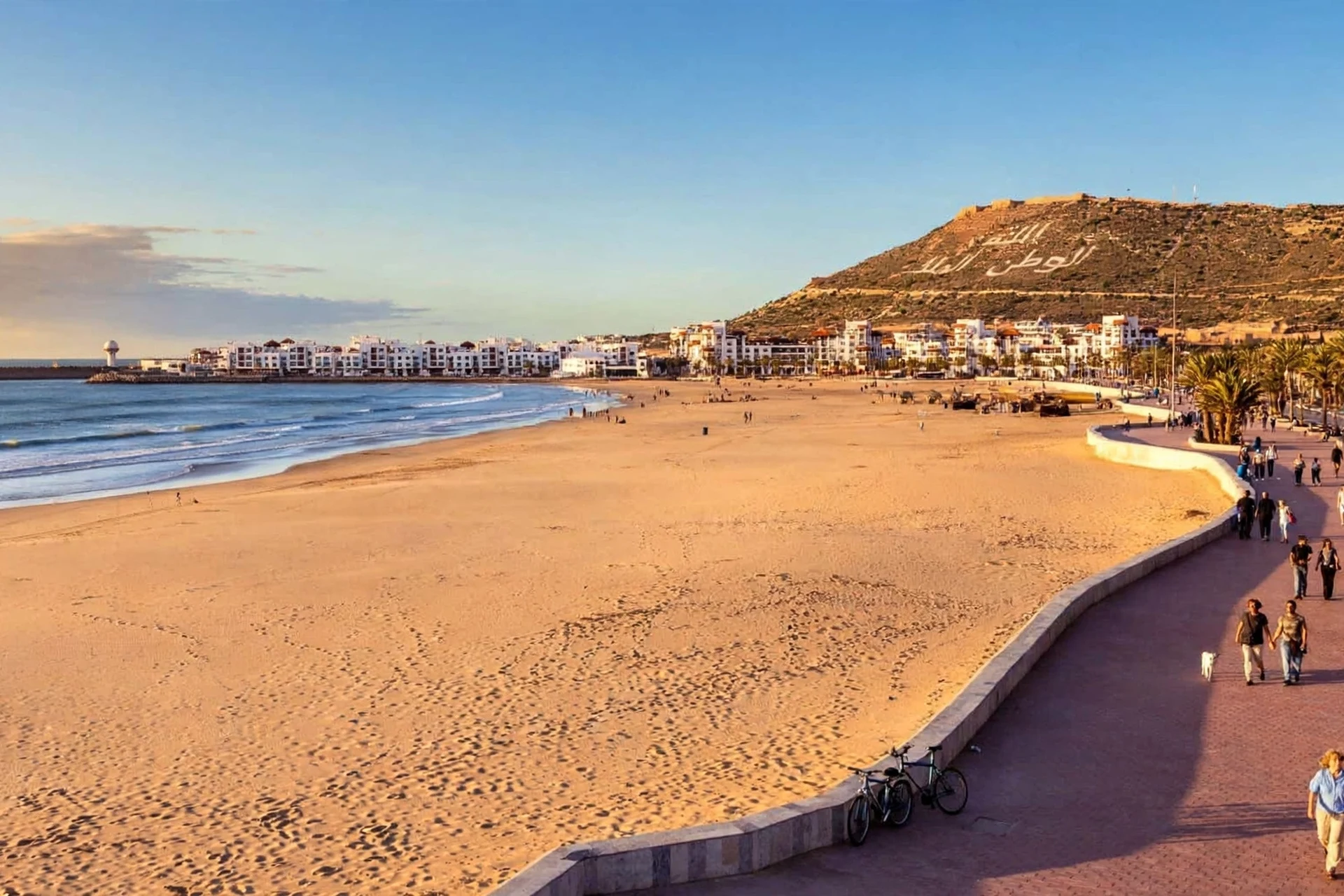
Living in Agadir is the warmest, easiest version of a Moroccan move: a modern beach city with 300 days of sunshine a year, nine kilometres of sand, and none of the maze-like medina that intimidates newcomers in Fes or Marrakech. If you want Morocco without the hassle, living in Agadir is where most long-term foreigners end up — and many never leave.
Agadir is not Morocco's prettiest city — it is a rebuilt city of wide boulevards and concrete blocks with a resort feel. What living in Agadir offers instead is comfort: reliable sunshine, a calm routine, affordable rent and a large, settled foreign community. It sits in our Living in Morocco section, alongside our wider Living in Morocco: The Complete Guide for Expats.
In this guide
- Why Expats Choose Living in Agadir
- Agadir at a Glance
- Best Neighbourhoods for Living in Agadir
- Rents and Housing: What You Pay in 2026
- Monthly Cost of Living in Agadir
- Weather: 300 Days of Sun and What It Really Means
- Working Remotely While Living in Agadir
- Daily Life: Food, Markets and Getting Around
- Healthcare and Schools
- The Downsides: Who Should Not Move Here
- Practical Steps to Move to Agadir
- Frequently Asked Questions
- Conclusion: Is Living in Agadir Right for You?
Why Expats Choose Living in Agadir
The first reason is the climate. Agadir claims around 300 sunny days a year, and the claim holds up: mild winters around 20–22°C, warm summers without Marrakech's punishing 45°C heat, and an Atlantic breeze that keeps living in Agadir comfortable all year.
The second reason is ease. The streets are wide and numbered, taxis are cheap and plentiful, and you can walk the corniche every evening without a map. Newcomers who found the medinas exhausting often say living in Agadir is where Morocco finally clicked.
The third reason is price. Living in Agadir costs noticeably less than living in Rabat or Tangier, and far less than a comparable beach city in Spain or Portugal: a one-bedroom flat starts around 4,000 MAD (about $400) a month, and a couple can live well on 13,000–16,000 MAD (about $1,300–$1,600). Our Cost of Living in Morocco guide ranks Agadir among the best-value coastal cities.
Finally, the community: Agadir has hosted foreign residents for generations — French and Belgian retirees, German and Scandinavian winter visitors, surfers drawn to Taghazout, and a growing number of remote workers. French is widely spoken, English works in most cafés, and it is easy to build a social life without Darija on day one — though learning a little Moroccan Arabic changes everything, and our guide to learning Darija is a good place to start.
Agadir at a Glance
Agadir sits on the Atlantic coast in the Souss Valley, about 500 km south of Casablanca and 230 km south of Essaouira. Agadir was almost entirely destroyed by an earthquake in 1960 and rebuilt from scratch — no ancient medina, no tangle of alleys, just a modern grid built for cars, sunshine and sea views. The hilltop kasbah, Agadir Oufella, was destroyed in the same quake and is now a viewpoint over the bay.
| Fact | Detail |
|---|---|
| Population | Around 600,000 in the wider urban area |
| Climate | Semi-arid Atlantic; 300 sunny days a year |
| Winter daytime high | 20–22°C |
| Summer daytime high | 26–30°C on the coast |
| Beach | 9 km of sand along the corniche |
| Airport | Agadir–Al Massira (AGA), 25 km south-east |
| Nearest surf town | Taghazout, 15 km north |
| Time from Marrakech | About 3 hours by motorway |
| Expat profile | Retirees, remote workers, surfers, winter visitors |
| Language | Arabic and French; English common in tourist areas |
Think of living in Agadir in three parts: the beachfront and marina, the modern centre around Avenue Hassan II and the big souk, and the residential districts inland. The rebuilt kasbah is the landmark and the best sunset spot, and Visit Morocco lists current events and practical information.
Best Neighbourhoods for Living in Agadir
Where you live shapes everything when living in Agadir, and the districts differ more than the flat skyline suggests. Our full comparison, Best Neighbourhoods to Live in Agadir, covers each area in depth.
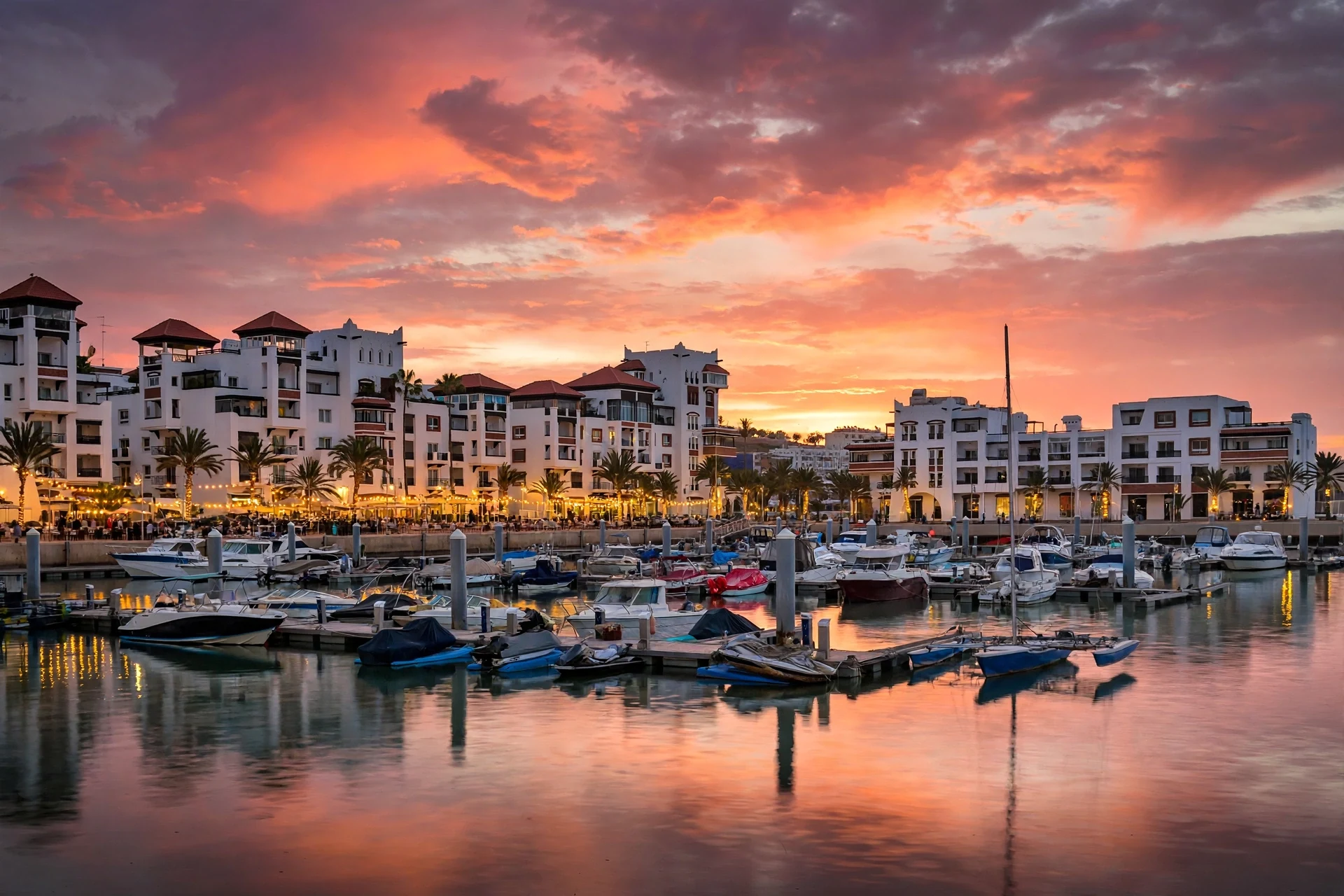
The corniche and marina suit newcomers who want the beach on their doorstep. Most short-term rentals sit here. It is the most expensive part of the city and the liveliest at night.
Hay Essalam and Cité Founty are the quiet residential favourites for long-term living in Agadir. Tree-lined streets, villas and mid-rise apartments, supermarkets and schools nearby, and a fifteen-minute walk to the sand.
The city centre around Avenue Hassan II and the municipal market is practical and affordable: older apartments and everything within walking distance. It is noisier and less polished, but your money stretches furthest here.
Taghazout, fifteen kilometres north, is a separate world: a surf village of hostels, cafés and yoga studios that has become a remote-worker hub in its own right. Some live there full-time; others treat it as a weekend escape. If surfing is your reason for moving, start there.
Rent first for three months before committing to a district. Living in Agadir changes character between the quiet winter and the busy summer, and the right neighbourhood in January is not always the right one in July.
Rents and Housing: What You Pay in 2026
Rent is the biggest line in any budget for living in Agadir, and the most negotiable. Prices below are typical asking rents for long-term leases in November 2026. Short stays of a month or less cost 30–50% more, and beachfront flats command a premium in summer.
| Home | Typical monthly rent |
|---|---|
| One-bedroom flat, city centre | 3,500–5,000 MAD ($350–$500) |
| One-bedroom flat, corniche or marina | 5,000–8,000 MAD ($500–$800) |
| Two-bedroom flat, Hay Essalam or Cité Founty | 5,000–8,000 MAD ($500–$800) |
| Two-bedroom flat, corniche | 7,000–12,000 MAD ($700–$1,200) |
| Three-bedroom villa, residential district | 10,000–18,000 MAD ($1,000–$1,800) |
| Studio near the beach, winter monthly rate | 4,000–6,000 MAD ($400–$600) |
| Furnished premium | Add 20–30% to the unfurnished price |
Three practical notes. First, an unfurnished flat often means no kitchen appliances at all — no fridge, no washing machine, sometimes no cooker — so check before signing and budget 5,000–10,000 MAD to equip it. Second, the best flats rarely reach listing sites; they move through neighbourhood semsars (brokers) and Facebook groups, and a broker's fee is usually one month's rent. Third, landlords expect two months' rent in advance plus a one-month deposit, and a one-year lease is the norm. Our guide to renting an apartment in Morocco explains contracts, deposits and the traps to avoid.
Winter rentals deserve a warning: thousands of Europeans arrive between November and March, pushing beachfront prices up by a third — sign before October, or take a flat a few streets back from the sea.
Monthly Cost of Living in Agadir
A single person living in Agadir comfortably spends roughly 9,000–13,000 MAD a month (about $900–$1,300); a couple spends roughly 14,000–20,000 MAD (about $1,400–$2,000). The table assumes a rented one-bedroom flat, home cooking and normal social life.
| Expense | Single person | Couple |
|---|---|---|
| Rent (one-bedroom, good district) | 4,500 MAD ($450) | 6,500 MAD ($650) |
| Utilities (electricity, water, internet) | 700 MAD ($70) | 900 MAD ($90) |
| Groceries and markets | 2,500 MAD ($250) | 4,000 MAD ($400) |
| Eating out and cafés | 1,000 MAD ($100) | 1,800 MAD ($180) |
| Transport (taxis and buses) | 400 MAD ($40) | 600 MAD ($60) |
| Health insurance and pharmacy | 600 MAD ($60) | 1,000 MAD ($100) |
| Leisure, gym and outings | 800 MAD ($80) | 1,200 MAD ($120) |
| Total | 10,500 MAD ($1,050) | 16,000 MAD ($1,600) |
Food is where living in Agadir rewards you. The Souk El Had is one of the largest covered markets in the country, with roughly 6,000 stalls selling vegetables, fish, spices and household goods far below supermarket prices. A weekly shop for two rarely passes 500–600 MAD ($50–$60), and fish is the local bargain, straight off the boats in the morning.
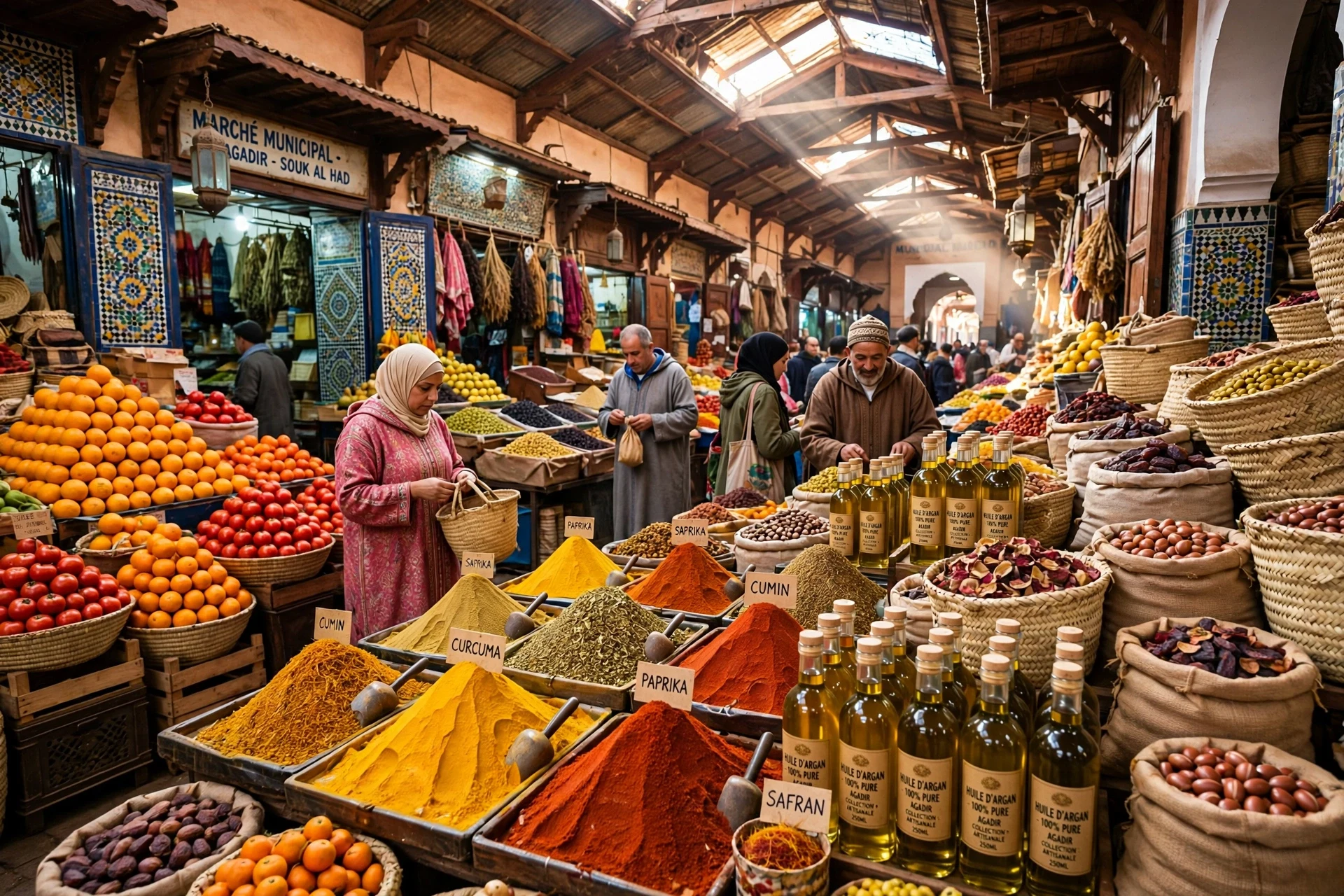
The costs that surprise newcomers are small and recurring: bottled gas (about 40 MAD a refill), a hammam visit (50–100 MAD), and the petit taxi, cheap per ride but costly at five a day. The costs that stay low: a coffee is 10–15 MAD, a taxi across town is 10–20 MAD, and a good lunch is 40–70 MAD.
Weather: 300 Days of Sun and What It Really Means
The sunshine claim is real, but it needs translating. Agadir's climate is shaped by the Atlantic: cool mornings, a sea breeze by afternoon, and a marine layer of fog that locals call the "camanchaca" rolling in some summer mornings and burning off by noon. The result: rarely hot, never cold, rarely dramatic.
Winter is the best season for living in Agadir. Daytime highs sit around 20–22°C, the sky is usually clear, and rain is rare — perhaps twenty wet days a year. Evenings drop to 10–12°C, which feels cold in an unheated flat — pack a small heater.
Summer brings 26–30°C on the coast, with occasional spells above 35°C when the inland chergui wind blows. The sea breeze saves the city: while Marrakech bakes at 45°C, Agadir stays comfortable enough for a beach afternoon — though morning fog can keep the beach grey until midday in July and August.
Spring and autumn are the sweet spots — warm, clear and quiet. If you are scouting living in Agadir before a move, come in October or April: the city at its best, at normal prices, without the winter crowds or summer haze.
Working Remotely While Living in Agadir
Agadir works well for remote work, with two caveats: fewer coworking spaces than Casablanca or Rabat, and fibre availability that is building-by-building, so check the exact address before signing a lease. Our guide to Morocco internet for expats explains how to verify a connection before you commit.
Fibre costs 200–400 MAD a month (about $20–$40) for 100–200 Mbps, and 4G is a reliable backup — a data SIM costs 50–100 MAD a month. Most corniche cafés have usable Wi-Fi, and many remote workers work from a favourite table by the sea. Taghazout, fifteen minutes north, has the coworking scene Agadir lacks.
The time zone is an underrated advantage for living in Agadir: Morocco runs on Western European Time, so you share working hours with London and Paris. The workday also runs later — cafés fill after 5 pm — so early risers get quiet mornings and social evenings.
Tax is the part nobody should wing. Morocco taxes residents on worldwide income, and the rules for freelancers are specific; our Morocco tax guide for expats gives the overview, and a local accountant costs far less than a mistake. Sort out your visa and tax position before your first year ends, not after.
Daily Life: Food, Markets and Getting Around
Daily life when living in Agadir runs on a relaxed rhythm: mornings at the markets and the beach, evenings on the corniche, where the whole city comes out to walk, run and eat ice cream. Nothing here demands urgency.
Food is the city's quiet strength. The Souss region grows much of Morocco's produce, so vegetables and fruit are fresh and cheap all year, and the Atlantic supplies fish that was swimming that morning. The dishes to know: sardines grilled on the port, a vegetable tajine with preserved lemon, harira in the evening, and argan oil from villages around the city — buy it in the souk, not a tourist shop, for a third of the price. Breakfast is usually bread, olive oil and amlou, the region's almond-and-argan paste.
Getting around is simple. Petit taxis are everywhere and cost 7–20 MAD within the city — always insist on the meter, or agree the price first. The Alsa bus network covers the city and the coast for 4–5 MAD a ride, and the corniche walk covers most of what a beachfront resident needs. A car is useful for weekend trips to the Anti-Atlas, Paradise Valley or the Souss-Massa National Park, but not a daily necessity.
Newcomers find friends through surf schools, French conversation groups, hiking clubs and the expat cafés near the marina.
Healthcare and Schools
Healthcare in Agadir is good by Moroccan standards and cheap by European ones: several private clinics with French-speaking doctors, plus the public Hassan II hospital for emergencies. A private GP costs 200–300 MAD (about $20–$30), a specialist 300–500 MAD. Most long-term residents living in Agadir keep international insurance for serious treatment and pay out of pocket for routine care. Our guide to healthcare in Morocco for expats covers hospitals, insurance and pharmacies in detail.
Pharmacies are plentiful, and pharmacists often advise on minor problems without a doctor's visit. Bring a supply of any prescription medicine when you first arrive, and carry prescriptions in French — local doctors write them that way.
For families, Agadir has French schools including a lycée français, private Moroccan schools with French sections, and growing bilingual options. French school fees run 3,000–6,000 MAD a month per child; good private Moroccan schools cost roughly half that. Our guide to schools in Morocco for expat families compares the options. Ibn Zohr University gives the centre a student population and a livelier café culture than most beach towns.
The Downsides: Who Should Not Move Here
Honesty first: living in Agadir is not for everyone. The city was rebuilt after the 1960 earthquake, so it has no old medina, no historic quarter, and little of the atmosphere that draws people to Fes or Marrakech. If you moved for the romance of the old cities, Agadir will feel plain, and you will drive to Taroudant or Essaouira on weekends to find it.
Summer brings its own irritations: the beachfront crowds with holidaymakers, prices rise, parking disappears, and morning fog can steal half the day. Winter brings the opposite problem: the city fills with long-stay visitors, and the beachfront can feel like a retirement resort.
The social scene is narrower than in Casablanca or Rabat: less nightlife, fewer events, a smaller professional network. The expat bubble is real — it is easy to keep living in Agadir for years speaking only French and English. Finally, Agadir is far from the north: Tangier is a seven-hour drive, and no train reaches the city, so northern Morocco is a flight or a long road trip away.
Practical Steps to Move to Agadir
A move to Agadir is straightforward if you do it in order. Start with a scouting trip of two to three weeks in the season you plan to be living in Agadir, renting a flat in the district you are considering. Use the trip to test the internet, meet a semsar, and check the neighbourhood at night.
Second, sort the paperwork early. Most nationalities enter visa-free for 90 days; staying longer means a carte de séjour from the préfecture, with proof of income, housing and health insurance. Our guide to moving to Morocco: visas and residency walks through the process, and our carte de séjour renewal guide covers what happens after the first year.
Third, open a bank account as a non-resident with your passport — it makes paying rent and utilities far simpler; our guide to opening a bank account in Morocco explains the documents. Fourth, rent for a year before deciding whether to buy — and read our buying property in Morocco guide first. If you are retiring rather than working, our retiring in Morocco guide covers the specific rules and the best towns.
Frequently Asked Questions
Is living in Agadir cheap compared with Europe?
Yes. A comfortable single-person life costs roughly 9,000–13,000 MAD a month (about $900–$1,300), including rent, food and transport — roughly half a similar life in southern Spain.
What is the best neighbourhood for living in Agadir?
For most newcomers living in Agadir, Hay Essalam or Cité Founty for quiet long-term living, and the corniche or marina for a first few months near the beach. Families choose the residential districts; surfers choose Taghazout, fifteen minutes north.
Do I need to speak French or Arabic to live in Agadir?
No, but it helps enormously. French is widely spoken in shops, clinics and offices, and English works in tourist areas. Basic Darija makes daily life warmer and cheaper.
How hot does Agadir get in summer?
Coastal highs run 26–30°C, with occasional spells above 35°C when the inland wind blows. The Atlantic breeze keeps the city far cooler than Marrakech.
Can I work remotely from Agadir?
Yes, and many people do. Fibre of 100–200 Mbps costs 200–400 MAD a month, 4G is a reliable backup, and the time zone matches Western Europe. Check the fibre connection at your exact address before signing a lease.
Is Agadir safe for expats?
Agadir is one of the calmest cities in Morocco, with low street crime and a relaxed atmosphere. The usual precautions apply — watch your bag on the beach, use metered taxis — but most residents call it the easiest Moroccan city to feel at home in.
Conclusion: Is Living in Agadir Right for You?
Living in Agadir suits people who want Morocco's sunshine and prices without its intensity: retirees who want a warm winter, remote workers who want a beach after work, and anyone who values a calm routine over constant stimulation. Think corniche walks, cheap fish at the port, and a life at the speed of the tide.
It will not suit you if you came for old medinas, nightlife, or the buzz of a big city — Agadir is none of those things. But if you want a sunny, affordable, easy place to build a life in Morocco, living in Agadir is the most forgiving place in the country to start. Rent a flat for three months, learn ten words of Darija, and let the city make its case.
Last checked: November 2026. Prices are typical ranges for long-term rentals and everyday spending, checked against listings and market prices in November 2026.