Living in Mohammedia suits expats who want the Atlantic coast, a real train to Casablanca, and rents lower than the big city — without giving up city life entirely. This small port city sits between Casablanca and Rabat, close enough to commute to either, and quiet enough to hear the waves at night. This guide covers living in Mohammedia honestly: the neighbourhoods, the rents, the schools, the commute, and the trade-offs.
In this guide
At its simplest, living in Mohammedia means big-city access at small-city prices: a port town of under 200,000 people, with beaches, a train station, and two major cities within an hour.
The centre is walkable, the corniche is the evening meeting point, and the pace is noticeably slower than Casablanca, 30 km down the coast.
Fact
Detail
Population (2024 census)
194,358 (commune); 514,057 (prefecture)
Distance to Casablanca
About 28–30 km; 25–30 minutes by train
Distance to Rabat
About 61 km by road; 40–55 minutes by train
Airport
Mohammed V International (CMN), about 35 km, roughly 40 minutes by car — check on arrival
Climate
Atlantic Mediterranean; summers around 26–28°C, winters around 12–17°C (approximate)
Checked November 2026.
Where Mohammedia Sits — Between Two Cities
Mohammedia sits on the Atlantic coast almost exactly between Morocco’s economic capital and its political capital. That in-between position is the whole point of the city for expats: you can work in Casablanca, spend weekends in Rabat, and sleep somewhere quieter and cheaper than either.
The practical geography is simple. Casablanca is about 28–30 km to the south-west, a 25–30 minute train ride or a 25–40 minute drive on the A1 motorway, depending on traffic. Rabat is about 61 km to the north-east by road, roughly 40–55 minutes by train. The A1 motorway has its own Mohammedia exit, so drivers are on the fast road within minutes of leaving home.
This is a commuter town by design, not by accident. Many residents work in Casablanca’s offices and industrial zones, or in the port and industrial areas around Mohammedia itself. Before choosing the city, test the commute at rush hour, not at midday. See our guide to living in Casablanca as an expat to compare the two lifestyles side by side.
From Fedala to Mohammedia: A Short History
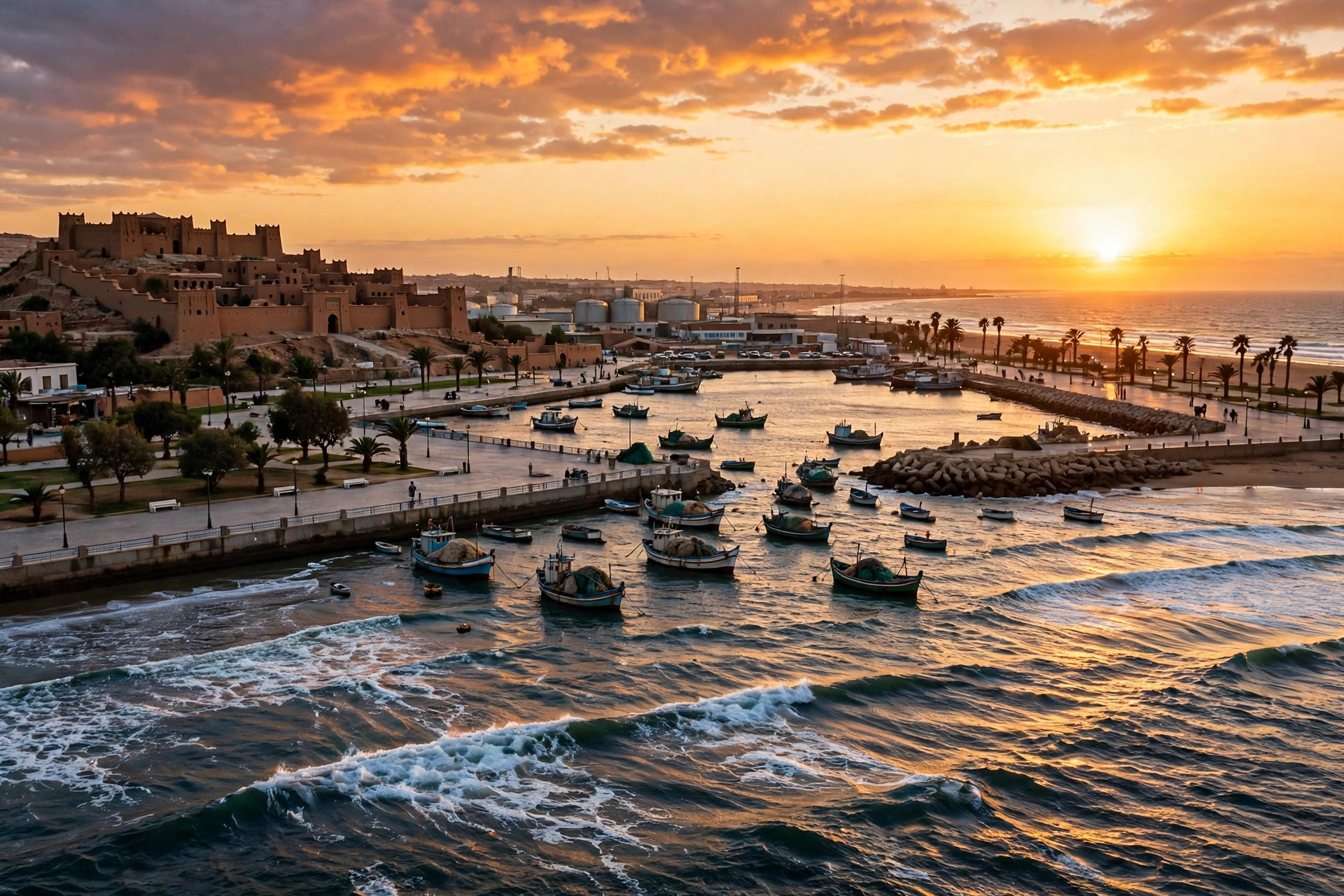
Mohammedia is a young city with an old harbour. The port was long known as Fedala, a trading post where European merchants came to buy grain and dried fruit as early as the 14th century. In 1773, Sultan Sidi Mohammed ben Abdallah made Fedala a grain warehouse for the region and built a kasbah to protect the traders — the old kasbah still stands above the port.
The modern town took shape under the French protectorate. A port company was founded in 1912, fuel depots for Vacuum Oil and Shell followed in 1923–24, and the seaside town grew through the 1920s and 1930s, with the esplanade built in 1938. Allied troops landed at Fedala in November 1942 during Operation Torch.
Then came oil. In February 1959 the Moroccan state agreed with Italy’s ENI to build a refinery at Mohammedia, and King Mohammed V laid its foundation stone on 25 June 1960 — the occasion on which Fedala was renamed Mohammedia in his honour. (Britannica dates the renaming itself to 1959; most other sources give 25 June 1960.) The SAMIR refinery was inaugurated in January 1962 and became the centre of Morocco’s petroleum industry, with three large industrial zones eventually covering about 800 hectares around the city.
The refinery stopped operating in August 2015 and has been in judicial liquidation since 2016. Its towers still dominate the skyline south of the city, and its future returns to the Moroccan press every year. For daily life, the city has outgrown its refinery: the port, the beaches and the commuter economy matter more now. See the Mohammedia article on Wikipedia.
Living in Mohammedia: Neighbourhoods Worth Your Rent
Choosing where to live is the biggest decision in living in Mohammedia, because the city changes character completely from one district to the next. Start with these areas.
Le Parc is the leafy, sought-after district around the park and the station, and the first place most expats should look. Flats here are bright and well finished, many with sea views, and the cafes, restaurants and shops of the centre are a short walk away. It is also the most expensive part of town for ordinary flats.
The centre-ville, around Boulevard Hassan II, is the practical choice: close to the station, the port, the markets and the administrative offices. Flats are older and plainer than in Le Parc, but the location saves a car for most daily errands.
Les Sablettes is the beach district, built around the city’s best-known beach. Expect modern residences with pools and parking, villas, and summer crowds. It suits families who want the beach on foot and do not mind paying for it.
Manesman (also spelled Mannesmann) is the modern residential area south of the centre, with new residences, villas and the beach at Monica nearby. It feels suburban and quiet, and it is popular with executives on assignment.
Hay El Hassania and the Al Alia district around the kasbah are the affordable, lived-in parts of town: older buildings, lower rents, and a more local feel. La Siesta, to the south, is quieter still, with villas and space. Check both on foot before signing anything — street by street, the feel changes fast.
Rents in Mohammedia vs Casablanca: What Your Money Buys
Rent is the reason most expats choose Mohammedia. Current listings from November 2026 show furnished two-bedroom flats in Le Parc at 5,500–8,700 MAD a month, studios in Le Parc from about 4,600 MAD, and modern villas in Manesman from around 14,000 MAD. A one-bedroom in central Casablanca typically runs 6,500–9,000 MAD — so a two-bedroom in Mohammedia can cost less than a one-bedroom in the big city.
Neighbourhood
1-bedroom (MAD/month)
2-bedroom (MAD/month)
3-bedroom / villa (MAD/month)
Le Parc / centre-ville
3,500–5,500 ($350–$550)
5,500–8,500 ($550–$850)
8,000–12,000 ($800–$1,200)
Les Sablettes
4,000–6,500 ($400–$650)
6,000–10,000 ($600–$1,000)
9,000–15,000 ($900–$1,500)
Manesman
4,500–6,500 ($450–$650)
6,500–9,000 ($650–$900)
10,000–14,000+ ($1,000–$1,400+)
Hay El Hassania / Al Alia
2,500–4,000 ($250–$400)
3,500–6,000 ($350–$600)
5,000–8,000 ($500–$800)
Indicative asking rents, November 2026. Confirm on arrival — listings move fast and furnished flats command a premium.
Deposits are usually one or two months’ rent, and agency fees about one month’s rent. Get the contract in writing and ask whether rent includes water and electricity — usually it does not. See our guide to renting an apartment in Morocco.
The Daily Budget: What a Couple Spends
For a couple, living in Mohammedia on 11,500–16,300 Moroccan dirhams (MAD) a month (about $1,150–$1,630), including rent, is comfortable. The saving against Casablanca comes almost entirely from housing; food, transport and services cost roughly the same.
Groceries are the pleasant surprise: a weekly shop for two at the souks and the Marjane supermarket rarely passes 700–800 MAD. Fish is a local bargain: the port lands fresh catch daily.
Item
Monthly cost (MAD)
Monthly cost (USD)
Rent, furnished 2-bedroom in Le Parc
5,500–7,500
$550–$750
Groceries and household
2,800–3,500
$280–$350
Utilities (water, electricity)
500–800
$50–$80
Internet (fibre) + two mobile plans
400–600
$40–$60
Transport (train, taxis, fuel)
500–900
$50–$90
Eating out and cafes
1,000–1,500
$100–$150
Health, pharmacy and insurance share
800–1,500
$80–$150
Total
11,500–16,300
$1,150–$1,630
November 2026 estimates. Confirm on arrival.
Getting Around: Trains, Taxis and the Motorway
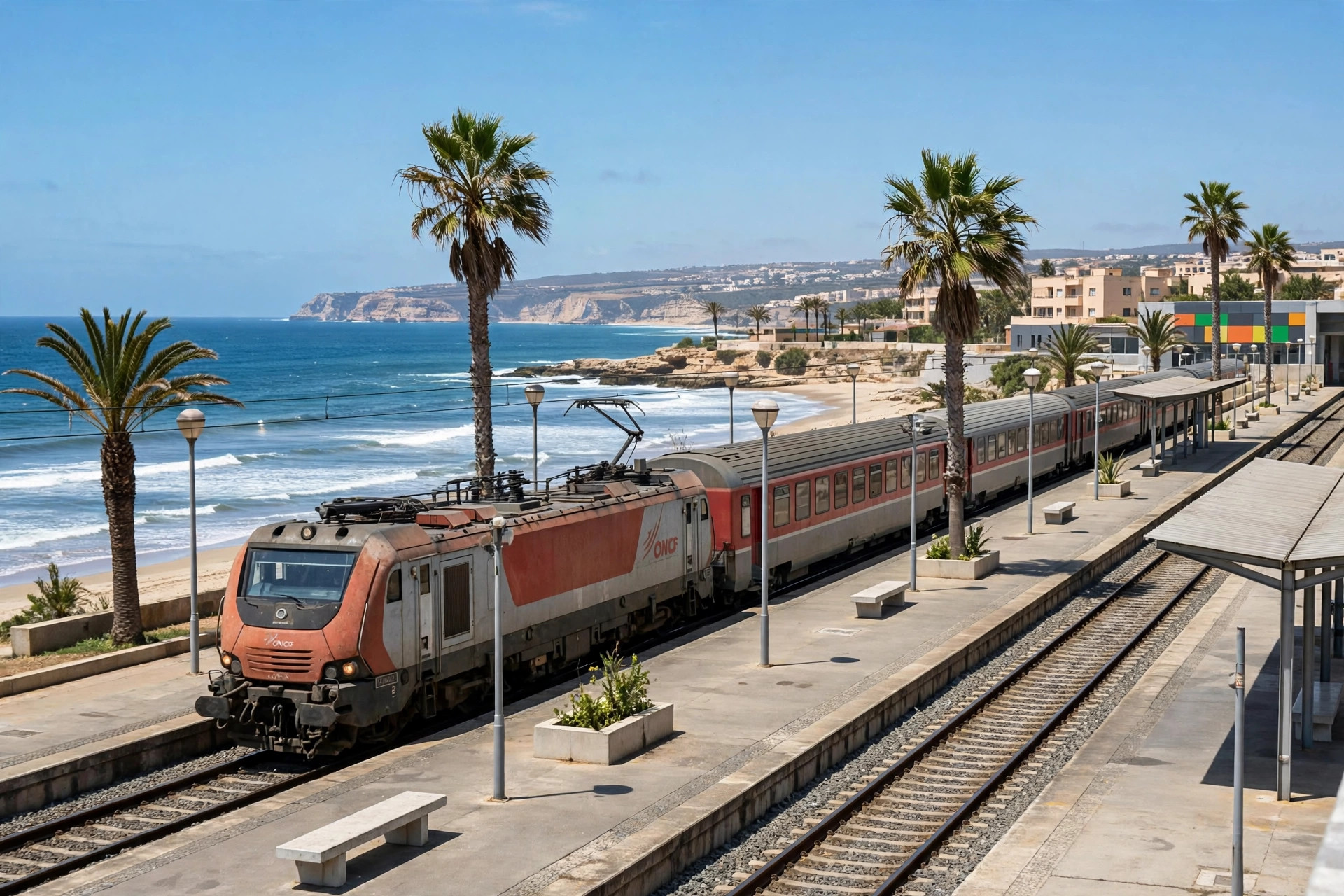
Transport is the part of life here that works best. Mohammedia station sits on the Casablanca–Rabat–Kenitra line, and ONCF’s TNR shuttle trains stop roughly every 30 minutes during the day. The ride to Casablanca Port takes about 25–30 minutes and costs roughly 10–21 MAD second class (10–15 MAD) or first class (15–21 MAD). Trains to Rabat Agdal take about 32 minutes direct, with some services running 40–55 minutes including stops, and cost roughly 25–50 MAD.
Check live times on the ONCF booking site before you travel — timetables change during engineering works, and the fastest services do not stop everywhere.
Inside the city, petit taxis cost about 10–20 MAD for short trips, and grand taxis run the inter-city routes. A car is useful but not essential at first: the centre, the station and the main beaches are all close together. The A1 motorway puts Casablanca at 25–40 minutes by car and Rabat at about an hour, outside rush hour. Mohammed V International Airport is about 35 km away, roughly 40 minutes by car — check on arrival.
Living in Mohammedia with Children: Schools and Family Life
Families considering living in Mohammedia need one honest fact first: no big English-language international school inside the town itself could be confirmed. The local option most often mentioned is the Groupe Scolaire Claude Monet, a French school near Le Parc — confirm its levels and admissions directly, as details could not be verified before publication.
Most expat families school their children in Casablanca, about 30 minutes away by train plus a taxi at the far end. The main options there are Casablanca American School, George Washington Academy, and the British International School of Casablanca in Bouskoura, all teaching in English with American or British curricula and the IB Diploma. Rabat’s schools, including Rabat American School, are about an hour away and a harder daily trip.
Fees at the Casablanca international schools are substantial — often 60,000–200,000 MAD a year depending on the school and the child’s age. Check on arrival, and apply months ahead: September places go early. Before enrolment, sort out residence paperwork; children need their own file. Our guide to moving to Morocco, visas and the carte de séjour walks through the process.
Day to day, Mohammedia is an easy place to raise children: safe streets, beaches close by, and family-sized flats with parking. The trade-off is that organised children’s activities in English are thin on the ground; most run in French or Arabic.
Healthcare: Clinics in Town, Hospitals in Casablanca
Healthcare in Mohammedia covers the everyday well and the serious less so. The city has a public hospital and a spread of private clinics, pharmacies and laboratories for routine care, minor emergencies and maternity. The name and exact services of the main public hospital could not be verified before publication — ask locally on arrival rather than relying on an online listing.
For anything complex, the major hospitals are 30 minutes away in Casablanca: the CHU Ibn Rochd university hospital and the private clinics of Maarif and Ain Diab. English-speaking doctors are easier to find there, so many expats register with a GP in Casablanca and use Mohammedia only for prescriptions and minor visits. For the full overview, see our guide to healthcare in Morocco for expats.
Keep a small pharmacy kit at home, and carry health insurance that covers private care in Casablanca — public hospitals are capable but slow, and French or Arabic is the working language throughout.
Working from Mohammedia: Internet, Coworking and the Commute
For remote workers, living in Mohammedia is practical as long as the flat has fibre. Fibre is available in newer buildings and across much of the city, from around 249 MAD a month, and commercial 5G launched in November 2025. Test the connection with a real video call before signing a lease — speeds vary street by street. See our guide to internet in Morocco for expats.
No well-known coworking space inside Mohammedia itself could be confirmed. Most remote workers here work from home, from a regular cafe, or take the train to a coworking space in Casablanca. If your employer is in Casablanca, the commute is the real test: 25–30 minutes on the train sounds easy, but add the walk to the station, the wait, and the taxi at the far end, and a working day in the city costs you two hours of travel.
The local economy offers fewer expat jobs than Casablanca: the port, the industrial zones and logistics. Most foreign residents here either work remotely or commute, and French is close to essential for local job-hunting.
The Honest Downsides — and the Everyday Pleasures
The downsides of living in Mohammedia are real but manageable. The industrial zones and the idle SAMIR refinery sit close to the city, and on some days the port side of town smells of it. The expat scene is small: fewer international restaurants, no real nightlife, and a foreign community you can count in dozens rather than thousands. French or Arabic is not optional; English alone goes only so far. Summer weekends bring crowds to Sablettes, and the Atlantic wind can be relentless in winter.
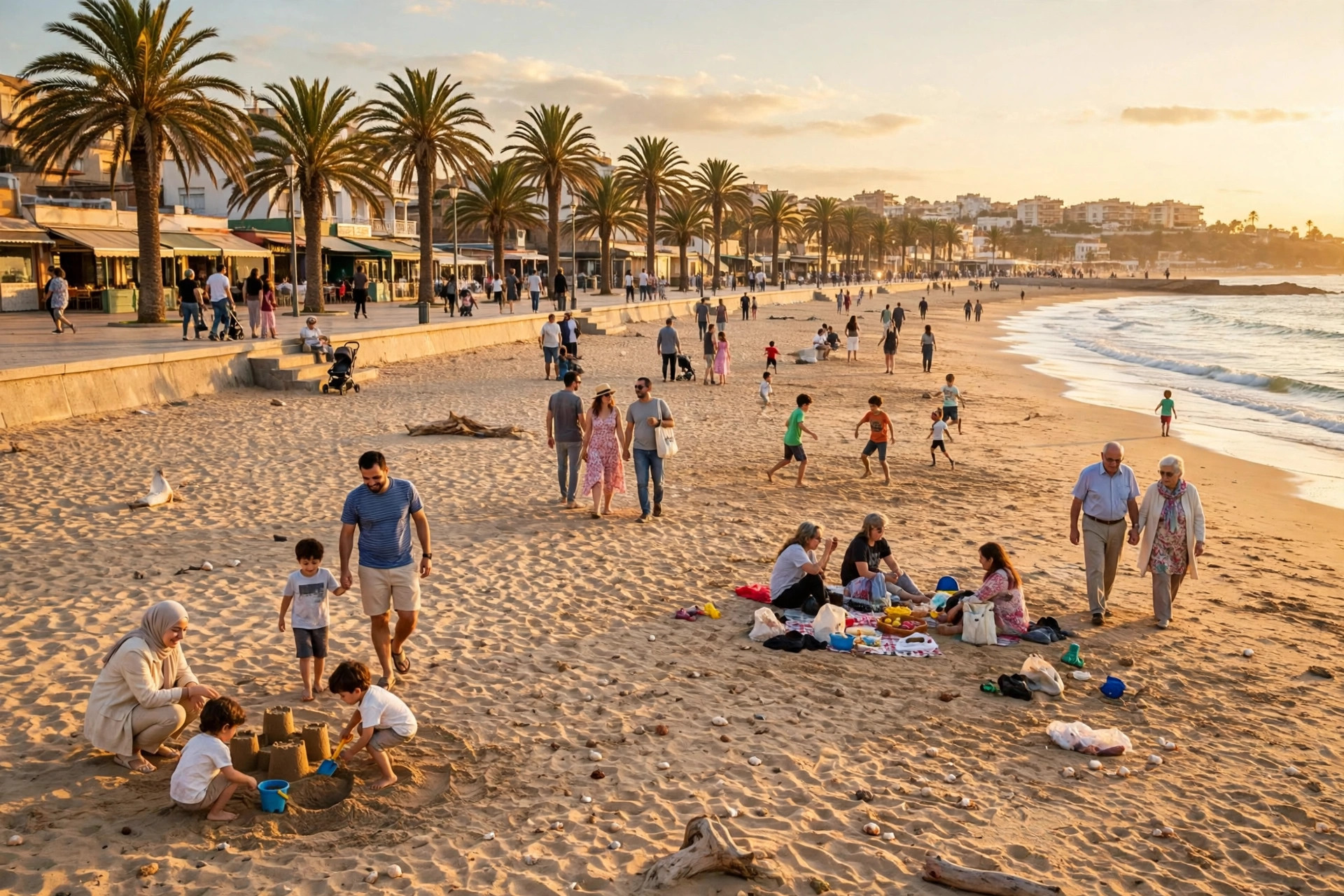
Set against that, the pleasures are everyday ones: a morning swim before work, grilled sardines on the corniche for a few dirhams, a round of golf, an evening walk past the kasbah, and a train that puts two great cities within an hour. The beaches are the best on this stretch of coast — wide, sandy, and far less crowded than Ain Diab on a weekday.
Frequently Asked Questions
Is living in Mohammedia cheaper than living in Casablanca?
Yes, by roughly 20–30% on rent. A one-bedroom in central Casablanca typically costs 6,500–9,000 MAD a month, while a similar flat in Le Parc or the centre-ville runs 3,500–5,500 MAD. The saving is mostly in housing — and living in Mohammedia keeps that saving every month.
Can I commute to Casablanca by train every day?
Yes, and many residents do. The TNR trains run roughly every 30 minutes during the day, and the ride to Casablanca Port takes about 25–30 minutes for 10–21 MAD. Allow an hour door to door once you add the station walk and the taxi at the far end.
Is Mohammedia safe for expats?
Mohammedia is generally safe, and most expats feel comfortable walking around in the daytime, including on the corniche in the evening. Watch for pickpockets in crowded markets and on trains, avoid poorly lit lanes late at night, and keep valuables out of sight.
Are there international schools in Mohammedia?
No major English-language international school inside the town itself could be confirmed. The local French school most often mentioned is Groupe Scolaire Claude Monet, near Le Parc. Most expat families use the American or British schools in Casablanca, about 30 minutes away by train.
Which beach is best in Mohammedia?
For families, Sablettes: wide sand, lifeguards in summer, cafes and parking. Monica beach, near Manesman, is quieter and popular with locals. The Atlantic has strong currents, so swim where others swim and respect the flags.
Do I need a car in Mohammedia?
No, not at first. The centre, the station and the main beaches are close together, petit taxis are cheap, and the train serves both Casablanca and Rabat. A car helps in La Siesta or Manesman, for school runs to Casablanca, or for weekend trips along the coast.
Conclusion: Is Living in Mohammedia Right for You?
Living in Mohammedia suits a particular kind of expat: someone who wants the Atlantic on their doorstep, a fast train to a big-city job, and a rent that leaves money for travel — and who does not need a buzzing expat scene or English on every menu. If you need an international school nearby, a lively nightlife, and a large foreign community, Casablanca will serve you better — and our guide to the best places to live in Morocco can help you compare.
But if you can live in French or Arabic, work from home or near the station, and enjoy a small port city that is cheaper, calmer and closer to the beach than its famous neighbours, living in Mohammedia is one of the best-value moves on Morocco’s Atlantic coast. Come for a week first, and price a flat in Le Parc.